
Salsalate 750 mg Tablet, 100-count — NDC 65162-513-10 (Billing 65162-0513-10)
This is a package of 100 tablets of Salsalate 750 mg Tablet from Amneal Pharmaceuticals LLC, marketed since Sep 2010 and currently FDA-listed; retail pharmacies pay about $0.2240 per tablet (NADAC). It is the main listing for this product, which comes in 3 package sizes.
NDC database record
One package, one record: these facts belong to NDC 65162-513-10 alone.
- Record
- FDA NDC Directory package listing · Human prescription drug
- Code segments
- 65162 labeler · 513 product · 10 package
- Package marketed since
- Sep 24, 2010
- Sample package
- No — commercial package
- Listing certified through
- Dec 31, 2027
- Billing quantity
- 100 EA per package
- Barcode (UPC)
- 0365162512106, 0365162513103
- Medicaid fills, this package
- 271 prescriptions in the last four reported quarters
- FDA record last changed
- Oct 8, 2026
Identity & classification
Regulatory identifiers FDA, NLM and CMS codes for this package
Drug-database identifiers Medi-Span GPI and First Databank GCN / HICL / AHFS classification
- GSN (GCN sequence number): 004439
- GCN: 16802
- GPI-14 (Medi-Span): 64100075000310
- HICL (First Databank): 001845
- AHFS class code: 28:08.04.24
- RxCUI (RxNorm): 312899
Where does this data come from?
- FDA openFDA NDC Directory · synced Oct 8, 2026
- FDA label on DailyMed · label index refreshed Oct 8, 2026
- RxNorm (NLM RxNav) · catalog refreshed Oct 1, 2026
- Medi-Span GPI (licensed)
- First Databank (licensed) · refreshed Oct 8, 2026
RxNorm drug class
This medicine belongs to the Salicylic acid and derivatives class.
Where does this data come from?
- RxClass (NLM) · catalog refreshed Oct 1, 2026
Clinical
Salsalate is used to relieve pain, tenderness, swelling, and stiffness caused by rheumatoid arthritis (arthritis caused by swelling of the lining of the joints), osteoarthritis (arthritis caused by a breakdown of the lining of the joints), and other conditions that cause swelling. Salsalate is in a class of nonsteroidal anti-inflammatory medications (NSAIDs) called salicylates. It works by stopping the body's production of a substance that causes pain, fever, and swelling.
Read the full MedlinePlus article ↗- It relieves the pain and stiffness of rheumatoid arthritis, osteoarthritis and related rheumatic disorders. It is a salicylate-type NSAID. Your prescriber should use the lowest eff...
- You swallow the tablets, usually split into two or three doses through the day, as your prescriber directs. Relief comes on gradually, and it can take 3 to 4 days to feel the full...
- How should I take it, and how fast will it work?
- The most common are ringing in the ears, nausea, hearing changes, rash and vertigo. Ringing or hearing changes are often used as a guide, so tell your prescriber if you notice them...
Patient education
Supplement & herbal interactions
Some supplements/herbs that may interact with Salsalate — tap one for details:
Salsalate may be associated with lower levels of 1 nutrient — worth a chat with your pharmacist, not a cause for alarm.
Where does this data come from?
- MedlinePlus (NLM) · refreshed Oct 8, 2026
- FDA label on DailyMed · label index refreshed Oct 8, 2026
Ask a licensed pharmacist directly — free, answered by our team.
Pricing
A drug doesn't have one price. Each row is a different public payment system, and none is what you'd pay at the counter — that depends on your insurance. The ⓘ on each row explains what it measures.
| Price system | Per ea | Per package |
|---|---|---|
| Retail pharmacies payNADAC · weekly | $0.224 | $22.40 / 100 tablets |
| Medicaid paysCMS SDUD · 12 mo | $0.4921 | $49.21 / 100 tablets |
| Medicare drug plans payPart D · quarterly | No Part D plan price is available for this NDC in our data. | |
Where does this data come from?
- CMS NADAC weekly file · file of Oct 7, 2026
- CMS ASP pricing files · refreshed Sep 20, 2026
- CMS Medicaid State Drug Utilization Data · through Q1 2026
- CMS Part D plan pricing files · refreshed Sep 24, 2026
- VA National Acquisition Center price file
Packaging — all sizes for this product
| Package NDC | Description | Per unit | Per pack | Marketing start | Marketing end | Status |
|---|---|---|---|---|---|---|
| 65162-0513-10 You're viewing this Main listing | 100 TABLET in 1 BOTTLE | $0.2240 / ea | $22.40 | 2010-09-24 | — | Active |
| 65162-0513-11 65162-513-11 | 1000 TABLET in 1 BOTTLE | — | — | 2010-09-24 | — | Active |
| 65162-0513-50 65162-513-50 | 500 TABLET in 1 BOTTLE | $0.2240 / ea | $112.00 | 2010-09-24 | — | Active |
You're viewing the smallest of 3 pack sizes for this product.
This pack has the lowest per-ea cost of the 2 priced pack sizes ($0.2240 NADAC).
In Medicaid, this is the most-dispensed pack of this product — about 100% of fills over the last four reported quarters. See all packs ↓
Pack size FAQ
What quantity is in this package?
How does this package differ from NDC 65162-0513-50?
What NDC number is used to bill for this package of Salsalate 750 mg Tablet?
Prices are the latest CMS NADAC pharmacy acquisition cost per NDC; per-pack figures are per-unit × pack quantity, shown only when the pack is denominated in the same measure NADAC prices.
Therapeutic equivalents
| Product | Labeler | Pack | NADAC/unit | TE | Status | Price vs. this |
|---|---|---|---|---|---|---|
| Salsalate 750 mgthis 65162-0513-10 | Amneal | 100 tablets | $0.224 | — | Availability likely | — |
| Salsalate 750 mg 69367-0616-01 | Westminster | 100 tablets | $0.224 | — | Availability likely | — |
| Salsalate 750 mg 72162-1569-07 | Bryant | 120 tablets | — | — | Discontinued | — |
Where does this data come from?
- FDA openFDA NDC Directory · synced Oct 8, 2026
- FDA Orange Book · refreshed Oct 3, 2026
- CMS NADAC weekly file · file of Oct 7, 2026
Availability & generic status
We did not find an FDA-approved generic match for this exact strength, form and route.
Where does this data come from?
- FDA Orange Book · refreshed Oct 3, 2026
What it looks like
Where does this data come from?
- FDA label on DailyMed · label index refreshed Oct 8, 2026
Inactive Ingredients / Excipients
Inactive ingredients, also called excipients, are components of the drug product other than the active ingredient. They may include fillers, dyes, coatings, preservatives, flavors, or other formulation ingredients.
🧪 Avoiding an ingredient? See Salsalate inactive ingredients by manufacturer: every current product's list side by side, so you can ask your pharmacy for the version that does not list it.
💡 Tap an ingredient (hover on desktop) to see what it is and why it’s used.
-
UNII R12CBM0EIZ
A natural wax derived from a Brazilian palm tree, used as a coating and polish on tablets and capsules. It creates a smooth, shiny finish that protects the medicine and improves appearance.
-
UNII OP1R32D61U
Microcrystalline cellulose is a purified form of cellulose, a natural fiber from plant sources. It acts as a binder and filler in tablets and capsules, helping hold ingredients together and give the medicine its shape and size.
-
UNII M28OL1HH48
Croscarmellose sodium is a plant-based substance derived from cellulose. It acts as a disintegrant, helping tablets and capsules break down quickly in the digestive system so the medicine can be absorbed.
-
UNII 35SW5USQ3G
A synthetic yellow dye used to color medicines. It helps make tablets, capsules, and liquids visually distinct so patients can easily identify their medication.
-
UNII 3NXW29V3WO
Hypromellose is a plant-based thickener made from cellulose. It's used in medicines as a binder to hold ingredients together, a coating for tablets, and a thickener for liquids.
-
UNII 3WJQ0SDW1A
Polyethylene glycol is a synthetic liquid or solid polymer used in medicines as a solvent, lubricant, and humectant. It helps dissolve active ingredients, reduces friction during manufacturing, and retains moisture in the final product.
-
UNII ETJ7Z6XBU4
Silicon dioxide is a naturally occurring mineral used as a glidant and anti-caking agent. It helps powder ingredients flow smoothly and prevents clumping during manufacturing and storage.
-
UNII 4ELV7Z65AP
Stearic acid is a fatty acid derived from plant or animal sources. It acts as a binder and lubricant in tablets and capsules, helping them hold together and flow smoothly during manufacturing.
-
UNII 15FIX9V2JP
Titanium dioxide is a bright white mineral powder commonly used as a colorant and opacifying agent. It makes pills and tablets white or lighter in color and helps make coatings non-transparent.
9 inactive ingredients listed in the exact product block matched to this NDC.
Where does this data come from?
ingredient classCode="IACT" elements from the exact product block matched by this NDC. Label-section narrative from DailyMed / the openFDA label index is shown separately when available.- FDA label on DailyMed · label index refreshed Oct 8, 2026
- FDA openFDA NDC Directory · synced Oct 8, 2026
Inactive ingredient FAQ
Are inactive ingredients the same for every manufacturer?
Why might an inactive ingredient be missing?
Can inactive ingredients matter?
Manufacturer & labeler
More NDCs from Amneal Pharmaceuticals LLC labeler code 65162
- EluRyng Etonogestrel and Ethinyl Estradiol .12 mg/d; .015 mg/d Ring NDC 65162-469-35
- Norethindrone Acetate 5 mg Tablet NDC 65162-475-03
- Nitrofurantoin (monohydrate/macrocrystals) 75 mg; 25 mg Capsule NDC 65162-478-10
- Indomethacin 75 mg Capsule, Extended Release NDC 65162-506-03
- Spironolactone 25 mg Tablet NDC 65162-511-03
- Salsalate 500 mg Tablet NDC 65162-512-10
- Spironolactone 50 mg Tablet NDC 65162-514-03
- Spironolactone 100 mg Tablet NDC 65162-515-03
- Calcitriol .25 ug Capsule NDC 65162-519-03
- Promethazine Hydrochloride 25 mg Tablet NDC 65162-521-10
- Promethazine Hydrochloride 50 mg Tablet NDC 65162-522-10
- Levetiracetam 250 mg Tablet, Film Coated NDC 65162-528-16
Where does this data come from?
- FDA openFDA NDC Directory · synced Oct 8, 2026
- Drugs@FDA
Full prescribing information FDA SPL
🚨 Boxed Warning ▾
Cardiovascular Risk NSAIDs may cause an increased risk of serious cardiovascular thrombotic events, myocardial infarction, and stroke, which can be fatal. This risk may increase with duration of use. Patients with cardiovascular disease or risk factors for cardiovascular disease may be at greater risk (see WARNINGS and CLINICAL TRIALS ).
Salsalate tablets are contraindicated for the treatment of perioperative pain in the setting of coronary artery bypass graft (CABG) surgery (see WARNINGS ). Gastrointestinal Risk NSAIDs cause an increased risk of serious gastrointestinal adverse events including bleeding, ulceration, and perforation of the stomach or intestines, which can be fatal. These events can occur at any time during use and without warning symptoms.
Elderly patients are at greater risk for serious gastrointestinal events (see WARNINGS ).
🎯 Indications and Usage ▾
INDICATIONS AND USAGE Carefully consider the potential benefits and risks of Salsalate tablets and other treatment options before deciding to use Salsalate tablets. Use the lowest effective dose for the shortest duration consistent with individual patient treatment goals (see WARNINGS ). Salsalate is indicated for relief of the signs and symptoms of rheumatoid arthritis, osteoarthritis and related rheumatic disorder.
⏱️ Dosage and Administration ▾
DOSAGE AND ADMINISTRATION Carefully consider the potential benefits and risks of Salsalate tablets and other treatment options before deciding to use Salsalate tablets. Use the lowest effective dose for the shortest duration consistent with individual patient treatment goals (see WARNINGS ). After observing the response to initial therapy with Salsalate tablets, the dose and frequency should be adjusted to suit an individual patient's needs.
Salsalate is indicated for relief of the signs and symptoms of rheumatoid arthritis, osteoarthritis and related rheumatic disorder. Adults: The usual dosage is 3000 mg daily, given in divided doses as follows: 1) two doses of two 750 mg tablets; 2) two doses of three 500 mg tablets; or 3) three doses of two 500 mg tablets. Some patients, e.g., the elderly, may require a lower dosage to achieve therapeutic blood concentrations and to avoid the more common side effects such as auditory.
Alleviation of symptoms is gradual, and full benefit may not be evident for 3 to 4 days, when plasma salicylate levels have achieved steady-state. There is no evidence for development of tissue tolerance (tachyphylaxis), but salicylate therapy may induce increased activity of metabolizing liver enzymes, causing a greater rate of salicyluric acid production and excretion, with a resultant increase in dosage requirement for maintenance of therapeutic serum salicylate levels. Children: Dosage recommendations and indications for salsalate use in children have not been established.
⛔ Contraindications ▾
CONTRAINDICATIONS Salsalate tablets are contraindicated in patients with known hypersensitivity to salsalate. Salsalate tablets should not be given to patients who have experienced asthma, urticaria, or allergic-type reactions after taking aspirin or other NSAIDs. Severe, rarely fatal, anaphylactic-like reactions to NSAIDs have been reported in such patients (see WARNINGS – Anaphylactoid Reactions , and PRECAUTIONS - Preexisting Asthma ).
Salsalate tablets are contraindicated for the treatment of peri-operative pain in the setting of coronary artery bypass graft (CABG) surgery (see WARNINGS ).
⚠️ Warnings ▾
WARNINGS Reye’s Syndrome may develop in individuals who have chicken pox, influenza, or flu symptoms. Some studies suggest a possible association between the development of Reye’s Syndrome and the use of medicines containing salicylate or aspirin. Salsalate contains a salicylate and therefore is not recommended for use in patients with chicken pox, influenza, or flu symptoms.
CARDIOVASCULAR EFFECTS Cardiovascular Thrombotic Events Clinical trials of several COX-2 selective and nonselective NSAIDs of up to three years duration have shown an increased risk of serious cardiovascular (CV) thrombotic events, myocardial infarction, and stroke, which can be fatal. All NSAIDs, both COX-2 selective and nonselective, may have a similar risk. Patients with known CV disease or risk factors for CV disease may be at greater risk.
To minimize the potential risk for an adverse CV event in patients treated with an NSAID, the lowest effective dose should be used for the shortest duration possible. Physicians and patients should remain alert for the development of such events, even in the absence of previous CV symptoms. Patients should be informed about the signs and/or symptoms of serious CV events and the steps to take if they occur.
There is no consistent evidence that concurrent use of aspirin mitigates the increased risk of serious CV thrombotic events associated with NSAID use. The concurrent use of aspirin and an NSAID does increase the risk of serious GI events (see GI WARNINGS ). Two large, controlled, clinical trials of a COX-2 selective NSAID for the treatment of pain in the first 10 to 14 days following CABG surgery found an increased incidence of myocardial infarction and stroke (see CONTRAINDICATIONS ).
Hypertension NSAIDs, including Salsalate tablets, can lead to onset of new hypertension or worsening of pre-existing hypertension, either of which may contribute to the increased incidence of CV events. Patients taking thiazides or loop diuretics may have impaired response to these therapies when taking NSAIDs. NSAIDs, including Salsalate tablets, should be used with caution in patients with hypertension.
Blood pressure (BP) should be monitored closely during the initiation of NSAID treatment and throughout the course of therapy. Congestive Heart Failure and Edema Fluid retention and edema have been observed in some patients taking NSAIDs. Salsalate tablets should be used with caution in patients with fluid retention or heart failure.
Gastrointestinal Effects-Risk of Ulceration, Bleeding, and Perforation NSAIDs, including Salsalate tablets, can cause serious gastrointestinal (GI) adverse events including inflammation, bleeding, ulceration, and perforation of the stomach, small intestine, or large intestine, which can be fatal. These serious adverse events can occur at any time, with or without warning symptoms, in patients treated with NSAIDs. Only one in five patients, who develop a serious upper GI adverse event on NSAID therapy, is symptomatic.
Upper GI ulcers, gross bleeding, or perforation caused by NSAIDs occur in approximately 1% of patients treated for 3 to 6 months, and in about 2% to 4% of patients treated for one year. These trends continue with longer duration of use, increasing the likelihood of developing a serious GI event at some time during the course of therapy. However, even short-term therapy is not without risk.
NSAIDs should be prescribed with extreme caution in those with a prior history of ulcer disease or gastrointestinal bleeding. Patients with a prior history of peptic ulcer disease and/or gastrointestinal bleeding who use NSAIDs have a greater than 10-fold increased risk for developing a GI bleed compared to patients with neither of these risk factors. Other factors that increase the risk for GI bleeding in patients treated with NSAIDs include concomitant use of oral corticosteroids or anticoagulants, longer duration of NSAID therapy, smoking, use of alcohol, older age, and poor general health status.
Mo… [Excerpted — this section continues on DailyMed.]
🤒 Adverse Reactions ▾
ADVERSE REACTIONS In two well-controlled clinical trials, the following reversible adverse experiences characteristic of salicylates were most commonly reported with salsalate (n-280 pts; listed in descending order of frequency): tinnitus, nausea, hearing impairment, rash, and vertigo. These common symptoms of salicylates, i.e., tinnitus or reversible hearing impairment, are often used as a guide to therapy. Although cause-and-effect relationships have not been established, spontaneous reports over a ten-year period have included the following additional medically significant adverse experiences: abdominal pain, abnormal hepatic function, anaphylactic shock, angioedema, bronchospasm, decreased creatinine clearance, diarrhea, G.I. bleeding, hepatitis, hypotension, nephritis and urticaria.
To report SUSPECTED ADVERSE REACTIONS, contact Amneal Pharmaceuticals at 1-877-835-5472 or FDA at 1-800-FDA-1088 or www.fda.gov/medwatch.
🆘 Overdosage ▾
OVERDOSAGE Death has followed ingestion of 10 to 30 g of salicylates in adults, but much larger amounts have been ingested without fatal outcome. Symptoms: The usual symptoms of salicylism - tinnitus, vertigo, headache, confusion, drowsiness, sweating, hyperventilation, vomiting and diarrhea - will occur. More severe intoxication will lead to disruption of electrolyte balance and blood pH, and hyperthermia and dehydration.
Treatment: Further absorption of salsalate from the G.I. tract should be prevented by emesis (syrup of ipecac), and, if necessary, by gastric lavage. Fluid and electrolyte imbalance should be corrected by the administration of appropriate I.V. therapy. Adequate renal function should be maintained.
Hemodialysis or peritoneal dialysis may be required in extreme cases.
🧬 Clinical Pharmacology ▾
CLINICAL PHARMACOLOGY Salsalate is insoluble in acid gastric fluids (<0.1 mg/ml at pH 1.0), but readily soluble in the small intestine where it is partially hydrolyzed to two molecules of salicylic acid. A significant portion of the parent compound is absorbed unchanged and undergoes rapid esterase hydrolysis in the body: its half-life is about one hour. About 13% is excreted through the kidneys as a glucuronide conjugate of the parent compound, the remainder as salicylic acid and its metabolites.
Thus, the amount of salicylic acid available from salsalate is about 15% less than from aspirin, when the two drugs are administered on a salicylic acid molar equivalent basis (3.6 g salsalate/5 g aspirin). Salicylic acid biotransformation is saturated at anti-inflammatory doses of salsalate. Such capacity-limited biotransformation results in an increase in the half-life of salicylic acid from 3.5 to 16 or more hours.
Thus, dosing with salsalate twice a day will satisfactorily maintain blood levels within the desired therapeutic range (10 to 30 mg/100 ml) throughout the 12-hour intervals. Therapeutic blood levels continue for up to 16 hours after the last dose. The parent compound does not show capacity-limited biotransformation, nor does it accumulate in the plasma on multiple dosing.
Food slows the absorption of all salicylates including salsalate. The mode of anti-inflammatory action of salsalate and other nonsteroidal anti-inflammatory drugs is not fully defined. Although salicylic acid (the primary metabolite of salsalate) is a weak inhibitor of prostaglandin synthesis in vitro , salsalate appears to selectively inhibit prostaglandin synthesis in vivo 1 , providing anti-inflammatory activity equivalent to aspirin 2 and indomethacin 3 .
Unlike aspirin, salsalate does not inhibit platelet aggregation 4 . The usefulness of salicylic acid, the active in vivo product of salsalate, in the treatment of arthritic disorders has been established 5,6 . In contrast to aspirin, salsalate causes no greater fecal gastrointestinal blood loss than placebo 7 .
📦 How Supplied / Storage and Handling ▾
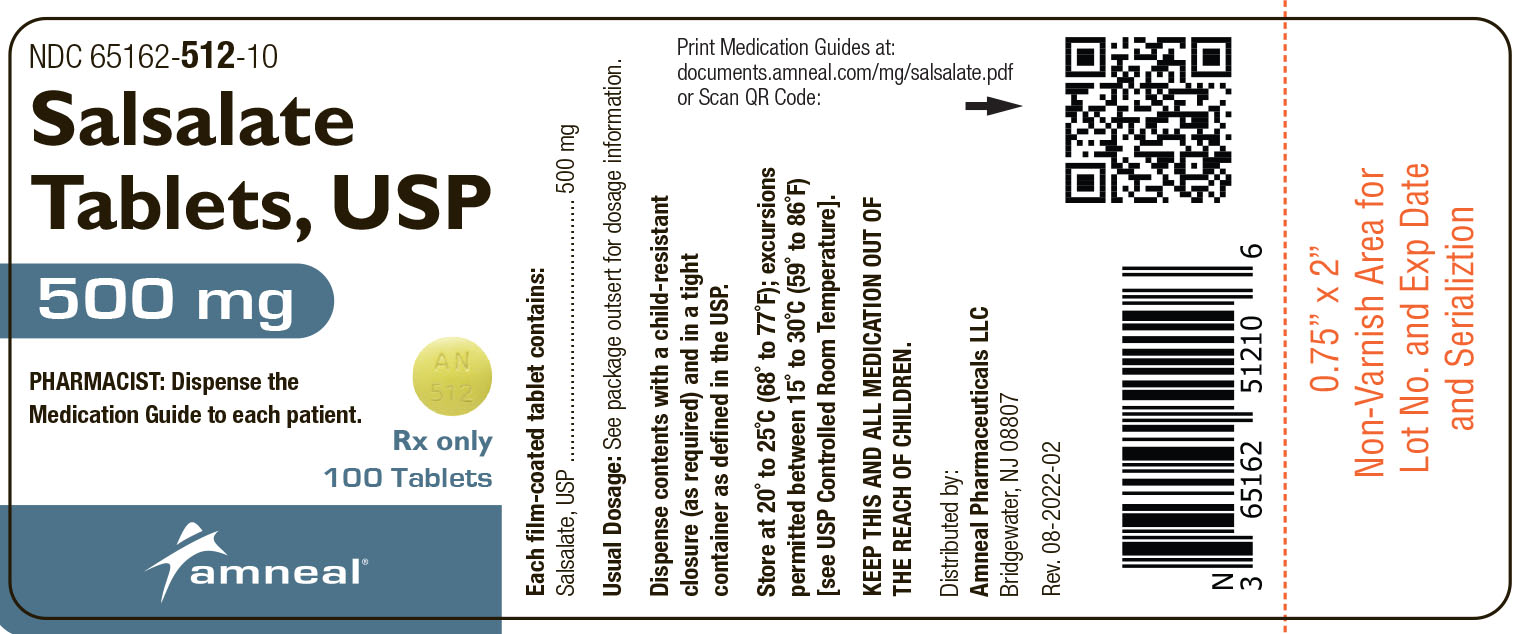
HOW SUPPLIED Salsalate tablets, USP 500 mg are available as yellow colored, round, film-coated tablets debossed “AN” over “512” on one side and plain on the other. They are supplied as follows: Bottles of 100 NDC 65162-512-10 Bottles of 500 NDC 65162-512-50 Bottles of 1,000ct NDC 65162-512-11 Salsalate tablets, USP 750 mg are available as yellow colored, capsule-shaped, scored, film-coated tablets debossed “AN 513” on one side and plain on the other. They are supplied as follows: Bottles of100 NDC 65162-513-10 Bottles of 500 NDC 65162-513-50 Bottles of 1,000 NDC 65162-513-11 Dispense contents with a child-resistant closure (as required) and in a tight container as defined in the USP.
Store at 20°C to 25°C (68°F to 77°F); excursions permitted between 15° to 30°C (59° to 86°F) [see USP Controlled Room Temperature]. Rx only
📋 Description ▾
DESCRIPTION Salsalate USP, is a nonsteroidal anti-inflammatory agent for oral administration. Chemically, salsalate, USP (salicylsalicylic acid or 2-hydroxy-benzoic acid, 2-carboxyphenyl ester) is a dimer of salicylic acid; its structural formula is shown below. Chemical Structure: Tablets: Inactive Ingredients: Carnauba wax, Colloidal Silicon Dioxide, Croscarmellose Sodium, D&C Yellow #10, Hypromellose, Microcrystalline Cellulose, Polyethylene Glycol, Stearic Acid, Titanium Dioxide, 401aea08-figure-01
💬 Medication Guide ▾
Medication Guide for Nonsteroidal Anti-inflammatory Drugs (NSAIDs) Dispense with Medication Guide available at: documents.amneal.com/mg/salsalate.pdf What is the most important information I should know about medicines called Nonsteroidal Anti-inflammatory Drugs (NSAIDs)? NSAIDs can cause serious side effects, including: Increased risk of a heart attack or stroke that can lead to death. This risk may happen early in treatment and may increase: with increasing doses of NSAIDs with longer use of NSAIDs Do not take NSAIDs right before or after a heart surgery called a “coronary artery bypass graft (CABG).” Avoid taking NSAIDs after a recent heart attack, unless your healthcare provider tells you to.
You may have an increased risk of another heart attack if you take NSAIDs after a recent heart attack. Increased risk of bleeding, ulcers, and tears (perforation) of the esophagus (tube leading from the mouth to the stomach), stomach and intestines: anytime during use without warning symptoms that may cause death The risk of getting an ulcer or bleeding increases with: past history of stomach ulcers, or stomach or intestinal bleeding with use of NSAIDs taking medicines called “corticosteroids”, “anticoagulants”, “SSRIs”, or “SNRIs” increasing doses of NSAIDs longer use of NSAIDs smoking drinking alcohol oolder age poor health advanced liver disease bleeding problems NSAIDs should only be used: exactly as prescribed at the lowest dose possible for your treatment for the shortest time needed What are NSAIDs?
NSAIDs are used to treat pain and redness, swelling, and heat (inflammation) from medical conditions such as different types of arthritis, menstrual cramps, and other types of short-term pain. Who should not take NSAIDs? Do not take NSAIDS: if you have had an asthma attack, hives, or other allergic reaction with aspirin or any other NSAIDs. right before or after heart bypass surgery.
Before taking NSAIDs, tell your health care provider about all of your medical conditions, including if you: have liver or kidney problems have high blood pressure have asthma are pregnant or plan to become pregnant. Taking NSAIDs at about 20 weeks of pregnancy or later may harm your unborn baby. If you need to take NSAIDs for more than 2 days when you are between 20 and 30 weeks of pregnancy, your healthcare provider may need to monitor the amount of fluid in your womb around your baby.
You should not take NSAIDs after about 30 weeks of pregnancy. are breastfeeding or plan to breast feed. Tell your health care provider about all of the medicines you take, including prescription or over-the-counter medicines, vitamins or herbal supplements. NSAIDs and some other medicines can interact with each other and cause serious side effects.
Do not start taking new medicine without talking to your health care provider first. What are the possible side effects of NSAIDs? NSAIDs can cause serious side effects, including: See “What is the most important information I should know about medicines called Nonsteroidal Anti-inflammatory Drugs (NSAIDs)?” ·new or worse high blood pressure heart failure liver problems including liver failure kidney problems including kidney failure low red blood cells (anemia) life-threatening skin reactions life-threatening allergic reactions Other side effects of NSAIDs include: stomach pain, constipation, diarrhea, gas, heartburn, nausea, vomiting and dizziness.
Get emergency help right away if you get any of the following symptoms: shortness of breath or trouble breathing chest pain weakness in one part or side of your body slurred speech swelling of the face or throat Stop taking your NSAID and call your health care provider right away if you get any of the following symptoms: ·nausea more tired or weaker than usual diarrhea itching your skin or eyes look yellow indigestion or stomach pain flu-like symptoms ·vomit blood there is blood in your bowel movement or it is black and sticky like tar unusual weight gain skin rash or blisters wi… [Excerpted — this section continues on DailyMed.]
⚠️ Precautions ▾
PRECAUTIONS General Patients on treatment with salsalate should be warned not to take other salicylates so as to avoid potentially toxic concentrations. Great care should be exercised when salsalate is prescribed in the presence of chronic renal insufficiency or peptic ulcer disease. Protein binding of salicylic acid can be influenced by nutritional status, competitive binding of other drugs, and fluctuations in serum proteins caused by disease (rheumatoid arthritis, etc.).
Although cross reactivity, including bronchospasm, has been reported occasionally with non-acetylated salicylates, including salsalate, in aspirin-sensitive patients 8,9 , salsalate is less likely than aspirin to induce asthma in such patients 10 . Salsalate tablets cannot be expected to substitute for corticosteroids or to treat corticosteroid insufficiency. Abrupt discontinuation of corticosteroids may lead to disease exacerbation.
Patients on prolonged corticosteroid therapy should have their therapy tapered slowly if a decision is made to discontinue corticosteroids. The pharmacological activity of Salsalate tablets in reducing [fever and] inflammation may diminish the utility of these diagnostic signs in detecting complications of presumed noninfectious, painful conditions. Hepatic Effects Borderline elevations of one or more liver tests may occur in up to 15% of patients taking NSAIDs including Salsalate tablets.
These laboratory abnormalities may progress, may remain unchanged, or may be transient with continuing therapy. Notable elevations of ALT or AST (approximately three or more times the upper limit of normal) have been reported in approximately 1% of patients in clinical trials with NSAIDs. In addition, rare cases of severe hepatic reactions, including jaundice and fatal fulminant hepatitis, liver necrosis and hepatic failure, some of them with fatal outcomes have been reported.
A patient with symptoms and/or signs suggesting liver dysfunction, or in whom an abnormal liver test has occurred, should be evaluated for evidence of the development of a more severe hepatic reaction while on therapy with Salsalate tablets. If clinical signs and symptoms consistent with liver disease develop, or if systemic manifestations occur (e.g., eosinophilia, rash, etc.), Salsalate tablets should be discontinued. Hematological Effects Anemia is sometimes seen in patients receiving NSAIDs, including Salsalate tablets.
This may be due to fluid retention, occult or gross GI blood loss, or an incompletely described effect upon erythropoiesis. Patients on long-term treatment with NSAIDs, including Salsalate tablets, should have their hemoglobin or hematocrit checked if they exhibit any signs or symptoms of anemia. NSAIDs inhibit platelet aggregation and have been shown to prolong bleeding time in some patients.
Unlike aspirin, their effect on platelet function is quantitatively less, of shorter duration, and reversible. Patients receiving Salsalate tablets, who may be adversely affected by alterations in platelet function, such as those with coagulation disorders or patients receiving anticoagulants, should be carefully monitored. Preexisting Asthma Patients with asthma may have aspirin-sensitive asthma.
The use of aspirin in patients with aspirin-sensitive asthma has been associated with severe bronchospasm which can be fatal. Since cross reactivity, including bronchospasm, between aspirin and other nonsteroidal anti-inflammatory drugs has been reported in such aspirin-sensitive patients, Salsalate tablets should not be administered to patients with this form of aspirin sensitivity and should be used with caution in patients with preexisting asthma. INFORMATION FOR PATIENTS Patients should be informed of the following information before initiating therapy with an NSAID and periodically during the course of ongoing therapy.
Patients should also be encouraged to read the NSAID Medication Guide that accompanies each prescription dispensed. 1. Salsalate tablets, like oth… [Excerpted — this section continues on DailyMed.]
🔒 Drug Abuse and Dependence ▾
DRUG ABUSE AND DEPENDENCE Drug abuse and dependence have not been reported with salsalate.
📚 References ▾
REFERENCES 1. Morris HG, Sherman NA, McQuain C, et al: Effects of Salsalate (Non- Acetylated Salicylate) and Aspirin (ASA) on Serum Prostaglandins in Humans. Ther.
Drug Monit. 7:435-438, 1985. 2.
April PA, Curran NJ, Ekohlm BP, et al: Multicenter Comparative Study of Salsalate (SSA) vs Aspirin (ASA) in Rheumatoid Arthritis (RA), Arthritis Rheumatism 30 (4 supplement):S93, 1987. 3. Deodhar SD, McLeod MM, Dick WC, et al: A Short-Term Comparative Trial of Salsalate and Indomethacin in Rheumatoid Arthritis.
Curr. Med. Res.
Opin., 5:185-188, 1977. 4. Estes D, Kaplan K: Lack of Platelet Effect With the Aspirin Analog, Salsalate, Arthritis and Rheumatism, 23:1303-1307, 1980.
5. Dick C, Dick PH, Nuki G, et al: Effect of Anti-inflammatory Drug Therapy on Clearance of 133Xe from Knee Joints of Patients with Rheumatoid Arthritis. British Med.
J. 3:278-280, 1969. 6.
Dick WC, Grayson MF, Woodburn A, et al: Indices of Inflammatory Activity. Ann. of the Rheum. Dis.
29:643-648, 1970. 7. Cohen A:Fecal Blood Loss and Plasma Salicylate Study of Salicylsalicylic Acid and Aspirin.
J. Clin. Pharmacol.
19:242-247, 1979. 8. Chudwin DS, Strub M.
Golden HE, et al: Sensitivity to Non-Acetylated Salicylates in a Patient with Asthma, Nasal Polyps, and Rheumatoid Arthritis. Annals of Allergy 57:133-134, 1986. 9.
Spector SL, Wangaard CH, Farr RS: Aspirin and Concomitant Idiosyncrasies in Adult Asthmatic Patients. J. Allergy Clin.
Immunol 64:500-506, 1979. 10. Stevenson DD, Schrank PJ, Hougham AJ, et al: Salsalate Cross Sensitivity in Aspirin-Sensitive Asthmatics.
J. Allergy Clin. Immunol 81:181, 1988.
Distributed by: Amneal Pharmaceuticals LLC Bridgewater, NJ 08807 Rev. 08-2022-02 Dispense with Medication Guide available at: documents.amneal.com/mg/salsalate.pdf
📄 Package Label / Principal Display Panel ▾
PACKAGE LABEL.PRINCIPAL DISPLAY PANEL 500mg label
750mg label
Medicaid utilization & spend
Medicaid utilization by pack size
Medicare Part D spend CMS · PART D · 2026 (Q1)
About this NDC listing & data coverage
Listed without an FDA application
This product's marketing category indicates it is marketed without an approved FDA application (no NDA, ANDA, or BLA on file). Having an NDC does not by itself establish FDA approval — the NDC Directory is a listing system, not an approval decision. Approval-linked data such as Orange Book therapeutic-equivalence ratings therefore does not apply.
What data is (and isn’t) available for this NDC — tap to expand
| NDC identity (package / product / labeler codes) | ✓ Available |
| Labeler | ✓ Available |
| Product & package description | ✓ Available |
| Marketing category & status | ✓ Available |
| Active ingredient / dosage form / route | ✓ Available |
| FDA label (SPL via DailyMed) | ✓ Available |
| Package photos | ✓ Available |
| Inactive ingredients (structured) | ✓ Available |
| NADAC pharmacy acquisition price (CMS) | ✓ Available |
| Orange Book / therapeutic-equivalence data | — Not published for this NDC Applies only to products approved under an NDA/ANDA; many listings are out of scope. |
| HCPCS J-code billing crosswalk | — Not published for this NDC Most self-administered / retail products have no J-code — that is normal. |
| Medicaid utilization (CMS SDUD) | ✓ Available |