
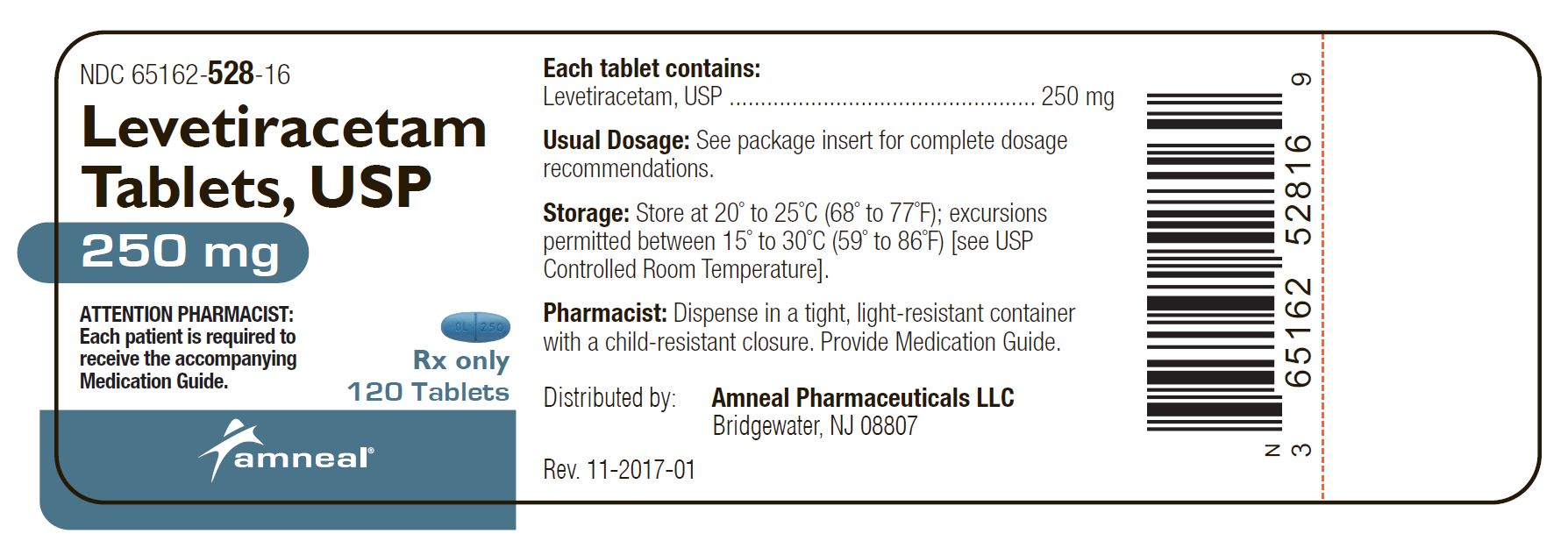
Levetiracetam 250 mg Tablet, Film Coated, 120-count — NDC 65162-528-16 (Billing 65162-0528-16)
This is a package of 120 tablets of Levetiracetam 250 mg Tablet, Film Coated from Amneal Pharmaceuticals LLC, marketed since Feb 2013 and currently FDA-listed. It is this product's only package size.
NDC database record
One package, one record: these facts belong to NDC 65162-528-16 alone.
- Record
- FDA NDC Directory package listing · Human prescription drug
- Code segments
- 65162 labeler · 528 product · 16 package
- Package marketed since
- Feb 28, 2013
- Sample package
- No — commercial package
- Listing certified through
- Dec 31, 2027
- Billing quantity
- 120 EA per package
- Barcode (UPC)
- 0365162528169, 0365162529166, 0365162538168, 0365162539066
- FDA record last changed
- Oct 8, 2026
Identity & classification
Regulatory identifiers FDA, NLM and CMS codes for this package
Drug-database identifiers Medi-Span GPI and First Databank GCN / HICL / AHFS classification
- GSN (GCN sequence number): 044632
- GCN: 41587
- HICL (First Databank): 020952
- AHFS class code: 28:12.92.00
- RxCUI (RxNorm): 311288
Where does this data come from?
- FDA openFDA NDC Directory · synced Oct 8, 2026
- FDA label on DailyMed · label index refreshed Oct 8, 2026
- RxNorm (NLM RxNav) · catalog refreshed Oct 1, 2026
- Medi-Span GPI (licensed)
- First Databank (licensed) · refreshed Oct 8, 2026
RxNorm drug class
This medicine belongs to the Other antiepileptics class.
Where does this data come from?
- RxClass (NLM) · catalog refreshed Oct 1, 2026
Clinical
- It treats seizures in epilepsy. Depending on the product, that means partial-onset seizures, and as add-on therapy, myoclonic seizures in juvenile myoclonic epilepsy and primary ge...
- Follow your prescriber and label. Tablets and solution are usually twice daily, while extended-release tablets are once daily and must be swallowed whole. Use a calibrated device f...
- Sleepiness, tiredness, dizziness and headache are common, especially early on. Children may become irritable or aggressive. Avoid driving until you know how it affects you.
- Call right away for new or worsening depression, suicidal thoughts, unusual behavior, a rash, swelling of the face or throat, or trouble walking. Get emergency help for trouble bre...
Patient education
Supplement & herbal interactions
Some supplements/herbs that may interact with Levetiracetam — tap one for details:
Levetiracetam may be associated with lower levels of 1 nutrient — worth a chat with your pharmacist, not a cause for alarm.
Where does this data come from?
- MedlinePlus (NLM) · refreshed Oct 8, 2026
- FDA label on DailyMed · label index refreshed Oct 8, 2026
Ask a licensed pharmacist directly — free, answered by our team.
Pricing
A drug doesn't have one price. Each row is a different public payment system, and none is what you'd pay at the counter — that depends on your insurance. The ⓘ on each row explains what it measures.
| Price system | Per each | Per package |
|---|---|---|
| Retail pharmacies payNADAC · weekly | Not in the retail survey — common for institutional, discontinued, or low-volume packs. | |
| Medicaid paysCMS SDUD · 12 mo | No recent Medicaid claims on file for this NDC — rare and low-volume NDCs are suppressed in the public data. | |
| Medicare drug plans payPart D · Q2 2026 | $0.1374 | $16.49 / 120 tablets |
Where does this data come from?
- CMS NADAC weekly file
- CMS ASP pricing files · refreshed Sep 20, 2026
- CMS Medicaid State Drug Utilization Data · refreshed Oct 8, 2026
- CMS Part D plan pricing files · refreshed Sep 24, 2026
- VA National Acquisition Center price file
Packaging — all sizes for this product
| Package NDC | Description | Marketing start | Marketing end | Status |
|---|---|---|---|---|
| 65162-0528-16 You're viewing this Main listing | 120 TABLET, FILM COATED in 1 BOTTLE | 2013-02-28 | — | Active |
Therapeutic equivalents
| Product | Labeler | Pack | NADAC/unit | TE | Status | Price vs. this |
|---|---|---|---|---|---|---|
| Levetiracetam 250 mg 00904-7123-61 | Major | 1 tablet | $0.056 | AB | Availability likely | — |
| Levetiracetam 250 mg 16714-0034-01 | NorthStar | 120 tablets | $0.056 | AB | Availability likely | — |
| Levetiracetam 250 mg 27808-0263-01 | Cranbury | 120 tablets | $0.056 | AB | Availability likely | — |
| Levetiracetam 250 mg 31722-0536-05 | Camber | 500 tablets | $0.056 | AB | Availability likely | — |
| Levetiracetam 250 mg 43547-0221-15 | Solco | 120 tablets | $0.056 | AB | Availability likely | — |
| Levetiracetam 250 mg 50228-0470-05 | ScieGen | 500 tablets | $0.056 | AB | Availability likely | — |
| Levetiracetam 250 mg 67877-0768-05 | Ascend | 500 tablets | $0.056 | AB | Availability likely | — |
| Levetiracetam 250 mg 68001-0402-03 | BluePoint | 500 tablets | $0.056 | AB | Availability likely | — |
| Levetiracetam 250 mg 68084-0859-01 | American | 1 tablet | $0.056 | AB | Availability likely | — |
| Levetiracetam 250 mg 68180-0112-02 | Lupin | 500 tablets | $0.056 | AB | Availability likely | — |
| Levetiracetam 250 mg 72205-0094-92 | Novadoz | 120 tablets | $0.056 | AB | Availability likely | — |
| Levetiracetam 250 mg 82009-0121-05 | Quallent | 500 tablets | $0.056 | AB | Availability likely | — |
| Levetiracetam 250 mg 13668-0014-05 | Torrent | 500 tablets | $0.064 | AB | FDA listed | — |
| Keppra 250 mg 50474-0594-40 | UCB, | 120 tablets | $8.079 | AB | Availability likely | — |
| Spritam 250 mg 43485-0101-60 | Aprecia | 1 tablet | $10.272 | — | Availability likely | — |
| Levetiracetam 250 mg 00615-8498-39 | NCS | 30 tablets | — | AB | FDA listed | — |
| Levetiracetam 250 mg 43547-0880-15 | Solco | 120 tablets | — | AB | FDA listed | — |
| Levetiracetam 250 mg 50090-7774-00 | A-S | 120 tablets | — | AB | FDA listed | — |
| Levetiracetam 250 mg 50405-0300-01 | SOHM, | 30 tablets | — | AB | FDA listed | — |
| Levetiracetam 250 mg 55111-0181-01 | Dr. | 100 tablets | — | AB | FDA listed | — |
| Levetiracetam 250 mg 55154-4171-00 | Cardinal | 1 tablet | — | AB | FDA listed | — |
| Levetiracetam 250 mg 63629-4675-01 | Bryant | 60 tablets | — | AB | FDA listed | — |
| Levetiracetam 250 mg 64980-0604-01 | Rising | 100 tablets | — | AB | FDA listed | — |
| Levetiracetam 250 mgthis 65162-0528-16 | Amneal | 120 tablets | — | AB | FDA listed | — |
| Levetiracetam 250 mg 65862-0245-05 | Aurobindo | 500 tablets | — | — | FDA listed | — |
| Levetiracetam 250 mg 67046-0880-03 | Coupler | 30 tablets | — | AB | FDA listed | — |
| Levetiracetam 250 mg 68788-7884-01 | Preferred | 100 tablets | — | AB | FDA listed | — |
| Roweepra 250 mg 69102-0108-01 | OWP | 120 tablets | — | AB | FDA listed | — |
| Levetiracetam 250 mg 70010-0521-03 | Granules | 30 tablets | — | — | FDA listed | — |
| Levetiracetam 250 mg 70518-4306-00 | REMEDYREPACK | 30 tablets | — | AB | FDA listed | — |
| Levetiracetam 250 mg 71335-0702-01 | Bryant | 60 tablets | — | AB | FDA listed | — |
| Levetiracetam 250 mg 71335-2275-01 | Bryant | 60 tablets | — | AB | FDA listed | — |
| Levetiracetam 250 mg 72189-0190-30 | DIRECT | 30 tablets | — | AB | FDA listed | — |
| Levetiracetam 250 mg 72865-0187-05 | XLCare | 500 tablets | — | AB | FDA listed | — |
| Levetiracetam 250 mg 76282-0246-12 | Exelan | 120 tablets | — | — | FDA listed | — |
| Levetiracetam 250 mg 76494-0528-12 | Prinston | 120 tablets | — | AB | FDA listed | — |
| Levetiracetam 250 mg 87063-0190-12 | ASCLEMED | 120 tablets | — | AB | FDA listed | — |
| Levetiracetam 250 mg 66993-0100-06 | Prasco | 1 tablet | — | — | FDA listed | — |
Where does this data come from?
- FDA openFDA NDC Directory · synced Oct 8, 2026
- FDA Orange Book · refreshed Oct 3, 2026
- CMS NADAC weekly file
Availability & generic status
This product is an FDA-approved generic. Other versions of the same drug are listed under Therapeutic equivalents, least expensive first.
Where does this data come from?
- FDA Orange Book · refreshed Oct 3, 2026
What it looks like
Where does this data come from?
- FDA label on DailyMed · label index refreshed Oct 8, 2026
Inactive Ingredients / Excipients
Inactive ingredients, also called excipients, are components of the drug product other than the active ingredient. They may include fillers, dyes, coatings, preservatives, flavors, or other formulation ingredients.
🧪 Avoiding an ingredient? See Levetiracetam inactive ingredients by manufacturer: every current product's list side by side, so you can ask your pharmacy for the version that does not list it.
💡 Tap an ingredient (hover on desktop) to see what it is and why it’s used.
-
UNII D9C330MD8B
Copovidone is a synthetic polymer made by combining two types of plastic-like molecules. It acts as a binder and film-former to help hold tablet ingredients together and improve how the medicine dissolves in your body.
-
UNII M28OL1HH48
Croscarmellose sodium is a plant-based substance derived from cellulose. It acts as a disintegrant, helping tablets and capsules break down quickly in the digestive system so the medicine can be absorbed.
-
UNII L06K8R7DQK
A synthetic blue dye approved by the FDA for use in medications and foods. It serves as a colorant to make pills and liquids visually distinct and easier to identify.
-
UNII 70097M6I30
Magnesium stearate is a salt made from magnesium and stearic acid, a fatty substance. It's used in tablets and capsules as a lubricant and glidant to help ingredients flow smoothly during manufacturing and prevent sticking.
-
UNII G2M7P15E5P
Polyethylene glycol 3350 is a synthetic polymer used as a solvent, humectant, and thickening agent in medicines. It helps dissolve other ingredients, retain moisture in the product, and achieve the desired consistency.
-
UNII 6OZP39ZG8H
Polysorbate 80 is a synthetic emulsifier derived from sorbitol and oleic acid. It helps mix oil and water-based ingredients together in medications and improves how the product disperses in the body.
-
UNII 532B59J990
Polyvinyl alcohol is a synthetic polymer made from plant-derived materials. It's used as a binder to hold ingredients together, a film-former in coatings, and a thickener in liquid formulations.
-
UNII O8232NY3SJ
A plant-based carbohydrate derived from corn kernels. It acts as a filler to add bulk, a binder to hold ingredients together, and a disintegrant to help the tablet break apart in your stomach for absorption.
-
UNII 7SEV7J4R1U
A powder made from a naturally occurring mineral. In medicines, talc works as a glidant and anti-caking agent, helping tablets and capsules flow smoothly during manufacturing and preventing clumping.
-
UNII 15FIX9V2JP
Titanium dioxide is a bright white mineral powder commonly used as a colorant and opacifying agent. It makes pills and tablets white or lighter in color and helps make coatings non-transparent.
10 inactive ingredients listed in the exact product block matched to this NDC.
Where does this data come from?
ingredient classCode="IACT" elements from the exact product block matched by this NDC. Label-section narrative from DailyMed / the openFDA label index is shown separately when available.- FDA label on DailyMed · label index refreshed Oct 8, 2026
- FDA openFDA NDC Directory · synced Oct 8, 2026
Inactive ingredient FAQ
Are inactive ingredients the same for every manufacturer?
Why might an inactive ingredient be missing?
Can inactive ingredients matter?
Manufacturer & labeler
More NDCs from Amneal Pharmaceuticals LLC labeler code 65162
- Salsalate 750 mg Tablet NDC 65162-513-10
- Spironolactone 50 mg Tablet NDC 65162-514-03
- Spironolactone 100 mg Tablet NDC 65162-515-03
- Calcitriol .25 ug Capsule NDC 65162-519-03
- Promethazine Hydrochloride 25 mg Tablet NDC 65162-521-10
- Promethazine Hydrochloride 50 mg Tablet NDC 65162-522-10
- Levetiracetam 500 mg Tablet, Film Coated NDC 65162-529-16
- Benzonatate 100 mg Capsule, Liquid Filled NDC 65162-536-10
- Benzonatate 200 mg Capsule, Liquid Filled NDC 65162-537-10
- Levetiracetam 750 mg Tablet, Film Coated NDC 65162-538-16
- Levetiracetam 1000 mg Tablet, Film Coated NDC 65162-539-06
- Cyclobenzaprine Hydrochloride 5 mg Tablet, Film Coated NDC 65162-540-10
Where does this data come from?
- FDA openFDA NDC Directory · synced Oct 8, 2026
- Drugs@FDA
Full prescribing information FDA SPL
🎯 Indications and Usage ▾
1 INDICATIONS AND USAGE Levetiracetam tablets are indicated for adjunctive therapy in the treatment of: Partial onset seizures in patients one month of age and older with epilepsy (1.1) Myoclonic seizures in patients 12 years of age and older with juvenile myoclonic epilepsy (1.2) Primary generalized tonic-clonic seizures in patients 6 years of age and older with idiopathic generalized epilepsy (1.3)
1.1Partial Onset Seizures Levetiracetam tablets are indicated as adjunctive therapy in the treatment of partial onset seizures in adults and children 1 month of age and older with epilepsy.
1.2Myoclonic Seizures in Patients with Juvenile Myoclonic Epilepsy Levetiracetam tablets are indicated as adjunctive therapy in the treatment of myoclonic seizures in adults and adolescents 12 years of age and older with juvenile myoclonic epilepsy.
1.3Primary Generalized Tonic-Clonic Seizures Levetiracetam tablets are indicated as adjunctive therapy in the treatment of primary generalized tonic-clonic seizures in adults and children 6 years of age and older with idiopathic generalized epilepsy.
⏱️ Dosage and Administration ▾
2 DOSAGE AND ADMINISTRATION Use the oral solution for pediatric patients with body weight ≤ 20 kg (2.1) . For pediatric patients, use weight-based dosing for the oral solution with a calibrated measuring device (not a household teaspoon or tablespoon) (2.1) Partial Onset Seizures 1 Month to < 6 Months: 7 mg/kg twice daily; increase by 7 mg/kg twice daily every 2 weeks to recommended dose of 21 mg/kg twice daily (2.2) 6 Months to < 4 Years: 10 mg/kg twice daily; increase by 10 mg/kg twice daily every 2 weeks to recommended dose of 25 mg/kg twice daily (2.2) 4 Years to < 16 Years: 10 mg/kg twice daily; increase by 10 mg/kg twice daily every 2 weeks to recommended dose of 30 mg/kg twice daily (2.2) Adults 16 Years and Older: 500 mg twice daily; increase by 500 mg twice daily every 2 weeks to a recommended dose of 1,500 mg twice daily (2.2) Myoclonic Seizures in Adults and Pediatric Patients 12 Years and Older 500 mg twice daily; increase by 500 mg twice daily every 2 weeks to recommended dose of 1,500 mg twice daily (2.3) Primary Generalized Tonic-Clonic Seizures 6 Years to < 16 Years: 10 mg/kg twice daily, increase in increments of 10 mg/kg twice daily every 2 weeks to recommended dose of 30 mg/kg twice daily (2.4) Adults 16 Years and Older: 500 mg twice daily, increase by 500 mg twice daily every 2 weeks to recommended dose of 1,500 mg twice daily (2.4) Adult Patients with Impaired Renal Function Dose adjustment is recommended, based on the patient’s estimated creatinine clearance (2.5, 8.6)
2.1Important Administration Instructions Levetiracetam tablets are given orally with or without food. The levetiracetam tablets dosing regimen depends on the indication, age group, dosage form (tablets or oral solution), and renal function. Prescribe the oral solution for pediatric patients with body weight ≤ 20 kg.
Prescribe the oral solution or tablets for pediatric patients with body weight above 20 kg. When using the oral solution in pediatric patients, dosing is weight-based (mg per kg) using a calibrated measuring device (not a household teaspoon or tablespoon). Levetiracetam tablets should be swallowed whole.
Levetiracetam tablets should not be chewed or crushed.
2.2Dosing for Partial Onset Seizures Adults 16 Years and Older Initiate treatment with a daily dose of 1,000 mg/day, given as twice-daily dosing (500 mg twice daily). Additional dosing increments may be given (1,000 mg/day additional every 2 weeks) to a maximum recommended daily dose of 3,000 mg. There is no evidence that doses greater than 3,000 mg/day confer additional benefit.
Pediatric Patients 1 Month to < 6 Months Initiate treatment with a daily dose of 14 mg/kg in 2 divided doses (7 mg/kg twice daily). Increase the daily dose every 2 weeks by increments of 14 mg/kg to the recommended daily dose of 42 mg/kg (21 mg/kg twice daily). In the clinical trial, the mean daily dose was 35 mg/kg in this age group.
The effectiveness of lower doses has not been studied. 6 Months to < 4 Years: Initiate treatment with a daily dose of 20 mg/kg in 2 divided doses (10 mg/kg twice daily). Increase the daily dose in 2 weeks by an increment of 20 mg/kg to the recommended daily dose of 50 mg/kg (25 mg/kg twice daily).
If a patient cannot tolerate a daily dose of 50 mg/kg, the daily dose may be reduced. In the clinical trial, the mean daily dose was 47 mg/kg in this age group. 4 Years to < 16 Years Initiate treatment with a daily dose of 20 mg/kg in 2 divided doses (10 mg/kg twice daily).
Increase the daily dose every 2 weeks by increments of 20 mg/kg to the recommended daily dose of 60 mg/kg (30 mg/kg twice daily). If a patient cannot tolerate a daily dose of 60 mg/kg, the daily dose may be reduced. In the clinical trial, the mean daily dose was 44 mg/kg.
The maximum daily dose was 3,000 mg/day. For levetiracetam tablets dosing in pediatric patients weighing 20 to 40 kg, initiate treatment with a daily dose of 500 mg given as twice daily dosing (250 mg twice daily). Increase the daily do… [Excerpted — this section continues on DailyMed.]
💊 Dosage Forms and Strengths ▾
3 DOSAGE FORMS AND STRENGTHS Levetiracetam tablets, USP 250 mg , are blue, oblong-shaped, scored, film-coated tablets debossed with “OL” and “250” on one side. Levetiracetam tablets, USP 500 mg, are yellow, oblong-shaped, scored, film-coated tablets debossed with “OL” and “500”on one side. Levetiracetam tablets, USP 750 mg, are dark pink, oblong-shaped, scored, film-coated tablets debossed with “OL” and “750” on one side.
Levetiracetam tablets, USP 1,000 mg, are white, oblong-shaped, scored, film-coated tablets debossed with “OL” and “1000” on one side. 250 mg, 500 mg, 750 mg, and 1,000 mg film-coated, scored tablets (3)
⛔ Contraindications ▾
4 CONTRAINDICATIONS Levetiracetam tablet is contraindicated in patients with a hypersensitivity to levetiracetam . Reactions have included anaphylaxis and angioedema [ see Warnings and Precautions (5.4) ]. Known hypersensitivity to levetiracetam; angioedema and anaphylaxis have occurred (4)
⚠️ Warnings and Cautions ▾
5 WARNINGS AND PRECAUTIONS Behavioral abnormalities including psychotic symptoms, suicidal ideation, irritability, and aggressive behavior have been observed; monitor patients for psychiatric signs and symptoms (5.1) Suicidal Behavior and Ideation: Monitor patients for new or worsening depression, suicidal thoughts/behavior, and/or unusual changes in mood or behavior (5.2) Monitor for somnolence and fatigue and advise patients not to drive or operate machinery until they have gained sufficient experience on levetiracetam (5.3) Withdrawal Seizures: Levetiracetam must be gradually withdrawn (5.7)
5.1Behavioral Abnormalities and Psychotic Symptoms Levetiracetam may cause behavioral abnormalities and psychotic symptoms. Patients treated with levetiracetam should be monitored for psychiatric signs and symptoms. Behavioral abnormalities In clinical studies, 13% of adult levetiracetam-treated patients and 38% of pediatric levetiracetam-treated patients (4 to 16 years of age) compared to 6% and 19% of adult and pediatric placebo-treated patients, experienced non-psychotic behavioral symptoms (reported as aggression, agitation, anger, anxiety, apathy, depersonalization, depression, emotional lability, hostility, hyperkinesias, irritability, nervousness, neurosis, and personality disorder).
A randomized double-blind, placebo-controlled study was performed to assess the neurocognitive and behavioral effects of levetiracetam as adjunctive therapy in pediatric patients (4 to 16 years of age). The results from an exploratory analysis indicated a worsening in levetiracetam-treated patients on aggressive behavior (one of eight behavior dimensions) as measured in a standardized and systematic way using a validated instrument, the Achenbach Child Behavior Checklist (CBCL/6 to 18). In clinical studies in pediatric patients 1 month to < 4 years of age, irritability was reported in 12% of the levetiracetam-treated patients compared to 0% of placebo-treated patients.
In clinical studies, 1.7% of adult levetiracetam-treated patients discontinued treatment due to behavioral adverse reactions, compared to 0.2% of placebo-treated patients. The treatment dose was reduced in 0.8% of adult levetiracetam-treated patients and in 0.5% of placebo-treated patients. Overall, 11% of levetiracetam-treated pediatric patients experienced behavioral symptoms associated with discontinuation or dose reduction, compared to 6% of placebo-treated patients.
Psychotic symptoms In clinical studies, 1% of levetiracetam-treated adult patients, 2% of levetiracetam-treated pediatric patients 4 to 16 years of age, and 17% of levetiracetam-treated pediatric patients 1 month to <4 years of age experienced psychotic symptoms, compared to 0.2%, 2%, and 5% in the corresponding age groups treated with placebo. In a controlled study that assessed the neurocognitive and behavioral effects of levetiracetam in pediatric patients 4 to 16 years of age, 1.6% of levetiracetam-treated patients experienced paranoia, compared to 0% of placebo-treated patients.
In the same study, 3.1% of levetiracetam-treated patients experienced confusional state, compared to 0% of placebo-treated patients [see Use in Specific Populations (8.4) ] . In clinical studies, two (0.3%) levetiracetam-treated adult patients were hospitalized and their treatment was discontinued due to psychosis. Both events, reported as psychosis, developed within the first week of treatment and resolved within 1 to 2 weeks following treatment discontinuation.
There was no difference between drug and placebo-treated patients in the incidence of the pediatric patients who discontinued treatment due to psychotic and non-psychotic adverse reactions.
5.2Suicidal Behavior and Ideation Antiepileptic drugs (AEDs), including levetiracetam, increase the risk of suicidal thoughts or behavior in patients taking these drugs for any indication. Patients treated with any AED for any indication should be monitored for the emergence or worsening of d… [Excerpted — this section continues on DailyMed.]
🤒 Adverse Reactions ▾
6 ADVERSE REACTIONS The following adverse reactions are discussed in more details in other sections of labeling: Psychiatric Symptoms [see Warnings and Precautions (5.1) ] Suicidal Behavior and Ideation [see Warnings and Precautions (5.2) ] Somnolence and Fatigue [see Warnings and Precautions (5.3) ] Anaphylaxis and Angioedema [ see Warnings and Precautions (5.4)] Serious Dermatological Reactions [see Warnings and Precautions (5.5) ] Coordination Difficulties [see Warnings and Precautions (5.6) ] Hematologic Abnormalities [see Warnings and Precautions (5.8) ] Increase in Blood Pressure [see Warnings and Precautions (5.9) ] Most common adverse reactions (incidence ≥ 5% more than placebo) include: Adult patients: somnolence, asthenia, infection and dizziness (6.1) Pediatric patients: fatigue, aggression, nasal congestion, decreased appetite, and irritability (6.1) To report SUSPECTED ADVERSE REACTIONS, contact Amneal Pharmaceuticals at 1-877-835-5472 or FDA at 1-800-FDA-1088 or www.fda.gov/medwatch .
6.1Clinical Trials Experience Because clinical trials are conducted under widely varying conditions, adverse reaction rates observed in the clinical trials of a drug cannot be directly compared to rates in the clinical trials of another drug and may not reflect the rates observed in practice. Partial Onset Seizures Adults In controlled clinical studies in adults with partial onset seizures, the most common adverse reactions in patients receiving levetiracetam in combination with other AEDs, for events with rates greater than placebo, were somnolence, asthenia, infection, and dizziness.
Of the most common adverse reactions in adults experiencing partial onset seizures, asthenia, somnolence, and dizziness occurred predominantly during the first 4 weeks of treatment with levetiracetam. Table 3 lists adverse reactions that occurred in at least 1% of adult epilepsy patients receiving levetiracetam in placebo-controlled studies and were numerically more common than in patients treated with placebo. In these studies, either levetiracetam or placebo was added to concurrent AED therapy.
Table 3: Adverse Reactions in Pooled Placebo-Controlled, Add-On Studies in Adults Experiencing Partial Onset Seizures Levetiracetam (N=769) % Placebo (N=439) % Asthenia 15 9 Somnolence 15 8 Headache 14 13 Infection 13 8 Dizziness 9 4 Pain 7 6 Pharyngitis 6 4 Depression 4 2 Nervousness 4 2 Rhinitis 4 3 Anorexia 3 2 Ataxia 3 1 Vertigo 3 1 Amnesia 2 1 Anxiety 2 1 Cough Increased 2 1 Diplopia 2 1 Emotional Lability 2 0 Hostility 2 1 Paresthesia 2 1 Sinusitis 2 1 In controlled adult clinical studies, 15% of patients receiving levetiracetam and 12% receiving placebo either discontinued or had a dose reduction as a result of an adverse reaction.
Table 4 lists the most common (>1%) adverse reactions that resulted in discontinuation or dose reduction and that occurred more frequently in levetiracetam-treated patients than in placebo-treated patients. Table 4: Adverse Reactions that Resulted in Discontinuation or Dose Reduction in Placebo-Controlled Studies in Adult Patients Experiencing Partial Onset Seizures Adverse Reaction Levetiracetam (N=769) % Placebo (N=439) % Somnolence 4 2 Dizziness 1 0 Pediatric Patients 4 Years to <16 Years The adverse reaction data presented below was obtained from a pooled analysis of two controlled pediatric clinical studies in pediatric patients 4 to 16 years of age with partial onset seizures.
The most common adverse reactions in pediatric patients receiving levetiracetam in combination with other AEDs, for events with rates greater than placebo, were fatigue, aggression, nasal congestion, decreased appetite, and irritability. Table 5 lists adverse reactions from the pooled pediatric controlled studies (4 to 16 years of age) that occurred in at least 2% of pediatric levetiracetam-treated patients and were numerically more common than in pediatric patients treated with placebo. In these studies, either levetiracetam or placebo was adde… [Excerpted — this section continues on DailyMed.]
👥 Use in Specific Populations ▾
8 USE IN SPECIFIC POPULATIONS Pregnancy: Plasma levels of levetiracetam may be decreased and therefore need to be monitored closely during pregnancy. Based on animal data, may cause fetal harm (5.10 , 8.1)
8.1Pregnancy Levetiracetam blood levels may decrease during pregnancy [see Warnings and Precautions (5.10) ] . Pregnancy Category C There are no adequate and controlled studies in pregnant women. In animal studies, levetiracetam produced evidence of developmental toxicity, including teratogenic effects, at doses similar to or greater than human therapeutic doses.
Levetiracetam should be used during pregnancy only if the potential benefit justifies the potential risk to the fetus. Oral administration of levetiracetam to female rats throughout pregnancy and lactation led to increased incidences of minor fetal skeletal abnormalities and retarded offspring growth pre- and/or postnatally at doses ≥350 mg/kg/day (equivalent to the maximum recommended human dose of 3,000 mg [MRHD] on a mg/m 2 basis) and with increased pup mortality and offspring behavioral alterations at a dose of 1,800 mg/kg/day (6 times the MRHD on a mg/m 2 basis).
The developmental no effect dose was 70 mg/kg/day (0.2 times the MRHD on a mg/m 2 basis). There was no overt maternal toxicity at the doses used in this study. Oral administration of levetiracetam to pregnant rabbits during the period of organogenesis resulted in increased embryofetal mortality and increased incidences of minor fetal skeletal abnormalities at doses ≥600 mg/kg/day (4 times MRHD on a mg/m 2 basis) and in decreased fetal weights and increased incidences of fetal malformations at a dose of 1,800 mg/kg/day (12 times the MRHD on a mg/m 2 basis).
The developmental no effect dose was 200 mg/kg/day (equivalent to the MRHD on a mg/m 2 basis). Maternal toxicity was also observed at 1,800 mg/kg/day. When levetiracetam was administered orally to pregnant rats during the period of organogenesis, fetal weights were decreased and the incidence of fetal skeletal variations was increased at a dose of 3,600 mg/kg/day (12 times the MRHD).
1,200 mg/kg/day (4 times the MRHD) was a developmental no effect dose. There was no evidence of maternal toxicity in this study. Treatment of rats with levetiracetam during the last third of gestation and throughout lactation produced no adverse developmental or maternal effects at doses of up to 1,800 mg/kg/day (6 times the MRHD on a mg/m 2 basis).
Pregnancy Registry To provide information regarding the effects of in utero exposure to levetiracetam, physicians are advised to recommend that pregnant patients taking levetiracetam enroll in the North American Antiepileptic Drug (NAAED) pregnancy registry. This can be done by calling the toll free number 1-888-233-2334, and must be done by the patients themselves. Information on the registry can also be found at the website http://www.aedpregnancyregistry.org/.
8.2Labor and Delivery The effect of levetiracetam on labor and delivery in humans is unknown.
8.3Nursing Mothers Levetiracetam is excreted in human milk. Because of the potential for serious adverse reactions in nursing infants from levetiracetam, a decision should be made whether to discontinue nursing or discontinue the drug, taking into account the importance of the drug to the mother.
8.4Pediatric Use The safety and effectiveness of levetiracetam in the adjunctive treatment of partial onset seizures in pediatric patients age 1 month to 16 years old with epilepsy have been established [see Clinical Studies (14.1) ] . The dosing recommendation in these pediatric patients varies according to age group and is weight-based [see Dosage and Administration (2.2) ] . The safety and effectiveness of levetiracetam as adjunctive treatment of myoclonic seizures in adolescents 12 years of age and older with juvenile myoclonic epilepsy have been established [see Clinical Studies (14.2) ] .
The safety and effectiveness of levetiracetam as adjunctive therapy in the treatment… [Excerpted — this section continues on DailyMed.]
🆘 Overdosage ▾
10 OVERDOSAGE
10.1Signs, Symptoms and Laboratory Findings of Acute Overdosage in Humans The highest known dose of levetiracetam received in the clinical development program was 6,000 mg/day. Other than drowsiness, there were no adverse reactions in the few known cases of overdose in clinical trials. Cases of somnolence, agitation, aggression, depressed level of consciousness, respiratory depression and coma were observed with levetiracetam overdoses in postmarketing use.
10.2Management of Overdose There is no specific antidote for overdose with levetiracetam. If indicated, elimination of unabsorbed drug should be attempted by emesis or gastric lavage; usual precautions should be observed to maintain airway. General supportive care of the patient is indicated including monitoring of vital signs and observation of the patient’s clinical status.
A Certified Poison Control Center should be contacted for up to date information on the management of overdose with levetiracetam.
10.3Hemodialysis Standard hemodialysis procedures result in significant clearance of levetiracetam (approximately 50% in 4 hours) and should be considered in cases of overdose. Although hemodialysis has not been performed in the few known cases of overdose, it may be indicated by the patient's clinical state or in patients with significant renal impairment.
🧬 Clinical Pharmacology ▾
12 CLINICAL PHARMACOLOGY
12.1Mechanism of Action The precise mechanism(s) by which levetiracetam exerts its antiepileptic effect is unknown. The antiepileptic activity of levetiracetam was assessed in a number of animal models of epileptic seizures. Levetiracetam did not inhibit single seizures induced by maximal stimulation with electrical current or different chemoconvulsants and showed only minimal activity in submaximal stimulation and in threshold tests.
Protection was observed, however, against secondarily generalized activity from focal seizures induced by pilocarpine and kainic acid, two chemoconvulsants that induce seizures that mimic some features of human complex partial seizures with secondary generalization. Levetiracetam also displayed inhibitory properties in the kindling model in rats, another model of human complex partial seizures, both during kindling development and in the fully kindled state. The predictive value of these animal models for specific types of human epilepsy is uncertain.
In vitro and in vivo recordings of epileptiform activity from the hippocampus have shown that levetiracetam inhibits burst firing without affecting normal neuronal excitability, suggesting that levetiracetam may selectively prevent hypersynchronization of epileptiform burst firing and propagation of seizure activity. Levetiracetam at concentrations of up to 10 μM did not demonstrate binding affinity for a variety of known receptors, such as those associated with benzodiazepines, GABA (gamma-aminobutyric acid), glycine, NMDA (N-methyl-D-aspartate), re-uptake sites, and second messenger systems.
Furthermore, in vitro studies have failed to find an effect of levetiracetam on neuronal voltage-gated sodium or T-type calcium currents and levetiracetam does not appear to directly facilitate GABAergic neurotransmission. However, in vitro studies have demonstrated that levetiracetam opposes the activity of negative modulators of GABA- and glycine-gated currents and partially inhibits N-type calcium currents in neuronal cells. A saturable and stereoselective neuronal binding site in rat brain tissue has been described for levetiracetam.
Experimental data indicate that this binding site is the synaptic vesicle protein SV2A, thought to be involved in the regulation of vesicle exocytosis. Although the molecular significance of levetiracetam binding to SV2A is not understood, levetiracetam and related analogs showed a rank order of affinity for SV2A which correlated with the potency of their antiseizure activity in audiogenic seizure-prone mice. These findings suggest that the interaction of levetiracetam with the SV2A protein may contribute to the antiepileptic mechanism of action of the drug.
12.2Pharmacodynamics Effects on QTc Interval The effect of levetiracetam on QTc prolongation was evaluated in a randomized, double-blind, positive-controlled (moxifloxacin 400 mg) and placebo-controlled crossover study of levetiracetam (1,000 mg or 5,000 mg) in 52 healthy subjects. The upper bound of the 90% confidence interval for the largest placebo-adjusted, baseline-corrected QTc was below 10 milliseconds. Therefore, there was no evidence of significant QTc prolongation in this study.
12.3Pharmacokinetics Absorption and Distribution Absorption of levetiracetam is rapid, with peak plasma concentrations occurring in about an hour following oral administration in fasted subjects. The oral bioavailability of levetiracetam tablets is 100% and the tablets and oral solution are bioequivalent in rate and extent of absorption. Food does not affect the extent of absorption of levetiracetam but it decreases C max by 20% and delays T max by 1.5 hours.
The pharmacokinetics of levetiracetam are linear over the dose range of 500 mg to 5,000 mg. Steady-state is achieved after 2 days of multiple twice-daily dosing. Levetiracetam and its major metabolite are less than 10% bound to plasma proteins; clinically significant interactions with other drugs through c… [Excerpted — this section continues on DailyMed.]
📦 How Supplied / Storage and Handling ▾
16 HOW SUPPLIED/STORAGE AND HANDLING
16.1How Supplied Levetiracetam tablets, USP, 250 mg, are supplied as blue, oblong-shaped, scored, film-coated tablets debossed with “OL” and “250” on one side. They are supplied in white HDPE bottles and are available as follows: Bottles of 120: NDC 65162-528-16 Levetiracetam tablets, USP, 500 mg, are supplied as yellow, oblong-shaped, scored, film-coated tablets debossed with “OL” and “500”on one side. They are supplied in white HDPE bottles and are available as follows: Bottles of 120: NDC 65162-529-16 Levetiracetam tablets, USP, 750 mg, are supplied as dark pink, oblong-shaped, scored, film-coated tablets debossed with “OL” and “750” on one side.
They are supplied in white HDPE bottles and are available as follows: Bottles of 120: NDC 65162-538-16 Levetiracetam tablets, USP, 1,000 mg, are supplied as white, oblong-shaped, scored, film-coated tablets debossed with “OL” and “1000” on one side. They are supplied in white HDPE bottles and are available as follows: Bottles of 60: NDC 65162-539-06
16.2Storage Store at 20° to 25°C (68° to 77°F); excursions permitted between 15° to 30°C (59° to 86°F) [see USP Controlled Room Temperature]. Dispense in a tight, light-resistant container with a child-resistant closure.
📋 Description ▾
11 DESCRIPTION Levetiracetam, USP is an antiepileptic drug available as 250 mg (blue), 500 mg (yellow), 750 mg (dark pink), and 1,000 mg (white) tablets for oral administration. The chemical name of levetiracetam, USP, a single enantiomer, is (-)-(S)-α-ethyl-2-oxo-1-pyrrolidine acetamide, its molecular formula is C 8 H 14 N 2 O 2 and its molecular weight is 170.21. Levetiracetam, USP is chemically unrelated to existing antiepileptic drugs (AEDs).
It has the following structural formula: Levetiracetam, USP is a white to off-white crystalline powder with a faint odor and a bitter taste. It is very soluble in water (104 g/100 mL). It is freely soluble in chloroform (65.3 g/100 mL) and in methanol (53.6 g/100 mL), soluble in ethanol (16.5 g/100 mL), sparingly soluble in acetonitrile (5.7 g/100 mL) and practically insoluble in n-hexane.
(Solubility limits are expressed as g/100 mL solvent.) Levetiracetam tablets, USP contain the labeled amount of levetiracetam, USP. Inactive ingredients: copovidone, croscarmellose sodium, magnesium stearate, polyethylene glycol 3350, polysorbate 80, polyvinyl alcohol, pregelatinized starch, talc, titanium dioxide, and additional agents listed below: 250 mg tablets: FD&C Blue #2/Indigo Carmine Aluminum Lake 500 mg tablets: Iron Oxide Yellow 750 mg tablets: FD&C Red #40/Allura Red A C Aluminum Lake Dissolution Method: Test 3 9596f2fe-figure-01
💬 Information for Patients ▾
17 PATIENT COUNSELING INFORMATION Advise the patient to read the FDA-approved patient labeling (Medication Guide). Psychiatric Reactions and Changes in Behavior Advise patients that levetiracetam may cause changes in behavior (e.g., aggression, agitation, anger, anxiety, apathy, depression, hostility, and irritability) and psychotic symptoms [ see Warnings and Precautions (5.1) ]. Suicidal Behavior and Ideation Counsel patients, their caregivers, and/or families that antiepileptic drugs (AEDs), including levetiracetam, may increase the risk of suicidal thoughts and behavior and advise patients to be alert for the emergence or worsening of symptoms of depression; unusual changes in mood or behavior; or suicidal thoughts, behavior, or thoughts about self-harm.
Advise patients, their caregivers, and/or families to immediately report behaviors of concern to a healthcare provider [ see Warnings and Precautions (5.2) ]. Effects on Driving or Operating Machinery Inform patients that levetiracetam may cause dizziness and somnolence. Inform patients not to drive or operate machinery until they have gained sufficient experience on levetiracetam to gauge whether it adversely affects their ability to drive or operate machinery [ see Warnings and Precautions (5.3) ].
Anaphylaxis and Angioedema Advise patients to discontinue levetiracetam and seek medical care if they develop signs and symptoms of anaphylaxis or angioedema [ see Warnings and Precautions (5.4) ] . Dermatological Adverse Reactions Advise patients that serious dermatological adverse reactions have occurred in patients treated with levetiracetam and instruct them to call their physician immediately if a rash develops [ see Warnings and Precautions (5.5) ]. Pregnancy Advise patients to notify their healthcare provider if they become pregnant or intend to become pregnant during levetiracetam therapy.
Encourage patients to enroll in the North American Antiepileptic Drug (NAAED) pregnancy registry if they become pregnant. This registry is collecting information about the safety of antiepileptic drugs during pregnancy. To enroll, patients can call the toll free number 1-888-233-2334 [see Use in Specific Populations (8.1) ] .
Distributed by: Amneal Pharmaceuticals LLC Bridgewater, NJ 08807 Rev. 11-2017-06
💬 Medication Guide ▾
MEDICATION GUIDE Levetiracetam (LEE-ve-tye-RA-se-tam) Tablets, USP Read this Medication Guide before you start taking levetiracetam tablets and each time you get a refill. There may be new information. This information does not take the place of talking to your healthcare provider about your medical condition or treatment.
What is the most important information I should know about levetiracetam tablets? Like other antiepileptic drugs, levetiracetam tablets may cause suicidal thoughts or actions in a very small number of people, about 1 in 500 people taking it. Call a healthcare provider right away if you have any of these symptoms, especially if they are new, worse, or worry you: thoughts about suicide or dying attempts to commit suicide new or worse depression new or worse anxiety feeling agitated or restless panic attacks trouble sleeping (insomnia) new or worse irritability acting aggressive, being angry, or violent acting on dangerous impulses an extreme increase in activity and talking (mania) other unusual changes in behavior or mood Do not stop levetiracetam tablets without first talking to a healthcare provider.
Stopping levetiracetam tablets suddenly can cause serious problems. Stopping a seizure medicine suddenly can cause seizures that will not stop (status epilepticus). Suicidal thoughts or actions can be caused by things other than medicines.
If you have suicidal thoughts or actions, your healthcare provider may check for other causes. How can I watch for early symptoms of suicidal thoughts and actions? Pay attention to any changes, especially sudden changes, in mood, behaviors, thoughts, or feelings.
Keep all follow-up visits with your healthcare provider as scheduled. Call your healthcare provider between visits as needed, especially if you are worried about symptoms. What are levetiracetam tablets?
Levetiracetam tablets are a prescription medicine taken by mouth that is used with other medicines to treat: partial onset seizures in people 1 month of age and older with epilepsy myoclonic seizures in people 12 years of age and older with juvenile myoclonic epilepsy primary generalized tonic-clonic seizures in people 6 years of age and older with certain types of generalized epilepsy. It is not known if levetiracetam tablets are safe or effective in children under 1 month of age. Before taking your medicine, make sure you have received the correct medicine.
Compare the name above with the name on your bottle and the appearance of your medicine with the description of levetiracetam tablets provided below. Tell your pharmacist immediately if you think you have been given the wrong medicine. Levetiracetam tablets, 250 mg, are blue, oblong-shaped, scored, film-coated tablets debossed with “OL” and “250” on one side.
Levetiracetam tablets, 500 mg, are yellow, oblong-shaped, scored, film-coated tablets debossed with “OL” and “500”on one side. Levetiracetam tablets, 750 mg, are dark pink, oblong-shaped, scored, film-coated tablets debossed with “OL” and “750” on one side. Levetiracetam tablets, 1,000 mg, are white, oblong-shaped, scored, film-coated tablets debossed with “OL” and “1000” on one side.
Who should not take levetiracetam tablets ? Do not take levetiracetam tablets if you are allergic to levetiracetam. What should I tell my healthcare provider before starting levetiracetam tablets?
Before taking levetiracetam tablets, tell your healthcare provider about all of your medical conditions, including if you: have or have had depression, mood problems or suicidal thoughts or behavior have kidney problems are pregnant or planning to become pregnant. It is not known if levetiracetam will harm your unborn baby. You and your healthcare provider will have to decide if you should take levetiracetam while you are pregnant.
If you become pregnant while taking levetiracetam, talk to your healthcare provider about registering with the North American Antiepileptic Drug Pregnancy Registry. You can enroll in this registry by calli… [Excerpted — this section continues on DailyMed.]
🔬 Clinical Studies ▾
14 CLINICAL STUDIES
14.1Partial Onset Seizures Effectiveness in Partial Onset Seizures in Adults with Epilepsy The effectiveness of levetiracetam as adjunctive therapy (added to other antiepileptic drugs) in adults was established in three multicenter, randomized, double-blind, placebo-controlled clinical studies in patients who had refractory partial onset seizures with or without secondary generalization. The tablet formulation was used in all these studies. In these studies, 904 patients were randomized to placebo, 1,000 mg, 2,000 mg, or 3,000 mg/day.
Patients enrolled in Study 1 or Study 2 had refractory partial onset seizures for at least two years and had taken two or more classical AEDs. Patients enrolled in Study 3 had refractory partial onset seizures for at least 1 year and had taken one classical AED. At the time of the study, patients were taking a stable dose regimen of at least one and could take a maximum of two AEDs.
During the baseline period, patients had to have experienced at least two partial onset seizures during each 4-week period. Study 1 Study 1 was a double-blind, placebo-controlled, parallel-group study conducted at 41 sites in the United States comparing levetiracetam 1,000 mg/day (N=97), levetiracetam 3,000 mg/day (N=101), and placebo (N=95) given in equally divided doses twice daily. After a prospective baseline period of 12 weeks, patients were randomized to one of the three treatment groups described above.
The 18-week treatment period consisted of a 6-week titration period, followed by a 12-week fixed dose evaluation period, during which concomitant AED regimens were held constant. The primary measure of effectiveness was a between group comparison of the percent reduction in weekly partial seizure frequency relative to placebo over the entire randomized treatment period (titration + evaluation period). Secondary outcome variables included the responder rate (incidence of patients with ≥50% reduction from baseline in partial onset seizure frequency).
The results of the analysis of Study 1 are displayed in Table 10. Table 10: Reduction in Mean Over Placebo in Weekly Frequency of Partial Onset Seizures in Study 1 Placebo (N=95) Levetiracetam 1,000 mg/day (N=97) Levetiracetam 3,000 mg/day (N=101) Percent reduction in partial seizure frequency over placebo – 26.1%* 30.1%* *statistically significant versus placebo The percentage of patients (y-axis) who achieved ≥50% reduction in weekly seizure rates from baseline in partial onset seizure frequency over the entire randomized treatment period (titration + evaluation period) within the three treatment groups (x-axis) is presented in Figure 1.
Figure 1: Responder Rate (≥50% Reduction from Baseline) in Study 1 *statistically significant versus placebo Study 2 Study 2 was a double-blind, placebo-controlled, crossover study conducted at 62 centers in Europe comparing levetiracetam 1,000 mg/day (N=106), levetiracetam 2,000 mg/day (N=105), and placebo (N=111) given in equally divided doses twice daily. The first period of the study (Period A) was designed to be analyzed as a parallel-group study. After a prospective baseline period of up to 12 weeks, patients were randomized to one of the three treatment groups described above.
The 16-week treatment period consisted of the 4-week titration period followed by a 12-week fixed dose evaluation period, during which concomitant AED regimens were held constant. The primary measure of effectiveness was a between group comparison of the percent reduction in weekly partial seizure frequency relative to placebo over the entire randomized treatment period (titration + evaluation period). Secondary outcome variables included the responder rate (incidence of patients with ≥50% reduction from baseline in partial onset seizure frequency).
The results of the analysis of Period A are displayed in Table 11. Table 11: Reduction in Mean Over Placebo in Weekly Frequency of Partial Onset Seizures in Study 2: Period A Placebo (N=… [Excerpted — this section continues on DailyMed.]
🧪 Nonclinical Toxicology ▾
13 NONCLINICAL TOXICOLOGY
13.1Carcinogenesis, Mutagenesis, Impairment of Fertility Carcinogenesis Rats were dosed with levetiracetam in the diet for 104 weeks at doses of 50 mg, 300 mg and 1,800 mg/kg/day. The highest dose is 6 times the maximum recommended daily human dose (MRHD) of 3,000 mg on a mg/m 2 basis and it also provided systemic exposure (AUC) approximately 6 times that achieved in humans receiving the MRHD. There was no evidence of carcinogenicity.
In mice, oral administration of levetiracetam for 80 weeks (doses up to 960 mg/kg/day) or 2 years (doses up to 4,000 mg/kg/day, lowered to 3,000 mg/kg/day after 45 weeks due to intolerability) was not associated with an increase in tumors. The highest dose tested in mice for 2 years (3,000 mg/kg/day) is approximately 5 times the MRHD on a mg/m 2 basis. Mutagenesis Levetiracetam was not mutagenic in the Ames test or in mammalian cells in vitro in the Chinese hamster ovary/HGPRT locus assay.
It was not clastogenic in an in vitro analysis of metaphase chromosomes obtained from Chinese hamster ovary cells or in an in vivo mouse micronucleus assay. The hydrolysis product and major human metabolite of levetiracetam (1-ethyl-2-oxo-pyrolidine acetic acid) was not mutagenic in the Ames test or the in vitro mouse lymphoma assay. Impairment of Fertility No adverse effects on male or female fertility or reproductive performance were observed in rats at oral doses up to 1,800 mg/kg/day (6 times the maximum recommended human dose on a mg/m 2 or systemic exposure [AUC] basis).
📄 Recent Major Changes ▾
RECENT MAJOR CHANGES Contraindications (4) 4/2017 Warnings and Precautions, Anaphylaxis and Angioedema (5.4) 4/2017 Warnings and Precautions, Hematologic Abnormalities (5.8) 10/2017
📄 Package Label / Principal Display Panel ▾
PACKAGE LABEL.PRINCIPAL DISPLAY PANEL NDC 65162-528-16 Levetiracetam Tablets USP, 250 mg Rx only 120 Tablets Amneal Pharmaceuticals NDC 65162-529-16 Levetiracetam Tablets USP, 500 mg Rx only 120 Tablets Amneal Pharmaceuticals NDC 65162-538-16 Levetiracetam Tablets USP, 750 mg Rx only 120 Tablets Amneal Pharmaceuticals NDC 65162-539-06 Levetiracetam Tablets USP, 1000 mg Rx only 60 Tablets Amneal Pharmaceuticals 20 23 26 29
Medicare Part D spend CMS · PART D · 2026 (Q1)
About this NDC listing & data coverage
What data is (and isn’t) available for this NDC — tap to expand
| NDC identity (package / product / labeler codes) | ✓ Available |
| Labeler | ✓ Available |
| Product & package description | ✓ Available |
| Marketing category & status | ✓ Available |
| Active ingredient / dosage form / route | ✓ Available |
| FDA label (SPL via DailyMed) | ✓ Available |
| Package photos | ✓ Available |
| Inactive ingredients (structured) | ✓ Available |
| NADAC pharmacy acquisition price (CMS) | — Not published for this NDC CMS publishes NADAC only for NDCs reported in its retail-pharmacy survey. |
| Orange Book / therapeutic-equivalence data | ✓ Available |
| HCPCS J-code billing crosswalk | — Not published for this NDC Most self-administered / retail products have no J-code — that is normal. |
| Medicaid utilization (CMS SDUD) | — Not published for this NDC CMS reports utilization only for NDCs with Medicaid claims above its privacy threshold. |