
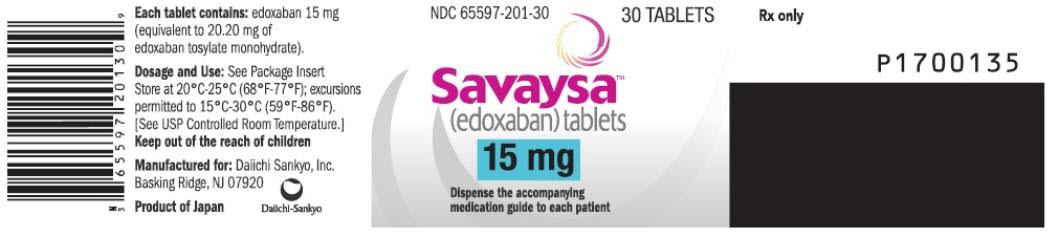
SAVAYSA EDOXABAN TOSYLATE 15 mg Tablet, Film Coated, 7-count
🆔 Identity & classification
Where does this data come from?
🏷️ RxNorm drug class
This medicine belongs to the Factor Xa Inhibitor class.
Where does this data come from?
🏭 Manufacturer & labeler
Where does this data come from?
🩺 Clinical
Edoxaban is used to: prevent strokes or blood clots in certain people who have atrial fibrillation (a condition where the heart beats irregularly and can lead to clots and stroke). treat deep vein thrombosis (DVT; a blood clot, usually in the leg) and pulmonary embolism (PE; a blood clot in the lung). Edoxaban is in a class of medications called factor Xa inhibitors. It works by blocking a natural substance that helps blood clots to form.
Read the full MedlinePlus article ↗- It depends on why your doctor prescribed it. If you have atrial fibrillation (an irregular heartbeat), Savaysa lowers your risk of having a stroke caused by a blood clot. If you've...
- What exactly is Savaysa supposed to do for me?
- It doesn't matter — you can take Savaysa with or without food, whichever is easier for you. What does matter is trying to take it at the same time each day. If you miss a dose, tak...
- Do I need to take this with food, or does it matter?
Patient education
Supplement & herbal interactions
Where does this data come from?
Ask a licensed pharmacist directly — free, answered by our team.
💊 What it looks like
Where does this data come from?
🧪 Inactive Ingredients / Excipients
Inactive ingredients, also called excipients, are components of the drug product other than the active ingredient. They may include fillers, dyes, coatings, preservatives, flavors, or other formulation ingredients.
Where does this data come from?
IACT rows and label-wide narrative are kept separate; availability and product-level specificity depend on the submitted label.Inactive ingredient FAQ
Are inactive ingredients the same for every manufacturer?
Why might an inactive ingredient be missing?
Can inactive ingredients matter?
💲 Pricing
A drug doesn't have one price. Each row is a different public payment system, and none is what you'd pay at the counter — that depends on your insurance. The ⓘ on each row explains what it measures.
| Price system | Per each | Per package |
|---|---|---|
| Retail pharmacies payNADAC · weekly | Not in the retail survey — common for institutional, discontinued, or low-volume packs. | |
| Medicaid paysCMS SDUD · 12 mo | No recent Medicaid claims on file for this NDC — rare and low-volume NDCs are suppressed in the public data. | |
| Medicare drug plans payPart D · quarterly | No Part D plan price is available for this NDC in our data. | |
Where does this data come from?
🔁 Therapeutic equivalents
| Product | Labeler | Pack | NADAC/unit | TE | Status | Price vs. this |
|---|---|---|---|---|---|---|
| Savaysa 15 mgthis 65597-0201-07 | Daiichi | 7 tablets | — | — | FDA listed | — |
Where does this data come from?
⏳ Availability & generic status
We did not find an FDA-approved generic match for this exact strength, form and route. Patent/protection dates below may affect future generic timing.
Why the date isn’t exact: Generic timing can change because patents may be challenged, settled, licensed, added, removed, or worked around with a narrower label — and FDA approval does not always mean a pharmacy can get the generic today.
🛈 What do these terms mean?
- Patent
- Legal protection listed in the Orange Book that may delay generic approval or launch. Issued by the U.S. Patent & Trademark Office.
- Substance patent
- Covers the active drug molecule itself — the hardest to design around. A generic generally can’t launch until it expires.
- Formulation (product) patent
- Covers a specific formulation or dosage form. A generic can sometimes work around it with a different formulation.
- Method-of-use patent
- A patent covering one specific approved use of the drug — not necessarily the whole molecule. A generic can sometimes launch with a “skinny label” that carves out the protected use and keeps the others.
- Skinny label
- A generic label that omits a still-patented use when the FDA allows it — letting a generic reach the market for the unprotected uses.
- Exclusivity
- FDA-granted marketing protection, separate from patents — e.g. 5-yr new chemical entity, 7-yr orphan drug, or a +6-month pediatric extension.
- Paragraph IV
- A generic applicant’s formal challenge to a listed patent. It can potentially lead to earlier generic entry, but often involves litigation or a settlement.
- RLD / RS
- Reference Listed Drug — the brand product the FDA uses as the reference for generic applications. Reference Standard — the product the FDA expects generics to compare against in bioequivalence testing.
- TE / AB rating
- FDA therapeutic-equivalence rating. An AB rating generally means the FDA considers a generic therapeutically equivalent to — and substitutable for — the brand.
- LOE (loss of exclusivity)
- The latest patent or exclusivity currently listed — the loss-of-exclusivity / latest-listed-protection date shown on this page. Paragraph-IV challenges and settlements can move the real date earlier; FDA approval and a manufacturer’s decision to market can move it later.
Built from the FDA Orange Book. The bars above are scaled to each protection’s expiry; the red LOE marker is the last one to lapse.
| Patent | Type | Use code | Expires |
|---|---|---|---|
| US 9149532 ↗ | Drug product | — | Mar 28, 2028 |
| US 9149532 ↗ | Drug product | — | Mar 28, 2028 |
| US 7365205 ↗ | Drug substance | — | Apr 18, 2027 |
| US 7365205 ↗ | Drug substance | — | Apr 18, 2027 |
| US 9149532 ↗ | Drug product | — | Mar 28, 2028 |
| US 7365205 ↗ | Drug substance | — | Apr 18, 2027 |
| Code | What it grants | Expires |
|---|---|---|
| M-14 | New indication / labeling change (3-year) | Oct 18, 2026 |
| M-14 | New indication / labeling change (3-year) | Oct 18, 2026 |
| M-14 | New indication / labeling change (3-year) | Oct 18, 2026 |
Is there a generic version of SAVAYSA 15 MG TABLET?
The FDA approved a generic — why can’t I get it at my pharmacy yet?
Why do different websites show different generic release dates?
What does “FDA listed” mean?
What does a patent or protection date mean here?
What does “current Orange Book estimate” mean?
Can a generic come out before the last patent expires?
Can a generic come out after the listed dates?
What is the difference between patents and exclusivity?
Why are there multiple patent dates?
Where does this data come from?
📊 Medicare Part D spend CMS · PART D · 2026 (Q1)
🔬 Reported adverse events (FAERS)
Top reported reactions
Age at onset
Reporter sex
Where does this data come from?
📦 Packaging — all sizes for this product
| Package NDC | Description | Marketing start | Status |
|---|---|---|---|
| 65597-0201-07 You're viewing this | 7 TABLET, FILM COATED in 1 BOTTLE (65597-201-07) | 2015-01-31 | Active |
| 65597-0201-10 | 10 TABLET, FILM COATED in 1 BLISTER PACK (65597-201-10) | 2015-01-31 | Active |
| 65597-0201-30 | 30 TABLET, FILM COATED in 1 BOTTLE (65597-201-30) | 2015-01-31 | Active |
| 65597-0201-50 | 500 TABLET, FILM COATED in 1 BOTTLE (65597-201-50) | 2015-01-31 | Active |
| 65597-0201-70 | 7 TABLET, FILM COATED in 1 BLISTER PACK (65597-201-70) | 2015-01-31 | Active |
| 65597-0201-90 | 90 TABLET, FILM COATED in 1 BOTTLE (65597-201-90) | 2015-01-31 | Active |
Pack size FAQ
What quantity is in NDC 65597-0201-07?
What is the difference between NDC 65597-0201-07 and NDC 65597-0201-70?
What NDC number is used to bill for this package of SAVAYSA EDOXABAN TOSYLATE 15 mg Tablet, Film Coated?
🧭 About this NDC listing & data coverage
What data is (and isn’t) available for this NDC — tap to expand
| NDC identity (package / product / labeler codes) | ✓ Available |
| Labeler | ✓ Available |
| Product & package description | ✓ Available |
| Marketing category & status | ✓ Available |
| Active ingredient / dosage form / route | ✓ Available |
| FDA label (SPL via DailyMed) | ✓ Available |
| Package photos | ✓ Available |
| Inactive ingredients (structured) | — Not published for this NDC The labeler did not submit a structured excipient list, or no SPL is available. |
| NADAC pharmacy acquisition price (CMS) | — Not published for this NDC CMS publishes NADAC only for NDCs reported in its retail-pharmacy survey. |
| Orange Book / therapeutic-equivalence data | ✓ Available |
| HCPCS J-code billing crosswalk | — Not published for this NDC Most self-administered / retail products have no J-code — that is normal. |
| Medicaid utilization (CMS SDUD) | — Not published for this NDC CMS reports utilization only for NDCs with Medicaid claims above its privacy threshold. |
Questions about this listing
Why is there no price listed?
Is the NDC printed on the package the same as the 11-digit billing NDC?
What do the three segments of this NDC mean?
Is this package still being marketed?
Does this product come in other package sizes?
Who lists this product with the FDA?
Do I need a prescription for this product?
Where does this data come from?
📄 Full prescribing information FDA SPL
🚨 Boxed Warning ▾
WARNING: (A) REDUCED EFFICACY IN NONVALVULAR ATRIAL FIBRILLATION PATIENTS WITH CREATININE CLEARANCE (CRCL) > 95 ML/MIN (B) PREMATURE DISCONTINUATION OF SAVAYSA INCREASES THE RISK OF ISCHEMIC EVENTS (C) SPINAL/EPIDURAL HEMATOMA WARNING: (A) REDUCED EFFICACY IN NONVALVULAR ATRIAL FIBRILLATION PATIENTS WITH CREATININE CLEARANCE (CRCL) > 95 ML/MIN (B) PREMATURE DISCONTINUATION OF SAVAYSA INCREASES THE RISK OF ISCHEMIC EVENTS (C) SPINAL/EPIDURAL HEMATOMA See full prescribing information for complete boxed warning. (A) REDUCED EFFICACY IN NONVALVULAR ATRIAL FIBRILLATION PATIENTS WITH CRCL > 95 ML/MIN: SAVAYSA should not be used in patients with CrCL > 95 mL/min.
In the ENGAGE AF-TIMI 48 study, nonvalvular atrial fibrillation patients with CrCL > 95 mL/min had an increased rate of ischemic stroke with SAVAYSA 60 mg once daily compared to patients treated with warfarin. In these patients another anticoagulant should be used ( 5.1 ). (B) PREMATURE DISCONTINUATION OF SAVAYSA INCREASES THE RISK OF ISCHEMIC EVENTS: Premature discontinuation of any oral anticoagulant in the absence of adequate alternative anticoagulation increases the risk of ischemic events.
If SAVAYSA is discontinued for a reason other than pathological bleeding or completion of a course of therapy, consider coverage with another anticoagulant as described in the transition guidance ( 2.4 , 5.2 , 14 ). (C) SPINAL/EPIDURAL HEMATOMA: Epidural or spinal hematomas may occur in patients treated with SAVAYSA who are receiving neuraxial anesthesia or undergoing spinal puncture. These hematomas may result in long-term or permanent paralysis.
Consider these risks when scheduling patients for spinal procedures ( 5.4 ). A. REDUCED EFFICACY IN NONVALVULAR ATRIAL FIBRILLATION PATIENTS WITH CRCL > 95 ML/MIN SAVAYSA should not be used in patients with CrCL > 95 mL/min.
In the ENGAGE AF-TIMI 48 study, nonvalvular atrial fibrillation patients with CrCL > 95 mL/min had an increased rate of ischemic stroke with SAVAYSA 60 mg once daily compared to patients treated with warfarin. In these patients another anticoagulant should be used [see Dosage and Administration (2.1) , Warnings and Precautions (5.1) , and Clinical Studies (14.1) ] . B.
PREMATURE DISCONTINUATION OF SAVAYSA INCREASES THE RISK OF ISCHEMIC EVENTS Premature discontinuation of any oral anticoagulant in the absence of adequate alternative anticoagulation increases the risk of ischemic events. If SAVAYSA is discontinued for a reason other than pathological bleeding or completion of a course of therapy, consider coverage with another anticoagulant as described in the transition guidance [see Dosage and Administration (2.4) , Warnings and Precautions (5.2) , and Clinical Studies (14.1) ] . C.
SPINAL/EPIDURAL HEMATOMA Epidural or spinal hematomas may occur in patients treated with SAVAYSA who are receiving neuraxial anesthesia or undergoing spinal puncture. These hematomas may result in long-term or permanent paralysis. Consider these risks when scheduling patients for spinal procedures.
Factors that can increase the risk of developing epidural or spinal hematomas in these patients include: use of indwelling epidural catheters concomitant use of other drugs that affect hemostasis, such as nonsteroidal anti-inflammatory drugs (NSAIDs), platelet inhibitors, other anticoagulants a history of traumatic or repeated epidural or spinal punctures a history of spinal deformity or spinal surgery optimal timing between the administration of SAVAYSA and neuraxial procedures is not known [see Warnings and Precautions (5.4) ] .
Monitor patients frequently for signs and symptoms of neurological impairment. If neurological compromise is noted, urgent treatment is necessary [see Warnings and Precautions (5.4) ] . Consider the benefits and risks before neuraxial intervention in patients anticoagulated or to be anticoagulated [see Warnings and Precautions (5.4) ] .
🎯 Indications and Usage ▾
1 INDICATIONS AND USAGE SAVAYSA is a factor Xa inhibitor indicated: To reduce the risk of stroke and systemic embolism (SE) in patients with nonvalvular atrial fibrillation (NVAF) ( 1.1 ) Limitation of Use for NVAF SAVAYSA should not be used in patients with creatinine clearance (CrCL) > 95 mL/min because of increased risk of ischemic stroke compared to warfarin at the highest dose studied (60 mg) ( 1.1 ) SAVAYSA is indicated for the treatment of deep vein thrombosis (DVT) and pulmonary embolism (PE) following 5 to 10 days of initial therapy with a parenteral anticoagulant ( 1.2 )
1.1Reduction in the Risk of Stroke and Systemic Embolism in Nonvalvular Atrial Fibrillation SAVAYSA is indicated to reduce the risk of stroke and systemic embolism (SE) in patients with nonvalvular atrial fibrillation (NVAF). Limitation of Use for NVAF SAVAYSA should not be used in patients with CrCL > 95 mL/min because of an increased risk of ischemic stroke compared to warfarin [see Dosage and Administration (2.1) , Warnings and Precautions (5.1) and Clinical Studies (14.1) ] .
1.2Treatment of Deep Vein Thrombosis and Pulmonary Embolism SAVAYSA is indicated for the treatment of deep vein thrombosis (DVT) and pulmonary embolism (PE) following 5 to 10 days of initial therapy with a parenteral anticoagulant.
⏱️ Dosage and Administration ▾
2 DOSAGE AND ADMINISTRATION Treatment of NVAF: Assess CrCL before initiating therapy ( 2.1 ) The recommended dose is 60 mg once daily in patients with CrCL >50 to ≤ 95 mL/min. Do not use SAVAYSA in patients with CrCL > 95 mL/min ( 2.1 ) Reduce dose to 30 mg once daily in patients with creatinine clearance 15 to 50 mL/min ( 2.1 ) Treatment of DVT and PE: The recommended dose is 60 mg once daily ( 2.2 ) Reduce dose to 30 mg once daily for patients with CrCL 15 to 50 mL/min or body weight less than or equal to 60 kg or who use certain P-gp inhibitors ( 2.2 )
2.1Nonvalvular Atrial Fibrillation The recommended dose of SAVAYSA is 60 mg taken orally once daily [see Warnings and Precautions (5.1) and Clinical Studies (14.1) ] . Assess creatinine clearance, as calculated using the Cockcroft-Gault equation Cockcroft-Gault CrCL = (140-age) × (weight in kg) × (0.85 if female) / (72 × creatinine in mg/dL). , before initiating therapy with SAVAYSA. Do not use SAVAYSA in patients with CrCL > 95 mL/min.
Reduce SAVAYSA dose to 30 mg once daily in patients with CrCL 15 to 50 mL/min [see Use in Specific Populations (8.6) , and Clinical Pharmacology (12.3) ] .
2.2Treatment of Deep Vein Thrombosis and Pulmonary Embolism The recommended dose of SAVAYSA is 60 mg taken orally once daily following 5 to 10 days of initial therapy with a parenteral anticoagulant [see Clinical Studies (14.2) ] . Reduce SAVAYSA dose to 30 mg once daily in patients with CrCL 15 to 50 mL/min, patients who weigh less than or equal to 60 kg, or patients who are taking certain concomitant P-gp inhibitor medications [see Clinical Studies (14.2) ] .
2.3Administration Information If a dose of SAVAYSA is missed, the dose should be taken as soon as possible on the same day. Dosing should resume the next day according to the normal dosing schedule. The dose should not be doubled to make up for a missed dose. SAVAYSA can be taken without regard to food [see Clinical Pharmacology (12.3) ] .
2.4Transition to or from SAVAYSA Transition to SAVAYSA From To Recommendation Warfarin or other Vitamin K Antagonists SAVAYSA Discontinue warfarin and start SAVAYSA when the INR is ≤
2.5Oral anticoagulants other than warfarin or other Vitamin K Antagonists SAVAYSA Discontinue current oral anticoagulant and start SAVAYSA at the time of the next scheduled dose of the other oral anticoagulant Low Molecular Weight Heparin (LMWH) SAVAYSA Discontinue LMWH and start SAVAYSA at the time of the next scheduled administration of LMWH Unfractionated heparin SAVAYSA Discontinue the infusion and start SAVAYSA 4 hours later Transition from SAVAYSA From To Recommendation Abbreviations: INR=International Normalized Ratio SAVAYSA Warfarin Oral option : For patients taking 60 mg of SAVAYSA, reduce the dose to 30 mg and begin warfarin concomitantly.
For patients receiving 30 mg of SAVAYSA, reduce the dose to 15 mg and begin warfarin concomitantly. INR must be measured at least weekly and just prior to the daily dose of SAVAYSA to minimize the influence of SAVAYSA on INR measurements. Once a stable INR ≥ 2.0 is achieved, SAVAYSA should be discontinued and the warfarin continued SAVAYSA Warfarin Parenteral option : Discontinue SAVAYSA and administer a parenteral anticoagulant and warfarin at the time of the next scheduled SAVAYSA dose.
Once a stable INR ≥ 2.0 is achieved the parenteral anticoagulant should be discontinued and the warfarin continued SAVAYSA Non-Vitamin-K-Dependent Oral anticoagulants Discontinue SAVAYSA and start the other oral anticoagulant at the time of the next dose of SAVAYSA SAVAYSA Parenteral anticoagulants Discontinue SAVAYSA and start the parenteral anticoagulant at the time of the next dose of SAVAYSA
2.5Discontinuation for Surgery and Other Interventions Discontinue SAVAYSA at least 24 hours before invasive or surgical procedures because of the risk of bleeding [see Warnings and Precautions (5.3) ] . If surgery cannot be delayed, there is an increased risk of bleeding. This risk of bleed…
💊 Dosage Forms and Strengths ▾
3 DOSAGE FORMS AND STRENGTHS 60 mg, yellow round shaped, film-coated tablets, debossed with DSC L60 on one side 30 mg, pink round shaped, film-coated tablets, debossed with DSC L30 on one side 15 mg, orange round shaped, film-coated tablets, debossed with DSC L15 on one side Tablets: 60 mg, 30 mg, and 15 mg ( 3 )
⛔ Contraindications ▾
4 CONTRAINDICATIONS SAVAYSA is contraindicated in patients with: Active pathological bleeding [see Warnings and Precautions (5.3) and Adverse Reactions (6.1) ] . Active pathological bleeding ( 4 )
⚠️ Warnings and Cautions ▾
5 WARNINGS AND PRECAUTIONS Bleeding: Serious and potentially fatal bleeding. Promptly evaluate signs and symptoms of blood loss ( 5.3 ) Mechanical Heart Valves or Moderate to Severe Mitral Stenosis: Use is not recommended ( 5.5 ) Increased Risk of Thrombosis in Patients with Triple Positive Antiphospholipid Syndrome: SAVAYSA use not recommended. ( 5.6 )
5.1Reduced Efficacy in Nonvalvular Atrial Fibrillation Patients with CrCL > 95 mL/min SAVAYSA should not be used in patients with CrCL > 95 mL/min. In the randomized ENGAGE AF-TIMI 48 study, NVAF patients with CrCL > 95 mL/min had an increased rate of ischemic stroke with SAVAYSA 60 mg daily compared to patients treated with warfarin. In these patients another anticoagulant should be used [see Dosage and Administration (2.1) and Clinical Studies (14.1) ] .
5.2Increased Risk of Stroke with Discontinuation of SAVAYSA in Patients with Nonvalvular Atrial Fibrillation Premature discontinuation of any oral anticoagulant in the absence of adequate alternative anticoagulation increases the risk of ischemic events. If SAVAYSA is discontinued for a reason other than pathological bleeding or completion of a course of therapy, consider coverage with another anticoagulant as described in the transition guidance [see Dosage and Administration (2.4) and Clinical Studies (14.1) ] .
5.3Risk of Bleeding SAVAYSA increases the risk of bleeding and can cause serious and potentially fatal bleeding. Promptly evaluate any signs or symptoms of blood loss. Discontinue SAVAYSA in patients with active pathological bleeding.
Concomitant use of drugs affecting hemostasis may increase the risk of bleeding. These include aspirin and other antiplatelet agents, other antithrombotic agents, fibrinolytic therapy, chronic use of nonsteroidal anti-inflammatory drugs (NSAIDs), selective serotonin reuptake inhibitors (SSRIs) and serotonin norepinephrine reuptake inhibitors (SNRIs) [see Drug Interactions (7.1) ] . Reversal of Anticoagulant Effect There is no established way to reverse the anticoagulant effects of SAVAYSA, which can be expected to persist for approximately 24 hours after the last dose.
The anticoagulant effect of SAVAYSA cannot be reliably monitored with standard laboratory testing. A specific reversal agent for edoxaban is not available. Hemodialysis does not significantly contribute to edoxaban clearance [see Clinical Pharmacology (12.3) ] .
Protamine sulfate, vitamin K, and tranexamic acid are not expected to reverse the anticoagulant activity of SAVAYSA. The use of prothrombin complex concentrates (PCC), or other procoagulant reversal agents such as activated prothrombin complex concentrate (APCC) or recombinant factor VIIa (rFVIIa) may be considered but has not been evaluated in clinical outcome studies [see Clinical Pharmacology (12.2) ] . When PCCs are used, monitoring for anticoagulation effect of edoxaban using clotting test (PT, INR, or aPTT) or anti-FXa activity is not useful and is not recommended.
5.4Spinal/Epidural Anesthesia or Puncture When neuraxial anesthesia (spinal/epidural anesthesia) or spinal/epidural puncture is employed, patients treated with antithrombotic agents for prevention of thromboembolic complications are at risk of developing an epidural or spinal hematoma, which can result in long-term or permanent paralysis. The risk of these events may be increased by the postoperative use of indwelling epidural catheters or the concomitant use of medicinal products affecting hemostasis. Indwelling epidural or intrathecal catheters should not be removed earlier than 12 hours after the last administration of SAVAYSA.
The next dose of SAVAYSA should not be administered earlier than 2 hours after the removal of the catheter. The risk may also be increased by traumatic or repeated epidural or spinal puncture. Monitor patients frequently for signs and symptoms of neurological impairment (e.g., numbness or weakness of the legs, bowel, or bladder dysfunction).
If neurological compromi…
🤒 Adverse Reactions ▾
6 ADVERSE REACTIONS The following clinically significant adverse reactions are discussed in greater detail in other sections of the prescribing information. Increased Risk of Stroke with Discontinuation of SAVAYSA in Patients with Nonvalvular Atrial Fibrillation [see Warnings and Precautions (5.2) ] Risk of Bleeding [see Warnings and Precautions (5.3) ] Spinal/Epidural Anesthesia or Puncture [see Warnings and Precautions (5.4) ] Treatment of NVAF : The most common adverse reactions (≥ 5%) are bleeding and anemia ( 6.1 ) Treatment of DVT and PE : The most common adverse reactions (≥ 1%) are bleeding, rash, abnormal liver function tests and anemia ( 6.1 ) To report SUSPECTED ADVERSE REACTIONS, contact Daiichi Sankyo, Inc. at 1-877-437-7763 or FDA at 1-800-FDA-1088 or www.fda.gov/medwatch.
6.1Clinical Trials Experience Because clinical trials are conducted under widely varying conditions, adverse reaction rates observed in the clinical trials of a drug cannot be directly compared to rates in the clinical trials of another drug and may not reflect the rates observed in practice. The safety of SAVAYSA was evaluated in the ENGAGE AF-TIMI 48, Hokusai VTE, and Hokusai VTE Cancer studies including 11,530 patients exposed to SAVAYSA 60 mg and 7124 patients exposed to SAVAYSA 30 mg once daily [see Clinical Studies (14) ] .
The ENGAGE AF-TIMI 48 Study In the ENGAGE AF-TIMI 48 study, the median study drug exposure for the SAVAYSA and warfarin treatment groups was 2.5 years. Bleeding was the most common reason for treatment discontinuation. Bleeding led to treatment discontinuation in 3.9% and 4.1% of patients in the SAVAYSA 60 mg and warfarin treatment groups, respectively.
In the overall population, major bleeding was lower in the SAVAYSA group compared to the warfarin group [HR 0.80 (0.70, 0.91), p < 0.001]. Table 6.1 shows major bleeding events (percentage of patients with at least one bleeding event, per year) for the indicated population (CrCL ≤ 95 mL/min). Table 6.1: Adjudicated Bleeding Events for NVAF Patients with CrCL ≤ 95 mL/min The on-treatment period is during treatment or within 2 days of stopping study treatment.
The difference in hemorrhagic stroke rate from Table 14.1 is because Table 14.1 includes events occurring during treatment or within 3 days of stopping study treatment and this table only includes patients with CrCL ≤ 95 mL/min. Event A subject can be included in multiple sub-categories if he/she had an event for those categories. SAVAYSA 60 mg Includes all patients with CrCL ≤ 95 mL/min randomized to receive 60 mg once daily, including those who were dose-reduced to 30 mg once daily because of prespecified baseline conditions.
N = 5417 n (%/year) Warfarin N = 5485 n (%/year) SAVAYSA 60 mg vs. Warfarin HR (95% CI) Abbreviations: HR = Hazard Ratio versus Warfarin, CI = Confidence Interval, n = number of patients with events, N = number of patients in Safety population, Major Bleeding A major bleeding event (the study primary safety endpoint) was defined as clinically overt bleeding that met one of the following criteria: fatal bleeding; symptomatic bleeding in a critical site such as retroperitoneal, intracranial, intraocular, intraspinal, intra-articular, pericardial, or intramuscular with compartment syndrome; a clinically overt bleeding event that caused a fall in hemoglobin of at least 2.0 g/dL (or a fall in hematocrit of at least 6.0% in the absence of hemoglobin data), when adjusted for transfusions (1 unit of transfusion = 1.0 g/dL drop in hemoglobin).
357 (3.1) 431 (3.7) 0.84 (0.73, 0.97) Intracranial Hemorrhage (ICH) ICH includes primary hemorrhagic stroke, subarachnoid hemorrhage, epidural/subdural hemorrhage, and ischemic stroke with major hemorrhagic conversion. 53 (0.5) 122 (1.0) 0.44 (0.32, 0.61) Hemorrhagic Stroke 33 (0.3) 69 (0.6) 0.49 (0.32, 0.74) Other ICH 20 (0.2) 55 (0.5) 0.37 (0.22, 0.62) Gastrointestinal Gastrointestinal (GI) bleeds include bleeding from upper and lower GI tract. Lower GI tract…
🔄 Drug Interactions ▾
7 DRUG INTERACTIONS Anticoagulants, Antiplatelets, Thrombolytics, and Selective Serotonin Reuptake Inhibitors (SSRIs)/Serotonin Norepinephrine Reuptake Inhibitors (SNRIs): Avoid concomitant use due to increased risk of bleeding. ( 7.1 ) Rifampin: Avoid concomitant use ( 7.2 )
7.1Anticoagulants, Antiplatelets, Thrombolytics, and SSRIs/SNRIs Co-administration of anticoagulants, antiplatelet drugs, thrombolytics and SSRIs or SNRIs may increase the risk of bleeding. Promptly evaluate any signs or symptoms of blood loss if patients are treated concomitantly with anticoagulants, aspirin, other platelet aggregation inhibitors, and/or NSAIDs [see Warnings and Precautions (5.3) ] . Long-term concomitant treatment with SAVAYSA and other anticoagulants is not recommended because of increased risk of bleeding [see Warnings and Precautions (5.3) ] .
Short term co-administration may be needed for patients transitioning to or from SAVAYSA [see Dosage and Administration (2.4) ] . In clinical studies with SAVAYSA concomitant use of aspirin (low dose ≤ 100 mg/day) or thienopyridines, and NSAIDs was permitted and resulted in increased rates of Clinically Relevant Bleeding. Carefully monitor for bleeding in patients who require chronic treatment with low dose aspirin and/or NSAIDs [see Warnings and Precautions (5.3) and Clinical Pharmacology (12.3) ] .
As with other anticoagulants the possibility may exist that patients are at an increased risk of bleeding in case of concomitant use with SSRIs or SNRIs due to their reported effect on platelets [see Warnings and Precautions (5.3) ].
7.2P-gp Inducers Avoid the concomitant use of SAVAYSA with rifampin [see Clinical Pharmacology (12.3) ] .
7.3P-gp Inhibitors Treatment of NVAF Based on clinical experience from the ENGAGE AF-TIMI 48 study, dose reduction in patients concomitantly receiving P-gp inhibitors resulted in edoxaban blood levels that were lower than in patients who were given the full dose. Consequently, no dose reduction is recommended for concomitant P-gp inhibitor use [see Dosage and Administration (2.1) , Clinical Pharmacology (12.3) , and Clinical Studies (14.1) ] . Treatment of Deep Vein Thrombosis and Pulmonary Embolism [see Clinical Studies (14.2) ]
👥 Use in Specific Populations ▾
8 USE IN SPECIFIC POPULATIONS Lactation: Advise not to breastfeed. ( 8.2 ) Impaired renal function (CrCL 15 to 50 mL/min): Reduce dose ( 2.1 , 2.2 , 8.6 ) Moderate or severe hepatic impairment: Not recommended ( 8.7 )
8.1Pregnancy Risk Summary Available data about SAVAYSA use in pregnant women are insufficient to determine whether there are drug-associated risks for adverse developmental outcomes. In animal developmental studies, no adverse developmental effects were seen when edoxaban was administered orally to pregnant rats and rabbits during organogenesis at up to 16-times and 8-times, respectively, the human exposure, when based on body surface area and AUC, respectively (see Data ) . The estimated background risk of major birth defects and miscarriage for the indicated population is unknown.
All pregnancies have a background risk of birth defect, loss, or other adverse outcomes. In the U.S. general population, the estimated background risk of major birth defects and miscarriage in clinically recognized pregnancies is 2-4% and 15-20%, respectively. Clinical Considerations Disease-associated maternal and/or embryo/fetal risk Pregnancy confers an increased risk of thromboembolism that is higher for women with underlying thromboembolic disease and certain high-risk pregnancy conditions.
Published data describe that women with a previous history of venous thrombosis are at high risk for recurrence during pregnancy. Fetal/Neonatal adverse reactions Use of anticoagulants, including edoxaban, may increase the risk of bleeding in the fetus and neonate. Monitor neonates for bleeding [see Warnings and Precautions (5.3) ] .
Labor or delivery All patients receiving anticoagulants, including pregnant women, are at risk for bleeding. SAVAYSA use during labor or delivery in women who are receiving neuraxial anesthesia may result in epidural or spinal hematomas. Consider use of a shorter acting anticoagulant as delivery approaches [see Warnings and Precautions (5.3) ] .
Data Animal Data Embryo-fetal development studies were conducted in pregnant rats and rabbits during the period of organogenesis. In rats, no malformation was seen when edoxaban was administered orally at doses up to 300 mg/kg/day, or 49 times the human dose of 60 mg/day normalized to body surface area. Increased post-implantation loss occurred at 300 mg/kg/day, but this effect may be secondary to the maternal vaginal hemorrhage seen at this dose.
In rabbits, no malformation was seen at doses up to 600 mg/kg/day (49 times the human exposure at a dose of 60 mg/day when based on AUC). Embryo-fetal toxicities occurred at maternally toxic doses, and included absent or small fetal gallbladder at 600 mg/kg/day, and increased post-implantation loss, increased spontaneous abortion, and decreased live fetuses and fetal weight at doses equal to or greater than 200 mg/kg/day, which is equal to or greater than 20 times the human exposure. In a rat pre- and post-natal developmental study, edoxaban was administered orally during the period of organogenesis and through lactation day 20 at doses up to 30 mg/kg/day, which is up to 3 times the human exposure when based on AUC.
Vaginal bleeding in pregnant rats and delayed avoidance response (a learning test) in female offspring were seen at 30 mg/kg/day.
8.2Lactation Risk Summary There are no data on the presence of edoxaban in human milk, or its effects on the breastfeeding infant or on milk production. Edoxaban was present in rat milk. Because of the potential for serious adverse reactions in nursing infants, including hemorrhage, advise patients that breastfeeding is not recommended during treatment with SAVAYSA.
8.3Females and Males of Reproductive Potential Females of reproductive potential requiring anticoagulation should discuss pregnancy planning with their physician. The risk of clinically significant uterine bleeding, potentially requiring gynecological surgical interventions, identified with oral anticoagulants including SAVAY…
🤰 Pregnancy ▾
8.1Pregnancy Risk Summary Available data about SAVAYSA use in pregnant women are insufficient to determine whether there are drug-associated risks for adverse developmental outcomes. In animal developmental studies, no adverse developmental effects were seen when edoxaban was administered orally to pregnant rats and rabbits during organogenesis at up to 16-times and 8-times, respectively, the human exposure, when based on body surface area and AUC, respectively (see Data ) . The estimated background risk of major birth defects and miscarriage for the indicated population is unknown.
All pregnancies have a background risk of birth defect, loss, or other adverse outcomes. In the U.S. general population, the estimated background risk of major birth defects and miscarriage in clinically recognized pregnancies is 2-4% and 15-20%, respectively. Clinical Considerations Disease-associated maternal and/or embryo/fetal risk Pregnancy confers an increased risk of thromboembolism that is higher for women with underlying thromboembolic disease and certain high-risk pregnancy conditions.
Published data describe that women with a previous history of venous thrombosis are at high risk for recurrence during pregnancy. Fetal/Neonatal adverse reactions Use of anticoagulants, including edoxaban, may increase the risk of bleeding in the fetus and neonate. Monitor neonates for bleeding [see Warnings and Precautions (5.3) ] .
Labor or delivery All patients receiving anticoagulants, including pregnant women, are at risk for bleeding. SAVAYSA use during labor or delivery in women who are receiving neuraxial anesthesia may result in epidural or spinal hematomas. Consider use of a shorter acting anticoagulant as delivery approaches [see Warnings and Precautions (5.3) ] .
Data Animal Data Embryo-fetal development studies were conducted in pregnant rats and rabbits during the period of organogenesis. In rats, no malformation was seen when edoxaban was administered orally at doses up to 300 mg/kg/day, or 49 times the human dose of 60 mg/day normalized to body surface area. Increased post-implantation loss occurred at 300 mg/kg/day, but this effect may be secondary to the maternal vaginal hemorrhage seen at this dose.
In rabbits, no malformation was seen at doses up to 600 mg/kg/day (49 times the human exposure at a dose of 60 mg/day when based on AUC). Embryo-fetal toxicities occurred at maternally toxic doses, and included absent or small fetal gallbladder at 600 mg/kg/day, and increased post-implantation loss, increased spontaneous abortion, and decreased live fetuses and fetal weight at doses equal to or greater than 200 mg/kg/day, which is equal to or greater than 20 times the human exposure. In a rat pre- and post-natal developmental study, edoxaban was administered orally during the period of organogenesis and through lactation day 20 at doses up to 30 mg/kg/day, which is up to 3 times the human exposure when based on AUC.
Vaginal bleeding in pregnant rats and delayed avoidance response (a learning test) in female offspring were seen at 30 mg/kg/day.
🧒 Pediatric Use ▾
8.4Pediatric Use The safety and effectiveness of SAVAYSA have not been established in pediatric patients with confirmed VTE (PE and/or DVT). Effectiveness was not demonstrated in an adequate and well-controlled study conducted in 145 SAVAYSA-treated pediatric patients, from birth to less than 18 years of age with confirmed VTE (PE and/or DVT), treated for 3 months up to a maximum of 12 months.
🧓 Geriatric Use ▾
8.5Geriatric Use Of the total patients in the ENGAGE AF-TIMI 48 study, 5182 (74%) were 65 years and older, while 2838 (41%) were 75 years and older. In Hokusai VTE, 1334 (32%) patients were 65 years and older, while 560 (14%) patients were 75 years and older. In the Hokusai VTE Cancer Study, 539 (52%) patients were 65 years and older and 176 (17%) were 75 years and older.
In clinical trials the efficacy and safety of SAVAYSA in elderly (65 years or older) and younger patients were similar [see Adverse Reactions (6.1) , Clinical Pharmacology (12.3) , and Clinical Studies (14) ] .
🆘 Overdosage ▾
10 OVERDOSAGE A specific reversal agent for edoxaban is not available. Overdose of SAVAYSA increases the risk of bleeding. The following are not expected to reverse the anticoagulant effects of edoxaban: protamine sulfate, vitamin K, and tranexamic acid [see Warnings and Precautions (5.3) ] . Hemodialysis does not significantly contribute to edoxaban clearance [see Clinical Pharmacology (12.3) ] .
🧬 Clinical Pharmacology ▾
12 CLINICAL PHARMACOLOGY
12.1Mechanism of Action Edoxaban is a selective inhibitor of FXa. It does not require antithrombin III for antithrombotic activity. Edoxaban inhibits free FXa, and prothrombinase activity and inhibits thrombin-induced platelet aggregation. Inhibition of FXa in the coagulation cascade reduces thrombin generation and reduces thrombus formation.
12.2Pharmacodynamics As a result of FXa inhibition, edoxaban prolongs clotting time tests such as prothrombin time (PT), and activated partial thromboplastin time (aPTT). Changes observed in PT, INR, and aPTT at the expected therapeutic dose, however, are small, subject to a high degree of variability and not useful in monitoring the anticoagulant effect of edoxaban. Following oral administration, peak pharmacodynamic effects are observed within 1-2 hours, which correspond with peak edoxaban concentrations (C max ).
Cardiac Electrophysiology In a thorough QT study in healthy men and women aged 19-45 years, no QTc interval prolongation was observed with edoxaban (90 mg and 180 mg). Effect of PCCs on Pharmacodynamics of SAVAYSA There is no systematic evaluation of bleeding reversal by 4-factor prothrombin complex concentrate (PCC) products in patients who have received SAVAYSA. Effects of PCC (50 IU/kg) on the pharmacodynamics of edoxaban were studied in healthy subjects following a punch biopsy.
Following administration of a single dose of edoxaban, endogenous thrombin potential (ETP) returned to pre-edoxaban baseline levels in 0.5 hours after the initiation of a 15-minute infusion of 50 IU/kg PCC, compared to more than 24 hours with placebo. Mean ETP levels continued to increase and exceeded pre-edoxaban baseline, reaching maximum elevations (~40% over pre-edoxaban levels) at 22 hours after initiating PCC dose, which was the last observation of ETP. The clinical relevance of this ETP increase is unknown.
Pharmacodynamic Interactions Aspirin Co-administration of aspirin (100 mg or 325 mg) and edoxaban increased bleeding time relative to that seen with either drug alone. NSAID (Naproxen) Co-administration of naproxen (500 mg) and edoxaban increased bleeding time relative to that seen with either drug alone.
12.3Pharmacokinetics Edoxaban displays approximately dose-proportional pharmacokinetics for doses of 15 to 150 mg and 60 to 120 mg following single and repeat doses, respectively, in healthy subjects. Absorption Following oral administration, peak plasma edoxaban concentrations are observed within 1-2 hours. Absolute bioavailability is 62%.
Food does not affect total systemic exposure to edoxaban. SAVAYSA was administered with or without food in the ENGAGE AF-TIMI 48 and Hokusai VTE trials. Administration of a crushed 60 mg tablet, either mixed into applesauce or suspended in water and given through a nasogastric tube, showed similar exposure compared to administration of an intact tablet.
Distribution Disposition is biphasic. The steady-state volume of distribution (Vd ss ) is 107 (19.9) L [mean (SD)]. In vitro plasma protein binding is approximately 55%.
There is no clinically relevant accumulation of edoxaban (accumulation ratio 1.14) with once daily dosing. Steady-state concentrations are achieved within 3 days. Metabolism Unchanged edoxaban is the predominant form in plasma.
There is minimal metabolism via hydrolysis (mediated by carboxylesterase 1), conjugation, and oxidation by CYP3A4. The predominant metabolite M-4, formed by hydrolysis, is human-specific and active and reaches less than 10% of the exposure of the parent compound in healthy subjects. Exposure to the other metabolites is less than 5% of exposure to edoxaban.
Elimination Edoxaban is eliminated primarily as unchanged drug in the urine. Renal clearance (11 L/hour) accounts for approximately 50% of the total clearance of edoxaban (22 L/hour). Metabolism and biliary/intestinal excretion account for the remaining clearance.
The terminal elimination half-life of edoxaban following oral adminis…
🧬 Mechanism of Action ▾
12.1Mechanism of Action Edoxaban is a selective inhibitor of FXa. It does not require antithrombin III for antithrombotic activity. Edoxaban inhibits free FXa, and prothrombinase activity and inhibits thrombin-induced platelet aggregation. Inhibition of FXa in the coagulation cascade reduces thrombin generation and reduces thrombus formation.
📦 How Supplied / Storage and Handling ▾
16 HOW SUPPLIED/STORAGE AND HANDLING SAVAYSA (edoxaban) is supplied as round shaped, film-coated, non-scored tablets containing edoxaban tosylate equivalent to 60, 30 or 15 mg of SAVAYSA, packaged in bottles and blisters. NDC 65597-xxx-yy Strength Color Deboss yy xxx Bottle of Blister of 30 90 500 10 × 10 10 blister cards of 10 counts 10 × 5 5 blister cards of 10 counts 15 mg orange DSC L15 201 30 - - - - 30 mg pink DSC L30 202 30 90 50 10 05 60 mg yellow DSC L60 203 30 90 50 10 05 Store at 20-25°C (68-77°F); excursions permitted to 15°-30°C (59°-86°F) [see USP Controlled Room Temperature] .
Keep out of the reach of children.
📦 Storage and Handling ▾
Store at 20-25°C (68-77°F); excursions permitted to 15°-30°C (59°-86°F) [see USP Controlled Room Temperature] . Keep out of the reach of children.
📋 Description ▾
11 DESCRIPTION Edoxaban, a factor Xa inhibitor, is supplied as edoxaban tosylate monohydrate. The chemical name is N- (5-Chloropyridin-2-yl)- N'- [(1 S ,2 R ,4 S )-4-( N,N- dimethylcarbamoyl)-2-(5-methyl-4,5,6,7-tetrahydro[1,3]thiazolo[5,4-c]pyridine-2-carboxamido)cyclohexyl] oxamide mono (4-methylbenzenesulfonate) monohydrate. Edoxaban tosylate monohydrate has the empirical formula C 24 H 30 ClN 7 O 4 S∙C 7 H 8 O 3 S∙H 2 O representing a molecular weight of 738.27.
The chemical structure of edoxaban tosylate monohydrate is: It is a white to pale yellowish-white crystalline powder. The solubility of edoxaban tosylate (pKa 6.7) decreases with increasing pH. It is slightly soluble in water, pH 3 to 5 buffer, very slightly soluble at pH 6 to 7; and practically insoluble at pH 8 to 9.
SAVAYSA is available for oral administration as a 60 mg, 30 mg, or 15 mg round shaped, film-coated tablet, debossed with product identification markings. Each 60 mg tablet contains 80.82 mg edoxaban tosylate monohydrate equivalent to 60 mg of edoxaban. Each 30 mg tablet contains 40.41 mg edoxaban tosylate monohydrate equivalent to 30 mg of edoxaban.
Each 15 mg tablet contains 20.20 mg edoxaban tosylate monohydrate equivalent to 15 mg of edoxaban. The inactive ingredients are: mannitol, pregelatinized starch, crospovidone, hydroxypropyl cellulose, magnesium stearate, talc, and carnauba wax. The color coatings contain hypromellose, titanium dioxide, talc, polyethylene glycol 8000, iron oxide yellow (60 mg tablets and 15 mg tablets), and iron oxide red (30 mg tablets and 15 mg tablets).
Chemical Structure
💬 Information for Patients ▾
17 PATIENT COUNSELING INFORMATION Advise the patient to read the FDA-approved patient labeling (Medication Guide). Advise patients of the following: Instructions for Patient Use Advise patients to take SAVAYSA exactly as prescribed. Remind patients to not discontinue SAVAYSA without talking to the healthcare provider who prescribed it.
Instruct patients to keep an adequate supply of tablets to ensure continuous dosing of SAVAYSA. Instruct patients who cannot swallow the tablet whole to crush SAVAYSA, combine with 2 to 3 ounces of water or applesauce and ingest immediately. Instruct patients who require a gastric tube to crush the SAVAYSA tablet and mix it with 2 to 3 ounces of water before administering immediately via the gastric feeding tube.
Inform patients that if a dose is missed, they should take SAVAYSA as soon as possible the same day, and resume the normal dosing schedule the following day. The dose should not be doubled to make up for a missing dose. Bleeding Risk Advise patients that they may bleed more easily, may bleed longer, or bruise more easily when treated with SAVAYSA.
Instruct patients to report any unusual bleeding immediately to their healthcare provider. For patients that are having neuraxial anesthesia or spinal puncture, advise patients to watch for signs and symptoms of spinal or epidural hematoma, such as back pain, tingling, numbness (especially in the lower limbs), muscle weakness, and stool or urine incontinence. If any of these symptoms occur, advise the patient to contact his or her physician immediately [see Boxed Warning ].
Invasive or Surgical Procedures Remind patients to inform their healthcare providers that they are taking SAVAYSA before any surgery, medical, or dental procedure is scheduled. Concomitant Medication and Herbals Remind patients to inform their healthcare providers and dentists if they plan to take, or are taking any prescription medications, over-the-counter drugs or herbal products. Pregnancy Remind patients to inform their healthcare provider immediately if they become pregnant or intend to become pregnant during treatment with SAVAYSA.
Inform patients to not breastfeed if they are taking SAVAYSA [see Use in Specific Populations (8.2) ].
💬 Medication Guide ▾
MEDICATION GUIDE SAVAYSA (sa vaye' sah) (edoxaban) tablets This Medication Guide has been approved by the U.S. Food and Drug Administration. Revised: 10/2023 What is the most important information I should know about SAVAYSA?
For people who take SAVAYSA for nonvalvular atrial fibrillation (a type of irregular heartbeat): People with nonvalvular atrial fibrillation are at an increased risk of forming a blood clot in the heart, which can travel to the brain, causing a stroke, or to other parts of the body. SAVAYSA reduces your risk of having a stroke by helping to prevent clots from forming. Your healthcare provider should check your kidney function before you start taking SAVAYSA.
People whose kidneys work really well should not receive SAVAYSA because it may not work well to prevent stroke. Do not stop taking SAVAYSA without first talking to the healthcare provider who prescribed it for you. Stopping SAVAYSA increases your risk of having a stroke.
SAVAYSA can cause bleeding which can be serious, and sometimes lead to death. This is because SAVAYSA is a blood thinner medicine that reduces blood clotting. During treatment with SAVAYSA, you may bleed more easily, bleed longer, or bruise more easily.
Call your healthcare provider or get medical help right away if you experience bleeding that is severe (for example, coughing up or vomiting blood) or bleeding that cannot be controlled. You may have a higher risk of bleeding if you take SAVAYSA and take other medicines that increase your risk of bleeding, including: aspirin or aspirin-containing products long-term (chronic) use of nonsteroidal anti-inflammatory drugs (NSAIDs) long-term (chronic) use of blood thinner medicines, such as: warfarin sodium (Coumadin, Jantoven) any medicine that contains heparin selective serotonin reuptake inhibitors (SSRIs) or serotonin norepinephrine reuptake inhibitors (SNRIs) other medicines to prevent or treat blood clots Tell your healthcare provider if you take any of these medicines.
Ask your healthcare provider or pharmacist if you are not sure if your medicine is one listed above. Spinal or epidural blood clots (hematoma). People who take a blood thinner medicine (anticoagulant) like SAVAYSA, and have medicine injected into their spinal and epidural area, or have a spinal puncture have a risk of forming a blood clot that can cause long-term or permanent loss of the ability to move (paralysis).
Your risk of developing a spinal or epidural blood clot is higher if: a thin tube called an epidural catheter is placed in your back to give you certain medicine you take NSAIDs or a medicine to prevent blood from clotting you have a history of difficult or repeated epidural or spinal punctures you have a history of problems with your spine or have had surgery on your spine. If you take SAVAYSA and receive spinal anesthesia or have a spinal puncture, your healthcare provider should watch you closely for symptoms of spinal or epidural blood clots.
Tell your healthcare provider right away if you have back pain, tingling, numbness (especially in your legs and feet), muscle weakness, or loss of control of the bowels or bladder (incontinence). SAVAYSA is not for people with mechanical heart valves or people who have moderate to severe narrowing (stenosis) of their mitral valve. SAVAYSA is not for use in people with antiphospholipid syndrome (APS), especially with positive triple antibody testing, who have a history of blood clots.
See " What are the possible side effects of SAVAYSA? " for more information about side effects. What is SAVAYSA? SAVAYSA is a prescription medicine used to: reduce the risk of stroke and blood clots in people who have atrial fibrillation not caused by a heart valve problem (nonvalvular atrial fibrillation). treat blood clots in the veins of your legs (deep vein thrombosis) or lungs (pulmonary embolism), after you have been treated with an injectable blood thinner medicine for 5 to 10 days.
It is not known if SAVAYSA is safe and effect…