
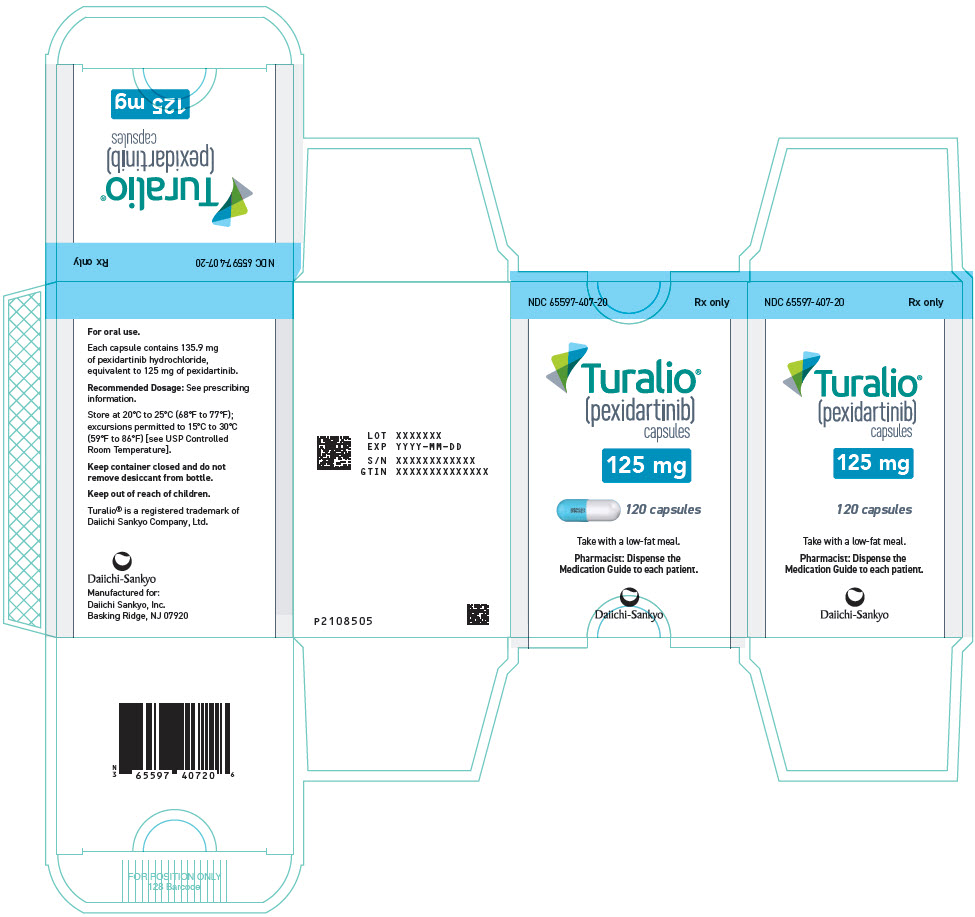
Turalio pexidartinib hydrochloride 125 mg Capsule, 120-count — NDC 65597-407-20 (Billing 65597-0407-20)
This is a package of 120 capsules of Turalio pexidartinib hydrochloride 125 mg Capsule from Daiichi Sankyo Inc., marketed since Feb 2023 and currently FDA-listed. It is the main listing for this product, which comes in 2 package sizes.
NDC database record
One package, one record: these facts belong to NDC 65597-407-20 alone.
- Record
- FDA NDC Directory package listing · Human prescription drug
- Code segments
- 65597 labeler · 407 product · 20 package
- Package marketed since
- Feb 1, 2023
- Sample package
- No — commercial package
- Listing certified through
- Dec 31, 2026
- Billing quantity
- 120 EA per package
- Barcode (UPC-A, from the NDC)
- 3 6559740720 6
- Medicaid fills, this package
- 157 prescriptions in the last four reported quarters
- FDA record last changed
- Jul 24, 2026
Identity & classification
Regulatory identifiers FDA, NLM and CMS codes for this package
Drug-database identifiers Medi-Span GPI and First Databank GCN / HICL / AHFS classification
- GSN (GCN sequence number): 084231
- GCN: 53437
- GPI-14 (Medi-Span): 21533045010110
- HICL (First Databank): 045912
- AHFS class code: 10:00.00.00
- RxCUI (RxNorm): 2626397
Where does this data come from?
- FDA openFDA NDC Directory · synced Oct 8, 2026
- FDA label on DailyMed · label index refreshed Oct 8, 2026
- RxNorm (NLM RxNav) · catalog refreshed Oct 8, 2026
- Medi-Span GPI (licensed)
- First Databank (licensed) · refreshed Oct 8, 2026
RxNorm drug class
This medicine belongs to the Kinase Inhibitor class.
Where does this data come from?
- RxClass (NLM) · catalog refreshed Oct 8, 2026
Clinical
Pexidartinib is used to treat a certain type of tenosynovial giant cell tumors (TGCT; tumors in or around a joint that can cause pain, swelling, and reduce movement). Pexidartinib is in a class of medications called kinase inhibitors. It works by blocking the action of an abnormal protein that may help the tumor to shrink.
Read the full MedlinePlus article ↗- It treats adults with symptomatic tenosynovial giant cell tumor, or TGCT, a tumor in the lining of a joint. It's used when the tumor causes severe problems and surgery can't improv...
- Swallow the capsules whole with a low-fat meal, twice a day. Please don't open, chew or break them. Avoid high-fat meals, since they raise drug levels and your liver risk. If you m...
- Serious liver injury, which can be fatal. That's why you'll have frequent blood tests, especially in the first few months. Call your doctor right away if you notice yellow skin or...
- Hair color changes, tiredness, rash, swelling around the eyes, and changes in taste are common. Nausea, vomiting and high blood pressure can also happen. Tell us about anything tha...
Patient education
Supplement & herbal interactions
Some supplements/herbs that may interact with Pexidartinib Hydrochloride — tap one for details:
Where does this data come from?
- MedlinePlus (NLM) · refreshed Oct 8, 2026
- FDA label on DailyMed · label index refreshed Oct 8, 2026
Ask a licensed pharmacist directly — free, answered by our team.
Pricing
A drug doesn't have one price. Each row is a different public payment system, and none is what you'd pay at the counter — that depends on your insurance. The ⓘ on each row explains what it measures.
| Price system | Per each | Per package |
|---|---|---|
| Retail pharmacies payNADAC · weekly | Not in the retail survey — common for institutional, discontinued, or low-volume packs. | |
| Medicaid paysCMS SDUD · 12 mo | $201.14 | $24,136.99 / 120 capsules |
| Medicare drug plans payPart D · Q2 2026 | $219.44 | $26,332.67 / 120 capsules |
Where does this data come from?
- CMS NADAC weekly file
- CMS ASP pricing files · refreshed Sep 20, 2026
- CMS Medicaid State Drug Utilization Data · through Q1 2026
- CMS Part D plan pricing files · refreshed Sep 24, 2026
- VA National Acquisition Center price file
Packaging — all sizes for this product
| Package NDC | Description | Marketing start | Marketing end | Status |
|---|---|---|---|---|
| 65597-0407-20 You're viewing this Main listing | 1 BOTTLE in 1 CARTON / 120 CAPSULE in 1 BOTTLE | 2023-02-01 | — | Active |
| 65597-0407-28 65597-407-28 | 1 BOTTLE in 1 CARTON / 28 CAPSULE in 1 BOTTLE | 2023-02-01 | — | Active |
In Medicaid, this is the most-dispensed pack of this product — about 100% of fills over the last four reported quarters. See all packs ↓
Pack size FAQ
What quantity is in this package?
How does this package differ from NDC 65597-0407-28?
What NDC number is used to bill for this package of Turalio pexidartinib hydrochloride 125 mg Capsule?
Therapeutic equivalents
| Product | Labeler | Pack | NADAC/unit | TE | Status | Price vs. this |
|---|---|---|---|---|---|---|
| Turalio 125 mgthis 65597-0407-20 | Daiichi | 120 capsules | — | — | FDA listed | — |
Where does this data come from?
- FDA openFDA NDC Directory · synced Oct 8, 2026
- FDA Orange Book · refreshed Oct 3, 2026
- CMS NADAC weekly file
Availability & generic status
We did not find an FDA-approved generic match for this exact strength, form and route. Patent/protection dates below may affect future generic timing.
Why the date isn’t exact: Generic timing can change because patents may be challenged, settled, licensed, added, removed, or worked around with a narrower label — and FDA approval does not always mean a pharmacy can get the generic today.
🛈 What do these terms mean?
- Patent
- Legal protection listed in the Orange Book that may delay generic approval or launch. Issued by the U.S. Patent & Trademark Office.
- Substance patent
- Covers the active drug molecule itself — the hardest to design around. A generic generally can’t launch until it expires.
- Formulation (product) patent
- Covers a specific formulation or dosage form. A generic can sometimes work around it with a different formulation.
- Method-of-use patent
- A patent covering one specific approved use of the drug — not necessarily the whole molecule. A generic can sometimes launch with a “skinny label” that carves out the protected use and keeps the others.
- Skinny label
- A generic label that omits a still-patented use when the FDA allows it — letting a generic reach the market for the unprotected uses.
- Exclusivity
- FDA-granted marketing protection, separate from patents — e.g. 5-yr new chemical entity, 7-yr orphan drug, or a +6-month pediatric extension.
- Paragraph IV
- A generic applicant’s formal challenge to a listed patent. It can potentially lead to earlier generic entry, but often involves litigation or a settlement.
- RLD / RS
- Reference Listed Drug — the brand product the FDA uses as the reference for generic applications. Reference Standard — the product the FDA expects generics to compare against in bioequivalence testing.
- TE / AB rating
- FDA therapeutic-equivalence rating. An AB rating generally means the FDA considers a generic therapeutically equivalent to — and substitutable for — the brand.
- LOE (loss of exclusivity)
- The latest patent or exclusivity currently listed — the loss-of-exclusivity / latest-listed-protection date shown on this page. Paragraph-IV challenges and settlements can move the real date earlier; FDA approval and a manufacturer’s decision to market can move it later.
Built from the FDA Orange Book. The bars above are scaled to each protection’s expiry; the red LOE marker is the last one to lapse.
| Patent | Type | Use code | Expires |
|---|---|---|---|
| US 9358235 ↗ | Method of use | U-2606 | Jun 8, 2033 |
| US 8461169 ↗ | Method of use | U-2606 | Apr 19, 2028 |
| US 10189833 ↗ | Method of use | U-2606 | May 5, 2036 |
| US 10961240 ↗ | Method of use | U-2606 | Jul 24, 2038 |
| US 10189833 ↗ | Method of use | U-2606 | May 5, 2036 |
| US 9358235 ↗ | Method of use | U-2606 | Jun 8, 2033 |
| US 8461169 ↗ | Method of use | U-2606 | Apr 19, 2028 |
| US 10961240 ↗ | Method of use | U-2606 | Jul 24, 2038 |
| US 8404700 ↗ | Drug substance | — | Nov 21, 2027 |
| US 10730876 ↗ | Drug substance | — | May 5, 2036 |
| US 7893075 ↗ | Drug substance | — | May 4, 2033 |
| US 8722702 ↗ | Drug substance | — | Nov 21, 2027 |
| US 10941142 ↗ | Drug product | — | Jul 24, 2038 |
| US 10435404 ↗ | Drug product | — | Jul 24, 2038 |
| US 10730876 ↗ | Drug substance | — | May 5, 2036 |
| US 9802932 ↗ | Drug substance | — | May 5, 2036 |
| US 8404700 ↗ | Drug substance | — | Nov 21, 2027 |
| US 10435404 ↗ | Drug product | — | Jul 24, 2038 |
| US 8722702 ↗ | Drug substance | — | Nov 21, 2027 |
| US 7893075 ↗ | Drug substance | — | May 4, 2033 |
| US 9169250 ↗ | Drug substance | — | Nov 21, 2027 |
| US 10941142 ↗ | Drug product | — | Jul 24, 2038 |
| US 9802932 ↗ | Drug substance | — | May 5, 2036 |
| US 9169250 ↗ | Drug substance | — | Nov 21, 2027 |
| Code | What it grants | Expires |
|---|---|---|
| ODE-250 | Orphan Drug Exclusivity (7-year) | Aug 2, 2026 |
| ODE* | Orphan Drug Exclusivity (7-year) | Aug 2, 2026 |
Is there a generic version of TURALIO 125 MG CAPSULE?
The FDA approved a generic — why can’t I get it at my pharmacy yet?
Why do different websites show different generic release dates?
What does “FDA listed” mean?
What does a patent or protection date mean here?
What does “current Orange Book estimate” mean?
Can a generic come out before the last patent expires?
Can a generic come out after the listed dates?
What is the difference between patents and exclusivity?
Why are there multiple patent dates?
Where does this data come from?
- FDA Orange Book · refreshed Oct 3, 2026
What it looks like
Where does this data come from?
- FDA label on DailyMed · label index refreshed Oct 8, 2026
Inactive Ingredients / Excipients
Inactive ingredients, also called excipients, are components of the drug product other than the active ingredient. They may include fillers, dyes, coatings, preservatives, flavors, or other formulation ingredients.
🧪 Avoiding an ingredient? See Pexidartinib inactive ingredients by manufacturer: every current product's list side by side, so you can ask your pharmacy for the version that does not list it.
💡 Tap an ingredient (hover on desktop) to see what it is and why it’s used.
-
UNII 2S7830E561
Crospovidone is a synthetic polymer derived from povidone. It acts as a disintegrant, helping the tablet or capsule break apart quickly in the stomach so the active ingredient can be absorbed.
-
UNII H3R47K3TBD
FD&C Blue No. 1 is a synthetic blue dye approved for use in foods and medicines. It serves as a colorant to give the medication its distinctive appearance and help with product identification.
-
UNII 3NXW29V3WO
Hypromellose is a plant-based thickener made from cellulose. It's used in medicines as a binder to hold ingredients together, a coating for tablets, and a thickener for liquids.
-
UNII 70097M6I30
Magnesium stearate is a salt made from magnesium and stearic acid, a fatty substance. It's used in tablets and capsules as a lubricant and glidant to help ingredients flow smoothly during manufacturing and prevent sticking.
-
UNII 3OWL53L36A
A natural sugar alcohol derived from seaweed or synthesized in the lab. It's used as a filler to add bulk, a sweetener in sugar-free formulas, and a disintegrant to help tablets break apart in the stomach.
-
UNII TUF2IVW3M2
Poloxamer 407 is a synthetic polymer made from ethylene oxide and propylene oxide. In medicines, it acts as a thickener, emulsifier, and solubilizer to help mix ingredients and create the right texture.
-
UNII 15FIX9V2JP
Titanium dioxide is a bright white mineral powder commonly used as a colorant and opacifying agent. It makes pills and tablets white or lighter in color and helps make coatings non-transparent.
7 inactive ingredients listed in the exact product block matched to this NDC.
Where does this data come from?
ingredient classCode="IACT" elements from the exact product block matched by this NDC. Label-section narrative from DailyMed / the openFDA label index is shown separately when available.- FDA label on DailyMed · label index refreshed Oct 8, 2026
- FDA openFDA NDC Directory · synced Oct 8, 2026
Inactive ingredient FAQ
Are inactive ingredients the same for every manufacturer?
Why might an inactive ingredient be missing?
Can inactive ingredients matter?
Manufacturer & labeler
More NDCs from Daiichi Sankyo Inc. labeler code 65597
- Savaysa Edoxaban Tosylate 15 mg Tablet, Film Coated NDC 65597-201-07
- Savaysa Edoxaban Tosylate 30 mg Tablet, Film Coated NDC 65597-202-05
- Savaysa Edoxaban Tosylate 60 mg Tablet, Film Coated NDC 65597-203-05
- Enhertu fam-trastuzumab deruxtecan-nxki 100 mg/5mL Injection, Powder, Lyophilized, For Solution NDC 65597-406-01
- Vanflyta Quizartinib 17.7 mg Tablet, Film Coated NDC 65597-504-04
- Vanflyta Quizartinib 26.5 mg Tablet, Film Coated NDC 65597-511-04
- DATROWAY Datopotamab Deruxtecan 100 mg/5mL Injection, Powder, Lyophilized, For Solution NDC 65597-801-01
Where does this data come from?
- FDA openFDA NDC Directory · synced Oct 8, 2026
- Drugs@FDA
Full prescribing information FDA SPL
🚨 Boxed Warning ▾
WARNING: HEPATOTOXICITY TURALIO can cause serious and potentially fatal liver injury, including vanishing bile duct syndrome [see Warnings and Precautions (5.1) ] . Monitor liver tests prior to initiation of TURALIO and at specified intervals during treatment. Withhold and dose reduce or permanently discontinue TURALIO based on severity of hepatotoxicity.
Monitoring and prompt cessation of TURALIO may not eliminate the risk of serious and potentially fatal liver injury [see Dosage and Administration (2.2) , Warnings and Precautions (5.1) ] . TURALIO is available only through a restricted program called the TURALIO Risk Evaluation and Mitigation Strategy (REMS) Program [see Warnings and Precautions (5.2) ] . WARNING: HEPATOTOXICITY See full prescribing information for complete boxed warning.
TURALIO can cause serious and potentially fatal liver injury, including vanishing bile duct syndrome. ( 5.1 ) Monitor liver tests prior to initiation of TURALIO and at specified intervals during treatment. Withhold and dose reduce or permanently discontinue TURALIO based on severity of hepatotoxicity.
Monitoring and prompt cessation of TURALIO may not eliminate the risk of serious and potentially fatal liver injury. ( 2.2 , 5.1 ) TURALIO is available only through a restricted program called the TURALIO Risk Evaluation and Mitigation Strategy (REMS) Program. ( 5.2 )
🎯 Indications and Usage ▾
1 INDICATIONS AND USAGE TURALIO is indicated for the treatment of adult patients with symptomatic tenosynovial giant cell tumor (TGCT) associated with severe morbidity or functional limitations and not amenable to improvement with surgery. TURALIO is a kinase inhibitor indicated for the treatment of adult patients with symptomatic tenosynovial giant cell tumor (TGCT) associated with severe morbidity or functional limitations and not amenable to improvement with surgery. ( 1 )
⏱️ Dosage and Administration ▾
2 DOSAGE AND ADMINISTRATION Recommended Dosage : 250 mg orally twice daily with a low-fat meal (approximately 11 to 14 grams of total fat). ( 2.1 ) See full prescribing information for dosage modifications due to adverse reactions, renal impairment and hepatic impairment. ( 2.2 , 2.5 , 2.6 )
2.1Recommended Dosage The recommended dosage of TURALIO is 250 mg taken orally twice daily with a low-fat meal (approximately 11 to 14 grams of total fat) until disease progression or unacceptable toxicity [see Clinical Pharmacology (12.3) ] . Taking TURALIO with a high-fat meal (approximately 55 to 65 grams of total fat) increases pexidartinib concentrations and may increase the risk of adverse reactions, including hepatotoxicity [see Warnings and Precautions (5.1 , 5.4) , Drug Interactions (7.2) , Clinical Pharmacology (12.2 , 12.3) ] .
Swallow TURALIO capsules whole. Do not open, break, or chew the capsules. If a patient vomits or misses a dose of TURALIO, instruct the patient to take the next dose at its scheduled time.
2.2Dosage Modifications for Adverse Reactions The recommended dose reductions for adverse reactions are provided in Table 1. Table 1: Recommended Dose Reductions for TURALIO for Adverse Reactions Dose Reduction Total Daily Dose Administration of Total Daily Dose with Low-Fat Meal First 375 mg 125 mg in the morning and 250 mg in the evening Second 250 mg 125 mg twice daily Permanently discontinue TURALIO in patients who are unable to tolerate 125 mg orally twice daily. The recommended dosage modifications for adverse reactions are summarized in Table 2.
Table 2: Recommended Dosage Modifications for TURALIO for Adverse Reactions Adverse Reaction Severity TURALIO Dosage Modifications ALT = alanine aminotransferase; ALP = alkaline phosphatase; AST = aspartate aminotransferase; DB = direct bilirubin; GGT = gamma-glutamyl transferase; TB = total bilirubin; ULN = upper limit of normal Hepatotoxicity [see Warnings and Precautions (5.1) ] Increased ALT and/or AST Greater than 3 to 5 times ULN Withhold and monitor liver tests weekly . If AST and ALT are less than or equal to 3 times ULN within 4 weeks, resume at reduced dose.
If AST or ALT is not less than or equal to 3 times ULN in 4 weeks, permanently discontinue TURALIO. Greater than 5 to 10 times ULN Withhold and monitor liver tests twice weekly . If AST and ALT are less than or equal to 3 times ULN within 4 weeks, resume at reduced dose.
If AST or ALT is not less than or equal to 3 times ULN in 4 weeks, permanently discontinue TURALIO. Greater than 10 times ULN Permanently discontinue TURALIO. Monitor liver tests twice weekly until AST or ALT is less than or equal to 5 times ULN, then weekly until less than or equal to 3 times ULN.
Increased ALP Confirm ALP elevations as liver isozyme fraction. and GGT ALP greater than 2 times ULN with GGT greater than 2 times ULN Permanently discontinue TURALIO. Monitor liver tests twice weekly until ALP is less than or equal to 5 times ULN, then weekly until less than or equal to 2 times ULN. Increased bilirubin TB greater than ULN to less than 2 times ULN or DB greater than ULN and less than 1.5 times ULN Withhold and monitor liver tests twice weekly .
If an alternate cause for increased bilirubin is confirmed and bilirubin is less than ULN within 4 weeks, resume at reduced dose. If bilirubin is not less than ULN in 4 weeks, permanently discontinue TURALIO. TB greater or equal to 2 times ULN or DB greater than 1.5 times ULN Permanently discontinue TURALIO.
Monitor liver tests twice weekly until bilirubin is less than or equal to ULN. Adverse Reactions or Other Laboratory Abnormalities [see Adverse Reactions (6.1) ] Any Severe or intolerable Withhold until improvement or resolution. Resume at a reduced dose upon improvement or resolution.
2.3Concomitant Use of Moderate or Strong CYP3A Inhibitors or UGT Inhibitors Avoid concomitant use of TURALIO with moderate or strong CYP3A inhibitors or UGT inhibitors during treatment with TURALIO. If… [Excerpted — this section continues on DailyMed.]
💊 Dosage Forms and Strengths ▾
3 DOSAGE FORMS AND STRENGTHS Capsules: 125 mg, size 1 with white opaque body and powder blue opaque cap with black print "DSC521" Capsules: 125 mg ( 3 )
⛔ Contraindications ▾
4 CONTRAINDICATIONS None. None. ( 4 )
⚠️ Warnings and Cautions ▾
5 WARNINGS AND PRECAUTIONS Embryo-Fetal Toxicity : May cause fetal harm. Advise patients of reproductive potential of the potential risk to a fetus and to use an effective non-hormonal method of contraception. ( 5.3 , 7.3 , 8.1 , 8.3 ) Potential Risks Associated with a High-Fat Meal : May increase incidence and severity of adverse reactions, including hepatotoxicity.
Avoid taking TURALIO with a high-fat meal (approximately 55 to 65 grams of total fat). ( 2.1 , 5.4 )
5.1Hepatotoxicity TURALIO can cause serious and potentially fatal liver injury and is available only through a restricted program under a Risk Evaluation and Mitigation Strategy (REMS) [see Warnings and Precautions (5.2) ]. Hepatotoxicity, including liver failure and life-threatening vanishing bile duct syndrome (VBDS), ductopenia, and symptomatic cholestasis (including severe pruritus) can occur in patients treated with TURALIO and can occur despite monitoring and prompt drug cessation. The mechanism of cholestatic hepatotoxicity is unknown and its occurrence cannot be predicted.
It is unknown whether liver injury can also occur in the absence of increased transaminases. Of the first 609 patients who received TURALIO under the REMS program, 32 (5.3%) developed a liver injury event of concern (LIEC), defined as any serious liver-related outcome or any liver abnormality that triggers drug discontinuation per the US Prescribing Information [ see Dosage and Administration (2.2) ]. These 32 patients developed liver toxicity within 71 days of the first dose of TURALIO; ten required hospitalization, and two developed VBDS.
Sixteen of the 32 patients had not fully recovered at the time of the analysis, including 6 patients followed for at least 6 months after discontinuation. Among 768 patients who received TURALIO in clinical trials, there were two irreversible cases of cholestatic liver injury. One patient with advanced cancer and ongoing liver toxicity died and one patient with a confirmed case of VBDS required a liver transplant.
In ENLIVEN, 3 of 61 (5%) patients who received TURALIO developed signs of serious liver injury, defined as ALT or AST ≥3 × ULN with total bilirubin ≥2 × ULN. In these patients, peak ALT ranged from 6 to 9 × ULN, peak total bilirubin ranged from 2.5 to 15 × ULN, and alkaline phosphatase (ALP) was ≥2 × ULN. ALT, AST, and total bilirubin improved to <2 × ULN in these three patients 1 to 7 months after discontinuing TURALIO.
Avoid TURALIO in patients with pre-existing increased serum transaminases; total bilirubin or direct bilirubin (>ULN); or active liver or biliary tract disease, including increased ALP. Monitor liver tests, including AST, ALT, total bilirubin, direct bilirubin, ALP, and gamma-glutamyl transferase (GGT) prior to initiation of TURALIO, weekly for the first 8 weeks, every 2 weeks for the next month and every 3 months thereafter. Withhold and dose reduce, or permanently discontinue TURALIO based on the severity of the hepatotoxicity [see Dosage and Administration (2.2) ] .
Refer patients to a hepatologist if liver tests do not return to normal. Rechallenge with a reduced dose of TURALIO may result in a recurrence of increased serum transaminases, bilirubin, ALP., or other signs of liver injury. Monitor liver tests weekly for the first month after rechallenge.
5.2TURALIO REMS Program TURALIO is only available through a restricted program under a REMS, because of the risk of hepatotoxicity [see Warnings and Precautions (5.1) ] . Notable requirements of the TURALIO REMS Program include the following: Prescribers must be certified with the program by enrolling and completing training. Patients must complete and sign an enrollment form for inclusion in a patient registry.
Pharmacies must be certified with the program and must only dispense to patients who are authorized to receive TURALIO. Further information is available at www.TURALIOREMS.com or 1-833-887-2546.
5.3Embryo-Fetal Toxicity Based on animal studies and its mechanism of… [Excerpted — this section continues on DailyMed.]
🤒 Adverse Reactions ▾
6 ADVERSE REACTIONS The following clinically significant adverse reactions are described elsewhere in the labeling: Hepatotoxicity [see Warnings and Precautions (5.1) ]. Most common adverse reactions (>20%) were increased lactate dehydrogenase, increased aspartate aminotransferase, hair color changes, fatigue, increased alanine aminotransferase, decreased neutrophils, increased cholesterol, increased alkaline phosphatase, decreased lymphocytes, eye edema, decreased hemoglobin, rash, dysgeusia, and decreased phosphate.
( 6.1 ) To report SUSPECTED ADVERSE REACTIONS, contact Daiichi Sankyo, Inc. at 1-877-437-7763 or FDA at 1-800-FDA-1088 or www.fda.gov/medwatch.
6.1Clinical Trials Experience Because clinical trials are conducted under widely varying conditions, adverse reaction rates observed in the clinical trials of a drug cannot be directly compared to rates in the clinical trials of another drug and may not reflect the rates observed in practice. The safety of TURALIO 250 mg orally twice daily administered with a low-fat meal has been established based on adequate and well-controlled studies of TURALIO 400 mg orally twice daily administered on an empty stomach and additional pharmacokinetic data that indicate there is no clinically significant difference in the relative exposure between the two dosages [see Clinical Pharmacology (12.3) ].
The safety of TURALIO was evaluated in ENLIVEN [see Clinical Studies (14.1) ] . ENLIVEN excluded patients with ALT, AST, or total bilirubin >1.5 × ULN; and known active or chronic infection with hepatitis B or C virus, or human immunodeficiency virus. Patients received TURALIO without food at a dose of 400 mg in the morning and 600 mg in the evening orally for 2 weeks followed by 400 mg orally twice daily until disease progression or unacceptable toxicity .
Seventy-nine percent of patients received TURALIO for 6 months or longer and 66% for greater than one year. The median age of TURALIO-treated patients was 44 years (range: 22-75), 57% were females, and 85% were White. Serious adverse reactions were reported in 13% of patients who received TURALIO.
Most frequent (occurring in >1 patient) serious adverse reactions included abnormal liver tests (3.3%) and hepatotoxicity (3.3%). Permanent discontinuation due to an adverse reaction occurred in 13% of patients who received TURALIO. Most frequent adverse reactions (occurring in >1 patient) requiring permanent discontinuation included increased ALT (4.9%), increased AST (4.9%) and hepatotoxicity (3.3%).
Dose reductions or interruptions occurred in 38% of patients who received TURALIO. Most frequent adverse reactions (occurring in >1 patient) requiring a dosage reduction or interruption were increased ALT (13%), increased AST (13%), nausea (8%), increased ALP (7%), vomiting (4.9%), increased bilirubin (3.3%), increased GGT (3.3%), dizziness (3.3%), and abdominal pain (3.3%). The most common (>20%) adverse reactions, including laboratory abnormalities, in patients who received TURALIO were: increased lactate dehydrogenase (LDH), increased AST, hair color changes, fatigue, increased ALT, decreased neutrophils, increased cholesterol, increased ALP, decreased lymphocytes, eye edema, decreased hemoglobin, rash, dysgeusia, and decreased phosphate.
Tables 4, 5, and 6 summarize the adverse reactions and laboratory abnormalities in ENLIVEN during the randomized phase (Week 25). Table 4: Adverse Reactions (≥10% All Grades or >2% Grade ≥ 3) in Patients Receiving TURALIO with a Difference Between Arms of >5% Compared to Placebo Through Week 25 in ENLIVEN TURALIO N=61 Placebo N=59 Adverse Reaction All Grades (%) Grade ≥ 3 (%) All Grades (%) Grade ≥ 3 (%) Skin and subcutaneous tissue Hair color changes 67 0 3.4 0 Rash Rash includes rash, maculo-papular rash, rash pruritic, urticaria, erythema, dermatitis acneiform, dermatitis allergic.
28 1.6 7 0 Pruritus Pruritis includes pruritus, pruritus generalized. 18 0 3.4 0 General Fatigue Fatigue includes fatigue, ast… [Excerpted — this section continues on DailyMed.]
🔄 Drug Interactions ▾
7 DRUG INTERACTIONS Use with Hepatotoxic Products : Avoid coadministration of TURALIO with other products known to cause hepatotoxicity. ( 7.1 ) Moderate or Strong CYP3A Inhibitors : Reduce the dose of TURALIO if concomitant use of moderate or strong CYP3A inhibitors cannot be avoided. ( 2.3 , 7.2 ) Strong CYP3A Inducers : Avoid concomitant use of strong CYP3A inducers.
( 7.2 ) UGT Inhibitors : Reduce the dose of TURALIO if concomitant use of UGT inhibitors cannot be avoided. ( 2.3 , 7.2 ) Acid-Reducing Agents : Avoid concomitant use of proton pump inhibitors. Use histamine-2 receptor antagonists or antacids if needed.
( 2.4 , 7.2 ) High-Fat Meal : Avoid taking TURALIO with a high-fat meal. ( 2.1 , 5.4 , 7.2 ). CYP3A Substrates : Avoid concomitant use with CYP3A substrates where minimal concentration changes may lead to serious therapeutic failure.
( 7.3 )
7.1Use with Hepatotoxic Products TURALIO can cause hepatotoxicity. In patients with increased serum transaminases, total bilirubin, or direct bilirubin (>ULN) or active liver or biliary tract disease, avoid coadministration of TURALIO with other products known to cause hepatotoxicity [see Warnings and Precautions (5.1) ] .
7.2Effect of Other Drugs or Food on TURALIO Table 7: Effect of Other Drugs or Food on TURALIO Moderate or Strong CYP3A Inhibitors Clinical Impact Concomitant use of a moderate or strong CYP3A inhibitor may increase pexidartinib concentrations [see Clinical Pharmacology (12.3) ], which may increase the incidence and severity of adverse reactions of TURALIO. Management Reduce TURALIO dosage if concomitant use of moderate or strong CYP3A inhibitors, including grapefruit or grapefruit juice, cannot be avoided [see Dosage and Administration (2.3) ].
Strong CYP3A Inducers Clinical Impact Concomitant use of a strong CYP3A inducer decreases pexidartinib concentrations [see Clinical Pharmacology (12.3) ] , which may decrease the efficacy of TURALIO. Management Avoid concomitant use of strong CYP3A inducers, including St John's wort. UGT Inhibitors Clinical Impact Concomitant use of a UGT inhibitor increases pexidartinib concentrations [see Clinical Pharmacology (12.3) ], which may increase the incidence and severity of adverse reactions of TURALIO.
Management Reduce TURALIO dosage if concomitant use of UGT inhibitors cannot be avoided [see Dosage and Administration (2.3) ]. Acid-Reducing Agents Clinical Impact Concomitant use of a PPI decreases pexidartinib concentrations [see Clinical Pharmacology (12.3) ], which may decrease the efficacy of TURALIO. Management Avoid concomitant use of PPIs with TURALIO.
As an alternative to PPIs, use locally-acting antacids or H 2 -receptor antagonists [see Dosage and Administration (2.4) ] . High-Fat Meal Clinical Impact Taking TURALIO with a high-fat meal increased pexidartinib concentrations [see Clinical Pharmacology (12.3) ] , which may increase the incidence and severity of TURALIO adverse reactions, including hepatotoxicity [see Warnings and Precautions (5.1 , 5.4) ]. Management Take TURALIO with a low-fat meal (approximately 11 to 14 grams of total fat) .
Avoid taking TURALIO with a high-fat meal (approximately 55 to 65 grams of total fat) [see Dosage and Administration (2.1) ] .
7.3Effect of TURALIO on Other Drugs Table 8: Effect of TURALIO on Other Drugs CYP3A Substrates Clinical Impact TURALIO is a moderate CYP3A inducer. Concomitant use of TURALIO decreases the concentration of CYP3A substrates [see Clinical Pharmacology (12.3) ] , which may reduce the efficacy of these substrates . Management Avoid coadministration of TURALIO with hormonal contraceptives [see Warnings and Precautions (5.3) , Use in Specific Populations (8.3) ].
Avoid concomitant use of TURALIO with other CYP3A substrates, where minimal concentration changes may lead to serious therapeutic failures. If concomitant use is unavoidable, increase the CYP3A substrate dosage in accordance with approved product labeling.
👥 Use in Specific Populations ▾
8 USE IN SPECIFIC POPULATIONS Lactation : Advise not to breastfeed. ( 8.2 ) Renal Impairment : Reduce the dosage for patients with mild to severe renal impairment. ( 2.5 , 8.6 ) Hepatic Impairment : Reduce the dosage for patients with moderate hepatic impairment. ( 2.6 , 8.7 )
8.1Pregnancy Risk Summary Based on findings from animal studies and its mechanism of action [see Clinical Pharmacology (12.1) ] , TURALIO may cause embryo-fetal harm when administered to a pregnant woman. The available human data do not establish the presence or absence of major birth defects or miscarriage related to the use of TURALIO. Oral administration of pexidartinib to pregnant animals during the period of organogenesis resulted in malformations, post-implantation loss, and abortion at maternal exposures that were approximately equal to the human exposure at the recommended dose (see Data ) .
Advise pregnant women of the potential risk to a fetus. In the U.S. general population, the estimated background risk of major birth defects and miscarriage in clinically recognized pregnancies is 2 to 4% and 15 to 20%, respectively. Data Animal Data Embryo-fetal development studies investigating the administration of pexidartinib during the period of organogenesis were conducted in rats and rabbits.
In rats, pexidartinib resulted in increased post-implantation loss and fetal malformations including localized fetal edema, absence of kidney and ureter, abnormalities of the reproductive tract, and developmental variations including misshapen kidney, decreased skeletal ossification and higher mean litter proportions of slightly or moderately malaligned sternebrae at doses of 40 mg/kg (approximately equal to the human exposure at the recommended dose). In rabbits, administration of pexidartinib resulted in increased post-implantation loss, abortion, and fetal malformations including absence of kidney or ureter, rudimentary, misshapen or malpositioned kidney, rib abnormalities, and skeletal variations of accessory skull bones at doses of 60 mg/kg (approximately equal to the human exposure at the recommended dose).
8.2Lactation Risk Summary There are no data on the presence of pexidartinib or its metabolites in either human or animal milk or its effects on a breastfed child or on milk production. Because of the potential for serious adverse reactions in the breastfed child, advise women not to breastfeed during treatment with TURALIO and for at least 1 week after the final dose.
8.3Females and Males of Reproductive Potential TURALIO may cause fetal harm when administered to a pregnant woman [see Use in Specific Populations (8.1) ] . Pregnancy Testing Verify pregnancy status in females of reproductive potential prior to the initiation of TURALIO [see Use in Specific Populations (8.1) ] . Contraception Females Advise females of reproductive potential to use effective non-hormonal contraception during treatment with TURALIO and for 1 month after the final dose.
Counsel patients to use non-hormonal method(s) of contraception, since TURALIO can render hormonal contraceptives ineffective [see Drug Interactions (7.3) , Nonclinical Toxicology (13.1) ] . Males Advise male patients with female partners of reproductive potential to use effective contraception during treatment with TURALIO and for 1 week after the final dose [see Nonclinical Toxicology (13.1) ] . Infertility Based on findings from animal studies, TURALIO may impair both male and female fertility [see Nonclinical Toxicology (13.1) ].
8.4Pediatric Use The safety and effectiveness of TURALIO in pediatric patients have not been established.
8.5Geriatric Use Clinical studies of TURALIO did not include sufficient numbers of subjects aged 65 and over to determine whether they respond differently from younger subjects.
8.6Renal Impairment Reduce the dosage when administering TURALIO to patients with mild to severe renal impairment (CLcr 15 to 89 mL/min, estimated by Cockcroft-Gault [C-G]) [see Dosage and Adminis… [Excerpted — this section continues on DailyMed.]
🤰 Pregnancy ▾
8.1Pregnancy Risk Summary Based on findings from animal studies and its mechanism of action [see Clinical Pharmacology (12.1) ] , TURALIO may cause embryo-fetal harm when administered to a pregnant woman. The available human data do not establish the presence or absence of major birth defects or miscarriage related to the use of TURALIO. Oral administration of pexidartinib to pregnant animals during the period of organogenesis resulted in malformations, post-implantation loss, and abortion at maternal exposures that were approximately equal to the human exposure at the recommended dose (see Data ) .
Advise pregnant women of the potential risk to a fetus. In the U.S. general population, the estimated background risk of major birth defects and miscarriage in clinically recognized pregnancies is 2 to 4% and 15 to 20%, respectively. Data Animal Data Embryo-fetal development studies investigating the administration of pexidartinib during the period of organogenesis were conducted in rats and rabbits.
In rats, pexidartinib resulted in increased post-implantation loss and fetal malformations including localized fetal edema, absence of kidney and ureter, abnormalities of the reproductive tract, and developmental variations including misshapen kidney, decreased skeletal ossification and higher mean litter proportions of slightly or moderately malaligned sternebrae at doses of 40 mg/kg (approximately equal to the human exposure at the recommended dose). In rabbits, administration of pexidartinib resulted in increased post-implantation loss, abortion, and fetal malformations including absence of kidney or ureter, rudimentary, misshapen or malpositioned kidney, rib abnormalities, and skeletal variations of accessory skull bones at doses of 60 mg/kg (approximately equal to the human exposure at the recommended dose).
🧒 Pediatric Use ▾
8.4Pediatric Use The safety and effectiveness of TURALIO in pediatric patients have not been established.
🧓 Geriatric Use ▾
8.5Geriatric Use Clinical studies of TURALIO did not include sufficient numbers of subjects aged 65 and over to determine whether they respond differently from younger subjects.
🆘 Overdosage ▾
10 OVERDOSAGE Due to the high plasma protein binding, TURALIO is not expected to be dialyzable [see Clinical Pharmacology (12.3) ] .
🧬 Clinical Pharmacology ▾
12 CLINICAL PHARMACOLOGY
12.1Mechanism of Action Pexidartinib is a small molecule tyrosine kinase inhibitor that targets colony stimulating factor 1 receptor (CSF1R), KIT proto-oncogene receptor tyrosine kinase (KIT), and FMS-like tyrosine kinase 3 (FLT3) harboring an internal tandem duplication (ITD) mutation. Overexpression of the CSF1R ligand promotes cell proliferation and accumulation in the synovium. In vitro, pexidartinib inhibited proliferation of cell lines dependent on CSF1R and ligand-induced autophosphorylation of CSF1R.
Pexidartinib also inhibited the proliferation of a CSF1R dependent cell line in vivo.
12.2Pharmacodynamics Exposure-Response Relationships There is an exposure response relationship between pexidartinib steady state exposure and serum transaminase levels (ALT and AST) with a higher risk of increased serum transaminases at higher exposure. Additionally, increased transaminases occurred more frequently with higher pexidartinib doses between 200 to 1200 mg per day administered on an empty stomach (0.25 to 1.5 times the exposure from the recommended dose). Cardiac Electrophysiology At two times the mean maximum exposure of the recommended dosage, TURALIO does not prolong the QTc interval to any clinically relevant extent.
12.3Pharmacokinetics The pharmacokinetics of TURALIO was evaluated following single doses in healthy subjects and following multiple doses in patients as summarized in Table 9. Table 9: TURALIO Exposure and Pharmacokinetic Parameters General Information Steady state exposure [Mean (SD)] Pexidartinib 400 mg twice daily on an empty stomach (similar exposure to that of the recommended dosage) C max 8625 (2746) ng/mL AUC 0-12h 77465 (24975) ng∙h/mL Dose proportionality Pexidartinib exposure (C max and AUC 0-INF ) increased linearly over the single oral dose range of 200 to 2400 mg administered on an empty stomach (0.5 to 6 times the exposure from the recommended dose).
Time to steady state Estimated based on half life Approximately 7 days Accumulation ratio (AUC) [Median]
3.6Absorption T max [Median] 2.5 hours Effect of food TURALIO 400 mg with a high-fat meal The high-fat meal comprised 800 to 1000 calories with approximately 50% from fat (approximately 55 to 65 grams of total fat). Compared to an empty stomach: Increased pexidartinib C max and AUC 0-INF by 100% Delayed T max by 2.5 hours TURALIO 400 mg with a low-fat meal The low-fat meal comprised approximately 400 calories with 25% from fat (approximately 11 to 14 grams of total fat). Compared to an empty stomach: Increased pexidartinib C max by 56% and AUC 0-INF by 59% Delayed T max by 1.5 hours Predicted relative AUC 0-24h of TURALIO 250 mg with a low-fat meal to that of TURALIO 400 mg on an empty stomach No clinically significant difference Distribution In vitro plasma protein binding Greater than 99% Human serum albumin: 99.9% α-1 acid glycoprotein: 89.9% Apparent volume of distribution (Vz/F) [Mean (CV%)] After a single oral dose of pexidartinib 187 L (27%) Elimination Apparent clearance [Mean (CV%)]
5.1L/h (36%) t 1/2 [Mean (SD)] 26.6 (6.5) hours Metabolism Primary pathway Oxidation: CYP3A4 Glucuronidation: UGT1A4 N -glucuronide metabolite Major inactive metabolite formed by UGT1A4 Approximately 10% higher exposure than pexidartinib after a single dose Excretion After a single oral dose of radiolabeled pexidartinib Feces: 65% (44% as unchanged) Urine: 27% as metabolites (≥10% as N -glucuronide) Specific Populations No clinically meaningful differences in the pharmacokinetics of pexidartinib were observed based on age (18 to 84 years), sex, race (White and Black), or mild hepatic impairment (total bilirubin ≤ ULN with AST > ULN or total bilirubin > 1 to 1.5 × ULN with any AST).
Patients with Renal Impairment Mild (CLcr 60 to 89 mL/min), moderate (CLcr 30 to 59 mL/min) and severe (CLcr 15 to 29 mL/min) renal impairment increased pexidartinib exposure (AUC) by approximately 30%, relative to that in patients with normal renal f… [Excerpted — this section continues on DailyMed.]
🧬 Mechanism of Action ▾
12.1Mechanism of Action Pexidartinib is a small molecule tyrosine kinase inhibitor that targets colony stimulating factor 1 receptor (CSF1R), KIT proto-oncogene receptor tyrosine kinase (KIT), and FMS-like tyrosine kinase 3 (FLT3) harboring an internal tandem duplication (ITD) mutation. Overexpression of the CSF1R ligand promotes cell proliferation and accumulation in the synovium. In vitro, pexidartinib inhibited proliferation of cell lines dependent on CSF1R and ligand-induced autophosphorylation of CSF1R.
Pexidartinib also inhibited the proliferation of a CSF1R dependent cell line in vivo.
📦 How Supplied / Storage and Handling ▾
16 HOW SUPPLIED/STORAGE AND HANDLING TURALIO 125 mg capsules are supplied as size 1 with white opaque body and powder blue opaque cap with black print "DSC521", available in: 28 count bottle 120 count bottle NDC#: 65597-407-28 NDC#: 65597-407-20 Store at 20°C to 25°C (68°F to 77°F); excursions permitted to 15°C to 30°C (59°F to 86°F) [see USP Controlled Room Temperature]. Keep containers closed and do not remove desiccant from bottles.
📦 Storage and Handling ▾
Store at 20°C to 25°C (68°F to 77°F); excursions permitted to 15°C to 30°C (59°F to 86°F) [see USP Controlled Room Temperature]. Keep containers closed and do not remove desiccant from bottles.
📋 Description ▾
11 DESCRIPTION Pexidartinib is a kinase inhibitor. The chemical name of pexidartinib hydrochloride is 5-[(5-Chloro-1H-pyrrolo[2,3-b]pyridin-3-yl)methyl]-N-{[6-(trifluoromethyl)pyridin-3-yl]methyl}pyridin-2-amine monohydrochloride. Pexidartinib hydrochloride is an off-white to white solid.
The molecular formula for pexidartinib hydrochloride is C 20 H 15 ClF 3 N 5 ∙HCl. The molecular weight is 454.28 for the hydrochloride salt and 417.81 for the free base. The chemical structure is: The solubility of pexidartinib hydrochloride in aqueous solutions decreases with increasing pH.
The pKa1 and pKa2 were determined to be 2.6 and 5.4 respectively for the conjugate acids. Pexidartinib hydrochloride is soluble in methanol, slightly soluble in water and ethanol, and practically insoluble in heptane. TURALIO (pexidartinib) capsules are for oral use.
Each capsule contains 125 mg pexidartinib which is equivalent to 135.9 mg pexidartinib hydrochloride. The capsule contains the following inactive ingredients: poloxamer 407, mannitol, crospovidone, and magnesium stearate. The hypromellose capsule shell contains hypromellose, titanium dioxide and FD&C Blue No.
1. Chemical Structure
💬 Information for Patients ▾
17 PATIENT COUNSELING INFORMATION Advise the patient to read the FDA-approved patient labeling (Medication Guide). Hepatotoxicity Advise patients of the risk of hepatotoxicity that could be fatal and that they will need to undergo monitoring for liver injury. Advise patients to immediately report any signs or symptoms of severe liver injury to their healthcare provider and that liver testing and prompt cessation of TURALIO may not eliminate the risk of severe or life-threatening liver injury [see Warnings and Precautions (5.1) ] .
TURALIO REMS Program TURALIO is available only through a restricted program called TURALIO REMS Program and patients are required to be part of the patient registry [see Warnings and Precautions (5.2) ] . TURALIO is available only from certified pharmacies participating in the program. Therefore, provide patients with the telephone number and website for information on how to obtain the product.
Embryo-Fetal Toxicity Advise pregnant women and females of reproductive potential of the potential risk to a fetus. Advise females of reproductive potential to inform their healthcare provider of a known or suspected pregnancy [see Warnings and Precautions (5.3) , Use in Specific Populations (8.1 , 8.3) ] . Advise females of reproductive potential to use effective non-hormonal contraception during treatment with TURALIO and for 1 month after the final dose [see Drug Interactions (7.3) , Use in Specific Populations (8.3) ] .
Advise male patients with female partners of reproductive potential to use effective contraception during treatment and for 1 week after the final dose [see Use in Specific Populations (8.3) , Nonclinical Toxicology (13.1) ] . Lactation Advise females not to breastfeed during treatment with TURALIO and for 1 week after the final dose [see Use in Specific Populations (8.2) ]. Infertility Advise females and males of reproductive potential that TURALIO may impair fertility [see Use in Specific Populations (8.3) , Nonclinical Toxicology (13.1) ].
Administration Instruct patients to take TURALIO with a low-fat meal (approximately 11 to 14 grams of total fat) and to avoid taking TURALIO with a high-fat meal (approximately 55 to 65 grams of total fat). Consider referring patients to a dietician as deemed necessary [see Dosage and Administration (2.1) , Warnings and Precautions (5.4) , Drug Interactions (7.2) ] . Instruct patients to swallow capsules whole (do not open, break, or chew) [see Dosage and Administration (2.1) ].
Drug Interactions Advise patients to inform their healthcare providers of all concomitant products, including over-the-counter products and supplements [see Dosage and Administration (2) , Drug Interactions (7) ] . Photosensitivity Inform patients of the signs and symptoms of photosensitivity. Advise patients to avoid prolonged sun exposure and to use sunscreen and protective clothing during treatment with TURALIO [see Adverse Reactions (6.1) ].
💬 Medication Guide ▾
This Medication Guide has been approved by the U.S. Food and Drug Administration. Revised: 1/2025 Medication Guide TURALIO ® (tur-a-lee-oh) (pexidartinib) capsules What is the most important information I should know about TURALIO?
TURALIO can cause serious side effects, including: Serious liver problems which may be severe and can lead to death, including liver failure and a liver injury called vanishing bile duct syndrome (VBDS) that can cause the loss of bile ducts in the liver. Severe or life-threatening liver problems can happen with TURALIO even if your healthcare provider monitors liver blood tests during treatment and stops treatment with TURALIO. Your healthcare provider will do blood tests to check for liver problems: before starting treatment with TURALIO, every week for the first 8 weeks during treatment, every 2 weeks for the next month, then, every 3 months after that.
If you develop liver problems during treatment with TURALIO, your healthcare provider may do blood tests more often to monitor you or refer you to a liver specialist (hepatologist). It is important to stay under the care of your healthcare provider during treatment with TURALIO. Stop taking TURALIO and call your healthcare provider right away if you develop: yellowing of your skin and whites of your eyes dark urine Tell your healthcare provider right away if you have any of these symptoms of liver problems during treatment with TURALIO: lack or loss of appetite right upper stomach-area (abdomen) pain or tenderness feeling overly tired nausea vomiting fever rash itching TURALIO Risk Evaluation and Mitigation Strategy (REMS).
Because of the risk of serious liver problems, TURALIO is available only through a restricted program called the TURALIO REMS Program. Your healthcare provider must be enrolled in the program in order for you to be prescribed TURALIO. There is a registry that collects information about the effects of taking TURALIO over time.
You must complete and sign an enrollment form for the TURALIO REMS Program and the registry. Ask your healthcare provider for more information. See " What are the possible side effects of TURALIO? " for more information about side effects.
What is TURALIO? TURALIO is a prescription medicine used to treat certain adults who have tenosynovial giant cell tumor (TGCT) that is not likely to improve with surgery. TGCT is also known as giant cell tumor of the tendon sheath (GCT-TS) or pigmented villonodular synovitis (PVNS).
It is not known if TURALIO is safe and effective in children. Before taking TURALIO, tell your healthcare provider about all of your medical conditions, including if you: have or had liver problems. have kidney problems. are pregnant or plan to become pregnant. TURALIO may harm your unborn baby.
If you are a female who is able to become pregnant: Your healthcare provider will do a pregnancy test before you start treatment with TURALIO. Females who are able to become pregnant should use effective non-hormonal birth control (contraception) during treatment with TURALIO and for 1 month after your final dose of TURALIO. Birth control pills (oral contraceptives) and other hormonal forms of birth control may not be effective if used during treatment with TURALIO.
Talk with your healthcare provider about birth control methods you can use during this time. Tell your healthcare provider right away if you become pregnant or think you are pregnant during treatment with TURALIO. If you are a male with a female partner who is able to become pregnant: Use effective birth control (contraception) during treatment and for 1 week after your final dose of TURALIO.
Tell your healthcare provider right away if your female partner becomes pregnant or thinks she is pregnant during your treatment with TURALIO. are breastfeeding or plan to breastfeed. Do not breastfeed during treatment with TURALIO and for at least 1 week after your final dose of TURALIO. Tell your healthcare provider about all the medicines you take,… [Excerpted — this section continues on DailyMed.]
🧬 Pharmacokinetics ▾
12.3Pharmacokinetics The pharmacokinetics of TURALIO was evaluated following single doses in healthy subjects and following multiple doses in patients as summarized in Table 9. Table 9: TURALIO Exposure and Pharmacokinetic Parameters General Information Steady state exposure [Mean (SD)] Pexidartinib 400 mg twice daily on an empty stomach (similar exposure to that of the recommended dosage) C max 8625 (2746) ng/mL AUC 0-12h 77465 (24975) ng∙h/mL Dose proportionality Pexidartinib exposure (C max and AUC 0-INF ) increased linearly over the single oral dose range of 200 to 2400 mg administered on an empty stomach (0.5 to 6 times the exposure from the recommended dose).
Time to steady state Estimated based on half life Approximately 7 days Accumulation ratio (AUC) [Median]
3.6Absorption T max [Median] 2.5 hours Effect of food TURALIO 400 mg with a high-fat meal The high-fat meal comprised 800 to 1000 calories with approximately 50% from fat (approximately 55 to 65 grams of total fat). Compared to an empty stomach: Increased pexidartinib C max and AUC 0-INF by 100% Delayed T max by 2.5 hours TURALIO 400 mg with a low-fat meal The low-fat meal comprised approximately 400 calories with 25% from fat (approximately 11 to 14 grams of total fat). Compared to an empty stomach: Increased pexidartinib C max by 56% and AUC 0-INF by 59% Delayed T max by 1.5 hours Predicted relative AUC 0-24h of TURALIO 250 mg with a low-fat meal to that of TURALIO 400 mg on an empty stomach No clinically significant difference Distribution In vitro plasma protein binding Greater than 99% Human serum albumin: 99.9% α-1 acid glycoprotein: 89.9% Apparent volume of distribution (Vz/F) [Mean (CV%)] After a single oral dose of pexidartinib 187 L (27%) Elimination Apparent clearance [Mean (CV%)]
5.1L/h (36%) t 1/2 [Mean (SD)] 26.6 (6.5) hours Metabolism Primary pathway Oxidation: CYP3A4 Glucuronidation: UGT1A4 N -glucuronide metabolite Major inactive metabolite formed by UGT1A4 Approximately 10% higher exposure than pexidartinib after a single dose Excretion After a single oral dose of radiolabeled pexidartinib Feces: 65% (44% as unchanged) Urine: 27% as metabolites (≥10% as N -glucuronide) Specific Populations No clinically meaningful differences in the pharmacokinetics of pexidartinib were observed based on age (18 to 84 years), sex, race (White and Black), or mild hepatic impairment (total bilirubin ≤ ULN with AST > ULN or total bilirubin > 1 to 1.5 × ULN with any AST).
Patients with Renal Impairment Mild (CLcr 60 to 89 mL/min), moderate (CLcr 30 to 59 mL/min) and severe (CLcr 15 to 29 mL/min) renal impairment increased pexidartinib exposure (AUC) by approximately 30%, relative to that in patients with normal renal function (CLcr ≥90 mL/min). Patients with Hepatic Impairment Moderate hepatic impairment (total bilirubin > 1.5 to 3 × ULN, not due to Gilbert's syndrome, with any AST) increased pexidartinib exposure (AUC) by 43% relative to exposure in patients with normal hepatic function (total bilirubin and AST ≤ ULN).
The pharmacokinetics of pexidartinib have not been studied in patients with severe hepatic impairment (total bilirubin > 3 to 10 × ULN with any AST). Drug Interaction Studies Clinical Studies Effects of Other Drugs on Pexidartinib Strong or Moderate CYP3A Inducers: Coadministration of rifampicin (strong CYP3A inducer) decreased pexidartinib C max by 33% and AUC 0-INF by 65%. Coadministration of efavirenz (moderate CYP3A inducer) is predicted to have no clinically significant differences in pexidartinib pharmacokinetics.
Strong or Moderate CYP3A Inhibitors: Coadministration of itraconazole (strong CYP3A inhibitor) increased pexidartinib C max by 48% and AUC 0-INF by 70%. Coadministration of fluconazole (moderate CYP3A inhibitor) is predicted to increase pexidartinib C max by 41% and AUC by 67% at steady state. UGT Inhibitors: Coadministration of probenecid (UGT inhibitor) increased pexidartinib AUC 0-INF by 60% with no effect on C max .
Acid-Reduci… [Excerpted — this section continues on DailyMed.]
🧬 Pharmacodynamics ▾
12.2Pharmacodynamics Exposure-Response Relationships There is an exposure response relationship between pexidartinib steady state exposure and serum transaminase levels (ALT and AST) with a higher risk of increased serum transaminases at higher exposure. Additionally, increased transaminases occurred more frequently with higher pexidartinib doses between 200 to 1200 mg per day administered on an empty stomach (0.25 to 1.5 times the exposure from the recommended dose). Cardiac Electrophysiology At two times the mean maximum exposure of the recommended dosage, TURALIO does not prolong the QTc interval to any clinically relevant extent.
🔬 Clinical Studies ▾
14 CLINICAL STUDIES
14.1Tenosynovial Giant Cell Tumor The efficacy of TURALIO 250 mg orally twice daily administered with a low-fat meal has been established based on adequate and well-controlled studies of TURALIO 400 mg orally twice daily administered on an empty stomach and additional pharmacokinetic data that indicate there is no clinically significant difference in the relative exposure between the two dosages . The efficacy of TURALIO was evaluated in ENLIVEN (NCT02371369), a double-blind, randomized (1:1), placebo-controlled, multicenter trial in patients with symptomatic TGCT [also referred to as giant cell tumor of the tendon sheath (GCT-TS) or pigmented villonodular synovitis (PVNS)] for whom surgical removal of the tumor would be associated with worsening functional limitation or severe morbidity.
Eligible patients were required to have measurable disease per the Response Evaluation Criteria in Solid Tumors (RECIST) v1.1. Patients were randomized to placebo or TURALIO administered on an empty stomach: 400 mg in the morning and 600 mg in the evening for 2 weeks followed by 400 mg twice daily until unacceptable toxicity or disease progression. Randomization was stratified by geographic region (US vs. non-US countries) and disease location (upper extremity vs. lower extremity involvement).
Patients who completed treatment in the double-blind, randomized part of the trial were eligible to advance to an open-label extension part in which all patients were given the option to receive pexidartinib. The major efficacy outcome measure was overall response rate (ORR) as assessed by blinded independent central review (BICR) at Week 25 using RECIST v1.1. Additional efficacy outcome measures were mean change from baseline in range of motion of the affected joint at Week 25 and ORR as assessed by BICR at Week 25 using tumor volume score (TVS).
Range of motion was measured as a percent of normal reference range for the affected joint. Range of motion assessments were performed by a third-party clinical assessor using a goniometer. TVS was defined in ENLIVEN as the estimated volume of the maximally distended synovial cavity or tendon sheath involved, measured in 10% increments.
Patients in the placebo arm were offered TURALIO at Week 25 beginning with a 400 mg twice daily dose, as permitted by the study protocol. A total of 120 patients were randomized, 61 to the TURALIO arm and 59 to the placebo arm. The median age was 44 years (range: 18-79); 59% were females; 88% were White; 53% had prior surgery; 88% were diagnosed with diffuse TGCT; and 9% had previously been treated with systemic therapy.
Disease locations were knee (61%), ankle (18%), hip (11%), wrist (3%), foot (3%) and other (5%). ENLIVEN demonstrated a statistically significant improvement in ORR in patients randomized to TURALIO compared with placebo. Efficacy results are summarized in Table 10.
Table 10: Efficacy Results Assessed at Week 25 for ENLIVEN Efficacy Parameter TURALIO N=61 Placebo N=59 CI: confidence interval; NA: not applicable; SD: standard deviation; LS: least squares; +: denotes ongoing at last assessment Overall Response Rate (ORR) Blinded independent central review , Data cut-off date January 31, 2018 ORR (95% CI) 38% (27%, 50%) 0 (0, 6%) Complete Response 15% 0 Partial Response 23% 0 P-value Fisher's exact test <0.0001 Duration of Response (DOR) Range (months) 6.9+, 24.9+ NA The analysis of mean change from baseline in range of motion at Week 25 demonstrated a statistically significant improvement in patients randomized to TURALIO compared to placebo.
Figure 1 shows the change from baseline in range of motion for each patient at Week 25 (TURALIO N=45, placebo N=43). Results were excluded for 1 patient with missing baseline and 31 patients with a missing range of motion assessment at Week 25. Figure 1: Change from Baseline in Range of Motion at Week 25 for ENLIVEN ORR by TVS was 56% (95% CI: 43%, 67%) in patients randomized to the TURALIO arm and 0% in… [Excerpted — this section continues on DailyMed.]
🧪 Nonclinical Toxicology ▾
13 NONCLINICAL TOXICOLOGY
13.1Carcinogenesis, Mutagenesis, Impairment of Fertility Carcinogenicity studies were performed in mice and rats. Both studies were negative for carcinogenic findings at exposures up to 9 times the human exposure at the recommended daily dose based on AUC. Pexidartinib was not mutagenic in an in vitro bacterial reverse mutation (AMES) assay or clastogenic in either an in vitro human peripheral blood lymphocyte chromosomal aberrations assay or in an in vivo mouse bone marrow micronucleus assay.
Based on nonclinical findings, TURALIO may impair male and female fertility. In a fertility study in which pexidartinib was administered orally to male and female rats, there were reductions in pregnancy, as well as increases in pre- and post-implantation loss with a corresponding reduction in viable embryos at 40 mg/kg (approximately 1.3 times the human exposure at the recommended dose). Males at this dose level displayed reductions in spermatogenic parameters and adverse effects on sperm concentration, production, motility, and morphology.
Lower testicular and epididymal weights occurred in this study at doses of ≥10 mg/kg/day (approximately 0.3 times the human exposure at the recommended dose). This is consistent with findings in chronic toxicology studies of germ cell depletion of the testes and hypospermia and cellular debris in the epididymis in male reproductive tissues of both rats and dogs at respective doses as low as 20 and 30 mg/kg/day (approximately 0.6 and 0.1 times the human exposure at the recommended dose). In rats, these changes persisted following a 16-week recovery period at the 60 mg/kg/day dose level (approximately 1.5 times the human exposure at the recommended dose).
In female rats, necrosis of corpora lutea occurred at doses ≥0.5 mg/kg/day (approximately 0.01 times the human exposure at the recommended dose) with pigment deposition within the interstitium of the ovaries, an increased incidence of luteal cysts and incidence/severity of hemorrhage of corpora lutea, and a decreased incidence of retained antral follicles and decreased corpora lutea at 60 mg/kg (approximately 1.8 times the human exposure at the recommended dose). In female dogs there were decreased follicle numbers and moderate atrophy of the oviduct, uterus, and cervix at doses as low as 1 mg/kg (approximately 0.01 times the human exposure at the recommended dose).
13.2Animal Toxicology and/or Pharmacology In repeat dose toxicity studies of up to 26 weeks in rats, there were findings of myxomatous change in the skin, tongue, and gastrointestinal tract, lymphoid depletion of the bone marrow and thymus, and chronic progressive nephropathy of the kidney at 20 mg/kg/day (approximately 0.6 times the human exposure at the recommended dose). Similar changes occurred in the rat carcinogenicity study along with alterations in the tunica intima of the aorta. Vascular inflammation consistent with polyarteritis nodosa occurred in male rats at 60 mg/kg/day (approximately 1.5 times the human exposure at the recommended dose).
There were also dose-dependent findings of minimal to moderate subphyseal or cortical hyperostosis and physeal hypertrophy in the femur that correlated with decreased systemic phosphate levels at doses ≥ 60 mg/kg.
📄 Carcinogenesis, Mutagenesis, Impairment of Fertility ▾
13.1Carcinogenesis, Mutagenesis, Impairment of Fertility Carcinogenicity studies were performed in mice and rats. Both studies were negative for carcinogenic findings at exposures up to 9 times the human exposure at the recommended daily dose based on AUC. Pexidartinib was not mutagenic in an in vitro bacterial reverse mutation (AMES) assay or clastogenic in either an in vitro human peripheral blood lymphocyte chromosomal aberrations assay or in an in vivo mouse bone marrow micronucleus assay.
Based on nonclinical findings, TURALIO may impair male and female fertility. In a fertility study in which pexidartinib was administered orally to male and female rats, there were reductions in pregnancy, as well as increases in pre- and post-implantation loss with a corresponding reduction in viable embryos at 40 mg/kg (approximately 1.3 times the human exposure at the recommended dose). Males at this dose level displayed reductions in spermatogenic parameters and adverse effects on sperm concentration, production, motility, and morphology.
Lower testicular and epididymal weights occurred in this study at doses of ≥10 mg/kg/day (approximately 0.3 times the human exposure at the recommended dose). This is consistent with findings in chronic toxicology studies of germ cell depletion of the testes and hypospermia and cellular debris in the epididymis in male reproductive tissues of both rats and dogs at respective doses as low as 20 and 30 mg/kg/day (approximately 0.6 and 0.1 times the human exposure at the recommended dose). In rats, these changes persisted following a 16-week recovery period at the 60 mg/kg/day dose level (approximately 1.5 times the human exposure at the recommended dose).
In female rats, necrosis of corpora lutea occurred at doses ≥0.5 mg/kg/day (approximately 0.01 times the human exposure at the recommended dose) with pigment deposition within the interstitium of the ovaries, an increased incidence of luteal cysts and incidence/severity of hemorrhage of corpora lutea, and a decreased incidence of retained antral follicles and decreased corpora lutea at 60 mg/kg (approximately 1.8 times the human exposure at the recommended dose). In female dogs there were decreased follicle numbers and moderate atrophy of the oviduct, uterus, and cervix at doses as low as 1 mg/kg (approximately 0.01 times the human exposure at the recommended dose).
📄 Recent Major Changes ▾
Boxed Warning 1/2025 Warnings and Precautions ( 5.1 ) 1/2025
📄 Package Label / Principal Display Panel ▾
PRINCIPAL DISPLAY PANEL - 125 mg Capsule Bottle Carton NDC 65597-407-20 Rx only Turalio ® (pexidartinib) capsules 125 mg 120 capsules Take with a low-fat meal. Pharmacist: Dispense the Medication Guide to each patient. Daiichi-Sankyo PRINCIPAL DISPLAY PANEL - 125 mg Capsule Bottle Carton
PRINCIPAL DISPLAY PANEL - 125 mg Capsule Bottle Carton - 65597-407-28 NDC 65597-407-28 Rx only Turalio ® (pexidartinib) capsules 125 mg 28 capsules Take with a low-fat meal. Pharmacist: Dispense the Medication Guide to each patient. Daiichi-Sankyo PRINCIPAL DISPLAY PANEL - 125 mg Capsule Bottle Carton - 65597-407-28
Medicaid utilization & spend
Medicaid utilization by pack size
Medicare Part D spend CMS · PART D · 2026 (Q1)
About this NDC listing & data coverage
What data is (and isn’t) available for this NDC — tap to expand
| NDC identity (package / product / labeler codes) | ✓ Available |
| Labeler | ✓ Available |
| Product & package description | ✓ Available |
| Marketing category & status | ✓ Available |
| Active ingredient / dosage form / route | ✓ Available |
| FDA label (SPL via DailyMed) | ✓ Available |
| Package photos | ✓ Available |
| Inactive ingredients (structured) | ✓ Available |
| NADAC pharmacy acquisition price (CMS) | — Not published for this NDC CMS publishes NADAC only for NDCs reported in its retail-pharmacy survey. |
| Orange Book / therapeutic-equivalence data | ✓ Available |
| HCPCS J-code billing crosswalk | — Not published for this NDC Most self-administered / retail products have no J-code — that is normal. |
| Medicaid utilization (CMS SDUD) | ✓ Available |