
Kit for the preparation of Lymphoseek (technetium Tc 99m tilmanocept) Kit
🆔 Identity & classification
Where does this data come from?
🏭 Manufacturer & labeler
Where does this data come from?
🩺 Clinical
Patient education
Supplement & herbal interactions
Where does this data come from?
Ask a licensed pharmacist directly — free, answered by our team.
🧪 Inactive Ingredients / Excipients
Inactive ingredients, also called excipients, are components of the drug product other than the active ingredient. They may include fillers, dyes, coatings, preservatives, flavors, or other formulation ingredients.
Where does this data come from?
IACT rows and label-wide narrative are kept separate; availability and product-level specificity depend on the submitted label.Inactive ingredient FAQ
Are inactive ingredients the same for every manufacturer?
Why might an inactive ingredient be missing?
Can inactive ingredients matter?
💲 Pricing
A drug doesn't have one price. Each row is a different public payment system, and none is what you'd pay at the counter — that depends on your insurance. The ⓘ on each row explains what it measures.
| Price system | Per each | Per package |
|---|---|---|
| Retail pharmacies payNADAC · weekly | Not in the retail survey — common for institutional, discontinued, or low-volume packs. | |
| Medicaid paysCMS SDUD · 12 mo | No recent Medicaid claims on file for this NDC — rare and low-volume NDCs are suppressed in the public data. | |
| Medicare drug plans payPart D · quarterly | No Part D plan price is available for this NDC in our data. | |
Where does this data come from?
🔁 Therapeutic equivalents
| Product | Labeler | Pack | NADAC/unit | TE | Status | Price vs. this |
|---|---|---|---|---|---|---|
| Kit for the preparation of Lymphoseek (technetium Tc 99m tilmanocept)this 65857-0450-05 | Cardinal | 1 kit | — | — | FDA listed | — |
| Kit for the preparation of Lymphoseek (technetium Tc 99m tilmanocept) 65857-0425-05 | Cardinal | 1 kit | — | — | FDA listed | — |
Where does this data come from?
⏳ Availability & generic status
We did not find an FDA-approved generic match for this exact strength, form and route. Patent/protection dates below may affect future generic timing.
Why the date isn’t exact: Generic timing can change because patents may be challenged, settled, licensed, added, removed, or worked around with a narrower label — and FDA approval does not always mean a pharmacy can get the generic today.
🛈 What do these terms mean?
- Patent
- Legal protection listed in the Orange Book that may delay generic approval or launch. Issued by the U.S. Patent & Trademark Office.
- Substance patent
- Covers the active drug molecule itself — the hardest to design around. A generic generally can’t launch until it expires.
- Formulation (product) patent
- Covers a specific formulation or dosage form. A generic can sometimes work around it with a different formulation.
- Method-of-use patent
- A patent covering one specific approved use of the drug — not necessarily the whole molecule. A generic can sometimes launch with a “skinny label” that carves out the protected use and keeps the others.
- Skinny label
- A generic label that omits a still-patented use when the FDA allows it — letting a generic reach the market for the unprotected uses.
- Exclusivity
- FDA-granted marketing protection, separate from patents — e.g. 5-yr new chemical entity, 7-yr orphan drug, or a +6-month pediatric extension.
- Paragraph IV
- A generic applicant’s formal challenge to a listed patent. It can potentially lead to earlier generic entry, but often involves litigation or a settlement.
- RLD / RS
- Reference Listed Drug — the brand product the FDA uses as the reference for generic applications. Reference Standard — the product the FDA expects generics to compare against in bioequivalence testing.
- TE / AB rating
- FDA therapeutic-equivalence rating. An AB rating generally means the FDA considers a generic therapeutically equivalent to — and substitutable for — the brand.
- LOE (loss of exclusivity)
- The latest patent or exclusivity currently listed — the loss-of-exclusivity / latest-listed-protection date shown on this page. Paragraph-IV challenges and settlements can move the real date earlier; FDA approval and a manufacturer’s decision to market can move it later.
Built from the FDA Orange Book. The bars above are scaled to each protection’s expiry; the red LOE marker is the last one to lapse.
| Patent | Type | Use code | Expires |
|---|---|---|---|
| US 9439985 ↗ | Drug product | — | Jan 30, 2029 |
Is there a generic version of LYMPHOSEEK PREPARATION KIT?
The FDA approved a generic — why can’t I get it at my pharmacy yet?
Why do different websites show different generic release dates?
What does “FDA listed” mean?
What does a patent or protection date mean here?
What does “current Orange Book estimate” mean?
Can a generic come out before the last patent expires?
Can a generic come out after the listed dates?
What is the difference between patents and exclusivity?
Why are there multiple patent dates?
Where does this data come from?
📦 Packaging — all sizes for this product
| Package NDC | Description | Marketing start | Status |
|---|---|---|---|
| 65857-0450-05 You're viewing this | 1 KIT in 1 CARTON (65857-450-05) / 1 KIT in 1 KIT * 1 INJECTION, POWDER, LYOPHILIZED, FOR SOLUTION in 1 VIAL (65857-400-01) * 1 INJECTION, SOLUTION in 1 VIAL (65857-401-45) | 2017-09-20 | Active |
🧭 About this NDC listing & data coverage
Kit / multi-component package
This NDC identifies a kit — a package containing more than one component. Structured data (pricing, ingredients, equivalents) is often reported per component rather than for the kit NDC itself, which can make this page look thinner than the components' own pages.
What data is (and isn’t) available for this NDC — tap to expand
| NDC identity (package / product / labeler codes) | ✓ Available |
| Labeler | ✓ Available |
| Product & package description | ✓ Available |
| Marketing category & status | ✓ Available |
| Active ingredient / dosage form / route | ✓ Available |
| FDA label (SPL via DailyMed) | ✓ Available |
| Package photos | ✓ Available |
| Inactive ingredients (structured) | — Not published for this NDC The labeler did not submit a structured excipient list, or no SPL is available. |
| NADAC pharmacy acquisition price (CMS) | — Not published for this NDC CMS publishes NADAC only for NDCs reported in its retail-pharmacy survey. |
| Orange Book / therapeutic-equivalence data | ✓ Available |
| HCPCS J-code billing crosswalk | — Not published for this NDC Most self-administered / retail products have no J-code — that is normal. |
| Medicaid utilization (CMS SDUD) | — Not published for this NDC CMS reports utilization only for NDCs with Medicaid claims above its privacy threshold. |
Questions about this listing
Why is there no price listed?
Is the NDC printed on the package the same as the 11-digit billing NDC?
What do the three segments of this NDC mean?
Is this package still being marketed?
Who lists this product with the FDA?
Do I need a prescription for this product?
Where does this data come from?
📄 Full prescribing information FDA SPL
🎯 Indications and Usage ▾
1 INDICATIONS AND USAGE Lymphoseek is a radioactive diagnostic agent indicated with or without scintigraphic imaging for: • Lymphatic mapping using a handheld gamma counter to locate lymph nodes draining a primary tumor site in adult and pediatric patients age one month and older with solid tumors for which this procedure is a component of intraoperative management. • Guiding sentinel lymph node biopsy using a handheld gamma counter in patients with clinically node negative squamous cell carcinoma of the oral cavity, breast cancer or melanoma.
Lymphoseek is a radioactive diagnostic agent indicated with or without scintigraphic imaging for: • Lymphatic mapping using a handheld gamma counter to locate lymph nodes draining a primary tumor site in adult and pediatric patients age one month and older with solid tumors for which this procedure is a component of intraoperative management. ( 1 ) • Guiding sentinel lymph node biopsy using a handheld gamma counter in patients with clinically node negative squamous cell carcinoma of the oral cavity, breast cancer or melanoma.
( 1 )
⏱️ Dosage and Administration ▾
2 DOSAGE AND ADMINISTRATION • Lymphoseek is supplied as a kit and must be prepared by radiolabeling with technetium Tc 99m and diluting with the supplied diluent or pharmacy-available sterile 0.9% sodium chloride injection prior to use. ( 2.3 ) • Use aseptic technique and radiation safety precautions during Lymphoseek preparation and handling. Determine the total injection volume and number of sites to be injected for each patient before preparing Lymphoseek.
( 2.1 , 2.3 ) • Recommended dose of Lymphoseek is
18.5MBq (0.5 mCi) administered at least 15 minutes before initiating intraoperative lymphatic mapping or sentinel node biopsy procedures: complete these procedures within 15 hours of Lymphoseek injection. ( 2.2 , 2.3 ) • Recommended routes of administration are intradermal, subcutaneous, subareolar, or peritumoral. ( 2.3 ) • Use radiolabeled Lymphoseek within 6 hours of its preparation.
( 2.3 ) • See Full Prescribing Information for important preparation and administration instructions. ( 2 )
2.1Radiation Safety - Drug Handling Lymphoseek is a radioactive drug and should be handled with appropriate safety measures to decrease radiation exposure [see Warnings and Precautions ( 5.2 )] . Use waterproof gloves, effective radiation shielding, and appropriate safety measures when preparing and handling Lymphoseek. Radiopharmaceuticals should be used by or under the control of physicians who are qualified by specific training and experience in the safe use and handling of radionuclides, and whose experience and training have been approved by the appropriate governmental agency authorized to license the use of radionuclides.
2.2 Recommended Dosing The recommended dose of Lymphoseek is
18.5MBq (0.5 mCi) as a radioactivity dose and 50 mcg as a mass dose. Administer Lymphoseek at least 15 minutes prior to initiating intraoperative lymphatic mapping and sentinel node biopsy; complete these procedures within 15 hours after Lymphoseek injection. Route of Administration and Injection Method The route of administration depends on the tumor location and the planned injection technique and includes: subcutaneous, intradermal, subareolar, or peritumoral injection.
Lymphoseek may be administered to a patient as a single injection or as multiple injections. The recommended total injection volume for each patient ( Table 1 ) is 0.1 mL administered in a single syringe; 0.5 mL administered in a single syringe or in multiple syringes (0.1 mL to 0.25 mL each); or 1 mL administered in multiple syringes (0.2 mL to 0.5 mL each). The lymphatic system architecture and function may be changed by prior surgery, radiation, edema, inflammation or metastatic disease, and may result in changes to lymph node localization by a radiopharmaceutical or other tracers, including colorimetric agents.
Avoid injections into biopsy wound areas that show evidence of edema or inflammation. In animal studies, locally injected anesthetics have been reported to reduce lymphatic flow. Concomitant administration of local anesthetics with Lymphoseek is not recommended and may impair the lymph nodal mapping.
2.3Drug Preparation General Considerations • Lymphoseek (kit for the preparation of technetium Tc 99m tilmanocept injection) contains five vials, each containing 250 mcg of tilmanocept from which 50 mcg is intended for administration to a patient. o The Lymphoseek kit is packaged either with or without five DILUENT for Lymphoseek vials each containing 4.5 mL of sterile buffered saline with phenol. o The Lymphoseek kit may also be diluted with pharmacy-available sterile 0.9% sodium chloride injection. o A diluent is used to dilute Lymphoseek after the radiolabeling procedure.
The amount of diluent used varies, depending on the total injection volume and the number of syringes used for each patient. • The vial components of the Lymphoseek kit are intended solely for use in the preparation of Lymphoseek. Do not administer the unprepared vial components of the kit directly t…
💊 Dosage Forms and Strengths ▾
3 DOSAGE FORMS AND STRENGTHS For Injection: Lymphoseek (kit for preparation of technetium Tc 99m tilmanocept injection) is supplied as five vials each containing 250 mcg tilmanocept, and is packaged either with or without five DILUENT for Lymphoseek vials each containing 4.5 mL of sterile buffered saline with phenol. After radiolabeling with technetium Tc 99m, Lymphoseek contains approximately
92.5MBq (2.5 mCi) and 250 mcg technetium Tc 99m tilmanocept in 0.5 mL to 5 mL total volume. For Injection: The Lymphoseek kit contains five vials each containing 250 mcg tilmanocept, and is packaged either with or without five DILUENT for Lymphoseek vials each containing 4.5 mL of sterile buffered saline with phenol. After radiolabeling with technetium Tc 99m and dilution, Lymphoseek contains approximately
92.5MBq (2.5 mCi) and 250 mcg of technetium Tc 99m tilmanocept in 0.5 mL to 5 mL total volume for injection. ( 3 )
⛔ Contraindications ▾
4 CONTRAINDICATIONS None. None. ( 4 )
⚠️ Warnings and Cautions ▾
5 WARNINGS AND PRECAUTIONS Hypersensitivity: Ask patients about prior reactions to drugs, especially dextran or modified forms of dextran. Observe for hypersensitivity signs and symptoms following Lymphoseek injection. Have resuscitation equipment and trained personnel immediately available. ( 5.1 )
5.1Hypersensitivity Reactions Lymphoseek may pose a risk of hypersensitivity reactions due to its chemical similarity to dextran [see Description ( 11 )] . Serious hypersensitivity reactions have been associated with dextran and modified forms of dextran (such as iron dextran drugs). Before administering Lymphoseek, ask patients about prior hypersensitivity reactions to drugs, especially to dextran and modified forms of dextran.
Have resuscitation equipment and trained personnel immediately available at the time of Lymphoseek administration.
5.2Radiation Risks Any radiation-emitting product may increase the risk for cancer, especially in pediatric patients. Adhere to the dose recommendations and ensure safe handling to decrease the risk for excessive radiation exposure to either patients or health care workers.
🤒 Adverse Reactions ▾
6 ADVERSE REACTIONS The most common adverse reactions (incidence < 1%) are injection site irritation and/or pain. ( 6.1 ) To report SUSPECTED ADVERSE REACTIONS, contact Cardinal Health at 1-800-618-2768 or www.lymphoseek.com or FDA at 1-800-FDA-1088 or www.fda.gov/medwatch
6.1Clinical Trials Experience Because clinical trials are conducted under widely varying conditions, adverse reaction rates observed in the clinical trials of a drug cannot be directly compared to rates in the clinical trials of another drug and may not reflect the rates observed in practice. In open label, single arm clinical trials, 553 adult patients with either breast cancer, melanoma, or squamous cell carcinoma of the oral cavity, skin, and lip received Lymphoseek. No patients experienced serious adverse reactions.
Injection site irritation (4 patients; 0.7%) and pain (1 patient; 0.2%) were reported.
👥 Use in Specific Populations ▾
8 USE IN SPECIFIC POPULATIONS Lactation. To decrease radiation exposure to the breastfed child, advise a lactating woman to pump and discard breast milk after the administration of Lymphoseek for 24 hours. ( 8.2 )
8.1Pregnancy Risk Summary There are no available data on Lymphoseek use in pregnant women. Additionally, animal reproduction studies have not been conducted with technetium Tc 99m tilmanocept. However, all radiopharmaceuticals, including Lymphoseek, have a potential to cause fetal harm depending on the fetal stage of development and the magnitude of the radiation dose.
If considering Lymphoseek administration to a pregnant woman, inform the patient about the potential for adverse pregnancy outcomes based on the radiation dose from the drug and the gestational timing of exposure. The estimated background risk of major birth defects and miscarriage for the indicated population is unknown. All pregnancies have a background risk of birth defect, loss, or other adverse outcomes.
In the U.S. general population, the estimated background risks of major birth defects and miscarriage in clinically recognized pregnancies are 2 to 4% and 15 to 20%, respectively, regardless of drug exposure.
8.2Lactation Risk Summary No data are available regarding the presence of technetium Tc 99m tilmanocept in human milk, the effects of the drug on the breastfed child, or the effects of the drug on milk production. Exposure of Lymphoseek to a breastfed child can be decreased by temporary discontinuation of breastfeeding [see Clinical Considerations ] . The developmental and health benefits of breastfeeding should be considered along with the mother’s clinical need for Lymphoseek and any potential adverse effects on the breastfed child from Lymphoseek or from the underlying maternal condition.
Clinical Considerations To decrease radiation exposure to the breastfed child, advise a lactating woman to pump and discard breast milk after the administration of Lymphoseek for 24 hours.
8.4Pediatric Use The safety and effectiveness of Lymphoseek have been established in pediatric patients 1 month of age and older. Use of Lymphoseek for this population is supported by evidence from adequate and well-controlled studies in adults with additional safety and diagnostic data from an open-label, single-arm trial in 23 pediatric patients with either melanoma (5), rhabdomyosarcoma (4), or other solid tumors (14) who received Lymphoseek (18.5 MBq and 50 mcg) and underwent intraoperative lymphatic mapping, with or without additional use of preoperative scintigraphic imaging and/or blue dye [see Clinical Studies ( 14.1 )] .
Review of the clinical data, including evaluation of the frequency of adverse reactions and localization of lymph nodes, has not identified differences in safety or efficacy between pediatric patients and older patients.
8.5Geriatric Use Of the 553 adult patients enrolled in clinical studies of breast cancer, melanoma, and squamous cell carcinoma (SCC) of oral cavity, skin, and lip, 179 (32%) were aged 65 or older. Review of the clinical data, including evaluation of the frequency of adverse reactions, has not identified differences in safety or efficacy between elderly patients (65 to 90 years of age) and younger adult patients (18 to 65 years of age).
🤰 Pregnancy ▾
8.1Pregnancy Risk Summary There are no available data on Lymphoseek use in pregnant women. Additionally, animal reproduction studies have not been conducted with technetium Tc 99m tilmanocept. However, all radiopharmaceuticals, including Lymphoseek, have a potential to cause fetal harm depending on the fetal stage of development and the magnitude of the radiation dose.
If considering Lymphoseek administration to a pregnant woman, inform the patient about the potential for adverse pregnancy outcomes based on the radiation dose from the drug and the gestational timing of exposure. The estimated background risk of major birth defects and miscarriage for the indicated population is unknown. All pregnancies have a background risk of birth defect, loss, or other adverse outcomes.
In the U.S. general population, the estimated background risks of major birth defects and miscarriage in clinically recognized pregnancies are 2 to 4% and 15 to 20%, respectively, regardless of drug exposure.
🧒 Pediatric Use ▾
8.4Pediatric Use The safety and effectiveness of Lymphoseek have been established in pediatric patients 1 month of age and older. Use of Lymphoseek for this population is supported by evidence from adequate and well-controlled studies in adults with additional safety and diagnostic data from an open-label, single-arm trial in 23 pediatric patients with either melanoma (5), rhabdomyosarcoma (4), or other solid tumors (14) who received Lymphoseek (18.5 MBq and 50 mcg) and underwent intraoperative lymphatic mapping, with or without additional use of preoperative scintigraphic imaging and/or blue dye [see Clinical Studies ( 14.1 )] .
Review of the clinical data, including evaluation of the frequency of adverse reactions and localization of lymph nodes, has not identified differences in safety or efficacy between pediatric patients and older patients.
🧓 Geriatric Use ▾
8.5Geriatric Use Of the 553 adult patients enrolled in clinical studies of breast cancer, melanoma, and squamous cell carcinoma (SCC) of oral cavity, skin, and lip, 179 (32%) were aged 65 or older. Review of the clinical data, including evaluation of the frequency of adverse reactions, has not identified differences in safety or efficacy between elderly patients (65 to 90 years of age) and younger adult patients (18 to 65 years of age).
🧬 Clinical Pharmacology ▾
12 CLINICAL PHARMACOLOGY
12.1Mechanism of Action Lymphoseek (technetium Tc 99m tilmanocept) is a radioactive diagnostic agent. It accumulates in lymphatic tissue and selectively binds to mannose binding receptors (CD206) located on the surface of macrophages and dendritic cells. Technetium Tc 99m tilmanocept is a macromolecule consisting of multiple units of diethylenetriaminepentaacetic acid (DTPA) and mannose, each covalently attached to a 10 kDa dextran backbone.
The mannose acts as a ligand for the receptor, and the DTPA serves as a chelating agent for labeling with technetium Tc 99m.
12.2Pharmacodynamics In in vitro studies, technetium Tc 99m tilmanocept exhibited binding to human mannose binding receptors with a primary binding site affinity of K d = 2.76 x 10 -11 M. In clinical studies, technetium Tc 99m tilmanocept has been detectable in lymph nodes within 10 minutes and up to 30 hours after injection.
12.3Pharmacokinetics In dose-ranging clinical studies, injection site clearance rates were similar across all Lymphoseek doses (4 to 200 mcg) with a mean elimination rate constant in the range of 0.222 to 0.396/hr, resulting in a drug half-life at the injection site of 1.8 to 3.1 hours. The amount of the accumulated radioactive dose in the liver, kidney, and bladder reached a maximum 1 hour post administration of Lymphoseek and was approximately 1% to 2% of the injected dose in each tissue.
🧬 Mechanism of Action ▾
12.1Mechanism of Action Lymphoseek (technetium Tc 99m tilmanocept) is a radioactive diagnostic agent. It accumulates in lymphatic tissue and selectively binds to mannose binding receptors (CD206) located on the surface of macrophages and dendritic cells. Technetium Tc 99m tilmanocept is a macromolecule consisting of multiple units of diethylenetriaminepentaacetic acid (DTPA) and mannose, each covalently attached to a 10 kDa dextran backbone.
The mannose acts as a ligand for the receptor, and the DTPA serves as a chelating agent for labeling with technetium Tc 99m.
📦 How Supplied / Storage and Handling ▾
16 HOW SUPPLIED/STORAGE AND HANDLING
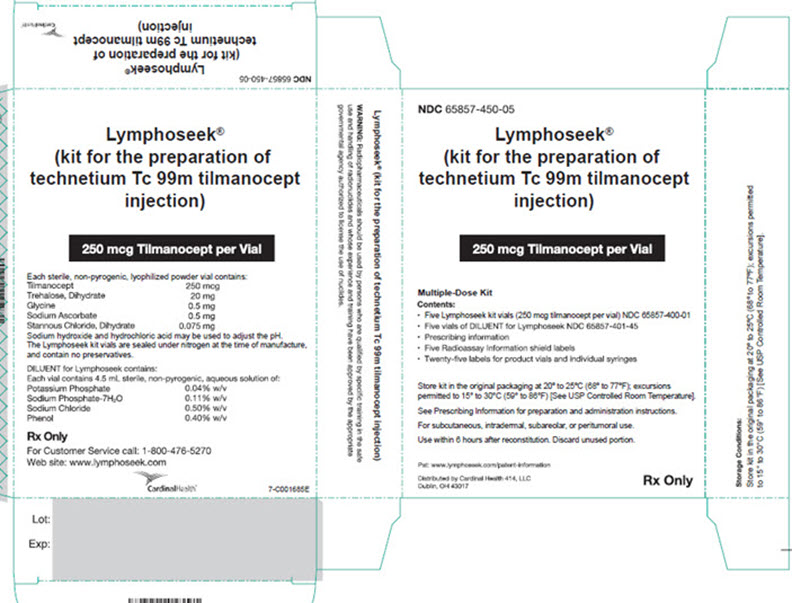
16.1How Supplied The Lymphoseek (kit for the preparation of technetium Tc 99m tilmanocept injection) (NDC 65857-425-05) includes: • Five Lymphoseek kit vials (250 mcg tilmanocept per vial) NDC 65857-400-01 • Prescribing information • Five labels for shields • Twenty-five labels for product vials and individual syringes The Lymphoseek (kit for the preparation of technetium Tc 99m tilmanocept injection) (NDC 65857-450-05) includes: • Five Lymphoseek kit vials (250 mcg tilmanocept per vial) NDC 65857-400-01 • Five vials of DILUENT for Lymphoseek (NDC 65857-401-45) • Prescribing information • Five labels for shields • Twenty-five labels for product vials and individual syringes
16.2Storage and Handling Storage Store Lymphoseek (kit for the preparation of technetium Tc 99m tilmanocept injection) in the original packaging at 20° to 25°C (68° to 77°F); excursions permitted to 15° to 30°C (59° to 86°F) [see USP Controlled Room Temperature]. Store radiolabeled Lymphoseek in radiation shielding at room temperature. Use radiolabeled Lymphoseek within 6 hours of preparation.
Discard unused portion. Handling This Lymphoseek (kit for the preparation of technetium Tc 99m tilmanocept injection) is approved for distribution to persons licensed by the U.S. Nuclear Regulatory Commission to use by product material identified in 10 CFR 35.200 or under an equivalent license issued by an Agreement State.
16.1How Supplied The Lymphoseek (kit for the preparation of technetium Tc 99m tilmanocept injection) (NDC 65857-425-05) includes: • Five Lymphoseek kit vials (250 mcg tilmanocept per vial) NDC 65857-400-01 • Prescribing information • Five labels for shields • Twenty-five labels for product vials and individual syringes The Lymphoseek (kit for the preparation of technetium Tc 99m tilmanocept injection) (NDC 65857-450-05) includes: • Five Lymphoseek kit vials (250 mcg tilmanocept per vial) NDC 65857-400-01 • Five vials of DILUENT for Lymphoseek (NDC 65857-401-45) • Prescribing information • Five labels for shields • Twenty-five labels for product vials and individual syringes
📦 Storage and Handling ▾
16.2Storage and Handling Storage Store Lymphoseek (kit for the preparation of technetium Tc 99m tilmanocept injection) in the original packaging at 20° to 25°C (68° to 77°F); excursions permitted to 15° to 30°C (59° to 86°F) [see USP Controlled Room Temperature]. Store radiolabeled Lymphoseek in radiation shielding at room temperature. Use radiolabeled Lymphoseek within 6 hours of preparation.
Discard unused portion. Handling This Lymphoseek (kit for the preparation of technetium Tc 99m tilmanocept injection) is approved for distribution to persons licensed by the U.S. Nuclear Regulatory Commission to use by product material identified in 10 CFR 35.200 or under an equivalent license issued by an Agreement State.
📋 Description ▾
11 DESCRIPTION Chemical Characteristics The active ingredient in Lymphoseek, a radioactive diagnostic agent, is technetium Tc 99m tilmanocept. Technetium Tc 99m binds to the diethylenetriaminepentaacetic acid (DTPA) moieties of the tilmanocept molecule. • Chemically, technetium Tc 99m tilmanocept consists of technetium Tc 99m, dextran 3-[(2-aminoethyl)thio]propyl 17-carboxy-10,13,16-tris(carboxymethyl)-8-oxo-4-thia-7,10,13,16-tetraazaheptadec-1-yl 3-[[2-[[1-oxo-2-(D-mannopyranosylthio)ethyl]amino]ethyl]thio]propyl ether complexes. • The molecular formula of technetium Tc 99m tilmanocept is [C 6 H 10 O 5 ] n ∙(C 19 H 28 N 4 O 9 S 99m Tc) b ∙(C 13 H 23 NO 6 S 2 ) c ∙(C 5 H 11 NS) a .
It contains 3-8 conjugated DTPA (diethylenetriaminepentaacetic acid) molecules (b); 12-20 conjugated mannose molecules (c) with 0-17 amine side chains (a) remaining free. • The calculated average molecular weight of tilmanocept ranges from 15,292 to 23,378 g/mol. • Technetium Tc 99m tilmanocept has the following structural formula: Lymphoseek is supplied as a kit which contains five vials, 250 mcg tilmanocept per vial. Each Lymphoseek vial contains the non-radioactive ingredients needed to produce technetium Tc 99m tilmanocept.
The vial contains a sterile, non-pyrogenic, white to off-white lyophilized powder (under nitrogen) that consists of a mixture of 250 mcg tilmanocept, 20 mg trehalose dihydrate, 0.5 mg glycine, 0.5 mg sodium ascorbate, and 0.075 mg stannous chloride dihydrate. Sodium hydroxide and hydrochloric acid may be used to adjust the pH prior to lyophilization. The DILUENT for Lymphoseek contains 4.5 mL sterile buffered saline consisting of 0.04% (w/v) potassium phosphate, 0.11% (w/v) sodium phosphate (heptahydrate), 0.5% (w/v) sodium chloride, and 0.4% (w/v) phenol.
Physical Characteristics Technetium Tc 99m decays by isomeric transition with a physical half-life of approximately 6 hours. The principal photon that is useful for detection and imaging studies is listed in Table 4 . Table 4.
Principal Radiation Emission Data From: Kocher, D.C. Radioactive decay data tables. DOE/TIC-11026, 108 (1981).
Radiation Mean % Disintegration Mean Energy (keV) Gamma-2 89.1 140.5 External Radiation The linear mass energy absorption attenuation coefficient for Tc 99m is 18.9 cm -1 . The first half-value layer is 0.037 cm of lead (Pb). The use of a 0.25 cm thick standard radiation lead shield will attenuate the radiation emitted by millicurie amounts of technetium Tc 99m by a factor of about 100.
A range of values for the relative attenuation of the radiation of technetium Tc 99m that results with various thicknesses of lead shielding are displayed in Table 5 . Table 5. Radiation Attenuation by Lead Shielding Shield Thickness, cm of lead (Pb) Coefficient of Attenuation 0.037 0.5 0.12 10 -1 0.24 10 -2 0.36 10 -3 0.49 10 -4 To correct for physical decay of the radionuclide, the fractions that remain at selected intervals after the time of calibration are shown in Table 6 .
Table 6. Physical Decay Chart; Tc 99m, Half-Life of approximately 6 Hours Hours Fraction Remaining 0 1 1 0.891 3 0.708 6 0.501 12 0.251 15 0.178 Structural Formula
💬 Information for Patients ▾
17 PATIENT COUNSELING INFORMATION • Advise patients to seek medical attention for reactions following injection of Lymphoseek such as difficulty breathing, skin rash, or other allergy manifestations. • Inform nursing women to pump and discard breast milk for at least 24 hours following administration of Lymphoseek injection [see Use in Specific Populations ( 8.2 )] . Distributed by: Cardinal Health 414, LLC Dublin, OH 43017 Lymphoseek is a registered trademark of Cardinal Health 414, LLC. Patent: www.lymphoseek.com/patent-information