
Sevelamer Carbonate 800 mg Tablet, Film Coated, 270-count — NDC 65862-921-27 (Billing 65862-0921-27)
This is a package of 270 tablets of Sevelamer Carbonate 800 mg Tablet, Film Coated from Aurobindo Pharma Limited, marketed since Jul 2017 and currently FDA-listed; retail pharmacies pay about $0.2140 per tablet (NADAC). It is the main listing for this product, which comes in 3 package sizes.
NDC database record
One package, one record: these facts belong to NDC 65862-921-27 alone.
- Record
- FDA NDC Directory package listing · Human prescription drug
- Code segments
- 65862 labeler · 921 product · 27 package
- Package marketed since
- Jul 17, 2017
- Sample package
- No — commercial package
- Listing certified through
- Dec 31, 2026
- Billing quantity
- 270 EA per package
- Barcode (UPC-A, from the NDC)
- 3 6586292127 7
- Medicaid fills, this package
- 72,858 prescriptions in the last four reported quarters
- FDA record last changed
- Jul 24, 2026
Identity & classification
Regulatory identifiers FDA, NLM and CMS codes for this package
Drug-database identifiers Medi-Span GPI and First Databank GCN / HICL / AHFS classification
- GSN (GCN sequence number): 063473
- GCN: 99200
- GPI-14 (Medi-Span): 52800070050340
- HICL (First Databank): 035262
- AHFS class code: 40:18.19.00
- RxCUI (RxNorm): 749206
Where does this data come from?
- FDA openFDA NDC Directory · synced Oct 8, 2026
- FDA label on DailyMed · label index refreshed Oct 8, 2026
- RxNorm (NLM RxNav) · catalog refreshed Oct 8, 2026
- Medi-Span GPI (licensed)
- First Databank (licensed) · refreshed Oct 8, 2026
RxNorm drug class
This medicine belongs to the Phosphate Binder class.
Where does this data come from?
- RxClass (NLM) · catalog refreshed Oct 8, 2026
Clinical
- It lowers high phosphorus in your blood if you have chronic kidney disease and are on dialysis. It does this by binding phosphate from food in your gut.
- Take it by mouth with meals, usually three times a day. Your prescriber sets and adjusts the amount based on your blood tests. Follow your pharmacy label.
- Stomach upset is most common, such as nausea, vomiting, diarrhea, gas, indigestion, and constipation. Call your doctor if constipation is severe or worsening, or if you have severe...
- Yes. Ciprofloxacin and mycophenolate need to be spaced apart from sevelamer. Tell us if you take levothyroxine, cyclosporine or tacrolimus, since your doctor may separate timing or...
Patient education
Supplement & herbal interactions
Where does this data come from?
- MedlinePlus (NLM) · refreshed Oct 8, 2026
- FDA label on DailyMed · label index refreshed Oct 8, 2026
Ask a licensed pharmacist directly — free, answered by our team.
Pricing
A drug doesn't have one price. Each row is a different public payment system, and none is what you'd pay at the counter — that depends on your insurance. The ⓘ on each row explains what it measures.
| Price system | Per ea | Per package |
|---|---|---|
| Retail pharmacies payNADAC · weekly | $0.214 | $57.78 / 270 tablets |
| Medicaid paysCMS SDUD · 12 mo | $0.4414 | $119.18 / 270 tablets |
| Medicare drug plans payPart D · Q2 2026 | $0.3584 | $96.77 / 270 tablets |
Where does this data come from?
- CMS NADAC weekly file · file of Oct 7, 2026
- CMS ASP pricing files · refreshed Sep 20, 2026
- CMS Medicaid State Drug Utilization Data · through Q1 2026
- CMS Part D plan pricing files · refreshed Sep 24, 2026
- VA National Acquisition Center price file
Packaging — all sizes for this product
| Package NDC | Description | Per unit | Per pack | Marketing start | Marketing end | Status |
|---|---|---|---|---|---|---|
| 65862-0921-18 65862-921-18 | 180 TABLET, FILM COATED in 1 BOTTLE | — | — | 2017-07-17 | — | Active |
| 65862-0921-27 You're viewing this Main listing | 270 TABLET, FILM COATED in 1 BOTTLE | $0.2140 / ea | $57.78 | 2017-07-17 | — | Active |
| 65862-0921-30 65862-921-30 | 30 TABLET, FILM COATED in 1 BOTTLE | — | — | 2017-07-17 | — | Active |
You're viewing the largest of 3 pack sizes for this product.
In Medicaid, this is the most-dispensed pack of this product — about 100% of fills over the last four reported quarters. See all packs ↓
Pack size FAQ
What quantity is in this package?
How does this package differ from NDC 65862-0921-30?
What NDC number is used to bill for this package of Sevelamer Carbonate 800 mg Tablet, Film Coated?
Prices are the latest CMS NADAC pharmacy acquisition cost per NDC; per-pack figures are per-unit × pack quantity, shown only when the pack is denominated in the same measure NADAC prices.
Therapeutic equivalents
| Product | Labeler | Pack | NADAC/unit | TE | Status | Price vs. this |
|---|---|---|---|---|---|---|
| Sevelamer Carbonate 800 mg 00904-6707-06 | Major | 1 tablet | $0.214 | AB | Availability likely | — |
| Sevelamer Carbonate 800 mg 11788-0116-07 | AiPing | 270 tablets | $0.214 | AB | Availability likely | — |
| Sevelamer Carbonate 800 mg 16714-0814-01 | NorthStar | 270 tablets | $0.214 | AB | Availability likely | — |
| Sevelamer Carbonate 800 mg 24979-0186-46 | TWi | 270 tablets | $0.214 | AB | Availability likely | — |
| Sevelamer Carbonate 800 mg 33342-0215-58 | Macleods | 270 tablets | $0.214 | AB | Availability likely | — |
| Sevelamer Carbonate 800 mg 50268-0720-15 | AvPAK | 1 tablet | $0.214 | AB | Availability likely | — |
| Sevelamer Carbonate 800 mg 55111-0789-11 | DR. | 4 tablets | $0.214 | AB | Availability likely | — |
| Sevelamer Carbonate 800 mg 60687-0328-31 | American | 1 tablet | $0.214 | AB | Availability likely | — |
| Sevelamer Carbonate 800 mgthis 65862-0921-27 | Aurobindo | 270 tablets | $0.214 | AB | Availability likely | — |
| Sevelamer Carbonate 800 mg 68094-0034-64 | Precision | 10 tablets | $0.214 | AB | Availability likely | — |
| Sevelamer carbonate 800 mg 69097-0967-93 | Cipla | 270 tablets | $0.214 | AB | Availability likely | — |
| Sevelamer Carbonate 800 mg 69367-0423-27 | Westminster | 270 tablets | $0.214 | AB | Availability likely | — |
| Sevelamer carbonate 800 mg 76282-0407-27 | Exelan | 270 tablets | $0.214 | AB | Availability likely | — |
| Sevelamer carbonate 800 mg 76282-0664-27 | Exelan | 270 tablets | $0.214 | AB | Availability likely | — |
| Sevelamer Carbonate 800 mg 00955-1050-27 | Sanofi-Aventis | 270 tablets | $0.254 | — | FDA listed | +19% |
| Renvela 800 mg 58468-0133-01 | Genzyme | 270 tablets | $5.685 | — | Availability likely | +2557% |
| Sevelamer Carbonate 800 mg 00615-8239-39 | NCS | 30 tablets | — | AB | FDA listed | — |
| Sevelamer Carbonate 800 mg 00955-1057-30 | Sanofi-Aventis | 270 tablets | — | — | FDA listed | — |
| Sevelamer Carbonate 800 mg 17856-0921-01 | ATLANTIC | 1 tablet | — | AB | FDA listed | — |
| Sevelamer Carbonate 800 mg 42571-0378-30 | Micro | 30 tablets | — | — | Discontinued | — |
| Sevelamer Carbonate 800 mg 51407-0706-27 | Golden | 270 tablets | — | AB | FDA listed | — |
| Sevelamer Carbonate 800 mg 55154-3358-00 | Cardinal | 1 tablet | — | AB | FDA listed | — |
| Sevelamer Carbonate 800 mg 55154-8188-00 | Cardinal | 1 tablet | — | AB | FDA listed | — |
| Sevelamer Carbonate 800 mg 58624-5001-02 | Shandong | 30 tablets | — | AB | FDA listed | — |
| Sevelamer Carbonate 800 mg 64380-0872-04 | Strides | 30 tablets | — | AB | FDA listed | — |
| Sevelamer Carbonate 800 mg 65162-0058-09 | Amneal | 90 tablets | — | AB | FDA listed | — |
| Sevelamer carbonate 800 mg 68382-0824-10 | Zydus | 1000 tablets | — | AB | FDA listed | — |
| Sevelamer carbonate 800 mg 68475-0010-01 | Navinta | 30 tablets | — | AB | FDA listed | — |
| Sevelamer carbonate 800 mg 69097-0893-93 | Cipla | 270 tablets | — | AB | FDA listed | — |
| Sevelamer carbonate 800 mg 70710-2170-03 | Zydus | 30 tablets | — | AB | FDA listed | — |
| Sevelamer carbonate 800 mg 70771-1520-00 | Zydus | 1000 tablets | — | AB | FDA listed | — |
| Sevelamer Carbonate 800 mg 71205-0966-67 | Proficient | 270 tablets | — | AB | FDA listed | — |
| Sevelamer Carbonate 800 mg 71335-3021-01 | Bryant | 50 tablets | — | AB | Discontinued | — |
| Sevelamer Carbonate 800 mg 72162-2499-01 | Bryant | 100 tablets | — | AB | FDA listed | — |
| Sevelamer Carbonate 800 mg 72789-0562-94 | PD-Rx | 270 tablets | — | AB | FDA listed | — |
| Sevelamer Carbonate 800 mg 73190-0014-27 | AvKARE | 270 tablets | — | AB | FDA listed | — |
| Sevelamer Carbonate 800 mg 85898-0101-27 | Marp | 270 tablets | — | — | FDA listed | — |
| Sevelamer Carbonate 800 mg 87367-0266-12 | INSIGNAMEDEX | 270 tablets | — | — | FDA listed | — |
Where does this data come from?
- FDA openFDA NDC Directory · synced Oct 8, 2026
- FDA Orange Book · refreshed Oct 9, 2026
- CMS NADAC weekly file · file of Oct 7, 2026
Availability & generic status
This product is an FDA-approved generic. Other versions of the same drug are listed under Therapeutic equivalents, least expensive first.
Where does this data come from?
- FDA Orange Book · refreshed Oct 9, 2026
What it looks like
Where does this data come from?
- FDA label on DailyMed · label index refreshed Oct 8, 2026
Inactive Ingredients / Excipients
Inactive ingredients, also called excipients, are components of the drug product other than the active ingredient. They may include fillers, dyes, coatings, preservatives, flavors, or other formulation ingredients.
🧪 Avoiding an ingredient? See Sevelamer inactive ingredients by manufacturer: every current product's list side by side, so you can ask your pharmacy for the version that does not list it.
💡 Tap an ingredient (hover on desktop) to see what it is and why it’s used.
-
UNII 5138Q19F1X
Ammonia is a colorless gas made from nitrogen and hydrogen. It's used in medicines as a pH buffer to maintain the correct acidity level and help keep the product stable.
-
UNII 68401960MK
Crospovidone is a synthetic polymer made from polyvinylpyrrolidone. It acts as a disintegrant, helping tablets break apart quickly in the stomach so the medicine dissolves and absorbs into the body.
-
UNII 5Z17386USF
A food-derived fat used as an emulsifier and stabilizer. It helps blend oil and water-based ingredients together and keeps the medicine's texture consistent throughout its shelf life.
-
UNII XM0M87F357
A dark iron oxide compound that gives medicines their black or dark color. It's used as a colorant in tablets and capsules to help identify the product and make it visually distinctive.
-
UNII R8WTH25YS2
Glyceryl dibehenate is a wax-like substance made from behenate fatty acids and glycerol. It functions as a binder and release-control agent in tablets and capsules, helping hold ingredients together and regulate how quickly the medicine dissolves and releases in your body.
-
UNII UKE75GEA7F
Hydroxypropyl cellulose is a plant-based polymer used as a binder and thickener. It helps hold tablet ingredients together, controls how fast the medicine dissolves, and improves the texture of liquid formulations.
-
UNII 3NXW29V3WO
Hypromellose is a plant-based thickener made from cellulose. It's used in medicines as a binder to hold ingredients together, a coating for tablets, and a thickener for liquids.
-
UNII 3OWL53L36A
A natural sugar alcohol derived from seaweed or synthesized in the lab. It's used as a filler to add bulk, a sweetener in sugar-free formulas, and a disintegrant to help tablets break apart in the stomach.
-
UNII 6DC9Q167V3
Propylene glycol is a clear liquid derived from petroleum or vegetable sources. It acts as a solvent, humectant, and preservative in medicines, helping dissolve active ingredients and maintain product stability.
-
UNII 46N107B71O
Shellac is a natural resin secreted by the lac beetle. It's used as a coating on tablets and capsules to control how quickly the medicine dissolves and to improve appearance and stability.
-
UNII ETJ7Z6XBU4
Silicon dioxide is a naturally occurring mineral used as a glidant and anti-caking agent. It helps powder ingredients flow smoothly and prevents clumping during manufacturing and storage.
-
UNII 7SEV7J4R1U
A powder made from a naturally occurring mineral. In medicines, talc works as a glidant and anti-caking agent, helping tablets and capsules flow smoothly during manufacturing and preventing clumping.
12 inactive ingredients listed in the exact product block matched to this NDC.
Where does this data come from?
ingredient classCode="IACT" elements from the exact product block matched by this NDC. Label-section narrative from DailyMed / the openFDA label index is shown separately when available.- FDA label on DailyMed · label index refreshed Oct 8, 2026
- FDA openFDA NDC Directory · synced Oct 8, 2026
Inactive ingredient FAQ
Are inactive ingredients the same for every manufacturer?
Why might an inactive ingredient be missing?
Can inactive ingredients matter?
Manufacturer & labeler
More NDCs from Aurobindo Pharma Limited labeler code 65862
- Isosulfan Blue 50 kg/50kg Powder NDC 65862-911-37
- Zolmitriptan 2.5 mg Tablet, Film Coated NDC 65862-914-69
- Zolmitriptan 5 mg Tablet, Film Coated NDC 65862-915-64
- Voriconazole 50 kg/50kg Powder NDC 65862-916-37
- Dalfampridine 50 kg/50kg Powder NDC 65862-917-37
- Fondaparinux Sodium 50 kg/50kg Powder NDC 65862-920-37
- Tramadol Hydrochloride and Acetaminophen 37.5 mg; 325 mg Tablet, Film Coated NDC 65862-922-01
- Sevelamer Carbonate 50 kg/50kg Powder NDC 65862-923-37
- Dextromethorphan Hydrobromide 50 kg/50kg Powder NDC 65862-924-37
- Incassia NORETHINDRONE .35 mg Tablet NDC 65862-925-28
- Nexesta Fe norethindrone and ethinyl estradiol and ferrous fumarate Kit NDC 65862-926-58
- Finasteride 1 mg Tablet, Film Coated NDC 65862-927-30
Where does this data come from?
- FDA openFDA NDC Directory · synced Oct 8, 2026
- Drugs@FDA
Full prescribing information FDA SPL
🎯 Indications and Usage ▾
1 INDICATIONS AND USAGE Sevelamer carbonate tablets are indicated for the control of serum phosphorus in adults and children 6 years of age and older with chronic kidney disease (CKD) on dialysis. Sevelamer carbonate tablets are a phosphate binder indicated for the control of serum phosphorus in adults and children 6 years of age and older with chronic kidney disease on dialysis. (1)
⏱️ Dosage and Administration ▾
2 DOSAGE AND ADMINISTRATION Starting dose of sevelamer carbonate tablets is 0.8 or 1.6 grams administered orally three times per day with meals based on serum phosphorus levels for adult patients and based on body surface area (BSA) category for pediatric patients. ( 2.1 ) Titrate by 0.8 g per meal in two-week intervals for adult patients as needed to obtain serum phosphorus target. (2.1) Titrate based on BSA category for pediatric patients in two-week intervals for 6 weeks and then every 4 weeks as needed to obtain serum phosphorus target.
( 2.1 )
2.1General Dosing Information Starting Dose for Adult Patients Not Taking a Phosphate Binder. The recommended starting dose of sevelamer carbonate tablets is 0.8 to 1.6 g taken orally with meals based on serum phosphorus level. Table 1 provides recommended starting doses of sevelamer carbonate tablets for adult patients not taking a phosphate binder.
Table 1: Starting Dose for Adult Dialysis Patients Not Taking a Phosphate Binder Serum Phosphorus Sevelamer Carbonate Tablets >5.5 and <7.5 mg/dL 0.8 g three times daily with meals ≥7.5 mg/dL 1.6 g three times daily with meals Dose Titration for Adult Patients Taking Sevelamer Carbonate Tablets . Titrate the sevelamer carbonate tablets dose by 0.8 g three times per day with meals at two-week intervals as necessary to achieve target serum phosphorus levels. Based on clinical studies, the average prescribed adult daily dose of sevelamer carbonate is approximately 7.2 g per day.
The highest daily adult dose of sevelamer carbonate studied was 14 grams in CKD patients on dialysis. Starting Dose for Pediatric Patients Not Taking a Phosphate Binder. The recommended starting dose for pediatric patients 6 years of age and older is 0.8 to 1.6 g taken three times per day with meals based on the patient’s body surface area (BSA) category; see Table 2.
Table 2: Recommended Starting Dosage and Titration Increment Based on Pediatric Patient’s Body Surface Area (m 2 ) BSA (m 2 ) Starting Dose Per Meal/Snack Titration Increases/Decreases Per Dose ≥0.75 to <1.2 0.8 g Titrate by 0.4 g ≥1.2 1.6 g Titrate by 0.8 g Dose Titration for Pediatric Patients Taking Sevelamer Carbonate Tablets . Titrate the sevelamer carbonate tablets dose as needed to achieve target levels at two-week intervals based on BSA category, as shown in Table 2. Switching from Sevelamer Hydrochloride Tablets.
For adult patients switching from sevelamer hydrochloride tablets to sevelamer carbonate tablets or powder, use the same dose in grams. Switching between Sevelamer Carbonate Tablets and Powder. Use the same dose in grams.
Switching from Calcium Acetate . Table 3 gives recommended starting doses of sevelamer carbonate tablets based on a patient’s current calcium acetate dose. Table 3: Starting Dose for Dialysis Patients Switching from Calcium Acetate to Sevelamer Carbonate Tablets Calcium Acetate 667 mg (Tablets per meal) Sevelamer Carbonate Tablets 1 tablet 0.8 g 2 tablets 1.6 g 3 tablets 2.4 g
💊 Dosage Forms and Strengths ▾
3 DOSAGE FORMS AND STRENGTHS Tablets: 800 mg white to off-white, oval shaped, film-coated tablets, imprinted with “J 75” on one side with edible black ink and plain on other side. Tablets: 800 mg (3)
⛔ Contraindications ▾
4 CONTRAINDICATIONS Sevelamer carbonate tablets are contraindicated in patients with bowel obstruction. Sevelamer carbonate tablets are contraindicated in patients with known hypersensitivity to sevelamer carbonate, sevelamer hydrochloride, or to any of the excipients. Bowel obstruction. (4) Known hypersensitivity to sevelamer carbonate, sevelamer hydrochloride, or to any of the excipients. ( 4 )
⚠️ Warnings and Cautions ▾
5 WARNINGS AND PRECAUTIONS Serious cases of dysphagia, bowel obstruction, bleeding gastrointestinal ulcers, colitis, ulceration, necrosis, and perforation have been associated with sevelamer use, some requiring hospitalization and surgery. ( 5.1 )
5.1Gastrointestinal Adverse Events Patients with dysphagia, swallowing disorders, severe gastrointestinal (GI) motility disorders, including severe constipation, or major GI tract surgery were not included in the sevelamer carbonate clinical studies. Cases of dysphagia and esophageal tablet retention have been reported in association with use of the tablet formulation of sevelamer, some requiring hospitalization and intervention. Consider using sevelamer suspension in patients with a history of swallowing disorders.
Cases of bowel obstruction, bleeding gastrointestinal ulcers, colitis, ulceration, necrosis, and perforation have also been reported with sevelamer use [see Adverse Reactions (6.2) ]. Inflammatory disorders may resolve upon sevelamer carbonate discontinuation. Treatment with sevelamer carbonate should be re-evaluated in patients who develop severe gastrointestinal symptoms.
5.2Reductions in Vitamins D, E, K (clotting factors) and Folic Acid Levels In preclinical studies in rats and dogs, sevelamer hydrochloride, which contains the same active moiety as sevelamer carbonate, reduced vitamins D, E, and K (coagulation parameters) and folic acid levels at doses of 6 to 10 times the recommended human dose. In short-term clinical trials, there was no evidence of reduction in serum levels of vitamins. However, in a one-year clinical trial, 25-hydroxyvitamin D (normal range 10 to 55 ng/mL) fell from 39 ± 22 ng/mL to 34 ± 22 ng/mL (p<0.01) with sevelamer hydrochloride treatment.
Most (approximately 75%) patients in sevelamer hydrochloride clinical trials were receiving vitamin supplements.
🤒 Adverse Reactions ▾
6 ADVERSE REACTIONS Most of the safety experience is with sevelamer carbonate tablets and sevelamer hydrochloride. In long-term studies with sevelamer hydrochloride, which contains the same active moiety as sevelamer carbonate, the most common adverse events included: vomiting (22%), nausea (20%), diarrhea (19%), dyspepsia (16%), abdominal pain (9%), flatulence (8%), and constipation (8%). ( 6.1 ) To report SUSPECTED ADVERSE REACTIONS, contact Aurobindo Pharma USA, Inc. at 1-866-850-2876 or FDA at 1-800-FDA-1088 or www.fda.gov/medwatch.
6.1Clinical Trials Experience Because clinical trials are conducted under widely varying conditions, adverse reaction rates observed in the clinical trials of a drug cannot be directly compared to rates in the clinical trials of another drug and may not reflect the rates observed in practice. There are limited clinical trial data on the safety of sevelamer carbonate. However, because it contains the same active ingredient as the hydrochloride salt, the adverse event profiles of the two salts are expected to be similar.
In a cross-over study in hemodialysis patients with treatment durations of eight weeks each and no washout, and another cross-over study in hemodialysis patients with treatment durations of four weeks each and no washout between treatment periods, the adverse reactions on sevelamer carbonate powder were similar to those reported for sevelamer hydrochloride. In a parallel design study of sevelamer hydrochloride with treatment duration of 52 weeks, adverse reactions reported for sevelamer hydrochloride (n=99) were similar to those reported for the active-comparator group (n=101).
Overall adverse reactions among those treated with sevelamer hydrochloride occurring in >5% of patients included: vomiting (22%), nausea (20%), diarrhea (19%), dyspepsia (16%), abdominal pain (9%), flatulence (8%), and constipation (8%). A total of 27 patients treated with sevelamer and 10 patients treated with comparator withdrew from the study due to adverse reactions. Based on studies of 8 to 52 weeks, the most common reason for withdrawal from sevelamer hydrochloride was gastrointestinal adverse reactions (3% to 16%).
In 143 peritoneal dialysis patients studied for 12 weeks using sevelamer hydrochloride, most common adverse reactions were similar to adverse reactions observed in hemodialysis patients. The most frequently occurring treatment emergent serious adverse reaction was peritonitis (8 reactions in 8 patients [8%] in the sevelamer group and 2 reactions in 2 patients [4%] on active control). Thirteen patients (14%) in the sevelamer group and 9 patients (20%) in the active-control group discontinued, mostly for gastrointestinal adverse reactions.
6.2Postmarketing Experience Because these reactions are reported voluntarily from a population of uncertain size, it is not always possible to reliably estimate their frequency or to establish a causal relationship to drug exposure. The following adverse reactions have been identified during postapproval use of sevelamer hydrochloride or sevelamer carbonate: hypersensitivity, pruritus, rash, abdominal pain, bleeding gastrointestinal ulcers, colitis, ulceration, necrosis, fecal impaction, and uncommon cases of ileus, intestinal obstruction, and intestinal perforation .
Appropriate medical management should be given to patients who develop constipation or have worsening of existing constipation to avoid severe complications.
🔄 Drug Interactions ▾
7 DRUG INTERACTIONS There are no empirical data on avoiding drug interactions between sevelamer carbonate and most concomitant oral drugs. For oral medication where a reduction in the bioavailability of that medication would have a clinically significant effect on its safety or efficacy (e.g., cyclosporine, tacrolimus, levothyroxine), consider separation of the timing of the administration of the two drugs [see Clinical Pharmacology (12.3) ] . The duration of separation depends upon the absorption characteristics of the medication concomitantly administered, such as the time to reach peak systemic levels and whether the drug is an immediate-release or an extended-release product.
Where possible consider monitoring clinical responses and/or blood levels of concomitant drugs that have a narrow therapeutic range. Table 5: Sevelamer Drug Interactions Oral drugs for which sevelamer did not alter the pharmacokinetics when administered concomitantly Digoxin Enalapril Iron Metoprolol Warfarin Oral drugs that have demonstrated interaction with sevelamer and are to be dosed separately from sevelamer carbonate Ciprofloxacin Mycophenolate mofetil Dosing Recommendations Take at least 2 hours before or 6 hours after sevelamer Take at least 2 hours before sevelamer For oral medication where a reduction in the bioavailability of that medication would have a clinically significant effect on its safety or efficacy, consider separation of the timing of administration and/or monitor clinical responses or blood levels of the concomitant medication.
( 7 ) Sevelamer did not alter the pharmacokinetics of digoxin, enalapril, iron, metoprolol and warfarin. (7) Sevelamer has demonstrated interaction with ciprofloxacin, mycophenolate mofetil, and therefore, these drugs should be dosed separately from sevelamer carbonate. (7)
👥 Use in Specific Populations ▾
8 USE IN SPECIFIC POPULATIONS
8.1Pregnancy Risk Summary Sevelamer carbonate is not absorbed systemically following oral administration and maternal use is not expected to result in fetal exposure to the drug. Clinical Considerations Sevelamer carbonate may decrease serum levels of fat-soluble vitamins and folic acid in pregnant women [see Clinical Pharmacology (12.2 )] . Consider supplementation.
Data Animal data In pregnant rats given dietary doses of 0.5, 1.5, or 4.5 g/kg/day of sevelamer hydrochloride during organogenesis, reduced or irregular ossification of fetal bones, probably due to a reduced absorption of fat-soluble vitamin D, occurred in mid and high-dose groups (human equivalent doses approximately equal to 3 to 4 times the maximum clinical trial dose of 13 g). In pregnant rabbits given oral doses of 100, 500, or 1,000 mg/kg/day of sevelamer hydrochloride by gavage during organogenesis, an increase of early resorptions occurred in the high-dose group (human equivalent dose twice the maximum clinical trial dose).
8.2Lactation Risk Summary Sevelamer carbonate is not absorbed systemically by the mother following oral administration, and breastfeeding is not expected to result in exposure of the child to sevelamer carbonate. Clinical Considerations Sevelamer carbonate may decrease serum levels of fat-soluble vitamins and folic acid in pregnant women [see Clinical Pharmacology (12.2) ] . Consider supplementation.
8.4Pediatric Use The safety and efficacy of sevelamer carbonate in lowering serum phosphorus levels was studied in patients 6 years of age and older with CKD. In this study, sevelamer carbonate was apparently less effective in children with a low baseline serum phosphorus, which described children <13 years of age and children not on dialysis. Given its mechanism of action, sevelamer carbonate is expected to be effective in lowering serum phosphorus levels in pediatric patients with CKD.
Most adverse events that were reported as related, or possibly related, to sevelamer carbonate were gastrointestinal in nature. No new risks or safety signals were identified with the use of sevelamer carbonate in the trial. Sevelamer carbonate has not been studied in pediatric patients below 6 years of age.
8.5Geriatric Use Clinical studies of sevelamer carbonate did not include sufficient numbers of subjects aged 65 and over to determine whether they respond differently from younger subjects. Other reported clinical experience has not identified differences in responses between the elderly and younger patients. In general, dose selection for an elderly patient should be cautious, usually starting at the low end of the dosing range.
🤰 Pregnancy ▾
8.1Pregnancy Risk Summary Sevelamer carbonate is not absorbed systemically following oral administration and maternal use is not expected to result in fetal exposure to the drug. Clinical Considerations Sevelamer carbonate may decrease serum levels of fat-soluble vitamins and folic acid in pregnant women [see Clinical Pharmacology (12.2 )] . Consider supplementation.
Data Animal data In pregnant rats given dietary doses of 0.5, 1.5, or 4.5 g/kg/day of sevelamer hydrochloride during organogenesis, reduced or irregular ossification of fetal bones, probably due to a reduced absorption of fat-soluble vitamin D, occurred in mid and high-dose groups (human equivalent doses approximately equal to 3 to 4 times the maximum clinical trial dose of 13 g). In pregnant rabbits given oral doses of 100, 500, or 1,000 mg/kg/day of sevelamer hydrochloride by gavage during organogenesis, an increase of early resorptions occurred in the high-dose group (human equivalent dose twice the maximum clinical trial dose).
🧒 Pediatric Use ▾
8.4Pediatric Use The safety and efficacy of sevelamer carbonate in lowering serum phosphorus levels was studied in patients 6 years of age and older with CKD. In this study, sevelamer carbonate was apparently less effective in children with a low baseline serum phosphorus, which described children <13 years of age and children not on dialysis. Given its mechanism of action, sevelamer carbonate is expected to be effective in lowering serum phosphorus levels in pediatric patients with CKD.
Most adverse events that were reported as related, or possibly related, to sevelamer carbonate were gastrointestinal in nature. No new risks or safety signals were identified with the use of sevelamer carbonate in the trial. Sevelamer carbonate has not been studied in pediatric patients below 6 years of age.
🧓 Geriatric Use ▾
8.5Geriatric Use Clinical studies of sevelamer carbonate did not include sufficient numbers of subjects aged 65 and over to determine whether they respond differently from younger subjects. Other reported clinical experience has not identified differences in responses between the elderly and younger patients. In general, dose selection for an elderly patient should be cautious, usually starting at the low end of the dosing range.
🆘 Overdosage ▾
10 OVERDOSAGE In CKD patients on dialysis, the maximum dose studied was 14 grams of sevelamer carbonate and 13 grams of sevelamer hydrochloride. There are no reports of overdosage with sevelamer carbonate or sevelamer hydrochloride in patients. Since sevelamer is not absorbed, the risk of systemic toxicity is low.
🧬 Clinical Pharmacology ▾
12 CLINICAL PHARMACOLOGY
12.1Mechanism of Action Sevelamer carbonate tablets contain sevelamer carbonate, a non-absorbed phosphate-binding cross-linked polymer, free of metal and calcium. It contains multiple amines separated by one carbon from the polymer backbone. These amines exist in a protonated form in the intestine and interact with phosphate molecules through ionic and hydrogen bonding.
By binding phosphate in the gastrointestinal tract and decreasing absorption, sevelamer carbonate lowers the phosphate concentration in the serum (serum phosphorus).
12.2Pharmacodynamics In addition to effects on serum phosphorus levels, sevelamer hydrochloride has been shown to bind bile acids in vitro and in vivo in experimental animal models. Because sevelamer binds bile acids, it may interfere with normal fat absorption and thus may reduce absorption of fat-soluble vitamins such as A, D and K. In clinical trials of sevelamer hydrochloride, both the mean total and LDL cholesterol declined by 15% to 31%; the clinical significance of this finding, which was observed after 2 weeks, is unclear.
Triglycerides, HDL cholesterol, and albumin did not change.
12.3Pharmacokinetics A mass balance study using 14 C-sevelamer hydrochloride, in 16 healthy male and female volunteers showed that sevelamer hydrochloride is not systemically absorbed. No absorption studies have been performed in patients with renal disease. Drug Interactions In vivo Sevelamer carbonate has been studied in human drug-drug interaction studies (9.6 grams once daily with a meal) with warfarin and digoxin.
Sevelamer hydrochloride, which contains the same active moiety as sevelamer carbonate, has been studied in human drug-drug interaction studies (2.4 to 2.8 grams single dose or three times daily with meals or two times daily without meals) with ciprofloxacin, digoxin, enalapril, iron, metoprolol, mycophenolate mofetil, and warfarin. Coadministered single dose of 2.8 grams of sevelamer hydrochloride in fasted state decreased the bioavailability of ciprofloxacin by approximately 50% in healthy subjects. Concomitant administration of sevelamer and mycophenolate mofetil in adult and pediatric patients decreased the mean MPA C max and AUC 0-12h by 36% and 26%, respectively.
Sevelamer carbonate or sevelamer hydrochloride did not alter the pharmacokinetics of enalapril, digoxin, iron, metoprolol, and warfarin when coadministered. During postmarketing experience, cases of increased thyroid stimulating hormone (TSH) levels have been reported in patients coadministered sevelamer hydrochloride and levothyroxine. Reduction in concentrations of cyclosporine and tacrolimus leading to dose increases has also been reported in transplant patients when coadministered with sevelamer hydrochloride without any clinical consequences (for example, graft rejection).
The possibility of an interaction cannot be excluded with these drugs.
🧬 Mechanism of Action ▾
12.1Mechanism of Action Sevelamer carbonate tablets contain sevelamer carbonate, a non-absorbed phosphate-binding cross-linked polymer, free of metal and calcium. It contains multiple amines separated by one carbon from the polymer backbone. These amines exist in a protonated form in the intestine and interact with phosphate molecules through ionic and hydrogen bonding.
By binding phosphate in the gastrointestinal tract and decreasing absorption, sevelamer carbonate lowers the phosphate concentration in the serum (serum phosphorus).
📦 How Supplied / Storage and Handling ▾
16 HOW SUPPLIED/STORAGE AND HANDLING Sevelamer Carbonate Tablets, 800 mg for oral use is supplied as white to off-white, oval shaped, film-coated tablets, imprinted with “J 75” on one side with edible black ink and plain on other side, containing 800 mg of sevelamer carbonate on an anhydrous basis. Bottles of 30 NDC 65862-921-30 Bottles of 180 NDC 65862-921-18 Bottles of 270 NDC 65862-921-27 Storage: Store at 20° to 25°C (68° to 77°F) [see USP Controlled Room Temperature]. Dispense in a tight container.
Protect from moisture.
📋 Description ▾
11 DESCRIPTION The active ingredient in sevelamer carbonate tablets is sevelamer carbonate, a polymeric amine that binds phosphate and is meant for oral administration. It was developed as a pharmaceutical alternative to sevelamer hydrochloride. Sevelamer carbonate is an anion exchange resin, with the same polymeric structure as sevelamer hydrochloride, in which carbonate replaces chloride as the counterion.
While the counterions differ for the two salts, the polymer itself, the active moiety involved in phosphate-binding, is the same. Sevelamer carbonate is known chemically as poly(allylamine- co -N,N’-diallyl-1,3-diamino-2-hydroxypropane) carbonate salt. Sevelamer carbonate is hygroscopic, but insoluble in water.
The structure is represented in Figure 1. Sevelamer Carbonate Tablets: Each film-coated tablet of sevelamer carbonate contains 800 mg of sevelamer carbonate on an anhydrous basis. The inactive ingredients are acetylated monoglycerides, ammonium hydroxide, black iron oxide, colloidal silicon dioxide, crospovidone, glyceryl dibehenate, hydroxypropyl cellulose, hypromellose, mannitol, propylene glycol, shellac glaze and talc.
Chemical Structure
💬 Information for Patients ▾
17 PATIENT COUNSELING INFORMATION Inform patients to take sevelamer carbonate tablets with meals and adhere to their prescribed diets. For patients using an oral medication where a reduction in the bioavailability of that medication would have a clinically significant effect on its safety or efficacy, advise the patient to take the oral medication at least one hour before or three hours after sevelamer carbonate tablets. Advise patients to report new onset or worsening of existing constipation or bloody stools promptly to their physician [see Warnings and Precautions (5.1) ].
Distributed by: Aurobindo Pharma USA, Inc. 279 Princeton-Hightstown Road East Windsor, NJ 08520 Manufactured by: Aurobindo Pharma Limited Hyderabad-500 032, India Revised: 04/2024
🧬 Pharmacokinetics ▾
12.3Pharmacokinetics A mass balance study using 14 C-sevelamer hydrochloride, in 16 healthy male and female volunteers showed that sevelamer hydrochloride is not systemically absorbed. No absorption studies have been performed in patients with renal disease. Drug Interactions In vivo Sevelamer carbonate has been studied in human drug-drug interaction studies (9.6 grams once daily with a meal) with warfarin and digoxin.
Sevelamer hydrochloride, which contains the same active moiety as sevelamer carbonate, has been studied in human drug-drug interaction studies (2.4 to 2.8 grams single dose or three times daily with meals or two times daily without meals) with ciprofloxacin, digoxin, enalapril, iron, metoprolol, mycophenolate mofetil, and warfarin. Coadministered single dose of 2.8 grams of sevelamer hydrochloride in fasted state decreased the bioavailability of ciprofloxacin by approximately 50% in healthy subjects. Concomitant administration of sevelamer and mycophenolate mofetil in adult and pediatric patients decreased the mean MPA C max and AUC 0-12h by 36% and 26%, respectively.
Sevelamer carbonate or sevelamer hydrochloride did not alter the pharmacokinetics of enalapril, digoxin, iron, metoprolol, and warfarin when coadministered. During postmarketing experience, cases of increased thyroid stimulating hormone (TSH) levels have been reported in patients coadministered sevelamer hydrochloride and levothyroxine. Reduction in concentrations of cyclosporine and tacrolimus leading to dose increases has also been reported in transplant patients when coadministered with sevelamer hydrochloride without any clinical consequences (for example, graft rejection).
The possibility of an interaction cannot be excluded with these drugs.
🧬 Pharmacodynamics ▾
12.2Pharmacodynamics In addition to effects on serum phosphorus levels, sevelamer hydrochloride has been shown to bind bile acids in vitro and in vivo in experimental animal models. Because sevelamer binds bile acids, it may interfere with normal fat absorption and thus may reduce absorption of fat-soluble vitamins such as A, D and K. In clinical trials of sevelamer hydrochloride, both the mean total and LDL cholesterol declined by 15% to 31%; the clinical significance of this finding, which was observed after 2 weeks, is unclear.
Triglycerides, HDL cholesterol, and albumin did not change.
🔬 Clinical Studies ▾
14 CLINICAL STUDIES The ability of sevelamer to control serum phosphorus in CKD patients on dialysis was predominantly determined from the effects of the hydrochloride salt to bind phosphate. Six clinical trials used sevelamer hydrochloride and three clinical trials used sevelamer carbonate. The sevelamer hydrochloride studies include one double-blind, placebo-controlled 2-week study (sevelamer N=24); two open-label, uncontrolled, 8-week studies (sevelamer N=220); and three active-controlled open-label studies with treatment durations of 8 to 52 weeks (sevelamer N=256).
The sevelamer carbonate studies include one double-blind, active-controlled, cross-over study with two 8-week treatment periods using sevelamer carbonate tablets (N=79); and one randomized, parallel, open-label study using sevelamer carbonate powder (N=144) dosed once daily or sevelamer hydrochloride tablets (N=73) dosed three times daily for 24 weeks. Five of the active-controlled studies are described here (two sevelamer carbonate and three sevelamer hydrochloride studies).
14.1Cross-Over Study of Sevelamer Carbonate 800 mg Tablets and Sevelamer Hydrochloride 800 mg Tablets Stage 5 CKD patients on hemodialysis were entered into a five-week sevelamer hydrochloride run-in period and 79 patients received, in random order, sevelamer carbonate 800 mg tablets and sevelamer hydrochloride 800 mg tablets for eight weeks each, with no intervening washout. Study dose during the cross-over period was determined based on the sevelamer hydrochloride dose during the run-in period on a gram-per-gram basis.
The phosphorus levels at the end of each of the two cross-over periods were similar. Average actual daily dose was 6 g/day divided among meals for both treatments. Thirty-nine of those completing the cross-over portion of the study were entered into a two-week washout period during which patients were instructed not to take any phosphate binders; this confirmed the activity of sevelamer in this study.
14.3Clinical Study of Sevelamer Carbonate Tablets in Pediatric Patients A clinical study with sevelamer carbonate was conducted in 101 patients 6 to 18 years of age with chronic kidney disease. This study included a washout period for patients on a phosphate binder, a 2-week, double-blind, fixed-dose period (FDP) in which patients were randomized to sevelamer carbonate (n=50) or placebo (n=51), and a 26-week, open-label, sevelamer carbonate dose titration period (DTP). Most patients were 13 to 18 years of age (73%) and had a BSA ≥1.2 m 2 (84%).
Approximately 78% of patients were CKD patients on dialysis. Sevelamer carbonate significantly reduced serum phosphorus through Week 2 (primary endpoint) by an LS Mean difference of -0.90 (SE 0.27) mg/dL compared to placebo (p=0.001). A similar treatment response was observed in patients who received sevelamer carbonate during the 6-month open-label DTP.
Approximately 30% of subjects reached their target serum phosphorus. The median prescribed daily dose was approximately 7 g per day during the titration period. The results of the primary efficacy endpoint were consistent by BSA subgroup.
In contrast, a treatment effect was not observed in subjects with a baseline serum phosphorus below 7 mg/dL, many of whom were the subjects 6 to <13 years of age or the subjects not on dialysis (Figure 2). [a]: LS Mean difference of Sevelamer Carbonate – Placebo, based on ANCOVA within subgroup and with treatment as fixed effect and screening BSA and baseline serum phosphorus as covariates. Figure 2
14.4Sevelamer Hydrochloride versus Active-Control, Cross-Over Study in Hemodialysis Patients Eighty-four CKD patients on hemodialysis who were hyperphosphatemic (serum phosphorus >6.0 mg/dL) following a two-week phosphate binder washout period were randomized in a cross-over design to receive in random order sevelamer hydrochloride and active control for eight weeks each. Treatment periods were separated by a two-week phosphate binder washout period. Pa… [Excerpted — this section continues on DailyMed.]
🧪 Nonclinical Toxicology ▾
13 NONCLINICAL TOXICOLOGY
13.1Carcinogenesis, Mutagenesis, Impairment of Fertility Standard lifetime carcinogenicity bioassays were conducted in mice and rats. Rats were given sevelamer hydrochloride by diet at 0.3, 1, or 3 g/kg/day. There was an increased incidence of urinary bladder transitional cell papilloma in male rats of the high dose group (human equivalent dose twice the maximum clinical trial dose of 13 g).
Mice received dietary administration of sevelamer hydrochloride at doses of up to 9 g/kg/day (human equivalent dose 3 times the maximum clinical trial dose). There was no increased incidence of tumors observed in mice. In an in vitro mammalian cytogenetic test with metabolic activation, sevelamer hydrochloride caused a statistically significant increase in the number of structural chromosome aberrations.
Sevelamer hydrochloride was not mutagenic in the Ames bacterial mutation assay. Sevelamer hydrochloride did not impair the fertility of male or female rats in a dietary administration study in which the females were treated from 14 days prior to mating through gestation and the males were treated for 28 days prior to mating. The highest dose in this study was 4.5 g/kg/day (human equivalent dose 3 times the maximum clinical trial dose of 13 g).
📄 Carcinogenesis, Mutagenesis, Impairment of Fertility ▾
13.1Carcinogenesis, Mutagenesis, Impairment of Fertility Standard lifetime carcinogenicity bioassays were conducted in mice and rats. Rats were given sevelamer hydrochloride by diet at 0.3, 1, or 3 g/kg/day. There was an increased incidence of urinary bladder transitional cell papilloma in male rats of the high dose group (human equivalent dose twice the maximum clinical trial dose of 13 g).
Mice received dietary administration of sevelamer hydrochloride at doses of up to 9 g/kg/day (human equivalent dose 3 times the maximum clinical trial dose). There was no increased incidence of tumors observed in mice. In an in vitro mammalian cytogenetic test with metabolic activation, sevelamer hydrochloride caused a statistically significant increase in the number of structural chromosome aberrations.
Sevelamer hydrochloride was not mutagenic in the Ames bacterial mutation assay. Sevelamer hydrochloride did not impair the fertility of male or female rats in a dietary administration study in which the females were treated from 14 days prior to mating through gestation and the males were treated for 28 days prior to mating. The highest dose in this study was 4.5 g/kg/day (human equivalent dose 3 times the maximum clinical trial dose of 13 g).
📄 Package Label / Principal Display Panel ▾
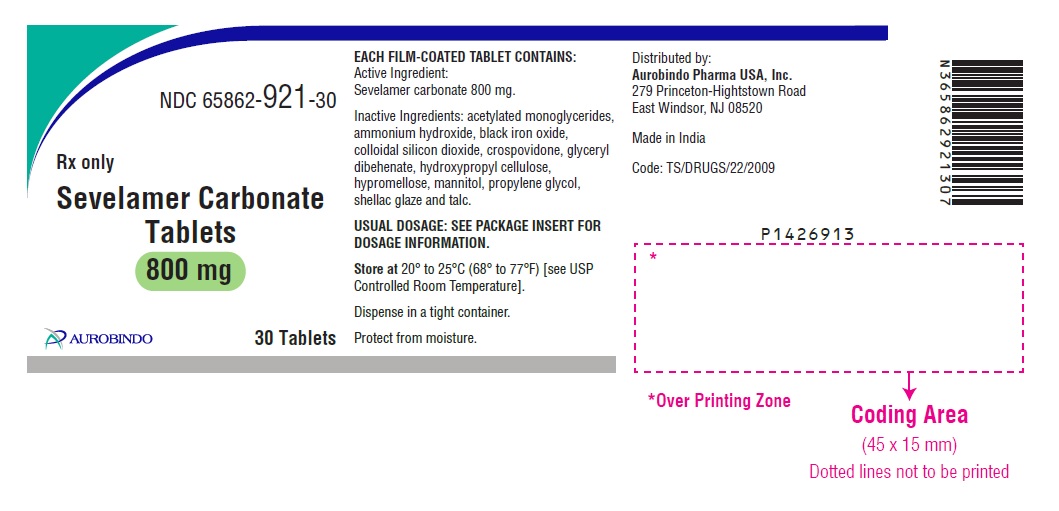
PACKAGE LABEL-PRINCIPAL DISPLAY PANEL - 800 mg (30 Tablets Bottle) NDC 65862-921-30 Rx only Sevelamer Carbonate Tablets 800 mg AUROBINDO 30 Tablets PACKAGE LABEL-PRINCIPAL DISPLAY PANEL - 800 mg (30 Tablets Bottle)