
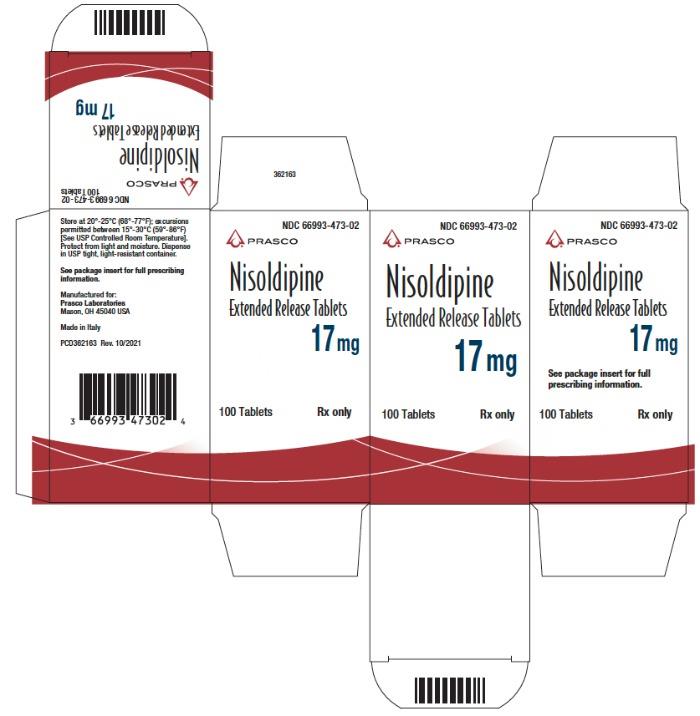
Nisoldipine 17 mg Tablet, Film Coated, Extended Release, 100-count — NDC 66993-473-02 (Billing 66993-0473-02)
This is a package of 100 tablets of Nisoldipine 17 mg Tablet, Film Coated, Extended Release from Prasco Laboratories, marketed since Feb 2012 and currently FDA-listed, this package's marketing is listed to end May 2027; retail pharmacies pay about $4.66 per tablet (NADAC). It is this product's only package size.
NDC database record
One package, one record: these facts belong to NDC 66993-473-02 alone.
- Record
- FDA NDC Directory package listing · Human prescription drug
- Code segments
- 66993 labeler · 473 product · 02 package
- Package marketed since
- Feb 27, 2012
- Package marketing ended
- May 31, 2027
- Sample package
- No — commercial package
- Billing quantity
- 100 EA per package
- Barcode (UPC-A, from the NDC)
- 3 6699347302 4
- FDA record last changed
- Jul 24, 2026
Identity & classification
Regulatory identifiers FDA, NLM and CMS codes for this package
Drug-database identifiers Medi-Span GPI and First Databank GCN / HICL / AHFS classification
- GSN (GCN sequence number): 063731
- GCN: 99446
- GPI-14 (Medi-Span): 34000024007517
- HICL (First Databank): 008268
- AHFS class code: 24:28.08.00
- RxCUI (RxNorm): 763519
Where does this data come from?
- FDA openFDA NDC Directory · synced Oct 1, 2026
- FDA label on DailyMed · label index refreshed Oct 3, 2026
- RxNorm (NLM RxNav) · catalog refreshed Oct 1, 2026
- Medi-Span GPI (licensed)
- First Databank (licensed) · refreshed Oct 1, 2026
RxNorm drug class
This medicine belongs to the Dihydropyridine Calcium Channel Blocker class.
Where does this data come from?
- RxClass (NLM) · catalog refreshed Oct 1, 2026
Clinical
Nisoldipine is used to treat high blood pressure. Nisoldipine is in a class of medications called calcium channel blockers. It works by relaxing your blood vessels so your heart does not have to pump as hard. High blood pressure is a common condition and when not treated, can cause damage to the brain, heart, blood vessels, kidneys and other parts of the body. Damage to these organs may cause heart disease, a heart attack, heart failure, stroke, kidney failure, loss of vision, and other problems. In addition to taking medication, making lifestyle changes will also help to control your blood pr...
Read the full MedlinePlus article ↗- It treats high blood pressure. Your doctor may prescribe it alone or with other blood pressure medicines. It works by relaxing and widening your small arteries.
- Take one tablet by mouth once a day on an empty stomach, either 1 hour before or 2 hours after a meal. Swallow it whole. Don't crush, split or chew it, because it's built to releas...
- No, please avoid grapefruit products before and after your dose. Grapefruit can raise the amount of nisoldipine in your blood a lot. That can make side effects such as low blood pr...
- The most common ones are swelling in the legs or feet, headache, dizziness, a sore throat and flushing. Swelling is more likely at higher doses. Tell me or your doctor if they both...
Patient education
Supplement & herbal interactions
Some supplements/herbs that may interact with Nisoldipine — tap one for details:
Nisoldipine may be associated with lower levels of 2 nutrients — worth a chat with your pharmacist, not a cause for alarm.
Where does this data come from?
- MedlinePlus (NLM) · refreshed Oct 1, 2026
- FDA label on DailyMed · label index refreshed Oct 3, 2026
Ask a licensed pharmacist directly — free, answered by our team.
Pricing
A drug doesn't have one price. Each row is a different public payment system, and none is what you'd pay at the counter — that depends on your insurance. The ⓘ on each row explains what it measures.
| Price system | Per ea | Per package |
|---|---|---|
| Retail pharmacies payNADAC · weekly | $4.659 | $465.90 / 100 tablets |
| Medicaid paysCMS SDUD · 12 mo | No recent Medicaid claims on file for this NDC — rare and low-volume NDCs are suppressed in the public data. | |
| Medicare drug plans payPart D · Q2 2026 | $4.32 | $431.63 / 100 tablets |
Where does this data come from?
- CMS NADAC weekly file · file of Sep 30, 2026
- CMS ASP pricing files · refreshed Sep 20, 2026
- CMS Medicaid State Drug Utilization Data · refreshed Oct 4, 2026
- CMS Part D plan pricing files · refreshed Sep 24, 2026
- VA National Acquisition Center price file
Packaging — all sizes for this product
| Package NDC | Description | Marketing start | Marketing end | Status |
|---|---|---|---|---|
| 66993-0473-02 You're viewing this Main listing | 1 BOTTLE in 1 CARTON / 100 TABLET, FILM COATED, EXTENDED RELEASE in 1 BOTTLE | 2012-02-27 | May 31, 2027 | Active |
Therapeutic equivalents
| Product | Labeler | Pack | NADAC/unit | TE | Status | Price vs. this |
|---|---|---|---|---|---|---|
| Nisoldipine 17 mgthis 66993-0473-02 | Prasco | 100 tablets | $4.659 | — | Availability likely | — |
| Sular 17 mg 70515-0501-10 | Covis | 100 tablets | — | — | FDA listed | — |
| nisoldipine 17 mg 23155-0977-01 | Heritage | 100 tablets | — | — | FDA listed | — |
Where does this data come from?
- FDA openFDA NDC Directory · synced Oct 1, 2026
- FDA Orange Book · refreshed Oct 3, 2026
- CMS NADAC weekly file · file of Sep 30, 2026
Availability & generic status
The FDA lists approved generic versions of this medicine, but that does not always mean a pharmacy can get one today. Patent rules, launch agreements, supply and pricing can affect when generics actually arrive.
Where does this data come from?
- FDA Orange Book · refreshed Oct 3, 2026
What it looks like
Where does this data come from?
- FDA label on DailyMed · label index refreshed Oct 3, 2026
Inactive Ingredients / Excipients
Inactive ingredients, also called excipients, are components of the drug product other than the active ingredient. They may include fillers, dyes, coatings, preservatives, flavors, or other formulation ingredients.
💡 Tap an ingredient (hover on desktop) to see what it is and why it’s used.
-
UNII R12CBM0EIZ
A natural wax derived from a Brazilian palm tree, used as a coating and polish on tablets and capsules. It creates a smooth, shiny finish that protects the medicine and improves appearance.
-
UNII I753WB2F1M
FD&C Yellow No. 5 is a synthetic yellow colorant approved by the FDA. It is added to medicines to make pills, tablets, or liquids visually distinct and easier to identify.
-
UNII 1K09F3G675
Ferric oxide red is an inorganic iron compound used as a colorant in medicines. It gives tablets, capsules, or other dosage forms a red or reddish tint for identification and appearance.
-
UNII R8WTH25YS2
Glyceryl dibehenate is a wax-like substance made from behenate fatty acids and glycerol. It functions as a binder and release-control agent in tablets and capsules, helping hold ingredients together and regulate how quickly the medicine dissolves and releases in your body.
-
UNII 87Y6436BKR
Hypromellose phthalate is a plant-derived polymer that forms a protective coating around pills and capsules. It dissolves in the intestines rather than the stomach, helping deliver the medicine to the right place for absorption.
-
UNII 3NXW29V3WO
Hypromellose is a plant-based thickener made from cellulose. It's used in medicines as a binder to hold ingredients together, a coating for tablets, and a thickener for liquids.
-
UNII J2B2A4N98G
Lactose is a natural sugar derived from milk. In medications, it serves as a filler and binder to add bulk and help hold tablet or capsule ingredients together during manufacturing.
-
UNII 70097M6I30
Magnesium stearate is a salt made from magnesium and stearic acid, a fatty substance. It's used in tablets and capsules as a lubricant and glidant to help ingredients flow smoothly during manufacturing and prevent sticking.
-
UNII 5KY68S2577
A synthetic plastic polymer made from two chemical compounds combined in a specific ratio. It forms a coating on tablets and capsules to control how and where the medication dissolves in the digestive tract.
-
UNII VH2XOU12IE
Polydextrose is a synthetic polymer made from dextrose (sugar) that acts as a bulking agent and filler in medicines. It helps give tablets and capsules proper volume and texture while often adding slight sweetness.
-
UNII 3WJQ0SDW1A
Polyethylene glycol is a synthetic liquid or solid polymer used in medicines as a solvent, lubricant, and humectant. It helps dissolve active ingredients, reduces friction during manufacturing, and retains moisture in the final product.
-
UNII FZ989GH94E
Povidone is a synthetic polymer made from a plastic-like material. It acts as a binder to hold tablet ingredients together and as a disintegrant to help the tablet break apart in your stomach so the medicine can be absorbed.
-
UNII ETJ7Z6XBU4
Silicon dioxide is a naturally occurring mineral used as a glidant and anti-caking agent. It helps powder ingredients flow smoothly and prevents clumping during manufacturing and storage.
-
UNII 368GB5141J
A detergent and foaming agent derived from coconut or palm oil. In medications, it helps break down and mix oil and water-based ingredients, aids in tablet disintegration, and improves how the drug dissolves and spreads in the mouth or digestive system.
-
UNII 15FIX9V2JP
Titanium dioxide is a bright white mineral powder commonly used as a colorant and opacifying agent. It makes pills and tablets white or lighter in color and helps make coatings non-transparent.
15 inactive ingredients listed in the exact product block matched to this NDC.
Where does this data come from?
ingredient classCode="IACT" elements from the exact product block matched by this NDC. Label-section narrative from DailyMed / the openFDA label index is shown separately when available.- FDA label on DailyMed · label index refreshed Oct 3, 2026
- FDA openFDA NDC Directory · synced Oct 1, 2026
Inactive ingredient FAQ
Are inactive ingredients the same for every manufacturer?
Why might an inactive ingredient be missing?
Can inactive ingredients matter?
Manufacturer & labeler
More NDCs from Prasco Laboratories labeler code 66993
- Prazosin Hydrochloride 1 mg Capsule NDC 66993-431-85
- Prazosin Hydrochloride 2 mg Capsule NDC 66993-432-85
- Prazosin Hydrochloride 5 mg Capsule NDC 66993-433-85
- Dapagliflozin 5 mg Tablet, Film Coated NDC 66993-456-30
- Dapagliflozin 10 mg Tablet, Film Coated NDC 66993-457-30
- Nisoldipine 8.5 mg Tablet, Film Coated, Extended Release NDC 66993-472-02
- Nisoldipine 34 mg Tablet, Film Coated, Extended Release NDC 66993-475-02
- Ibuprofen Lysine 10 mg/mL Solution NDC 66993-490-36
- Teriparatide 250 ug/mL Injection, Solution NDC 66993-495-28
- Fluticasone Propionate and Salmeterol DISKUS 100 ug; 50 ug Powder NDC 66993-584-97
- Fluticasone Propionate and Salmeterol DISKUS 250 ug; 50 ug Powder NDC 66993-585-97
- Fluticasone Propionate and Salmeterol DISKUS 500 ug; 50 ug Powder NDC 66993-586-97
Where does this data come from?
- FDA openFDA NDC Directory · synced Oct 1, 2026
- Drugs@FDA
Full prescribing information FDA SPL
🎯 Indications and Usage ▾
INDICATIONS AND USAGE Nisoldipine is indicated for the treatment of hypertension. It may be used alone or in combination with other antihypertensive agents.
⏱️ Dosage and Administration ▾
DOSAGE AND ADMINISTRATION The dosage of Nisoldipine must be adjusted to each patient’s needs. Therapy usually should be initiated with 17 mg orally once daily, then increased by 8.5 mg per week or longer intervals, to attain adequate control of blood pressure. Usual maintenance dosage is 17 to 34 mg once daily.
Blood pressure response increases over the 8.5 - 34 mg daily dose range but adverse event rates also increase. Doses beyond 34 mg once daily are not recommended. Nisoldipine has been used safely with diuretics, ACE inhibitors, and beta-blocking agents.
Patients over age 65, or patients with impaired liver function, are expected to develop higher plasma concentrations of nisoldipine. Their blood pressure should be monitored closely during any dosage adjustment. A starting dose not exceeding 8.5 mg daily is recommended in these patient groups.
Nisoldipine tablets should be administered orally once daily. Nisoldipine should be taken on an empty stomach (1 hour before or 2 hours after a meal). Grapefruit products should be avoided before and after dosing.
Nisoldipine is an extended release dosage form and tablets should be swallowed whole, not bitten, divided or crushed.
⛔ Contraindications ▾
CONTRAINDICATIONS Nisoldipine is contraindicated in patients with known hypersensitivity to dihydropyridine calcium channel blockers.
⚠️ Warnings ▾
WARNINGS Increased angina and/or myocardial infarction in patients with coronary artery disease : Rarely, patients, particularly those with severe obstructive coronary artery disease, have developed increased frequency, duration and/or severity of angina, or acute myocardial infarction on starting calcium channel blocker therapy or at the time of dosage increase. The mechanism of this effect has not been established. In controlled studies of Nisoldipine in patients with angina this was seen about 1.5% of the time in patients given nisoldipine, compared with 0.9% in patients given placebo.
🤒 Adverse Reactions ▾
ADVERSE EXPERIENCES More than 6000 patients world-wide have received nisoldipine in clinical trials for the treatment of hypertension, either as the immediate release or the Nisoldipine extended release formulation. Of about 1,500 patients who received Nisoldipine in hypertension studies, about 55% were exposed for at least 2 months and about one third were exposed for over 6 months, the great majority at doses equivalent to 17 mg and above. Nisoldipine is generally well-tolerated.
In the U.S. clinical trials of Nisoldipine in hypertension, 10.9% of the 921 Nisoldipine patients discontinued treatment due to adverse events compared with 2.9% of 280 placebo patients. The frequency of discontinuations due to adverse experiences was related to dose, with a 5.4% and 10.9% discontinuation rate at the lowest and highest daily dose, respectively. The most frequently occurring adverse experiences with Nisoldipine are those related to its vasodilator properties; these are generally mild and only occasionally lead to patient withdrawal from treatment.
The table below, from U.S. placebo-controlled parallel dose response trials of Nisoldipine using doses across the clinical dosage range in patients with hypertension, lists all of the adverse events, regardless of the causal relationship to Nisoldipine, for which the overall incidence on Nisoldipine was both >1% and greater with Nisoldipine than with placebo. Adverse Event Nisoldipine (%) (n=663) Placebo (%) (n=280) Peripheral Edema 22 10 Headache 22 15 Dizziness 5 4 Pharyngitis 5 4 Vasodilation 4 2 Sinusitis 3 2 Palpitation 3 1 Chest Pain 2 1 Nausea 2 1 Rash 2 1 Only peripheral edema and possibly dizziness appear to be dose related.
Nisoldipine, dose bioequivalent to: Adverse Event Placebo 8.5 mg 17 mg 25.5 mg 34 mg (Rates in %) N=280 N=30 N=170 N=105 N=139 Peripheral Edema 10 7 15 20 27 Dizziness 4 7 3 3 4 The common adverse events occurred at about the same rate in men as in women, and at a similar rate in patients over age 65 as in those under that age, except that headache was much less common in older patients. Except for peripheral edema and vasodilation, which were more common in whites, adverse event rates were similar in blacks and whites.
The following adverse events occurred in ≤1% of all patients treated for hypertension in U.S. and foreign clinical trials, or with unspecified incidence in other studies. Although a causal relationship of Nisoldipine to these events cannot be established, they are listed to alert the physician to a possible relationship with Nisoldipine treatment. Body As A Whole : cellulitis, chills, facial edema, fever, flu syndrome, malaise Cardiovascular : atrial fibrillation, cerebrovascular accident, congestive heart failure, first degree AV block, hypertension, hypotension, jugular venous distension, migraine, myocardial infarction, postural hypotension, ventricular extrasystoles, supraventricular tachycardia, syncope, systolic ejection murmur, T wave abnormalities on ECG (flattening, inversion, nonspecific changes), venous insufficiency Digestive : abnormal liver function tests, anorexia, colitis, diarrhea, dry mouth, dyspepsia, dysphagia, flatulence, gastritis, gastrointestinal hemorrhage, gingival hyperplasia, glossitis, hepatomegaly, increased appetite, melena, mouth ulceration Endocrine : diabetes mellitus, thyroiditis Hemic and Lymphatic : anemia, ecchymoses, leukopenia, petechiae Metabolic and Nutritional : gout, hypokalemia, increased serum creatine kinase, increased nonprotein nitrogen, weight gain, weight loss Musculoskeletal : arthralgia, arthritis, leg cramps, myalgia, myasthenia, myositis, tenosynovitis Nervous : abnormal dreams, abnormal thinking and confusion, amnesia, anxiety, ataxia, cerebral ischemia, decreased libido, depression, hypesthesia, hypertonia, insomnia, nervousness, paresthesia, somnolence, tremor, vertigo Respiratory : asthma, dyspnea, end inspiratory wheeze and fine rales, epistaxis, increased cough, laryngitis, pharyngitis… [Excerpted — this section continues on DailyMed.]
🔄 Drug Interactions ▾
Drug Interactions A 30 to 45% increase in AUC and C max of nisoldipine was observed with concomitant administration of cimetidine 400 mg twice daily. Ranitidine 150 mg twice daily did not interact significantly with nisoldipine (AUC was decreased by 15 - 20%). No pharmacodynamic effects of either histamine H 2 receptor antagonist were observed.
CYP3A4 inhibitors and inducers : Nisoldipine is substrate of CYP3A4 and coadministration of Nisoldipine with any known inducer or inhibitor of CYP3A4 should be avoided in general. Coadministration of phenytoin with a dose bioequivalent to 34 mg Nisoldipine tablets in epileptic patients lowered the nisoldipine plasma concentrations to undetectable levels. Coadministration of Nisoldipine with phenytoin should be avoided and alternative antihypertensive therapy should be considered.
Pharmacokinetic interactions between nisoldipine and beta-blockers (atenolol, propranolol) were variable and not significant. Propranolol attenuated the heart rate increase following administration of immediate release nisoldipine. The blood pressure effect of Nisoldipine tended to be greater in patients on atenolol than in patients on no other antihypertensive therapy.
Quinidine at 648 mg bid decreased the bioavailability (AUC) of nisoldipine by 26%, but not the peak concentration. Immediate release nisoldipine increased plasma quinidine concentrations by about 20%. This interaction was not accompanied by ECG changes and its clinical significance is not known.
No significant interactions were found between nisoldipine and warfarin or digoxin.
🧒 Pediatric Use ▾
Pediatric Use Safety and effectiveness in pediatric patients have not been established.
🧓 Geriatric Use ▾
Geriatric Use Clinical studies of nisoldipine did not include sufficient numbers of subjects aged 65 and over to determine whether they respond differently from younger subjects. Other reported clinical experience has not identified differences in responses between the elderly and younger patients. Patients over 65 are expected to develop higher plasma concentrations of nisoldipine.
In general, dose selection for an elderly patient should be cautious, usually starting at the low end of the dosing range, reflecting the greater frequency of decreased hepatic, renal or cardiac function, and of concomitant disease or other drug therapy.
🆘 Overdosage ▾
OVERDOSAGE There is no experience with nisoldipine overdosage. Generally, overdosage with other dihydropyridines leading to pronounced hypotension calls for active cardiovascular support including monitoring of cardiovascular and respiratory function, elevation of extremities, judicious use of calcium infusion, pressor agents and fluids. Clearance of nisoldipine would be expected to be slowed in patients with impaired liver function.
Since nisoldipine is highly protein bound, dialysis is not likely to be of any benefit; however, plasmapheresis may be beneficial.
🧬 Clinical Pharmacology ▾
CLINICAL PHARMACOLOGY Mechanism of Action Nisoldipine is a member of the dihydropyridine class of calcium channel antagonists (calcium ion antagonists or slow channel blockers) that inhibit the transmembrane influx of calcium into vascular smooth muscle and cardiac muscle. It reversibly competes with other dihydropyridines for binding to the calcium channel. Because the contractile process of vascular smooth muscle is dependent upon the movement of extracellular calcium into the muscle through specific ion channels, inhibition of the calcium channel results in dilation of the arterioles.
In vitro studies show that the effects of nisoldipine on contractile processes are selective, with greater potency on vascular smooth muscle than on cardiac muscle. Although, like other dihydropyridine calcium channel blockers, nisoldipine has negative inotropic effects in vitro , studies conducted in intact anesthetized animals have shown that the vasodilating effect occurs at doses lower than those that affect cardiac contractility. The effect of nisoldipine on blood pressure is principally a consequence of a dose-related decrease of peripheral vascular resistance.
While nisoldipine, like other dihydropyridines, exhibits a mild diuretic effect, most of the antihypertensive activity is attributed to its effect on peripheral vascular resistance. Pharmacokinetics and Metabolism Nisoldipine pharmacokinetics are independent of the dose across the clinical dosage range of 17 to 51 mg, with plasma concentrations proportional to dose. Nisoldipine accumulation, during multiple dosing, is predictable from a single dose.
Nisoldipine is relatively well absorbed into the systemic circulation with 87% of the radiolabeled drug recovered in urine and feces. The absolute bioavailability of nisoldipine is about 5%. Nisoldipine's low bioavailability is due, in part, to pre-systemic metabolism in the gut wall, and this metabolism decreases from the proximal to the distal parts of the intestine.
A pronounced food-effect is observed when Nisoldipine is administered with a high-fat meal resulting in an increased peak concentration (C max ) of up to 245%. Total exposure (AUC) is decreased by 25%. As a result, Nisoldipine should be taken on an empty stomach (1 hour before or 2 hours after a meal).
Maximal plasma concentrations of nisoldipine are reached at 9.2 ± 5.1 hours. The terminal elimination half-life (reflecting post absorption clearance of nisoldipine) ranges from 13.7 ± 4.3 hours. After oral administration, the concentration of (+)-nisoldipine, the active enantiomer, is about 6 times higher than the inactive (-) -nisoldipine enantiomer.
The plasma protein binding of nisoldipine is very high, with less than 1% unbound over the plasma concentration range of 100 ng/mL to 10 mcg/mL. Nisoldipine is highly metabolized; 5 major urinary metabolites have been identified. Although 60 - 80% of an oral dose undergoes urinary excretion, only traces of unchanged nisoldipine are found in urine.
The major biotransformation pathway appears to be the hydroxylation of the isobutyl ester. A hydroxylated derivative of the side chain, present in plasma at concentrations approximately equal to the parent compound, appears to be the only active metabolite, and has about 10% of the activity of the parent compound. Cytochrome P450 enzymes are believed to play a major role in the metabolism of nisoldipine.
The particular isoenzyme system responsible for its metabolism has not been identified, but other dihydropyridines are metabolized by cytochrome P450 IIIA4. Nisoldipine should not be administered with grapefruit juice, as this has been shown, in a study of 12 subjects, to interfere with nisoldipine metabolism, resulting in a mean increase in C max of about 3-fold (ranging up to about 7-fold) and AUC of almost 2-fold (ranging up to about 5-fold). A similar phenomenon has been seen with several other dihydropyridine calcium channel blockers.
Special Populations Renal Dysfunction : Be… [Excerpted — this section continues on DailyMed.]
🧬 Mechanism of Action ▾
Mechanism of Action Nisoldipine is a member of the dihydropyridine class of calcium channel antagonists (calcium ion antagonists or slow channel blockers) that inhibit the transmembrane influx of calcium into vascular smooth muscle and cardiac muscle. It reversibly competes with other dihydropyridines for binding to the calcium channel. Because the contractile process of vascular smooth muscle is dependent upon the movement of extracellular calcium into the muscle through specific ion channels, inhibition of the calcium channel results in dilation of the arterioles.
In vitro studies show that the effects of nisoldipine on contractile processes are selective, with greater potency on vascular smooth muscle than on cardiac muscle. Although, like other dihydropyridine calcium channel blockers, nisoldipine has negative inotropic effects in vitro , studies conducted in intact anesthetized animals have shown that the vasodilating effect occurs at doses lower than those that affect cardiac contractility. The effect of nisoldipine on blood pressure is principally a consequence of a dose-related decrease of peripheral vascular resistance.
While nisoldipine, like other dihydropyridines, exhibits a mild diuretic effect, most of the antihypertensive activity is attributed to its effect on peripheral vascular resistance.
📦 How Supplied / Storage and Handling ▾
HOW SUPPLIED Nisoldipine extended release tablets are supplied as 8.5 mg and 17 mg round film coated tablets and 34 mg elliptic film coated tablets. The different strengths can be identified as follows: Strength Color Markings 8.5 mg Oyster SCI 500 17 mg Yellow Cream SCI 501 34 mg Burnt Orange SCI 503 Nisoldipine Tablets are supplied in bottles of 100: NDC Code Strength 66993-472-02 8.5 mg 66993-473-02 17 mg 66993-475-02 34 mg Protect from light and moisture. Store at 20°-25°C (68°-77°F); excursions permitted to 15°-30°C (59°-86°F) [see USP Controlled Room Temperature].
Dispense in tight, light-resistant containers. Rx only Manufactured for: Prasco Laboratories Mason, OH 45040 USA Rev 10/2021 362168
📋 Description ▾
DESCRIPTION Nisoldipine is an extended release tablet dosage form of the dihydropyridine calcium channel blocker nisoldipine. Nisoldipine is 3,5-pyridinedicarboxylic acid, 1,4-dihydro-2,6-dimethyl-4-(2-nitrophenyl)-, methyl 2-methylpropyl ester, C 20 H 24 N 2 O 6 , and has the structural formula: Nisoldipine is a yellow crystalline substance, practically insoluble in water but soluble in ethanol. It has a molecular weight of 388.4.
Nisoldipine tablets comprise three layers: a top barrier layer, a middle layer containing nisoldipine, and a bottom barrier layer. The erodible barrier layers and the hydrogel middle layer provide for the controlled release of the drug. Nisoldipine tablets contain either 8.5, 17, or 34 mg of nisoldipine for once-a-day oral administration.
Inactive ingredients in the formulation include: Hypromellose, hypromellose phthalate, lactose, glyceryl behenate, povidone, magnesium stearate, silicon dioxide, methacrylic acid copolymer, and sodium lauryl sulfate. Inactive ingredients in the film coating include: polydextrose, titanium dioxide, hypromellose, polyethylene glycol, iron oxide, and carnauba wax. Additionally, the 17 mg formulation contains FD&C Yellow #5. chem
💬 Information for Patients ▾
Information for Patients Nisoldipine is an extended release tablet and should be swallowed whole. Tablets should not be chewed, divided or crushed. Nisoldipine should be taken on an empty stomach (1 hour before or 2 hours after a meal).
Grapefruit juice, which has been shown to increase significantly the bioavailability of nisoldipine and other dihydropyridine type calcium channel blockers, should not be taken with Nisoldipine. This product contains FD&C Yellow No. 5 (tartrazine) which may cause allergic-type reactions (including bronchial asthma) in certain susceptible persons.
Although the overall incidence of FD&C Yellow No. 5 (tartrazine) sensitivity in the general population is low, it is frequently seen in patients who also have aspirin hypersensitivity.
⚠️ Precautions ▾
PRECAUTIONS General Hypotension : Because nisoldipine, like other vasodilators, decreases peripheral vascular resistance, careful monitoring of blood pressure during the initial administration and titration of Nisoldipine is recommended. Close observation is especially important for patients already taking medications that are known to lower blood pressure. Although in most patients the hypotensive effect of Nisoldipine is modest and well tolerated, occasional patients have had excessive and poorly tolerated hypotension.
These responses have usually occurred during initial titration or at the time of subsequent upward dosage adjustment. Congestive Heart Failure : Although acute hemodynamic studies of nisoldipine in patients with NYHA Class II-IV heart failure have not demonstrated negative inotropic effects, safety of Nisoldipine in patients with heart failure has not been established. Caution therefore should be exercised when using Nisoldipine in patients with heart failure or compromised ventricular function, particularly in combination with a beta-blocker.
Patients with Hepatic Impairment : Because nisoldipine is extensively metabolized by the liver and, in patients with cirrhosis, it reaches blood concentrations about 5 times those in normals, Nisoldipine should be administered cautiously in patients with severe hepatic dysfunction (see DOSAGE AND ADMINISTRATION ). Information for Patients Nisoldipine is an extended release tablet and should be swallowed whole. Tablets should not be chewed, divided or crushed.
Nisoldipine should be taken on an empty stomach (1 hour before or 2 hours after a meal). Grapefruit juice, which has been shown to increase significantly the bioavailability of nisoldipine and other dihydropyridine type calcium channel blockers, should not be taken with Nisoldipine. This product contains FD&C Yellow No.
5 (tartrazine) which may cause allergic-type reactions (including bronchial asthma) in certain susceptible persons. Although the overall incidence of FD&C Yellow No. 5 (tartrazine) sensitivity in the general population is low, it is frequently seen in patients who also have aspirin hypersensitivity.
Laboratory Tests Nisoldipine is not known to interfere with the interpretation of laboratory tests. Drug Interactions A 30 to 45% increase in AUC and C max of nisoldipine was observed with concomitant administration of cimetidine 400 mg twice daily. Ranitidine 150 mg twice daily did not interact significantly with nisoldipine (AUC was decreased by 15 - 20%).
No pharmacodynamic effects of either histamine H 2 receptor antagonist were observed. CYP3A4 inhibitors and inducers : Nisoldipine is substrate of CYP3A4 and coadministration of Nisoldipine with any known inducer or inhibitor of CYP3A4 should be avoided in general. Coadministration of phenytoin with a dose bioequivalent to 34 mg Nisoldipine tablets in epileptic patients lowered the nisoldipine plasma concentrations to undetectable levels.
Coadministration of Nisoldipine with phenytoin should be avoided and alternative antihypertensive therapy should be considered. Pharmacokinetic interactions between nisoldipine and beta-blockers (atenolol, propranolol) were variable and not significant. Propranolol attenuated the heart rate increase following administration of immediate release nisoldipine.
The blood pressure effect of Nisoldipine tended to be greater in patients on atenolol than in patients on no other antihypertensive therapy. Quinidine at 648 mg bid decreased the bioavailability (AUC) of nisoldipine by 26%, but not the peak concentration. Immediate release nisoldipine increased plasma quinidine concentrations by about 20%.
This interaction was not accompanied by ECG changes and its clinical significance is not known. No significant interactions were found between nisoldipine and warfarin or digoxin. Carcinogenesis, Mutagenesis, Impairment of Fertility Dietary administration of nisoldipine to male and female rats for up to 24 months (mean doses up… [Excerpted — this section continues on DailyMed.]
🍼 Nursing Mothers ▾
Nursing Mothers It is not known whether nisoldipine is excreted in human milk. Because many drugs are excreted in human milk, a decision should be made to discontinue nursing, or to discontinue Nisoldipine, taking into account the importance of the drug to the mother.
🧬 Pharmacokinetics ▾
Pharmacokinetics and Metabolism Nisoldipine pharmacokinetics are independent of the dose across the clinical dosage range of 17 to 51 mg, with plasma concentrations proportional to dose. Nisoldipine accumulation, during multiple dosing, is predictable from a single dose. Nisoldipine is relatively well absorbed into the systemic circulation with 87% of the radiolabeled drug recovered in urine and feces.
The absolute bioavailability of nisoldipine is about 5%. Nisoldipine's low bioavailability is due, in part, to pre-systemic metabolism in the gut wall, and this metabolism decreases from the proximal to the distal parts of the intestine. A pronounced food-effect is observed when Nisoldipine is administered with a high-fat meal resulting in an increased peak concentration (C max ) of up to 245%.
Total exposure (AUC) is decreased by 25%. As a result, Nisoldipine should be taken on an empty stomach (1 hour before or 2 hours after a meal). Maximal plasma concentrations of nisoldipine are reached at 9.2 ± 5.1 hours.
The terminal elimination half-life (reflecting post absorption clearance of nisoldipine) ranges from 13.7 ± 4.3 hours. After oral administration, the concentration of (+)-nisoldipine, the active enantiomer, is about 6 times higher than the inactive (-) -nisoldipine enantiomer. The plasma protein binding of nisoldipine is very high, with less than 1% unbound over the plasma concentration range of 100 ng/mL to 10 mcg/mL.
Nisoldipine is highly metabolized; 5 major urinary metabolites have been identified. Although 60 - 80% of an oral dose undergoes urinary excretion, only traces of unchanged nisoldipine are found in urine. The major biotransformation pathway appears to be the hydroxylation of the isobutyl ester.
A hydroxylated derivative of the side chain, present in plasma at concentrations approximately equal to the parent compound, appears to be the only active metabolite, and has about 10% of the activity of the parent compound. Cytochrome P450 enzymes are believed to play a major role in the metabolism of nisoldipine. The particular isoenzyme system responsible for its metabolism has not been identified, but other dihydropyridines are metabolized by cytochrome P450 IIIA4.
Nisoldipine should not be administered with grapefruit juice, as this has been shown, in a study of 12 subjects, to interfere with nisoldipine metabolism, resulting in a mean increase in C max of about 3-fold (ranging up to about 7-fold) and AUC of almost 2-fold (ranging up to about 5-fold). A similar phenomenon has been seen with several other dihydropyridine calcium channel blockers.
🧬 Pharmacodynamics ▾
Pharmacodynamics Hemodynamic Effects Administration of a single dose of nisoldipine leads to decreased systemic vascular resistance and blood pressure with a transient increase in heart rate. The change in heart rate is greater with immediate release nisoldipine preparations. The effect on blood pressure is directly related to the initial degree of elevation above normal.
Chronic administration of nisoldipine results in a sustained decrease in vascular resistance and small increases in stroke index and left ventricular ejection fraction. A study of the immediate release formulation showed no effect of nisoldipine on the renin-angiotensin-aldosterone system or on plasma norepinephrine concentration in normals. Changes in blood pressure in hypertensive patients given Nisoldipine were dose related over the clinical dosage range.
Nisoldipine does not appear to have significant negative inotropic activity in intact animals or humans, and did not lead to worsening of clinical heart failure in three small studies of patients with asymptomatic and symptomatic left ventricular dysfunction. There is little information, however, in patients with severe congestive heart failure, and all calcium channel blockers should be used with caution in any patient with heart failure. Electrophysiologic Effects Nisoldipine has no clinically important chronotropic effects.
Except for mild shortening of sinus cycle, SA conduction time and AH intervals, single oral doses up to 20 mg of immediate release nisoldipine did not significantly change other conduction parameters. Similar electrophysiologic effects were seen with single IV doses, which could be blunted in patients pre-treated with beta-blockers. Dose and plasma level related flattening or inversion of T-waves have been observed in a few small studies.
Such reports were concentrated in patients receiving rapidly increased high doses in one study; the phenomenon has not been a cause of safety concern in large clinical trials.
🔬 Clinical Studies ▾
Clinical Studies in Hypertension The antihypertensive efficacy of Nisoldipine was studied in 5 double-blind, placebo-controlled, randomized studies, in which over 600 patients were treated with Nisoldipine as monotherapy and about 300 with placebo; 4 of the five studies compared 2 or 3 fixed doses while the fifth allowed titration from doses bioequivalent to 8.5 - 34 mg. Once daily administration of Nisoldipine produced sustained reductions in systolic and diastolic blood pressures over the 24 hour dosing interval in both supine and standing positions.
The mean placebo-subtracted reductions in supine systolic and diastolic blood pressure at trough, 24 hours post-dose, in these studies, are shown below. Changes in standing blood pressure were similar: MEAN SUPINE TROUGH SYSTOLIC AND DIASTOLIC BLOOD PRESSURE CHANGES (mm Hg) Nisoldipine Doses bioequivalent to: (mg/day) 8.5 mg 17 mg 25.5 mg 34 mg 8.5-34 mg titrated Systolic 8 11 11 14 15 Diastolic 3 5 7 7 8 In patients receiving atenolol, supine blood pressure reductions with Nisoldipine at doses bioequivalent to 17 and 34 mg once daily were 12/6 and 19/8 mm Hg, respectively.
The sustained antihypertensive effect of Nisoldipine was demonstrated by 24 hour blood pressure monitoring and examination of peak and trough effects. The trough/peak ratios ranged from 70 to 100% for diastolic and systolic blood pressure. The mean change in heart rate in these studies was less than one beat per minute.
In 4 of the 5 studies, patients received initial doses bioequivalent to 17-25.5 mg Nisoldipine without incident (excessive effects on blood pressure or heart rate). The fifth study started patients on lower doses of Nisoldipine. Patient race and gender did not influence the blood pressure lowering effect of Nisoldipine.
Despite the higher plasma concentration of nisoldipine in the elderly, there was no consistent difference in their blood pressure response except that the lowest clinical dose was somewhat more effective than in non-elderly patients. No postural effect on blood pressure was apparent and there was no evidence of tolerance to the antihypertensive effect of Nisoldipine in patients treated for up to one year.
📄 Carcinogenesis, Mutagenesis, Impairment of Fertility ▾
Carcinogenesis, Mutagenesis, Impairment of Fertility Dietary administration of nisoldipine to male and female rats for up to 24 months (mean doses up to 82 and 111 mg/kg/day, 16 and 19 times the maximum recommended human dose [MRHD] on a mg/m 2 basis, respectively) and female mice for up to 21 months (mean doses of up to 217 mg/kg/day, 20 times the MRHD on a mg/m 2 basis) revealed no evidence of tumorigenic effect of nisoldipine. In male mice receiving a mean dose of 163 mg nisoldipine/kg/day (16 times the MRHD of 60 mg/day on a mg/m 2 basis), an increased frequency of stomach papilloma, but still within the historical range, was observed.
No evidence of stomach neoplasia was observed at lower doses (up to 58 mg/kg/day). Nisoldipine was negative when tested in a battery of genotoxicity assays including the Ames test and the CHO/HGRPT assay for mutagenicity and the in vivo mouse micronucleus test and in vitro CHO cell test for clastogenicity. When administered to male and female rats at doses of up to 30 mg/kg/day (about 5 times the MRHD on a mg/m 2 basis) nisoldipine had no effect on fertility.
📄 Package Label / Principal Display Panel ▾
PRINCIPAL DISPLAY PANEL - 8.5 mg Tablet Bottle Carton NDC 66993-472-02 Nisoldipine Extended Release Tablets 8.5 mg 100 Tablets Rx only Carton
PRINCIPAL DISPLAY PANEL - 17 mg Tablet Bottle Carton NDC 66993-473-02 Nisoldipine Extended Release Tablets 17 mg 100 Tablets Rx Only Carton
PRINCIPAL DISPLAY PANEL - 34 mg Tablet Bottle Carton NDC 66993-475-02 Nisoldipine Extended Release Tablets 34 mg 100 Tablets Rx Only carton