
Dipyridamole 75 mg Tablet, Film Coated — NDC 68382-189-77 (Billing 68382-0189-77)
This is a package of Dipyridamole 75 mg Tablet, Film Coated from Zydus Pharmaceuticals USA Inc., marketed since May 2008 and currently FDA-listed.
NDC database record
One package, one record: these facts belong to NDC 68382-189-77 alone.
- Record
- FDA NDC Directory package listing · Human prescription drug
- Code segments
- 68382 labeler · 189 product · 77 package
- Package marketed since
- May 22, 2008
- Sample package
- No — commercial package
- Listing certified through
- Dec 31, 2026
- Barcode (UPC-A, from the NDC)
- 3 6838218977 6
- FDA record last changed
- Jul 24, 2026
Identity & classification
Regulatory identifiers FDA, NLM and CMS codes for this package
Drug-database identifiers Medi-Span GPI and First Databank GCN / HICL / AHFS classification
- GSN (GCN sequence number): 041700
- GCN: 53143
- GPI-14 (Medi-Span): 85150030000330
- HICL (First Databank): 000168
- AHFS class code: 20:12.18.00
- RxCUI (RxNorm): 197622
Where does this data come from?
- FDA openFDA NDC Directory · synced Oct 8, 2026
- FDA label on DailyMed · label index refreshed Oct 8, 2026
- RxNorm (NLM RxNav) · catalog refreshed Oct 8, 2026
- Medi-Span GPI (licensed)
- First Databank (licensed) · refreshed Oct 8, 2026
RxNorm drug class
This medicine belongs to the Platelet Aggregation Inhibitor class.
Where does this data come from?
- RxClass (NLM) · catalog refreshed Oct 8, 2026
Clinical
Dipyridamole is used to reduce the risk of blood clots after a heart valve replacement. Dipyridamole is in a class of medications called platelet inhibitors. It works by stopping blood from clotting too much.
Read the full MedlinePlus article ↗- It depends on the form. The tablets are added to warfarin-type blood thinners to help prevent clots after cardiac valve replacement. The injection is used in a heart imaging stress...
- You take them by mouth, generally four times a day, along with your usual warfarin. Follow your prescriber’s directions and the label closely.
- The label says aspirin should not be given together with coumarin anticoagulants like warfarin. Check with me or your prescriber before taking any aspirin product.
- The label’s side effect numbers come from the injection. People often had chest pain, headache, dizziness, nausea or flushing. Get help right away for severe chest pain, trouble br...
Patient education
Supplement & herbal interactions
Some supplements/herbs that may interact with Dipyridamole — tap one for details:
Where does this data come from?
- MedlinePlus (NLM) · refreshed Oct 8, 2026
- FDA label on DailyMed · label index refreshed Oct 8, 2026
Ask a licensed pharmacist directly — free, answered by our team.
Pricing
A drug doesn't have one price. Each row is a different public payment system, and none is what you'd pay at the counter — that depends on your insurance. The ⓘ on each row explains what it measures.
| Price system | Per each | Per package |
|---|---|---|
| Retail pharmacies payNADAC · weekly | Not in the retail survey — common for institutional, discontinued, or low-volume packs. | |
| Medicaid paysCMS SDUD · 12 mo | No recent Medicaid claims on file for this NDC — rare and low-volume NDCs are suppressed in the public data. | |
| Medicare drug plans payPart D · Q2 2026 | $0.5076 | $50.76 / 100 tablets |
Where does this data come from?
- CMS NADAC weekly file
- CMS ASP pricing files · refreshed Sep 20, 2026
- CMS Medicaid State Drug Utilization Data · refreshed Oct 9, 2026
- CMS Part D plan pricing files · refreshed Sep 24, 2026
- VA National Acquisition Center price file
Packaging — all sizes for this product
| Package NDC | Description | Per unit | Per pack | Marketing start | Marketing end | Status |
|---|---|---|---|---|---|---|
| 68382-0189-01 68382-189-01 Main listing | 100 TABLET, FILM COATED in 1 BOTTLE | $0.2358 / ea | $23.58 | 2008-05-22 | — | Active |
| 68382-0189-05 68382-189-05 | 500 TABLET, FILM COATED in 1 BOTTLE | — | — | 2008-05-22 | — | Active |
| 68382-0189-10 68382-189-10 | 1000 TABLET, FILM COATED in 1 BOTTLE | — | — | 2008-05-22 | — | Active |
| 68382-0189-77 You're viewing this | 10 BLISTER PACK in 1 CARTON / 10 TABLET, FILM COATED in 1 BLISTER PACK | — | — | 2008-05-22 | — | Active |
Pack size FAQ
What quantity is in this package?
What NDC number is used to bill for this package of Dipyridamole 75 mg Tablet, Film Coated?
Prices are the latest CMS NADAC pharmacy acquisition cost per NDC; per-pack figures are per-unit × pack quantity, shown only when the pack is denominated in the same measure NADAC prices.
Therapeutic equivalents
| Product | Labeler | Pack | NADAC/unit | TE | Status | Price vs. this |
|---|---|---|---|---|---|---|
| Dipyridamole 75 mg 00115-1072-01 | Amneal | 100 tablets | $0.236 | AB | Availability likely | — |
| Dipyridamole 75 mg 69584-0183-10 | Oxford | 100 tablets | $0.236 | AB | Availability likely | — |
| Dipyridamole 75 mg 65841-0664-01 | Zydus | 100 tablets | — | AB | FDA listed | — |
| Dipyridamole 75 mgthis 68382-0189-77 | Zydus | 10 tablets | — | AB | FDA listed | — |
Where does this data come from?
- FDA openFDA NDC Directory · synced Oct 8, 2026
- FDA Orange Book · refreshed Oct 3, 2026
- CMS NADAC weekly file
Availability & generic status
This product is an FDA-approved generic. Other versions of the same drug are listed under Therapeutic equivalents, least expensive first.
Where does this data come from?
- FDA Orange Book · refreshed Oct 3, 2026
What it looks like
Where does this data come from?
- FDA label on DailyMed · label index refreshed Oct 8, 2026
Inactive Ingredients / Excipients
Inactive ingredients, also called excipients, are components of the drug product other than the active ingredient. They may include fillers, dyes, coatings, preservatives, flavors, or other formulation ingredients.
🧪 Avoiding an ingredient? See Dipyridamole inactive ingredients by manufacturer: every current product's list side by side, so you can ask your pharmacy for the version that does not list it.
💡 Tap an ingredient (hover on desktop) to see what it is and why it’s used.
-
UNII EX438O2MRT
Ferric oxide yellow is a naturally occurring iron compound used as a colorant in medications. It gives tablets, capsules, and other forms a yellow or golden hue for identification and appearance.
-
UNII 0WZ8WG20P6
Hypromellose 2910 is a plant-based cellulose derivative that acts as a thickener, binder, and film-coating agent. It helps control how quickly the medicine dissolves and protects the tablet or capsule from moisture and light.
-
UNII EWQ57Q8I5X
Lactose monohydrate is a natural sugar derived from milk. It serves as a filler and binder in tablets and capsules, helping create the proper size, texture, and consistency of the medicine.
-
UNII 70097M6I30
Magnesium stearate is a salt made from magnesium and stearic acid, a fatty substance. It's used in tablets and capsules as a lubricant and glidant to help ingredients flow smoothly during manufacturing and prevent sticking.
-
UNII 3WJQ0SDW1A
Polyethylene glycol is a synthetic liquid or solid polymer used in medicines as a solvent, lubricant, and humectant. It helps dissolve active ingredients, reduces friction during manufacturing, and retains moisture in the final product.
-
UNII U725QWY32X
Povidone K30 is a synthetic polymer made from petroleum. It acts as a binder to hold tablet ingredients together and as a disintegrant to help the tablet break apart in the stomach so the medicine can be absorbed.
-
UNII O8232NY3SJ
A plant-based carbohydrate derived from corn kernels. It acts as a filler to add bulk, a binder to hold ingredients together, and a disintegrant to help the tablet break apart in your stomach for absorption.
-
UNII 15FIX9V2JP
Titanium dioxide is a bright white mineral powder commonly used as a colorant and opacifying agent. It makes pills and tablets white or lighter in color and helps make coatings non-transparent.
8 inactive ingredients listed in the exact product block matched to this NDC.
Where does this data come from?
ingredient classCode="IACT" elements from the exact product block matched by this NDC. Label-section narrative from DailyMed / the openFDA label index is shown separately when available.- FDA label on DailyMed · label index refreshed Oct 8, 2026
- FDA openFDA NDC Directory · synced Oct 8, 2026
Inactive ingredient FAQ
Are inactive ingredients the same for every manufacturer?
Why might an inactive ingredient be missing?
Can inactive ingredients matter?
Manufacturer & labeler
More NDCs from Zydus Pharmaceuticals USA Inc. labeler code 68382
- Buspirone hydrochloride 30 mg Tablet NDC 68382-183-05
- Glipizide and Metformin Hydrochloride 2.5 mg; 250 mg Tablet, Film Coated NDC 68382-184-01
- Glipizide and Metformin Hydrochloride 2.5 mg; 500 mg Tablet, Film Coated NDC 68382-185-01
- Glipizide and Metformin Hydrochloride 5 mg; 500 mg Tablet, Film Coated NDC 68382-186-01
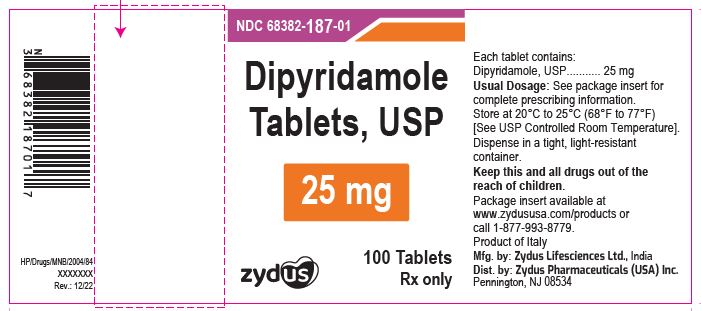
- Dipyridamole 25 mg Tablet, Film Coated NDC 68382-187-01
- Dipyridamole 50 mg Tablet, Film Coated NDC 68382-188-01
- Gabapentin 600 mg Tablet, Film Coated NDC 68382-204-01
- Gabapentin 800 mg Tablet, Film Coated NDC 68382-205-01
- Anastrozole 1 mg Tablet, Coated NDC 68382-209-06
- atomoxetine 40 mg Capsule NDC 68382-218-02
- amiodarone hydrochloride 200 mg Tablet NDC 68382-227-05
- Benzonatate 100 mg Capsule NDC 68382-247-01
Where does this data come from?
- FDA openFDA NDC Directory · synced Oct 8, 2026
- Drugs@FDA
Full prescribing information FDA SPL
🎯 Indications and Usage ▾
INDICATIONS AND USAGE Dipyridamole tablets are indicated as an adjunct to coumarin anticoagulants in the prevention of postoperative thromboembolic complications of cardiac valve replacement.
⏱️ Dosage and Administration ▾
DOSAGE AND ADMINISTRATION Adjunctive Use in Prophylaxis of Thromboembolism after Cardiac Valve Replacement The recommended dose is 75 to 100 mg four times daily as an adjunct to the usual warfarin therapy. Please note that aspirin is not to be administered concomitantly with coumarin anticoagulants.
⛔ Contraindications ▾
CONTRAINDICATIONS Hypersensitivity to dipyridamole and any of the other components.
🤒 Adverse Reactions ▾
ADVERSE REACTIONS Adverse reactions at therapeutic doses are usually minimal and transient. On long-term use of dipyridamole tablets initial side effects usually disappear. The following reactions in Table 1 were reported in two heart valve replacement trials comparing dipyridamole tablets and warfarin therapy to either warfarin alone or warfarin and placebo: Table 1 Adverse Reactions Reported in 2 Heart Valve Replacement Trials Adverse Reaction Dipyridamole Tablets/ Placebo/ Warfarin Warfarin Number of patients 147 170 Dizziness 13.6% 8.2% Abdominal distress 6.
1% 3.5% Headache 2.3% 0.0% Rash 2.3% 1.1% Other reactions from uncontrolled studies include diarrhea, vomiting, flushing and pruritus. In addition, angina pectoris has been reported rarely and there have been rare reports of liver dysfunction. On those uncommon occasions when adverse reactions have been persistent or intolerable, they have ceased on withdrawal of the medication.
When dipyridamole tablets were administered concomitantly with warfarin, bleeding was no greater in frequency or severity than that observed when warfarin was administered alone. In rare cases, increased bleeding during or after surgery has been observed. In post-marketing reporting experience, there have been rare reports of hypersensitivity reactions (such as rash, urticaria, severe bronchospasm, and angioedema), larynx edema, fatigue, malaise, myalgia, arthritis, nausea, dyspepsia, paresthesia, hepatitis, thrombocytopenia, alopecia, cholelithiasis, hypotension, palpitation, and tachycardia.
🔄 Drug Interactions ▾
Drug Interactions No pharmacokinetic drug-drug interaction studies were conducted with dipyridamole tablets. The following information was obtained from the literature. Adenosinergic agents (e.g., adenosine, regadenoson) Dipyridamole has been reported to increase the plasma levels and cardiovascular effects of adenosine.
Adjustment of adenosine dosage may be necessary. Dipyridamole also increases the cardiovascular effects of regadenoson, an adenosine A 2A -receptor agonist. The potential risk of cardiovascular side effects with intravenous adenosinergic agents may be increased during the testing period when dipyridamole is not held 48 hours prior to stress testing.
Cholinesterase Inhibitors Dipyridamole may counteract the anticholinesterase effect of cholinesterase inhibitors, thereby potentially aggravating myasthenia gravis.
🤰 Pregnancy ▾
Pregnancy Teratogenic Effects: PREGNANCY CATEGORY B Reproduction studies have been performed in mice, rabbits and rats at oral dipyridamole doses of up to 125 mg/kg, 40 mg/kg and 1000 mg/kg, respectively (about 1 1/2 , 2 and 25 times the maximum recommended daily human oral dose, respectively, on a mg/m 2 basis) and have revealed no evidence of harm to the fetus due to dipyridamole. There are, however, no adequate and well-controlled studies in pregnant women. Because animal reproduction studies are not always predictive of human response, dipyridamole tablets should be used during pregnancy only if clearly needed.
🧒 Pediatric Use ▾
Pediatric Use Safety and effectiveness in the pediatric population below the age of 12 years have not been established.
🆘 Overdosage ▾
OVERDOSAGE In case of real or suspected overdose, seek medical attention or contact a Poison Control Center immediately. Careful medical management is essential. Based upon the known hemodynamic effects of dipyridamole, symptoms such as warm feeling, flushes, sweating, restlessness, feeling of weakness and dizziness may occur.
A drop in blood pressure and tachycardia might also be observed. Symptomatic treatment is recommended, possibly including a vasopressor drug. Gastric lavage should be considered.
Administration of xanthine derivatives (e.g., aminophylline) may reverse the hemodynamic effects of dipyridamole overdose. Since dipyridamole is highly protein bound, dialysis is not likely to be of benefit.
🧬 Clinical Pharmacology ▾
CLINICAL PHARMACOLOGY It is believed that platelet reactivity and interaction with prosthetic cardiac valve surfaces, resulting in abnormally shortened platelet survival time, is a significant factor in thromboembolic complications occurring in connection with prosthetic heart valve replacement. Dipyridamole tablets have been found to lengthen abnormally shortened platelet survival time in a dose-dependent manner. In three randomized controlled clinical trials involving 854 patients who had undergone surgical placement of a prosthetic heart valve, dipyridamole tablets, in combination with warfarin, decreased the incidence of postoperative thromboembolic events by 62 to 91% compared to warfarin treatment alone.
The incidence of thromboembolic events in patients receiving the combination of dipyridamole tablets and warfarin ranged from 1.2 to 1.8%. In three additional studies involving 392 patients taking dipyridamole tablets and coumarin-like anticoagulants, the incidence of thromboembolic events ranged from 2.3 to 6.9%. In these trials, the coumarin anticoagulant was begun between 24 hours and 4 days postoperatively, and the dipyridamole tablets were begun between 24 hours and 10 days postoperatively.
The length of follow-up in these trials varied from 1 to 2 years. Dipyridamole tablets do not influence prothrombin time or activity measurements when administered with warfarin. Mechanism of Action Dipyridamole inhibits the uptake of adenosine into platelets, endothelial cells and erythrocytes in vitro and in vivo ; the inhibition occurs in a dose-dependent manner at therapeutic concentrations (0.5 to 1.9 mcg/mL).
This inhibition results in an increase in local concentrations of adenosine which acts on the platelet A 2 -receptor thereby stimulating platelet adenylate cyclase and increasing platelet cyclic-3',5'-adenosine monophosphate (cAMP) levels. Via this mechanism, platelet aggregation is inhibited in response to various stimuli such as platelet activating factor (PAF), collagen and adenosine diphosphate (ADP). Dipyridamole inhibits phosphodiesterase (PDE) in various tissues.
While the inhibition of cAMP-PDE is weak, therapeutic levels of dipyridamole inhibit cyclic-3',5'-guanosine monophosphate-PDE (cGMP-PDE), thereby augmenting the increase in cGMP produced by EDRF (endothelium-derived relaxing factor, now identified as nitric oxide). Hemodynamics In dogs intraduodenal doses of dipyridamole of 0.5 to 4.0 mg/kg produced dose-related decreases in systemic and coronary vascular resistance leading to decreases in systemic blood pressure and increases in coronary blood flow. Onset of action was in about 24 minutes and effects persisted for about 3 hours.
Similar effects were observed following intravenous dipyridamole in doses ranging from 0.025 to 2.0 mg/kg. In man the same qualitative hemodynamic effects have been observed. However, acute intravenous administration of dipyridamole may worsen regional myocardial perfusion distal to partial occlusion of coronary arteries.
Pharmacokinetics and Metabolism Following an oral dose of dipyridamole tablets, the average time to peak concentration is about 75 minutes. The decline in plasma concentration following a dose of dipyridamole tablets fits a two-compartment model. The alpha half-life (the initial decline following peak concentration) is approximately 40 minutes.
The beta half-life (the terminal decline in plasma concentration) is approximately 10 hours. Dipyridamole is highly bound to plasma proteins. It is metabolized in the liver where it is conjugated as a glucuronide and excreted with the bile.
🧬 Mechanism of Action ▾
Mechanism of Action Dipyridamole inhibits the uptake of adenosine into platelets, endothelial cells and erythrocytes in vitro and in vivo ; the inhibition occurs in a dose-dependent manner at therapeutic concentrations (0.5 to 1.9 mcg/mL). This inhibition results in an increase in local concentrations of adenosine which acts on the platelet A 2 -receptor thereby stimulating platelet adenylate cyclase and increasing platelet cyclic-3',5'-adenosine monophosphate (cAMP) levels. Via this mechanism, platelet aggregation is inhibited in response to various stimuli such as platelet activating factor (PAF), collagen and adenosine diphosphate (ADP).
Dipyridamole inhibits phosphodiesterase (PDE) in various tissues. While the inhibition of cAMP-PDE is weak, therapeutic levels of dipyridamole inhibit cyclic-3',5'-guanosine monophosphate-PDE (cGMP-PDE), thereby augmenting the increase in cGMP produced by EDRF (endothelium-derived relaxing factor, now identified as nitric oxide).
📦 How Supplied / Storage and Handling ▾
HOW SUPPLIED Dipyridamole Tablets USP, 25 mg are light yellow, round, biconvex, film-coated tablets debossed with 'ZE 43' on one side and plain on the other side are supplied as follows: NDC 68382-187-01 in bottle of 100 tablets NDC 68382-187-05 in bottle of 500 tablets NDC 68382-187-10 in bottle of 1000 tablets NDC 68382-187-77 in unit-dose blister cartons of 100 (10 x 10) unit-dose tablets Dipyridamole Tablets USP, 50 mg are light yellow, round, biconvex, beveled-edge, film-coated tablets debossed with 'ZE 49' on one side and plain on the other side are supplied as follows: NDC 68382-188-01 in bottle of 100 tablets NDC 68382-188-05 in bottle of 500 tablets NDC 68382-188-10 in bottle of 1000 tablets NDC 68382-188-77 in unit-dose blister cartons of 100 (10 x 10) unit-dose tablets Dipyridamole Tablets USP, 75 mg are light yellow, round, biconvex, beveled-edge, film-coated tablets debossed with 'ZE 50' on one side and plain on the other side are supplied as follows: NDC 68382-189-01 in bottle of 100 tablets NDC 68382-189-05 in bottle of 500 tablets NDC 68382-189-10 in bottle of 1000 tablets NDC 68382-189-77 in unit-dose blister cartons of 100 (10 x 10) unit-dose tablets
📦 Storage and Handling ▾
STORAGE Store at 20°C to 25°C (68°F to 77°F) [ See USP Controlled Room Temperature ]. Keep out of reach of children. Dispense in a tight, light-resistant container. Package insert available at www.zydususa.com/products or call 1-877-993-8779.
📋 Description ▾
DESCRIPTION Dipyridamole is a platelet inhibitor chemically described as 2,2',2'',2'''-[(4,8-Dipiperidinopyrimido[5,4- d ]pyrimidine-2,6-diyl)dinitrilo]-tetraethanol. It has the following structural formula: C 24 H 40 N 8 O 4 Mol. Wt.
504.63 Dipyridamole, USP is intensely yellow crystalline powder or needles. It is very soluble in methanol, in alcohol, and in chloroform; slightly soluble in water; very slightly soluble in acetone and in ethyl acetate. Each dipyridamole tablet intended for oral administration contains 25 mg or 50 mg or 75 mg of dipyridamole.
In addition, each tablet contains the following inactive ingredients: corn starch, hypromellose, iron oxide yellow, lactose monohydrate, magnesium stearate, polyethylene glycol, povidone and titanium dioxide. structured formula for dipyridamole
⚠️ Precautions ▾
PRECAUTIONS General Coronary Artery Disease Dipyridamole has a vasodilatory effect and should be used with caution in patients with severe coronary artery disease (e.g., unstable angina or recently sustained myocardial infarction). Chest pain may be aggravated in patients with underlying coronary artery disease who are receiving dipyridamole. Hepatic Insufficiency Elevations of hepatic enzymes and hepatic failure have been reported in association with dipyridamole administration.
Hypotension Dipyridamole should be used with caution in patients with hypotension since it can produce peripheral vasodilation. Stress Testing with Intravenous Dipyridamole and Other Adenosinergic Agents Clinical experience suggests that patients being treated with dipyridamole tablets who also require pharmacological stress testing with intravenous dipyridamole or other adenosinergic agents (e.g. adenosine, regadenoson) should interrupt dipyridamole tablets for 48 hours prior to stress testing. Intake of dipyridamole tablets within 48 hours prior to stress testing with intravenous dipyridamole or other adenosinergic agents may increase the risk for cardiovascular side effects of these agents and may impair the sensitivity of the test.
Laboratory Tests Dipyridamole has been associated with elevated hepatic enzymes. Drug Interactions No pharmacokinetic drug-drug interaction studies were conducted with dipyridamole tablets. The following information was obtained from the literature.
Adenosinergic agents (e.g., adenosine, regadenoson) Dipyridamole has been reported to increase the plasma levels and cardiovascular effects of adenosine. Adjustment of adenosine dosage may be necessary. Dipyridamole also increases the cardiovascular effects of regadenoson, an adenosine A 2A -receptor agonist.
The potential risk of cardiovascular side effects with intravenous adenosinergic agents may be increased during the testing period when dipyridamole is not held 48 hours prior to stress testing. Cholinesterase Inhibitors Dipyridamole may counteract the anticholinesterase effect of cholinesterase inhibitors, thereby potentially aggravating myasthenia gravis. Carcinogenesis, Mutagenesis, Impairment of Fertility In studies in which dipyridamole was administered in the feed to mice (up to 111 weeks in males and females) and rats (up to 128 weeks in males and up to 142 weeks in females), there was no evidence of drug-related carcinogenesis.
The highest dose administered in these studies (75 mg/kg/day) was, on a mg/m 2 basis, about equivalent to the maximum recommended daily human oral dose (MRHD) in mice and about twice the MRHD in rats. Mutagenicity tests of dipyridamole with bacterial and mammalian cell systems were negative. There was no evidence of impaired fertility when dipyridamole was administered to male and female rats at oral doses up to 500 mg/kg/day (about 12 times the MRHD on a mg/m 2 basis).
A significant reduction in number of corpora lutea with consequent reduction in implantations and live fetuses was, however, observed at 1250 mg/kg (more than 30 times the MRHD on a mg/m 2 basis). Pregnancy Teratogenic Effects: PREGNANCY CATEGORY B Reproduction studies have been performed in mice, rabbits and rats at oral dipyridamole doses of up to 125 mg/kg, 40 mg/kg and 1000 mg/kg, respectively (about 1 1/2 , 2 and 25 times the maximum recommended daily human oral dose, respectively, on a mg/m 2 basis) and have revealed no evidence of harm to the fetus due to dipyridamole.
There are, however, no adequate and well-controlled studies in pregnant women. Because animal reproduction studies are not always predictive of human response, dipyridamole tablets should be used during pregnancy only if clearly needed. Nursing Mothers As dipyridamole is excreted in human milk , caution should be exercised when dipyridamole tablets are administered to a nursing woman.
Pediatric Use Safety and effectiveness in the pediatric population below the age of 12 years have not been established… [Excerpted — this section continues on DailyMed.]
🍼 Nursing Mothers ▾
Nursing Mothers As dipyridamole is excreted in human milk , caution should be exercised when dipyridamole tablets are administered to a nursing woman.
📄 Package Label / Principal Display Panel ▾
PACKAGE LABEL.PRINCIPAL DISPLAY PANEL NDC 68382-187-05 in bottle of 500 tablets Dipyridamole Tablets USP, 25 mg R x only 500 tablets NDC 68382-188-05 in bottle of 500 tablets Dipyridamole Tablets USP, 50 mg R x only 500 tablets NDC 68382-189-05 in bottle of 500 tablets Dipyridamole Tablets USP, 75 mg R x only 500 tablets Dipyridamole tablets, 25 mg Dipyridamole Tablets, 50 mg Dipyridamole Tablets, 75 mg
Medicaid utilization by pack size
Medicare Part D spend CMS · PART D · 2026 (Q1)
Reported adverse events (FAERS)
Top reported reactions
Reporter sex
Serious outcomes
Where does this data come from?
About this NDC listing & data coverage
What data is (and isn’t) available for this NDC — tap to expand
| NDC identity (package / product / labeler codes) | ✓ Available |
| Labeler | ✓ Available |
| Product & package description | ✓ Available |
| Marketing category & status | ✓ Available |
| Active ingredient / dosage form / route | ✓ Available |
| FDA label (SPL via DailyMed) | ✓ Available |
| Package photos | ✓ Available |
| Inactive ingredients (structured) | ✓ Available |
| NADAC pharmacy acquisition price (CMS) | — Not published for this NDC CMS publishes NADAC only for NDCs reported in its retail-pharmacy survey. |
| Orange Book / therapeutic-equivalence data | ✓ Available |
| HCPCS J-code billing crosswalk | — Not published for this NDC Most self-administered / retail products have no J-code — that is normal. |
| Medicaid utilization (CMS SDUD) | — Not published for this NDC CMS reports utilization only for NDCs with Medicaid claims above its privacy threshold. |