
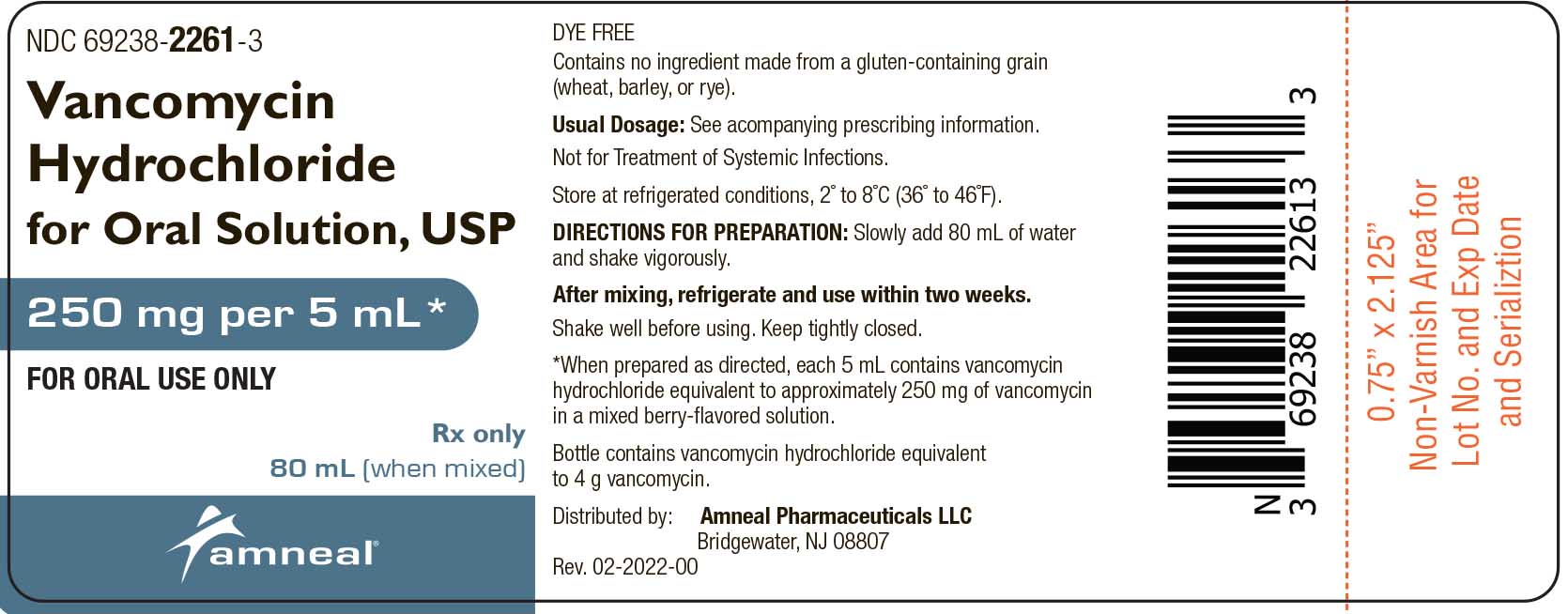
Vancomycin Hydrochloride 250 mg/5mL Solution, 300 mL — NDC 69238-2261-5 (Billing 69238-2261-05)
This is a package of 300 mL of Vancomycin Hydrochloride 250 mg/5mL Solution from Amneal Pharmaceuticals NY LLC, marketed since Jun 2023 and currently FDA-listed; retail pharmacies pay about $0.8007 per mL (NADAC).
Other active recalls for Vancomycin Hydrochloride (different manufacturers) — 2 · tap to view
Past resolved recalls for this product (1)
Identity & classification
Regulatory identifiers FDA, NLM and CMS codes for this package
Drug-database identifiers Medi-Span GPI and First Databank GCN / HICL / AHFS classification
- GSN (GCN sequence number): 009333
- GCN: 41291
- HICL (First Databank): 004042
- AHFS class code: 08:12.28.16
- RxCUI (RxNorm): 2000134
Where does this data come from?
- FDA openFDA NDC Directory · synced Oct 1, 2026
- FDA label on DailyMed · label index refreshed Oct 1, 2026
- RxNorm (NLM RxNav) · catalog refreshed Oct 1, 2026
- Medi-Span GPI (licensed)
- First Databank (licensed) · refreshed Oct 1, 2026
RxNorm drug class
This medicine belongs to the Glycopeptide Antibacterial class.
Where does this data come from?
- RxClass (NLM) · catalog refreshed Oct 1, 2026
Clinical
Vancomycin is used to treat colitis (inflammation of the intestine caused by certain bacteria) that may occur after taking an antibiotic. Vancomycin is in a class of medications called glycopeptide antibiotics. It works by killing bacteria in the intestines. Vancomycin will not kill bacteria in any other part of the body when taken by mouth. Antibiotics such as vancomycin will not work for colds, flu, or other viral infections. Taking antibiotics when they are not needed increases your risk of getting an infection later that resists antibiotic treatment.
Read the full MedlinePlus article ↗- It is an antibiotic. By IV, it treats serious infections like bloodstream, heart valve, bone, skin and lung infections. By mouth, it treats C. difficile diarrhea and staph infectio...
- Oral capsules or liquid are usually taken 3 or 4 times a day for about 7 to 10 days. IV doses are given slowly by a healthcare team. Follow your prescriber's directions and finish...
- With oral vancomycin, nausea, stomach pain, vomiting and low potassium are most common. Call your doctor promptly for hearing changes, ringing in the ears, rash or blisters, less u...
- Yes. It can cause kidney injury and hearing problems, especially with higher levels, older age, kidney disease, or other drugs that affect these organs. Your care team may check ki...
Patient education
Supplement & herbal interactions
Some supplements/herbs that may interact with Vancomycin Hydrochloride — tap one for details:
Vancomycin Hydrochloride may be associated with lower levels of 7 nutrients — worth a chat with your pharmacist, not a cause for alarm.
Where does this data come from?
- MedlinePlus (NLM) · refreshed Oct 1, 2026
- FDA label on DailyMed · label index refreshed Oct 1, 2026
Ask a licensed pharmacist directly — free, answered by our team.
Pricing
A drug doesn't have one price. Each row is a different public payment system, and none is what you'd pay at the counter — that depends on your insurance. The ⓘ on each row explains what it measures.
| Price system | Per mL | Per package |
|---|---|---|
| Retail pharmacies payNADAC · weekly | $0.801 | $240.21 / 300 ml |
| Medicaid paysCMS SDUD · 12 mo | No recent Medicaid claims on file for this NDC — rare and low-volume NDCs are suppressed in the public data. | |
| Medicare drug plans payPart D · Q2 2026 | $1.93 | $580.32 / 300 ml |
Where does this data come from?
- CMS NADAC weekly file · file of Sep 30, 2026
- CMS ASP pricing files · refreshed Sep 20, 2026
- CMS Medicaid State Drug Utilization Data · refreshed Oct 3, 2026
- CMS Part D plan pricing files · refreshed Sep 24, 2026
- VA National Acquisition Center price file
Packaging — all sizes for this product
| Package NDC | Description | Per unit | Per pack | Marketing start | Marketing end | Status |
|---|---|---|---|---|---|---|
| 69238-2261-03 69238-2261-3 Main listing | 80 mL in 1 BOTTLE | $2.91 / mL | $232.75 | 2023-06-26 | — | Active |
| 69238-2261-05 You're viewing this | 300 mL in 1 BOTTLE | $0.8007 / mL | $240.21 | 2023-06-26 | — | Active |
| 69238-2261-07 69238-2261-7 | 150 mL in 1 BOTTLE | $0.7416 / mL | $111.23 | 2023-06-26 | — | Active |
You're viewing the largest of 3 pack sizes for this product.
Per mL, this pack runs about 8% above the cheapest pack (150 mL, $0.7416 vs $0.8007 NADAC).
Pack size FAQ
What quantity is in this package?
How does this package differ from NDC 69238-2261-03?
What NDC number is used to bill for this package of Vancomycin Hydrochloride 250 mg/5mL Solution?
Prices are the latest CMS NADAC pharmacy acquisition cost per NDC; per-pack figures are per-unit × pack quantity, shown only when the pack is denominated in the same measure NADAC prices.
Therapeutic equivalents
| Product | Labeler | Pack | NADAC/unit | TE | Status | Price vs. this |
|---|---|---|---|---|---|---|
| Vancomycin Hydrochloride for Oral Solution 52536-0106-05 | Wilshire | 1 kit | $0.702 | AA | Availability likely | save 12% |
| Vancomycin Hydrochloride for Oral Solution 52536-0108-10 | Wilshire | 1 kit | $0.801 | AA | Availability likely | — |
| Vancomycin Hydrochloride 250 mg/5mL 62559-0830-03 | ANI | 300 ml | $0.801 | — | Availability likely | — |
| Vancomycin Hydrochloride 67877-0751-58 | Ascend | 1 kit | $0.801 | AA | Availability likely | — |
| Vancomycin Hydrochloride 250 mg/5mLthis 69238-2261-05 | Amneal | 300 ml | $0.801 | — | Availability likely | — |
| Firvanq 65628-0206-05 | Azurity | 1 kit | $1.186 | AA | Availability likely | +48% |
| Vancomycin Hydrochloride 250 mg/5mL 63629-1970-01 | Bryant | 80 ml | — | — | FDA listed | — |
| Vancomycin Hydrochloride 250 mg/5mL 63629-1971-01 | Bryant | 150 ml | — | — | FDA listed | — |
| Vancomycin Hydrochloride 250 mg/5mL 63629-1972-01 | Bryant | 300 ml | — | — | FDA listed | — |
| Firvanq 65628-0208-10 | Azurity | 1 kit | — | AA | FDA listed | — |
| Vancomycin Hydrochloride 250 mg/5mL 71335-2948-01 | Bryant | 80 ml | — | — | FDA listed | — |
| Vancomycin Hydrochloride 250 mg/5mL 71335-2950-01 | Bryant | 150 ml | — | — | FDA listed | — |
| Vancomycin Hydrochloride 250 mg/5mL 72162-1775-02 | Bryant | 150 ml | — | — | FDA listed | — |
Where does this data come from?
- FDA openFDA NDC Directory · synced Oct 1, 2026
- FDA Orange Book · refreshed Sep 3, 2026
- CMS NADAC weekly file · file of Sep 30, 2026
Availability & generic status
This product is an FDA-approved generic. Other versions of the same drug are listed under Therapeutic equivalents, least expensive first.
Where does this data come from?
- FDA Orange Book · refreshed Sep 3, 2026
What it looks like
Where does this data come from?
- FDA label on DailyMed · label index refreshed Oct 1, 2026
Inactive Ingredients / Excipients
Inactive ingredients, also called excipients, are components of the drug product other than the active ingredient. They may include fillers, dyes, coatings, preservatives, flavors, or other formulation ingredients.
💡 Tap an ingredient (hover on desktop) to see what it is and why it’s used.
-
UNII 5C5403N26O
Acacia is a natural gum derived from acacia tree sap. It serves as a binder, thickener, and emulsifier to help hold ingredients together, improve texture, and stabilize the medicine.
-
UNII 0N8672707O
A starch derived from corn kernels. It acts as a binder to hold tablet ingredients together, a filler to give the tablet bulk, and a disintegrant to help the tablet break apart in your stomach.
-
UNII WZB9127XOA
A synthetic red dye used to color medications and make them easier to identify. It serves as a colorant in tablets, capsules, and liquid formulations.
-
UNII 817L1N4CKP
Malic acid is a naturally occurring organic acid found in fruits. It works as a buffer and flavor agent to maintain the medicine's pH balance and add tartness to the product.
-
UNII 7CVR7L4A2D
A starch-derived carbohydrate produced by breaking down corn, potato, or tapioca starch. It functions as a filler and binder to give the medicine bulk and texture, and sometimes as a mild sweetener or texture enhancer in powders and tablets.
-
UNII OJ245FE5EU
Sodium benzoate is a salt derived from benzoic acid, a preservative. It's added to medicines to prevent growth of bacteria, fungi, and other microorganisms that could spoil the product.
-
UNII KH7I04HPUU
A salt compound made from sodium and phosphoric acid, used as a buffer to help maintain a stable pH level in the medicine, and sometimes as a binder or filler in tablets and capsules.
-
UNII 96K6UQ3ZD4
Sucralose is a synthetic sweetener made from sugar. It's added to medicines to improve taste without adding calories, helping make bitter or unpleasant-tasting drugs easier to take.
8 inactive ingredients listed in the exact product block matched to this NDC.
Where does this data come from?
ingredient classCode="IACT" elements from the exact product block matched by this NDC. Label-section narrative from DailyMed / the openFDA label index is shown separately when available.- FDA label on DailyMed · label index refreshed Oct 1, 2026
- FDA openFDA NDC Directory · synced Oct 1, 2026
Inactive ingredient FAQ
Are inactive ingredients the same for every manufacturer?
Why might an inactive ingredient be missing?
Can inactive ingredients matter?
Manufacturer & labeler
Where does this data come from?
- FDA openFDA NDC Directory · synced Oct 1, 2026
- Drugs@FDA
Full prescribing information FDA SPL
🎯 Indications and Usage ▾
INDICATIONS AND USAGE Vancomycin Hydrochloride for Oral Solution is administered orally for treatment of enterocolitis caused by Staphylococcus aureus (including methicillin-resistant strains) and antibiotic-associated pseudomembranous colitis caused by C. difficile . Parenteral administration of vancomycin is not effective for the above indications; therefore, Vancomycin Hydrochloride for Oral Solution must be given orally for these infections. Orally administered Vancomycin Hydrochloride for Oral Solution is not effective for other types of infection.
To reduce the development of drug-resistant bacteria and maintain the effectiveness of Vancomycin Hydrochloride for Oral Solution and other antibacterial drugs, Vancomycin Hydrochloride for Oral Solution should be used only to treat or prevent infections that are proven or strongly suspected to be caused by susceptible bacteria. When culture and susceptibility information are available, they should be considered in selecting or modifying antibacterial therapy. In the absence of such data, local epidemiology and susceptibility patterns may contribute to the empiric selection of therapy.
⏱️ Dosage and Administration ▾
DOSAGE AND ADMINISTRATION Adults Vancomycin Hydrochloride for Oral Solution is used in treating antibiotic-associated pseudomembranous colitis caused by C. difficile and staphylococcal enterocolitis. Vancomycin Hydrochloride for Oral Solution is not effective by the oral route for other types of infections. The usual adult total daily dosage is 500 mg to 2 g administered orally in 3 or 4 divided doses for 7 to 10 days.
Pediatric Patients The usual daily dosage is 40 mg/kg in 3 or 4 divided doses for 7 to 10 days. The total daily dosage should not exceed 2 g. PREPARATION AND STABILITY Mix the contents of the bottle with water as directed below.
When reconstituted, each 5 mL contains approximately 250 mg of vancomycin. These mixtures may be kept for two weeks in a refrigerator without significant loss of potency. Directions for mixing Vancomycin Hydrochloride for Oral Solution, USP: 80 mL – Slowly add 80 mL water and shake vigorously.
150 mL – Slowly add 150 mL water and shake vigorously. 300 mL – Slowly add 300 mL water and shake vigorously. The appropriate oral solution dose may be diluted in 1 oz of water and given to the patient to drink.
The diluted material may be administered via nasogastric tube.
⛔ Contraindications ▾
CONTRAINDICATIONS Vancomycin Hydrochloride for Oral Solution is contraindicated in patients with known hypersensitivity to vancomycin.
⚠️ Warnings ▾
WARNINGS Nephrotoxicity Nephrotoxicity (e.g., reports of renal failure, renal impairment, blood creatinine increased) has occurred following oral vancomycin hydrochloride therapy in randomized controlled clinical trials, and can occur either during or after completion of therapy. The risk of nephrotoxicity is increased in patients over 65 years of age. In patients over 65 years of age, including those with normal renal function prior to treatment, renal function should be monitored during and following treatment with vancomycin oral solution to detect potential vancomycin induced nephrotoxicity.
Ototoxicity Ototoxicity has occurred in patients receiving vancomycin. It may be transient or permanent. It has been reported mostly in patients who have been given excessive intravenous doses, who have an underlying hearing loss, or who are receiving concomitant therapy with another ototoxic agent, such as an aminoglycoside.
Serial tests of auditory function may be helpful in order to minimize the risk of ototoxicity. Severe Dermatologic Reactions Severe dermatologic reactions such as toxic epidermal necrolysis (TEN), Stevens-Johnson syndrome (SJS), drug reaction with eosinophilia and systemic symptoms (DRESS), acute generalized exanthematous pustulosis (AGEP), and linear IgA bullous dermatosis (LABD) have been reported in association with the use of vancomycin. Cutaneous signs or symptoms reported include skin rashes, mucosal lesions, and blisters.
Discontinue Vancomycin Hydrochloride for Oral Solution at the first appearance of signs and symptoms of TEN, SJS, DRESS, AGEP, or LABD. Clostridium Difficile Associated Diarrhea (CDAD) Significant systemic absorption has been reported in some patients (e.g., patients with renal insufficiency and/or colitis) who have taken multiple oral doses of vancomycin hydrochloride for C. difficile -associated diarrhea. In these patients, serum vancomycin concentrations reached therapeutic levels for the treatment of systemic infections.
Some patients with inflammatory disorders of the intestinal mucosa also may have significant systemic absorption of vancomycin. These patients may be at risk for the development of adverse reactions associated with higher doses of vancomycin oral solution; therefore, monitoring of serum concentrations of vancomycin may be appropriate in some instances, e.g., in patients with renal insufficiency and/or colitis or in those receiving concomitant therapy with an aminoglycoside antibacterial drug.
🤒 Adverse Reactions ▾
ADVERSE REACTIONS Nephrotoxicity Nephrotoxicity (e.g., reports of renal failure, renal impairment, blood creatinine increased) occurred in 5% of subjects treated with vancomycin hydrochloride. Nephrotoxicity following vancomycin hydrochloride typically first occurred within one week after completion of treatment (median day of onset was Day 16). Nephrotoxicity following vancomycin hydrochloride occurred in 6% of subjects over 65 years of age and 3% of subjects 65 years of age and younger.
Nephrotoxicity can also occur during oral vancomycin administration. The incidences of hypokalemia, urinary tract infection, peripheral edema, insomnia, constipation, anemia, depression, vomiting, and hypotension were higher among subjects over 65 years of age than in subjects 65 years of age and younger. Discontinuation of study drug due to adverse events occurred in 7% of subjects treated with vancomycin hydrochloride.
The most common adverse events leading to discontinuation of vancomycin hydrochloride were C. difficile colitis (< 1%), nausea (< 1%), and vomiting (< 1%). Ototoxicity Cases of hearing loss associated with intravenously administered vancomycin have been reported. Most of these patients had kidney dysfunction or a preexisting hearing loss or were receiving concomitant treatment with an ototoxic drug.
Vertigo, dizziness, and tinnitus have been reported rarely. Hematopoietic Reversible neutropenia, usually starting 1 week or more after onset of intravenous therapy with vancomycin or after a total dosage of more than 25 g, has been reported for several dozen patients. Neutropenia appears to be promptly reversible when vancomycin is discontinued.
Thrombocytopenia has rarely been reported. Miscellaneous Patients have been reported to have had anaphylaxis, drug fever, nausea, chills, eosinophilia, rashes including exfoliative dermatitis, Stevens-Johnson syndrome (see WARNINGS, Severe Dermatologic Reactions ), and vasculitis in association with the administration of vancomycin. A condition has been reported that is similar to the IV-induced syndrome with symptoms consistent with anaphylactoid reactions, including hypotension, wheezing, dyspnea, urticaria, pruritus, flushing of the upper body (“Red Man Syndrome”), pain and muscle spasm of the chest and back.
These reactions usually resolve within 20 minutes but may persist for several hours. Post Marketing Reports Skin and Subcutaneous Tissue Disorders Severe dermatologic reactions such as toxic epidermal necrolysis (TEN), drug reaction with eosinophilia and systemic symptoms (DRESS), acute generalized exanthematous pustulosis (AGEP), and linear IgA bullous dermatosis (LABD) (see WARNINGS, Severe Dermatologic Reactions ). To report SUSPECTED ADVERSE REACTIONS, contact Amneal Pharmaceuticals at 1-877-835-5472 or FDA at 1-800-FDA-1088 or www.fda.gov/medwatch.
🤰 Pregnancy ▾
Pregnancy Animal reproduction studies have not been conducted with vancomycin. It is not known whether vancomycin can affect reproduction capacity. In a controlled clinical study, the potential ototoxic and nephrotoxic effects of vancomycin on infants were evaluated when the drug was administered intravenously to pregnant women for serious staphylococcal infections complicating intravenous drug abuse.
Vancomycin was found in cord blood. No sensorineural hearing loss or nephrotoxicity attributable to vancomycin was noted. One infant whose mother received vancomycin in the third trimester experienced conductive hearing loss that was not attributed to the administration of vancomycin.
Because the number of patients treated in this study was limited and vancomycin was administered only in the second and third trimesters, it is not known whether vancomycin causes fetal harm. Vancomycin Hydrochloride for Oral Solution should be given to a pregnant woman only if clearly needed.
🆘 Overdosage ▾
OVERDOSAGE Supportive care is advised, with maintenance of glomerular filtration. Vancomycin is poorly removed by dialysis. Hemofiltration and hemoperfusion with polysulfone resin have been reported to result in increased vancomycin clearance. For current information on the management of overdosage, contact the National Poison Control Center at 1-800-222-1222 or www.poison.org .
🧬 Clinical Pharmacology ▾
CLINICAL PHARMACOLOGY Vancomycin is poorly absorbed after oral administration. During multiple dosing of 250 mg every 8 hours for 7 doses, fecal concentrations of vancomycin in volunteers exceeded 100 mg/kg in the majority of samples. No blood concentrations were detected and urinary recovery did not exceed 0.76%.
In anephric patients with no inflammatory bowel disease, blood concentrations of vancomycin were barely measurable (0.66 mcg/mL) in 2 of 5 subjects who received 2 g of Vancomycin Hydrochloride for Oral Solution daily for 16 days. No measurable blood concentrations were attained in the other 3 subjects. With doses of 2 g daily, very high concentrations of drug can be found in the feces (>3,100 mg/kg) and very low concentrations (<1 mcg/mL) can be found in the serum of patients with normal renal function who have pseudomembranous colitis.
Orally administered vancomycin does not usually enter the systemic circulation even when inflammatory lesions are present. After multiple-dose oral administration of vancomycin, measurable serum concentrations may infrequently occur in patients with active C. difficile -induced pseudomembranous colitis, and, in the presence of renal impairment, the possibility of accumulation exists. Microbiology The bactericidal action of vancomycin results primarily from inhibition of cell-wall biosynthesis.
In addition, vancomycin alters bacterial-cell-membrane permeability and RNA synthesis. NOTE: The oral form of vancomycin is effective only for the infections noted in the INDICATIONS AND USAGE section. The oral form is not effective for any other type of infection.
Vancomycin has been shown to be active against most strains of the following microorganisms in clinical infections as described in the INDICATIONS AND USAGE section. Aerobic gram-positive microorganisms Staphylococcus aureus (including methicillin-resistant strains) associated with enterocolitis Aerobic gram-positive microorganisms Clostridium difficile antibiotic-associated pseudomembranous colitis
📦 How Supplied / Storage and Handling ▾
HOW SUPPLIED Vancomycin Hydrochloride for Oral Solution, USP equivalent to 250 mg per 5 mL vancomycin is available as: 80 mL bottle (4 g*) NDC 69238-2261-3 150 mL bottle (7.5 g*) NDC 69238-2261-7 300 mL bottle (15 g*) NDC 69238-2261-5 * Equivalent to vancomycin Store at refrigerated conditions, 2° to 8°C (36° to 46°F). After mixing, refrigerate and use within two weeks. Shake well before using.
Keep tightly closed. Distributed by: Amneal Pharmaceuticals LLC Bridgewater, NJ 08807 Rev. 05-2023-01
📋 Description ▾
DESCRIPTION Vancomycin Hydrochloride for Oral Solution, USP contains chromatographically purified vancomycin hydrochloride USP, a tricyclic glycopeptide antibiotic derived from Amycolatopsis orientalis (formerly Nocardia orientalis ), which has the chemical formula C 66 H 75 Cl 2 N 9 O 24 •HCl. The molecular weight of vancomycin hydrochloride, USP is 1,485.73; 500 mg of the base is equivalent to 0.34 mmol. Vancomycin hydrochloride, USP has the following structural formula: Vancomycin Hydrochloride for Oral Solution, USP is intended for reconstitution with water.
Each 5 mL of reconstituted solution contains vancomycin hydrochloride, USP equivalent to 250 mg (0.17 mmol) vancomycin, USP. Inactive ingredients: berry type flavor (arabic gum, corn maltodextrin, natural flavor), FD&C Red No. 40, malic acid, sodium benzoate, sodium phosphate monobasic anhydrous, and sucralose.
Contains no ingredient made from a gluten-containing grain (wheat, barley or rye). Structural Formula
⚠️ Precautions ▾
PRECAUTIONS Use of vancomycin may result in the overgrowth of non-susceptible bacteria. If superinfection occurs during therapy, appropriate measures should be taken. Prescribing vancomycin in the absence of a proven or strongly suspected bacterial infection is unlikely to provide benefit to the patient and increases the risk of the development of drug resistant bacteria.
Hemorrhagic occlusive retinal vasculitis, including permanent loss of vision, occurred in patients receiving intracameral or intravitreal administration of vancomycin during or after cataract surgery. The safety and efficacy of vancomycin administered by the intracameral or intravitreal route have not been established by adequate and well-controlled studies. Vancomycin is not indicated for prophylaxis of endophthalmitis.
Pregnancy Animal reproduction studies have not been conducted with vancomycin. It is not known whether vancomycin can affect reproduction capacity. In a controlled clinical study, the potential ototoxic and nephrotoxic effects of vancomycin on infants were evaluated when the drug was administered intravenously to pregnant women for serious staphylococcal infections complicating intravenous drug abuse.
Vancomycin was found in cord blood. No sensorineural hearing loss or nephrotoxicity attributable to vancomycin was noted. One infant whose mother received vancomycin in the third trimester experienced conductive hearing loss that was not attributed to the administration of vancomycin.
Because the number of patients treated in this study was limited and vancomycin was administered only in the second and third trimesters, it is not known whether vancomycin causes fetal harm. Vancomycin Hydrochloride for Oral Solution should be given to a pregnant woman only if clearly needed. Nursing Mothers Vancomycin is excreted in human milk based on information obtained with the intravenous administration of vancomycin.
However, systemic absorption of vancomycin is very low following oral administration of Vancomycin Hydrochloride for Oral Solution (see CLINICAL PHARMACOLOGY ). It is not known whether oral vancomycin is excreted in human milk, as no studies of vancomycin concentration in human milk after oral administration have been done. Caution should be exercised when Vancomycin Hydrochloride for Oral Solution is administered to a nursing woman.
Because of the potential for adverse events, a decision should be made whether to discontinue nursing or discontinue the drug, taking into account the importance of the drug to the mother. Geriatric Use In clinical trials, 54% of vancomycin hydrochloride-treated subjects were > 65 years of age. Of these, 40% were between the ages of > 65 and 75, and 60% were > 75 years of age.
Clinical studies with vancomycin hydrochloride in C. difficile -associated diarrhea have demonstrated that geriatric subjects are at increased risk of developing nephrotoxicity following treatment with oral vancomycin hydrochloride, which may occur during or after completion of therapy. In patients over 65 years of age, including those with normal renal function prior to treatment, renal function should be monitored during and following treatment with vancomycin hydrochloride to detect potential vancomycin induced nephrotoxicity.
Patients over 65 years of age may take longer to respond to therapy compared to patients 65 years of age and younger. Clinicians should be aware of the importance of appropriate duration of vancomycin hydrochloride treatment in patients over 65 years of age and not discontinue or switch to alternative treatment prematurely. Information for Patients Severe Dermatologic Reactions Advise patients about the signs and symptoms of serious skin manifestations.
Instruct patients to stop taking Vancomycin Hydrochloride for Oral Solution immediately and promptly seek medical attention at the first signs or symptoms of skin rash, mucosal lesions and blisters (see WARNINGS ). Patients should be counseled that antibacterial drugs… [Excerpted — this section continues on DailyMed.]
🍼 Nursing Mothers ▾
Nursing Mothers Vancomycin is excreted in human milk based on information obtained with the intravenous administration of vancomycin. However, systemic absorption of vancomycin is very low following oral administration of Vancomycin Hydrochloride for Oral Solution (see CLINICAL PHARMACOLOGY ). It is not known whether oral vancomycin is excreted in human milk, as no studies of vancomycin concentration in human milk after oral administration have been done.
Caution should be exercised when Vancomycin Hydrochloride for Oral Solution is administered to a nursing woman. Because of the potential for adverse events, a decision should be made whether to discontinue nursing or discontinue the drug, taking into account the importance of the drug to the mother. Geriatric Use In clinical trials, 54% of vancomycin hydrochloride-treated subjects were > 65 years of age.
Of these, 40% were between the ages of > 65 and 75, and 60% were > 75 years of age. Clinical studies with vancomycin hydrochloride in C. difficile -associated diarrhea have demonstrated that geriatric subjects are at increased risk of developing nephrotoxicity following treatment with oral vancomycin hydrochloride, which may occur during or after completion of therapy. In patients over 65 years of age, including those with normal renal function prior to treatment, renal function should be monitored during and following treatment with vancomycin hydrochloride to detect potential vancomycin induced nephrotoxicity.
Patients over 65 years of age may take longer to respond to therapy compared to patients 65 years of age and younger. Clinicians should be aware of the importance of appropriate duration of vancomycin hydrochloride treatment in patients over 65 years of age and not discontinue or switch to alternative treatment prematurely. Information for Patients Severe Dermatologic Reactions Advise patients about the signs and symptoms of serious skin manifestations.
Instruct patients to stop taking Vancomycin Hydrochloride for Oral Solution immediately and promptly seek medical attention at the first signs or symptoms of skin rash, mucosal lesions and blisters (see WARNINGS ). Patients should be counseled that antibacterial drugs including Vancomycin Hydrochloride for Oral Solution should only be used to treat bacterial infections. They do not treat viral infections (e.g., the common cold).
When Vancomycin Hydrochloride for Oral Solution is prescribed to treat a bacterial infection, patients should be told that although it is common to feel better early in the course of therapy, the medication should be taken exactly as directed. Skipping doses or not completing the full course of therapy may (1) decrease the effectiveness of the immediate treatment and (2) increase the likelihood that bacteria will develop resistance and will not be treatable by Vancomycin Hydrochloride for Oral Solution or other antibacterial drugs in the future.
📄 Package Label / Principal Display Panel ▾
PRINCIPAL DISPLAY PANEL 80 mL label 150 mL label 300 mL label