
PHENYLEPHRINE HYDROCHLORIDE 100 mg/mL Solution — NDC 69315-324-05 (Billing 69315-0324-05)
This is a package of PHENYLEPHRINE HYDROCHLORIDE 100 mg/mL Solution from Leading Pharma, LLC, marketed since Sep 2024 and currently FDA-listed; retail pharmacies pay about $5.24 per mL (NADAC). It is this product's only package size.
NDC database record
One package, one record: these facts belong to NDC 69315-324-05 alone.
- Record
- FDA NDC Directory package listing · Human prescription drug
- Code segments
- 69315 labeler · 324 product · 05 package
- Package marketed since
- Sep 5, 2024
- Sample package
- No — commercial package
- Listing certified through
- Dec 31, 2026
- Barcode (UPC)
- 0369315324059, 0369315323083, 0369315323151
- FDA record last changed
- Jul 24, 2026
Identity & classification
Regulatory identifiers FDA, NLM and CMS codes for this package
Drug-database identifiers Medi-Span GPI and First Databank GCN / HICL / AHFS classification
- GSN (GCN sequence number): 007763
- GCN: 32282
- GPI-14 (Medi-Span): 86350037102015
- HICL (First Databank): 002087
- AHFS class code: 12:12.04.00
- RxCUI (RxNorm): 1234571
Where does this data come from?
- FDA openFDA NDC Directory · synced Oct 1, 2026
- FDA label on DailyMed · label index refreshed Oct 3, 2026
- RxNorm (NLM RxNav) · catalog refreshed Oct 1, 2026
- Medi-Span GPI (licensed)
- First Databank (licensed) · refreshed Oct 1, 2026
RxNorm drug class
This medicine belongs to the alpha-1 Adrenergic Agonist class.
Where does this data come from?
- RxClass (NLM) · catalog refreshed Oct 1, 2026
Clinical
Phenylephrine opthalmic is used to cause pupil dilation (making the black center of the eye bigger) before an eye examination. Phenylephrine is in a class of medications called mydriatics. It works by relaxing certain muscles in the eye.
Read the full MedlinePlus article ↗- It depends on the product. The injection raises low blood pressure during anesthesia and, for some products, septic shock. Eye drops dilate the pupil, nasal products relieve conges...
- Be careful. Over-the-counter phenylephrine should not be used with a prescription MAOI or within 2 weeks of stopping one. If you aren't sure whether your medicine is an MAOI, ask m...
- With the injection, the most common are nausea, vomiting and headache. Call for help right away if you have chest pain, a very slow heartbeat, or pain or skin changes around the IV...
- Stop and talk to a doctor if you get nervousness, dizziness or sleeplessness. Also stop if symptoms last more than 7 days or come with a fever. Don't use more than the label recomm...
Patient education
Supplement & herbal interactions
Some supplements/herbs that may interact with Phenylephrine Hydrochloride — tap one for details:
Where does this data come from?
- MedlinePlus (NLM) · refreshed Oct 1, 2026
- FDA label on DailyMed · label index refreshed Oct 3, 2026
Ask a licensed pharmacist directly — free, answered by our team.
Pricing
A drug doesn't have one price. Each row is a different public payment system, and none is what you'd pay at the counter — that depends on your insurance. The ⓘ on each row explains what it measures.
| Price system | Per mL | Per package |
|---|---|---|
| Retail pharmacies payNADAC · weekly | $5.238 | $26.19 / 5 ml |
| Medicaid paysCMS SDUD · 12 mo | No recent Medicaid claims on file for this NDC — rare and low-volume NDCs are suppressed in the public data. | |
| Medicare drug plans payPart D · quarterly | No Part D plan price is available for this NDC in our data. | |
Where does this data come from?
- CMS NADAC weekly file · file of Sep 30, 2026
- CMS ASP pricing files · refreshed Sep 20, 2026
- CMS Medicaid State Drug Utilization Data · refreshed Oct 4, 2026
- CMS Part D plan pricing files · refreshed Sep 24, 2026
- VA National Acquisition Center price file
Packaging — all sizes for this product
| Package NDC | Description | Marketing start | Marketing end | Status |
|---|---|---|---|---|
| 69315-0324-05 You're viewing this Main listing | 1 BOTTLE, DROPPER in 1 CARTON / 5 mL in 1 BOTTLE, DROPPER | 2024-09-05 | — | Active |
Therapeutic equivalents
| Product | Labeler | Pack | NADAC/unit | TE | Status | Price vs. this |
|---|---|---|---|---|---|---|
| Phenylephrine Hydrochloride 25 mg/mL 82260-0103-05 | Bausch | 1 bottle | $5.131 | AT | Availability likely | save 2% |
| Phenylephrine Hydrochloride 100 mg/mL 00065-0343-02 | Alcon | 1 bottle | $5.238 | AT | Availability likely | — |
| Phenylephrine Hydrochloride 100 mg/mL 42702-0103-05 | Paragon | 1 bottle | $5.238 | AT | Availability likely | — |
| Phenylephrine Hydrochloride 100 mg/mL 65145-0150-01 | Caplin | 1 bottle | $5.238 | AT | Availability likely | — |
| Phenylephrine Hydrochloride 100 mg/mLthis 69315-0324-05 | Leading | 1 bottle | $5.238 | AT | Availability likely | — |
| Phenylephrine Hydrochloride 100 mg/mL 70512-0866-05 | SOLA | 1 bottle | $5.238 | AT | Availability likely | — |
| Phenylephrine Hydrochloride 100 mg/mL 70756-0614-30 | Lifestar | 1 bottle | $5.238 | AT | Availability likely | — |
| Phenylephrine Hydrochloride 100 mg/mL 72603-0530-01 | NorthStar | 1 bottle | $5.238 | AT | Availability likely | — |
| Phenylephrine Hydrochloride 100 mg/mL 75907-0130-23 | Dr.Reddy's | 1 bottle | $5.238 | AT | Availability likely | — |
| Phenylephrine Hydrochloride 100 mg/mL 68083-0594-01 | Gland | 1 bottle | — | AT | FDA listed | — |
| Phenylephrine Hydrochloride 100 mg/mL 81469-0169-05 | First | 1 bottle | — | AT | FDA listed | — |
Where does this data come from?
- FDA openFDA NDC Directory · synced Oct 1, 2026
- FDA Orange Book · refreshed Oct 3, 2026
- CMS NADAC weekly file · file of Sep 30, 2026
Availability & generic status
This product is an FDA-approved generic. Other versions of the same drug are listed under Therapeutic equivalents, least expensive first.
Where does this data come from?
- FDA Orange Book · refreshed Oct 3, 2026
What it looks like
Where does this data come from?
- FDA label on DailyMed · label index refreshed Oct 3, 2026
Inactive Ingredients / Excipients
Inactive ingredients, also called excipients, are components of the drug product other than the active ingredient. They may include fillers, dyes, coatings, preservatives, flavors, or other formulation ingredients.
💡 Tap an ingredient (hover on desktop) to see what it is and why it’s used.
-
UNII F5UM2KM3W7
Benzalkonium chloride is a chemical compound that works as a preservative and antimicrobial agent in medications. It prevents bacterial and fungal growth in liquid formulations to keep the product safe during storage and use.
-
UNII E4GA8884NN
Phosphoric acid is a weak mineral acid used in medicines as a buffer and pH adjuster. It helps stabilize the product and control its acidity level.
-
UNII 55X04QC32I
A strong alkaline chemical used to adjust and maintain the pH balance of liquid medicines. It helps keep the medicine stable and ensures it stays effective during storage.
-
UNII GR686LBA74
Sodium phosphate, dibasic is a salt derived from phosphoric acid. It acts as a buffer to help maintain the medicine's pH balance and may serve as a binder or filler in tablets and capsules.
-
UNII 3980JIH2SW
A salt form of phosphoric acid that acts as a buffer and pH adjuster in medicines. It helps keep the product at the correct acidity level for stability and effectiveness.
-
UNII 059QF0KO0R
Water is a liquid solvent that dissolves and mixes ingredients together in liquid medicines, syrups, and injections. It helps distribute the active drug evenly throughout the product.
6 inactive ingredients listed in the exact product block matched to this NDC.
Where does this data come from?
ingredient classCode="IACT" elements from the exact product block matched by this NDC. Label-section narrative from DailyMed / the openFDA label index is shown separately when available.- FDA label on DailyMed · label index refreshed Oct 3, 2026
- FDA openFDA NDC Directory · synced Oct 1, 2026
Inactive ingredient FAQ
Are inactive ingredients the same for every manufacturer?
Why might an inactive ingredient be missing?
Can inactive ingredients matter?
Manufacturer & labeler
More NDCs from Leading Pharma, LLC labeler code 69315
- ciprofloxacin 3 mg/mL Solution NDC 69315-308-02
- Procto-Med HC HYDROCORTISONE 25 mg/g Cream NDC 69315-312-28
- Lacosamide 10 mg/mL Solution NDC 69315-318-20
- OFLOXACIN 3 mg/mL Solution NDC 69315-320-05
- Ketorolac Tromethamine 5 mg/mL Solution/ Drops NDC 69315-322-03
- PHENYLEPHRINE HYDROCHLORIDE 25 mg/mL Solution NDC 69315-323-08
- TIMOLOL MALEATE 5 mg/mL Solution NDC 69315-325-05
- OFLOXACIN 3 mg/mL Solution NDC 69315-327-05
- DIFLUPREDNATE .5 mg/mL Emulsion NDC 69315-329-05
- Brimonidine Tartrate/Timolol Maleate Ophthalmic Solution 2 mg/mL; 5 mg/mL Solution NDC 69315-330-05
- GATIFLOXACIN 5 mg/mL Solution NDC 69315-331-02
- Varenicline Tartrate .5 mg/561 Tablet, Film Coated NDC 69315-402-56
Where does this data come from?
- FDA openFDA NDC Directory · synced Oct 1, 2026
- Drugs@FDA
Full prescribing information FDA SPL
🎯 Indications and Usage ▾
1 INDICATIONS AND USAGE Phenylephrine Hydrochloride Ophthalmic Solution, USP 2.5% and 10%, is indicated to dilate the pupil. Phenylephrine Hydrochloride Ophthalmic Solution is an alpha-1 adrenergic receptor agonist indicated to dilate the pupil (1)
⏱️ Dosage and Administration ▾
2 DOSAGE AND ADMINISTRATION For patients 1 year of age and older: (2.1) Apply one drop of Phenylephrine Hydrochloride Ophthalmic Solution (2.5% or 10% strength) to conjunctival fornix at 3 to 5 minute intervals up to a maximum of 3 drops per eye. To obtain a greater degree of mydriasis, use 10% strength For pediatric patients less than 1 year of age: (2.2) Instill one drop of 2.5% strength to conjunctival fornix at 3 to 5 minute intervals up to a maximum of 3 drops per eye
2.1General Dosing Recommendations In patients 1 year of age or greater, apply one drop of either phenylephrine hydrochloride ophthalmic solution 2.5% or 10% every 3 to 5 minutes to the conjunctival fornix as required up to a maximum of 3 drops per eye per day. In order to obtain a greater degree of mydriasis, phenylephrine hydrochloride ophthalmic solution 10% may be needed.
2.2Dosing in Pediatric Patients Less Than 1 Year of Age In pediatric patients less than 1 year of age, one drop of phenylephrine hydrochloride ophthalmic solution 2.5% should be instilled at 3 to 5 minute intervals up to a maximum of 3 drops per eye.
2.1General Dosing Recommendations In patients 1 year of age or greater, apply one drop of either phenylephrine hydrochloride ophthalmic solution 2.5% or 10% every 3 to 5 minutes to the conjunctival fornix as required up to a maximum of 3 drops per eye per day. In order to obtain a greater degree of mydriasis, phenylephrine hydrochloride ophthalmic solution 10% may be needed.
2.2Dosing in Pediatric Patients Less Than 1 Year of Age In pediatric patients less than 1 year of age, one drop of phenylephrine hydrochloride ophthalmic solution 2.5% should be instilled at 3 to 5 minute intervals up to a maximum of 3 drops per eye.
💊 Dosage Forms and Strengths ▾
3 DOSAGE FORMS AND STRENGTHS Phenylephrine hydrochloride ophthalmic solution, USP 2.5% is a clear, colorless to yellow solution, sterile topical ophthalmic solution containing phenylephrine hydrochloride 2.5%: each mL contains 25 mg of phenylephrine hydrochloride. Phenylephrine hydrochloride ophthalmic solution, USP 10% is a clear, colorless to yellow solution, sterile topical ophthalmic solution containing phenylephrine hydrochloride 10%.: each mL contains 100 mg of phenylephrine hydrochloride. Ophthalmic solution (sterile): (3) 25 mg of phenylephrine hydrochloride in one mL of solution (2.5%) 100 mg of phenylephrine hydrochloride in one mL of solution (10%)
⛔ Contraindications ▾
4 CONTRAINDICATIONS The 10% strength is contraindicated in: • Patients with hypertension, or thyrotoxicosis (4.1) • Pediatric patients less than 1 year of age due to increased risk of systemic toxicity (4.2)
4.1Cardiac and Endocrine Disease Phenylephrine hydrochloride ophthalmic solution 10% is contraindicated in patients with hypertension or thyrotoxicosis. Phenylephrine hydrochloride ophthalmic solution 2.5% should be used in these patients.
4.2Pediatric Patients Less Than 1 Year of Age Phenylephrine hydrochloride ophthalmic solution 10% is contraindicated in pediatric patients less than 1 year of age due to the increased risk of systemic toxicity. Phenylephrine hydrochloride ophthalmic solution 2.5% should be used in these patients [See Dosage and Administration (2.2) ] .
4.1Cardiac and Endocrine Disease Phenylephrine hydrochloride ophthalmic solution 10% is contraindicated in patients with hypertension or thyrotoxicosis. Phenylephrine hydrochloride ophthalmic solution 2.5% should be used in these patients.
4.2Pediatric Patients Less Than 1 Year of Age Phenylephrine hydrochloride ophthalmic solution 10% is contraindicated in pediatric patients less than 1 year of age due to the increased risk of systemic toxicity. Phenylephrine hydrochloride ophthalmic solution 2.5% should be used in these patients [See Dosage and Administration (2.2) ] .
⚠️ Warnings and Cautions ▾
5 WARNINGS AND PRECAUTIONS Not for injection: Topical ophthalmic use only (5.1) Serious cardiovascular reactions with 10% strength: Reactions have included ventricular arrhythmias and some have been fatal. Monitor blood pressure in patients with cardiovascular disease (5.2) . Significant elevations in blood pressure: Caution in pediatric patients less than 5 years of age, and in patients with cardiovascular disease or perthyroidism.
In patients at high risk, monitor blood pressure post Treatment (5.3) . Rebound miosis: Reported one day after instillation (5.4)
5.1Topical Ophthalmic Use Only Phenylephrine hydrochloride ophthalmic solution 2.5% and 10% is not indicated for injection.
5.2Cardiovascular Reactions There have been reports of serious cardiovascular reactions, including ventricular arrhythmias and myocardial infarctions, in patients using phenylephrine 10%. These episodes, some fatal, have usually occurred in patients with pre-existing cardiovascular diseases. Phenylephrine Hydrochloride Ophthalmic Solution, USP 2.5% should be used in these patients.
5.3Elevation of Blood Pressure A significant elevation in blood pressure is not common but has been reported following conjunctival instillation of recommended doses of phenylephrine 10%. The risk is less with phenylephrine 2.5%. Caution should be exercised with the use of phenylephrine 10% in pediatric patients less than 5 years of age and patients with hyperthyroidism, or cardiovascular disease.
The post-treatment blood pressure of patients with cardiac and endocrine diseases and any patients who develop symptoms should be carefully monitored. 5.4. Rebound Miosis Rebound miosis has been reported one day after receiving phenylephrine hydrochloride ophthalmic solution, and re-instillation of the drug produced a lesser mydriatic effect.
5.1Topical Ophthalmic Use Only Phenylephrine hydrochloride ophthalmic solution 2.5% and 10% is not indicated for injection.
5.2Cardiovascular Reactions There have been reports of serious cardiovascular reactions, including ventricular arrhythmias and myocardial infarctions, in patients using phenylephrine 10%. These episodes, some fatal, have usually occurred in patients with pre-existing cardiovascular diseases. Phenylephrine Hydrochloride Ophthalmic Solution, USP 2.5% should be used in these patients.
5.3Elevation of Blood Pressure A significant elevation in blood pressure is not common but has been reported following conjunctival instillation of recommended doses of phenylephrine 10%. The risk is less with phenylephrine 2.5%. Caution should be exercised with the use of phenylephrine 10% in pediatric patients less than 5 years of age and patients with hyperthyroidism, or cardiovascular disease.
The post-treatment blood pressure of patients with cardiac and endocrine diseases and any patients who develop symptoms should be carefully monitored.
5.4. Rebound Miosis Rebound miosis has been reported one day after receiving phenylephrine hydrochloride ophthalmic solution, and re-instillation of the drug produced a lesser mydriatic effect.
🤒 Adverse Reactions ▾
6 ADVERSE REACTIONS The following serious adverse reactions are described below and elsewhere in the labeling: Cardiovascular Effects [See Warnings and Precautions (5.2) ] Elevation in Blood Pressure [See Warnings and Precautions (5.3) ] The following adverse reactions have been identified following use of phenylephrine hydrochloride ophthalmic solution. Because these reactions are reported voluntarily from a population of uncertain size, it is not always possible to reliably estimate their frequency or establish a causal relationship to drug exposure.
Ocular adverse reactions include eye pain and stinging on instillation, temporary blurred vision, and photophobia (6.1) Cardiovascular adverse reactions include increase in blood pressure, syncope, myocardial infarction, tachycardia, arrhythmia and subarachnoid hemorrhage (6.2) To report SUSPECTED ADVERSE REACTIONS, contact LEADING PHARMA,LLC AT 1-844-740-7500 or FDA at 1-800-FDA-1088 or www.fda.gov/medwatch.
6.1Ocular Adverse Reactions Eye pain and stinging on instillation, temporary blurred vision and photophobia, and conjunctival sensitization may occur.
6.2Systemic Adverse Reactions A marked increase in blood pressure has been reported particularly, but not limited to low weight premature neonates, infants and hypertensive patients. Cardiovascular effects which have been seen primarily in hypertensive patients following topical ocular use of phenylephrine hydrochloride ophthalmic solution 10% include marked increase in blood pressure, syncope, myocardial infarction, tachycardia, arrhythmia and subarachnoid hemorrhage [See Warnings and Precautions (5.2 and 5.3) ].
6.1Ocular Adverse Reactions Eye pain and stinging on instillation, temporary blurred vision and photophobia, and conjunctival sensitization may occur.
6.2Systemic Adverse Reactions A marked increase in blood pressure has been reported particularly, but not limited to low weight premature neonates, infants and hypertensive patients. Cardiovascular effects which have been seen primarily in hypertensive patients following topical ocular use of phenylephrine hydrochloride ophthalmic solution 10% include marked increase in blood pressure, syncope, myocardial infarction, tachycardia, arrhythmia and subarachnoid hemorrhage [See Warnings and Precautions (5.2 and 5.3) ].
🔄 Drug Interactions ▾
7 DRUG INTERACTIONS Atropine-like drugs: May exaggerate the adrenergic pressor response (7.1) Potent inhalation anesthetic agents: May potentiate cardiovascular depressant effects (7.1)
7.1Agents That May Exaggerate Pressor Responses Concomitant use of phenylephrine and atropine may enhance the pressor effects and induce tachycardia in some patients. Phenylephrine may potentiate the cardiovascular depressant effects of some inhalation anesthetic agents.
7.1Agents That May Exaggerate Pressor Responses Concomitant use of phenylephrine and atropine may enhance the pressor effects and induce tachycardia in some patients. Phenylephrine may potentiate the cardiovascular depressant effects of some inhalation anesthetic agents.
👥 Use in Specific Populations ▾
8 USE IN SPECIFIC POPULATIONS
8.1Pregnancy Animal reproduction studies have not been conducted with topical phenylephrine. It is also not known whether phenylephrine can cause fetal harm when administered to a pregnant woman or can affect reproduction capacity. Phenylephrine hydrochloride should be given to a pregnant woman only if clearly needed.
8.3Nursing Mothers It is not known whether this drug is excreted in human breast milk. Because many drugs are excreted in human milk, caution should be exercised when phenylephrine hydrochloride ophthalmic solution 2.5% and 10% is administered to a nursing woman.
8.4Pediatric Use Phenylephrine hydrochloride ophthalmic solution 10% is contraindicated in pediatric patients less than 1 year of age [S ee Contraindications (4.2) ].
8.5Geriatric Use No overall differences in safety and effectiveness have been observed between elderly and younger adult patients.
🤰 Pregnancy ▾
8.1Pregnancy Animal reproduction studies have not been conducted with topical phenylephrine. It is also not known whether phenylephrine can cause fetal harm when administered to a pregnant woman or can affect reproduction capacity. Phenylephrine hydrochloride should be given to a pregnant woman only if clearly needed.
🧒 Pediatric Use ▾
8.4Pediatric Use Phenylephrine hydrochloride ophthalmic solution 10% is contraindicated in pediatric patients less than 1 year of age [S ee Contraindications (4.2) ].
🧓 Geriatric Use ▾
8.5Geriatric Use No overall differences in safety and effectiveness have been observed between elderly and younger adult patients.
🆘 Overdosage ▾
10 OVERDOSAGE Overdosage of phenylephrine may cause a rapid rise in blood pressure. It may also cause headache, anxiety, nausea, and vomiting, and ventricular arrhythmias. Prompt injection of a rapidly acting alpha-adrenergic blocking agent such as phentolamine has been recommended.
🧬 Clinical Pharmacology ▾
12 CLINICAL PHARMACOLOGY
12.1Mechanism of Action Phenylephrine hydrochloride is an α-1 adrenergic agonist drug that is used in ophthalmology mainly for its mydriatic effect. After topical application to the conjunctiva, phenylephrine acts directly on α-adrenergic receptors in the eye, producing contraction of the dilator muscle of the pupil and constriction of the arterioles in the conjunctiva.
12.2Pharmacodynamics Maximal mydriasis occurs in 20 to 90 minutes with recovery after 3 to 8 hours. Systemic absorption of sufficient quantities of phenylephrine may lead to systemic α-adrenergic effects, such as rise in blood pressure which may be accompanied by a reflex atropine-sensitive bradycardia.
12.3Pharmacokinetics The systemic exposure following topical administration of phenylephrine hydrochloride ophthalmic solution has not been studied. A higher systemic absorption is expected for the 10% solution than the 2.5% solution and when the corneal barrier function is compromised.
🧬 Mechanism of Action ▾
12.1Mechanism of Action Phenylephrine hydrochloride is an α-1 adrenergic agonist drug that is used in ophthalmology mainly for its mydriatic effect. After topical application to the conjunctiva, phenylephrine acts directly on α-adrenergic receptors in the eye, producing contraction of the dilator muscle of the pupil and constriction of the arterioles in the conjunctiva.
📦 How Supplied / Storage and Handling ▾
16 HOW SUPPLIED/STORAGE AND HANDLING Phenylephrine Hydrochloride Ophthalmic Solution, USP 2.5% is supplied as a sterile, aqueous, topical ophthalmic solution in an opaque, white low density polyethylene (LDPE) bottle with a natural LDPE dropper tip and red cap in the following sizes: NDC 69315-323-08 2 mL in 5 mL bottle NDC 69315-323-15 15 mL in 15 mL bottle Phenylephrine Hydrochloride Ophthalmic Solution, USP 10% is supplied as a sterile, aqueous, topical ophthalmic solution in an opaque, white low density polyethylene (LDPE) bottle with a natural LDPE dropper tip and red cap in the following sizes: NDC 69315-324-05 5 mL in 10 mL bottle After opening, Phenylephrine Hydrochloride Ophthalmic Solution, USP can be used until the expiration date on the bottle.
Storage: Store at 20° to 25°C (68° to 77°F). Keep container tightly closed. Protect from light and excessive heat.
Do not use if solution is brown or contains precipitate.
📋 Description ▾
11 DESCRIPTION Phenylephrine Hydrochloride Ophthalmic Solution, USP is a sterile, clear, colorless, topical α- adrenergic agonist for ophthalmic use. The active ingredient is represented by the chemical structure Chemical Name: (R)-3-hydroxy-α[(methylamino)methyl]benzenemethanol hydrochloride. Molecular Formula: C 9 H 13 NO 2 .HCl Molecular Weight: 203.67 g/mol Each mL of Phenylephrine Hydrochloride Ophthalmic Solution, USP 2.5% contains: ACTIVE: Phenylephrine Hydrochloride 25 mg (2.5%); INACTIVES: Sodium Phosphate Dibasic, Sodium Phosphate Monobasic, Water for Injection.
Phosphoric Acid and/or Sodium Hydroxide may be added to adjust pH (4.0 to 7.5). The solution has a tonicity of 340 mOsm/kg; PRESERVATIVE: Benzalkonium Chloride 0.1 mg (0.01%). Each mL of Phenylephrine Hydrochloride Ophthalmic Solution, USP 10% contains: ACTIVE: Phenylephrine Hydrochloride 100 mg (10%); INACTIVES: Sodium Phosphate Dibasic, Sodium Phosphate Monobasic, Water for Injection.
Phosphoric Acid and/or Sodium Hydroxide may be added to adjust pH (4.0 to 7.5). The solution has a tonicity of 985 mOsm/kg; PRESERVATIVE: Benzalkonium Chloride 0.1 mg (0.01%). chemicalstructure
🍼 Nursing Mothers ▾
8.3Nursing Mothers It is not known whether this drug is excreted in human breast milk. Because many drugs are excreted in human milk, caution should be exercised when phenylephrine hydrochloride ophthalmic solution 2.5% and 10% is administered to a nursing woman.
🧬 Pharmacokinetics ▾
12.3Pharmacokinetics The systemic exposure following topical administration of phenylephrine hydrochloride ophthalmic solution has not been studied. A higher systemic absorption is expected for the 10% solution than the 2.5% solution and when the corneal barrier function is compromised.
🧬 Pharmacodynamics ▾
12.2Pharmacodynamics Maximal mydriasis occurs in 20 to 90 minutes with recovery after 3 to 8 hours. Systemic absorption of sufficient quantities of phenylephrine may lead to systemic α-adrenergic effects, such as rise in blood pressure which may be accompanied by a reflex atropine-sensitive bradycardia.
🔬 Clinical Studies ▾
14 CLINICAL STUDIES Pupillary dilation following topical administration of phenylephrine hydrochloride ophthalmic solution has been demonstrated in controlled clinical studies in adults and pediatric patients with different levels of iris pigmentation. Pupil movement is generally seen within 15 minutes, maximal mydriasis between 20 to 90 minutes and recovery after 3 to 8 hours. Darker irides tend to dilate slower than lighter irides.
📄 Package Label / Principal Display Panel ▾
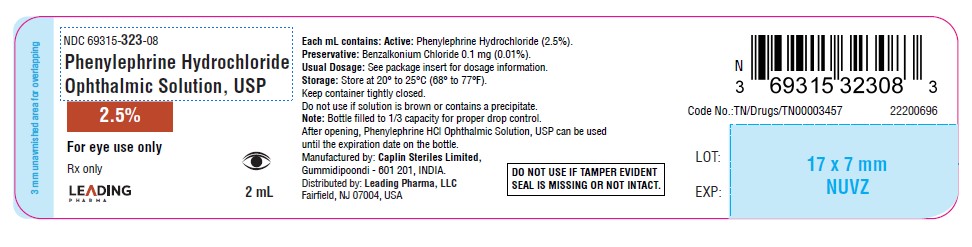
PACKAGE LABEL.PRINCIPAL DISPLAY PANEL NDC 69315- 323 -08 Phenylephrine Hydrochloride Ophthalmic Solution, USP 2.5% For eye use only 2 mL Rx only NDC 69315- 323 -15 Phenylephrine Hydrochloride Ophthalmic Solution, USP 2.5% For eye use only 15 mL Rx only NDC 69315- 324 -05 Phenylephrine Hydrochloride Ophthalmic Solution, USP 10% For eye use only 5 mL Rx only cartonlabel2p5p2mL cartonlabel2p5p15mL cartonlabel10p5mL containerlabel2p5p2mL containerlabel2p5p15mL containerlabel10p5mL