
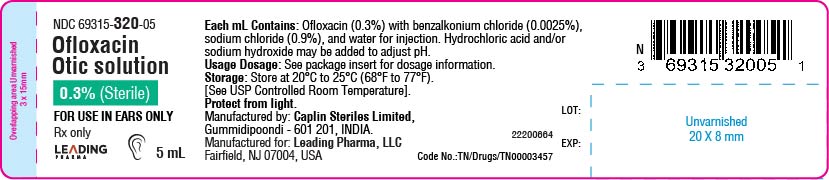
OFLOXACIN 3 mg/mL Solution, 5 mL — NDC 69315-320-05 (Billing 69315-0320-05)
This is a package of 5 mL of OFLOXACIN 3 mg/mL Solution from Leading Pharma, LLC, marketed since Mar 2024 and currently FDA-listed; retail pharmacies pay about $1.11 per mL (NADAC). It is the main listing for this product, which comes in 2 package sizes.
NDC database record
One package, one record: these facts belong to NDC 69315-320-05 alone.
- Record
- FDA NDC Directory package listing · Human prescription drug
- Code segments
- 69315 labeler · 320 product · 05 package
- Package marketed since
- Mar 1, 2024
- Sample package
- No — commercial package
- Listing certified through
- Dec 31, 2026
- Billing quantity
- 5 mL per package
- Barcode (UPC)
- 0369315320105, 0369315320051
- Medicaid fills, this package
- 39,477 prescriptions in the last four reported quarters
- FDA record last changed
- Jul 24, 2026
Identity & classification
Regulatory identifiers FDA, NLM and CMS codes for this package
Drug-database identifiers Medi-Span GPI and First Databank GCN / HICL / AHFS classification
- GSN (GCN sequence number): 048292
- GCN: 13880
- GPI-14 (Medi-Span): 87100060002010
- HICL (First Databank): 006035
- AHFS class code: 08:12.18.00
- RxCUI (RxNorm): 242446
Where does this data come from?
- FDA openFDA NDC Directory · synced Oct 8, 2026
- FDA label on DailyMed · label index refreshed Oct 6, 2026
- RxNorm (NLM RxNav) · catalog refreshed Oct 1, 2026
- Medi-Span GPI (licensed)
- First Databank (licensed) · refreshed Oct 8, 2026
RxNorm drug class
This medicine belongs to the Quinolone Antimicrobial class.
Where does this data come from?
- RxClass (NLM) · catalog refreshed Oct 1, 2026
Clinical
Ofloxacin otic is used to treat outer ear infections in adults and children, chronic (long-lasting) middle ear infections in adults and children with a perforated eardrum (a condition where the eardrum has a hole in it), and acute (suddenly occurring) middle ear infections in children with ear tubes. Ofloxacin otic is in a class of medications called quinolone antibiotics. It works by killing the bacteria that cause infection.
Read the full MedlinePlus article ↗- It is an antibiotic for certain bacterial infections. Tablets treat things like pneumonia, skin infections, and some urethral and cervical infections. Eye drops treat bacterial con...
- Follow the schedule on your label. Tablets are usually taken about every 12 hours. Keep antacids, iron, and zinc multivitamins at least two hours before or after. For ear drops, wa...
- With the tablets, the most common are nausea, headache, trouble sleeping, dizziness, and diarrhea. Women may also notice vaginal itching. These are often mild, but tell me if they...
- Stop the medicine and call if you have tendon pain or swelling, tingling or numbness, confusion, hallucinations, or a rash or swelling. Also call for severe diarrhea or sudden seve...
Patient education
Supplement & herbal interactions
Some supplements/herbs that may interact with Ofloxacin — tap one for details:
Ofloxacin may be associated with lower levels of 11 nutrients — worth a chat with your pharmacist, not a cause for alarm.
Where does this data come from?
- MedlinePlus (NLM) · refreshed Oct 1, 2026
- FDA label on DailyMed · label index refreshed Oct 6, 2026
Ask a licensed pharmacist directly — free, answered by our team.
Pricing
A drug doesn't have one price. Each row is a different public payment system, and none is what you'd pay at the counter — that depends on your insurance. The ⓘ on each row explains what it measures.
| Price system | Per mL | Per package |
|---|---|---|
| Retail pharmacies payNADAC · weekly | $1.110 | $5.55 / 5 ml |
| Medicaid paysCMS SDUD · 12 mo | $2.52 | $12.62 / 5 ml |
| Medicare drug plans payPart D · Q2 2026 | $2.37 | $11.84 / 5 ml |
Where does this data come from?
- CMS NADAC weekly file · file of Oct 7, 2026
- CMS ASP pricing files · refreshed Sep 20, 2026
- CMS Medicaid State Drug Utilization Data · through Q4 2025
- CMS Part D plan pricing files · refreshed Sep 24, 2026
- VA National Acquisition Center price file
Packaging — all sizes for this product
| Package NDC | Description | Per unit | Per pack | Marketing start | Marketing end | Status |
|---|---|---|---|---|---|---|
| 69315-0320-05 You're viewing this Main listing | 5 mL in 1 BOTTLE, DROPPER | $1.11 / mL | $5.55 | 2024-03-01 | — | Active |
| 69315-0320-10 69315-320-10 | 10 mL in 1 BOTTLE, DROPPER | $0.9790 / mL | $9.79 | 2024-03-01 | — | Active |
You're viewing the smallest of 2 pack sizes for this product.
Per mL, this pack runs about 13% above the cheapest pack (10 mL, $0.9790 vs $1.11 NADAC).
In Medicaid, this is the most-dispensed pack of this product — about 60% of fills over the last four reported quarters. See all packs ↓
Pack size FAQ
What quantity is in this package?
How does this package differ from NDC 69315-0320-10?
What NDC number is used to bill for this package of OFLOXACIN 3 mg/mL Solution?
Prices are the latest CMS NADAC pharmacy acquisition cost per NDC; per-pack figures are per-unit × pack quantity, shown only when the pack is denominated in the same measure NADAC prices.
Therapeutic equivalents
| Product | Labeler | Pack | NADAC/unit | TE | Status | Price vs. this |
|---|---|---|---|---|---|---|
| Ofloxacin 3 mg/mL 64980-0432-01 | Rising | 1 bottle | $0.979 | AT | Availability likely | save 12% |
| Ofloxacin 3 mg/mL 65145-0144-01 | Caplin | 1 bottle | $0.979 | AT | Availability likely | save 12% |
| Ofloxacin 3 mg/mL 69238-1616-06 | Amneal | 1 bottle | $0.979 | AT | Availability likely | save 12% |
| Ofloxacin 3 mg/mL 70069-0687-01 | Somerset | 1 bottle | $0.979 | AT | Availability likely | save 12% |
| ofloxacin 3 mg/mL 70756-0610-30 | Lifestar | 10 ml | $0.979 | AT | Availability likely | save 12% |
| Ofloxacin 3 mg/mL 24208-0410-05 | Bausch | 1 bottle | $1.110 | AT | Availability likely | — |
| Ofloxacin Otic 3 mg/mL 60505-0363-01 | Apotex | 5 ml | $1.110 | AT | Availability likely | — |
| Ofloxacin 3 mg/mL 65145-0143-01 | Caplin | 1 bottle | $1.110 | AT | Availability likely | — |
| Ofloxacin 3 mg/mL 69238-1615-03 | Amneal | 1 bottle | $1.110 | AT | Availability likely | — |
| Ofloxacin 3 mg/mLthis 69315-0320-05 | Leading | 5 ml | $1.110 | AT | Availability likely | — |
| Ofloxacin 3 mg/mL 70069-0686-01 | Somerset | 1 bottle | $1.110 | AT | Availability likely | — |
| ofloxacin 3 mg/mL 70756-0609-15 | Lifestar | 5 ml | $1.110 | AT | Availability likely | — |
| ofloxacin 3 mg/mL 72603-0186-01 | NorthStar | 5 ml | $1.110 | AT | Availability likely | — |
| Ofloxacin Otic 3 mg/mL 50090-1090-00 | A-S | 5 ml | — | AT | FDA listed | — |
| Ofloxacin 3 mg/mL 50090-5670-00 | A-S | 1 bottle | — | AT | FDA listed | — |
| ofloxacin 3 mg/mL 50090-7207-00 | A-S | 5 ml | — | AT | FDA listed | — |
| Ofloxacin Otic 3 mg/mL 63187-0184-05 | Proficient | 5 ml | — | AT | FDA listed | — |
| Ofloxacin 3 mg/mL 63187-0472-05 | Proficient | 1 bottle | — | AT | FDA listed | — |
| Ofloxacin Otic 3 mg/mL 63629-8716-01 | Bryant | 5 ml | — | AT | FDA listed | — |
| Ofloxacin 3 mg/mL 67296-1925-01 | Redpharm | 1 bottle | — | AT | FDA listed | — |
| Ofloxacin 3 mg/mL 67296-2159-05 | Redpharm | 5 ml | — | AT | FDA listed | — |
| Ofloxacin 3 mg/mL 67296-2179-05 | Redpharm | 1 bottle | — | AT | FDA listed | — |
| Ofloxacin Otic 3 mg/mL 68071-1588-05 | NuCare | 5 ml | — | AT | FDA listed | — |
| Ofloxacin Otic 3 mg/mL 68071-1630-03 | NuCare | 10 ml | — | AT | FDA listed | — |
| ofloxacin 3 mg/mL 68071-3604-03 | NuCare | 10 ml | — | AT | FDA listed | — |
| Ofloxacin 3 mg/mL 68788-4086-01 | Preferred | 1 bottle | — | AT | FDA listed | — |
| ofloxacin 3 mg/mL 68788-8551-01 | Preferred | 10 ml | — | AT | Discontinued | — |
| ofloxacin 3 mg/mL 70518-3984-00 | REMEDYREPACK | 5 ml | — | AT | FDA listed | — |
| Ofloxacin Otic 3 mg/mL 70518-4226-00 | REMEDYREPACK | 5 ml | — | AT | FDA listed | — |
| Ofloxacin Otic 3 mg/mL 71335-2822-01 | Bryant | 5 ml | — | AT | FDA listed | — |
| Ofloxacin Otic 3 mg/mL 72162-1709-02 | Bryant | 5 ml | — | AT | FDA listed | — |
| Ofloxacin Otic 3 mg/mL 72189-0108-05 | DIRECT | 5 ml | — | AT | FDA listed | — |
| Olfoxacin Otic Soln 3 mg/mL 72189-0490-05 | Direct_Rx | 5 ml | — | AT | FDA listed | — |
| ofloxacin 3 mg/mL 76420-0748-05 | Asclemed | 5 ml | — | AT | FDA listed | — |
| ofloxacin 3 mg/mL 76420-0749-10 | Asclemed | 10 ml | — | AT | FDA listed | — |
| ofloxacin 3 mg/mL 82804-0061-05 | Proficient | 5 ml | — | AT | FDA listed | — |
| Ofloxacin 3 mg/mL 70518-4752-00 | REMEDYREPACK | 1 bottle | — | AT | FDA listed | — |
Where does this data come from?
- FDA openFDA NDC Directory · synced Oct 8, 2026
- FDA Orange Book · refreshed Oct 3, 2026
- CMS NADAC weekly file · file of Oct 7, 2026
Availability & generic status
This product is an FDA-approved generic. Other versions of the same drug are listed under Therapeutic equivalents, least expensive first.
Where does this data come from?
- FDA Orange Book · refreshed Oct 3, 2026
Inactive Ingredients / Excipients
Inactive ingredients, also called excipients, are components of the drug product other than the active ingredient. They may include fillers, dyes, coatings, preservatives, flavors, or other formulation ingredients.
🧪 Avoiding an ingredient? See Ofloxacin inactive ingredients by manufacturer: every current product's list side by side, so you can ask your pharmacy for the version that does not list it.
💡 Tap an ingredient (hover on desktop) to see what it is and why it’s used.
-
UNII F5UM2KM3W7
Benzalkonium chloride is a chemical compound that works as a preservative and antimicrobial agent in medications. It prevents bacterial and fungal growth in liquid formulations to keep the product safe during storage and use.
-
UNII QTT17582CB
A strong acid used to adjust and maintain the proper pH level in liquid medicines, ensuring stability and preventing breakdown of active ingredients.
-
UNII 451W47IQ8X
Sodium chloride is common table salt. It's used in medicines as a buffer to maintain proper pH, as a filler to add bulk, or to adjust the osmotic balance in liquid formulations.
-
UNII 55X04QC32I
A strong alkaline chemical used to adjust and maintain the pH balance of liquid medicines. It helps keep the medicine stable and ensures it stays effective during storage.
-
UNII 059QF0KO0R
Water is a liquid solvent that dissolves and mixes ingredients together in liquid medicines, syrups, and injections. It helps distribute the active drug evenly throughout the product.
5 inactive ingredients listed in the exact product block matched to this NDC.
Where does this data come from?
ingredient classCode="IACT" elements from the exact product block matched by this NDC. Label-section narrative from DailyMed / the openFDA label index is shown separately when available.- FDA label on DailyMed · label index refreshed Oct 6, 2026
- FDA openFDA NDC Directory · synced Oct 8, 2026
Inactive ingredient FAQ
Are inactive ingredients the same for every manufacturer?
Why might an inactive ingredient be missing?
Can inactive ingredients matter?
Manufacturer & labeler
More NDCs from Leading Pharma, LLC labeler code 69315
- Dorzolamide and Timolol 20 mg/mL; 5 mg/mL Solution NDC 69315-305-05
- NYSTATIN 100000 [USP'U]/g Powder NDC 69315-306-15
- NYSTATIN 100000 [USP'U]/g Ointment NDC 69315-307-15
- ciprofloxacin 3 mg/mL Solution NDC 69315-308-02
- Procto-Med HC HYDROCORTISONE 25 mg/g Cream NDC 69315-312-28
- Lacosamide 10 mg/mL Solution NDC 69315-318-20
- Ketorolac Tromethamine 5 mg/mL Solution/ Drops NDC 69315-322-03
- PHENYLEPHRINE HYDROCHLORIDE 25 mg/mL Solution NDC 69315-323-08
- PHENYLEPHRINE HYDROCHLORIDE 100 mg/mL Solution NDC 69315-324-05
- TIMOLOL MALEATE 5 mg/mL Solution NDC 69315-325-05
- OFLOXACIN 3 mg/mL Solution NDC 69315-327-05
- DIFLUPREDNATE .5 mg/mL Emulsion NDC 69315-329-05
Where does this data come from?
- FDA openFDA NDC Directory · synced Oct 8, 2026
- Drugs@FDA
Full prescribing information FDA SPL
🎯 Indications and Usage ▾
INDICATIONS AND USAGE Ofloxacin Otic Solution 0.3% is indicated for the treatment of infections caused by susceptible isolates of the designated microorganisms in the specific conditions listed below: Otitis Externa in adults and pediatric patients, 6 months and older, due to Escherichia coli, Pseudomonas aeruginosa and Staphylococcus aureus. Chronic Suppurative Otitis Media in patients 12 years and older with perforated tympanic membranes due to Proteus mirabilis, Pseudomonas aeruginosa and Staphylococcus aureus. Acute Otitis Media in pediatric patients one year and older with tympanostomy tubes due to Haemophilus influenzae, Moraxella catarrhalis, Pseudomonas aeruginosa, Staphylococcus aureus and Streptococcus pneumoniae.
⏱️ Dosage and Administration ▾
DOSAGE AND ADMINISTRATION Otitis Externa: The recommended dosage regimen for the treatment of otitis externa is: For pediatric patients (from 6 months to 13 years old): Five drops (0.25 mL, 0.75 mg ofloxacin) instilled into the affected ear once daily for seven days. For patients 13 years and older: Ten drops (0.5 mL, 1.5 mg ofloxacin) instilled into the affected ear once daily for seven days. The solution should be warmed by holding the bottle in the hand for one or two minutes to avoid dizziness which may result from the instillation of a cold solution.
The patient should lie with the affected ear upward, and then the drops should be instilled. This position should be maintained for five minutes to facilitate penetration of the drops into the ear canal. Repeat, if necessary, for the opposite ear.
Acute Otitis Media in pediatric patients with tympanostomy tubes: The recommended dosage regimen for the treatment of acute otitis media in pediatric patients (from 1 to 12 years old) with tympanostomy tubes is: Five drops (0.25 mL, 0.75 mg ofloxacin) instilled into the affected ear twice daily for ten days. The solution should be warmed by holding the bottle in the hand for one or two minutes to avoid dizziness that may result from the instillation of a cold solution. The patient should lie with the affected ear upward, and then the drops should be instilled.
The tragus should then be pumped 4 times by pushing inward to facilitate penetration of the drops into the middle ear. This position should be maintained for five minutes. Repeat, if necessary, for the opposite ear.
Chronic Suppurative Otitis Media with perforated tympanic membranes: The recommended dosage regimen for the treatment of chronic suppurative otitis media with perforated tympanic membranes in patients 12 years and older is: Ten drops (0.5 mL, 1.5 mg ofloxacin) instilled into the affected ear twice daily for fourteen days. The solution should be warmed by holding the bottle in the hand for one or two minutes to avoid dizziness which may result from the instillation of a cold solution. The patient should lie with the affected ear upward, before instilling the drops.
The tragus should then be pumped 4 times by pushing inward to facilitate penetration into the middle ear. This position should be maintained for five minutes. Repeat, if necessary, for the opposite ear.
⛔ Contraindications ▾
CONTRAINDICATIONS Ofloxacin Otic Solution 0.3% is contraindicated in patients with a history of hypersensitivity to ofloxacin, to other quinolones, or to any of the components in this medication.
⚠️ Warnings ▾
WARNINGS NOT FOR OPHTHALMIC USE. NOT FOR INJECTION. Serious and occasionally fatal hypersensitivity (anaphylactic) reactions, some following the first dose, have been reported in patients receiving systemic quinolones, including ofloxacin.
Some reactions were accompanied by cardiovascular collapse, loss of consciousness, angioedema (including laryngeal, pharyngeal or facial edema), airway obstruction, dyspnea, urticaria, and itching. If an allergic reaction to ofloxacin is suspected, stop the drug. Serious acute hypersensitivity reactions may require immediate emergency treatment.
Oxygen and airway management, including intubation, should be administered as clinically indicated.
🤒 Adverse Reactions ▾
ADVERSE REACTIONS Subjects with Otitis Externa In the phase III clinical trials performed in support of once-daily dosing, 799 subjects with otitis externa and intact tympanic membranes were treated with Ofloxacin Otic Solution. The studies, which served as the basis for approval, were 020 (pediatric, adolescents and adults), 016 (adolescents and adults) and 017 (pediatric). The following treatment-related adverse events occurred in two or more of the subjects: Adverse Event Incidence Rate Studies 002/003 Studies 002/003 (BID) and 016/017 (QD) were active-controlled and comparative.
Study 020 (QD) was open and non-comparative. BID (N=229) Studies 016/017 QD (N=310) Study 020 QD (N=489) Application Site Reaction 3% 16.8% 0.6% Pruritus 4% 1.2% 1.0% Earache 1% 0.6% 0.8% Dizziness 1% 0.0% 0.6% Headache 0% 0.3% 0.2% Vertigo 1% 0.0% 0.0% An unexpected increased incidence of application site reaction was seen in studies 016/017 and was similar for both ofloxacin and the active control drug (neomycin-polymyxin B sulfate-hydrocortisone). This finding is believed to be the result of specific questioning of the subjects regarding the incidence of application site reactions.
In once daily dosing studies, there were also single reports of nausea, seborrhea, transient loss of hearing, tinnitus, otitis externa, otitis media, tremor, hypertension and fungal infection. In twice daily dosing studies, the following treatment-related adverse events were each reported in a single subject: dermatitis, eczema, erythematous rash, follicular rash, hypoaesthesia, tinnitus, dyspepsia, hot flushes, flushing and otorrhagia. Subjects with Acute Otitis Media with Tympanostomy Tubes (AOM TT) and Subjects with Chronic Suppurative Otitis Media (CSOM) with Perforated Tympanic Membranes: In phase III clinical trials which formed the basis for approval, the following treatment-related adverse events occurred in 1% or more of the 656 subjects with non-intact tympanic membranes in AOM TT or CSOM treated twice daily with Ofloxacin Otic Solution: Adverse Event Incidence (N=656) Taste Perversion 7% Earache 1% Pruritus 1% Paraesthesia 1% Rash 1% Dizziness 1% Other treatment-related adverse reactions reported in subjects with non-intact tympanic membranes included: diarrhea (0.6%), nausea (0.3%), vomiting (0.3%), dry mouth (0.5%), headache (0.3%), vertigo (0.5%), otorrhagia (0.6%), tinnitus (0.3%), fever (0.3%).
The following treatment-related adverse events were each reported in a single subject: application site reaction, otitis externa, urticaria, abdominal pain, dysaesthesia, hyperkinesia, halitosis, inflammation, pain, insomnia, coughing, pharyngitis, rhinitis, sinusitis, and tachycardia. Post-Marketing Adverse Events Cases of uncommon transient neuropsychiatric disturbances have been included in spontaneous postmarketing reports. A causal relationship with Ofloxacin Otic Solution 0.3% is unknown.
To report SUSPECTED ADVERSE REACTIONS, contact Leading Pharma, LLC at 1-844-740-7500 or FDA at 1-800-FDA-1088 or www.fda.gov/medwatch.
🔄 Drug Interactions ▾
Drug Interactions Specific drug interaction studies have not been conducted with Ofloxacin Otic Solution 0.3%.
🤰 Pregnancy ▾
Pregnancy Teratogenic effects: Ofloxacin has been shown to have an embryocidal effect in rats at a dose of 810 mg/kg/day and in rabbits at 160 mg/ kg/day. These dosages resulted in decreased fetal body weights and increased fetal mortality in rats and rabbits, respectively. Minor fetal skeletal variations were reported in rats receiving doses of 810 mg/kg/day.
Ofloxacin has not been shown to be teratogenic at doses as high as 810 mg/kg/day and 160 mg/kg/day when administered to pregnant rats and rabbits, respectively. Ofloxacin has not been shown to have any adverse effects on the developing embryo or fetus at doses relevant to the amount of ofloxacin that will be delivered ototopically at the recommended clinical doses. Nonteratogenic Effects: Additional studies in the rat demonstrated that doses up to 360 mg/kg/day during late gestation had no adverse effects on late fetal development, labor, delivery, lactation, neonatal viability, or growth of the newborn.
There are, however, no adequate and well-controlled studies in pregnant women. Ofloxacin Otic Solution 0.3% should be used during pregnancy only if the potential benefit justifies the potential risk to the fetus.
🧒 Pediatric Use ▾
Pediatric Use Safety and efficacy have been demonstrated in pediatric patients of the following ages for the listed indications: six months and older: otitis externa with intact tympanic membranes one year and older: acute otitis media with tympanostomy tubes twelve years and older: chronic suppurative otitis media with perforated tympanic membranes Safety and efficacy in pediatric patients below these ages have not been established. Although no data are available on patients less than age 6 months, there are no known safety concerns or differences in the disease process in this population that will preclude use of this product.
No changes in hearing function occurred in 30 pediatric subjects treated with ofloxacin otic and tested for audiometric parameters. Although quinolones, including ofloxacin, have been shown to cause arthropathy in immature animals after systemic administration, young growing guinea pigs dosed in the middle ear with 0.3% Ofloxacin Otic Solution for one month showed no systemic effects, quinolone induced lesions, erosions of the cartilage in weight-bearing joints, or other signs of arthropathy.
🧬 Clinical Pharmacology ▾
CLINICAL PHARMACOLOGY Pharmacokinetics: Drug concentrations in serum (in subjects with tympanostomy tubes and perforated tympanic membranes), in otorrhea, and in mucosa of the middle ear (in subjects with perforated tympanic membranes) were determined following otic administration of ofloxacin solution. In two single-dose studies, mean ofloxacin serum concentrations were low in adult patients with tympanostomy tubes, with and without otorrhea, after otic administration of a 0.3% solution (4.1 ng/mL (n=3) and 5.4 ng/mL (n=5), respectively).
In adults with perforated tympanic membranes, the maximum serum drug level of ofloxacin detected was 10 ng/mL after administration of a 0.3% solution. Ofloxacin was detectable in the middle ear mucosa of some adult subjects with perforated tympanic membranes (11 of 16 subjects). The variability of ofloxacin concentration in middle ear mucosa was high.
The concentrations ranged from 1.2 to 602 mcg/g after otic administration of a 0.3% solution. Ofloxacin was present in high concentrations in otorrhea (389 - 2850 mcg/g, n=13) 30 minutes after otic administration of a 0.3% solution in subjects with chronic suppurative otitis media and perforated tympanic membranes. However, the measurement of ofloxacin in the otorrhea does not necessarily reflect the exposure of the middle ear to ofloxacin.
Microbiology: Ofloxacin has in vitro activity against a wide range of gram-negative and gram-positive microorganisms. Ofloxacin exerts its antibacterial activity by inhibiting DNA gyrase, a bacterial topoisomerase. DNA gyrase is an essential enzyme which controls DNA topology and assists in DNA replication, repair, deactivation, and transcription.
Cross-resistance has been observed between ofloxacin and other fluoroquinolones. There is generally no cross-resistance between ofloxacin and other classes of antibacterial agents such as beta-lactams or aminoglycosides. Ofloxacin has been shown to be active against most isolates of the following microorganisms, both in vitro and clinically in otic infections as described in the INDICATIONS AND USAGE section.
Aerobic and facultative gram-positive microorganisms: Staphylococcus aureus Streptococcus pneumoniae Aerobic and facultative gram-negative microorganisms: Escherichia coli Haemophilus influenzae Moraxella catarrhalis Proteus mirabilis Pseudomonas aeruginosa
📦 How Supplied / Storage and Handling ▾
HOW SUPPLIED Ofloxacin Otic Solution 0.3% is supplied in plastic dropper bottles in the following sizes: NDC 69315-320-05 5 mL NDC 69315-320-10 10 mL Storage: Store at 20 ºC to 25 ºC (68 ºF to 77 ºF). [See USP Controlled Room Temperature]. Protect from light.
📦 Storage and Handling ▾
Storage: Store at 20 ºC to 25 ºC (68 ºF to 77 ºF). [See USP Controlled Room Temperature]. Protect from light.
📋 Description ▾
DESCRIPTION Ofloxacin Otic Solution 0.3% is a sterile aqueous anti-infective (antibacterial) solution for otic use. Chemically, ofloxacin has three condensed 6-membered rings made up of a fluorinated carboxyquinolone with a benzoxazine ring. The chemical name of ofloxacin is: (±)-9-fluoro-2,3-dihydro-3-methyl-10-(4-methyl-1-piperazinyl)-7-oxo-7 H -pyrido [1,2,3- de ]-1,4-benzoxazine-6-carboxylic acid.
The empirical formula of ofloxacin is C18H20FN3O4 and its molecular weight is 361.38. The structural formula is Ofloxacin otic solution contains 0.3% (3 mg/mL) ofloxacin with benzalkonium chloride (0.0025%), sodium chloride (0.9%), and water for injection. Hydrochloric acid and/or sodium hydroxide may be added to adjust the pH 6.5±0.5. chemstruc
💬 Information for Patients ▾
Information for Patients Avoid contaminating the applicator tip with material from the fingers or other sources. This precaution is necessary if the sterility of the drops is to be preserved. Systemic quinolones, including ofloxacin, have been associated with hypersensitivity reactions, even following a single dose.
Discontinue use immediately and contact your physician at the first sign of a rash or allergic reaction. Otitis Externa: Prior to administration of ofloxacin otic, the solution should be warmed by holding the bottle in the hand for one or two minutes to avoid dizziness which may result from the instillation of a cold solution. The patient should lie with the affected ear upward, and then the drops should be instilled.
This position should be maintained for five minutes to facilitate penetration of the drops into the ear canal. Repeat, if necessary, for the opposite ear (see DOSAGE AND ADMINISTRATION ). Acute Otitis Media and Chronic Suppurative Otitis Media: Prior to administration of ofloxacin otic, the solution should be warmed by holding the bottle in the hand for one or two minutes to avoid dizziness which may result from the instillation of a cold solution.
The patient should lie with the affected ear upward, and then the drops should be instilled. The tragus should then be pumped 4 times by pushing inward to facilitate penetration of the drops into the middle ear. This position should be maintained for five minutes.
Repeat, if necessary, for the opposite ear (see DOSAGE AND ADMINISTRATION ).
⚠️ Precautions ▾
PRECAUTIONS General: As with other anti-infective preparations, prolonged use may result in over-growth of nonsusceptible organisms, including fungi. If the infection is not improved after one week, cultures should be obtained to guide further treatment. If otorrhea persists after a full course of therapy, or if two or more episodes of otorrhea occur within six months, further evaluation is recommended to exclude an underlying condition such as cholesteatoma, foreign body, or a tumor.
The systemic administration of quinolones, including ofloxacin at doses much higher than given or absorbed by the otic route, has led to lesions or erosions of the cartilage in weight-bearing joints and other signs of arthropathy in immature animals of various species. Young growing guinea pigs dosed in the middle ear with 0.3% Ofloxacin Otic Solution showed no systemic effects, lesions or erosions of the cartilage in weight-bearing joints, or other signs of arthropathy. No drug-related structural or functional changes of the cochlea and no lesions in the ossicles were noted in the guinea pig following otic administration of 0.3% ofloxacin for one month.
No signs of local irritation were found when 0.3% ofloxacin was applied topically in the rabbit eye. Ofloxacin was also shown to lack dermal sensitizing potential in the guinea pig maximization study. Information for Patients Avoid contaminating the applicator tip with material from the fingers or other sources.
This precaution is necessary if the sterility of the drops is to be preserved. Systemic quinolones, including ofloxacin, have been associated with hypersensitivity reactions, even following a single dose. Discontinue use immediately and contact your physician at the first sign of a rash or allergic reaction.
Otitis Externa: Prior to administration of ofloxacin otic, the solution should be warmed by holding the bottle in the hand for one or two minutes to avoid dizziness which may result from the instillation of a cold solution. The patient should lie with the affected ear upward, and then the drops should be instilled. This position should be maintained for five minutes to facilitate penetration of the drops into the ear canal.
Repeat, if necessary, for the opposite ear (see DOSAGE AND ADMINISTRATION ). Acute Otitis Media and Chronic Suppurative Otitis Media: Prior to administration of ofloxacin otic, the solution should be warmed by holding the bottle in the hand for one or two minutes to avoid dizziness which may result from the instillation of a cold solution. The patient should lie with the affected ear upward, and then the drops should be instilled.
The tragus should then be pumped 4 times by pushing inward to facilitate penetration of the drops into the middle ear. This position should be maintained for five minutes. Repeat, if necessary, for the opposite ear (see DOSAGE AND ADMINISTRATION ).
Drug Interactions Specific drug interaction studies have not been conducted with Ofloxacin Otic Solution 0.3%. Carcinogenesis, Mutagenesis, Impairment of Fertility Long-term studies to determine the carcinogenic potential of ofloxacin have not been conducted. Ofloxacin was not mutagenic in the Ames test, the sister chromatid exchange assay (Chinese hamster and human cell lines), the unscheduled DNA synthesis (UDS) assay using human fibroblasts, the dominant lethal assay, or the mouse micronucleus assay.
Ofloxacin was positive in the rat hepatocyte UDS assay, and in the mouse lymphoma assay. In rats, ofloxacin did not affect male or female reproductive performance at oral doses up to 360 mg/kg/day. This would be over 1000 times the maximum recommended clinical dose, based upon body surface area, assuming total absorption of ofloxacin from the ear of a patient treated with Ofloxacin Otic Solution 0.3% twice per day.
Pregnancy Teratogenic effects: Ofloxacin has been shown to have an embryocidal effect in rats at a dose of 810 mg/kg/day and in rabbits at 160 mg/ kg/day. These dosages resulted in de… [Excerpted — this section continues on DailyMed.]
🍼 Nursing Mothers ▾
Nursing Mothers In nursing women, a single 200 mg oral dose resulted in concentrations of ofloxacin in milk which were similar to those found in plasma. It is not known whether ofloxacin is excreted in human milk following topical otic administration. Because of the potential for serious adverse reactions from ofloxacin in nursing infants, a decision should be made whether to discontinue nursing or to discontinue the drug, taking into account the importance of the drug to the mother.
🧬 Pharmacokinetics ▾
Pharmacokinetics: Drug concentrations in serum (in subjects with tympanostomy tubes and perforated tympanic membranes), in otorrhea, and in mucosa of the middle ear (in subjects with perforated tympanic membranes) were determined following otic administration of ofloxacin solution. In two single-dose studies, mean ofloxacin serum concentrations were low in adult patients with tympanostomy tubes, with and without otorrhea, after otic administration of a 0.3% solution (4.1 ng/mL (n=3) and 5.4 ng/mL (n=5), respectively).
In adults with perforated tympanic membranes, the maximum serum drug level of ofloxacin detected was 10 ng/mL after administration of a 0.3% solution. Ofloxacin was detectable in the middle ear mucosa of some adult subjects with perforated tympanic membranes (11 of 16 subjects). The variability of ofloxacin concentration in middle ear mucosa was high.
The concentrations ranged from 1.2 to 602 mcg/g after otic administration of a 0.3% solution. Ofloxacin was present in high concentrations in otorrhea (389 - 2850 mcg/g, n=13) 30 minutes after otic administration of a 0.3% solution in subjects with chronic suppurative otitis media and perforated tympanic membranes. However, the measurement of ofloxacin in the otorrhea does not necessarily reflect the exposure of the middle ear to ofloxacin.
📄 Carcinogenesis, Mutagenesis, Impairment of Fertility ▾
Carcinogenesis, Mutagenesis, Impairment of Fertility Long-term studies to determine the carcinogenic potential of ofloxacin have not been conducted. Ofloxacin was not mutagenic in the Ames test, the sister chromatid exchange assay (Chinese hamster and human cell lines), the unscheduled DNA synthesis (UDS) assay using human fibroblasts, the dominant lethal assay, or the mouse micronucleus assay. Ofloxacin was positive in the rat hepatocyte UDS assay, and in the mouse lymphoma assay.
In rats, ofloxacin did not affect male or female reproductive performance at oral doses up to 360 mg/kg/day. This would be over 1000 times the maximum recommended clinical dose, based upon body surface area, assuming total absorption of ofloxacin from the ear of a patient treated with Ofloxacin Otic Solution 0.3% twice per day.
📄 Package Label / Principal Display Panel ▾
PACKAGE LABEL-PRINCIPAL DISPLAY PANEL LEADING PHARMA NDC 69315- 320 -05 Ofloxacin Otic Solution 0.3% Rx only 5 mL LEADING PHARMA NDC 69315-320-10 Ofloxacin Otic Solution 0.3% Rx only 10 mL containerlabel5ml cartonlabel5ml containerlabel10ml cartonlabel10ml