by Cardinal Health · 1 BOTTLE, DROPPER in 1 BOX / 15 mL in 1 BOTTLE, DROPPER
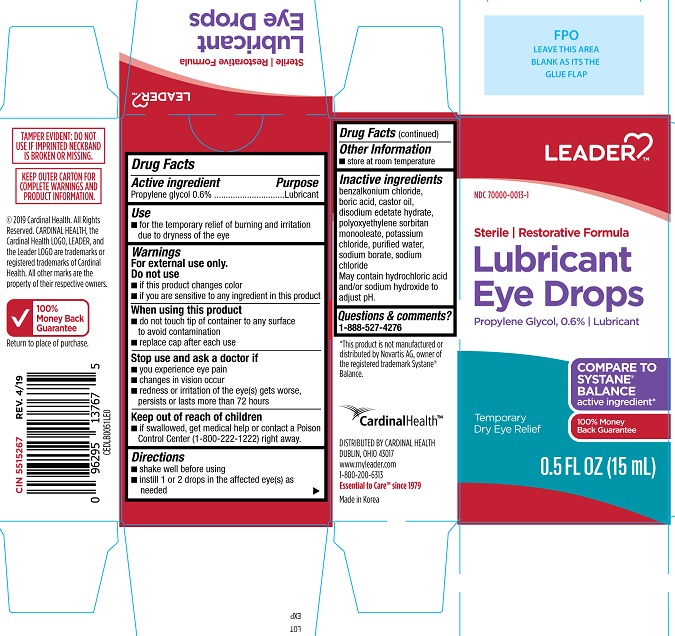
This is a package of Leader Restorative Formula Lubricant Eye Drops propylene glycol .6 g/100mL Solution/ Drops from Cardinal Health, marketed since Apr 2019 and currently FDA-listed; retail pharmacies pay about $0.2141 per mL (NADAC). It is the main listing for this product, which comes in 2 package sizes.
NDC 70000-0013-01
🏷️ FDA NDC (as labeled)70000-0013-1billing pads the package segment with a zero
This package
Contains15 mL in 1 bottle, dropperCost per mL$0.2141 NADACPer package$3.21 / 15 ml Pack sizes2 compare ↓
🗂️ FDA directory synced Oct 1, 2026 · this listing last changed Jul 24, 2026 · sources: openFDA · FDA label (DailyMed) · FDA Orange & Purple Book · First Databank · CMS NADAC, ASP, Medicare & Medicaid · RxNorm
Compiled from public FDA, CMS, DailyMed, NADAC, and related drug data sources. Editorial policy
⚠️
Other active recalls for Propylene Glycol (different manufacturers) — 1 · tap to view
These affect other manufacturers’ products for the same ingredient — not necessarily the exact NDC on this page.
Class II · Dec 31, 2025 — Lack of Assurance of Sterility: Products have not been manufactured in conformance with current good manufacturing practices. (Wizcure Pharmaa Private Limited)· FDA recall D-0348-2026
Each entry is an official FDA enforcement report — look up any recall number in the FDA recall database ↗
Identity & classification
Regulatory identifiers FDA, NLM and CMS codes for this package
Drug-database identifiers Medi-Span GPI and First Databank GCN / HICL / AHFS classification
GPI-1486200060002015
GPI classLubricant Eye Drops
GCN Seq No066795
GCN29189
HICL code003808
Ingredient (HICL)Propylene Glycol
HIC1 codeQ
Therapeutic class — broad (HIC1)Ear/Eye/Nose/Rectum/Topical/Vagina/Other
HIC2 codeQ6
Therapeutic class — intermediate (HIC2)Ophthalmic Preparations
HIC3 codeQ6T
Therapeutic class — specific (HIC3)Artificial Tears
AHFS code52:92.00.00
AHFS classEent Drugs, Miscellaneous
FDB label nameLUBRICANT 0.6% EYE DROP
FDB brand nameLubricant Eye Drop
Legend statusO — Over-the-counter (OTC) drug or device
Quick answers
GSN (GCN sequence number):066795
GCN:29189
GPI-14 (Medi-Span):86200060002015
HICL (First Databank):003808
AHFS class code:52:92.00.00
RxCUI (RxNorm):1041798
Why two NDCs?
The FDA registers this code as 70000-0013-1 — a 5-4-1 layout, and that's what's printed on the package and shown on DailyMed. For insurance claims, every NDC is standardized to a uniform 11-digit 5-4-2 format by adding a zero to the package segment → 70000-0013-01. Same drug, same package — only the format differs.
Where does this data come from?
Identifiers from the FDA openFDA NDC Directory and Structured Product Labeling; RxCUI from RxNorm (NLM); GPI from Medi-Span; GCN / HIC / AHFS / legend from First Databank.
Label name LUBRICANT 0.6% EYE DROPIngredient Propylene Glycol
🧪 What is this product?
Leader Restorative Formula Lubricant Eye Drops is an over-the-counter eye drop solution containing propylene glycol. Propylene glycol is a humectant commonly used in lubricating eye drops to help retain moisture and reduce dryness on the eye surface. This product is marketed as an OTC monograph drug, meaning it follows FDA's established rules for over-the-counter eye lubricants rather than undergoing individual product review.
Plain-language summary from MedlinePlus (U.S. National Library of Medicine); supplement & herbal interactions and nutrient depletion data from the Natural Medicines database; our full guide is HelloPharmacist editorial content.
A drug doesn't have one price. Each row is a different public payment system, and none is what you'd pay at the counter — that depends on your insurance. The ⓘ on each row explains what it measures.
Price system
Per mL
Per package
Retail pharmacies payNADAC · weekly
$0.214
$3.21 / 15 ml
Medicaid paysCMS SDUD · 12 mo
$0.8168
$12.25 / 15 ml
Medicare drug plans payPart D · quarterly
No Part D plan price is available for this NDC in our data.
NADAC price history (per mL) — tap or hover for the price & month
▲ Up 54% over the last 5 months.
Where does this data come from?
NADAC (National Average Drug Acquisition Cost) is the CMS weekly pharmacy-acquisition-cost survey — what pharmacies pay. ASP (Average Sales Price) is the CMS Medicare Part B drug-payment file, published quarterly. Medicaid pays is computed by us from CMS State Drug Utilization Data (total reimbursed ÷ units, trailing 12 months) — gross of rebates and inclusive of dispensing fees, so it reflects what Medicaid paid, not an acquisition cost. Medicare drug plans pay is the median negotiated point-of-sale unit cost across plans listing this NDC in the CMS quarterly Prescription Drug Plan pricing files, before rebates. The VA pays is the federal contract price (FSS, and the statutory Big 4 ceiling where listed) from the VA National Acquisition Center pharmaceutical price file. All are free public government data; each measures a different payer, so the figures are not directly comparable.
2 BOTTLE, DROPPER in 1 BOX / 15 mL in 1 BOTTLE, DROPPER
$0.1561 / mL
$4.68
2019-04-30
—
Discontinued by firm
Swipe sideways for more columns →
Per mL, this pack runs about 37% above the cheapest pack (NDC 70000-0013-02, $0.1561 vs $0.2141 NADAC).
In Medicaid, this is the most-dispensed pack of this product — about 100% of fills over the last four reported quarters. See all packs ↓
Pack size FAQ
What quantity is in this package?
This package is listed by the FDA — 1 bottle, dropper in 1 box / 15 ml in 1 bottle, dropper.
What NDC number is used to bill for this package of Leader Restorative Formula Lubricant Eye Drops propylene glycol .6 g/100mL Solution/ Drops?
Use the 11-digit billing form listed in the identifiers section of this page. Pharmacy and medical claims use the 11-digit form; the FDA label may print a shorter form of the same code.
Prices are the latest CMS NADAC pharmacy acquisition cost per NDC; per-pack figures are per-unit × pack quantity, shown only when the pack is denominated in the same measure NADAC prices.
About this product: other versions of the same ingredient, strength and form are listed above, least expensive first, with FDA equivalence ratings where available.
Where does this data come from?
Equivalents are other NDCs of the same ingredient, form and route from the openFDA NDC Directory, ranked least-expensive-first by NADAC. Therapeutic-equivalence (AB) ratings come from the FDA Orange Book; biologics use the FDA Purple Book for biosimilar & interchangeable status.
We did not find an FDA-approved generic match for this exact strength, form and route.
Where does this data come from?
Patents and exclusivity from the FDA Orange Book (small-molecule drugs), refreshed from public FDA data. Generic launch timing is an estimate, not a guarantee.
Inactive ingredients, also called excipients, are components of the drug product
other than the active ingredient. They may include fillers, dyes, coatings, preservatives, flavors,
or other formulation ingredients.
Loading inactive ingredients from the official FDA label in the background. No external source is being called by this page request.
Where does this data come from?
Source: official FDA Structured Product Labeling (SPL) via DailyMed and the openFDA label index. Structured IACT rows and label-wide narrative are kept separate; availability and product-level specificity depend on the submitted label.
Are inactive ingredients the same for every manufacturer?
No. Inactive ingredients can differ by manufacturer, dosage form, strength, and package / product version.
Why might an inactive ingredient be missing?
Some SPLs do not provide a complete structured inactive-ingredient list, and older or unusual labels may only include the information in narrative text.
Can inactive ingredients matter?
Yes. They can matter for allergies, intolerances, dyes, gluten / lactose concerns, preservatives, and formulation differences — but confirm with a pharmacist or the manufacturer when it’s clinically important.
The labeler markets the product; the application holder owns the FDA approval. They’re often the same company but can differ (e.g. a repackager or an authorized generic). A mailing address / phone appears here when the manufacturer includes it in the product’s FDA label (not all do).
Where does this data come from?
Labeler, application holder and registered establishment from the FDA openFDA NDC Directory and Drugs@FDA; address/contact from the product’s FDA label.
The complete FDA label for this product — the official Drug Facts labeling, verbatim, section by section. Jump with a chip, search within the label, or expand everything.
Uses • for the temporary relief of burning and irritation due to dryness of the eye
⏱️Dosage and Administration16 words▾
Directions Shake well before using. Instill 1 or 2 drops in the affected eye(s) as needed
⚠️Warnings81 words▾
Warnings For external use only Do not use • if this product changes color • if you are sensitive to any ingredient in this product When using this product • do not touch tip of container to any surface to avoid contamination • replace cap after each use Stop use and ask a doctor if • you experience eye pain • changes in vision occur • redness or irritation of the eye(s) gets worse, persists or lasts more than 72 hours
No label section mentions that — try another word, or open the full label on DailyMed below.
Source: FDA Structured Product Labeling, mirrored from DailyMed / openFDA.
Prefer the government’s original formatting? View this label on DailyMed ↗
Medicaid utilization & spend
📍 This exact package only: Medicaid data is reported per full 11-digit NDC — labeler, product and pack size — so every number here is for this package alone, not the drug overall. Other pack sizes report separately.
💊 Pharmacy benefit only: These are Medicaid outpatient pharmacy claims, billed by NDC. They exclude the medical benefit — clinic- or hospital-administered drugs billed under HCPCS J-codes — so drugs used mostly that way (e.g. Avastin, Lucentis, Keytruda) can look low or missing here. That’s expected, not an error.
📅 Q1 2025 – Q4 2025 · 4 quarters of data
ⓘ The newest quarter is usually incomplete when first published; states restate recent quarters in later CMS releases, so the latest figures typically revise upward. State coverage-policy changes can also shift quarter-to-quarter totals.
Prescriptions last 4 qtrs
17.1K
Units reimbursed last 4 qtrs
265.6K
Gross reimbursed last 4 qtrs
$216.9K
Avg / prescription
$12.69
Avg / unit
$0.8168
Latest quarter Q4 2025
1.3KRx
Medicaid pays / mL
$0.8168
gross reimbursed
vs
NADAC / mL
$0.2141
acquisition cost
=
Spread
+$0.6027
+282% vs cost
What Medicaid paid per mL (before rebates; includes the pharmacy’s dispensing fee) compared with NADAC — the average price pharmacies pay to buy the drug. A positive spread means Medicaid reimbursed more than the purchase price, before manufacturer rebates.
Fee-for-service vs managed care ⓘ
97% FFS
Fee-for-service · 16,622 Rx Managed care · 473 Rx
State Medicaid map
Units reimbursed · per 100k residents
3.11,024
gray = no data reported ⓘ
Colors are per 100,000 residents, so big states don’t automatically dominate. Tap or hover a state for its actual totals.
Tap or hover a state
…for its Medicaid breakdown
Prescriptions—
Units—
Reimbursed—
🏆 Top states by units · per 100k residents
1New York1,024 /100k
2California142 /100k
3New Jersey49.0 /100k
4Massachusetts13.7 /100k
5Texas9.8 /100k
6Ohio8.7 /100k
7Indiana3.1 /100k
National units — by quarter
💵 About the dollar figures: “reimbursed” is what Medicaid paid pharmacies before confidential manufacturer rebates, so the program’s real net cost is lower than these numbers. Fee-for-service and managed-care claims are combined unless split above. Source: CMS State Drug Utilization Data; per-100k rates use 2023 Census population estimates.
Medicaid utilization by pack size
Medicaid (SDUD) totals over the four most recent reported quarters for every package size of this drug — handy when a specific package (e.g. a starter/titration pack) carries little or no Medicaid volume on its own.
Drug total (last 4 qtrs): 17,095 Rx · 265,581 units · $216,924 gross reimbursed
Tap a pack size to open its page. Source: CMS State Drug Utilization Data, last 4 quarters.
Reported adverse events (FAERS)
Read carefully: FAERS reports are voluntary and unverified. Counts are not incidence, do not establish causation, are subject to reporting bias, and cannot be used to compare one drug to another. Shown for signal context only. Reports for Leader Restorative Formula Lubricant Eye Drops (this brand).
Top reported reactions
Nausea146
Vomiting132
Dyspnoea116
Pulmonary Embolism107
Chronic Obstructive Pulmonary Disease104
Sepsis98
Abdominal Pain92
Reporter sex
Male · 45%
Female · 55%
Serious outcomes
Hospitalization335
Death173
Disabling116
Life-threatening103
Reports over time (by year) — tap or hover for the count & year
Most recent year is provisional (FAERS lags ~3 months).
Where does this data come from?
Adverse-event reports from the FDA Adverse Event Reporting System (FAERS) via openFDA. FAERS reports are voluntary and unverified — counts are not incidence and don’t establish causation.
For educational and professional reference only — not medical advice. Pricing reflects published
NADAC and CMS ASP (free public data) and may differ from your acquisition cost; always verify before billing or dispensing.