
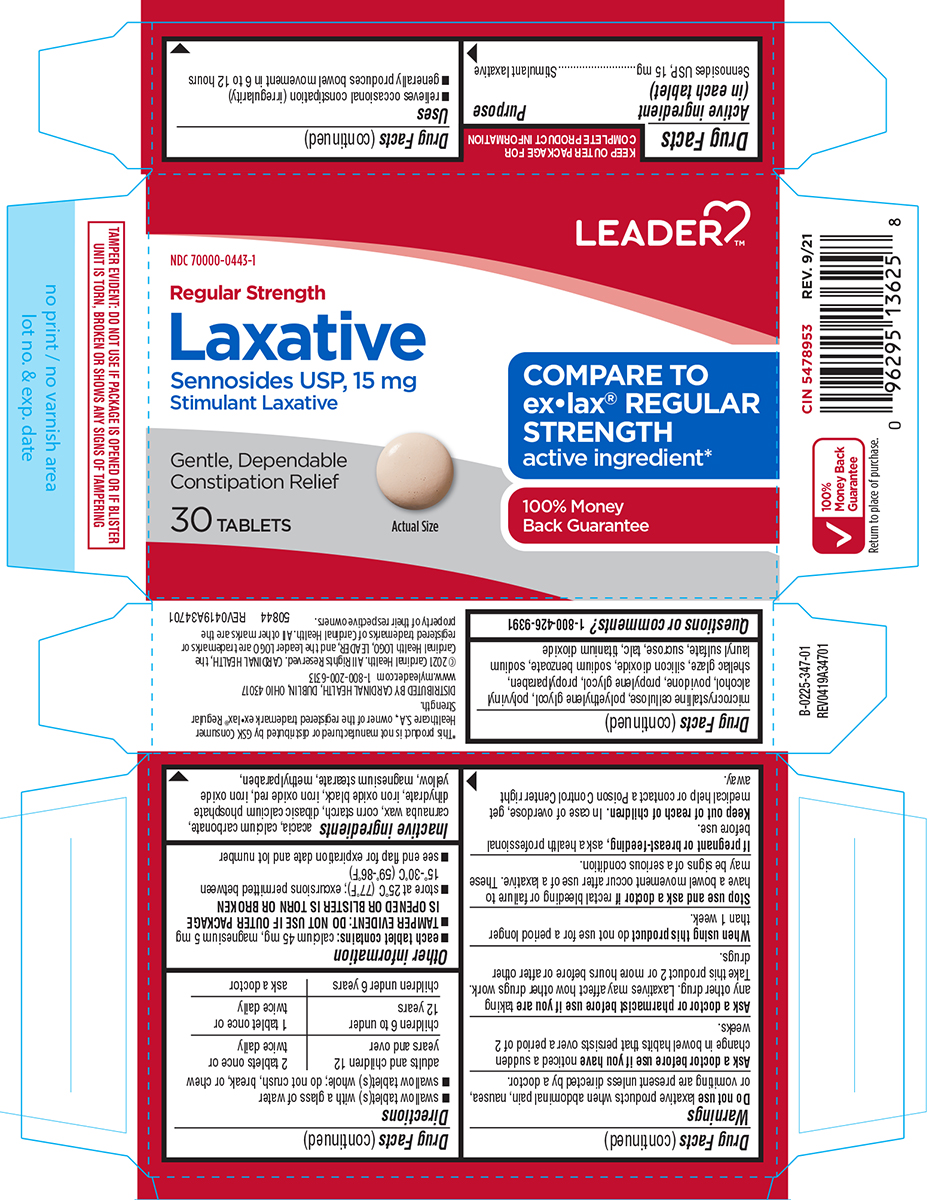
Laxative Sennosides 15 mg Tablet, Sugar Coated — NDC 70000-0443-1 (Billing 70000-0443-01)
This is a package of Laxative Sennosides 15 mg Tablet, Sugar Coated from Cardinal Health 110, LLC. DBA Leader, marketed since Mar 2019 and currently FDA-listed; retail pharmacies pay about $0.0673 per unit (NADAC). It is this product's only package size.
NDC database record
One package, one record: these facts belong to NDC 70000-0443-1 alone.
- Record
- FDA NDC Directory package listing · Human OTC drug
- Code segments
- 70000 labeler · 0443 product · 1 package
- Package marketed since
- Mar 1, 2019
- Sample package
- No — commercial package
- Listing certified through
- Dec 31, 2027
- Barcode (UPC)
- 0096295136258
- Medicaid fills, this package
- 237 prescriptions in the last four reported quarters
- FDA record last changed
- Jul 24, 2026
Identity & classification
Regulatory identifiers FDA, NLM and CMS codes for this package
Drug-database identifiers Medi-Span GPI and First Databank GCN / HICL / AHFS classification
- GSN (GCN sequence number): 021754
- GCN: 00704
- GPI-14 (Medi-Span): 46200060200315
- HICL (First Databank): 001289
- AHFS class code: 56:12.00.00
- RxCUI (RxNorm): 200162
Where does this data come from?
- FDA openFDA NDC Directory · synced Oct 8, 2026
- FDA label on DailyMed · label index refreshed Oct 8, 2026
- RxNorm (NLM RxNav) · catalog refreshed Oct 1, 2026
- Medi-Span GPI (licensed)
- First Databank (licensed) · refreshed Oct 8, 2026
RxNorm drug class
This medicine belongs to the Contact laxatives class.
Where does this data come from?
- RxClass (NLM) · catalog refreshed Oct 1, 2026
Clinical
Senna is used on a short-term basis to treat constipation. It also is used to empty the bowels before surgery and certain medical procedures. Senna is in a class of medications called stimulant laxatives. It works by increasing activity of the intestines to cause a bowel movement.
Read the full MedlinePlus article ↗- Senna typically produces a bowel movement within 6 to 12 hours. That's why most people take it at bedtime — so it can do its job overnight and you get results in the morning. If no...
- How long does it take for senna to work?
- Senna is designed for short-term, occasional use. You should not use it for more than 1 week unless your doctor specifically tells you it's okay. Using laxatives too often or for t...
- Laxatives like senna can affect how your body absorbs other medications. To be safe, take senna at least 2 hours before or after any other drugs you use. It's always a good idea to...
Patient education
Supplement & herbal interactions
Some supplements/herbs that may interact with Sennosides (OTC drug) — tap one for details:
Sennosides (OTC drug) may be associated with lower levels of 3 nutrients — worth a chat with your pharmacist, not a cause for alarm.
Where does this data come from?
- MedlinePlus (NLM) · refreshed Oct 8, 2026
- FDA label on DailyMed · label index refreshed Oct 8, 2026
Ask a licensed pharmacist directly — free, answered by our team.
Pricing
A drug doesn't have one price. Each row is a different public payment system, and none is what you'd pay at the counter — that depends on your insurance. The ⓘ on each row explains what it measures.
| Price system | Per ea | Per package |
|---|---|---|
| Retail pharmacies payNADAC · weekly | $0.067 | $2.02 / 30 tablets |
| Medicaid paysCMS SDUD · 12 mo | $0.2166 | $6.50 / 30 tablets |
| Medicare drug plans payPart D · quarterly | No Part D plan price is available for this NDC in our data. | |
Where does this data come from?
- CMS NADAC weekly file · file of Oct 7, 2026
- CMS ASP pricing files · refreshed Sep 20, 2026
- CMS Medicaid State Drug Utilization Data · through Q1 2026
- CMS Part D plan pricing files · refreshed Sep 24, 2026
- VA National Acquisition Center price file
Packaging — all sizes for this product
| Package NDC | Description | Marketing start | Marketing end | Status |
|---|---|---|---|---|
| 70000-0443-01 You're viewing this Main listing | 2 BLISTER PACK in 1 CARTON / 15 TABLET, SUGAR COATED in 1 BLISTER PACK | 2019-03-01 | — | Active |
Therapeutic equivalents
| Product | Labeler | Pack | NADAC/unit | TE | Status | Price vs. this |
|---|---|---|---|---|---|---|
| Laxative 15 mgthis 70000-0443-01 | Cardinal | 15 tablets | $0.067 | — | Availability likely | — |
| Leader Regular Strength Chocolate Laxative sennosides 15 mg 70000-0477-01 | CARDINAL | 24 tablets | $0.106 | — | Availability likely | +58% |
| Ex-Lax Regular Strength Stimulant Laxative 15 mg 00067-8141-01 | Haleon | 8 tablets | — | — | FDA listed | — |
| Perdiem 15 mg 00067-8143-01 | Haleon | 60 tablets | — | — | FDA listed | — |
| Laxative Regular Strength 15 mg 37835-0214-45 | Bi-Mart | 15 tablets | — | — | FDA listed | — |
| Sennosides 15 mg 49483-0079-00 | TIME | 50000 tablets | — | — | FDA listed | — |
| Stimulant Laxative 15 mg 51316-0734-01 | CVS | 15 tablets | — | — | FDA listed | — |
| Laxative Regular Strength 15 mg 69842-0347-01 | CVS | 15 tablets | — | — | FDA listed | — |
Where does this data come from?
- FDA openFDA NDC Directory · synced Oct 8, 2026
- FDA Orange Book · refreshed Oct 3, 2026
- CMS NADAC weekly file · file of Oct 7, 2026
Availability & generic status
We did not find an FDA-approved generic match for this exact strength, form and route.
Where does this data come from?
- FDA Orange Book · refreshed Oct 3, 2026
What it looks like
Where does this data come from?
- FDA label on DailyMed · label index refreshed Oct 8, 2026
Inactive Ingredients / Excipients
Inactive ingredients, also called excipients, are components of the drug product other than the active ingredient. They may include fillers, dyes, coatings, preservatives, flavors, or other formulation ingredients.
🧪 Avoiding an ingredient? See Senna inactive ingredients by manufacturer: every current product's list side by side, so you can ask your pharmacy for the version that does not list it.
💡 Tap an ingredient (hover on desktop) to see what it is and why it’s used.
-
UNII 5C5403N26O
Acacia is a natural gum derived from acacia tree sap. It serves as a binder, thickener, and emulsifier to help hold ingredients together, improve texture, and stabilize the medicine.
-
UNII H0G9379FGK
Calcium carbonate is a white mineral powder used as a filler and buffering agent in medicines. It helps give tablets their bulk and size while neutralizing stomach acid in some formulations.
-
UNII R12CBM0EIZ
A natural wax derived from a Brazilian palm tree, used as a coating and polish on tablets and capsules. It creates a smooth, shiny finish that protects the medicine and improves appearance.
-
UNII O7TSZ97GEP
A mineral compound that serves as a filler and binding agent in tablets and capsules. It adds bulk to the medicine and helps hold ingredients together during manufacturing.
-
UNII 1K09F3G675
Ferric oxide red is an inorganic iron compound used as a colorant in medicines. It gives tablets, capsules, or other dosage forms a red or reddish tint for identification and appearance.
-
UNII EX438O2MRT
Ferric oxide yellow is a naturally occurring iron compound used as a colorant in medications. It gives tablets, capsules, and other forms a yellow or golden hue for identification and appearance.
-
UNII XM0M87F357
A dark iron oxide compound that gives medicines their black or dark color. It's used as a colorant in tablets and capsules to help identify the product and make it visually distinctive.
-
UNII 70097M6I30
Magnesium stearate is a salt made from magnesium and stearic acid, a fatty substance. It's used in tablets and capsules as a lubricant and glidant to help ingredients flow smoothly during manufacturing and prevent sticking.
-
UNII A2I8C7HI9T
Methylparaben is a preservative derived from benzoic acid that prevents growth of bacteria, fungi, and mold in medicines. It extends the product's shelf life and maintains safety during storage.
-
UNII OP1R32D61U
Microcrystalline cellulose is a purified form of cellulose, a natural fiber from plant sources. It acts as a binder and filler in tablets and capsules, helping hold ingredients together and give the medicine its shape and size.
-
UNII 3WJQ0SDW1A
Polyethylene glycol is a synthetic liquid or solid polymer used in medicines as a solvent, lubricant, and humectant. It helps dissolve active ingredients, reduces friction during manufacturing, and retains moisture in the final product.
-
UNII 532B59J990
Polyvinyl alcohol is a synthetic polymer made from plant-derived materials. It's used as a binder to hold ingredients together, a film-former in coatings, and a thickener in liquid formulations.
-
UNII FZ989GH94E
Povidone is a synthetic polymer made from a plastic-like material. It acts as a binder to hold tablet ingredients together and as a disintegrant to help the tablet break apart in your stomach so the medicine can be absorbed.
-
UNII 6DC9Q167V3
Propylene glycol is a clear liquid derived from petroleum or vegetable sources. It acts as a solvent, humectant, and preservative in medicines, helping dissolve active ingredients and maintain product stability.
-
UNII Z8IX2SC1OH
Propylparaben is a chemical preservative used to prevent bacterial and fungal growth in medicines and personal care products. It helps extend shelf life and maintain product safety during storage.
-
UNII 46N107B71O
Shellac is a natural resin secreted by the lac beetle. It's used as a coating on tablets and capsules to control how quickly the medicine dissolves and to improve appearance and stability.
-
UNII ETJ7Z6XBU4
Silicon dioxide is a naturally occurring mineral used as a glidant and anti-caking agent. It helps powder ingredients flow smoothly and prevents clumping during manufacturing and storage.
-
UNII OJ245FE5EU
Sodium benzoate is a salt derived from benzoic acid, a preservative. It's added to medicines to prevent growth of bacteria, fungi, and other microorganisms that could spoil the product.
-
UNII 368GB5141J
A detergent and foaming agent derived from coconut or palm oil. In medications, it helps break down and mix oil and water-based ingredients, aids in tablet disintegration, and improves how the drug dissolves and spreads in the mouth or digestive system.
-
UNII O8232NY3SJ
A plant-based carbohydrate derived from corn kernels. It acts as a filler to add bulk, a binder to hold ingredients together, and a disintegrant to help the tablet break apart in your stomach for absorption.
-
UNII C151H8M554
A natural sugar derived from sugar cane or sugar beets. It's used as a sweetener, filler, and binder to improve taste, add bulk, and help hold tablet or capsule ingredients together.
-
UNII 7SEV7J4R1U
A powder made from a naturally occurring mineral. In medicines, talc works as a glidant and anti-caking agent, helping tablets and capsules flow smoothly during manufacturing and preventing clumping.
-
UNII 15FIX9V2JP
Titanium dioxide is a bright white mineral powder commonly used as a colorant and opacifying agent. It makes pills and tablets white or lighter in color and helps make coatings non-transparent.
23 inactive ingredients listed in the exact product block matched to this NDC.
Label-section wording can be broader than the structured product block and may mention additional formulation ingredients.
Where does this data come from?
ingredient classCode="IACT" elements from the exact product block matched by this NDC. Label-section narrative from DailyMed / the openFDA label index is shown separately when available.- FDA label on DailyMed · label index refreshed Oct 8, 2026
- FDA openFDA NDC Directory · synced Oct 8, 2026
Inactive ingredient FAQ
Are inactive ingredients the same for every manufacturer?
Why might an inactive ingredient be missing?
Can inactive ingredients matter?
Manufacturer & labeler
More NDCs from Cardinal Health 110, LLC. DBA Leader labeler code 70000
- Hemorrhoidal Cream Glycerin, Phenylephrine Hydrochloride, Pramoxine Hydrochloride, White Petrolatum .28 g/28g; 4.032 g/28g; .07 g/28g; 4.2 g/28g Cream NDC 70000-0425-1
- Glycerin 1 g Suppository NDC 70000-0429-1
- Leader Extra Strength Antacid Calcium carbonate 750 mg Tablet, Chewable NDC 70000-0430-2
- Leader Extra Strength Antacid Calcium carbonate 750 mg Tablet, Chewable NDC 70000-0431-1
- Leader Gas relief Simethicone 80 mg Tablet, Chewable NDC 70000-0434-1
- Leader Ultra Strength Antacid Calcium carbonate 1000 mg Tablet, Chewable NDC 70000-0436-1
- LEADER Mineral Oil 1000 mg/mL Liquid NDC 70000-0448-1
- Leader Advanced Relief Eye Drops DEXTRAN 70, POLYETHYLENE GLYCOL 400, POVIDONE, TETRAHYDROZOLINE HCl 70 100 mg/100mL; 400 1000 mg/100mL; 1000 mg/100mL; 50 mg/100mL Solution/ Drops NDC 70000-0456-1
- Leader Ultra Lubricating Eye Drops Polyethylene glycol 400, propylene 400 .4 g/100mL; .3 g/100mL Solution/ Drops NDC 70000-0457-1
- Sore Throat Relief Cherry Flavor Phenol 1.4 g/100mL Spray NDC 70000-0458-1
- LEADER Ultra Strength Peppermint Flavor Chewable Antacid Tablets 1000 mg Tablet, Chewable NDC 70000-0459-1
- Leader Extra Strength Sugar Free Antacid 750 mg Tablet, Chewable NDC 70000-0460-1
Where does this data come from?
- FDA openFDA NDC Directory · synced Oct 8, 2026
- Drugs@FDA
FDA label — Drug Facts FDA SPL
🎯 Indications and Usage ▾
Uses relieves occasional constipation (irregularity) generally produces bowel movement in 6 to 12 hours
⏱️ Dosage and Administration ▾
Directions do not take more than directed swallow tablet(s) with a glass of water swallow tablet(s) whole; do not crush, break, or chew adults and children 12 years and over 2 tablets once or twice daily children 6 to under 12 years 1 tablet once or twice daily children under 6 years ask a doctor
⚠️ Warnings ▾
Warnings Do not use laxative products when abdominal pain, nausea, or vomiting are present unless directed by a doctor for a period longer than 1 week unless directed by a doctor Ask a doctor before use if you have noticed a sudden change in bowel habits that persists over a period of 2 weeks. Ask a doctor or pharmacist before use if you are taking any other drug. Laxatives may affect how other drugs work.
Take this product 2 or more hours before or after other drugs. Stop use and ask a doctor if rectal bleeding or failure to have a bowel movement occur after use of a laxative. These may be signs of a serious condition.
If pregnant or breast-feeding, ask a health professional before use. Keep out of reach of children. In case of overdose, get medical help or contact a Poison Control Center right away.
📦 Storage and Handling ▾
Other information each tablet contains: calcium 45 mg TAMPER EVIDENT: DO NOT USE IF OUTER PACKAGE IS OPENED OR BLISTER IS TORN OR BROKEN store at 25°C (77°F); excursions permitted between 15°-30°C (59°-86°F) see end flap for expiration date and lot number
🧪 Active Ingredient ▾
Active ingredient (in each tablet) Sennosides USP, 15 mg
🧪 Inactive Ingredients ▾
Inactive ingredients acacia, calcium carbonate, carnauba wax, corn starch, dibasic calcium phosphate dihydrate, iron oxide black, iron oxide red, iron oxide yellow, magnesium stearate, methylparaben, microcrystalline cellulose, polyethylene glycol, polyvinyl alcohol, povidone, propylene glycol, propylparaben, shellac glaze, silicon dioxide, sodium benzoate, sodium lauryl sulfate, sucrose, talc, titanium dioxide
🎯 Purpose ▾
Purpose Stimulant laxative
📄 Do Not Use ▾
Do not use laxative products when abdominal pain, nausea, or vomiting are present unless directed by a doctor for a period longer than 1 week unless directed by a doctor
📄 Ask a Doctor Before Use If ▾
Ask a doctor before use if you have noticed a sudden change in bowel habits that persists over a period of 2 weeks.
📄 Ask a Doctor or Pharmacist Before Use If ▾
Ask a doctor or pharmacist before use if you are taking any other drug. Laxatives may affect how other drugs work. Take this product 2 or more hours before or after other drugs.
📄 Stop Use and Ask a Doctor If ▾
Stop use and ask a doctor if rectal bleeding or failure to have a bowel movement occur after use of a laxative. These may be signs of a serious condition.
🤰 If Pregnant or Breast-Feeding ▾
If pregnant or breast-feeding, ask a health professional before use.
📄 Keep Out of Reach of Children ▾
Keep out of reach of children. In case of overdose, get medical help or contact a Poison Control Center right away.
📄 Questions or Comments ▾
Questions or comments? 1-800-426-9391
📄 Package Label / Principal Display Panel ▾
Principal display panel LEADER ™ NDC 70000-0443-1 Regular Strength Laxative Sennosides USP, 15 mg Stimulant Laxative Gentle, Dependable Constipation Relief 30 TABLETS Actual Size COMPARE TO ex•lax ® REGULAR STRENGTH active ingredient* 100% Money Back Guarantee TAMPER EVIDENT: DO NOT USE IF PACKAGE IS OPENED OR IF BLISTER UNIT IS TORN, BROKEN OR SHOWS ANY SIGNS OF TAMPERING *This product is not manufactured or distributed by Haleon CH SARL, owner of the registered trademark ex•lax ® Regular Strength. 50844 REV0824B34708 DISTRIBUTED BY CARDINAL HEALTH, DUBLIN, OHIO 43017 www.myleader.com 1-800-200-6313 © 2025 Cardinal Health.
All Rights Reserved. CARDINAL HEALTH, the Cardinal Health LOGO, LEADER, and the LEADER LOGO are trademarks or registered trademarks of Cardinal Health. All other marks are the property of their respective owners.
100% Money Back Guarantee Return to place of purchase. Leader 44-347 Leader 44-347