
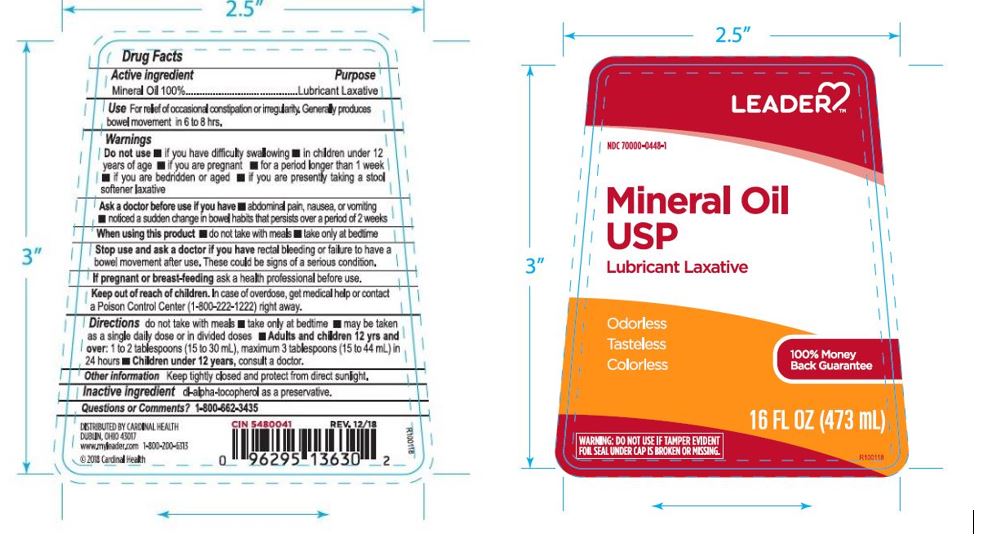
LEADER Mineral Oil 1000 mg/mL Liquid, 473 mL — NDC 70000-0448-1 (Billing 70000-0448-01)
This is a package of 473 mL of LEADER Mineral Oil 1000 mg/mL Liquid from Cardinal Health, 110 dba Leader, marketed since Dec 2018 and currently FDA-listed, this package's marketing is listed to end Feb 2027; retail pharmacies pay about $0.0105 per mL (NADAC). It is this product's only package size.
NDC database record
One package, one record: these facts belong to NDC 70000-0448-1 alone.
- Record
- FDA NDC Directory package listing · Human OTC drug
- Code segments
- 70000 labeler · 0448 product · 1 package
- Package marketed since
- Dec 18, 2018
- Package marketing ended
- Feb 28, 2027
- Sample package
- No — commercial package
- Billing quantity
- 473 mL per package
- Barcode (UPC-A, from the NDC)
- 3 7000004481 7
- Medicaid fills, this package
- 107 prescriptions in the last four reported quarters
- FDA record last changed
- Jul 24, 2026
Identity & classification
Regulatory identifiers FDA, NLM and CMS codes for this package
Drug-database identifiers Medi-Span GPI and First Databank GCN / HICL / AHFS classification
- GSN (GCN sequence number): 002997
- GCN: 09020
- GPI-14 (Medi-Span): 46400010001700
- HICL (First Databank): 001319
- AHFS class code: 56:12.00.00
- RxCUI (RxNorm): 343017
Where does this data come from?
- FDA openFDA NDC Directory · synced Oct 8, 2026
- FDA label on DailyMed · label index refreshed Oct 8, 2026
- RxNorm (NLM RxNav) · catalog refreshed Oct 1, 2026
- Medi-Span GPI (licensed)
- First Databank (licensed) · refreshed Oct 8, 2026
RxNorm drug class
This medicine belongs to the Softeners, emollients class.
Where does this data come from?
- RxClass (NLM) · catalog refreshed Oct 1, 2026
Clinical
- Mostly for occasional constipation, by mouth or as an enema. Some enemas are also used for fecal impaction or to clear residue after a barium test. One topical product is used for...
- Take it only at bedtime and not with meals. It usually works in about 6 to 8 hours. An enema usually works within 2 to 15 minutes.
- Space it out. Take mineral oil 2 or more hours before or after other drugs, since laxatives may affect how they work. Tell me if you take a stool softener.
- Not longer than 1 week. If constipation continues or your bowel habits suddenly change for 2 weeks, see your doctor.
Patient education
Supplement & herbal interactions
Some supplements/herbs that may interact with Mineral Oil — tap one for details:
Mineral Oil may be associated with lower levels of 7 nutrients — worth a chat with your pharmacist, not a cause for alarm.
Where does this data come from?
- MedlinePlus (NLM) · refreshed Oct 8, 2026
- FDA label on DailyMed · label index refreshed Oct 8, 2026
Ask a licensed pharmacist directly — free, answered by our team.
Pricing
A drug doesn't have one price. Each row is a different public payment system, and none is what you'd pay at the counter — that depends on your insurance. The ⓘ on each row explains what it measures.
| Price system | Per mL | Per package |
|---|---|---|
| Retail pharmacies payNADAC · weekly | $0.011 | $4.97 / 473 ml |
| Medicaid paysCMS SDUD · 12 mo | $0.2139 | $101.17 / 473 ml |
| Medicare drug plans payPart D · quarterly | No Part D plan price is available for this NDC in our data. | |
Where does this data come from?
- CMS NADAC weekly file · file of Feb 21, 2024
- CMS ASP pricing files · refreshed Sep 20, 2026
- CMS Medicaid State Drug Utilization Data · through Q4 2025
- CMS Part D plan pricing files · refreshed Sep 24, 2026
- VA National Acquisition Center price file
Packaging — all sizes for this product
| Package NDC | Description | Marketing start | Marketing end | Status |
|---|---|---|---|---|
| 70000-0448-01 You're viewing this Main listing | 473 mL in 1 BOTTLE, PLASTIC | 2018-12-18 | Feb 28, 2027 | Active |
Therapeutic equivalents
| Product | Labeler | Pack | NADAC/unit | TE | Status | Price vs. this |
|---|---|---|---|---|---|---|
| Mineral Oil 100 mg/100mL 46122-0395-16 | AmerisourceBergen | 473 ml | $0.010 | — | Availability likely | save 5% |
| LEADER Mineral Oil 1000 mg/mLthis 70000-0448-01 | Cardinal | 473 ml | $0.010 | — | FDA listed | — |
| oil 1 mg/mL 00869-0831-43 | Vi-Jon, | 473 ml | — | — | FDA listed | — |
| Mineral Oil 1000 mg/mL 48433-0202-30 | Safecor | 30 ml | — | — | FDA listed | — |
| Mineral oil 100 mg/100mL 49580-0334-06 | P | 473 ml | — | — | FDA listed | — |
| CVS Mineral Oil 1000 mg/mL 69842-0238-16 | CVS | 473 ml | — | — | FDA listed | — |
| Mineral Oil 1000 mg/mL 81033-0042-50 | Kesin | 50 cups | — | — | FDA listed | — |
| Humco Mineral Oil Heavy 1000 mg/mL 00395-1685-28 | Humco | 3800 ml | — | — | FDA listed | — |
| Mineral Oil Heavy 1000 mg/mL 82645-0906-16 | Pharma | 473 ml | — | — | FDA listed | — |
Where does this data come from?
- FDA openFDA NDC Directory · synced Oct 8, 2026
- FDA Orange Book · refreshed Oct 3, 2026
- CMS NADAC weekly file · file of Feb 21, 2024
Availability & generic status
We did not find an FDA-approved generic match for this exact strength, form and route.
Where does this data come from?
- FDA Orange Book · refreshed Oct 3, 2026
Inactive Ingredients / Excipients
Inactive ingredients, also called excipients, are components of the drug product other than the active ingredient. They may include fillers, dyes, coatings, preservatives, flavors, or other formulation ingredients.
🧪 Avoiding an ingredient? See Mineral Oil inactive ingredients by manufacturer: every current product's list side by side, so you can ask your pharmacy for the version that does not list it.
💡 Tap an ingredient (hover on desktop) to see what it is and why it’s used.
-
UNII WR1WPI7EW8
A synthetic form of vitamin E used as an antioxidant. It prevents oils and fats in the medicine from breaking down and becoming rancid, helping keep the product stable during storage.
1 inactive ingredient listed in the exact product block matched to this NDC.
Label-section wording can be broader than the structured product block and may mention additional formulation ingredients.
Where does this data come from?
ingredient classCode="IACT" elements from the exact product block matched by this NDC. Label-section narrative from DailyMed / the openFDA label index is shown separately when available.- FDA label on DailyMed · label index refreshed Oct 8, 2026
- FDA openFDA NDC Directory · synced Oct 8, 2026
Inactive ingredient FAQ
Are inactive ingredients the same for every manufacturer?
Why might an inactive ingredient be missing?
Can inactive ingredients matter?
Manufacturer & labeler
More NDCs from Cardinal Health, 110 dba Leader labeler code 70000
- Glycerin 1 g Suppository NDC 70000-0429-1
- Leader Extra Strength Antacid Calcium carbonate 750 mg Tablet, Chewable NDC 70000-0430-2
- Leader Extra Strength Antacid Calcium carbonate 750 mg Tablet, Chewable NDC 70000-0431-1
- Leader Gas relief Simethicone 80 mg Tablet, Chewable NDC 70000-0434-1
- Leader Ultra Strength Antacid Calcium carbonate 1000 mg Tablet, Chewable NDC 70000-0436-1
- Laxative Sennosides 15 mg Tablet, Sugar Coated NDC 70000-0443-1
- Leader Advanced Relief Eye Drops DEXTRAN 70, POLYETHYLENE GLYCOL 400, POVIDONE, TETRAHYDROZOLINE HCl 70 100 mg/100mL; 400 1000 mg/100mL; 1000 mg/100mL; 50 mg/100mL Solution/ Drops NDC 70000-0456-1
- Leader Ultra Lubricating Eye Drops Polyethylene glycol 400, propylene 400 .4 g/100mL; .3 g/100mL Solution/ Drops NDC 70000-0457-1
- Sore Throat Relief Cherry Flavor Phenol 1.4 g/100mL Spray NDC 70000-0458-1
- LEADER Ultra Strength Peppermint Flavor Chewable Antacid Tablets 1000 mg Tablet, Chewable NDC 70000-0459-1
- Leader Extra Strength Sugar Free Antacid 750 mg Tablet, Chewable NDC 70000-0460-1
- Anti-Diarrheal LOPERAMIDE HYDROCHLORIDE 2 mg Capsule, Liquid Filled NDC 70000-0461-1
Where does this data come from?
- FDA openFDA NDC Directory · synced Oct 8, 2026
- Drugs@FDA
FDA label — Drug Facts FDA SPL
🎯 Indications and Usage ▾
For relief of occasional constpation or irregularity. Generally produces bowel movement in 6 to 8 hours.
⏱️ Dosage and Administration ▾
Adults and children 12 yrs and older: 1 to 2 tablespoonfulls at bedtime. Children 6 to 12 yes of age: 1 to 3 teaspoonfulls at bedtime. Children under 6 yrs of age: Consult a doctor before use
⚠️ Warnings ▾
Do not use if you have difficulty swallowing, in children under 12 years of age, if you are pregnant, for a period longer than 1 week, if you are bedridden or aged, if you are presently taking a stool softener laxative
🧪 Active Ingredient ▾
Mineral Oil
🧪 Inactive Ingredients ▾
dl-alpha-tocopherol as a preservative
🎯 Purpose ▾
Lubricant Laxative
📄 Ask a Doctor Before Use If ▾
Ask a doctor before usage if you hav abdominal pain, nausea, or vomiting, noticed a sudden change in bowel habits that persists over a period of 2 weeks.
📄 Stop Use and Ask a Doctor If ▾
and consult a doctor if there is a fialure to have a bowel movement after use.
📄 Keep Out of Reach of Children ▾
In case of accidental overdose, seek professional assistance or contact Poison Control Center immediately. In case of eye contact wash gently with water for 15 minutes.
📄 Other Information ▾
Keep tightly closed and protected from direct light
📄 Package Label / Principal Display Panel ▾
mineraloil