
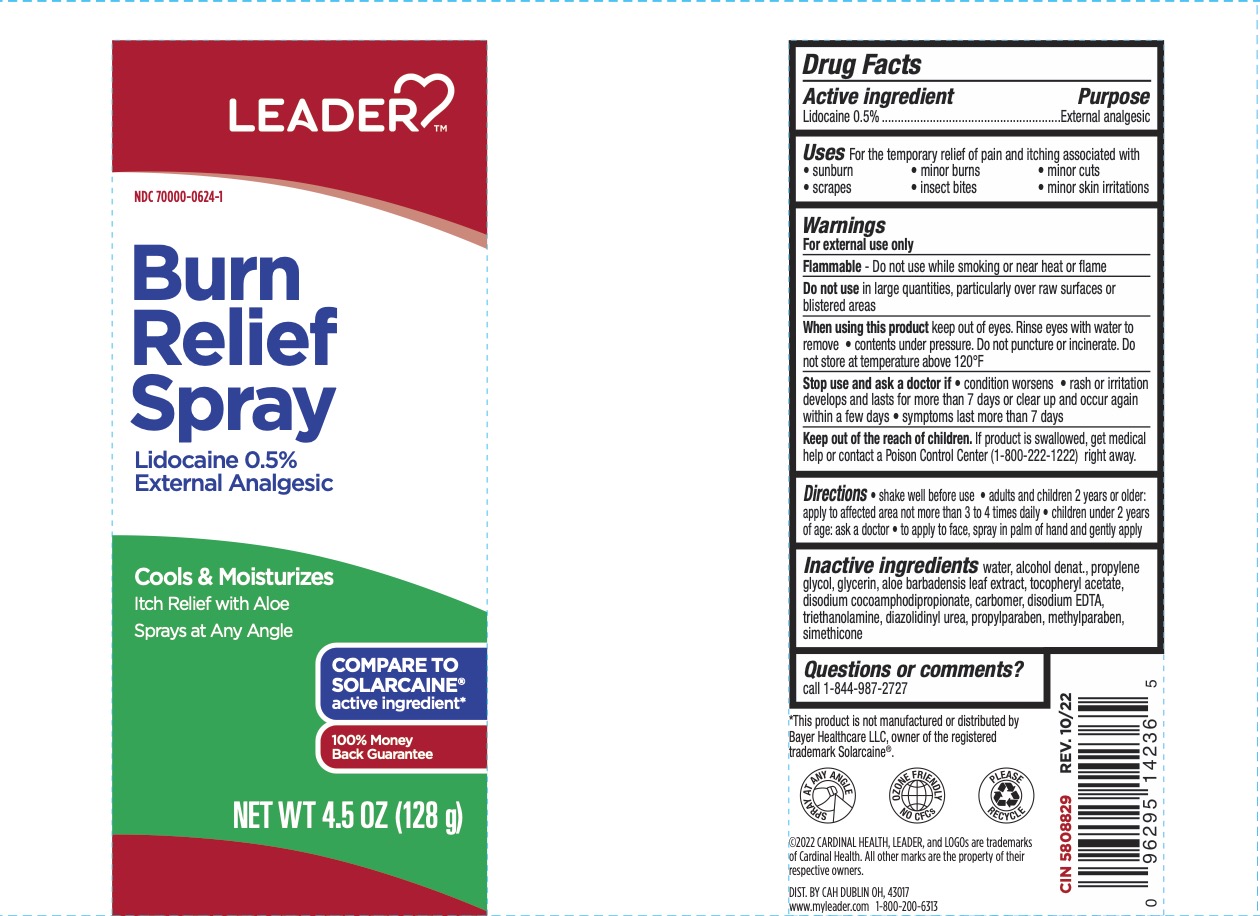
Leader Burn Relief Lidocaine .5 g/100g Spray, 128 g — NDC 70000-0624-1 (Billing 70000-0624-01)
This is a package of 128 g of Leader Burn Relief Lidocaine .5 g/100g Spray from Cardinal Health, marketed since Feb 2023 and currently FDA-listed; retail pharmacies pay about $0.0276 per g (NADAC). It is this product's only package size.
NDC database record
One package, one record: these facts belong to NDC 70000-0624-1 alone.
- Record
- FDA NDC Directory package listing · Human OTC drug
- Code segments
- 70000 labeler · 0624 product · 1 package
- Package marketed since
- Feb 17, 2023
- Sample package
- No — commercial package
- Listing certified through
- Dec 31, 2026
- Billing quantity
- 128 g per package
- Barcode (UPC)
- 0096295142365
- FDA record last changed
- Jul 24, 2026
Other active recalls for Lidocaine (different manufacturers) — 1 · tap to view
Identity & classification
Regulatory identifiers FDA, NLM and CMS codes for this package
Drug-database identifiers Medi-Span GPI and First Databank GCN / HICL / AHFS classification
- GSN (GCN sequence number): 016027
- GCN: 75200
- HICL (First Databank): 006110
- AHFS class code: 72:00.00.00
- RxCUI (RxNorm): 1442274
Where does this data come from?
- FDA openFDA NDC Directory · synced Oct 1, 2026
- FDA label on DailyMed · label index refreshed Oct 5, 2026
- RxNorm (NLM RxNav) · catalog refreshed Oct 1, 2026
- Medi-Span GPI (licensed)
- First Databank (licensed) · refreshed Oct 1, 2026
RxNorm drug class
This medicine belongs to the Antiarrhythmic class.
Where does this data come from?
- RxClass (NLM) · catalog refreshed Oct 1, 2026
Clinical
- Lidocaine numbs the area where it is used. Clinicians inject it for procedures. Skin products are used for pain, itching, minor burns, insect bites, hemorrhoid discomfort, and in s...
- Clean and dry the skin first, then apply as your product’s directions say. Wash your hands afterward. Don’t exceed the number of uses on the label. Ask a doctor before using a prod...
- No. Heat can increase how much lidocaine your body absorbs. Don’t bandage tightly either. Also avoid using other topical pain products at the same time.
- Can I use a heating pad with a lidocaine patch?
Patient education
Supplement & herbal interactions
Some supplements/herbs that may interact with Lidocaine — tap one for details:
Where does this data come from?
- MedlinePlus (NLM) · refreshed Oct 1, 2026
- FDA label on DailyMed · label index refreshed Oct 5, 2026
Ask a licensed pharmacist directly — free, answered by our team.
Pricing
A drug doesn't have one price. Each row is a different public payment system, and none is what you'd pay at the counter — that depends on your insurance. The ⓘ on each row explains what it measures.
| Price system | Per g | Per package |
|---|---|---|
| Retail pharmacies payNADAC · weekly | $0.028 | $3.53 / 128 g |
| Medicaid paysCMS SDUD · 12 mo | No recent Medicaid claims on file for this NDC — rare and low-volume NDCs are suppressed in the public data. | |
| Medicare drug plans payPart D · quarterly | No Part D plan price is available for this NDC in our data. | |
Where does this data come from?
- CMS NADAC weekly file · file of Sep 30, 2026
- CMS ASP pricing files · refreshed Sep 20, 2026
- CMS Medicaid State Drug Utilization Data · refreshed Oct 5, 2026
- CMS Part D plan pricing files · refreshed Sep 24, 2026
- VA National Acquisition Center price file
Packaging — all sizes for this product
| Package NDC | Description | Marketing start | Marketing end | Status |
|---|---|---|---|---|
| 70000-0624-01 You're viewing this Main listing | 128 g in 1 BOTTLE, PLASTIC | 2023-02-17 | — | Active |
Therapeutic equivalents
| Product | Labeler | Pack | NADAC/unit | TE | Status | Price vs. this |
|---|---|---|---|---|---|---|
| Leader Burn Relief .5 g/100gthis 70000-0624-01 | Cardinal | 128 g | $0.028 | — | Availability likely | — |
| Burn Relief .64 g/127g 46122-0555-28 | AmerisourceBergen | 127 g | $0.028 | — | Availability likely | +2% |
| Lidocaine .64 g/127g 36800-0031-45 | Topco | 127 g | — | — | FDA listed | — |
| Lidocaine .64 g/127g 41520-0162-45 | Foodhold | 127 g | — | — | FDA listed | — |
| Lidocaine .64 g/127g 50804-0756-45 | Perrigo | 127 g | — | — | FDA listed | — |
| Burn Relief .64 g/127g 69842-0236-45 | CVS | 127 g | — | — | FDA listed | — |
| DCH Burn Relief .5 g/100g 72839-0021-04 | Derma | 128 g | — | — | FDA listed | — |
| Meijer Burn Relief .5 g/100g 79481-2183-04 | Meijer | 128 g | — | — | FDA listed | — |
| Burn Relief .5 g/100g 79903-0036-45 | WALMART | 127 g | — | — | FDA listed | — |
Where does this data come from?
- FDA openFDA NDC Directory · synced Oct 1, 2026
- FDA Orange Book · refreshed Oct 3, 2026
- CMS NADAC weekly file · file of Sep 30, 2026
Availability & generic status
We did not find an FDA-approved generic match for this exact strength, form and route.
Where does this data come from?
- FDA Orange Book · refreshed Oct 3, 2026
Inactive Ingredients / Excipients
Inactive ingredients, also called excipients, are components of the drug product other than the active ingredient. They may include fillers, dyes, coatings, preservatives, flavors, or other formulation ingredients.
🧪 Avoiding an ingredient? See Lidocaine inactive ingredients by manufacturer: every current product's list side by side, so you can ask your pharmacy for the version that does not list it.
💡 Tap an ingredient (hover on desktop) to see what it is and why it’s used.
-
UNII 3K9958V90M
A liquid solvent derived from fermentation or chemical synthesis. In medicines, alcohol dissolves active ingredients, helps preserve the product, and improves how the body absorbs certain drugs.
-
UNII ZY81Z83H0X
Aloe vera leaf is a plant extract derived from the aloe plant. It is used in medicines as a natural moisturizer and skin-soothing agent in topical formulations.
-
UNII 4Q93RCW27E
A synthetic polymer made from acrylic acid that's crosslinked for stability. It acts as a thickener and gelling agent in creams and gels, helping the medicine spread evenly and maintain its texture.
-
UNII H5RIZ3MPW4
A chemical preservative used to prevent bacterial and fungal growth in medicines. It helps extend shelf life and maintain product safety during storage and use.
-
UNII 6K8PRP397M
A plant-derived cleansing agent made from coconut oil. It helps the medicine dissolve evenly and improves how the product spreads or mixes in formulations.
-
UNII 7FLD91C86K
Edetate disodium is a chemical compound that binds and removes certain metal ions. In medicines, it acts as a preservative and stabilizer by preventing metals like calcium from interfering with the product's shelf life and consistency.
-
UNII PDC6A3C0OX
Glycerin is a clear, thick liquid derived from plant oils or fats. It acts as a humectant to retain moisture, a sweetener, and a solvent in medications.
-
UNII A2I8C7HI9T
Methylparaben is a preservative derived from benzoic acid that prevents growth of bacteria, fungi, and mold in medicines. It extends the product's shelf life and maintains safety during storage.
-
UNII 6OZP39ZG8H
Polysorbate 80 is a synthetic emulsifier derived from sorbitol and oleic acid. It helps mix oil and water-based ingredients together in medications and improves how the product disperses in the body.
-
UNII 6DC9Q167V3
Propylene glycol is a clear liquid derived from petroleum or vegetable sources. It acts as a solvent, humectant, and preservative in medicines, helping dissolve active ingredients and maintain product stability.
-
UNII Z8IX2SC1OH
Propylparaben is a chemical preservative used to prevent bacterial and fungal growth in medicines and personal care products. It helps extend shelf life and maintain product safety during storage.
-
UNII ETJ7Z6XBU4
Silicon dioxide is a naturally occurring mineral used as a glidant and anti-caking agent. It helps powder ingredients flow smoothly and prevents clumping during manufacturing and storage.
-
UNII 9O3K93S3TK
Trolamine is an alkaline compound used as a pH buffer and emulsifier in medicines. It helps neutralize acids, stabilize formulations, and enable mixing of oil and water-based ingredients.
-
UNII 059QF0KO0R
Water is a liquid solvent that dissolves and mixes ingredients together in liquid medicines, syrups, and injections. It helps distribute the active drug evenly throughout the product.
14 inactive ingredients listed in the exact product block matched to this NDC.
Label-section wording can be broader than the structured product block and may mention additional formulation ingredients.
Where does this data come from?
ingredient classCode="IACT" elements from the exact product block matched by this NDC. Label-section narrative from DailyMed / the openFDA label index is shown separately when available.- FDA label on DailyMed · label index refreshed Oct 5, 2026
- FDA openFDA NDC Directory · synced Oct 1, 2026
Inactive ingredient FAQ
Are inactive ingredients the same for every manufacturer?
Why might an inactive ingredient be missing?
Can inactive ingredients matter?
Manufacturer & labeler
More NDCs from Cardinal Health labeler code 70000
- Witch Hazel 842 mg/mL Liquid NDC 70000-0615-1
- Nighttime Sleep Aid Diphenhydramine HCl 50 mg Capsule NDC 70000-0616-1
- Leader Roll-On Cooling Pain Relief Topical Analgesic MENTHOL, UNSPECIFIED FORM 40 mg/mL Gel NDC 70000-0617-1
- Leader Cooling Pain Relief Topical Analgesic MENTHOL, UNSPECIFIED FORM 40 mg/mL Gel NDC 70000-0618-1
- Acetaminophen and Ibuprofen 250 mg; 125 mg Tablet NDC 70000-0622-1
- leader tussin cf Acetaminophen, Dextromethorphan Hydrobromide, Guaifenesin, Phenylephrine Hydrochloride 650 mg/20mL; 20 mg/20mL; 400 mg/20mL; 10 mg/20mL Solution NDC 70000-0623-1
- Leader Triple antibiotic and pain relief Bacitracin,Neomycin,Polymxin, Pramoxine 500 [USP'U]/g; 3.5 mg/g; 10 mg/g; 10000 [USP'U]/g Ointment NDC 70000-0625-1
- Acetaminophen 650 mg Tablet NDC 70000-0626-1
- Acetaminophen 650 mg Tablet NDC 70000-0627-1
- Tussin DM Dextromethorphan HBr, Guaifenesin 20 mg/20mL; 400 mg/20mL Solution NDC 70000-0628-1
- Leader Childrens Multi Symptom Cold Dextromethorphan HBr, guaifenesin, Phenylephrine HCl 5 mg/5mL; 100 mg/5mL; 2.5 mg/5mL Liquid NDC 70000-0629-1
- Childrens Mucus and Cough Relief Dextromethorphan HBr, Guaifenesin 5 mg/5mL; 100 mg/5mL Liquid NDC 70000-0630-1
Where does this data come from?
- FDA openFDA NDC Directory · synced Oct 1, 2026
- Drugs@FDA
FDA label — Drug Facts FDA SPL
🎯 Indications and Usage ▾
Shake well before use. Adults and children 2 years and older: apply to the affected area, not more than 3 to 4 times a day. Children under 2 years of age: ask a doctor. To apply to face, spray in palm of hand and gently apply.
⏱️ Dosage and Administration ▾
For the temporary relief of pain and itching due to sunburn, minor burns, insect bites, minor cuts, scrapes, and minor skin irritations.
⚠️ Warnings ▾
For external use only . Flammable-- do not use while smoking or near heat or flame. Do not use in large quantities, particularly over raw surfaces or blistered areas.
When using this product avoid contact with eyes. Rinse with water to remove. Contents under pressure.
Do not puncture or incinerate. Do not store at temperature above 120F. Stop use and ask a doctor if the condition worsens or symptoms persist for more than 7 days or clear up and occur again within a few days.
🧪 Active Ingredient ▾
Lidocaine 0.5%
🧪 Inactive Ingredients ▾
Water, Alcohol Denat., Propylene Glycol, Glycerin, Aloe Barbadensis Leaf Extract, Tocopheryl Acetate, Disodium Cocoamphodipipropionate, Carbomer, Disodium EDTA, Triethanolamine, Diazolidinyl Urea, Propylparaben, methylparaben, Simethicone.
🎯 Purpose ▾
External Analgesic.
📄 Keep Out of Reach of Children ▾
Keep out of reach of children. If the product is swallowed, get medical help or contact a Poison Control Center right away.
📄 Package Label / Principal Display Panel ▾
Label