
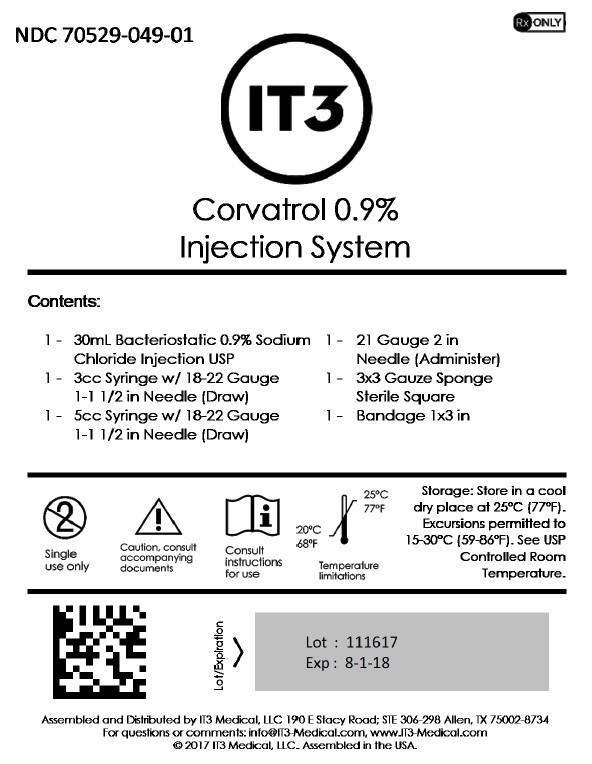
Corvatrol 0.9% SODIUM CHLORIDE 9 mg/mL Injection
Other active recalls for Sodium Chloride (different manufacturers) — 6 · tap to view
🆔 Identity & classification
Where does this data come from?
🏭 Manufacturer & labeler
Where does this data come from?
🩺 Clinical
- Yes, exactly. Saline is just sodium chloride dissolved in water — it's essentially a sterile salt-water solution. Depending on the concentration and form, it can be used as an IV f...
- I've heard of saline solution — is that the same thing as sodium chloride?
- In some situations — like after surgery, during serious illness, or when someone can't take anything by mouth — the body needs fluids and electrolytes delivered directly into the b...
- Why would someone need sodium chloride through an IV? Can't you just drink water?
Patient education
Supplement & herbal interactions
Some supplements/herbs that may interact with Sodium Chloride — tap one for details:
Where does this data come from?
Ask a licensed pharmacist directly — free, answered by our team.
🧪 Inactive Ingredients / Excipients
Inactive ingredients, also called excipients, are components of the drug product other than the active ingredient. They may include fillers, dyes, coatings, preservatives, flavors, or other formulation ingredients.
💡 Tap an ingredient (hover on desktop) to see what it is and why it’s used.
-
UNII LKG8494WBH
Benzyl alcohol is a clear liquid used as a preservative and solvent in medicines. It helps prevent bacterial and fungal growth and dissolves other ingredients to create uniform liquid formulations.
-
UNII QTT17582CB
A strong acid used to adjust and maintain the proper pH level in liquid medicines, ensuring stability and preventing breakdown of active ingredients.
-
UNII 55X04QC32I
A strong alkaline chemical used to adjust and maintain the pH balance of liquid medicines. It helps keep the medicine stable and ensures it stays effective during storage.
3 inactive ingredients listed in the exact product block matched to this NDC.
Where does this data come from?
ingredient classCode="IACT" elements from the exact product block matched by this NDC. Label-section narrative from DailyMed / the openFDA label index is shown separately when available.Inactive ingredient FAQ
Are inactive ingredients the same for every manufacturer?
Why might an inactive ingredient be missing?
Can inactive ingredients matter?
💲 Pricing
A drug doesn't have one price. Each row is a different public payment system, and none is what you'd pay at the counter — that depends on your insurance. The ⓘ on each row explains what it measures.
| Price system | Per each | Per package |
|---|---|---|
| Retail pharmacies payNADAC · weekly | Not in the retail survey — common for institutional, discontinued, or low-volume packs. | |
| Medicaid paysCMS SDUD · 12 mo | No recent Medicaid claims on file for this NDC — rare and low-volume NDCs are suppressed in the public data. | |
| Medicare drug plans payPart D · quarterly | No Part D plan price is available for this NDC in our data. | |
Where does this data come from?
🔁 Therapeutic equivalents
| Product | Labeler | Pack | NADAC/unit | TE | Status | Price vs. this |
|---|---|---|---|---|---|---|
| Corvatrol 0.9% 9 mg/mLthis 70529-0049-30 | IT3 | 3 vials | — | AP | Discontinued | — |
Where does this data come from?
⏳ Availability & generic status
This product is an FDA-approved generic. Other versions of the same drug are listed under Therapeutic equivalents, least expensive first.
Where does this data come from?
📊 Medicare Part D spend CMS · PART D · 2026 (Q1)
📦 Packaging — all sizes for this product
| Package NDC | Description | Marketing start | Status |
|---|---|---|---|
| 70529-0049-01 | 1 VIAL, MULTI-DOSE in 1 PACKAGE (70529-049-01) / 30 mL in 1 VIAL, MULTI-DOSE | 2017-03-01 | Inactivated by FDA |
| 70529-0049-15 | 1 VIAL, MULTI-DOSE in 1 PACKAGE (70529-049-15) / 10 mL in 1 VIAL, MULTI-DOSE | 2017-03-01 | Inactivated by FDA |
| 70529-0049-20 | 2 VIAL, MULTI-DOSE in 1 PACKAGE (70529-049-20) / 30 mL in 1 VIAL, MULTI-DOSE | 2017-03-01 | Inactivated by FDA |
| 70529-0049-25 | 2 VIAL, MULTI-DOSE in 1 PACKAGE (70529-049-25) / 10 mL in 1 VIAL, MULTI-DOSE | 2017-03-01 | Inactivated by FDA |
| 70529-0049-30 You're viewing this | 3 VIAL, MULTI-DOSE in 1 PACKAGE (70529-049-30) / 30 mL in 1 VIAL, MULTI-DOSE | 2017-03-01 | Inactivated by FDA |
| 70529-0049-35 | 3 VIAL, MULTI-DOSE in 1 PACKAGE (70529-049-35) / 10 mL in 1 VIAL, MULTI-DOSE | 2017-03-01 | Inactivated by FDA |
| 70529-0049-40 | 4 VIAL, MULTI-DOSE in 1 PACKAGE (70529-049-40) / 30 mL in 1 VIAL, MULTI-DOSE | 2017-03-01 | Inactivated by FDA |
| 70529-0049-45 | 4 VIAL, MULTI-DOSE in 1 PACKAGE (70529-049-45) / 10 mL in 1 VIAL, MULTI-DOSE | 2017-03-01 | Inactivated by FDA |
Pack size FAQ
What quantity is in NDC 70529-0049-30?
What NDC number is used to bill for this package of Corvatrol 0.9% SODIUM CHLORIDE 9 mg/mL Injection?
🧭 About this NDC listing & data coverage
What data is (and isn’t) available for this NDC — tap to expand
| NDC identity (package / product / labeler codes) | ✓ Available |
| Labeler | ✓ Available |
| Product & package description | ✓ Available |
| Marketing category & status | ✓ Available |
| Active ingredient / dosage form / route | ✓ Available |
| FDA label (SPL via DailyMed) | ✓ Available |
| Package photos | ✓ Available |
| Inactive ingredients (structured) | ✓ Available |
| NADAC pharmacy acquisition price (CMS) | — Not published for this NDC CMS publishes NADAC only for NDCs reported in its retail-pharmacy survey. |
| Orange Book / therapeutic-equivalence data | ✓ Available |
| HCPCS J-code billing crosswalk | — Not published for this NDC Most self-administered / retail products have no J-code — that is normal. |
| Medicaid utilization (CMS SDUD) | — Not published for this NDC CMS reports utilization only for NDCs with Medicaid claims above its privacy threshold. |
Questions about this listing
Why is there no price listed?
What does the discontinued status mean for this NDC?
Is the NDC printed on the package the same as the 11-digit billing NDC?
What do the three segments of this NDC mean?
Does this product come in other package sizes?
Who lists this product with the FDA?
Do I need a prescription for this product?
Where does this data come from?
📄 Full prescribing information FDA SPL
🎯 Indications and Usage ▾
INDICATIONS AND USAGE These parenteral preparations are indicated only for diluting or dissolving drugs for intravenous, intramuscular or subcutaneous injection, according to instructions of the manufacturer of the drug to be administered. NOT FOR INHALATION .
⏱️ Dosage and Administration ▾
DOSAGE AND ADMINISTRATION NOT FOR INHALATION . Before Bacteriostatic Sodium Chloride Injection, USP, 0.9% is used as a vehicle for the administration of a drug, specific references should be checked for any possible incompatibility with sodium chloride or benzyl alcohol. The volume of the preparation to be used for diluting or dissolving any drug for injection is dependent on the vehicle concentration, dose and route of administration as recommended by the manufacturer.
Isotonic solutions may be given subcutaneously, intravenously, and occasionally, intramuscularly. Use Bacteriostatic Sodium Chloride Injection, USP, 0.9% with due regard for the compatibility of the benzyl alcohol it contains with the particular medicinal substance that is to be dissolved or diluted. Parenteral drug products should be inspected visually for particulate matter and discoloration prior to administration, whenever solution and container permit.
⛔ Contraindications ▾
CONTRAINDICATIONS Due to potential toxicity of benzyl alcohol in newborns, Bacteriostatic Sodium Chloride Injection, USP, 0.9% containing benzyl alcohol must not be used in this patient population. Bacteriostatic Sodium Chloride Injection, USP, 0.9% should not be used for fluid or sodium chloride replacement.
⚠️ Warnings ▾
WARNINGS Benzyl alcohol as a preservative in Bacteriostatic Sodium Chloride Injection, USP, 0.9% has been associated with toxicity in newborns. Data is unavailable on the toxicity of other preservatives in this age group. Preservative-free Sodium Chloride Injection, USP, 0.9% should be used for flushing intravascular catheters.
Where a sodium chloride solution is required for preparing or diluting medications for use in newborns, only preservative-free Sodium Chloride Injection, USP, 0.9% should be used.
🤒 Adverse Reactions ▾
ADVERSE REACTIONS Reactions which may occur because of Bacteriostatic Sodium Chloride Injection, USP, 0.9%, added drugs or the technique of reconstitution or administration include febrile response, local tenderness, abscess, tissue necrosis or infection at the site of injection, venous thrombosis or phlebitis extending from the site of injection and extravasation. If an adverse reaction does occur, discontinue the infusion, evaluate the patient, institute appropriate countermeasures and if possible, retrieve and save the remainder of the unused vehicle for examination.
Although adverse reactions to intravenous, intramuscular or subcutaneous injection of 0.9% benzyl alcohol are not known to occur in man, experimental studies of small volume parenteral preparations containing 0.9% benzyl alcohol in several species of animals have indicated that an estimated intravenous dose up to 30 mL may be safely given to an adult without toxic effects. Administration of an estimated 9 mL to a 6 kg infant is potentially capable of producing blood pressure changes.
🆘 Overdosage ▾
OVERDOSAGE Use only as a diluent or solvent. This parenteral preparation is unlikely to pose a threat of sodium chloride or fluid overload except possibly in very small infants. In the event these should occur, reevaluate the patient and institute appropriate corrective measures. See PRECAUTIONS and ADVERSE REACTIONS .
🧬 Clinical Pharmacology ▾
CLINICAL PHARMACOLOGY Sodium chloride in water dissociates to provide sodium (Na + ) and chloride (Cl - ) ions. These ions are normal constituents of the body fluids (principally extracellular) and are essential for maintaining electrolyte balance. The distribution and excretion of sodium (Na + ) and chloride (Cl - ) are largely under the control of the kidney which maintains a balance between intake and output.
The small volume of fluid and amount of sodium chloride provided by Bacteriostatic Sodium Chloride Injection, USP, 0.9%, when used only as a vehicle for parenteral injection of drugs, is unlikely to exert a significant effect on fluid and electrolyte balance except possibly in very small infants. Water is an essential constituent of all body tissues and accounts for approximately 70% of total body weight. Average normal adult daily requirement ranges from two to three liters (1 to 1.5 liters each of insensible water loss by perspiration and urine production).
Water balance is maintained by various regulatory mechanisms. Water distribution depends primarily on the concentration of electrolytes in the body compartments and sodium (Na + ) plays a major role in maintaining physiologic equilibrium.
📦 How Supplied / Storage and Handling ▾
HOW SUPPLIED Bacteriostatic Sodium Chloride Injection, USP, 0.9%, preserved with benzyl alcohol is available as follows: NDC No. Strength 70529-049-01 0.9% 30 mL multiple dose plastic vial, in a package. 70529-049-20 0.9% Two 30 mL multiple dose plastic vials, in a package.
70529-049-30 0.9% Three 30 mL multiple dose plastic vials, in a package. 70529-049-40 0.9% Four 30 mL multiple dose plastic vials, in a package. 70529-049-15 0.9% 10 mL multiple dose plastic vial, in a package.
70529-049-25 0.9% Two 10 mL multiple dose plastic vials, in a package. 70529-049-35 0.9% Three 10 mL multiple dose plastic vials, in a package. 70529-049-45 0.9% Four 10 mL multiple dose plastic vials, in a package.
Use only if solution is clear and seal intact. Store at 20° to 25°C (68° to 77°F) [see USP Controlled Room Temperature]. 45765D Revised: April 2008 Assembled and Distributed by IT3 Medical, LLC 190 E Stacy Road; STE 306-298, Allen, TX 75002-8734 For questions or comments: [email protected], www.IT3-Medical.com
📋 Description ▾
DESCRIPTION Bacteriostatic Sodium Chloride Injection, USP, 0.9% is a sterile, nonpyrogenic, isotonic solution. Each mL contains: Sodium chloride 9 mg; benzyl alcohol 0.9%; Water for Injection q.s. Hydrochloric acid and/or sodium hydroxide may have been added for pH adjustment (pH 4.5-7.0).
Sodium chloride occurs as colorless cubic crystals or white crystalline powder and has a saline taste. Sodium chloride is freely soluble in water. It is soluble in glycerin and slightly soluble in alcohol.
The empirical formula for sodium chloride is NaCl and the molecular weight is 58.44.