
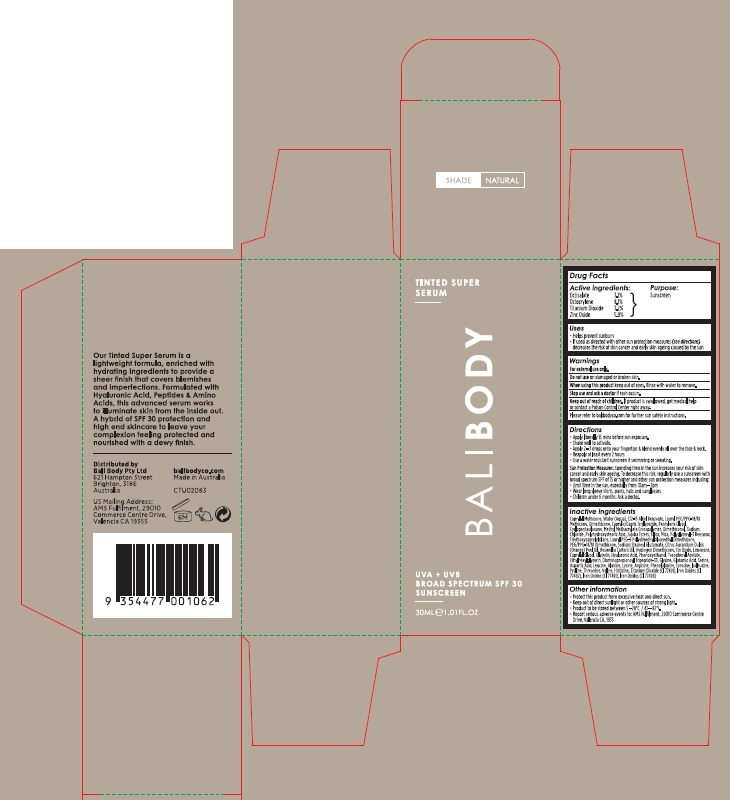
Bali Body Tinted Super Serum Tan SPF 30 Octisalate, Octocrylene, Titanium Dioxide, Zinc Oxide 78 mg/mL; 49 mg/mL; 31 mg/mL; 56 mg/mL Lotion — NDC 70630-0032-1 (Billing 70630-0032-01)
This is a package of Bali Body Tinted Super Serum Tan SPF 30 Octisalate, Octocrylene, Titanium Dioxide, Zinc Oxide 78 mg/mL; 49 mg/mL; 31 mg/mL; 56 mg/mL Lotion from Bali Body Pty Ltd, marketed since Jul 2023 and currently FDA-listed. It is this product's only package size.
NDC database record
One package, one record: these facts belong to NDC 70630-0032-1 alone.
- Record
- FDA NDC Directory package listing · Human OTC drug
- Code segments
- 70630 labeler · 0032 product · 1 package
- Package marketed since
- Jul 31, 2023
- Sample package
- No — commercial package
- Listing certified through
- Dec 31, 2026
- Barcode (UPC-A, from the NDC)
- 3 7063000321 5
- FDA record last changed
- Oct 8, 2026
Identity & classification
Regulatory identifiers FDA, NLM and CMS codes for this package
Where does this data come from?
- FDA openFDA NDC Directory · synced Oct 8, 2026
- FDA label on DailyMed · label index refreshed Oct 8, 2026
- RxNorm (NLM RxNav) · catalog refreshed Oct 8, 2026
- Medi-Span GPI (licensed)
- First Databank (licensed) · refreshed Oct 8, 2026
Clinical
Bali Body Tinted Super Serum Tan SPF 30 is a topical lotion containing four mineral active ingredients commonly used as ultraviolet (UV) filters in sunscreen products. Octisalate and octocrylene function as chemical UV absorbers, while titanium dioxide and zinc oxide work as mineral (physical) UV reflectors. This over-the-counter monograph product is marketed to provide sun protection when applied to the skin.
Patient education
Supplement & herbal interactions
Where does this data come from?
- MedlinePlus (NLM) · refreshed Oct 8, 2026
- FDA label on DailyMed · label index refreshed Oct 8, 2026
Ask a licensed pharmacist directly — free, answered by our team.
Pricing
A drug doesn't have one price. Each row is a different public payment system, and none is what you'd pay at the counter — that depends on your insurance. The ⓘ on each row explains what it measures.
| Price system | Per g | Per package |
|---|---|---|
| Retail pharmacies payNADAC · weekly | Not in the retail survey — common for institutional, discontinued, or low-volume packs. | |
| Medicaid paysCMS SDUD · 12 mo | No recent Medicaid claims on file for this NDC — rare and low-volume NDCs are suppressed in the public data. | |
| Medicare drug plans payPart D · quarterly | No Part D plan price is available for this NDC in our data. | |
Where does this data come from?
- CMS NADAC weekly file
- CMS ASP pricing files · refreshed Sep 20, 2026
- CMS Medicaid State Drug Utilization Data · refreshed Oct 9, 2026
- CMS Part D plan pricing files · refreshed Sep 24, 2026
- VA National Acquisition Center price file
Packaging — all sizes for this product
| Package NDC | Description | Marketing start | Marketing end | Status |
|---|---|---|---|---|
| 70630-0032-01 You're viewing this Main listing | 1 BOTTLE in 1 BOX / 30 mL in 1 BOTTLE | 2023-07-31 | — | Active |
Therapeutic equivalents
| Product | Labeler | Pack | NADAC/unit | TE | Status | Price vs. this |
|---|---|---|---|---|---|---|
| Bali Body Tinted Super Serum Tan SPF 30 78 mg/mL; 49 mg/mL; 31 mg/mL; 56 mg/mLthis 70630-0032-01 | Bali | 1 bottle | — | — | FDA listed | — |
Where does this data come from?
- FDA openFDA NDC Directory · synced Oct 8, 2026
- FDA Orange Book · refreshed Oct 3, 2026
- CMS NADAC weekly file
Availability & generic status
We did not find an FDA-approved generic match for this exact strength, form and route.
Where does this data come from?
- FDA Orange Book · refreshed Oct 3, 2026
Inactive Ingredients / Excipients
Inactive ingredients, also called excipients, are components of the drug product other than the active ingredient. They may include fillers, dyes, coatings, preservatives, flavors, or other formulation ingredients.
💡 Tap an ingredient (hover on desktop) to see what it is and why it’s used.
-
UNII 9E8X80D2L0
A synthetic form of vitamin E used as an antioxidant and preservative in medications. It helps prevent the active ingredients from degrading when exposed to oxygen or light.
-
UNII OF5P57N2ZX
Alanine is a naturally occurring amino acid used in medicines as a buffering agent and pH stabilizer. It helps maintain the proper acidity level in liquid formulations to improve stability and taste.
-
UNII A9EJ3J61HQ
A synthetic liquid derived from benzoic acid and long-chain alcohols. It functions as a solvent and penetration enhancer in topical formulations, helping active ingredients dissolve and absorb into the skin.
-
UNII 94ZLA3W45F
Arginine is an amino acid used in medicines as a buffer and pH adjuster. It helps maintain the proper acidity level and stability of liquid formulations.
-
UNII 30KYC7MIAI
Aspartic acid is an amino acid used in pharmaceutical formulations as a pH buffer and to help stabilize active ingredients. It works to maintain the proper acidity level in the medicine.
-
UNII 00YIU5438U
Caprylyl glycol is a clear liquid derived from coconut oil. In medicines, it acts as a humectant to retain moisture, a preservative booster to prevent microbial growth, and a solvent to help dissolve or mix other ingredients.
-
UNII Q95M2P1KJL
A silicone-based ingredient that acts as a lubricant and glidant. It helps the tablet or capsule move smoothly through manufacturing equipment and improves powder flow during production.
-
UNII 0THT5PCI0R
A silicone-based liquid that helps distribute active ingredients evenly throughout topical products. It acts as a solvent and emollient, allowing medicines to spread smoothly on skin while improving texture and absorption.
-
UNII 92RU3N3Y1O
Dimethicone is a silicone-based oil that acts as an anti-foaming agent and lubricant in medicines. It reduces gas bubbles in liquid formulations and helps coat and protect the stomach lining when ingested.
-
UNII T74O12AN6Y
A silicone oil that reduces foam and prevents clumping. It's used as an anti-foaming agent and lubricant in tablets and capsules to improve how the medicine flows during manufacturing.
-
UNII 147D247K3P
Ethylhexylglycerin is a synthetic preservative used to prevent bacteria and mold from growing in medicines and personal care products. It helps keep the product safe and stable throughout its shelf life.
-
UNII 1K09F3G675
Ferric oxide red is an inorganic iron compound used as a colorant in medicines. It gives tablets, capsules, or other dosage forms a red or reddish tint for identification and appearance.
-
UNII EX438O2MRT
Ferric oxide yellow is a naturally occurring iron compound used as a colorant in medications. It gives tablets, capsules, and other forms a yellow or golden hue for identification and appearance.
-
UNII XM0M87F357
A dark iron oxide compound that gives medicines their black or dark color. It's used as a colorant in tablets and capsules to help identify the product and make it visually distinctive.
-
UNII 67ZYA5T02K
Frankincense oil is a natural aromatic extract from tree resin. In medicines, it's used as a fragrance and flavoring agent to improve taste and smell, and may also help preserve the product.
-
UNII 3KX376GY7L
Glutamic acid is an amino acid used in pharmaceuticals as a buffer and pH regulator. It helps maintain the medicine's chemical stability and proper acidity level.
-
UNII PDC6A3C0OX
Glycerin is a clear, thick liquid derived from plant oils or fats. It acts as a humectant to retain moisture, a sweetener, and a solvent in medications.
-
UNII TE7660XO1C
Glycine is an amino acid used in medicines as a buffer to help stabilize pH and improve taste. It may also serve as a filler or binder to give the product proper form and consistency.
-
UNII 4QD397987E
An amino acid used as a buffer and stabilizer in medications. It helps maintain the pH balance and protects the active drug from breaking down during storage and use.
-
UNII S270N0TRQY
Hyaluronic acid is a naturally occurring substance found in skin and joints. In medicines, it acts as a moisturizer and thickening agent to improve texture and help the product spread smoothly.
-
UNII 4QGR4P2YOI
A silicone-based lubricant that reduces friction between tablet particles and manufacturing equipment. It helps tablets flow smoothly during production and prevents them from sticking together or to machinery.
-
UNII 04Y7590D77
A naturally occurring amino acid used as a buffering agent and pH stabilizer in medications. It helps maintain the chemical balance of the formulation to protect drug stability.
-
UNII 7F0EV20QYL
Jojoba oil is a liquid wax extracted from jojoba plant seeds. In medications, it serves as an emollient and carrier oil that helps soften skin, improve texture, and distribute active ingredients evenly in topical formulations.
-
UNII 25G622K2RA
A silicone-based surfactant that helps blend oil and water in cosmetic or topical formulations. It reduces surface tension to improve product spreadability and texture.
-
UNII ZJ5S27D9NX
A silicone-based substance that combines polymers with lauryl (a fatty compound). It acts as an emulsifier and surfactant to help mix oil and water ingredients and improve how the medicine feels when applied or swallowed.
-
UNII GMW67QNF9C
Leucine is an amino acid derived from natural sources. It acts as a glidant and flow agent in powders and tablets, helping the medicine move smoothly during manufacturing and packaging.
-
UNII GFD7C86Q1W
A natural oil extracted from citrus peels, (+)-limonene is used as a flavoring agent and solvent in medicines. It helps dissolve active ingredients and provides a lemon or orange taste.
-
UNII K3Z4F929H6
Lysine is an amino acid that serves as a buffer and pH regulator in medications. It helps maintain the medicine's stability and proper acidity level during storage and use.
-
UNII C9H2L21V7U
A fat derived from coconut or palm oil containing shorter fatty acid chains. It serves as a solvent and carrier to help dissolve or suspend active ingredients, improving absorption and stability in liquid formulations.
-
UNII EG97988M5Q
A synthetic plastic polymer that forms a three-dimensional network. It's used as a coating on tablets and capsules to control how fast the medicine releases into the body, or as a binder to hold pill ingredients together.
-
UNII V8A1AW0880
Mica is a naturally occurring mineral that's ground into fine powder. It's used in medicines as a colorant and anti-caking agent to improve appearance and prevent clumping in tablets or powders.
-
UNII AKN3KSD11B
Orange oil obtained by cold pressing orange peel. It serves as a flavoring agent and fragrance in medicines to improve taste and aroma.
-
UNII 9H0AO7T794
A silicone-based lubricant mixed with polyethylene glycol and polypropylene glycol polymers. It reduces friction between pill surfaces and equipment during manufacturing, and helps the finished product slide smoothly when swallowed.
-
UNII 50C1307PZG
Pentylene glycol is a humectant and preservative helper derived from petroleum or plant sources. It draws moisture into the product and helps prevent bacterial growth, keeping medicines stable during storage.
-
UNII HIE492ZZ3T
Phenoxyethanol is a synthetic preservative and antimicrobial agent used to prevent bacterial and fungal growth in medicines and cosmetic products, extending shelf life and maintaining product safety.
-
UNII 47E5O17Y3R
Phenylalanine is an amino acid used as a sweetener and flavor enhancer in medicines and supplements. It helps make products taste better while keeping them shelf-stable.
-
UNII YXH47AOU0F
A synthetic fatty acid used as a thickener and stabilizer in medicines. It helps create the right texture and prevents separation of ingredients in liquid or semi-solid formulations.
-
UNII 9DLQ4CIU6V
Proline is an amino acid used in pharmaceutical formulations as a bulking agent and stabilizer. It helps maintain product stability and can improve the texture or consistency of medicines, particularly in powders and freeze-dried products.
-
UNII 452VLY9402
Serine is an amino acid, a building block of proteins. In medications, it functions as a buffering agent and stabilizer to help maintain the product's pH balance and protect active ingredients during storage.
-
UNII ETJ7Z6XBU4
Silicon dioxide is a naturally occurring mineral used as a glidant and anti-caking agent. It helps powder ingredients flow smoothly and prevents clumping during manufacturing and storage.
-
UNII 451W47IQ8X
Sodium chloride is common table salt. It's used in medicines as a buffer to maintain proper pH, as a filler to add bulk, or to adjust the osmotic balance in liquid formulations.
-
UNII 65A9F4P024
A synthetic compound derived from the amino acid glutamate and stearic acid. It acts as an emulsifier and surfactant to help mix oil and water-based ingredients, keeping the medicine uniform throughout.
-
UNII JB2MV9I3LS
Stannous oxide is a tin-based compound used as a polishing agent in toothpaste formulations. It helps remove surface stains and create a smooth tooth surface during brushing.
-
UNII 2ZD004190S
Threonine is an amino acid, a naturally occurring protein building block. It functions as a buffering agent and pH stabilizer in medicines to maintain proper acidity levels and product stability.
-
UNII LDC331P08E
A silicone-based compound that acts as a glidant and flow agent in solid medications. It reduces friction between powder particles, helping the medicine flow smoothly during manufacturing and tablet compression.
-
UNII 42HK56048U
Tyrosine is an amino acid, a building block of proteins. In medicines, it's used as a buffering agent to help stabilize the product's pH and improve its chemical stability during storage.
-
UNII HG18B9YRS7
Valine is an amino acid, one of the building blocks of proteins. In medicines, it acts as a filler and bulking agent to give the product proper volume and texture.
-
UNII 059QF0KO0R
Water is a liquid solvent that dissolves and mixes ingredients together in liquid medicines, syrups, and injections. It helps distribute the active drug evenly throughout the product.
48 inactive ingredients listed in the exact product block matched to this NDC.
Label-section wording can be broader than the structured product block and may mention additional formulation ingredients.
Where does this data come from?
ingredient classCode="IACT" elements from the exact product block matched by this NDC. Label-section narrative from DailyMed / the openFDA label index is shown separately when available.- FDA label on DailyMed · label index refreshed Oct 8, 2026
- FDA openFDA NDC Directory · synced Oct 8, 2026
Inactive ingredient FAQ
Are inactive ingredients the same for every manufacturer?
Why might an inactive ingredient be missing?
Can inactive ingredients matter?
Manufacturer & labeler
More NDCs from Bali Body Pty Ltd labeler code 70630
- Bali Body BB Cream SPF 15 Natural OCTOCRYLENE, OCTINOXATE, AVOBENZONE, OXYBENZONE 60 mg/mL; 50 mg/mL; 30 mg/mL; 30 mg/mL Cream NDC 70630-0029-1
- Bali Body BB Cream SPF 15 Tan OCTOCRYLENE, OCTINOXATE, AVOBENZONE, OXYBENZONE 60 mg/mL; 50 mg/mL; 30 mg/mL; 30 mg/mL Cream NDC 70630-0030-1
- Bali Body Tinted Super Serum Natural SPF 30 Octisalate, Octocrylene, Titanium Dioxide, Zinc Oxide 81 mg/mL; 31 mg/mL; 32 mg/mL; 59 mg/mL Lotion NDC 70630-0031-1
- Bali Body Watermelon Tanning Oil SPF 6 OCTOCRYLENE, OCTISALATE, AVOBENZONE 30 mg/mL; 50 mg/mL; 10 mg/mL Oil NDC 70630-0033-1
- Bali Body Cacao Tanning Oil SPF 15 OCTOCRYLENE, OCTISALATE, AVOBENZONE 90 mg/mL; 50 mg/mL; 30 mg/mL Oil NDC 70630-0034-1
- Bali Body Watermelon Tanning Oil SPF 15 AVOBENZONE, OCTISALATE, OCTOCRYLENE 30 mg/mL; 50 mg/mL; 90 mg/mL Oil NDC 70630-0035-1
- Bali Body Watermelon Tanning Oil SPF 50 AVOBENZONE, HOMOSALATE, OCTISALATE, OCTOCRYLENE 50 mg/mL; 30 mg/mL; 150 mg/mL; 100 mg/mL Oil NDC 70630-0036-1
- Bali Body Pineapple Tanning Oil SPF15 OCTOCRYLENE, OCTISALATE, AVOBENZONE 90 mg/mL; 50 mg/mL; 30 mg/mL Oil NDC 70630-0037-1
- Bali Body SPF15 Bronze Shimmering Tanning Avobenzone, Octisalate, Octocrylene 70 mg/g; 50 mg/g; 20 mg/g Gel NDC 70630-0038-1
Where does this data come from?
- FDA openFDA NDC Directory · synced Oct 8, 2026
- Drugs@FDA
FDA label — Drug Facts FDA SPL
🎯 Indications and Usage ▾
Uses Helps prevent sunburn If used as directed with other sun protection measures (see directions ) decreases the risk of skin cancer and early skin ageing caused by the sun
⏱️ Dosage and Administration ▾
Directions Apply liberally 15 mins before sun exposure. Shake well to activate. Apply 2-3 drops onto your fingertips & blend evenly all over the face & neck.
Reapply at least every 2 hours Use a water resistant sunscreen if swimming or sweating. Sun Protection Measures : Spending time in the sun increases your risk of skin cancer and early skin ageing. To decrease this risk, regularly use a sunscreen with broad spectrum SPF of 15 or higher and other sun protection measures including: Limit time in the sun, especially from 10am - 2pm Wear long sleeve shirts, pants, hats and sunglasses Children under 6 months: Ask a doctor.
⚠️ Warnings ▾
Warnings For external use only. Do not use on damaged or broken skin. When using this product keep out of eyes. Rinse with water to remove. Stop use and ask a doctor if rash occurs. Keep out of reach of children. If product is swallowed, get medical help or contact a Poison Control Center right away. Please refer to balibodyco.com for further sun safety instructions.
🧪 Active Ingredient ▾
Active ingredients:- Natural Shade Octisalate 3.1% Octocrylene 8.1% Titanium Dioxide 3.2% Zinc Oxide 5.9%
Active ingredients - Tan Shade Octisalate 4.9% Octocrylene 7.8% Titanium Dioxide 3.1% Zinc Oxide 5.6%
🧪 Inactive Ingredients ▾
Inactive ingredients - Natural Shade Caprylyl Methicone, Water (Aqua), C12-15 Alkyl Benzoate, Lauryl PEG/PPG-18/18 Methicone, Dimethicone, Caprylic/Capric Triglyceride, Pentylene Glycol, Cyclopentasiloxane, Methyl Methacrylate Crosspolymer, Dimethiconol, Sodium Chloride, Polyhydroxystearic Acid, Jojoba Esters, Silica, Mica, Polyglyceryl-3 Beeswax, Triethoxycaprylylsilane, Lauryl PEG-9 Polydimethylsiloxyethyl Dimethicone, PEG/PPG-18/18 Dimethicone, Sodium Stearoyl Glutamate, Citrus Aurantium Dulcis (Orange) Peel Oil, Boswellia Carterii Oil, Hydrogen Dimethicone, Tin Oxide, Limonene, Caprylyl Glycol, Glycerin, Hyaluronic Acid, Phenoxyethanol, Tocopheryl Acetate, Ethylhexylglycerin, Diaminopropionoyl Tripeptide-33, Glycine, Glutamic Acid, Serine, Aspartic Acid, Leucine, Alanine, Lysine, Arginine, Phenylalanine, Tyrosine, Isoleucine, Proline, Threonine, Valine, Histidine, Titanium Dioxide (CI 77891), Iron Oxides (CI 77492), Iron Oxides (CI 77491), Iron Oxides (CI 77499)
Inactive ingredients - Tan Shade Water (Aqua), Caprylyl Methicone, C12-15 Alkyl Benzoate, Lauryl PEG/PPG-18/18 Methicone, Dimethicone, Caprylic/Capric Triglyceride, Cyclopentasiloxane, Pentylene Glycol, Methyl Methacrylate Crosspolymer, Polyhydroxystearic Acid, Sodium Chloride, Dimethiconol, Jojoba Esters, Silica, Lauryl PEG-9 Polydimethylsiloxyethyl Dimethicone, Mica, PEG/PPG-18/18 Dimethicone, Polyglyceryl-3 Beeswax, Triethoxycaprylylsilane, Sodium Stearoyl Glutamate, Hydrogen Dimethicone, Citrus Aurantium Dulcis (Orange) Peel Oil, Boswellia Carterii Oil, Tin Oxide, Limonene, Caprylyl Glycol, Hyaluronic Acid, Glycerin, Tocopheryl Acetate, Phenoxyethanol, Diaminopropionoyl Tripeptide-33, Ethylhexylglycerin, Glycine, Glutamic Acid, Serine, Aspartic Acid, Leucine, Alanine, Lysine, Arginine, Phenylalanine, Tyrosine, Isoleucine, Proline, Threonine, Valine, Histidine, Titanium Dioxide (CI 77891), Iron Oxides (CI 77492), Iron Oxides (CI 77491), Iron Oxides (CI 77499)
🎯 Purpose ▾
Purpose Sunscreen
📄 Do Not Use ▾
Do not use on damaged or broken skin.
📄 When Using This Product ▾
When using this product keep out of eyes. Rinse with water to remove.
📄 Stop Use and Ask a Doctor If ▾
Stop use and ask a doctor if rash occurs.
📄 Keep Out of Reach of Children ▾
Keep out of reach of children. If product is swallowed, get medical help or contact a Poison Control Center right away. Please refer to balibodyco.com for further sun safety instructions.
📄 Other Information ▾
Other information Protect this product from excessive heat and direct sun. Keep out of direct sunlight or other sources of strong light. Product to be stored between 5-28C/41-82F. Report serious adverse events to: AMS Fulfillment, 29010 Commerce Centre Drive, Valencia CA, 1935
📄 Package Label / Principal Display Panel ▾
Product Packaging - Natural Shade natural
Product Packaging - Tan Shade Tan
About this NDC listing & data coverage
What data is (and isn’t) available for this NDC — tap to expand
| NDC identity (package / product / labeler codes) | ✓ Available |
| Labeler | ✓ Available |
| Product & package description | ✓ Available |
| Marketing category & status | ✓ Available |
| Active ingredient / dosage form / route | ✓ Available |
| FDA label (SPL via DailyMed) | ✓ Available |
| Package photos | ✓ Available |
| Inactive ingredients (structured) | ✓ Available |
| NADAC pharmacy acquisition price (CMS) | — Not published for this NDC CMS publishes NADAC only for NDCs reported in its retail-pharmacy survey. |
| Orange Book / therapeutic-equivalence data | — Not published for this NDC Applies only to products approved under an NDA/ANDA; many listings are out of scope. |
| HCPCS J-code billing crosswalk | — Not published for this NDC Most self-administered / retail products have no J-code — that is normal. |
| Medicaid utilization (CMS SDUD) | — Not published for this NDC CMS reports utilization only for NDCs with Medicaid claims above its privacy threshold. |