
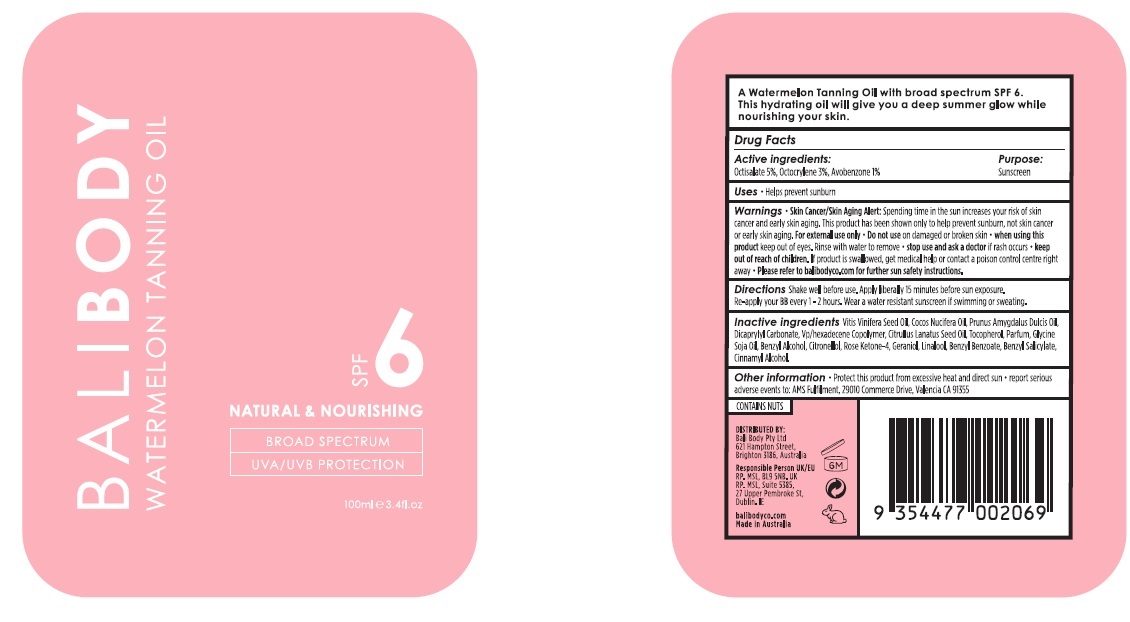
Bali Body Watermelon Tanning Oil SPF 6 OCTOCRYLENE, OCTISALATE, AVOBENZONE 30 mg/mL; 50 mg/mL; 10 mg/mL Oil, 100 mL — NDC 70630-0033-1 (Billing 70630-0033-01)
This is a package of 100 mL of Bali Body Watermelon Tanning Oil SPF 6 OCTOCRYLENE, OCTISALATE, AVOBENZONE 30 mg/mL; 50 mg/mL; 10 mg/mL Oil from Bali Body Pty Ltd, marketed since Dec 2023 and currently FDA-listed. It is this product's only package size.
NDC database record
One package, one record: these facts belong to NDC 70630-0033-1 alone.
- Record
- FDA NDC Directory package listing · Human OTC drug
- Code segments
- 70630 labeler · 0033 product · 1 package
- Package marketed since
- Dec 1, 2023
- Sample package
- No — commercial package
- Listing certified through
- Dec 31, 2026
- Barcode (UPC-A, from the NDC)
- 3 7063000331 4
- FDA record last changed
- Aug 27, 2026
Identity & classification
Regulatory identifiers FDA, NLM and CMS codes for this package
Where does this data come from?
- FDA openFDA NDC Directory · synced Oct 8, 2026
- FDA label on DailyMed · label index refreshed Oct 8, 2026
- RxNorm (NLM RxNav) · catalog refreshed Oct 8, 2026
- Medi-Span GPI (licensed)
- First Databank (licensed) · refreshed Oct 8, 2026
Clinical
Bali Body Watermelon Tanning Oil SPF 6 is a topical oil product marketed as an over-the-counter sunscreen under FDA's monograph rules. It contains three UV-filtering ingredients (avobenzone, octisalate, and octocrylene) that are typically used to help absorb or reflect ultraviolet radiation from the sun. This type of product is commonly used when spending time outdoors, though the SPF 6 rating indicates relatively minimal sun protection compared to higher SPF products.
Patient education
Supplement & herbal interactions
Where does this data come from?
- MedlinePlus (NLM) · refreshed Oct 8, 2026
- FDA label on DailyMed · label index refreshed Oct 8, 2026
Ask a licensed pharmacist directly — free, answered by our team.
Pricing
A drug doesn't have one price. Each row is a different public payment system, and none is what you'd pay at the counter — that depends on your insurance. The ⓘ on each row explains what it measures.
| Price system | Per each | Per package |
|---|---|---|
| Retail pharmacies payNADAC · weekly | Not in the retail survey — common for institutional, discontinued, or low-volume packs. | |
| Medicaid paysCMS SDUD · 12 mo | No recent Medicaid claims on file for this NDC — rare and low-volume NDCs are suppressed in the public data. | |
| Medicare drug plans payPart D · quarterly | No Part D plan price is available for this NDC in our data. | |
Where does this data come from?
- CMS NADAC weekly file
- CMS ASP pricing files · refreshed Sep 20, 2026
- CMS Medicaid State Drug Utilization Data · refreshed Oct 9, 2026
- CMS Part D plan pricing files · refreshed Sep 24, 2026
- VA National Acquisition Center price file
Packaging — all sizes for this product
| Package NDC | Description | Marketing start | Marketing end | Status |
|---|---|---|---|---|
| 70630-0033-01 You're viewing this Main listing | 100 mL in 1 BOTTLE | 2023-12-01 | — | Active |
Therapeutic equivalents
| Product | Labeler | Pack | NADAC/unit | TE | Status | Price vs. this |
|---|---|---|---|---|---|---|
| Bali Body Watermelon Tanning Oil SPF 6 30 mg/mL; 50 mg/mL; 10 mg/mLthis 70630-0033-01 | Bali | 100 ml | — | — | FDA listed | — |
Where does this data come from?
- FDA openFDA NDC Directory · synced Oct 8, 2026
- FDA Orange Book · refreshed Oct 9, 2026
- CMS NADAC weekly file
Availability & generic status
We did not find an FDA-approved generic match for this exact strength, form and route.
Where does this data come from?
- FDA Orange Book · refreshed Oct 9, 2026
Inactive Ingredients / Excipients
Inactive ingredients, also called excipients, are components of the drug product other than the active ingredient. They may include fillers, dyes, coatings, preservatives, flavors, or other formulation ingredients.
💡 Tap an ingredient (hover on desktop) to see what it is and why it’s used.
-
UNII 565OK72VNF
A natural-origin fragrance compound derived from plants like citronella and geranium. Used as a flavoring agent and fragrance ingredient to improve taste or aroma in medications.
-
UNII 66YXD4DKO9
A natural oil extracted from almond kernels. It's used in medicines as an emollient and solvent to help dissolve or suspend active ingredients and improve texture in topical and oral formulations.
-
UNII LKG8494WBH
Benzyl alcohol is a clear liquid used as a preservative and solvent in medicines. It helps prevent bacterial and fungal growth and dissolves other ingredients to create uniform liquid formulations.
-
UNII N863NB338G
Benzyl benzoate is a liquid organic compound used as a solvent and preservative in medicines. It helps dissolve active ingredients and can extend shelf life by preventing microbial growth in liquid formulations.
-
UNII WAO5MNK9TU
Benzyl salicylate is a fragrant chemical compound used as a flavor and scent ingredient in medicines. It helps mask unpleasant tastes or odors in liquid or oral formulations.
-
UNII SS8YOP444F
Cinnamyl alcohol is an organic compound derived from cinnamon oil or made synthetically. It functions as a fragrance ingredient and flavoring agent in medicines, providing aroma and taste.
-
UNII Q9L0O73W7L
Coconut oil is a natural fat extracted from coconut fruit. It's used in medicines as a lubricant, emollient, or carrier to help dissolve or deliver active ingredients smoothly through the formulation.
-
UNII 609A3V1SUA
A silky liquid derived from caprylic acid that acts as an emollient and solvent in formulations. It helps dissolve active ingredients and improves the spreadability and feel of lotions, creams, and topical products.
-
UNII L837108USY
Geraniol is a natural fragrant compound found in plants like roses and lemons. It's used in medicines as a flavoring agent and to improve the taste or aroma of the product.
-
UNII 930MLC8XGG
A plant oil extracted from grape seeds, used as an emollient and solvent in medicines. It helps dissolve active ingredients and improve the texture and absorption of topical or liquid formulations.
-
UNII D81QY6I88E
Linalool is a natural fragrant oil found in plants like lavender and citrus. It's used in medicines as a flavoring agent and to mask unpleasant tastes or smells.
-
UNII 241ATL177A
Soybean oil is a natural plant oil derived from soybean seeds. It's used in medicines as a solvent and carrier to help dissolve or suspend active ingredients and improve how the body absorbs them.
-
UNII R0ZB2556P8
Tocopherol is a form of vitamin E derived from plant oils. It acts as an antioxidant in medicines to prevent oils and fats from breaking down and spoiling during storage.
-
UNII KFR5QEN0N9
A synthetic plastic polymer that helps form a protective film coating on the medicine. It's used as a binder and film-former to hold the tablet or capsule together and control how quickly the drug dissolves.
-
UNII L33J06UQTT
A plant-derived oil from watermelon seeds used as an emollient and skin-conditioning agent in topical formulations. It helps soften the product texture and improve how it spreads on skin.
15 inactive ingredients listed in the exact product block matched to this NDC.
Label-section wording can be broader than the structured product block and may mention additional formulation ingredients.
Where does this data come from?
ingredient classCode="IACT" elements from the exact product block matched by this NDC. Label-section narrative from DailyMed / the openFDA label index is shown separately when available.- FDA label on DailyMed · label index refreshed Oct 8, 2026
- FDA openFDA NDC Directory · synced Oct 8, 2026
Inactive ingredient FAQ
Are inactive ingredients the same for every manufacturer?
Why might an inactive ingredient be missing?
Can inactive ingredients matter?
Manufacturer & labeler
More NDCs from Bali Body Pty Ltd labeler code 70630
- Bali Body BB Cream SPF 15 Natural OCTOCRYLENE, OCTINOXATE, AVOBENZONE, OXYBENZONE 60 mg/mL; 50 mg/mL; 30 mg/mL; 30 mg/mL Cream NDC 70630-0029-1
- Bali Body BB Cream SPF 15 Tan OCTOCRYLENE, OCTINOXATE, AVOBENZONE, OXYBENZONE 60 mg/mL; 50 mg/mL; 30 mg/mL; 30 mg/mL Cream NDC 70630-0030-1
- Bali Body Tinted Super Serum Natural SPF 30 Octisalate, Octocrylene, Titanium Dioxide, Zinc Oxide 81 mg/mL; 31 mg/mL; 32 mg/mL; 59 mg/mL Lotion NDC 70630-0031-1
- Bali Body Tinted Super Serum Tan SPF 30 Octisalate, Octocrylene, Titanium Dioxide, Zinc Oxide 78 mg/mL; 49 mg/mL; 31 mg/mL; 56 mg/mL Lotion NDC 70630-0032-1
- Bali Body Cacao Tanning Oil SPF 15 OCTOCRYLENE, OCTISALATE, AVOBENZONE 90 mg/mL; 50 mg/mL; 30 mg/mL Oil NDC 70630-0034-1
- Bali Body Watermelon Tanning Oil SPF 15 AVOBENZONE, OCTISALATE, OCTOCRYLENE 30 mg/mL; 50 mg/mL; 90 mg/mL Oil NDC 70630-0035-1
- Bali Body Watermelon Tanning Oil SPF 50 AVOBENZONE, HOMOSALATE, OCTISALATE, OCTOCRYLENE 50 mg/mL; 30 mg/mL; 150 mg/mL; 100 mg/mL Oil NDC 70630-0036-1
- Bali Body Pineapple Tanning Oil SPF15 OCTOCRYLENE, OCTISALATE, AVOBENZONE 90 mg/mL; 50 mg/mL; 30 mg/mL Oil NDC 70630-0037-1
- Bali Body SPF15 Bronze Shimmering Tanning Avobenzone, Octisalate, Octocrylene 70 mg/g; 50 mg/g; 20 mg/g Gel NDC 70630-0038-1
- Bali Body Sheer Glow Sunscreen SPF 50 Avobenzone, Homosalate, Octisalate, Octocrylene 100 mg/mL; 150 mg/mL; 30 mg/mL; 50 mg/mL Gel NDC 70630-0040-1
Where does this data come from?
- FDA openFDA NDC Directory · synced Oct 8, 2026
- Drugs@FDA
FDA label — Drug Facts FDA SPL
🎯 Indications and Usage ▾
Uses Helps prevent sunburn
⏱️ Dosage and Administration ▾
Directions Shake well before use. Apply liberally 15 minutes before sun exposure. Re-apply your BB every 1-2 hours. Wear a water resistant sunscreen if swimming or sweating.
⚠️ Warnings ▾
Warnings Skin Cancer/Skin Aging Alert: Spending time in the sun increases your risk of skin cancer and early skin aging. This product has been shown only to prevent sunburn, not skin cancer or early skin aging. For external use only.
Do not use on damaged or broken skin. When using this product keep out of eyes. Rinse with water to remove.
Stop use and ask a doctor if rash occurs. Keep out of reach of children. If product is swallowed, get medical help or contact a poison control centre right away.
Please refer to balibody.com for further sun safety instructions.
🧪 Active Ingredient ▾
Active ingredients Octisalate 5% Octocrylene 3% Avobenzone 1%
🧪 Inactive Ingredients ▾
Inactive ingredients: Vitis Vinifera Seed Oil, Cocos Nucifera Oil, Prunus Amygdalus Dulcis Oil, Dicaprylyl Carbonate, Vp/hexadecene Copolymer, Citrullus Lanatus Seed Oil, Tocopherol, Parfum, Glycine Soja Oil, Benzyl Alcohol, Citronellol, Rose Ketone-4, Geraniol, Linalool, Benzyl Benzoate, Benzyl Salicylate, Cinnamyl Alcohol.
🎯 Purpose ▾
Purpose Sunscreen
📄 Do Not Use ▾
Do not use on damaged or broken skin.
📄 When Using This Product ▾
When using this product keep out of eyes. Rinse with water to remove.
📄 Stop Use and Ask a Doctor If ▾
Stop use and ask a doctor if rash occurs.
📄 Keep Out of Reach of Children ▾
Keep out of reach of children. If product is swallowed, get medical help or contact a poison control centre right away. Please refer to balibody.com for further sun safety instructions.
📄 Other Information ▾
Other information Protect this product from excessive heat and direct sun Report serious adverse events to: AMS Fulfilment, 29010 Commerce Drive, Valencia CA 91355
📄 Package Label / Principal Display Panel ▾
Package Labeling watermelon6
About this NDC listing & data coverage
What data is (and isn’t) available for this NDC — tap to expand
| NDC identity (package / product / labeler codes) | ✓ Available |
| Labeler | ✓ Available |
| Product & package description | ✓ Available |
| Marketing category & status | ✓ Available |
| Active ingredient / dosage form / route | ✓ Available |
| FDA label (SPL via DailyMed) | ✓ Available |
| Package photos | ✓ Available |
| Inactive ingredients (structured) | ✓ Available |
| NADAC pharmacy acquisition price (CMS) | — Not published for this NDC CMS publishes NADAC only for NDCs reported in its retail-pharmacy survey. |
| Orange Book / therapeutic-equivalence data | — Not published for this NDC Applies only to products approved under an NDA/ANDA; many listings are out of scope. |
| HCPCS J-code billing crosswalk | — Not published for this NDC Most self-administered / retail products have no J-code — that is normal. |
| Medicaid utilization (CMS SDUD) | — Not published for this NDC CMS reports utilization only for NDCs with Medicaid claims above its privacy threshold. |