
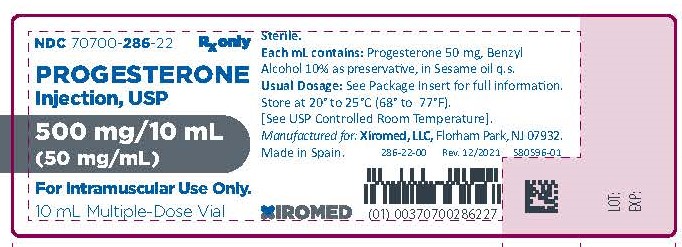
PROGESTERONE 50 mg/mL Injection, Solution, 10 mL — NDC 70700-286-22 (Billing 70700-0286-22)
This is a package of 10 mL of PROGESTERONE 50 mg/mL Injection, Solution from XIROMED, LLC, marketed since Mar 2022 and currently FDA-listed; retail pharmacies pay about $1.36 per mL (NADAC). It is this product's only package size.
Other active recalls for Progesterone (different manufacturers) — 2 · tap to view
Identity & classification
Regulatory identifiers FDA, NLM and CMS codes for this package
Drug-database identifiers Medi-Span GPI and First Databank GCN / HICL / AHFS classification
- GSN (GCN sequence number): 003262
- GCN: 11142
- GPI-14 (Medi-Span): 26000040001705
- HICL (First Databank): 001440
- AHFS class code: 68:32.00.00
- RxCUI (RxNorm): 312644
Where does this data come from?
- FDA openFDA NDC Directory · synced Oct 1, 2026
- FDA label on DailyMed · label index refreshed Oct 1, 2026
- RxNorm (NLM RxNav) · catalog refreshed Oct 1, 2026
- Medi-Span GPI (licensed)
- First Databank (licensed) · refreshed Oct 1, 2026
RxNorm drug class
This medicine belongs to the Progesterone class.
Where does this data come from?
- RxClass (NLM) · catalog refreshed Oct 1, 2026
Clinical
- It depends on the product. Vaginal forms support pregnancy in fertility treatment. Capsules prevent overgrowth of the uterine lining in postmenopausal women taking estrogen, and tr...
- Take them at bedtime, as your prescriber directs. If they're hard to swallow, use a full glass of water while standing. Food can increase how much your body absorbs.
- With capsules taken alongside estrogen, headache, breast tenderness, joint pain, dizziness, and bloating were common. Vaginal discharge and nausea were reported too. Tell your doct...
- Get help for chest pain, sudden weakness or trouble speaking, leg swelling, or sudden shortness of breath. These can be signs of a stroke, heart attack, or blood clot. Sudden visio...
Patient education
Supplement & herbal interactions
Some supplements/herbs that may interact with Progesterone — tap one for details:
Where does this data come from?
- MedlinePlus (NLM) · refreshed Oct 1, 2026
- FDA label on DailyMed · label index refreshed Oct 1, 2026
Ask a licensed pharmacist directly — free, answered by our team.
Pricing
A drug doesn't have one price. Each row is a different public payment system, and none is what you'd pay at the counter — that depends on your insurance. The ⓘ on each row explains what it measures.
| Price system | Per mL | Per package |
|---|---|---|
| Retail pharmacies payNADAC · weekly | $1.361 | $13.61 / 10 ml |
| Medicaid paysCMS SDUD · 12 mo | $1.45 | $14.45 / 10 ml |
| Medicare drug plans payPart D · quarterly | No Part D plan price is available for this NDC in our data. | |
| Medicare Part B allowsASP · J2675 | $0.559 / J2675 unit | — |
Where does this data come from?
- CMS NADAC weekly file · file of Sep 30, 2026
- CMS ASP pricing files · refreshed Sep 20, 2026
- CMS Medicaid State Drug Utilization Data · through Q1 2026
- CMS Part D plan pricing files · refreshed Sep 24, 2026
- VA National Acquisition Center price file
Billing & reimbursement
Where does this data come from?
- CMS ASP NDC-HCPCS crosswalk · refreshed Sep 22, 2026
- DMEPDAC NDC-HCPCS crosswalk
- openFDA NSDE billing units · refreshed Sep 7, 2026
Packaging — all sizes for this product
| Package NDC | Description | Marketing start | Marketing end | Status |
|---|---|---|---|---|
| 70700-0286-22 You're viewing this Main listing | 10 mL in 1 VIAL, MULTI-DOSE | 2022-03-29 | — | Active |
Therapeutic equivalents
| Product | Labeler | Pack | NADAC/unit | TE | Status | Price vs. this |
|---|---|---|---|---|---|---|
| Progesterone 50 mg 00143-9725-01 | Hikma | 10 injections | $1.361 | AO | Availability likely | — |
| Progesterone 50 mg/mL 00591-3128-79 | Actavis | 10 ml | $1.361 | — | Discontinued | — |
| Progesterone 50 mg/mL 55150-0306-10 | Eugia | 10 ml | $1.361 | AO | Availability likely | — |
| Progesterone 50 mg/mL 63323-0261-10 | Fresenius | 1 vial | $1.361 | AO | Availability likely | — |
| Progesterone 50 mg/mLthis 70700-0286-22 | XIROMED, | 10 ml | $1.361 | AO | Availability likely | — |
Where does this data come from?
- FDA openFDA NDC Directory · synced Oct 1, 2026
- FDA Orange Book · refreshed Sep 3, 2026
- CMS NADAC weekly file · file of Sep 30, 2026
Availability & generic status
This product is an FDA-approved generic. Other versions of the same drug are listed under Therapeutic equivalents, least expensive first.
Where does this data come from?
- FDA Orange Book · refreshed Sep 3, 2026
Inactive Ingredients / Excipients
Inactive ingredients, also called excipients, are components of the drug product other than the active ingredient. They may include fillers, dyes, coatings, preservatives, flavors, or other formulation ingredients.
Where does this data come from?
IACT rows and label-wide narrative are kept separate; availability and product-level specificity depend on the submitted label.- FDA label on DailyMed · label index refreshed Oct 1, 2026
- FDA openFDA NDC Directory · synced Oct 1, 2026
Inactive ingredient FAQ
Are inactive ingredients the same for every manufacturer?
Why might an inactive ingredient be missing?
Can inactive ingredients matter?
Manufacturer & labeler
Where does this data come from?
- FDA openFDA NDC Directory · synced Oct 1, 2026
- Drugs@FDA
Full prescribing information FDA SPL
🎯 Indications and Usage ▾
INDICATIONS AND USAGE This drug is indicated in amenorrhea and abnormal uterine bleeding due to hormonal imbalance in the absence of organic pathology, such as submucous fibroids or uterine cancer.
⏱️ Dosage and Administration ▾
DOSAGE AND ADMINISTRATION Progesterone is administered by intramuscular injection. It differs from other commonly used steroids in that it is irritating at the place of injection. Amenorrhea: Five to 10 mg are given for six to eight consecutive days.
If there has been sufficient ovarian activity to produce a proliferative endometrium, one can expect withdrawal bleeding forty-eight to seventy-two hours after the last injection. This may be followed by spontaneous normal cycles. Functional Uterine Bleeding: Five to 10 mg are given daily for six doses.
Bleeding may be expected to cease within six days. When estrogen is given as well, the administration of progesterone is begun after two weeks of estrogen therapy. If menstrual flow begins during the course of injections of progesterone, they are discontinued.
Parenteral drug products should be inspected visually for particulate matter and discoloration prior to administration whenever the solution and container permit.
⛔ Contraindications ▾
CONTRAINDICATIONS Current or past history of thrombophlebitis, thromboembolic disorders, or cerebral apoplexy. Liver dysfunction or disease. Known or suspected malignancy of breast or genital organs. Undiagnosed vaginal bleeding. Missed abortion. Known sensitivity to progesterone injection. Known sensitivity to sesame oil/seeds.
⚠️ Warnings ▾
WARNINGS The physician should be alert to the earliest manifestations of thrombotic disorders (thrombophlebitis, cerebrovascular disorders, pulmonary embolism, and retinal thrombosis). Should any of these occur or be suspected, the drug should be discontinued immediately. Medication should be discontinued pending examination if there is a sudden partial or complete loss of vision, or if there is a sudden onset of proptosis, diplopia or migraine.
If examination reveals papilledema or retinal vascular lesions, medication should be withdrawn. Acute eosinophilic pneumonia has been reported in patients receiving progesterone in sesame oil. In reported cases associated with progesterone in sesame oil, patients developed fever, dyspnea with hypoxic respiratory insufficiency, and diffuse pulmonary infiltrates.
In general, patients developed eosinophilic pneumonia 2 to 4 weeks after starting progesterone in sesame oil and improved when progesterone in sesame oil was discontinued and a different formulation of progesterone and/or steroid therapy was initiated. Patients who develop these signs and symptoms while receiving progesterone in sesame oil should undergo prompt medical evaluation, and progesterone in sesame oil should be discontinued immediately.
🤒 Adverse Reactions ▾
ADVERSE REACTIONS Breakthrough bleeding; spotting; change in menstrual flow; amenorrhea; edema; change in weight (increase or decrease); changes in cervical erosion and cervical secretions; cholestatic jaundice; breast tenderness and galactorrhea; pain, irritation, and/or redness at the injection area; skin sensitivity reactions consisting of urticaria, pruritus, edema and generalized rash; acne, alopecia and hirsutism; rash (allergic) with and without pruritus; anaphylactoid reactions (including eosinophilic pneumonia); mental depression; pyrexia; insomnia; nausea; and somnolence.
A statistically significant association has been demonstrated between use of estrogen-progestin combination drugs and pulmonary embolism and cerebral thrombosis and embolism. For this reason patients on progestin therapy should be carefully observed. There is also evidence suggestive of an association with neuro-ocular lesions, e.g., retinal thrombosis and optic neuritis.
The following adverse reactions have been observed in patients receiving estrogen-progestin combination drugs: rise in blood pressure in susceptible individual, premenstrual syndrome, changes in libido, changes in appetite, cystitis-like syndrome, headache, nervousness, fatigue, backache, hirsutism, loss of scalp hair, erythema multiforme, erythema nodosum, hemorrhagic eruption, itching, and dizziness. The following laboratory results may be altered by the use of estrogen-progestin combination drugs: increased sulfobromophthalein retention and other hepatic function tests; coagulation tests: increase in prothrombin factors VII, VIII, IX, and X; metyrapone test; pregnanediol determinations; thyroid function: increase in PBI and butanol extractable protein bound iodine, and decrease in T 3 uptake values.
🧬 Clinical Pharmacology ▾
CLINICAL PHARMACOLOGY Transforms proliferative endometrium into secretory endometrium. Inhibits (at the usual dose range) the secretion of pituitary gonadotropins, which in turn prevents follicular maturation and ovulation. Pharmacokinetics and Metabolism: Absorption: After intramuscular administration of 10 mg of progesterone in oil, maximum plasma concentrations (geometric mean of 7 ng/mL) were reached within approximately 8 hours after injection and plasma concentrations remained above baseline for about 24 hours after injection.
Injection of 10, 25, and 50 mg resulted in geometric mean values for maximum plasma concentration (C MAX ) of 7, 28, and 50 ng/mL, respectively. Distribution: Progesterone is extensively bound to plasma proteins, primarily albumin (50-54%) and cortisol-binding protein (43-48%). Metabolism: Progesterone is metabolized primarily in the liver by reduction to pregnanediol, pregnanetriol, and pregnanolone.
Subsequent conjugation results in the formation of glucuronide and sulfate metabolites. The mean plasma metabolic clearance rate in cycling women is 2510 ± 135 (SEM) L/day. Excretion: The glucuronide and sulfate conjugates of pregnanediol and pregnanolone are excreted in the urine and bile.
Progesterone metabolites which are excreted in the bile may undergo enterohepatic recycling or may be excreted in the feces. The pharmacokinetic data was determined in a small number of patients, limiting the precision in which population values may be estimated. Special Populations: Renal Insufficiency: The safety and effectiveness in patients with renal insufficiency have not been established.
Since progesterone metabolites are excreted mainly by the kidneys, progesterone should be administered with caution and careful monitoring in this patient population (see PRECAUTIONS ). Hepatic Insufficiency: The safety and effectiveness in patients with hepatic insufficiency have not been established. Since progesterone is metabolized by the liver, use in patients with liver dysfunction or disease is contraindicated (see CONTRAINDICATIONS ).
Drug Interactions: The metabolism of progesterone by human liver microsomes was inhibited by ketoconazole (IC 50 < 01 μM). Ketoconazole is a known inhibitor of cytochrome P450 3A4 and these data suggest that ketoconazole or other known inhibitors of this enzyme may increase the bioavailability of progesterone. The clinical relevance of the in vitro findings is unknown.
📦 How Supplied / Storage and Handling ▾
HOW SUPPLIED Progesterone Injection USP, 500 mg/10 mL (50 mg/mL) is available in 10 mL multiple dose vials, individually boxed. (NDC 70700-286-22) Store at 20°-25°C (68°-77°F). [See USP controlled room temperature.] Rx only Manufactured for: Xiromed, LLC Florham Park, NJ 07932 Made in Spain Revised: Dec 2021 PI-286-00
📋 Description ▾
DESCRIPTION Progesterone injection, a progestin, is a sterile solution of progesterone in a suitable vegetable oil available for intramuscular use. Progesterone occurs as a white or creamy white, crystalline powder. It is odorless and is stable in air.
Practically insoluble in water, it is soluble in alcohol, acetone, and dioxane and sparingly soluble in vegetable oils. It has the following structural formula: C 21 H 30 O 2 M.W. 314.47 Pregn-4-ene-3, 20-dione Each mL contains: Progesterone 50 mg, Benzyl Alcohol 10% as preservative in Sesame Oil q.s.
Progesterone structural
⚠️ Precautions ▾
PRECAUTIONS General The pretreatment physical examination should include special reference to breast and pelvic organs, as well as a Papanicolaou smear. Because progestational drugs may cause some degree of fluid retention, conditions which might be influenced by this condition, such as epilepsy, migraine, asthma, cardiac, or renal dysfunction, require careful observation. In cases of breakthrough bleeding, as in all cases of irregular bleeding per vaginum, nonfunctional causes should be borne in mind, and adequate diagnostic measures undertaken.
Patients who have a history of psychic depression should be carefully observed and the drug discontinued if the depression recurs to a serious degree. The age of the patient constitutes no absolute limiting factor although treatment with progestin may mask the onset of the climacteric. The pathologist should be advised of progestin therapy when relevant specimens are submitted.
There are possible risks which may be associated with the use of progestin treatment, including adverse effects on carbohydrate and lipid metabolism. The dosage used may be important in minimizing these adverse effects. A decrease in glucose tolerance has been observed in a small percentage of patients on estrogen-progestin combination treatment.
The mechanism of this decrease is obscure. For this reason, diabetic patients should be carefully observed while receiving such therapy. Carcinogenesis, Mutagenesis, Impairment of Fertility Long-term intramuscular administration of Medroxyprogesterone acetate (MPA) has been shown to produce mammary tumors in beagle dogs.
There is no evidence of a carcinogenic effect associated with the oral administration of MPA to rats and mice. Medroxyprogesterone acetate was not mutagenic in a battery of in vitro or in vivo genetic toxicity assays. Progesterone at high doses is an antifertility drug and high doses would be expected to impair fertility until the cessation of treatment.
Geriatric Use: The safety and effectiveness in geriatric patients (over age 65) have not been established. Pediatric Use: Safety and effectiveness in pediatric patients have not been established. Nursing Mothers: Detectable amounts of drug have been identified in the milk of mothers receiving progestational drugs.
The effect of this on the nursing infant has not been determined.
📄 Patient Package Insert ▾
PATIENT INFORMATION FOR THE TREATMENT OF AMENORRHEA (ABSENCE OF MENSES IN WOMEN WHO HAVE PREVIOUSLY HAD A MENSTRUAL PERIOD) OR ABNORMAL UTERINE BLEEDING DUE TO HORMONAL IMBALANCE. Please read this information carefully before you start to use Progesterone Injection and each time your prescription is renewed, in case anything has changed. This leaflet does not take the place of discussions with your doctor.
If you still have any questions, ask your doctor or health-care provider. About Progesterone Injection Progesterone Injection is a sterile injectable solution containing the natural female hormone called progesterone. Progesterone Injection is indicated for the treatment of amenorrhea and abnormal uterine bleeding due to progesterone deficiency.
Understanding the role of Progesterone Injection in the treatment of your menstrual irregularities. Progesterone is one of the hormones essential for regular menstrual periods. If your doctor has determined your body does not produce enough progesterone on its own, Progesterone Injection may be prescribed to provide the progesterone you need.
When you do not produce enough progesterone, menstrual irregularities can occur. Progesterone Injection can provide you with the progesterone needed during a normal menstrual cycle. Possible side effects of Progesterone Injection The following side effects have been reported with Progesterone Injection.
Consult your doctor if you experience any of the side effects mentioned below, or other side effects. anaphylactoid (life-threatening allergic) reaction with symptoms that may include a sense of uneasiness or apprehension; flushing; fast, throbbing heartbeat; itching; hives; difficult breathing; swelling of the throat; eosinophilic pneumonia (gathering of eosinophils, a type of white blood cell, in the lungs), fainting; nausea; vomiting; or convulsions. breakthrough bleeding spotting changes in menstrual flow amenorrhea change in weight (increase or decrease) pain, irritation, swelling, and/or redness at the injection area general swelling vaginal discharge yellow discoloration of skin or white of eyes breast tenderness, discharge from the nipple skin reactions including rash, hives, itching, and swelling acne hair loss or growth of new hair mental depression fever insomnia or sleepiness* nausea *If you experience sleepiness, do not drive or operate machinery.
When you should not use Progesterone Injection If you are allergic to progesterone, progesterone-like drugs, benzyl alcohol or sesame oil/seeds. If you have unusual vaginal bleeding which has not been evaluated by your doctor. If you have liver disease.
If you have known or suspected cancer of the breast or genital organs. If you have a miscarriage and your physician suspects some tissue is still in the uterus. If you have or have had blood clots in the legs, lungs, eyes, or elsewhere.
Risks of Progesterone Injection Abnormal blood clotting. Blood clots have been reported with the use of estrogens and progestational drugs (alone or in combination). If blood clots do form in your bloodstream, they can cut off the blood supply to vital organs, causing serious problems.
These problems may include a stroke (by cutting off blood to part of the brain), a heart attack (by cutting off blood to part of the heart), a pulmonary embolus (by cutting off blood to part of the lungs), or other problems. Any of these conditions may cause death or serious long-term disability. Call your doctor immediately if you suspect you have any of these conditions.
He or she may advise you to stop using this drug. Precautions Be alert for unusual signs and symptoms. If any of these warning signals (or any other unusual symptoms) happen while you are using Progesterone Injection, call your doctor immediately: Abnormal bleeding from the vagina.
Pains in the calves or chest, a sudden shortness of breath or coughing blood indicating possible clots in the legs, heart, or lungs. Severe headache or vomiting, dizziness, faintne… [Excerpted — this section continues on DailyMed.]
📄 Package Label / Principal Display Panel ▾
PACKAGE LABEL.PRINCIPAL DISPLAY PANEL Progesterone Injection USP 50mg/mL NDC 70700-286-22 Vial Label Progesterone Injection USP 50mg/mL NDC 70700-286-22 Carton Label Progesterone Injection USP-50mg/mL-NDC 70700-286-22 Vial-Label Progesterone Injection-USP-50mg/mL-NDC 70700-286-22-Carton-Label