
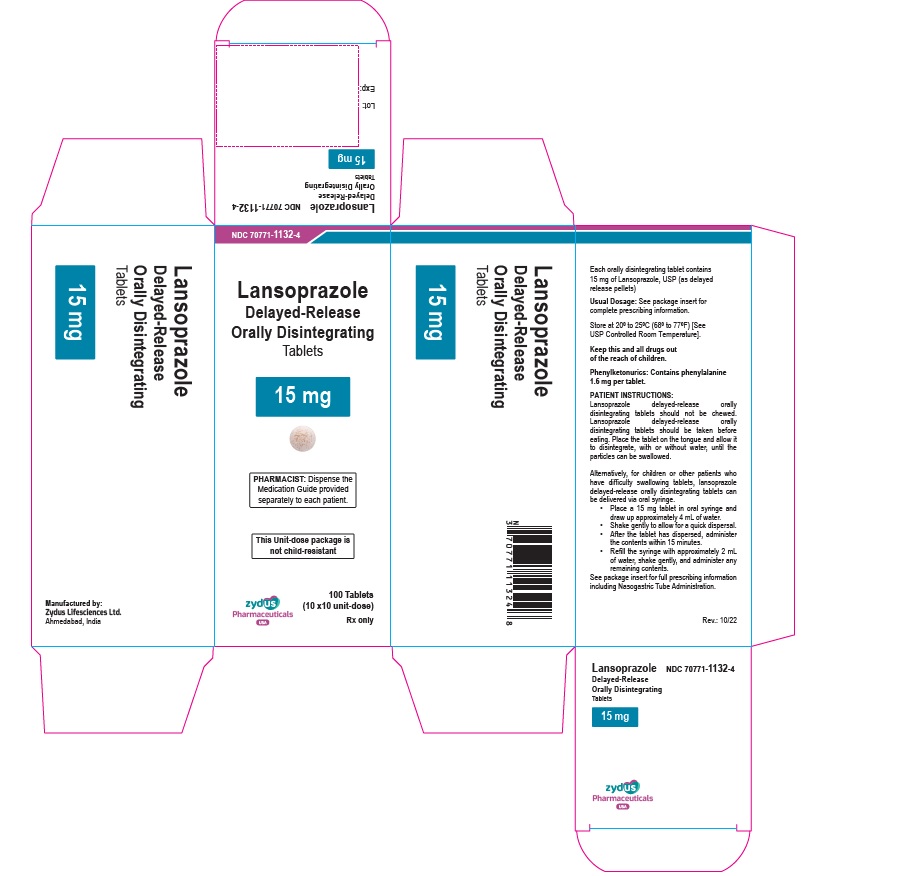
Lansoprazole 15 mg Tablet, Orally Disintegrating — NDC 70771-1132-4 (Billing 70771-1132-04)
This is a package of Lansoprazole 15 mg Tablet, Orally Disintegrating from Zydus Lifesciences Limited, marketed since Nov 2018 and currently FDA-listed. It is this product's only package size.
Identity & classification
Regulatory identifiers FDA, NLM and CMS codes for this package
- RxCUI (RxNorm): 351260
Where does this data come from?
- FDA openFDA NDC Directory · synced Oct 1, 2026
- FDA label on DailyMed · label index refreshed Oct 1, 2026
- RxNorm (NLM RxNav) · catalog refreshed Oct 1, 2026
- Medi-Span GPI (licensed)
- First Databank (licensed) · refreshed Oct 1, 2026
RxNorm drug class
This medicine belongs to the Proton Pump Inhibitor class.
Where does this data come from?
- RxClass (NLM) · catalog refreshed Oct 1, 2026
Clinical
Prescription lansoprazole is used to treat the symptoms of gastroesophageal reflux disease (GERD), a condition in which backward flow of acid from the stomach causes heartburn and possible injury of the esophagus (the tube between the throat and stomach) in adults and children 1 year of age and older. Prescription lansoprazole is used to treat the damage from GERD in adults and children 1 year of age and older. Prescription lansoprazole is used to allow the esophagus to heal and prevent further damage to the esophagus in adults with GERD. Prescription lansoprazole is also used to treat ulcers...
Read the full MedlinePlus article ↗- It lowers stomach acid. Prescription forms treat ulcers, GERD, erosive esophagitis and conditions with too much acid. It is also used with antibiotics for H. pylori. Over-the-count...
- Take it once a day, before eating, usually in the morning. Swallow capsules whole. Let orally disintegrating tablets dissolve on your tongue without chewing. For over-the-counter u...
- For heartburn, the over-the-counter label says full effect can take 1 to 4 days, though some people feel relief within 24 hours. It is not meant for instant relief.
- The most common are diarrhea, belly pain, nausea and constipation. Call your doctor if you get a severe rash, swelling, trouble breathing, diarrhea that will not clear, or muscle s...
Patient education
Supplement & herbal interactions
Some supplements/herbs that may interact with Lansoprazole — tap one for details:
Lansoprazole may be associated with lower levels of 9 nutrients — worth a chat with your pharmacist, not a cause for alarm.
Where does this data come from?
- MedlinePlus (NLM) · refreshed Oct 1, 2026
- FDA label on DailyMed · label index refreshed Oct 1, 2026
Ask a licensed pharmacist directly — free, answered by our team.
Pricing
A drug doesn't have one price. Each row is a different public payment system, and none is what you'd pay at the counter — that depends on your insurance. The ⓘ on each row explains what it measures.
| Price system | Per each | Per package |
|---|---|---|
| Retail pharmacies payNADAC · weekly | Not in the retail survey — common for institutional, discontinued, or low-volume packs. | |
| Medicaid paysCMS SDUD · 12 mo | No recent Medicaid claims on file for this NDC — rare and low-volume NDCs are suppressed in the public data. | |
| Medicare drug plans payPart D · Q2 2026 | $4.48 | $448.03 / 100 tablets |
Where does this data come from?
- CMS NADAC weekly file
- CMS ASP pricing files · refreshed Sep 20, 2026
- CMS Medicaid State Drug Utilization Data · refreshed Oct 3, 2026
- CMS Part D plan pricing files · refreshed Sep 24, 2026
- VA National Acquisition Center price file
Packaging — all sizes for this product
| Package NDC | Description | Marketing start | Marketing end | Status |
|---|---|---|---|---|
| 70771-1132-04 You're viewing this Main listing | 10 BLISTER PACK in 1 CARTON / 10 TABLET, ORALLY DISINTEGRATING in 1 BLISTER PACK | 2018-11-30 | — | Active |
Therapeutic equivalents
| Product | Labeler | Pack | NADAC/unit | TE | Status | Price vs. this |
|---|---|---|---|---|---|---|
| Lansoprazole 15 mg 00093-3008-93 | Teva | 1 tablet | $1.922 | AB | Availability likely | — |
| Lansoprazole 15 mg 00378-6981-88 | Mylan | 10 tablets | $1.922 | AB | Availability likely | — |
| Lansoprazole 15 mg 65862-0895-78 | Aurobindo | 10 tablets | $1.922 | AB | Availability likely | — |
| Lansoprazole 15 mg 68382-0771-77 | Zydus | 10 tablets | $1.922 | AB | Availability likely | — |
| Lansoprazole 15 mg 72603-0313-10 | NorthStar | 10 tablets | $1.922 | AB | Availability likely | — |
| Lansoprazole 15 mg 16714-0185-02 | NorthStar | 10 tablets | $4.720 | AB | Discontinued | — |
| Good Sense Lansoprazole 15 mg 00113-0116-55 | L. | 1 tablet | — | — | FDA listed | — |
| Lansoprazole 15 mg 00363-1419-55 | Walgreen | 1 tablet | — | — | FDA listed | — |
| lansoprazole 15 mg 30142-0192-55 | Kroger | 1 tablet | — | — | FDA listed | — |
| topcare Lansoprazole 15 mg 36800-0295-74 | Topco | 1 tablet | — | — | FDA listed | — |
| equate lansoprazole 15 mg 49035-0373-55 | Wal-Mart | 1 tablet | — | — | FDA listed | — |
| Prevacid SoluTab 15 mg 64764-0543-05 | Takeda | 3 tablets | — | AB | FDA listed | — |
| Lansoprazole 15 mg 69842-0507-55 | CVS | 1 tablet | — | — | FDA listed | — |
| Lansoprazole 15 mgthis 70771-1132-04 | Zydus | 10 tablets | — | AB | FDA listed | — |
| basic care lansoprazole 15 mg 72288-0829-55 | Amazon.com | 1 tablet | — | — | FDA listed | — |
Where does this data come from?
- FDA openFDA NDC Directory · synced Oct 1, 2026
- FDA Orange Book · refreshed Sep 3, 2026
- CMS NADAC weekly file
Availability & generic status
This product is an FDA-approved generic. Other versions of the same drug are listed under Therapeutic equivalents, least expensive first.
Where does this data come from?
- FDA Orange Book · refreshed Sep 3, 2026
What it looks like
Where does this data come from?
- FDA label on DailyMed · label index refreshed Oct 1, 2026
Inactive Ingredients / Excipients
Inactive ingredients, also called excipients, are components of the drug product other than the active ingredient. They may include fillers, dyes, coatings, preservatives, flavors, or other formulation ingredients.
💡 Tap an ingredient (hover on desktop) to see what it is and why it’s used.
-
UNII XF417D3PSL
Anhydrous citric acid is a sour, crystalline powder derived from citric acid with water removed. In medicines, it acts as a buffer to control pH, adds tartness to improve taste, and helps tablets disintegrate.
-
UNII Z0H242BBR1
Aspartame is an artificial sweetener made from amino acids. It's added to medicines to improve taste, making bitter or unpleasant-tasting drugs easier to take.
-
UNII OP1R32D61U
Microcrystalline cellulose is a purified form of cellulose, a natural fiber from plant sources. It acts as a binder and filler in tablets and capsules, helping hold ingredients together and give the medicine its shape and size.
-
UNII 68401960MK
Crospovidone is a synthetic polymer made from polyvinylpyrrolidone. It acts as a disintegrant, helping tablets break apart quickly in the stomach so the medicine dissolves and absorbs into the body.
-
UNII 1K09F3G675
Ferric oxide red is an inorganic iron compound used as a colorant in medicines. It gives tablets, capsules, or other dosage forms a red or reddish tint for identification and appearance.
-
UNII 230OU9XXE4
A waxy substance made from glycerin and stearic acid that acts as an emulsifier to blend oily and watery ingredients together. It also helps thicken and stabilize the medicine's texture.
-
UNII QTT17582CB
A strong acid used to adjust and maintain the proper pH level in liquid medicines, ensuring stability and preventing breakdown of active ingredients.
-
UNII 3NXW29V3WO
Hypromellose is a plant-based thickener made from cellulose. It's used in medicines as a binder to hold ingredients together, a coating for tablets, and a thickener for liquids.
-
UNII 0E53J927NA
Magnesium carbonate is a mineral powder used in medicines as a filler to add bulk and as a buffer to help regulate acidity in the formulation.
-
UNII 70097M6I30
Magnesium stearate is a salt made from magnesium and stearic acid, a fatty substance. It's used in tablets and capsules as a lubricant and glidant to help ingredients flow smoothly during manufacturing and prevent sticking.
-
UNII 3OWL53L36A
A natural sugar alcohol derived from seaweed or synthesized in the lab. It's used as a filler to add bulk, a sweetener in sugar-free formulas, and a disintegrant to help tablets break apart in the stomach.
-
UNII NX76LV5T8J
A synthetic plastic polymer made from methacrylic acid and ethyl acrylate. It's used as a coating or binder to control how and where the medicine dissolves in your digestive system.
-
UNII 9G2MAD7J6W
Polyacrylic acid is a synthetic polymer used as a binder and thickening agent in medicines. It helps hold tablet ingredients together and can increase the viscosity of liquid or semi-solid formulations.
-
UNII 3WJQ0SDW1A
Polyethylene glycol is a synthetic liquid or solid polymer used in medicines as a solvent, lubricant, and humectant. It helps dissolve active ingredients, reduces friction during manufacturing, and retains moisture in the final product.
-
UNII 6OZP39ZG8H
Polysorbate 80 is a synthetic emulsifier derived from sorbitol and oleic acid. It helps mix oil and water-based ingredients together in medications and improves how the product disperses in the body.
-
UNII ETJ7Z6XBU4
Silicon dioxide is a naturally occurring mineral used as a glidant and anti-caking agent. It helps powder ingredients flow smoothly and prevents clumping during manufacturing and storage.
-
UNII 55X04QC32I
A strong alkaline chemical used to adjust and maintain the pH balance of liquid medicines. It helps keep the medicine stable and ensures it stays effective during storage.
-
UNII 5856J3G2A2
A starch-based powder made from potatoes and processed with sodium. It acts as a disintegrant, helping the tablet or capsule break apart quickly in the stomach so the medicine can be absorbed.
-
UNII O8232NY3SJ
A plant-based carbohydrate derived from corn kernels. It acts as a filler to add bulk, a binder to hold ingredients together, and a disintegrant to help the tablet break apart in your stomach for absorption.
-
UNII 4J2TY8Y81V
A natural flavoring derived from strawberries that gives the medicine its strawberry taste and smell. It helps make the medicine more pleasant to take, especially for children.
-
UNII 7SEV7J4R1U
A powder made from a naturally occurring mineral. In medicines, talc works as a glidant and anti-caking agent, helping tablets and capsules flow smoothly during manufacturing and preventing clumping.
-
UNII 8Z96QXD6UM
Triethyl citrate is a clear liquid derived from citric acid. It acts as a plasticizer and solvent in tablet coatings and film formulations, helping the coating remain flexible and adhere properly to the medicine.
-
UNII TTV12P4NEE
Xanthan gum is a thickening and stabilizing ingredient made from fermented corn or other sugars. It's added to medicines to improve texture, prevent separation of liquids and solids, and help the product stay consistent.
23 inactive ingredients listed in the exact product block matched to this NDC.
Where does this data come from?
ingredient classCode="IACT" elements from the exact product block matched by this NDC. Label-section narrative from DailyMed / the openFDA label index is shown separately when available.- FDA label on DailyMed · label index refreshed Oct 1, 2026
- FDA openFDA NDC Directory · synced Oct 1, 2026
Inactive ingredient FAQ
Are inactive ingredients the same for every manufacturer?
Why might an inactive ingredient be missing?
Can inactive ingredients matter?
Manufacturer & labeler
Where does this data come from?
- FDA openFDA NDC Directory · synced Oct 1, 2026
- Drugs@FDA
Full prescribing information FDA SPL
💬 Medication Guide ▾
SPL MEDGUIDE
📄 Package Label / Principal Display Panel ▾
PACKAGE LABEL.PRINCIPAL DISPLAY PANEL NDC 70771-1132-4 Lansoprazole Delayed-release Orally Disintegrating Tablets, 15 mg R x only 100 Tablets (10 x 10 Unit Dose) NDC 70771-1133-4 Lansoprazole Delayed-release Orally Disintegrating Tablets, 30 mg R x only 100 Tablets (10 x 10 Unit Dose) Lansoprazole delayed-release orally disintegrating tablets, 15 mg Lansoprazole delayed-release orally disintegrating tablets, 30 mg
Medicare Part D spend CMS · PART D · 2026 (Q1)
About this NDC listing & data coverage
What data is (and isn’t) available for this NDC — tap to expand
| NDC identity (package / product / labeler codes) | ✓ Available |
| Labeler | ✓ Available |
| Product & package description | ✓ Available |
| Marketing category & status | ✓ Available |
| Active ingredient / dosage form / route | ✓ Available |
| FDA label (SPL via DailyMed) | ✓ Available |
| Package photos | ✓ Available |
| Inactive ingredients (structured) | ✓ Available |
| NADAC pharmacy acquisition price (CMS) | — Not published for this NDC CMS publishes NADAC only for NDCs reported in its retail-pharmacy survey. |
| Orange Book / therapeutic-equivalence data | ✓ Available |
| HCPCS J-code billing crosswalk | — Not published for this NDC Most self-administered / retail products have no J-code — that is normal. |
| Medicaid utilization (CMS SDUD) | — Not published for this NDC CMS reports utilization only for NDCs with Medicaid claims above its privacy threshold. |