
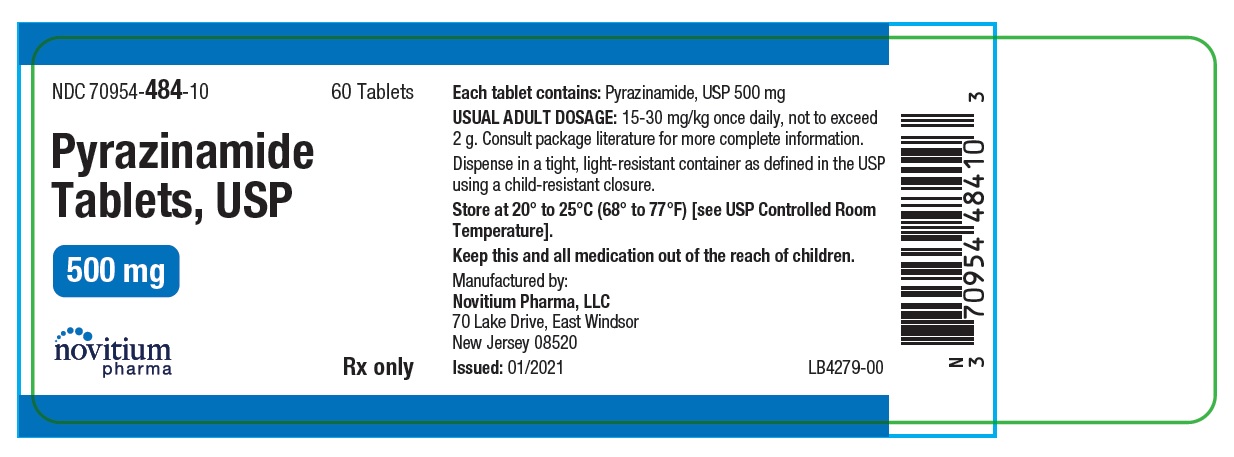
Pyrazinamide 500 mg Tablet, 100-count — NDC 70954-484-30 (Billing 70954-0484-30)
This is a package of 100 tablets of Pyrazinamide 500 mg Tablet from ANI Pharmaceuticals, Inc., marketed since May 2021 and currently FDA-listed; retail pharmacies pay about $1.31 per tablet (NADAC). It is the main listing for this product, which comes in 4 package sizes.
NDC database record
One package, one record: these facts belong to NDC 70954-484-30 alone.
- Record
- FDA NDC Directory package listing · Human prescription drug
- Code segments
- 70954 labeler · 484 product · 30 package
- Package marketed since
- May 11, 2021
- Sample package
- No — commercial package
- Listing certified through
- Dec 31, 2027
- Billing quantity
- 100 EA per package
- Barcode (UPC)
- 0370954484103, 0370954484301, 0370954484202
- Medicaid fills, this package
- 250 prescriptions in the last four reported quarters
- FDA record last changed
- Jul 24, 2026
Identity & classification
Regulatory identifiers FDA, NLM and CMS codes for this package
Drug-database identifiers Medi-Span GPI and First Databank GCN / HICL / AHFS classification
- GSN (GCN sequence number): 009424
- GCN: 41790
- GPI-14 (Medi-Span): 09000070000310
- HICL (First Databank): 004084
- AHFS class code: 08:16.04.00
- RxCUI (RxNorm): 198181
Where does this data come from?
- FDA openFDA NDC Directory · synced Oct 1, 2026
- FDA label on DailyMed · label index refreshed Oct 6, 2026
- RxNorm (NLM RxNav) · catalog refreshed Oct 1, 2026
- Medi-Span GPI (licensed)
- First Databank (licensed) · refreshed Oct 1, 2026
RxNorm drug class
This medicine belongs to the Antimycobacterial class.
Where does this data come from?
- RxClass (NLM) · catalog refreshed Oct 1, 2026
Clinical
- It treats active tuberculosis in adults and children. It is never used alone. You take it with other TB medicines, usually during the first two months of treatment.
- You swallow the tablets by mouth, usually once a day. Take it exactly as your prescriber and the label direct. Do not skip doses, because TB treatment depends on taking every medic...
- Nausea, vomiting, poor appetite, and mild joint or muscle aches are the most common. Some people get a rash or itching. Let your doctor know if these bother you.
- Call if you notice signs of liver trouble, a sudden painful gout flare, an allergic reaction, or unusual bleeding. Liver problems are the main serious concern and can happen at any...
Patient education
Supplement & herbal interactions
Some supplements/herbs that may interact with Pyrazinamide — tap one for details:
Pyrazinamide may be associated with lower levels of 8 nutrients — worth a chat with your pharmacist, not a cause for alarm.
Where does this data come from?
- MedlinePlus (NLM) · refreshed Oct 1, 2026
- FDA label on DailyMed · label index refreshed Oct 6, 2026
Ask a licensed pharmacist directly — free, answered by our team.
Pricing
A drug doesn't have one price. Each row is a different public payment system, and none is what you'd pay at the counter — that depends on your insurance. The ⓘ on each row explains what it measures.
| Price system | Per ea | Per package |
|---|---|---|
| Retail pharmacies payNADAC · weekly | $1.308 | $130.81 / 100 tablets |
| Medicaid paysCMS SDUD · 12 mo | $2.55 | $255.05 / 100 tablets |
| Medicare drug plans payPart D · Q2 2026 | $3.00 | $300.10 / 100 tablets |
Where does this data come from?
- CMS NADAC weekly file · file of Sep 30, 2026
- CMS ASP pricing files · refreshed Sep 20, 2026
- CMS Medicaid State Drug Utilization Data · through Q1 2026
- CMS Part D plan pricing files · refreshed Sep 24, 2026
- VA National Acquisition Center price file
Packaging — all sizes for this product
| Package NDC | Description | Per unit | Per pack | Marketing start | Marketing end | Status |
|---|---|---|---|---|---|---|
| 70954-0484-10 70954-484-10 | 60 TABLET in 1 BOTTLE | $1.31 / ea | $78.48 | 2021-05-11 | — | Active |
| 70954-0484-20 70954-484-20 | 90 TABLET in 1 BOTTLE | $1.31 / ea | $117.73 | 2021-05-11 | — | Active |
| 70954-0484-30 You're viewing this Main listing | 100 TABLET in 1 BOTTLE | $1.31 / ea | $130.81 | 2021-05-11 | — | Active |
| 70954-0484-40 70954-484-40 | 500 TABLET in 1 BOTTLE | — | — | 2021-05-11 | — | Discontinued by firm |
You're viewing one of 4 pack sizes for this product.
This pack effectively ties for the lowest per-ea cost of the 3 priced pack sizes ($1.31 NADAC).
In Medicaid, this is the most-dispensed pack of this product — about 44% of fills over the last four reported quarters. See all packs ↓
Pack size FAQ
What quantity is in this package?
How does this package differ from NDC 70954-0484-10?
What NDC number is used to bill for this package of Pyrazinamide 500 mg Tablet?
Prices are the latest CMS NADAC pharmacy acquisition cost per NDC; per-pack figures are per-unit × pack quantity, shown only when the pack is denominated in the same measure NADAC prices.
Therapeutic equivalents
| Product | Labeler | Pack | NADAC/unit | TE | Status | Price vs. this |
|---|---|---|---|---|---|---|
| pyrazinamide 500 mg 00054-0812-21 | Hikma | 60 tablets | $1.308 | AB | Availability likely | — |
| Pyrazinamide 500 mg 60687-0789-01 | American | 100 tablets | $1.308 | AB | Availability likely | — |
| Pyrazinamide 500 mgthis 70954-0484-30 | ANI | 100 tablets | $1.308 | AB | Availability likely | — |
| Pyrazinamide 500 mg 10135-0735-01 | MARLEX | 100 tablets | — | AB | FDA listed | — |
| Pyrazinamide 500 mg 33342-0447-03 | Macleods | 10 tablets | — | AB | FDA listed | — |
Where does this data come from?
- FDA openFDA NDC Directory · synced Oct 1, 2026
- FDA Orange Book · refreshed Oct 3, 2026
- CMS NADAC weekly file · file of Sep 30, 2026
Availability & generic status
This product is an FDA-approved generic. Other versions of the same drug are listed under Therapeutic equivalents, least expensive first.
Where does this data come from?
- FDA Orange Book · refreshed Oct 3, 2026
Inactive Ingredients / Excipients
Inactive ingredients, also called excipients, are components of the drug product other than the active ingredient. They may include fillers, dyes, coatings, preservatives, flavors, or other formulation ingredients.
🧪 Avoiding an ingredient? See Pyrazinamide inactive ingredients by manufacturer: every current product's list side by side, so you can ask your pharmacy for the version that does not list it.
Where does this data come from?
IACT rows and label-wide narrative are kept separate; availability and product-level specificity depend on the submitted label.- FDA label on DailyMed · label index refreshed Oct 6, 2026
- FDA openFDA NDC Directory · synced Oct 1, 2026
Inactive ingredient FAQ
Are inactive ingredients the same for every manufacturer?
Why might an inactive ingredient be missing?
Can inactive ingredients matter?
Manufacturer & labeler
More NDCs from ANI Pharmaceuticals, Inc. labeler code 70954
- Misoprostol 100 ug Tablet NDC 70954-443-10
- Misoprostol 200 ug Tablet NDC 70954-444-10
- Bisoprolol Fumarate 5 mg Tablet NDC 70954-455-10
- Bisoprolol Fumarate 10 mg Tablet NDC 70954-456-10
- Estazolam 1 mg Tablet NDC 70954-480-10
- Estazolam 2 mg Tablet NDC 70954-481-10
- Lacosamide 10 mg/mL Solution NDC 70954-488-10
- Levocarnitine 330 mg Tablet NDC 70954-492-10
- Nitrofurantoin 25 mg/5mL Suspension NDC 70954-496-10
- Selegiline Hydrochloride 5 mg Capsule NDC 70954-504-10
- Alprazolam .25 mg Tablet NDC 70954-508-10
- Alprazolam .5 mg Tablet NDC 70954-509-10
Where does this data come from?
- FDA openFDA NDC Directory · synced Oct 1, 2026
- Drugs@FDA
Full prescribing information FDA SPL
🎯 Indications and Usage ▾
INDICATIONS & USAGE Pyrazinamide is indicated for the initial treatment of active tuberculosis in adults and children when combined with other antituberculous agents. (The current recommendation of the CDC for drug-susceptible disease is to use a six-month regimen for initial treatment of active tuberculosis, consisting of isoniazid, rifampin and pyrazinamide given for 2 months, followed by isoniazid and rifampin for 4 months. *4 ) (Patients with drug-resistant disease should be treated with regimens individualized to their situation.
Pyrazinamide frequently will be an important component of such therapy.) (In patients with concomitant HIV infection, the physician should be aware of current recommendations of CDC. It is possible these patients may require a longer course of treatment.) It is also indicated after treatment failure with other primary drugs in any form of active tuberculosis. Pyrazinamide should only be used in conjunction with other effective antituberculous agents. *See recommendations of Center for Disease Control (CDC) and American Thoracic Society for complete regimen and dosage recommendations.
4
⏱️ Dosage and Administration ▾
DOSAGE & ADMINISTRATION Pyrazinamide should always be administered with other effective antituberculous drugs. It is administered for the initial 2 months of a 6-month or longer treatment regimen for drug-susceptible patients. Patients who are known or suspected to have drug-resistant disease should be treated with regimens individualized to their situation.
Pyrazinamide frequently will be an important component of such therapy. Patients with concomitant HIV infection may require longer courses of therapy. Physicians treating such patients should be alert to any revised recommendations from CDC for this group of patients.
Usual dose: Pyrazinamide is administered orally, 15 to 30 mg/kg once daily. Older regimens employed 3 to 4 divided doses daily, but most current recommendations are for once a day. Three grams per day should not be exceeded.
The CDC recommendations do not exceed 2 g per day when given as a daily regimen (see table). Alternatively, a twice weekly dosing regimen (50 to 70 mg/kg twice weekly based on lean body weight) has been developed to promote patient compliance with a regimen on an outpatient basis. In studies evaluating the twice weekly regimen, doses of pyrazinamide in excess of 3 g twice weekly have been administered.
This exceeds the recommended maximum 3 g/daily dose. However, an increased incidence of adverse reactions has not been reported. The table is taken from the CDC-American Thoracic Society joint recommendations: 4 Recommended Drugs for the Initial Treatment of Tuberculosis in Children and Adults Drug Daily Dose* Maximal Daily Dose in Children and Adults Twice Weekly Dose Children Adults Children Adults Isoniazid 10 to 20 mg/kg PO or IM 5 mg/kg PO or IM 300 mg 20 to 40 mg/kg Max.
900 mg 15 mg/kg Max. 900 mg Rifampin 10 to 20 mg/kg PO 10 mg/kg PO 600 mg 10 to 20 mg/kg Max. 600 mg 10 mg/kg Max.
600 mg Pyrazinamide 15 to 30 mg/kg PO 15 to 30 mg/kg PO 2 g 50 to 70 mg/kg 50 to 70 mg/kg Streptomycin 20 to 40 mg/kg IM 15 mg/kg** IM 1 g** 25 to 30 mg/kg IM 25 to 30 mg/kg IM Ethambutol 15 to 25 mg/kg PO 15 to 25 mg/kg PO 2.5 g 50 mg/kg 50 mg/kg Definition of abbreviations: PO = perorally; IM = intramuscularly. * Doses based on weight should be adjusted as weight changes. **In persons older than 60 yrs of age the daily dose of streptomycin should be limited to 10 mg/kg with a maximal dose of 750 mg.
⛔ Contraindications ▾
CONTRAINDICATIONS Pyrazinamide is contraindicated in persons: with severe hepatic damage. who have shown hypersensitivity to it. with acute gout.
⚠️ Warnings ▾
WARNINGS Patients started on pyrazinamide should have baseline serum uric acid and liver function determinations. Those patients with preexisting liver disease or those at increased risk for drug related hepatitis (e.g., alcohol abusers) should be followed closely. Pyrazinamide should be discontinued and not be resumed if signs of hepatocellular damage or hyperuricemia accompanied by an acute gouty arthritis appear.
🤒 Adverse Reactions ▾
ADVERSE REACTIONS General Fever, porphyria and dysuria have rarely been reported. Gout (see PRECAUTIONS ). Gastrointestinal The principal adverse effect is a hepatic reaction (see WARNINGS ).
Hepatotoxicity appears to be dose related, and may appear at any time during therapy. GI disturbances including nausea, vomiting and anorexia have also been reported. Hematologic and Lymphatic Thrombocytopenia and sideroblastic anemia with erythroid hyperplasia, vacuolation of erythrocytes and increased serum iron concentration have occurred rarely with this drug.
Adverse effects on blood clotting mechanisms have also been rarely reported. Other Mild arthralgia and myalgia have been reported frequently. Hypersensitivity reactions including rashes, urticaria, and pruritus have been reported.
Fever, acne, photosensitivity, porphyria, dysuria and interstitial nephritis have been reported rarely.
🔄 Drug / Laboratory Test Interactions ▾
DRUG & OR LABORATORY TEST INTERACTIONS Pyrazinamide has been reported to interfere with ACETEST ® and KETOSTIX ® urine tests to produce a pink-brown color. 5
🤰 Pregnancy ▾
PREGNANCY Teratogenic Effects – Pregnancy Category C Animal reproduction studies have not been conducted with pyrazinamide. It is also not known whether pyrazinamide can cause fetal harm when administered to a pregnant woman or can affect reproduction capacity. Pyrazinamide should be given to a pregnant woman only if clearly needed.
🧒 Pediatric Use ▾
PEDIATRIC USE Pyrazinamide regimens employed in adults are probably equally effective in pediatric patients. 4, 10, 11 Pyrazinamide appears to be well tolerated in pediatric patients.
🧓 Geriatric Use ▾
GERIATRIC USE Clinical studies of pyrazinamide did not include sufficient numbers of patients aged 65 and over to determine whether they respond differently from younger patients. Other reported clinical experience has not identified differences in responses between the elderly and younger patients. In general, dose selection for an elderly patient should be cautious, usually starting at the low end of the dosing range, reflecting the greater frequency of decreased hepatic or renal function, and of concomitant disease or other drug therapy.
It does not appear that patients with impaired renal function require a reduction in dose. It may be prudent to select doses at the low end of the dosing range, however. 13
🆘 Overdosage ▾
OVERDOSAGE Overdosage experience is limited. In one case report of overdose, abnormal liver function tests developed. These spontaneously reverted to normal when the drug was stopped. Clinical monitoring and supportive therapy should be employed. Pyrazinamide is dialyzable. 13
🧬 Clinical Pharmacology ▾
CLINICAL PHARMACOLOGY Pyrazinamide is well absorbed from the GI tract and attains peak plasma concentrations within 2 hours. Plasma concentrations generally range from 30 to 50 mcg/mL with doses of 20 to 25 mg/kg. It is widely distributed in body tissues and fluids including the liver, lungs and cerebrospinal fluid (CSF).
The CSF concentration is approximately equal to concurrent steady-state plasma concentrations in patients with inflamed meninges. 1 Pyrazinamide is approximately 10% bound to plasma proteins. 2 The half-life (t 1/2 ) of pyrazinamide is 9 to 10 hours in patients with normal renal and hepatic function.
The plasma half-life may be prolonged in patients with impaired renal or hepatic function. Pyrazinamide is hydrolyzed in the liver to its major active metabolite, pyrazinoic acid. Pyrazinoic acid is hydroxylated to the main excretory product, 5-hydroxypyrazinoic acid.
3 Approximately 70% of an oral dose is excreted in urine, mainly by glomerular filtration within 24 hours. 3 Pyrazinamide may be bacteriostatic or bactericidal against Mycobacterium tuberculosis depending on the concentration of the drug attained at the site of infection. The mechanism of action is unknown.
In vitro and in vivo the drug is active only at a slightly acidic pH.
📦 How Supplied / Storage and Handling ▾
HOW SUPPLIED Pyrazinamide Tablets, USP 500 mg are round, white, scored tablets, debossed "N" above the score and "484" below the score. NDC 70954-484-10 - Bottle of 60 NDC 70954-484-20 - Bottle of 90 NDC 70954-484-30 - Bottle of 100 NDC 70954-484-40 - Bottle of 500 Store at 20° to 25°C (68° to 77°F) [See USP Controlled Room Temperature]. Dispense in a tight, light-resistant container as defined in the USP using a child-resistant closure.
📋 Description ▾
DESCRIPTION Pyrazinamide, the pyrazine analogue of nicotinamide, is an antituberculous agent. It is a white crystalline powder, stable at room temperature, and sparingly soluble in water. Pyrazinamide has the following structural formula: Each pyrazinamide tablet for oral administration contains 500 mg of pyrazinamide and the following inactive ingredients: Corn Starch, Magnesium Stearate, Pregelatinized Starch and Stearic Acid. structure
💬 Information for Patients ▾
INFORMATION FOR PATIENTS Patients should be instructed to notify their physicians promptly if they experience any of the following: fever, loss of appetite, malaise, nausea and vomiting, darkened urine, yellowish discoloration of the skin and eyes, pain or swelling of the joints. Compliance with the full course of therapy must be emphasized, and the importance of not missing any doses must be stressed.
⚠️ Precautions ▾
PRECAUTIONS GENERAL PRECAUTIONS Pyrazinamide inhibits renal excretion of urates, frequently resulting in hyperuricemia which is usually asymptomatic. If hyperuricemia is accompanied by acute gouty arthritis, pyrazinamide should be discontinued. Pyrazinamide should be used with caution in patients with a history of diabetes mellitus, as management may be more difficult.
Primary resistance of M. tuberculosis to pyrazinamide is uncommon. In cases with known or suspected drug resistance, in vitro susceptibility tests with recent cultures of M. tuberculosis against pyrazinamide and the usual primary drugs should be performed. There are few reliable in vitro tests for pyrazinamide resistance.
A reference laboratory capable of performing these studies must be employed. INFORMATION FOR PATIENTS Patients should be instructed to notify their physicians promptly if they experience any of the following: fever, loss of appetite, malaise, nausea and vomiting, darkened urine, yellowish discoloration of the skin and eyes, pain or swelling of the joints. Compliance with the full course of therapy must be emphasized, and the importance of not missing any doses must be stressed.
LABORATORY TESTS Baseline liver function studies [especially ALT (SGPT), AST (SGOT) determinations] and uric acid levels should be determined prior to therapy. Appropriate laboratory testing should be performed at periodic intervals and if any clinical signs or symptoms occur during therapy. DRUG & OR LABORATORY TEST INTERACTIONS Pyrazinamide has been reported to interfere with ACETEST ® and KETOSTIX ® urine tests to produce a pink-brown color.
5 CARCINOGENESIS & MUTAGENESIS & IMPAIRMENT OF FERTILITY In lifetime bioassays in rats and mice, pyrazinamide was administered in the diet at concentrations of up to 10,000 ppm. This resulted in estimated daily doses for the mouse of 2 g/kg, or 40 times the maximum human dose, and for the rat of 0.5 g/kg, or 10 times the maximum human dose. Pyrazinamide was not carcinogenic in rats or male mice and no conclusion was possible for female mice due to insufficient numbers of surviving control mice.
Pyrazinamide was not mutagenic in the Ames bacterial test, but induced chromosomal aberrations in human lymphocyte cell cultures. PREGNANCY Teratogenic Effects – Pregnancy Category C Animal reproduction studies have not been conducted with pyrazinamide. It is also not known whether pyrazinamide can cause fetal harm when administered to a pregnant woman or can affect reproduction capacity.
Pyrazinamide should be given to a pregnant woman only if clearly needed. NURSING MOTHERS Pyrazinamide has been found in small amounts in breast milk. Therefore, it is advised that pyrazinamide be used with caution in nursing mothers taking into account the risk-benefit of this therapy.
9 PEDIATRIC USE Pyrazinamide regimens employed in adults are probably equally effective in pediatric patients. 4, 10, 11 Pyrazinamide appears to be well tolerated in pediatric patients. GERIATRIC USE Clinical studies of pyrazinamide did not include sufficient numbers of patients aged 65 and over to determine whether they respond differently from younger patients.
Other reported clinical experience has not identified differences in responses between the elderly and younger patients. In general, dose selection for an elderly patient should be cautious, usually starting at the low end of the dosing range, reflecting the greater frequency of decreased hepatic or renal function, and of concomitant disease or other drug therapy. It does not appear that patients with impaired renal function require a reduction in dose.
It may be prudent to select doses at the low end of the dosing range, however. 13
🍼 Nursing Mothers ▾
NURSING MOTHERS Pyrazinamide has been found in small amounts in breast milk. Therefore, it is advised that pyrazinamide be used with caution in nursing mothers taking into account the risk-benefit of this therapy. 9
📄 Carcinogenesis, Mutagenesis, Impairment of Fertility ▾
CARCINOGENESIS & MUTAGENESIS & IMPAIRMENT OF FERTILITY In lifetime bioassays in rats and mice, pyrazinamide was administered in the diet at concentrations of up to 10,000 ppm. This resulted in estimated daily doses for the mouse of 2 g/kg, or 40 times the maximum human dose, and for the rat of 0.5 g/kg, or 10 times the maximum human dose. Pyrazinamide was not carcinogenic in rats or male mice and no conclusion was possible for female mice due to insufficient numbers of surviving control mice.
Pyrazinamide was not mutagenic in the Ames bacterial test, but induced chromosomal aberrations in human lymphocyte cell cultures.
📚 References ▾
REFERENCES Drug Information, American Hospital Formulary Service . American Society of Hospital Pharmacists. Bethesda, MD.
1991. USPDI, Drug Information for the Health Care Professional . United States Pharmacopeial Convention, Inc.
Rockville, MD. 1991:1B:2226-2227. Goodman-Gilman A, Rall TW, Nies AS, Taylor P.
The Pharmacological Basis of Therapeutics , ed 8. New York, Pergamon Press. 1990;1154.
Treatment of tuberculosis and tuberculosis infection in adults and children. Am Rev Respir Dis . 1986;134:363-368.
Reynolds JEF, Parfitt K, Parsons AV, Sweetman SC. Martindale The Extra Pharmacopoeia , ed 29. London, The Pharmaceutical Press.
1989;569-570. Bioassay of pyrazinamide for possible carcinogenicity. National Cancer Institute Carcinogenesis Technical Report Series No.
48, 1978. Zerger E, Anderson B, Haworth S, Lawlor T, Mortelmans K, Speck W. Salmonella mutagenicity tests:III.
Results from the testing of 255 chemicals. Environ Mutagen . 1987;9 (Suppl 9):1-109.
Roman IC, Georgian L. Cytogenetic effects of some antituberculosis drugs in vitro. Mutation Research .
1977;48:215-224. Holdiness M. Antituberculosis drugs and breast-feeding.
Arch Intern Med . 1984;144:1888. Turcios N, Evans H.
Preventing and managing tuberculosis in children. J Resp Dis . 1989;10(6)(Jun):23.
Starke JR. Multidrug therapy for tuberculosis in children. Pediatr Infec Dis J .
1990;9:785793. Specific requirements on content and format of labeling for human prescription drugs; proposed addition of "geriatric use" subsection in the labeling. Federal Register .
1990;55(212)(Nov 1):46134-46137. Stamathakis G, Montes C, Trouvin JH, et al. Pyrazinamide and pyrazinoic acid pharmacokinetics in patients with chronic renal failure.
Clinical Nephrology . 1988;30:230-234. All trademarks are the property of their respective owners.
Manufactured by: Novitium Pharma, LLC 70 Lake Drive, East Windsor New Jersey 08520 Issued: 01/2021 LB4280-00
📄 Package Label / Principal Display Panel ▾
PACKAGE LABEL.PRINCIPAL DISPLAY PANEL Pyrazinamide Tablets, USP 500 mg 70954-484-10 - Bottle of 60 Pyrazinamide Tablets, USP 500 mg 70954-484-20 - Bottle of 90 Pyrazinamide Tablets, USP 500 mg 70954-484-30 - Bottle of 100 container-60 container-90 container-100