
Lovastatin 40 mg Tablet, 60-count — NDC 71205-199-60 (Billing 71205-0199-60)
This is a package of 60 tablets of Lovastatin 40 mg Tablet from Proficient Rx LP, marketed since Nov 2007 and currently FDA-listed.
NDC database record
One package, one record: these facts belong to NDC 71205-199-60 alone.
- Record
- FDA NDC Directory package listing · Human prescription drug
- Code segments
- 71205 labeler · 199 product · 60 package
- Package marketed since
- Jan 1, 2019
- Sample package
- No — commercial package
- Listing certified through
- Dec 31, 2027
- Barcode (UPC)
- 0371205199906
- FDA record last changed
- Oct 8, 2026
Identity & classification
Regulatory identifiers FDA, NLM and CMS codes for this package
Drug-database identifiers Medi-Span GPI and First Databank GCN / HICL / AHFS classification
- GSN (GCN sequence number): 006461
- GCN: 47041
- GPI-14 (Medi-Span): 39400050000320
- HICL (First Databank): 002793
- AHFS class code: 24:06.08.00
- RxCUI (RxNorm): 197905
Where does this data come from?
- FDA openFDA NDC Directory · synced Oct 8, 2026
- FDA label on DailyMed · label index refreshed Oct 6, 2026
- RxNorm (NLM RxNav) · catalog refreshed Oct 1, 2026
- Medi-Span GPI (licensed)
- First Databank (licensed) · refreshed Oct 8, 2026
RxNorm drug class
This medicine belongs to the HMG-CoA Reductase Inhibitor class.
Where does this data come from?
- RxClass (NLM) · catalog refreshed Oct 1, 2026
Clinical
- It's a statin that lowers LDL cholesterol when diet alone isn't enough. It also lowers the risk of heart attack and slows coronary atherosclerosis in people with coronary heart dis...
- Take your tablets by mouth with meals, usually with the evening meal. Keep following your cholesterol-lowering diet. Your prescriber will set and adjust your dose, so follow their...
- Gas, constipation, stomach pain, diarrhea, nausea, headache and mild muscle aches are the most reported. Most are mild. In studies they were not statistically different from placeb...
- Call promptly for unexplained muscle pain, tenderness or weakness, especially with fever or feeling unwell. Also call for yellowing of the skin or eyes, or signs of a serious aller...
Patient education
Supplement & herbal interactions
Some supplements/herbs that may interact with Lovastatin — tap one for details:
Lovastatin may be associated with lower levels of 1 nutrient — worth a chat with your pharmacist, not a cause for alarm.
Where does this data come from?
- MedlinePlus (NLM) · refreshed Oct 1, 2026
- FDA label on DailyMed · label index refreshed Oct 6, 2026
Ask a licensed pharmacist directly — free, answered by our team.
Pricing
A drug doesn't have one price. Each row is a different public payment system, and none is what you'd pay at the counter — that depends on your insurance. The ⓘ on each row explains what it measures.
| Price system | Per each | Per package |
|---|---|---|
| Retail pharmacies payNADAC · weekly | Not in the retail survey — common for institutional, discontinued, or low-volume packs. | |
| Medicaid paysCMS SDUD · 12 mo | No recent Medicaid claims on file for this NDC — rare and low-volume NDCs are suppressed in the public data. | |
| Medicare drug plans payPart D · Q2 2026 | $0.1433 | $8.60 / 60 tablets |
Where does this data come from?
- CMS NADAC weekly file
- CMS ASP pricing files · refreshed Sep 20, 2026
- CMS Medicaid State Drug Utilization Data · refreshed Oct 8, 2026
- CMS Part D plan pricing files · refreshed Sep 24, 2026
- VA National Acquisition Center price file
Packaging — all sizes for this product
| Package NDC | Description | Marketing start | Marketing end | Status |
|---|---|---|---|---|
| 71205-0199-30 71205-199-30 Main listing | 30 TABLET in 1 BOTTLE | 2019-01-01 | — | Active |
| 71205-0199-60 You're viewing this | 60 TABLET in 1 BOTTLE | 2019-01-01 | — | Active |
| 71205-0199-90 71205-199-90 | 90 TABLET in 1 BOTTLE | 2019-01-01 | — | Active |
You're viewing one of 3 pack sizes for this product.
Pack size FAQ
What quantity is in this package?
How does this package differ from NDC 71205-0199-30?
What NDC number is used to bill for this package of Lovastatin 40 mg Tablet?
Therapeutic equivalents
| Product | Labeler | Pack | NADAC/unit | TE | Status | Price vs. this |
|---|---|---|---|---|---|---|
| Lovastatin 40 mg 00093-0928-06 | Teva | 60 tablets | $0.055 | AB | Availability likely | — |
| Lovastatin 40 mg 61442-0143-01 | Carlsbad | 100 tablets | $0.055 | AB | Availability likely | — |
| Lovastatin 40 mg 68001-0316-00 | BluePoint | 100 tablets | $0.055 | AB | Availability likely | — |
| Lovastatin 40 mg 68180-0469-01 | Lupin | 100 tablets | $0.055 | AB | Availability likely | — |
| Lovastatin 40 mg 68645-0567-90 | Legacy | 90 tablets | $0.055 | AB | Availability likely | — |
| Lovastatin 40 mg 00615-8152-39 | NCS | 30 tablets | — | AB | FDA listed | — |
| Lovastatin 40 mg 43063-0548-14 | PD-Rx | 14 tablets | — | AB | FDA listed | — |
| Lovastatin 40 mg 43063-0939-30 | PD-Rx | 30 tablets | — | AB | FDA listed | — |
| Lovastatin 40 mg 50090-0761-00 | A-S | 30 tablets | — | AB | FDA listed | — |
| Lovastatin 40 mg 50090-0762-00 | A-S | 30 tablets | — | AB | FDA listed | — |
| Lovastatin 40 mg 51407-0253-10 | Golden | 1000 tablets | — | AB | FDA listed | — |
| Lovastatin 40 mg 51655-0469-26 | Northwind | 90 tablets | — | AB | FDA listed | — |
| Lovastatin 40 mg 55289-0692-14 | PD-Rx | 14 tablets | — | AB | FDA listed | — |
| Lovastatin 40 mg 63187-0345-30 | Proficient | 30 tablets | — | AB | FDA listed | — |
| Lovastatin 40 mg 66267-0561-30 | NuCare | 30 tablets | — | AB | FDA listed | — |
| Lovastatin 40 mg 68788-8232-03 | Preferred | 30 tablets | — | AB | FDA listed | — |
| Lovastatin 40 mg 68788-9668-01 | Preferred | 100 tablets | — | AB | FDA listed | — |
| Lovastatin 40 mg 70518-2425-01 | REMEDYREPACK | 90 tablets | — | AB | FDA listed | — |
| Lovastatin 40 mg 70518-3064-00 | REMEDYREPACK | 90 tablets | — | AB | FDA listed | — |
| Lovastatin 40 mgthis 71205-0199-60 | Proficient | 60 tablets | — | AB | FDA listed | — |
| Lovastatin 40 mg 71205-0994-00 | Proficient | 100 tablets | — | AB | FDA listed | — |
| Lovastatin 40 mg 71335-0045-01 | Bryant | 30 tablets | — | AB | FDA listed | — |
| Lovastatin 40 mg 71335-0882-01 | Bryant | 30 tablets | — | AB | Discontinued | — |
| Lovastatin 40 mg 71610-0709-45 | Aphena | 45 tablets | — | AB | FDA listed | — |
| Lovastatin 40 mg 71610-0775-30 | Aphena | 30 tablets | — | AB | FDA listed | — |
| Lovastatin 40 mg 83209-0143-30 | Boswell | 30 tablets | — | AB | FDA listed | — |
Where does this data come from?
- FDA openFDA NDC Directory · synced Oct 8, 2026
- FDA Orange Book · refreshed Oct 3, 2026
- CMS NADAC weekly file
Availability & generic status
This product is an FDA-approved generic. Other versions of the same drug are listed under Therapeutic equivalents, least expensive first.
Where does this data come from?
- FDA Orange Book · refreshed Oct 3, 2026
What it looks like
Where does this data come from?
- FDA label on DailyMed · label index refreshed Oct 6, 2026
Inactive Ingredients / Excipients
Inactive ingredients, also called excipients, are components of the drug product other than the active ingredient. They may include fillers, dyes, coatings, preservatives, flavors, or other formulation ingredients.
🧪 Avoiding an ingredient? See Lovastatin inactive ingredients by manufacturer: every current product's list side by side, so you can ask your pharmacy for the version that does not list it.
💡 Tap an ingredient (hover on desktop) to see what it is and why it’s used.
-
UNII 3SY5LH9PMK
Anhydrous lactose is a milk sugar with no water content. It acts as a filler and binder in tablets and capsules, adding bulk and helping ingredients stick together.
-
UNII REK4960K2U
Butylated hydroxyanisole is a synthetic preservative that prevents oils and fats in medicines from spoiling or becoming rancid. It keeps the medicine stable and extends its shelf life.
-
UNII 35SW5USQ3G
A synthetic yellow dye used to color medicines. It helps make tablets, capsules, and liquids visually distinct so patients can easily identify their medication.
-
UNII H3R47K3TBD
FD&C Blue No. 1 is a synthetic blue dye approved for use in foods and medicines. It serves as a colorant to give the medication its distinctive appearance and help with product identification.
-
UNII EWQ57Q8I5X
Lactose monohydrate is a natural sugar derived from milk. It serves as a filler and binder in tablets and capsules, helping create the proper size, texture, and consistency of the medicine.
-
UNII 70097M6I30
Magnesium stearate is a salt made from magnesium and stearic acid, a fatty substance. It's used in tablets and capsules as a lubricant and glidant to help ingredients flow smoothly during manufacturing and prevent sticking.
-
UNII OP1R32D61U
Microcrystalline cellulose is a purified form of cellulose, a natural fiber from plant sources. It acts as a binder and filler in tablets and capsules, helping hold ingredients together and give the medicine its shape and size.
-
UNII O8232NY3SJ
A plant-based carbohydrate derived from corn kernels. It acts as a filler to add bulk, a binder to hold ingredients together, and a disintegrant to help the tablet break apart in your stomach for absorption.
8 inactive ingredients listed in the exact product block matched to this NDC.
Where does this data come from?
ingredient classCode="IACT" elements from the exact product block matched by this NDC. Label-section narrative from DailyMed / the openFDA label index is shown separately when available.- FDA label on DailyMed · label index refreshed Oct 6, 2026
- FDA openFDA NDC Directory · synced Oct 8, 2026
Inactive ingredient FAQ
Are inactive ingredients the same for every manufacturer?
Why might an inactive ingredient be missing?
Can inactive ingredients matter?
Manufacturer & labeler
More NDCs from Proficient Rx LP labeler code 71205
- Norgestimate and Ethinyl Estradiol Kit NDC 71205-191-28
- Simvastatin 40 mg Tablet, Film Coated NDC 71205-192-30
- Escitalopram 20 mg Tablet, Film Coated NDC 71205-193-30
- topiramate 100 mg Tablet, Film Coated NDC 71205-195-30
- pseudoephedrine hydrochloride Pseudoephedrine HCl 30 mg Tablet, Film Coated NDC 71205-197-24
- Paroxetine 40 mg Tablet, Film Coated NDC 71205-198-30
- Cyclobenzaprine Hydrochloride 10 mg Tablet, Film Coated NDC 71205-201-10
- topiramate 25 mg Tablet, Film Coated NDC 71205-202-30
- Piroxicam 20 mg Capsule NDC 71205-203-30
- Sertraline Hydrochloride 50 mg Tablet, Film Coated NDC 71205-205-30
- Oseltamivir phosphate 75 mg Capsule NDC 71205-206-10
- cetirizine hydrochloride 10 mg Tablet NDC 71205-207-06
Where does this data come from?
- FDA openFDA NDC Directory · synced Oct 8, 2026
- Drugs@FDA
Full prescribing information FDA SPL
🎯 Indications and Usage ▾
INDICATIONS AND USAGE Therapy with lovastatin tablets USP should be a component of multiple risk factor intervention in those individuals with dyslipidemia at risk for atherosclerotic vascular disease. Lovastatin tablets USP should be used in addition to a diet restricted in saturated fat and cholesterol as part of a treatment strategy to lower total-C and LDL-C to target levels when the response to diet and other nonpharmacological measures alone has been inadequate to reduce risk. Primary Prevention of Coronary Heart Disease In individuals without symptomatic cardiovascular disease, average to moderately elevated total-C and LDL-C and below average HDL-C, lovastatin tablets USP are indicated to reduce the risk of: -Myocardial infarction -Unstable angina -Coronary revascularization procedures (See Error!
Hyperlink reference not valid. ). Coronary Heart Disease Lovastatin tablets USP are indicated to slow the progression of coronary atherosclerosis in patients with coronary heart disease as part of a treatment strategy to lower total-C and LDL-C to target levels. Hypercholesterolemia Therapy with lipid-altering agents should be a component of multiple risk factor intervention in those individuals at significantly increased risk for atherosclerotic vascular disease due to hypercholesterolemia.
Lovastatin tablets USP are indicated as an adjunct to diet for the reduction of elevated total-C and LDL-C levels in patients with primary hypercholesterolemia (Types IIa and IIb 2 ), when the response to diet restricted in saturated fat and cholesterol and to other nonpharmacological measures alone has been inadequate. 2 Classification of Hyperlipoproteinemias IDL = intermediate-density lipoprotein. Type Lipoproteins elevated Lipid Elevations major minor I chylomicrons TG ↑→C IIa LDL C — IIb LDL,VLDL C TG III (rare) IDL C/TG — IV VLDL TG ↑→C V (rare) chylomicrons,VLDL TG ↑→C Adolescent Patients with Heterozygous Familial Hypercholesterolemia Lovastatin tablets USP are indicated as an adjunct to diet to reduce total-C, LDL-C and apolipoprotein B levels in adolescent boys and girls who are at least one year post-menarche, 10 to 17 years of age, with heFH if after an adequate trial of diet therapy the following findings are present: 1.
LDL-C remains >189 mg/dL or 2. LDL-C remains >160 mg/dL and: • there is a positive family history of premature cardiovascular disease or • two or more other CVD risk factors are present in the adolescent patient General Recommendations Prior to initiating therapy with lovastatin, secondary causes for hypercholesterolemia (e.g., poorly controlled diabetes mellitus, hypothyroidism, nephrotic syndrome, dysproteinemias, obstructive liver disease, other drug therapy, alcoholism) should be excluded, and a lipid profile performed to measure total-C, HDL-C, and TG.
For patients with TG less than 400 mg / dL (<4.5 mmol / L), LDL-C can be estimated using the following equation: LDL-C = total-C – [0.2 × (TG) + HDL-C] For TG levels >400 mg/dL (>4.5 mmol/L), this equation is less accurate and LDL-C concentrations should be determined by ultracentrifugation. In hypertriglyceridemic patients, LDL-C may be low or normal despite elevated total-C. In such cases, lovastatin tablets USP are not indicated.
The National Cholesterol Education Program (NCEP) Treatment Guidelines are summarized below: † CHD, coronary heart disease †† Some authorities recommend use of LDL-lowering drugs in this category if an LDL-C level of <100 mg/dL cannot be achieved by therapeutic lifestyle changes. Others prefer use of drugs that primarily modify triglycerides and HDL-C, e.g., nicotinic acid or fibrate. Clinical judgment also may call for deferring drug therapy in this subcategory. ††† Almost all people with 0 to 1 risk factor have a 10-year risk <10%; thus, 10-year risk assessment in people with 0 to 1 risk factor is not necessary.
NCEP Treatment Guidelines: LDL-C Goals and Cutpoints for Therapeutic Lifestyle Changes and Drug Therapy in Differen… [Excerpted — this section continues on DailyMed.]
⏱️ Dosage and Administration ▾
DOSAGE AND ADMINISTRATION The patient should be placed on a standard cholesterol-lowering diet before receiving lovastatin tablets USP and should continue on this diet during treatment with lovastatin tablets USP (see NCEP Treatment Guidelines for details on dietary therapy). Lovastatin tablets USP should be given with meals. Adult Patients The usual recommended starting dose is 20 mg once a day given with the evening meal.
The recommended dosing range of lovastatin is 10 to 80 mg / day in single or two divided doses; the maximum recommended dose is 80 mg / day. Doses should be individualized according to the recommended goal of therapy (see Error! Hyperlink reference not valid. and CLINICAL PHARMACOLOGY ).
Patients requiring reductions in LDL-C of 20% or more to achieve their goal (see INDICATIONS AND USAGE ) should be started on 20 mg/day of lovastatin tablets. A starting dose of 10 mg of lovastatin may be considered for patients requiring smaller reductions. Adjustments should be made at intervals of 4 weeks or more.
Cholesterol levels should be monitored periodically and consideration should be given to reducing the dosage of lovastatin tablets if cholesterol levels fall significantly below the targeted range. Dosage in Patients taking Danazol, Diltiazem, Dronedarone or Verapamil In patients taking danazol, diltiazem, dronedarone or verapamil concomitantly with lovastatin, therapy should begin with 10 mg of lovastatin and should not exceed 20 mg / day (see CLINICAL PHARMACOLOGY, Pharmacokinetics , Error! Hyperlink reference not valid. , Error!
Hyperlink reference not valid. , Error! Hyperlink reference not valid. ). Dosage in Patients taking Amiodarone In patients taking amiodarone concomitantly with lovastatin, the dose should not exceed 40 mg/day (see Error!
Hyperlink reference not valid. and Error! Hyperlink reference not valid. , Error! Hyperlink reference not valid. ).
Adolescent Patients (10 to 17 years of age) with Heterozygous Familial Hypercholesterolemia The recommended dosing range of lovastatin is 10 to 40 mg / day; the maximum recommended dose is 40 mg / day. Doses should be individualized according to the recommended goal of therapy (see Error! Hyperlink reference not valid.
4 , CLINICAL PHARMACOLOGY , and INDICATIONS AND USAGE ). Patients requiring reductions in LDL-C of 20% or more to achieve their goal should be started on 20 mg/day of lovastatin. A starting dose of 10 mg of lovastatin may be considered for patients requiring smaller reductions.
Adjustments should be made at intervals of 4 weeks or more. Concomitant Lipid-Lowering Therapy Lovastatin tablets USP are effective alone or when used concomitantly with bile-acid sequestrants (see Error! Hyperlink reference not valid. and Error!
Hyperlink reference not valid. ). Dosage in Patients with Renal Insufficiency In patients with severe renal insufficiency (creatinine clearance <30 mL / min), dosage increases above 20 mg / day should be carefully considered and, if deemed necessary, implemented cautiously (see CLINICAL PHARMACOLOGY and Error! Hyperlink reference not valid. ).
⛔ Contraindications ▾
CONTRAINDICATIONS Hypersensitivity to any component of this medication. Active liver disease or unexplained persistent elevations of serum transaminases (see WARNINGS ). Concomitant administration with strong CYP3A4 inhibitors (e.g., itraconazole, ketoconazole, posaconazole, voriconazole, HIV protease inhibitors, boceprevir, telaprevir, erythromycin, clarithromycin, telithromycin, nefazodone, and cobicistat-containing products) (see Error!
Hyperlink reference not valid. ). Pregnancy and lactation (see Error! Hyperlink reference not valid. and Error!
Hyperlink reference not valid. ). Atherosclerosis is a chronic process and the discontinuation of lipid-lowering drugs during pregnancy should have little impact on the outcome of long-term therapy of primary hypercholesterolemia. Moreover, cholesterol and other products of the cholesterol biosynthesis pathway are essential components for fetal development, including synthesis of steroids and cell membranes.
Because of the ability of inhibitors of HMG-CoA reductase such as lovastatin to decrease the synthesis of cholesterol and possibly other products of the cholesterol biosynthesis pathway, lovastatin is contraindicated during pregnancy and in nursing mothers. Lovastatin should be administered to women of childbearing age only when such patients are highly unlikely to conceive. If the patient becomes pregnant while taking this drug, lovastatin should be discontinued immediately and the patient should be apprised of the potential hazard to the fetus (see Error!
Hyperlink reference not valid. ).
⚠️ Warnings ▾
WARNINGS Myopathy/Rhabdomyolysis Lovastatin, like other inhibitors of HMG-CoA reductase, occasionally causes myopathy manifested as muscle pain, tenderness or weakness with creatine kinase (CK) above ten times the upper limit of normal (ULN). Myopathy sometimes takes the form of rhabdomyolysis with or without acute renal failure secondary to myoglobinuria, and rare fatalities have occurred. The risk of myopathy is increased by high levels of HMG-CoA reductase inhibitory activity in plasma.
The risk of myopathy/rhabdomyolysis is dose related. In a clinical study (EXCEL) in which patients were carefully monitored and some interacting drugs were excluded, there was one case of myopathy among 4933 patients randomized to lovastatin 20 to 40 mg daily for 48 weeks, and 4 among 1649 patients randomized to 80 mg daily. There have been rare reports of immune-mediated necrotizing myopathy (IMNM), an autoimmune myopathy, associated with statin use.
IMNM is characterized by: proximal muscle weakness and elevated serum creatine kinase, which persist despite discontinuation of statin treatment; muscle biopsy showing necrotizing myopathy without significant inflammation; improvement with immunosuppressive agents. All patients starting therapy with lovastatin, or whose dose of lovastatin is being increased, should be advised of the risk of myopathy and told to report promptly any unexplained muscle pain, tenderness or weakness particularly if accompanied by malaise or fever or if muscle signs and symptoms persists after discontinuing lovastatin.
Lovastatin therapy should be discontinued immediately if myopathy is diagnosed or suspected. In most cases, muscle symptoms and CK increases resolved when treatment was promptly discontinued. Periodic CK determinations may be considered in patients starting therapy with lovastatin or whose dose is being increased, but there is no assurance that such monitoring will prevent myopathy.
Many of the patients who have developed rhabdomyolysis on therapy with lovastatin have had complicated medical histories, including renal insufficiency usually as a consequence of long-standing diabetes mellitus. Such patients merit closer monitoring. Lovastatin therapy should be discontinued if markedly elevated CPK levels occur or myopathy is diagnosed or suspected.
Lovastatin therapy should also be temporarily withheld in any patient experiencing an acute or serious condition predisposing to the development of renal failure secondary to rhabdomyolysis, e.g., sepsis; hypotension; major surgery; trauma; severe metabolic, endocrine, or electrolyte disorders; or uncontrolled epilepsy. The risk of myopathy/rhabdomyolysis is increased by concomitant use of lovastatin with the following: Strong inhibitors of CYP3A4 Lovastatin, like several other inhibitors of HMG-CoA reductase, is a substrate of cytochrome P450 3A4 (CYP3A4).
Certain drugs which inhibit this metabolic pathway can raise the plasma levels of lovastatin and may increase the risk of myopathy. These include itraconazole, ketoconazole, posaconazole, voriconazole, the macrolide antibiotics erythromycin and clarithromycin, the ketolide antibiotic telithromycin, HIV protease inhibitors, boceprevir, telaprevir, the antidepressant nefazodone, or cobicistat-containing products. Combination of these drugs with lovastatin is contraindicated.
If short-term treatment with strong CYP3A4 inhibitors is unavoidable, therapy with lovastatin should be suspended during the course of treatment (see CONTRAINDICATIONS ; Error! Hyperlink reference not valid. ). Gemfibrozil The combined use of lovastatin with gemfibrozil should be avoided.
Other lipid-lowering drugs (other fibrates or ≥1 g/day of niacin) Caution should be used when prescribing other fibrates or lipid-lowering doses (≥1 g/day) of niacin with lovastatin, as these agents can cause myopathy when given alone. The benefit of further alterations in lipid levels by the combined use of lovastatin with other fibrates or niacin shoul… [Excerpted — this section continues on DailyMed.]
🤒 Adverse Reactions ▾
ADVERSE REACTIONS Phase III Clinical Studies In Phase III controlled clinical studies involving 613 patients treated with lovastatin, the adverse experience profile was similar to that shown below for the 8,245-patient EXCEL study (see Error! Hyperlink reference not valid. ). Persistent increases of serum transaminases have been noted (see Error!
Hyperlink reference not valid. ). About 11% of patients had elevations of CK levels of at least twice the normal value on one or more occasions. The corresponding values for the control agent cholestyramine was 9 percent.
This was attributable to the noncardiac fraction of CK. Large increases in CK have sometimes been reported (see Error! Hyperlink reference not valid. ).
Expanded Clinical Evaluation of Lovastatin (EXCEL) Study Lovastatin was compared to placebo in 8,245 patients with hypercholesterolemia (total-C 240 to 300 mg / dL [6.2 to 7.8 mmol / L]) in the randomized, double-blind, parallel, 48-week EXCEL study. Clinical adverse experiences reported as possibly, probably or definitely drug-related in ≥1% in any treatment group are shown in the table below. For no event was the incidence on drug and placebo statistically different.
Placebo (N =1663) % Lovastatin 20 mg q.p.m. (N = 1642) % Lovastatin 40 mg q.p.m. (N = 1645) % Lovastatin 20 mg b.i.d.
(N = 1646) % Lovastatin 40 mg b.i.d. (N = 1649) % Body As a Whole Asthenia 1.4 1.7 1.4 1.5
1.2Gastrointestinal Abdominal pain 1.6 2.0 2.0 2.2
2.5Constipation 1.9 2.0 3.2 3.2
3.5Diarrhea 2.3 2.6 2.4 2.2
2.6Dyspepsia 1.9 1.3 1.3 1.0
1.6Flatulence 4.2 3.7 4.3 3.9
4.5Nausea 2.5 1.9 2.5 2.2
2.2Musculoskeletal Muscle cramps 0.5 0.6 0.8 1.1
1.0Myalgia 1.7 2.6 1.8 2.2
3.0Nervous System/ Psychiatric Dizziness 0.7 0.7 1.2 0.5
0.5Headache 2.7 2.6 2.8 2.1
3.2Skin Rash 0.7 0.8 1.0 1.2
1.3Special Senses Blurred vision 0.8 1.1 0.9 0.9
1.2Other clinical adverse experiences reported as possibly, probably or definitely drug-related in 0.5 to 1.0 percent of patients in any drug-treated group are listed below. In all these cases the incidence on drug and placebo was not statistically different. Body as a Whole: chest pain; Gastrointestinal: acid regurgitation, dry mouth, vomiting; Musculoskeletal: leg pain, shoulder pain, arthralgia; Nervous System/Psychiatric: insomnia, paresthesia; Skin: alopecia, pruritus; Special Senses: eye irritation.
In the EXCEL study (see Error! Hyperlink reference not valid. ) , 4.6% of the patients treated up to 48 weeks were discontinued due to clinical or laboratory adverse experiences which were rated by the investigator as possibly, probably or definitely related to therapy with lovastatin. The value for the placebo group was 2.5%.
Air Force/Texas Coronary Atherosclerosis Prevention Study (AFCAPS/TexCAPS) In AFCAPS/TexCAPS (see Error! Hyperlink reference not valid. ) involving 6,605 participants treated with 20 to 40 mg/day of lovastatin (n=3,304) or placebo (n=3,301), the safety and tolerability profile of the group treated with lovastatin was comparable to that of the group treated with placebo during a median of 5.1 years of follow-up. The adverse experiences reported in AFCAPS/TexCAPS were similar to those reported in EXCEL (see Error!
Hyperlink reference not valid. ). Concomitant Therapy In controlled clinical studies in which lovastatin was administered concomitantly with cholestyramine, no adverse reactions peculiar to this concomitant treatment were observed. The adverse reactions that occurred were limited to those reported previously with lovastatin or cholestyramine.
Other lipid-lowering agents were not administered concomitantly with lovastatin during controlled clinical studies. Preliminary data suggests that the addition of gemfibrozil to therapy with lovastatin is not associated with greater reduction in LDL-C than that achieved with lovastatin alone. In uncontrolled clinical studies, most of the patients who have developed myopathy were receiving concomitant therapy with cyclosporine, gemfibrozil… [Excerpted — this section continues on DailyMed.]
🆘 Overdosage ▾
OVERDOSAGE After oral administration of lovastatin to mice, the median lethal dose observed was >15 g / m 2 . Five healthy human volunteers have received up to 200 mg of lovastatin as a single dose without clinically significant adverse experiences. A few cases of accidental overdosage have been reported; no patients had any specific symptoms, and all patients recovered without sequelae.
The maximum dose taken was 5 to 6 g. Until further experience is obtained, no specific treatment of overdosage with lovastatin can be recommended. The dialyzability of lovastatin and its metabolites in man is not known at present.
🧬 Clinical Pharmacology ▾
CLINICAL PHARMACOLOGY The involvement of low-density lipoprotein cholesterol (LDL-C) in atherogenesis has been well-documented in clinical and pathological studies, as well as in many animal experiments. Epidemiological and clinical studies have established that high LDL-C and low high-density lipoprotein cholesterol (HDL-C) are both associated with coronary heart disease. However, the risk of developing coronary heart disease is continuous and graded over the range of cholesterol levels and many coronary events do occur in patients with total cholesterol (total-C) and LDL-C in the lower end of this range.
Lovastatin has been shown to reduce elevated LDL-C concentrations. LDL is formed from very low-density lipoprotein (VLDL) and is catabolized predominantly by the high affinity LDL receptor. The mechanism of the LDL-lowering effect of lovastatin may involve both reduction of VLDL-C concentration, and induction of the LDL receptor, leading to reduced production and / or increased catabolism of LDL-C.
Apolipoprotein B also falls during treatment with lovastatin. Lovastatin is a specific inhibitor of HMG-CoA reductase, the enzyme which catalyzes the conversion of HMG-CoA to mevalonate. The conversion of HMG-CoA to mevalonate is an early step in the biosynthetic pathway for cholesterol.
PHARMACOKINETICS Lovastatin is a lactone which is readily hydrolyzed in vivo to the corresponding β-hydroxyacid, a strong inhibitor of HMG-CoA reductase. Inhibition of HMG-CoA reductase is the basis for an assay in pharmacokinetic studies of the β-hydroxyacid metabolites (active inhibitors) and, following base hydrolysis, active plus latent inhibitors (total inhibitors) in plasma following administration of lovastatin. Following an oral dose of 14 C-labeled lovastatin in man, 10% of the dose was excreted in urine and 83% in feces.
The latter represents absorbed drug equivalents excreted in bile, as well as any unabsorbed drug. Plasma concentrations of total radioactivity (lovastatin plus 14 C-metabolites) peaked at 2 hours and declined rapidly to about 10% of peak by 24 hours postdose. Absorption of lovastatin, estimated relative to an intravenous reference dose, in each of four animal species tested, averaged about 30% of an oral dose.
In animal studies, after oral dosing, lovastatin had high selectivity for the liver, where it achieved substantially higher concentrations than in non-target tissues. Lovastatin undergoes extensive first-pass extraction in the liver, its primary site of action, with subsequent excretion of drug equivalents in the bile. As a consequence of extensive hepatic extraction of lovastatin, the availability of drug to the general circulation is low and variable.
In a single dose study in four hypercholesterolemic patients, it was estimated that less than 5% of an oral dose of lovastatin reaches the general circulation as active inhibitors. Following administration of lovastatin tablets the coefficient of variation, based on between-subject variability, was approximately 40% for the area under the curve (AUC) of total inhibitory activity in the general circulation. Both lovastatin and its β-hydroxyacid metabolite are highly bound (>95%) to human plasma proteins.
Animal studies demonstrated that lovastatin crosses the blood-brain and placental barriers. The major active metabolites present in human plasma are the β-hydroxyacid of lovastatin, its 6′-hydroxy derivative, and two additional metabolites. Peak plasma concentrations of both active and total inhibitors were attained within 2 to 4 hours of dose administration.
While the recommended therapeutic dose range is 10 to 80 mg / day, linearity of inhibitory activity in the general circulation was established by a single dose study employing lovastatin tablet dosages from 60 to as high as 120 mg. With a once-a-day dosing regimen, plasma concentrations of total inhibitors over a dosing interval achieved a steady state between the second and third days of therapy and were about… [Excerpted — this section continues on DailyMed.]
📦 How Supplied / Storage and Handling ▾
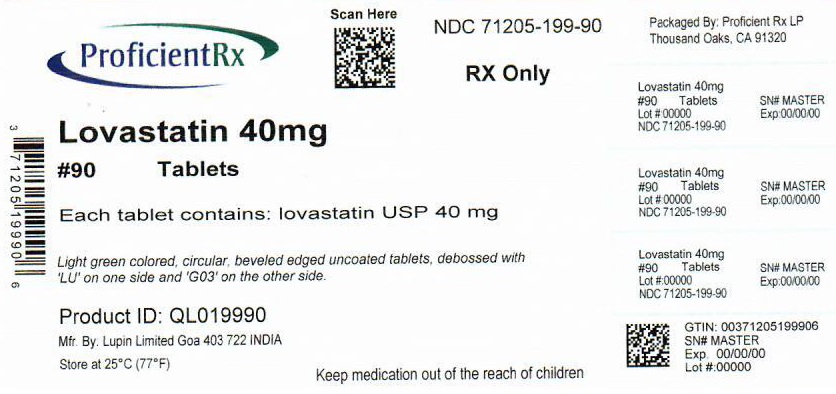
HOW SUPPLIED Lovastatin Tablets USP, 40 mg are light green colored, circular, beveled edged uncoated tablets, debossed with 'LU' on one side and 'G03' on the other side. They are supplied as follows: NDC 71205-199-30 Bottles of 30 NDC 71205-199-60 Bottles of 60 NDC 71205-199-90 Bottles of 90 Storage Store at 25°C (77°F); excursions permitted to 15° to 30°C (59° to 86°F) [see USP Controlled Room Temperature]. Lovastatin tablets must be protected from light and stored in a well-closed, light-resistant container.
1 Kantola, T, et al., Clin Pharmacol Ther 1998; 63(4): 397-402 3 Manson, J.M., Freyssinges,C.Ducrocq, M.B., Stephenson, W.P., Postmarketing Surveillance of Lovastatin and Simvastatin Exposure During Pregnancy. Reproductive Toxicology. 10(6):439-446, 1996.
4 National Cholesterol Education Program (NCEP): Highlights of the Report of the Expert Panel on Blood Cholesterol Levels in Children and Adolescents. Pediatrics . 89(3):495-501.
1992. Manufactured for Lupin Pharmaceuticals, Inc. Baltimore, Maryland 21202 United States Manufactured by Lupin Limited Goa 403 722 INDIA Repackaged by Proficient Rx LP Thousand Oaks, CA 91320 Revised: April 27, 2017 ID#: 251578
📋 Description ▾
DESCRIPTION Lovastatin is a cholesterol lowering agent isolated from a strain of Aspergillus terreus. After oral ingestion, lovastatin, which is an inactive lactone, is hydrolyzed to the corresponding β-hydroxyacid form. This is a principal metabolite and an inhibitor of 3-hydroxy-3-methylglutaryl-coenzyme A (HMG-CoA) reductase.
This enzyme catalyzes the conversion of HMG-CoA to mevalonate, which is an early and rate limiting step in the biosynthesis of cholesterol. Lovastatin is [1 S -[1α( R * ),3α,7β,8β(2 S * ,4 S * ),8aβ]]-1,2,3,7, 8,8a-hexahydro-3,7-dimethyl-8-[2-(tetrahydro-4-hydroxy-6-oxo-2 H -pyran-2-yl)ethyl]-1-naphthalenyl 2-methylbutanoate. The empirical formula of lovastatin is C 24 H 36 O 5 and its molecular weight is 404.55.
Its structural formula is: Lovastatin is a white, nonhygroscopic crystalline powder that is insoluble in water and sparingly soluble in ethanol, methanol, and acetonitrile. Lovastatin tablets USP are supplied as 40 mg tablets for oral administration. In addition to the active ingredient lovastatin, each tablet contains the following inactive ingredients: D&C Yellow No.
10 Aluminum Lake, FD&C Blue No. 2 Aluminum Lake, lactose anhydrous, lactose monohydrate, magnesium stearate, microcrystalline cellulose and pregelatinized corn starch. Butylated hydroxyanisole (BHA) is added as a preservative. lovastatin
⚠️ Precautions ▾
PRECAUTIONS General Lovastatin may elevate creatine phosphokinase and transaminase levels (see WARNINGS and ADVERSE REACTIONS ). This should be considered in the differential diagnosis of chest pain in a patient on therapy with lovastatin. Homozygous Familial Hypercholesterolemia Lovastatin is less effective in patients with the rare homozygous familial hypercholesterolemia, possibly because these patients have no functional LDL receptors.
Lovastatin appears to be more likely to raise serum transaminases (see ADVERSE REACTIONS ) in these homozygous patients. Information for Patients Patients should be advised about substances they should not take concomitantly with lovastatin and be advised to report promptly unexplained muscle pain, tenderness, or weakness particularly if accompanied by malaise or fever or if muscle signs and symptoms persist after discontinuing lovastatin (see list below and Error! Hyperlink reference not valid. ).
Patients should also be advised to inform other physicians prescribing a new medication that they are taking lovastatin. It is recommended that liver enzymes be checked before starting therapy, and if signs or symptoms of liver injury occur. All patients treated with lovastatin should be advised to report promptly any symptoms that may indicate liver injury, including fatigue, anorexia, right upper abdominal discomfort, dark urine or jaundice.
Drug Interactions CYP3A4 Interactions Lovastatin is metabolized by CYP3A4 but has no CYP3A4 inhibitory activity; therefore it is not expected to affect the plasma concentrations of other drugs metabolized by CYP3A4. Strong inhibitors of CYP3A4 (e.g., itraconazole, ketoconazole, posaconazole, voriconazole, clarithromycin, telithromycin, HIV protease inhibitors, boceprevir, telaprevir, nefazodone, erythromycin, and cobicistat-containing products), and grapefruit juice increase the risk of myopathy by reducing the elimination of lovastatin.
(See CONTRAINDICATIONS , Error! Hyperlink reference not valid. , and CLINICAL PHARMACOLOGY, Pharmacokinetics ) Interactions With Lipid-Lowering Drugs That Can Cause Myopathy When Given Alone The risk of myopathy is also increased by the following lipid-lowering drugs that are not strong CYP3A4 inhibitors, but which can cause myopathy when given alone. See Error!
Hyperlink reference not valid. . Gemfibrozil Other fibrates Niacin (nicotinic acid) ( ≥ 1 g/day) Other Drug Interactions Cyclosporine: The risk of myopathy/rhabdomyolysis is increased by concomitant administration of cyclosporine (see Error! Hyperlink reference not valid. ).
Danazol, Diltiazem, Dronedarone or Verapamil: The risk of myopathy/rhabdomyolysis is increased by concomitant administration of danazol, diltiazem, dronedarone or verapamil particularly with higher doses of lovastatin (see Error! Hyperlink reference not valid. ; CLINICAL PHARMACOLOGY, Pharmacokinetics ). Amiodarone: The risk of myopathy/rhabdomyolysis is increased when amiodarone is used concomitantly with a closely related member of the HMG-CoA reductase inhibitor class (see Error!
Hyperlink reference not valid. ). Coumarin Anticoagulants: In a small clinical trial in which lovastatin was administered to warfarin treated patients, no effect on prothrombin time was detected. However, another HMG-CoA reductase inhibitor has been found to produce a less than two-second increase in prothrombin time in healthy volunteers receiving low doses of warfarin.
Also, bleeding and / or increased prothrombin time have been reported in a few patients taking coumarin anticoagulants concomitantly with lovastatin. It is recommended that in patients taking anticoagulants, prothrombin time be determined before starting lovastatin and frequently enough during early therapy to insure that no significant alteration of prothrombin time occurs. Once a stable prothrombin time has been documented, prothrombin times can be monitored at the intervals usually recommended for patients on coumarin anticoagulants.
If the dose of… [Excerpted — this section continues on DailyMed.]
🧬 Pharmacokinetics ▾
PHARMACOKINETICS Lovastatin is a lactone which is readily hydrolyzed in vivo to the corresponding β-hydroxyacid, a strong inhibitor of HMG-CoA reductase. Inhibition of HMG-CoA reductase is the basis for an assay in pharmacokinetic studies of the β-hydroxyacid metabolites (active inhibitors) and, following base hydrolysis, active plus latent inhibitors (total inhibitors) in plasma following administration of lovastatin. Following an oral dose of 14 C-labeled lovastatin in man, 10% of the dose was excreted in urine and 83% in feces.
The latter represents absorbed drug equivalents excreted in bile, as well as any unabsorbed drug. Plasma concentrations of total radioactivity (lovastatin plus 14 C-metabolites) peaked at 2 hours and declined rapidly to about 10% of peak by 24 hours postdose. Absorption of lovastatin, estimated relative to an intravenous reference dose, in each of four animal species tested, averaged about 30% of an oral dose.
In animal studies, after oral dosing, lovastatin had high selectivity for the liver, where it achieved substantially higher concentrations than in non-target tissues. Lovastatin undergoes extensive first-pass extraction in the liver, its primary site of action, with subsequent excretion of drug equivalents in the bile. As a consequence of extensive hepatic extraction of lovastatin, the availability of drug to the general circulation is low and variable.
In a single dose study in four hypercholesterolemic patients, it was estimated that less than 5% of an oral dose of lovastatin reaches the general circulation as active inhibitors. Following administration of lovastatin tablets the coefficient of variation, based on between-subject variability, was approximately 40% for the area under the curve (AUC) of total inhibitory activity in the general circulation. Both lovastatin and its β-hydroxyacid metabolite are highly bound (>95%) to human plasma proteins.
Animal studies demonstrated that lovastatin crosses the blood-brain and placental barriers. The major active metabolites present in human plasma are the β-hydroxyacid of lovastatin, its 6′-hydroxy derivative, and two additional metabolites. Peak plasma concentrations of both active and total inhibitors were attained within 2 to 4 hours of dose administration.
While the recommended therapeutic dose range is 10 to 80 mg / day, linearity of inhibitory activity in the general circulation was established by a single dose study employing lovastatin tablet dosages from 60 to as high as 120 mg. With a once-a-day dosing regimen, plasma concentrations of total inhibitors over a dosing interval achieved a steady state between the second and third days of therapy and were about 1.5 times those following a single dose. When lovastatin was given under fasting conditions, plasma concentrations of total inhibitors were on average about two-thirds those found when lovastatin was administered immediately after a standard test meal.
In a study of patients with severe renal insufficiency (creatinine clearance 10 to 30 mL/min), the plasma concentrations of total inhibitors after a single dose of lovastatin were approximately two-fold higher than those in healthy volunteers. In a study including 16 elderly patients between 70 to 78 years of age who received lovastatin 80 mg/day, the mean plasma level of HMG-CoA reductase inhibitory activity was increased approximately 45% compared with 18 patients between 18 to 30 years of age ( see Error! Hyperlink reference not valid. ).
Although the mechanism is not fully understood, cyclosporine has been shown to increase the AUC of HMG-CoA reductase inhibitors. The increase in AUC for lovastatin and lovastatin acid is presumably due, in part, to inhibition of CYP3A4. The risk of myopathy is increased by high levels of HMG-CoA reductase inhibitory activity in plasma.
Strong inhibitors of CYP3A4 can raise the plasma levels of HMG-CoA reductase inhibitory activity and increase the risk of myopathy (see Error! Hyperlink reference not… [Excerpted — this section continues on DailyMed.]
📄 Package Label / Principal Display Panel ▾
PACKAGE LABEL.PRINCIPAL DISPLAY PANEL NDC 71205-199-90 LOVASTATIN TABLETS USP 40 mg Rx only Bottle of 90 Tablets 71205-199-90
Medicare Part D spend CMS · PART D · 2026 (Q1)
About this NDC listing & data coverage
What data is (and isn’t) available for this NDC — tap to expand
| NDC identity (package / product / labeler codes) | ✓ Available |
| Labeler | ✓ Available |
| Product & package description | ✓ Available |
| Marketing category & status | ✓ Available |
| Active ingredient / dosage form / route | ✓ Available |
| FDA label (SPL via DailyMed) | ✓ Available |
| Package photos | ✓ Available |
| Inactive ingredients (structured) | ✓ Available |
| NADAC pharmacy acquisition price (CMS) | — Not published for this NDC CMS publishes NADAC only for NDCs reported in its retail-pharmacy survey. |
| Orange Book / therapeutic-equivalence data | ✓ Available |
| HCPCS J-code billing crosswalk | — Not published for this NDC Most self-administered / retail products have no J-code — that is normal. |
| Medicaid utilization (CMS SDUD) | — Not published for this NDC CMS reports utilization only for NDCs with Medicaid claims above its privacy threshold. |