
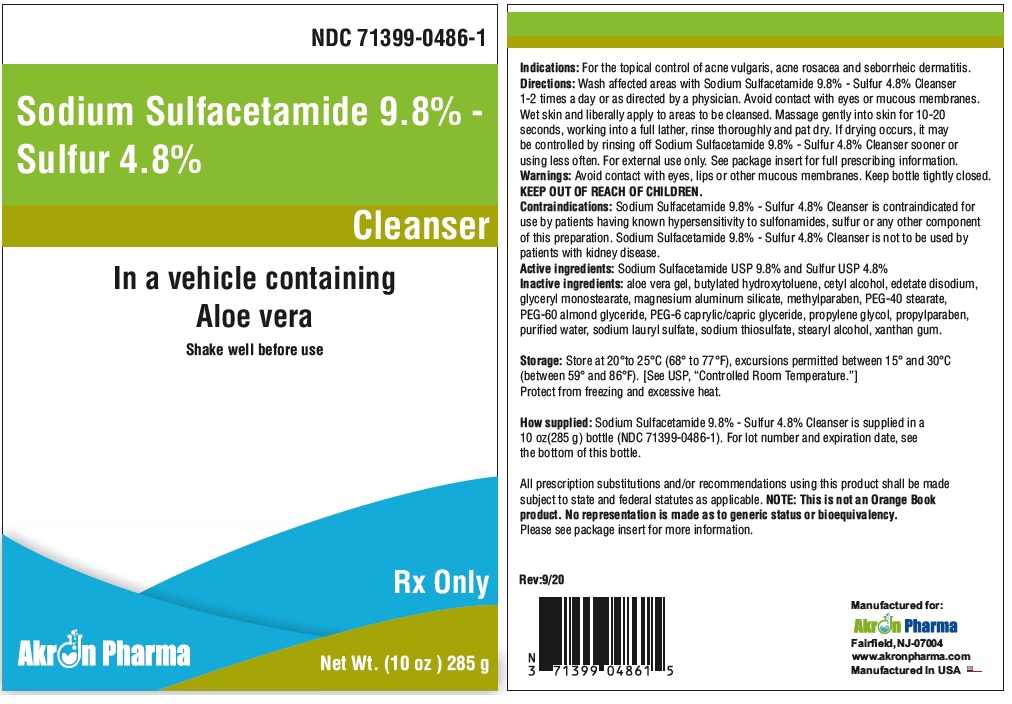
NDC 71399-0486-01: Sodium Sulfacetamide 9.8% and Sulfur 4.8% Cleanser 9.8 mg/g; 4.8 mg/g Liquid, 285 g Bottle
This is a package of 285 g of Sodium Sulfacetamide 9.8% and Sulfur 4.8% Cleanser 9.8 mg/g; 4.8 mg/g Liquid from Akron Pharma Inc., first listed with the FDA Sep 2024 and currently FDA-listed. It is this product's only package size.
NDC Database Record
One package, one record: these facts belong to NDC 71399-0486-1 alone.
- Record
- FDA NDC Directory package listing · Human prescription drug
- Code segments
- 71399 labeler · 0486 product · 1 package
- Package marketed since
- Sep 13, 2024
- Sample package
- No — commercial package
- Listing certified through
- Dec 31, 2027
- Billing quantity
- 285 g per package
- Barcode (UPC-A, from the NDC)
- 3 7139904861 5
- FDA record last changed
- Nov 1, 2026
Identity & Classification
Regulatory identifiers FDA, NLM and CMS codes for this package
Drug-database identifiers Medi-Span GPI and First Databank GCN / HICL / AHFS classification
- GSN (GCN sequence number): 072168
- GCN: 36287
- GPI-14 (Medi-Span): 90059903200917
- HICL (First Databank): 003344
- AHFS class code: 84:04.92.00
Where does this data come from?
- FDA openFDA NDC Directory · synced Nov 26, 2026
- FDA label on DailyMed · label index refreshed Nov 26, 2026
- RxNorm (NLM RxNav) · catalog refreshed Nov 26, 2026
- Medi-Span GPI (licensed)
- First Databank (licensed) · refreshed Nov 26, 2026
Clinical
This is a topical liquid cleanser containing sodium sulfacetamide and sulfur. Sulfacetamide is a sulfonamide antibacterial agent typically used in skincare products for acne and certain bacterial skin conditions. Sulfur is commonly used in cleansing and skin treatment products, often paired with sulfacetamide for its keratolytic and antimicrobial properties. This product is marketed as an unapproved drug and has not received FDA approval.
Patient education
Supplement & herbal interactions
Where does this data come from?
- MedlinePlus (NLM) · refreshed Nov 26, 2026
- FDA label on DailyMed · label index refreshed Nov 26, 2026
Ask a licensed pharmacist directly — free, answered by our team.
Pricing
A drug doesn't have one price. Each row is a different public payment system, and none is what you'd pay at the counter — that depends on your insurance. The ⓘ on each row explains what it measures.
| Price system | Per mL | Per package |
|---|---|---|
| Retail pharmacies payNADAC · weekly | Not in the retail survey — common for institutional, discontinued, or low-volume packs. | |
| Medicaid paysCMS SDUD · 12 mo | No recent Medicaid claims on file for this NDC — rare and low-volume NDCs are suppressed in the public data. | |
| Medicare drug plans payPart D · quarterly | No Part D plan price is available for this NDC in our data. | |
Where does this data come from?
- CMS NADAC weekly file
- CMS ASP pricing files · refreshed Nov 20, 2026
- CMS Medicaid State Drug Utilization Data · refreshed Nov 28, 2026
- CMS Part D plan pricing files · refreshed Nov 24, 2026
- VA National Acquisition Center price file
Packaging — All Sizes for This Product
| Package NDC | Description | Marketing start | Marketing end | Status |
|---|---|---|---|---|
| 71399-0486-01 You're viewing this Main listing | 285 g in 1 BOTTLE, PLASTIC | 2020-11-09 | — | Active |
Therapeutic Equivalents
Where does this data come from?
- FDA openFDA NDC Directory · synced Nov 26, 2026
- FDA Orange Book · refreshed Nov 6, 2026
- CMS NADAC weekly file
Availability & Generic Status
We did not find an FDA-approved generic match for this exact strength, form and route.
Where does this data come from?
- FDA Orange Book · refreshed Nov 6, 2026
Inactive Ingredients / Excipients
Inactive ingredients, also called excipients, are components of the drug product other than the active ingredient. They may include fillers, dyes, coatings, preservatives, flavors, or other formulation ingredients.
Tap an ingredient (hover on desktop) to see what it is and why it’s used.
-
UNII ZY81Z83H0X
Aloe vera leaf is a plant extract derived from the aloe plant. It is used in medicines as a natural moisturizer and skin-soothing agent in topical formulations.
-
UNII 1P9D0Z171K
BHT is a synthetic antioxidant that prevents fats and oils in medicines from breaking down and becoming rancid. It helps keep the product stable and effective during storage.
-
UNII 936JST6JCN
Cetyl alcohol is a waxy, fatty substance derived from plant or animal sources. It acts as an emulsifier and thickener in medicines, helping blend oil and water components and giving products a smooth, creamy texture.
-
UNII 7FLD91C86K
Edetate disodium is a chemical compound that binds and removes certain metal ions. In medicines, it acts as a preservative and stabilizer by preventing metals like calcium from interfering with the product's shelf life and consistency.
-
UNII 230OU9XXE4
A waxy substance made from glycerin and stearic acid that acts as an emulsifier to blend oily and watery ingredients together. It also helps thicken and stabilize the medicine's texture.
-
UNII 6M3P64V0NC
A fine powder made from magnesium, aluminum, and silicon compounds. It absorbs moisture and helps keep medicine ingredients from clumping or separating, so the product stays stable and flows smoothly during manufacturing.
-
UNII A2I8C7HI9T
Methylparaben is a preservative derived from benzoic acid that prevents growth of bacteria, fungi, and mold in medicines. It extends the product's shelf life and maintains safety during storage.
-
UNII ECU18C66Q7
PEG-40 stearate is a synthetic compound made by combining polyethylene glycol with stearic acid. It acts as an emulsifier and solubilizer to help mix oil and water-based ingredients together and improve how the medicine dissolves and is absorbed.
-
UNII GO50W2HWO8
A synthetic liquid made from plant oils and polyethylene glycol. It works as a solvent and emulsifier to help dissolve and mix active ingredients evenly throughout the medicine.
-
UNII 4Y0E651N0F
A plant-derived emulsifier made from almond oil and polyethylene glycol. It helps mix oil and water-based ingredients together and improves how the medicine dissolves and is absorbed in the body.
-
UNII 6DC9Q167V3
Propylene glycol is a clear liquid derived from petroleum or vegetable sources. It acts as a solvent, humectant, and preservative in medicines, helping dissolve active ingredients and maintain product stability.
-
UNII Z8IX2SC1OH
Propylparaben is a chemical preservative used to prevent bacterial and fungal growth in medicines and personal care products. It helps extend shelf life and maintain product safety during storage.
-
UNII 368GB5141J
A detergent and foaming agent derived from coconut or palm oil. In medications, it helps break down and mix oil and water-based ingredients, aids in tablet disintegration, and improves how the drug dissolves and spreads in the mouth or digestive system.
-
UNII HX1032V43M
Sodium thiosulfate is a salt compound used in medicines as a buffer and pH regulator. It helps stabilize the medication and may also serve as a preservative or antioxidant to maintain product quality.
-
UNII 2KR89I4H1Y
Stearyl alcohol is a waxy, fatty substance derived from natural oils or made synthetically. It acts as an emulsifier and thickener in medicines, helping mix ingredients together and give the product the right texture.
-
UNII 059QF0KO0R
Water is a liquid solvent that dissolves and mixes ingredients together in liquid medicines, syrups, and injections. It helps distribute the active drug evenly throughout the product.
-
UNII TTV12P4NEE
Xanthan gum is a thickening and stabilizing ingredient made from fermented corn or other sugars. It's added to medicines to improve texture, prevent separation of liquids and solids, and help the product stay consistent.
17 inactive ingredients listed in the exact product block matched to this NDC.
Where does this data come from?
ingredient classCode="IACT" elements from the exact product block matched by this NDC. Label-section narrative from DailyMed / the openFDA label index is shown separately when available.- FDA label on DailyMed · label index refreshed Nov 26, 2026
- FDA openFDA NDC Directory · synced Nov 26, 2026
Inactive ingredient FAQ
Are inactive ingredients the same for every manufacturer?
Why might an inactive ingredient be missing?
Can inactive ingredients matter?
Manufacturer & Labeler
More NDCs from Akron Pharma Inc. labeler code 71399
- Medpura Zinc Oxide 20% 20 g/100g Ointment NDC 71399-0245-2
- Hydroquinone 4% 40 mg/g Cream NDC 71399-0400-1
- Sodium Sulfacetamide 100 mg/mL Liquid NDC 71399-0480-2
- Sodium Sulfacetamide 9% - Sulfur 4% 90 mg/mL; 40 mg/mL Suspension NDC 71399-0482-6
- Sodium Sulfacetamide 9% - Sulfur 4.5% Wash 90 mg/g; 45 mg/g Liquid NDC 71399-0484-6
- Sodium Sulfacetamide 10% and Sulfur 2% Cleanser 100 mg/g; 20 mg/g Liquid NDC 71399-0485-8
- Sodium Sulfacetamide 8% and Sulfur 4% 80 mg/mL; 40 mg/mL Suspension NDC 71399-0487-6
- Sodium Sulfacetamide 10% and Sulfur 5% Cleanser 100 mg/g; 50 mg/g Liquid NDC 71399-0488-6
- Clotrimazole 1 g/mL Solution NDC 71399-0500-1
- Clotrimazole Topical Solution USP, 1% 10 mg/mL Solution NDC 71399-0666-3
- Low Dose Aspirin 81 mg Tablet, Coated NDC 71399-1014-1
- Senna Sennosides 8.6 mg Tablet NDC 71399-1017-1
Where does this data come from?
- FDA openFDA NDC Directory · synced Nov 26, 2026
- Drugs@FDA
Full Prescribing Information FDA SPL
Indications and Usage
INDICATIONS SODIUM SULFACETAMIDE 9.8% - SULFUR 4.8% CLEANSER is indicated for use in the topical control of acne vulgaris, acne rosacea and seborrheic dermatitis.
Dosage and Administration
DOSAGE AND ADMINISTRATION Wash affected areas with SODIUM SULFACETAMIDE 9.8% - SULFUR 4.8% CLEANSER 1 to 2 times daily or as directed by a physician. Avoid contact with eyes or mucous membranes. Wet skin and liberally apply to areas to be cleansed, massage gently into skin for 10 to 20 seconds working into a full lather, rinse thoroughly and pat dry. If drying occurs, it may be controlled by rinsing cleanser off sooner or using cleanser less often.
Contraindications
CONTRAINDICATIONS: SODIUM SULFACETAMIDE 9.8% - SULFUR 4.8% CLEANSER is contraindicated for use by patients having known hypersensitivity to sulfonamides, sulfur or any other component of this preparation. SODIUM SULFACETAMIDE 9.8% - SULFUR 4.8% CLEANSER is not to be used by patients with kidney disease.
Warnings
WARNINGS Although rare, sensitivity to sodium sulfacetamide may occur. Therefore, caution and careful supervision should be observed when prescribing this drug for patients who may be prone to hypersensitivity to topical sulfonamides. Systemic toxic reactions such as agranulocytosis, acute hemolytic anemia, purpura hemorrhagica, drug fever, jaundice and contact dermatitis indicate hypersensitivity to sulfonamides.
Particular caution should be employed if areas of denuded or abraded skin are involved. Sulfonamides are known to cause Stevens-Johnson syndrome in hypersensitive individuals. Stevens-Johnson syndrome also has been reported following the use of sodium sulfacetamide topically.
Cases of drug induced systemic lupus erythematosus from topical sulfacetamide also have been reported. In one of these cases, there was a fatal outcome. KEEP OUT OF REACH OF CHILDREN.
Adverse Reactions
ADVERSE REACTIONS Although rare, sodium sulfacetamide may cause local irritation. Call your doctor for medical advice about side effects.
Clinical Pharmacology
CLINICAL PHARMACOLOGY The most widely accepted mechanism of action of sulfonamides is the Woods-Fildes theory, which is based on the fact that sulfonamides act as competitive antagonists to para-aminobenzoic acid (PABA), an essential component for bacterial growth. While absorption through intact skin has not been determined, sodium sulfacetamide is readily absorbed from the gastrointestinal tract when taken orally and excreted in the urine, largely unchanged. The biological half-life has variously been reported as 7 to 12.8 hours.
The exact mode of action of sulfur in the treatment of acne is unknown, but it has been reported that it inhibits the growth of Propionibacterium acnes and the formation of free fatty acids.
How Supplied / Storage and Handling
HOW SUPPLIED SODIUM SULFACETAMIDE 9.8% - SULFUR 4.8% CLEANSER is supplied in an 10oz. (285 g) bottle, NDC 71399-0486-1
Storage and Handling
STORAGE Store at 25°C (77°F); excursions permitted to 15° to 30°C (59° to 86°F). [See USP “Controlled Room Temperature.”] Note: Protect from freezing and excessive heat. The product may tend to darken slightly on storage. Slight discoloration does not impair the efficacy or safety of the product.
Keep container or packet tightly closed. Occasionally, a slight yellowish discoloration may occur when an excessive amount of the product is used and comes in contact with white fabrics. This discoloration, however, presents no problem, as it is readily removed by ordinary laundering without bleaches.
All prescription substitutions and/or recommendations using this product shall be made subject to state and federal statutes as applicable. Please NOTE: This is not an Orange Book product and has not been subjected to FDA therapeutic or other equivalency testing. No representation is made as to generic status or bioequivalency.
Each person recommending a prescription substitution using this product shall make such recommendation based on his/her professional knowledge and opinion, upon evaluating the active ingredients, inactive ingredients, excipients and chemical information provided herein. QUESTIONS? Please Call 1(877) 225-6999 Manufactured for: Akron Pharma, Inc.
Fairfield, NJ 07004 Manufactured in U.S.A
Precautions
PRECAUTIONS FOR EXTERNAL USE ONLY. NOT FOR OPHTHALMIC USE. General: If irritation develops, use of the product should be discontinued and appropriate therapy instituted.
Patients should be carefully observed for possible local irritation or sensitization during long-term therapy. The object of this therapy is to achieve desquamation without irritation, but sodium sulfacetamide and sulfur can cause reddening and scaling of the epidermis. These side effects are not unusual in the treatment of acne vulgaris, but patients should be cautioned about the possibility.
Carcinogenesis, Mutagenesis and Impairment of Fertility: Long-term studies in animals have not been performed to evaluate carcinogenic potential. Pregnancy: Category C. Animal reproduction studies have not been conducted with SODIUM SULFACETAMIDE 9.8% - SULFUR 4.8% CLEANSER.
It is also not known whether SODIUM SULFACETAMIDE 9.8% - SULFUR 4.8% CLEANSER can cause fetal harm when administered to a pregnant woman or can affect reproduction capacity. SODIUM SULFACETAMIDE 9.8% - SULFUR 4.8% CLEANSER should be given to a pregnant woman only if clearly needed. Nursing Mothers: It is not known whether sodium sulfacetamide is excreted in human milk following topicaI use of SODIUM SULFACETAMIDE 9.8% - SULFUR 4.8% CLEANSER.
However, small amounts of orally administered sulfonamides have been reported to be excreted in human milk. In view of this and because many drugs are excreted in human milk, caution should be exercised when SODIUM SULFACETAMIDE 9.8% - SULFUR 4.8% CLEANSER is administered to a nursing woman. Pediatric Use: Safety and effectiveness in children under the age of 12 has not been established.
Package Label / Principal Display Panel
sod
Medicare Part D Spend CMS · Part D · 2026 (Q1)
Reported Adverse Events (FAERS)
Top reported reactions
Age at onset
Reporter sex
Serious outcomes
Where does this data come from?
About This NDC Listing & Data Coverage
Listed without an FDA application
This product's marketing category indicates it is marketed without an approved FDA application (no NDA, ANDA, or BLA on file). Having an NDC does not by itself establish FDA approval — the NDC Directory is a listing system, not an approval decision. Approval-linked data such as Orange Book therapeutic-equivalence ratings therefore does not apply.
What data is (and isn’t) available for this NDC — tap to expand
| NDC identity (package / product / labeler codes) | Available |
| Labeler | Available |
| Product & package description | Available |
| Marketing category & status | Available |
| Active ingredient / dosage form / route | Available |
| FDA label (SPL via DailyMed) | Available |
| Package photos | Available |
| Inactive ingredients (structured) | Available |
| NADAC pharmacy acquisition price (CMS) | — Not published for this NDC CMS publishes NADAC only for NDCs reported in its retail-pharmacy survey. |
| Orange Book / therapeutic-equivalence data | — Not published for this NDC Applies only to products approved under an NDA/ANDA; many listings are out of scope. |
| HCPCS J-code billing crosswalk | — Not published for this NDC Most self-administered / retail products have no J-code — that is normal. |
| Medicaid utilization (CMS SDUD) | — Not published for this NDC CMS reports utilization only for NDCs with Medicaid claims above its privacy threshold. |