
Home › NDC Lookup › Ingredients › Triamcinolone Acetonide › 71656-0040-60
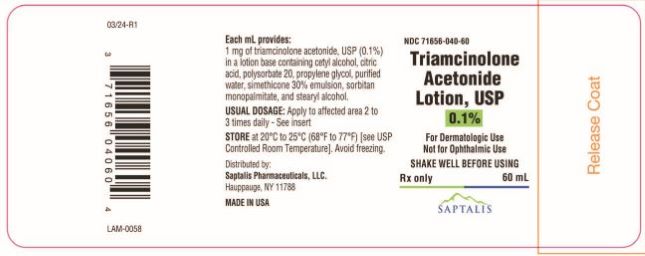
Triamcinolone Acetonide 1 mg/mL Lotion, 60 mL — NDC 71656-0040-60 package photo

Triamcinolone Acetonide 1 mg/mL Lotion, 60 mL

by Saptalis Pharmaceuticals, LLC. · 60 mL in 1 BOTTLE (71656-040-60)
NDC 71656-0040-60
🏷️ FDA NDC (as labeled) 71656-040-60 billing pads the product segment with a zero
Rx only Generic On market Non-controlled
🗂️ Data synced Jul 24, 2026 · sources: openFDA · FDA label (DailyMed) · FDA Orange & Purple Book · First Databank · CMS NADAC, ASP, Medicare & Medicaid · RxNorm
📋 All sources & update times →
⚠️
Other active recalls for Triamcinolone Acetonide (different manufacturers) — 1 · tap to view
These affect other manufacturers’ products for the same ingredient — not necessarily the exact NDC on this page.
Class II · Sep 28, 2023 — Presence of Particulate Matter: A product complaint of a piece of glass was identified in a vial. The piece of glass appears to be roughly 1 cm x 0.5 cm inside the vial. (Eugia US LLC) · FDA recall D-0041-2024
Each entry is an official FDA enforcement report — look up any recall number in the FDA recall database ↗

🆔 Identity & classification

FDA NDC (as labeled) 71656-040-60
Product NDC 71656-040
11-digit billing NDC 71656004060
NCPDP billing unit ML — per mL (volume)
RxCUI 1085745
UNII F446C597KA
Application # ANDA040672
SPL Set ID a77a31dd-048e-4a4d-b006-6913978d7438
Established class (EPC) Corticosteroid
Mechanism of action Corticosteroid Hormone Receptor Agonists
DEA schedule Non-controlled
Marketing category ANDA
Marketing status On market
FDA listing status Listed (active directory)
Marketing start 2024-07-30
Route TOPICAL
Dosage form LOTION
Substance TRIAMCINOLONE ACETONIDE
GPI-14 90550085104110
GCN Seq No 007600
GCN 31261
HICL code 002891
Ingredient (HICL) Triamcinolone Acetonide
HIC1 code Q
Therapeutic class — broad (HIC1) Ear/Eye/Nose/Rectum/Topical/Vagina/Other
HIC2 code Q5
Therapeutic class — intermediate (HIC2) Agents Acting Principally On The Skin
HIC3 code Q5P
Therapeutic class — specific (HIC3) Topical Anti-Inflammatory Steroidal
AHFS code 48:10.08.00
AHFS class Corticosteroids (Respiratory Tract)
FDB label name TRIAMCINOLONE 0.1% LOTION
FDB brand name Triamcinolone Acetonide
Legend status F — Federal legend — prescription drug or device
TE code (Orange Book) AT · RLD · RS
Why two NDCs? The FDA registers this code as 71656-040-60 — a 5-3-2 layout, and that's what's printed on the package and shown on DailyMed. For insurance claims, every NDC is standardized to a uniform 11-digit 5-4-2 format by adding a zero to the product segment → 71656-0040-60. Same drug, same package — only the format differs.
Where does this data come from?
Identifiers from the FDA openFDA NDC Directory and Structured Product Labeling; RxCUI from RxNorm (NLM); GPI from Medi-Span; GCN / HIC / AHFS / legend from First Databank.

🏷️ RxNorm drug class

This medicine belongs to the Corticosteroid class.

Pharmacologic class Corticosteroid
Drug family (ATC) Corticosteroids for local oral treatment, Corticosteroids, Corticosteroids, moderately potent (group II)
How it works Corticosteroid Hormone Receptor Agonists
Where does this data come from?
Therapeutic classes from RxNorm RxClass (U.S. National Library of Medicine) — Established Pharmacologic Class (FDA), ATC drug family (WHO) and mechanism of action, matched by this product’s RxCUI.

🏭 Manufacturer & labeler

LabelerSaptalis Pharmaceuticals, LLC.
Application holderMICRO LABS LTD
FDA applicationANDA040672 (ANDA)
Labeler code71656
First marketedJul 2024
Product typeHuman Prescription Drug
Portfolio11 products on file
The labeler markets the product; the application holder owns the FDA approval. They’re often the same company but can differ (e.g. a repackager or an authorized generic). A mailing address / phone appears here when the manufacturer includes it in the product’s FDA label (not all do).
Where does this data come from?
Labeler, application holder and registered establishment from the FDA openFDA NDC Directory and Drugs@FDA; address/contact from the product’s FDA label.

🩺 Clinical

Label name TRIAMCINOLONE 0.1% LOTION Ingredient Triamcinolone Acetonide
📖 What it is MedlinePlus · NLM

Triamcinolone topical is used to treat the itching, redness, dryness, crusting, scaling, inflammation, and discomfort of various skin conditions, including psoriasis (a skin disease in which red, scaly patches form on some areas of the body and eczema (a skin disease that causes the skin to be dry and itchy and to sometimes develop red, scaly rashes). It is also used as a dental paste to relieve the discomfort of mouth sores. Triamcinolone is in a class of medications called corticosteroids. It works by activating natural substances in the skin to reduce swelling, redness, and itching.

Read the full MedlinePlus article ↗
📗 Our plain-language guide HelloPharmacist
  • Yes, intra-articular triamcinolone is specifically approved to give short-term relief for knee arthritis, gout flares, bursitis, and similar joint conditions. The extended-release...
  • I'm getting a triamcinolone injection in my knee. Will it actually help, and how long does it last?
  • That's a really important thing to flag with your doctor before your injection or prescription. Triamcinolone can raise blood sugar — even in people whose diabetes is well-controll...
  • I have diabetes. Should I be worried about using triamcinolone?
📖 Read our full Triamcinolone guide →
8
Nutrient depletion considerations

Triamcinolone Acetonide may be associated with lower levels of 8 nutrients — worth a chat with your pharmacist, not a cause for alarm.

An association is not a deficiency. Educational only — don't start or stop anything without professional guidance.
Where does this data come from?
Plain-language summary from MedlinePlus (U.S. National Library of Medicine); supplement & herbal interactions and nutrient depletion data from the Natural Medicines database; our full guide is HelloPharmacist editorial content.

💊 What it looks like

Color white
One label can cover several strengths, so colors may be combined — always confirm a loose pill against the dispensed prescription label or a pharmacist.
Where does this data come from?
Physical description (imprint, shape, color, scoring, coating) from this product’s FDA Structured Product Labeling (SPL), mirrored from DailyMed / openFDA.

🧪 Inactive Ingredients / Excipients

Inactive ingredients, also called excipients, are components of the drug product other than the active ingredient. They may include fillers, dyes, coatings, preservatives, flavors, or other formulation ingredients.

💡 Tap an ingredient (hover on desktop) to see what it is and why it’s used.

  • UNII XF417D3PSL
    Anhydrous citric acid is a sour, crystalline powder derived from citric acid with water removed. In medicines, it acts as a buffer to control pH, adds tartness to improve taste, and helps tablets disintegrate.
  • UNII 936JST6JCN
    Cetyl alcohol is a waxy, fatty substance derived from plant or animal sources. It acts as an emulsifier and thickener in medicines, helping blend oil and water components and giving products a smooth, creamy texture.
  • UNII 92RU3N3Y1O
    Dimethicone is a silicone-based oil that acts as an anti-foaming agent and lubricant in medicines. It reduces gas bubbles in liquid formulations and helps coat and protect the stomach lining when ingested.
  • UNII 7T1F30V5YH
    A synthetic emulsifier derived from sorbitol and oleic acid. It helps mix oil and water-based ingredients together and keeps them from separating in liquid formulations.
  • UNII 6DC9Q167V3
    Propylene glycol is a clear liquid derived from petroleum or vegetable sources. It acts as a solvent, humectant, and preservative in medicines, helping dissolve active ingredients and maintain product stability.
  • UNII 77K6Z421KU
    Sorbitan monopalmitate is an emulsifier made from sorbitol, a natural sugar alcohol, combined with palmitic acid. It helps mix oil and water ingredients together in medications and keeps them evenly blended throughout the product's shelf life.
  • UNII 2KR89I4H1Y
    Stearyl alcohol is a waxy, fatty substance derived from natural oils or made synthetically. It acts as an emulsifier and thickener in medicines, helping mix ingredients together and give the product the right texture.
  • UNII 059QF0KO0R
    Water is a liquid solvent that dissolves and mixes ingredients together in liquid medicines, syrups, and injections. It helps distribute the active drug evenly throughout the product.

8 inactive ingredients listed in the exact product block matched to this NDC.

Where does this data come from?
Data sourced from official FDA Structured Product Labeling (SPL) via DailyMed — ingredient classCode="IACT" elements from the exact product block matched by this NDC. Label-section narrative from DailyMed / the openFDA label index is shown separately when available.

Inactive ingredient FAQ

Are inactive ingredients the same for every manufacturer?
No. Inactive ingredients can differ by manufacturer, dosage form, strength, and package / product version.
Why might an inactive ingredient be missing?
Some SPLs do not provide a complete structured inactive-ingredient list, and older or unusual labels may only include the information in narrative text.
Can inactive ingredients matter?
Yes. They can matter for allergies, intolerances, dyes, gluten / lactose concerns, preservatives, and formulation differences — but confirm with a pharmacist or the manufacturer when it’s clinically important.

💲 Pricing

A drug doesn't have one price. Each row is a different public payment system, and none is what you'd pay at the counter — that depends on your insurance. The ⓘ on each row explains what it measures.

Price systemPer mLPer package
Retail pharmacies payNADAC · weekly $0.271 $16.26 / 60 ml
Medicaid paysCMS SDUD · 12 mo $0.3608 $21.65 / 60 ml
Medicare drug plans payPart D · Q2 2026 $0.3040 $18.24 / 60 ml
NADAC price history (per mL) — tap or hover for the price & month
Dec 2025 Mar 2026 Jun 2026 Sep 2026 $0.284 $0.271
▼ Down 4% over the last 10 months.
Where does this data come from?
NADAC (National Average Drug Acquisition Cost) is the CMS weekly pharmacy-acquisition-cost survey — what pharmacies pay. ASP (Average Sales Price) is the CMS Medicare Part B drug-payment file, published quarterly. Medicaid pays is computed by us from CMS State Drug Utilization Data (total reimbursed ÷ units, trailing 12 months) — gross of rebates and inclusive of dispensing fees, so it reflects what Medicaid paid, not an acquisition cost. Medicare drug plans pay is the median negotiated point-of-sale unit cost across plans listing this NDC in the CMS quarterly Prescription Drug Plan pricing files, before rebates. The VA pays is the federal contract price (FSS, and the statutory Big 4 ceiling where listed) from the VA National Acquisition Center pharmaceutical price file. All are free public government data; each measures a different payer, so the figures are not directly comparable.

🔁 Therapeutic equivalents

ProductLabelerPackNADAC/unitTEStatusPrice vs. this
Triamcinolone Acetonide 1 mg/mL 00713-0676-53 Cosette 1 bottle $0.271 AT Availability likely —
Triamcinolone Acetonide 1 mg/mL 42571-0385-19 MICRO 60 ml $0.271 AT Availability likely —
Triamcinolone Acetonide 1 mg/mL 70752-0130-05 QUAGEN 60 ml $0.271 AT Availability likely —
Triamcinolone Acetonide 1 mg/mLthis 71656-0040-60 Saptalis 60 ml $0.271 AT Availability likely —
Triamcinolone Acetonide 1 mg/mL 72162-2070-06 Bryant 60 ml — AT FDA listed —
About this product: this is a generic version of the medicine. FDA equivalence ratings are shown when available, and other versions are listed above, least expensive first.
Where does this data come from?
Equivalents are other NDCs of the same ingredient, form and route from the openFDA NDC Directory, ranked least-expensive-first by NADAC. Therapeutic-equivalence (AB) ratings come from the FDA Orange Book; biologics use the FDA Purple Book for biosimilar & interchangeable status.

⏳ Availability & generic status

🏛️
2024
On the market since
Jul 2024
📍
2026
Currently FDA-listed
2 years listed
🔓
·
Generic on the market
this product is a generic
✅This is a generic drug

This product is an FDA-approved generic. Other versions of the same drug are listed under Therapeutic equivalents, least expensive first.

Where does this data come from?
Patents and exclusivity from the FDA Orange Book (small-molecule drugs), refreshed from public FDA data. Generic launch timing is an estimate, not a guarantee.

🗺️ Medicaid utilization & spend

📍 This exact package only: Medicaid data is reported per full 11-digit NDC — labeler, product and pack size — so every number here is for 71656-0040-60, not the drug overall. Other pack sizes report separately.
💊 Pharmacy benefit only: These are Medicaid outpatient pharmacy claims, billed by NDC. They exclude the medical benefit — clinic- or hospital-administered drugs billed under HCPCS J-codes — so drugs used mostly that way (e.g. Avastin, Lucentis, Keytruda) can look low or missing here. That’s expected, not an error.
📅 Q1 2025 – Q4 2025 · 4 quarters of data
ⓘ The newest quarter is usually incomplete when first published; states restate recent quarters in later CMS releases, so the latest figures typically revise upward. State coverage-policy changes can also shift quarter-to-quarter totals.
Prescriptions last 4 qtrs
4.3K
Units reimbursed last 4 qtrs
279.7K
Gross reimbursed last 4 qtrs
$100.9K
Avg / prescription
$23.48
Avg / unit
$0.3608
Latest quarter Q4 2025
1.2KRx
Medicaid pays / mL
$0.3608
gross reimbursed
vs
NADAC / mL
$0.2710
acquisition cost
=
Spread
+$0.0898
+33% vs cost
What Medicaid paid per mL (before rebates; includes the pharmacy’s dispensing fee) compared with NADAC — the average price pharmacies pay to buy the drug. A positive spread means Medicaid reimbursed more than the purchase price, before manufacturer rebates.
Fee-for-service vs managed care ⓘ
28% FFS 72% MCO
Fee-for-service · 1,219 Rx Managed care · 3,080 Rx
State Medicaid map
Alaska: no data reported AK Maine: no data reported ME Washington: 2,100 units · 26.9 per 100k residents WA Idaho: no data reported ID Montana: no data reported MT North Dakota: no data reported ND Minnesota: no data reported MN Wisconsin: no data reported WI Michigan: no data reported MI New York: 6,780 units · 34.6 per 100k residents NY Vermont: no data reported VT New Hampshire: 660 units · 47.1 per 100k residents NH Oregon: no data reported OR Nevada: 4,740 units · 148 per 100k residents NV Wyoming: no data reported WY South Dakota: no data reported SD Iowa: no data reported IA Illinois: no data reported IL Indiana: no data reported IN Ohio: 660 units · 5.6 per 100k residents OH Pennsylvania: no data reported PA New Jersey: 780 units · 8.4 per 100k residents NJ Massachusetts: 41,460 units · 592 per 100k residents MA California: 27,421 units · 70.4 per 100k residents CA Utah: no data reported UT Colorado: no data reported CO Nebraska: no data reported NE Missouri: no data reported MO Kentucky: 1,380 units · 30.5 per 100k residents KY West Virginia: no data reported WV Virginia: 26,280 units · 302 per 100k residents VA Maryland: 5,940 units · 96.1 per 100k residents MD Connecticut: 30,060 units · 831 per 100k residents CT Rhode Island: 18,360 units · 1,677 per 100k residents RI Arizona: 9,900 units · 133 per 100k residents AZ New Mexico: no data reported NM Kansas: no data reported KS Arkansas: no data reported AR Tennessee: 2,820 units · 39.6 per 100k residents TN North Carolina: 24,360 units · 225 per 100k residents NC South Carolina: 19,348 units · 360 per 100k residents SC Delaware: no data reported DE Oklahoma: no data reported OK Louisiana: 9,900 units · 216 per 100k residents LA Mississippi: no data reported MS Alabama: 3,600 units · 70.5 per 100k residents AL Georgia: 10,440 units · 94.7 per 100k residents GA D.C.: 4,860 units · 716 per 100k residents DC Hawaii: 7,380 units · 514 per 100k residents HI Texas: 19,620 units · 64.3 per 100k residents TX Florida: 900 units · 4.0 per 100k residents FL
Units reimbursed · per 100k residents
4.01,677
gray = no data reported ⓘ
Colors are per 100,000 residents, so big states don’t automatically dominate. Tap or hover a state for its actual totals.
Tap or hover a state
…for its Medicaid breakdown
🏆 Top states by units · per 100k residents
1 Rhode Island 1,677 /100k
2 Connecticut 831 /100k
3 D.C. 716 /100k
4 Massachusetts 592 /100k
5 Hawaii 514 /100k
6 South Carolina 360 /100k
7 Virginia 302 /100k
8 North Carolina 225 /100k
National units — by quarter
💵 About the dollar figures: “reimbursed” is what Medicaid paid pharmacies before confidential manufacturer rebates, so the program’s real net cost is lower than these numbers. Fee-for-service and managed-care claims are combined unless split above. Source: CMS State Drug Utilization Data; per-100k rates use 2023 Census population estimates.

📊 Medicare Part D spend CMS · PART D · 2026 (Q1)

Medicare Part D (outpatient prescription) spending for Triamcinolone Acetonide — the program that covers self-administered drugs. 22 manufacturers.
⚠️ Drug-level data: CMS publishes Part D spending by drug, not by NDC — these figures combine every manufacturer, strength and package size sold under the name Triamcinolone Acetonide. That’s a different level of aggregation than the Medicaid card above, which is specific to this exact 11-digit NDC (pack size included), so the two aren’t directly comparable.
Period
Total Part D spend
$17.79M
Claims incl. refills
1.7M
Beneficiaries
1.4M
Spend / beneficiary
$13.01
Spend / claim
$10.45
Trend by period
💵 About the dollar figures: spending is what Part D plans paid before confidential manufacturer rebates, so the program’s real net cost is lower. A blank patient count means fewer than 11 people — CMS hides counts that small to protect privacy. Source: CMS Medicare Quarterly Part D Spending by Drug (data.cms.gov), updated quarterly.

🔬 Reported adverse events (FAERS)

Read carefully: FAERS reports are voluntary and unverified. Counts are not incidence, do not establish causation, are subject to reporting bias, and cannot be used to compare one drug to another. Shown for signal context only. Reports for Triamcinolone Acetonide — the ingredient across all brands.

Top reported reactions

Pruritus2,650
Rash2,534
Pain2,232
Fatigue2,133
Nausea2,043
Headache1,916
Condition Aggravated1,747

Reporter sex

31,697 reports
Male · 34%
Female · 66%
Unknown · 0%

Serious outcomes

Hospitalization6,577
Death3,076
Disabling2,415
Reports over time (by year) — tap or hover for the count & year
2019 2021 2023 2026 4,201 0
Most recent year is provisional (FAERS lags ~3 months).
Where does this data come from?
Adverse-event reports from the FDA Adverse Event Reporting System (FAERS) via openFDA. FAERS reports are voluntary and unverified — counts are not incidence and don’t establish causation.

📦 Packaging — all sizes for this product

Package NDCDescription Marketing startStatus
71656-0040-60 You're viewing this 60 mL in 1 BOTTLE (71656-040-60) 2024-07-30 Active

📄 Full prescribing information FDA SPL

The complete FDA label for this product — the official prescribing information, verbatim, section by section. Jump with a chip, search within the label, or expand everything.
🎯 Indications and Usage 20 words ▾

INDICATIONS AND USAGE Triamcinolone acetonide lotion, 0.1% is indicated for relief of the inflammatory and pruritic manifestations of corticosteroid-responsive dermatoses.

⏱️ Dosage and Administration 186 words ▾

DOSAGE AND ADMINISTRATION Apply the 0.1% triamcinolone acetonide lotion to the affected area two to three times daily. Rub in gently. Occlusive Dressing Technique Occlusive dressings may be used for the management of psoriasis or other recalcitrant conditions.

Gently rub a small amount of lotion into the lesion until it disappears. Reapply the preparation leaving a thin coating on the lesion, cover with pliable nonporous film, and seal the edges. If needed, additional moisture may be provided by covering the lesion with a dampened clean cotton cloth before the nonporous film is applied or by briefly wetting the affected area with water immediately prior to applying the medication.

The frequency of changing dressings is best determined on an individual basis. It may be convenient to apply triamcinolone acetonide lotion under an occlusive dressing in the evening and to remove the dressing in the morning (i.e.,12-hour occlusion). When utilizing the 12‑hour occlusion regimen, additional lotion should be applied, without occlusion, during the day.

Reapplication is essential at each dressing change. If an infection develops, the use of occlusive dressings should be discontinued and appropriate antimicrobial therapy instituted.

⛔ Contraindications 21 words ▾

CONTRAINDICATIONS Topical corticosteroids are contraindicated in those patients with a history of hypersensitivity to any of the components of the preparations.

🤒 Adverse Reactions 76 words ▾

ADVERSE REACTIONS The following local adverse reactions are reported infrequently with topical corticosteroids, but may occur more frequently with the use of occlusive dressings (reactions are listed in an approximate decreasing order of occurrence): burning, itching, irritation, dryness, folliculitis, hypertrichosis, acneiform eruptions, hypopigmentation, perioral dermatitis, allergic contact dermatitis, maceration of the skin, secondary infection, skin atrophy, striae, and miliaria. To report SUSPECTED ADVERSE REACTIONS, contact Saptalis Pharmaceuticals, LLC at 1-833-727-8254 or FDA at 1-­800-FDA-1088 or www.fda.gov/medwatch.

🧒 Pediatric Use 113 words ▾

Pediatric Use Pediatric patients may demonstrate greater susceptibility to topical corticosteroid-induced HPA axis suppression and Cushing's syndrome than mature patients because of a larger skin surface area to body weight ratio. HPA axis suppression, Cushing's syndrome, and intracranial hypertension have been reported in children receiving topical corticosteroids. Manifestations of adrenal suppression in children include linear growth retardation, delayed weight gain, low plasma cortisol levels, and absence of response to ACTH stimulation.

Manifestations of intracranial hypertension include bulging fontanelles, headaches, and bilateral papilledema. Administration of topical corticosteroids to children should be limited to the least amount compatible with an effective therapeutic regimen. Chronic corticosteroid therapy may interfere with the growth and development of children.

🆘 Overdosage 19 words ▾

OVERDOSAGE Topically applied corticosteroids can be absorbed in sufficient amounts to produce systemic effects (see PRECAUTIONS , General ).

🧬 Clinical Pharmacology 192 words ▾

CLINICAL PHARMACOLOGY Topical corticosteroids share anti-inflammatory, antipruritic and vasoconstrictive actions. The mechanism of anti-inflammatory activity of the topical corticosteroids is unclear. Various laboratory methods, including vasoconstrictor assays, are used to compare and predict potencies and/or clinical efficacies of the topical corticosteroids.

There is some evidence to suggest that a recognizable correlation exists between vasoconstrictor potency and therapeutic efficacy in man. Pharmacokinetics The extent of percutaneous absorption of topical corticosteroids is determined by many factors including the vehicle, the integrity of the epidermal barrier, and the use of occlusive dressings. Topical corticosteroids can be absorbed from normal intact skin.

Inflammation and/or other disease processes in the skin increase percutaneous absorption. Occlusive dressings substantially increase the percutaneous absorption of topical corticosteroids. Thus, occlusive dressings may be a valuable therapeutic adjunct for treatment of resistant dermatoses (see DOSAGE AND ADMINISTRATION ).

Once absorbed through the skin, topical corticosteroids are handled through pharmacokinetic pathways similar to systemically administered corticosteroids. Corticosteroids are bound to plasma proteins in varying degrees. Corticosteroids are metabolized primarily in the liver and are then excreted by the kidneys.

Some of the topical corticosteroids and their metabolites are also excreted into the bile.

📦 How Supplied / Storage and Handling 49 words ▾

HOW SUPPLIED Triamcinolone acetonide lotion, USP 0.1%: plastic squeeze bottles containing 60 mL of lotion (NDC 71656-040-60) Storage Store at 20° to 25°C (68° to 77°F) [see USP Controlled Room Temperature]. Avoid freezing. Shake well before using. Distributed by: Saptalis Pharmaceuticals, LLC Hauppauge, NY 11788 MADE IN USA 09/24-R1

📋 Description 84 words ▾

DESCRIPTION The topical corticosteroids constitute a class of primarily synthetic steroids used as anti inflammatory and antipruritic agents. The steroids in this class include triamcinolone acetonide. Triamcinolone acetonide is designated chemically as 9-Fluoro-11β,16α,17,21-tetrahydroxypregna-1,4 diene-3,20-dione cyclic 16, 17-acetal with acetone.

Structural formula: C24H31FO6 MW 434.51 g/mol Each mL of 0.1% triamcinolone acetonide lotion, USP provides 1 mg triamcinolone acetonide, USP in a lotion base containing cetyl alcohol, citric acid, polysorbate 20, propylene glycol, purified water, simethicone 30% emulsion, sorbitan monopalmitate and stearyl alcohol. image description

Source: FDA Structured Product Labeling, mirrored from DailyMed / openFDA. Prefer the government’s original formatting? View this label on DailyMed ↗
For educational and professional reference only — not medical advice. Pricing reflects published NADAC and CMS ASP (free public data) and may differ from your acquisition cost; always verify before billing or dispensing.