
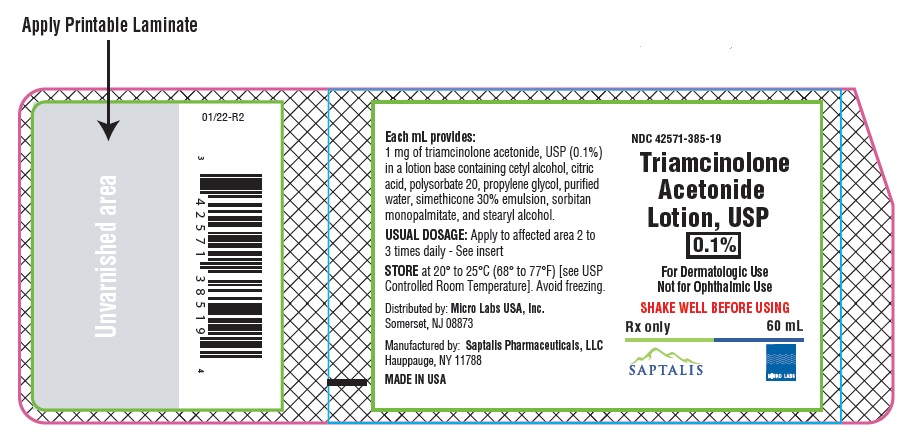
Triamcinolone Acetonide 1 mg/mL Lotion, 60 mL — NDC 42571-385-19 (Billing 42571-0385-19)
This is a package of 60 mL of Triamcinolone Acetonide 1 mg/mL Lotion from MICRO LABS LIMITED, marketed since Aug 2021 and currently FDA-listed; retail pharmacies pay about $0.2710 per mL (NADAC). It is this product's only package size.
NDC database record
One package, one record: these facts belong to NDC 42571-385-19 alone.
- Record
- FDA NDC Directory package listing · Human prescription drug
- Code segments
- 42571 labeler · 385 product · 19 package
- Package marketed since
- Aug 16, 2021
- Sample package
- No — commercial package
- Listing certified through
- Dec 31, 2026
- Billing quantity
- 60 mL per package
- Barcode (UPC-A, from the NDC)
- 3 4257138519 4
- Medicaid fills, this package
- 1,346 prescriptions in the last four reported quarters
- FDA record last changed
- Jul 24, 2026
Other active recalls for Triamcinolone Acetonide (different manufacturers) — 1 · tap to view
Identity & classification
Regulatory identifiers FDA, NLM and CMS codes for this package
Drug-database identifiers Medi-Span GPI and First Databank GCN / HICL / AHFS classification
- GSN (GCN sequence number): 007600
- GCN: 31261
- GPI-14 (Medi-Span): 90550085104110
- HICL (First Databank): 002891
- AHFS class code: 48:10.08.00
- RxCUI (RxNorm): 1085745
Where does this data come from?
- FDA openFDA NDC Directory · synced Oct 1, 2026
- FDA label on DailyMed · label index refreshed Oct 1, 2026
- RxNorm (NLM RxNav) · catalog refreshed Oct 1, 2026
- Medi-Span GPI (licensed)
- First Databank (licensed) · refreshed Oct 1, 2026
RxNorm drug class
This medicine belongs to the Corticosteroid class.
Where does this data come from?
- RxClass (NLM) · catalog refreshed Oct 1, 2026
Clinical
Triamcinolone topical is used to treat the itching, redness, dryness, crusting, scaling, inflammation, and discomfort of various skin conditions, including psoriasis (a skin disease in which red, scaly patches form on some areas of the body and eczema (a skin disease that causes the skin to be dry and itchy and to sometimes develop red, scaly rashes). It is also used as a dental paste to relieve the discomfort of mouth sores. Triamcinolone is in a class of medications called corticosteroids. It works by activating natural substances in the skin to reduce swelling, redness, and itching.
Read the full MedlinePlus article ↗- It depends on the product. Injections treat severe allergic conditions, joint inflammation, certain skin problems and eye inflammation. Creams and ointments calm itchy, inflamed sk...
- Injections are given by a healthcare professional. Ointment is applied as a thin film to the affected area two to three times daily. Nasal spray bottles need priming before first u...
- Possible effects include injection site pain, joint swelling, headache, muscle spasms, cough, sinusitis and bruising. People with diabetes may see higher blood sugar. Tell your doc...
- Call right away for signs of an allergic reaction, fever or infection, a very painful and swollen joint, vision changes, or mood changes. Also report black stools, severe stomach p...
Patient education
Supplement & herbal interactions
Some supplements/herbs that may interact with Triamcinolone Acetonide — tap one for details:
Triamcinolone Acetonide may be associated with lower levels of 8 nutrients — worth a chat with your pharmacist, not a cause for alarm.
Where does this data come from?
- MedlinePlus (NLM) · refreshed Oct 1, 2026
- FDA label on DailyMed · label index refreshed Oct 1, 2026
Ask a licensed pharmacist directly — free, answered by our team.
Pricing
A drug doesn't have one price. Each row is a different public payment system, and none is what you'd pay at the counter — that depends on your insurance. The ⓘ on each row explains what it measures.
| Price system | Per mL | Per package |
|---|---|---|
| Retail pharmacies payNADAC · weekly | $0.271 | $16.26 / 60 ml |
| Medicaid paysCMS SDUD · 12 mo | $0.4222 | $25.33 / 60 ml |
| Medicare drug plans payPart D · Q2 2026 | $0.3841 | $23.05 / 60 ml |
Where does this data come from?
- CMS NADAC weekly file · file of Sep 30, 2026
- CMS ASP pricing files · refreshed Sep 20, 2026
- CMS Medicaid State Drug Utilization Data · through Q1 2026
- CMS Part D plan pricing files · refreshed Sep 24, 2026
- VA National Acquisition Center price file
Packaging — all sizes for this product
| Package NDC | Description | Marketing start | Marketing end | Status |
|---|---|---|---|---|
| 42571-0385-19 You're viewing this Main listing | 60 mL in 1 BOTTLE | 2021-08-16 | — | Active |
Therapeutic equivalents
| Product | Labeler | Pack | NADAC/unit | TE | Status | Price vs. this |
|---|---|---|---|---|---|---|
| Triamcinolone Acetonide 1 mg/mL 00713-0676-53 | Cosette | 1 bottle | $0.271 | AT | Availability likely | — |
| Triamcinolone Acetonide 1 mg/mLthis 42571-0385-19 | MICRO | 60 ml | $0.271 | AT | Availability likely | — |
| Triamcinolone Acetonide 1 mg/mL 70752-0130-05 | QUAGEN | 60 ml | $0.271 | AT | Availability likely | — |
| Triamcinolone Acetonide 1 mg/mL 71656-0040-60 | Saptalis | 60 ml | $0.271 | AT | Availability likely | — |
| Triamcinolone Acetonide 1 mg/mL 72162-2070-06 | Bryant | 60 ml | — | AT | FDA listed | — |
Where does this data come from?
- FDA openFDA NDC Directory · synced Oct 1, 2026
- FDA Orange Book · refreshed Oct 3, 2026
- CMS NADAC weekly file · file of Sep 30, 2026
Availability & generic status
This product is an FDA-approved generic. Other versions of the same drug are listed under Therapeutic equivalents, least expensive first.
Where does this data come from?
- FDA Orange Book · refreshed Oct 3, 2026
What it looks like
Where does this data come from?
- FDA label on DailyMed · label index refreshed Oct 1, 2026
Inactive Ingredients / Excipients
Inactive ingredients, also called excipients, are components of the drug product other than the active ingredient. They may include fillers, dyes, coatings, preservatives, flavors, or other formulation ingredients.
💡 Tap an ingredient (hover on desktop) to see what it is and why it’s used.
-
UNII XF417D3PSL
Anhydrous citric acid is a sour, crystalline powder derived from citric acid with water removed. In medicines, it acts as a buffer to control pH, adds tartness to improve taste, and helps tablets disintegrate.
-
UNII 936JST6JCN
Cetyl alcohol is a waxy, fatty substance derived from plant or animal sources. It acts as an emulsifier and thickener in medicines, helping blend oil and water components and giving products a smooth, creamy texture.
-
UNII 92RU3N3Y1O
Dimethicone is a silicone-based oil that acts as an anti-foaming agent and lubricant in medicines. It reduces gas bubbles in liquid formulations and helps coat and protect the stomach lining when ingested.
-
UNII 7T1F30V5YH
A synthetic emulsifier derived from sorbitol and oleic acid. It helps mix oil and water-based ingredients together and keeps them from separating in liquid formulations.
-
UNII 6DC9Q167V3
Propylene glycol is a clear liquid derived from petroleum or vegetable sources. It acts as a solvent, humectant, and preservative in medicines, helping dissolve active ingredients and maintain product stability.
-
UNII 77K6Z421KU
Sorbitan monopalmitate is an emulsifier made from sorbitol, a natural sugar alcohol, combined with palmitic acid. It helps mix oil and water ingredients together in medications and keeps them evenly blended throughout the product's shelf life.
-
UNII 2KR89I4H1Y
Stearyl alcohol is a waxy, fatty substance derived from natural oils or made synthetically. It acts as an emulsifier and thickener in medicines, helping mix ingredients together and give the product the right texture.
-
UNII 059QF0KO0R
Water is a liquid solvent that dissolves and mixes ingredients together in liquid medicines, syrups, and injections. It helps distribute the active drug evenly throughout the product.
8 inactive ingredients listed in the exact product block matched to this NDC.
Where does this data come from?
ingredient classCode="IACT" elements from the exact product block matched by this NDC. Label-section narrative from DailyMed / the openFDA label index is shown separately when available.- FDA label on DailyMed · label index refreshed Oct 1, 2026
- FDA openFDA NDC Directory · synced Oct 1, 2026
Inactive ingredient FAQ
Are inactive ingredients the same for every manufacturer?
Why might an inactive ingredient be missing?
Can inactive ingredients matter?
Manufacturer & labeler
More NDCs from MICRO LABS LIMITED labeler code 42571
- Lincomycin 300 mg/mL Injection, Solution NDC 42571-374-75
- Ramelteon 8 mg Tablet NDC 42571-375-01
- Tofacitinib 10 mg Tablet, Film Coated NDC 42571-377-05
- Sevelamer Carbonate 800 mg Tablet NDC 42571-378-30
- Chlordiazepoxide HCl and Clidinium Bromide 5 mg; 2.5 mg Capsule NDC 42571-381-01
- DORZOLAMIDE HYDROCHLORIDE AND TIMOLOL MALEATE 20 mg/mL; 5 mg/mL Solution/ Drops NDC 42571-382-27
- Fluoxetine 10 mg Capsule NDC 42571-387-01
- Fluoxetine 20 mg Capsule NDC 42571-388-01
- Fluoxetine 40 mg Capsule NDC 42571-389-01
- Rufinamide 200 mg Tablet NDC 42571-391-12
- Rufinamide 400 mg Tablet NDC 42571-392-12
- Nitrofurantoin 100 mg Capsule NDC 42571-393-01
Where does this data come from?
- FDA openFDA NDC Directory · synced Oct 1, 2026
- Drugs@FDA
Full prescribing information FDA SPL
🎯 Indications and Usage ▾
INDICATIONS AND USAGE Triamcinolone acetonide lotion, 0.1% is indicated for relief of the inflammatory and pruritic manifestations of corticosteroid-responsive dermatoses.
⏱️ Dosage and Administration ▾
DOSAGE AND ADMINISTRATION Apply the 0.1% triamcinolone acetonide lotion to the affected area two to three times daily. Rub in gently. Occlusive Dressing Technique Occlusive dressings may be used for the management of psoriasis or other recalcitrant conditions.
Gently rub a small amount of lotion into the lesion until it disappears. Reapply the preparation leaving a thin coating on the lesion, cover with pliable nonporous film, and seal the edges. If needed, additional moisture may be provided by covering the lesion with a dampened clean cotton cloth before the nonporous film is applied or by briefly wetting the affected area with water immediately prior to applying the medication.
The frequency of changing dressings is best determined on an individual basis. It may be convenient to apply triamcinolone acetonide lotion under an occlusive dressing in the evening and to remove the dressing in the morning (i.e.,12-hour occlusion). When utilizing the 12‑hour occlusion regimen, additional lotion should be applied, without occlusion, during the day.
Reapplication is essential at each dressing change. If an infection develops, the use of occlusive dressings should be discontinued and appropriate antimicrobial therapy instituted.
⛔ Contraindications ▾
CONTRAINDICATIONS Topical corticosteroids are contraindicated in those patients with a history of hypersensitivity to any of the components of the preparations.
🤒 Adverse Reactions ▾
ADVERSE REACTIONS The following local adverse reactions are reported infrequently with topical corticosteroids, but may occur more frequently with the use of occlusive dressings (reactions are listed in an approximate decreasing order of occurrence): burning, itching, irritation, dryness, folliculitis, hypertrichosis, acneiform eruptions, hypopigmentation, perioral dermatitis, allergic contact dermatitis, maceration of the skin, secondary infection, skin atrophy, striae, and miliaria. To report SUSPECTED ADVERSE REACTIONS, contact Saptalis Pharmaceuticals, LLC at 1-833-727-8254 or FDA at 1-800-FDA-1088 or www.fda.gov/medwatch.
🧒 Pediatric Use ▾
Pediatric Use Pediatric patients may demonstrate greater susceptibility to topical corticosteroid-induced HPA axis suppression and Cushing's syndrome than mature patients because of a larger skin surface area to body weight ratio. HPA axis suppression, Cushing's syndrome, and intracranial hypertension have been reported in children receiving topical corticosteroids. Manifestations of adrenal suppression in children include linear growth retardation, delayed weight gain, low plasma cortisol levels, and absence of response to ACTH stimulation.
Manifestations of intracranial hypertension include bulging fontanelles, headaches, and bilateral papilledema. Administration of topical corticosteroids to children should be limited to the least amount compatible with an effective therapeutic regimen. Chronic corticosteroid therapy may interfere with the growth and development of children.
🆘 Overdosage ▾
OVERDOSAGE Topically applied corticosteroids can be absorbed in sufficient amounts to produce systemic effects (see PRECAUTIONS , General ).
🧬 Clinical Pharmacology ▾
CLINICAL PHARMACOLOGY Topical corticosteroids share anti-inflammatory, antipruritic and vasoconstrictive actions. The mechanism of anti-inflammatory activity of the topical corticosteroids is unclear. Various laboratory methods, including vasoconstrictor assays, are used to compare and predict potencies and/or clinical efficacies of the topical corticosteroids.
There is some evidence to suggest that a recognizable correlation exists between vasoconstrictor potency and therapeutic efficacy in man. Pharmacokinetics The extent of percutaneous absorption of topical corticosteroids is determined by many factors including the vehicle, the integrity of the epidermal barrier, and the use of occlusive dressings. Topical corticosteroids can be absorbed from normal intact skin.
Inflammation and/or other disease processes in the skin increase percutaneous absorption. Occlusive dressings substantially increase the percutaneous absorption of topical corticosteroids. Thus, occlusive dressings may be a valuable therapeutic adjunct for treatment of resistant dermatoses (see DOSAGE AND ADMINISTRATION ).
Once absorbed through the skin, topical corticosteroids are handled through pharmacokinetic pathways similar to systemically administered corticosteroids. Corticosteroids are bound to plasma proteins in varying degrees. Corticosteroids are metabolized primarily in the liver and are then excreted by the kidneys.
Some of the topical corticosteroids and their metabolites are also excreted into the bile.
📦 How Supplied / Storage and Handling ▾
HOW SUPPLIED Triamcinolone acetonide lotion, USP 0.1%: plastic squeeze bottles containing 60 mL of lotion (NDC 42571-385-19) Storage Store at 20° to 25°C (68° to 77°F) [see USP Controlled Room Temperature]. Avoid freezing. Shake well before using. Distributed by: Micro Labs USA, Inc. Somerset, NJ 08873 Manufactured by: Saptalis Pharmaceuticals, LLC Hauppauge, NY 11788 MADE IN USA 01/22-R2
📋 Description ▾
DESCRIPTION The topical corticosteroids constitute a class of primarily synthetic steroids used as anti‑inflammatory and antipruritic agents. The steroids in this class include triamcinolone acetonide. Triamcinolone acetonide is designated chemically as 9-Fluoro-11β,16α,17,21-tetrahydroxypregna-1,4‑diene-3,20-dione cyclic 16, 17-acetal with acetone.
Structural formula: C 24 H 31 FO 6 MW 434.51 g/mol Each mL of 0.1% triamcinolone acetonide lotion, USP provides 1 mg triamcinolone acetonide, USP in a lotion base containing cetyl alcohol, citric acid, polysorbate 20, propylene glycol, purified water, simethicone 30% emulsion, sorbitan monopalmitate and stearyl alcohol. Image
⚠️ Precautions ▾
PRECAUTIONS General Systemic absorption of topical corticosteroids has produced reversible hypothalamic-pituitary-adrenal (HPA) axis suppression, manifestations of Cushing's syndrome, hyperglycemia, and glucosuria in some patients. Conditions which augment systemic absorption include the application of the more potent steroids, use over large surface areas, prolonged use, and the addition of occlusive dressings. Therefore, patients receiving a large dose of any potent topical steroid applied to a large surface area or under an occlusive dressing should be evaluated periodically for evidence of HPA axis suppression by using the urinary free cortisol and ACTH stimulation tests, and for impairment of thermal homeostasis.
If HPA axis suppression or elevation of the body temperature occurs, an attempt should be made to withdraw the drug, to reduce the frequency of application, substitute a less potent steroid, or use a sequential approach when utilizing the occlusive technique. Recovery of HPA axis function and thermal homeostasis are generally prompt and complete upon discontinuation of the drug. Infrequently, signs and symptoms of steroid withdrawal may occur, requiring supplemental systemic corticosteroids.
Occasionally, a patient may develop a sensitivity reaction to a particular occlusive dressing material or adhesive and a substitute material may be necessary. Children may absorb proportionally larger amounts of topical corticosteroids and thus be more susceptible to systemic toxicity (see PRECAUTIONS , Pediatric Use ). If irritation develops, topical corticosteroids should be discontinued and appropriate therapy instituted.
In the presence of dermatological infections, the use of an appropriate antifungal or antibacterial agent should be instituted. If a favorable response does not occur promptly, the corticosteroid should be discontinued until the infection has been adequately controlled. These preparations are not for ophthalmic use.
Information for the Patients Patients using topical corticosteroids should receive the following information and instructions: This medication is to be used as directed by the physician. It is for external use only. Avoid contact with the eyes.
Patients should be advised not to use this medication for any disorder other than for which it was prescribed. The treated skin area should not be bandaged or otherwise covered or wrapped as to be occlusive unless directed by the physician. Patients should report any signs of local adverse reactions especially under occlusive dressing.
Parents of pediatric patients should be advised not to use tight-fitting diapers or plastic pants on a child being treated in the diaper area, as these garments may constitute occlusive dressings. Laboratory Tests A urinary free cortisol test and ACTH stimulation test may be helpful in evaluating HPA axis suppression. Carcinogenesis, Mutagenesis, and Impairment of Fertility Long-term animal studies have not been performed to evaluate the carcinogenic potential or the effect on fertility of topical corticosteroids.
Studies to determine mutagenicity with prednisolone and hydrocortisone showed negative results. Pregnancy Corticosteroids are generally teratogenic in laboratory animals when administered systemically at relatively low dosage levels. The more potent corticosteroids have been shown to be teratogenic after dermal application in laboratory animals.
There are no adequate and well-controlled studies in pregnant women on teratogenic effects from topically applied corticosteroids. Therefore, topical corticosteroids should be used during pregnancy only if the potential benefit justifies the potential risk to the fetus. Drugs of this class should not be used extensively on pregnant patients, in large amounts, or for prolonged periods of time.
Nursing Mothers It is not known whether topical administration of corticosteroids could result in sufficient systemic absorption to produce detectable quantities in breast milk. Sys… [Excerpted — this section continues on DailyMed.]
🍼 Nursing Mothers ▾
Nursing Mothers It is not known whether topical administration of corticosteroids could result in sufficient systemic absorption to produce detectable quantities in breast milk. Systemically administered corticosteroids are secreted into breast milk in quantities not likely to have a deleterious effect on the infant. Nevertheless, caution should be exercised when topical corticosteroids are administered to a nursing woman.
🧬 Pharmacokinetics ▾
Pharmacokinetics The extent of percutaneous absorption of topical corticosteroids is determined by many factors including the vehicle, the integrity of the epidermal barrier, and the use of occlusive dressings. Topical corticosteroids can be absorbed from normal intact skin. Inflammation and/or other disease processes in the skin increase percutaneous absorption.
Occlusive dressings substantially increase the percutaneous absorption of topical corticosteroids. Thus, occlusive dressings may be a valuable therapeutic adjunct for treatment of resistant dermatoses (see DOSAGE AND ADMINISTRATION ). Once absorbed through the skin, topical corticosteroids are handled through pharmacokinetic pathways similar to systemically administered corticosteroids.
Corticosteroids are bound to plasma proteins in varying degrees. Corticosteroids are metabolized primarily in the liver and are then excreted by the kidneys. Some of the topical corticosteroids and their metabolites are also excreted into the bile.
📄 Package Label / Principal Display Panel ▾
PRINCIPAL DISPLAY PANEL Bottle Label NDC 42571-385-19 Triamcinolone Acetonide Lotion, USP 0.1% For Dermatologic Use Not for Ophthalmic Use SHAKE WELL BEFORE USING Rx only 60 mL Bottle Label