
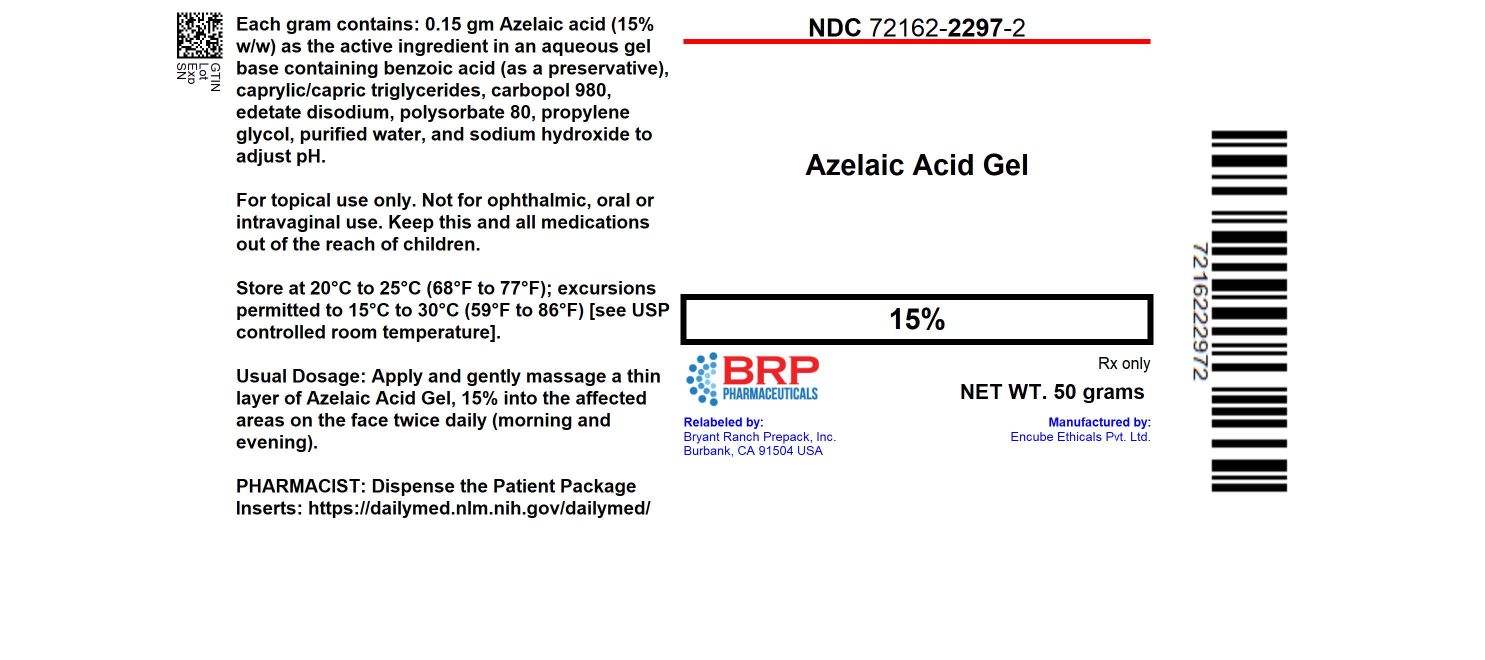
Azelaic Acid Gel .15 g/g Gel — NDC 72162-2297-2 (Billing 72162-2297-02)
This is a package of Azelaic Acid Gel .15 g/g Gel from Bryant Ranch Prepack, marketed since Nov 2023 and currently FDA-listed. It is this product's only package size.
NDC database record
One package, one record: these facts belong to NDC 72162-2297-2 alone.
- Record
- FDA NDC Directory package listing · Human prescription drug
- Code segments
- 72162 labeler · 2297 product · 2 package
- Package marketed since
- Nov 30, 2023
- Sample package
- No — commercial package
- Listing certified through
- Dec 31, 2027
- Barcode (UPC-A, from the NDC)
- 3 7216222972 9
- FDA record last changed
- Jul 24, 2026
Other active recalls for Azelaic Acid (different manufacturers) — 3 · tap to view
Identity & classification
Regulatory identifiers FDA, NLM and CMS codes for this package
Drug-database identifiers Medi-Span GPI and First Databank GCN / HICL / AHFS classification
- GSN (GCN sequence number): 051812
- GCN: 19198
- HICL (First Databank): 007471
- AHFS class code: 84:04.04.00
- RxCUI (RxNorm): 1041518
Where does this data come from?
- FDA openFDA NDC Directory · synced Oct 8, 2026
- FDA label on DailyMed · label index refreshed Oct 6, 2026
- RxNorm (NLM RxNav) · catalog refreshed Oct 1, 2026
- Medi-Span GPI (licensed)
- First Databank (licensed) · refreshed Oct 8, 2026
RxNorm drug class
This medicine belongs to the Other anti-acne preparations for topical use class.
Where does this data come from?
- RxClass (NLM) · catalog refreshed Oct 1, 2026
Clinical
- Azelaic acid gel, 15% treats the red bumps and pimples of mild to moderate rosacea. It has not been studied for redness alone, without bumps and pimples.
- It goes on your skin only. For FINACEA Foam, shake it, wash your face with a very mild cleanser, pat dry, and apply a thin layer to your whole face morning and evening. Wash your h...
- Yes, burning, stinging, itching and dryness are the most common effects, usually in the first few weeks. If irritation becomes severe or doesn't go away, stop and call your doctor.
- Get help for swelling of your face or eyes, hives or trouble breathing, since these can be signs of an allergic reaction. Also call your doctor if your asthma gets worse.
Patient education
Supplement & herbal interactions
Some supplements/herbs that may interact with Azelaic Acid — tap one for details:
Where does this data come from?
- MedlinePlus (NLM) · refreshed Oct 1, 2026
- FDA label on DailyMed · label index refreshed Oct 6, 2026
Ask a licensed pharmacist directly — free, answered by our team.
Pricing
A drug doesn't have one price. Each row is a different public payment system, and none is what you'd pay at the counter — that depends on your insurance. The ⓘ on each row explains what it measures.
| Price system | Per g | Per package |
|---|---|---|
| Retail pharmacies payNADAC · weekly | Not in the retail survey — common for institutional, discontinued, or low-volume packs. | |
| Medicaid paysCMS SDUD · 12 mo | No recent Medicaid claims on file for this NDC — rare and low-volume NDCs are suppressed in the public data. | |
| Medicare drug plans payPart D · quarterly | No Part D plan price is available for this NDC in our data. | |
Where does this data come from?
- CMS NADAC weekly file
- CMS ASP pricing files · refreshed Sep 20, 2026
- CMS Medicaid State Drug Utilization Data · refreshed Oct 8, 2026
- CMS Part D plan pricing files · refreshed Sep 24, 2026
- VA National Acquisition Center price file
Packaging — all sizes for this product
| Package NDC | Description | Marketing start | Marketing end | Status |
|---|---|---|---|---|
| 72162-2297-02 You're viewing this Main listing | 1 TUBE in 1 CARTON / 50 g in 1 TUBE | 2023-11-30 | — | Active |
Therapeutic equivalents
| Product | Labeler | Pack | NADAC/unit | TE | Status | Price vs. this |
|---|---|---|---|---|---|---|
| azelaic acid .15 g/g 00591-2131-55 | Actavis | 1 tube | $0.441 | AB | Availability likely | — |
| Azelaic Acid Gel .15 g/g 00781-7172-50 | Sandoz | 1 tube | $0.441 | AB | Availability likely | — |
| Azelaic Acid Gel .15 g/g 21922-0038-14 | Encube | 1 tube | $0.441 | AB | Availability likely | — |
| Azelaic Acid .15 g/g 51672-1389-03 | Sun | 1 tube | $0.441 | AB | Availability likely | — |
| azelaic acid .15 g/g 68462-0626-52 | Glenmark | 1 tube | $0.441 | AB | Availability likely | — |
| Azelaic Acid Gel .15 g/gthis 72162-2297-02 | Bryant | 1 tube | — | AB | FDA listed | — |
Where does this data come from?
- FDA openFDA NDC Directory · synced Oct 8, 2026
- FDA Orange Book · refreshed Oct 3, 2026
- CMS NADAC weekly file
Availability & generic status
This product is an FDA-approved generic. Other versions of the same drug are listed under Therapeutic equivalents, least expensive first.
Where does this data come from?
- FDA Orange Book · refreshed Oct 3, 2026
Inactive Ingredients / Excipients
Inactive ingredients, also called excipients, are components of the drug product other than the active ingredient. They may include fillers, dyes, coatings, preservatives, flavors, or other formulation ingredients.
🧪 Avoiding an ingredient? See Azelaic Acid Topical inactive ingredients by manufacturer: every current product's list side by side, so you can ask your pharmacy for the version that does not list it.
💡 Tap an ingredient (hover on desktop) to see what it is and why it’s used.
-
UNII 8SKN0B0MIM
Benzoic acid is a naturally occurring organic acid used as a preservative in medicines and foods. It helps prevent bacterial and fungal growth to extend shelf life and maintain product stability.
-
UNII 4Q93RCW27E
A synthetic polymer made from acrylic acid that's crosslinked for stability. It acts as a thickener and gelling agent in creams and gels, helping the medicine spread evenly and maintain its texture.
-
UNII 7FLD91C86K
Edetate disodium is a chemical compound that binds and removes certain metal ions. In medicines, it acts as a preservative and stabilizer by preventing metals like calcium from interfering with the product's shelf life and consistency.
-
UNII C9H2L21V7U
A fat derived from coconut or palm oil containing shorter fatty acid chains. It serves as a solvent and carrier to help dissolve or suspend active ingredients, improving absorption and stability in liquid formulations.
-
UNII 6OZP39ZG8H
Polysorbate 80 is a synthetic emulsifier derived from sorbitol and oleic acid. It helps mix oil and water-based ingredients together in medications and improves how the product disperses in the body.
-
UNII 6DC9Q167V3
Propylene glycol is a clear liquid derived from petroleum or vegetable sources. It acts as a solvent, humectant, and preservative in medicines, helping dissolve active ingredients and maintain product stability.
-
UNII 55X04QC32I
A strong alkaline chemical used to adjust and maintain the pH balance of liquid medicines. It helps keep the medicine stable and ensures it stays effective during storage.
-
UNII 059QF0KO0R
Water is a liquid solvent that dissolves and mixes ingredients together in liquid medicines, syrups, and injections. It helps distribute the active drug evenly throughout the product.
8 inactive ingredients listed in the exact product block matched to this NDC.
Where does this data come from?
ingredient classCode="IACT" elements from the exact product block matched by this NDC. Label-section narrative from DailyMed / the openFDA label index is shown separately when available.- FDA label on DailyMed · label index refreshed Oct 6, 2026
- FDA openFDA NDC Directory · synced Oct 8, 2026
Inactive ingredient FAQ
Are inactive ingredients the same for every manufacturer?
Why might an inactive ingredient be missing?
Can inactive ingredients matter?
Manufacturer & labeler
More NDCs from Bryant Ranch Prepack labeler code 72162
- ESTRADIOL .5 mg/.5g Gel NDC 72162-2291-3
- ESTRADIOL .75 mg/.75g Gel NDC 72162-2292-3
- ESTRADIOL 1 mg/g Gel NDC 72162-2293-3
- Ivermectin 10 mg/g Cream NDC 72162-2294-2
- Adapalene Gel USP, 0.3% 3 mg/g Gel NDC 72162-2295-2
- Adapalene and Benzoyl Peroxide Gel, 0.1%/2.5% 1 mg/g; 25 mg/g Gel NDC 72162-2296-2
- CICLOPIROX 80 mg/mL Solution NDC 72162-2298-2
- Clindamycin Phosphate and Benzoyl Peroxide 10 mg/g; 50 mg/g Gel NDC 72162-2299-2
- Clobetasol Propionate Cream USP, 0.05% .5 mg/g Cream NDC 72162-2300-2
- hydrocortisone valerate cream 2 mg/g Cream NDC 72162-2301-4
- Mesalamine 4 g/60mL Suspension NDC 72162-2302-2
- Tretinoin .8 mg/g Gel NDC 72162-2303-2
Where does this data come from?
- FDA openFDA NDC Directory · synced Oct 8, 2026
- Drugs@FDA
Full prescribing information FDA SPL
🎯 Indications and Usage ▾
1 INDICATIONS AND USAGE Azelaic Acid Gel, 15% is indicated for topical treatment of the inflammatory papules and pustules of mild to moderate rosacea. Limitations of Use Although some reduction of erythema which was present in patients with papules and pustules of rosacea occurred in clinical studies, efficacy for treatment of erythema in rosacea in the absence of papules and pustules has not been evaluated. Azelaic Acid Gel, 15% is indicated for topical treatment of the inflammatory papules and pustules of mild to moderate rosacea ( 1 ).
Limitations of Use Efficacy for treatment of erythema in rosacea in the absence of papules and pustules has not been evaluated. ( 1 )
⏱️ Dosage and Administration ▾
2 DOSAGE AND ADMINISTRATION Cleanse affected area(s) using only very mild soaps or soapless cleansing lotion and pat dry with a soft towel before application of Azelaic Acid Gel, 15%. Apply and gently massage a thin layer of Azelaic Acid Gel, 15% into the affected areas on the face twice daily (morning and evening). Wash hands immediately following application of Azelaic Acid Gel,15%.
Cosmetics may be applied after the application of Azelaic Acid Gel,15% has dried. Reassess the diagnosis if no improvement is observed upon completing 12 weeks of therapy. Avoid the use of occlusive dressings or wrappings.
Instruct patients to avoid use of alcoholic cleansers, tinctures and astringents, abrasives and peeling agents. For topical use. Not for oral, ophthalmic or intravaginal use.
Apply a thin layer twice daily to affected area(s). ( 2 ) Use only very mild soaps or soapless cleansing lotion and pat dry with a soft towel before applying Azelaic Acid Gel, 15%. (2 ) Wash hands immediately following application.
( 2 ) Cosmetics may be applied after the application of Azelaic Acid Gel, 15% has dried. ( 2 ) Avoid use of alcoholic cleansers, tinctures and astringents, abrasives and peeling agents. ( 2 ) For topical use.
( 2 ) Not for oral, ophthalmic or intravaginal use. ( 2 )
💊 Dosage Forms and Strengths ▾
3 DOSAGE FORMS AND STRENGTHS Azelaic Acid Gel, 15% is a white to yellowish white opaque gel. Each gram of Azelaic Acid Gel, 15% contains 0.15 gm of azelaic acid (15% w/w). Gel, 15% ( 3 )
⛔ Contraindications ▾
4 CONTRAINDICATIONS None. None. ( 4 )
⚠️ Warnings and Cautions ▾
5 WARNINGS AND PRECAUTIONS Hypersensitivity: Hypersensitivity reactions, including cases of angioedema, eye swelling, facial swelling, dyspnea, urticaria, and adverse skin reactions, have been reported. In case of known hypersensitivity to any component of the gel, avoid the use of Azelaic Acid Gel, 15%. If hypersensitivity develops, discontinue treatment and institute appropriate therapy.
( 5.1 ) Skin Reactions: Skin irritation (i.e. pruritus, burning or stinging) may occur, usually during the first few weeks of treatment. If sensitivity or severe irritation develops and persists, discontinue treatment and institute appropriate therapy. ( 5.2 ) Hypopigmentation: Isolated cases of hypopigmentation occurred after azelaic acid use.
Monitor patients with dark complexion for early signs of hypopigmentation ( 5.2 ) Eye and Mucous Membrane Irritation: Azelaic Acid Gel, 15% has been reported to cause irritation of the eyes. Avoid contact with the eyes and mucous membranes. ( 5.3 ) Exacerbation of Asthma: Consult a physician if asthma is exacerbated with Azelaic Acid Gel, 15% use.
( 5.4 )
5.1Hypersensitivity Hypersensitivity reactions, including cases of angioedema, eye swelling, facial swelling, dyspnea, urticaria, and adverse skin reactions, have been reported during post marketing surveillance. Avoid the use of Azelaic Acid Gel,15% in patients with known hypersensitivity to any component of the gel. If hypersensitivity develops during treatment, discontinue Azelaic Acid Gel,15% and institute appropriate therapy.
5.2Skin Reactions Skin irritation (i.e. pruritus, burning or stinging) may occur during use of Azelaic Acid Gel,15%, usually during the first few weeks of treatment. If sensitivity or severe irritation develops and persists, discontinue treatment and institute appropriate therapy. There have been isolated reports of hypopigmentation after use of azelaic acid.
Since azelaic acid has not been well studied in patients with dark complexion, monitor these patients for early signs of hypopigmentation.
5.3Eye and Mucous Membranes Irritation Azelaic Acid Gel, 15% has been reported to cause irritation of the eyes. Avoid contact with the eyes, mouth and other mucous membranes. If Azelaic Acid Gel, 15% comes in contact with the eyes, wash the eyes with large amounts of water and consult a physician if eye irritation persists [ see Adverse Reactions (6.2) ]
5.4Exacerbation of Asthma Worsening of asthma has been reported in patients using azelaic acid formulations including Azelaic Acid Gel,15%. Consult a physician if asthma is exacerbated with use of Azelaic Acid Gel,15%.
🤒 Adverse Reactions ▾
6 ADVERSE REACTIONS The most common adverse reactions are burning/stinging/tingling (29%), pruritus (11%), scaling/dry skin/xerosis (8%) and erythema/irritation (4%). ( 6 ) To report SUSPECTED ADVERSE REACTIONS, contact Encube Ethicals Private Limited at 1-833-285-4151 or FDA at 1-800-FDA-1088 or www.fda.gov/medwatch.
6.1Clinical Trials Experience Because clinical trials are conducted under widely varying conditions, adverse reaction rates observed in the clinical trials of a drug cannot be directly compared to rates in the clinical trials of another drug and may not reflect the rates observed in practice. In two vehicle-controlled and one active-controlled U.S. clinical trials, treatment safety was monitored in 788 subjects who used twice-daily Azelaic Acid Gel,15% for 12 weeks (N=333) or 15 weeks (N=124), or the gel vehicle (N=331) for 12 weeks.
In all three trials, the most common treatment-related adverse events were: burning/stinging/tingling (29%), pruritus (11%), scaling/dry skin/xerosis (8%) and erythema/irritation (4%). In the active-controlled trial, overall adverse reactions (including burning, stinging/tingling, dryness/tightness/scaling, itching, and erythema/irritation/redness) were 19.4% (24/124) for Azelaic Acid Gel, 15% compared to 7.1%(9/127) for the active comparator gel at 15 weeks. Table 1: Adverse Events Occurring in ≥1% of Subjects in the Rosacea Trials by Treatment Group and Maximum Intensity* Azelaic acid gel, 15% N=457 (100%) Vehicle N=331 (100%) Mild N=99 (22%) Moderate N=61 (13%) Severe N=27 (6%) Mild N=46 (14%) Moderate N=30 (9%) Severe N=5 (2%) Burning/stinging/tingling 71 (16%) 42 (9%) 17 (4%) 8 (2%) 6 (2%) 2 (1%) Pruritus 29 (6%) 18 (4%) 5 (1%) 9 (3%) 6 (2%) 0 (0%) Scaling/dry skin/xerosis 21 (5%) 10 (2%) 5 (1%) 31 (9%) 14 (4%) 1 (<1%) Erythema/irritation 6 (1%) 7 (2%) 2 (<1%) 8 (2%) 4 (1%) 2 (1%) Contact dermatitis 2 (<1%) 3 (1%) 0 (0%) 1 (<1%) 0 (0%) 0 (0%) Edema 3 (1%) 2 (<1%) 0 (0%) 3 (1%) 0 (0%) 0 (0%) Acne 3 (1%) 1 (<1%) 0 (0%) 1 (<1%) 0 (0%) 0 (0%) *Subjects may have & gt; 1 cutaneous adverse event; thus, the sum of the frequencies of preferred terms may exceed the number of subjects with at least 1 cutaneous adverse event.
In patients using azelaic acid formulations, the following adverse events have been reported: worsening of asthma, vitiligo, depigmentation, small depigmented spots, hypertrichosis, reddening (signs of keratosis pilaris) and exacerbation of recurrent herpes labialis. Local Tolerability Studies Azelaic Acid Gel, 15% and its vehicle caused irritant reactions at the application site in human dermal safety studies. Azelaic Acid Gel, 15% caused significantly more irritation than its vehicle in a cumulative irritation study.
Some improvement in irritation was demonstrated over the course of the clinical trials, but this improvement might be attributed to subject dropouts. No phototoxicity or photoallergenicity were reported in human dermal safety studies.
6.2Postmarketing Experience The following adverse reactions have been identified post approval of Azelaic Acid Gel, 15%. Because these reactions are reported voluntarily from a population of uncertain size, it is not always possible to reliably estimate the frequency or establish a causal relationship to drug exposure: Eyes : iridocyclitis upon accidental exposure of the eyes to Azelaic Acid Gel, 15%. Hypersensitivity : angioedema, eye swelling, facial swelling, urticaria.
Respiratory : worsening of asthma, dyspnea, wheezing, Skin reactions : application site rash.
👥 Use in Specific Populations ▾
8 USE IN SPECIFIC POPULATIONS
8.1Pregnancy Risk Summary Azelaic acid is minimally absorbed systemically following topical route of administration, and maternal use is not expected to result in fetal exposure to the drug [ see Clinical Pharmacology (12.3) ]. In animal reproduction studies, embryofetal toxicity was noted when azelaic acid was administered orally during the period of organogenesis at doses 162, 19, and 65 times the maximum recommended human dose (MRHD) in rats, rabbits, and monkeys, respectively. Maternal toxicity was noted at these doses but no malformations were observed in these embryofetal developmental studies (see Data ).
The background risk of major birth defects and miscarriage for the indicated population is unknown. All pregnancies have a background risk of birth defect, loss, or other adverse outcomes. In the U.S. general population, the estimated background risk of major birth defects and miscarriage in clinically recognized pregnancies is 2 to 4% and 15 to 20%, respectively.
Data Animal Data Dermal embryofetal developmental toxicology studies have not been performed with azelaic acid, 15% gel. Oral embryofetal developmental studies were conducted with azelaic acid in rats, rabbits, and cynomolgus monkeys. Azelaic acid was administered during the period of organogenesis in all three animal species.
Embryotoxicity was observed in rats, rabbits, and monkeys at oral doses of azelaic acid that generated some maternal toxicity. Embryotoxicity was observed in rats given 2500 mg/kg/day [162 times the MRHD based on body surface area (BSA) comparison], rabbits given 150 or 500 mg/kg/day (19 or 65 times the MRHD based on BSA comparison) and cynomolgus monkeys given 500 mg/kg/day (65 times the MRHD based on BSA comparison) azelaic acid. No malformations were observed in the oral embryofetal developmental studies conducted in rats, rabbits and cynomolgus monkeys.
An oral peri- and post-natal developmental study was conducted in rats. Azelaic acid was administered from gestational day 15 through day 21 postpartum up to a dose level of 2500 mg/kg/day. Embryotoxicity was observed in rats at an oral dose of 2500 mg/kg/day (162 times the MRHD based on BSA comparison) that generated some maternal toxicity.
In addition, slight disturbances in the post-natal development of fetuses was noted in rats at oral doses that generated some maternal toxicity (500 and 2500 mg/kg/day; 32 and 162 times the MRHD based on BSA comparison). No effects on sexual maturation of the fetuses were noted in this study.
8.2Lactation Risk Summary Azelaic acid is naturally present in human milk. When used as prescribed, azelaic acid is unlikely to be absorbed through the skin in clinically relevant amounts to cause a change in azelaic acid concentration in milk or milk production; therefore, breastfeeding is not expected to result in exposure of the infant to Azelaic Acid Gel, 15%. The developmental and health benefits of breastfeeding should be considered along with the mother’s clinical need for Azelaic Acid Gel, 15% and any potential adverse effects on the breastfed child from Azelaic Acid Gel, 15% or from the underlying maternal condition.
8.4Pediatric Use The safety and effectiveness of Azelaic Acid Gel, 15% have not been established in pediatric patients.
8.5Geriatric Use Clinical studies of Azelaic Acid Gel, 15% did not include sufficient numbers of subjects aged 65 and over to determine if they respond differently than younger subjects.
🤰 Pregnancy ▾
8.1Pregnancy Risk Summary Azelaic acid is minimally absorbed systemically following topical route of administration, and maternal use is not expected to result in fetal exposure to the drug [ see Clinical Pharmacology (12.3) ]. In animal reproduction studies, embryofetal toxicity was noted when azelaic acid was administered orally during the period of organogenesis at doses 162, 19, and 65 times the maximum recommended human dose (MRHD) in rats, rabbits, and monkeys, respectively. Maternal toxicity was noted at these doses but no malformations were observed in these embryofetal developmental studies (see Data ).
The background risk of major birth defects and miscarriage for the indicated population is unknown. All pregnancies have a background risk of birth defect, loss, or other adverse outcomes. In the U.S. general population, the estimated background risk of major birth defects and miscarriage in clinically recognized pregnancies is 2 to 4% and 15 to 20%, respectively.
Data Animal Data Dermal embryofetal developmental toxicology studies have not been performed with azelaic acid, 15% gel. Oral embryofetal developmental studies were conducted with azelaic acid in rats, rabbits, and cynomolgus monkeys. Azelaic acid was administered during the period of organogenesis in all three animal species.
Embryotoxicity was observed in rats, rabbits, and monkeys at oral doses of azelaic acid that generated some maternal toxicity. Embryotoxicity was observed in rats given 2500 mg/kg/day [162 times the MRHD based on body surface area (BSA) comparison], rabbits given 150 or 500 mg/kg/day (19 or 65 times the MRHD based on BSA comparison) and cynomolgus monkeys given 500 mg/kg/day (65 times the MRHD based on BSA comparison) azelaic acid. No malformations were observed in the oral embryofetal developmental studies conducted in rats, rabbits and cynomolgus monkeys.
An oral peri- and post-natal developmental study was conducted in rats. Azelaic acid was administered from gestational day 15 through day 21 postpartum up to a dose level of 2500 mg/kg/day. Embryotoxicity was observed in rats at an oral dose of 2500 mg/kg/day (162 times the MRHD based on BSA comparison) that generated some maternal toxicity.
In addition, slight disturbances in the post-natal development of fetuses was noted in rats at oral doses that generated some maternal toxicity (500 and 2500 mg/kg/day; 32 and 162 times the MRHD based on BSA comparison). No effects on sexual maturation of the fetuses were noted in this study.
🧒 Pediatric Use ▾
8.4Pediatric Use The safety and effectiveness of Azelaic Acid Gel, 15% have not been established in pediatric patients.
🧓 Geriatric Use ▾
8.5Geriatric Use Clinical studies of Azelaic Acid Gel, 15% did not include sufficient numbers of subjects aged 65 and over to determine if they respond differently than younger subjects.
🧬 Clinical Pharmacology ▾
12 CLINICAL PHARMACOLOGY
12.1Mechanism of Action The mechanism(s) by which azelaic acid interferes with the pathogenic events in rosacea are unknown.
12.2Pharmacodynamics The pharmacodynamics of azelaic acid in association with the treatment of rosacea are unknown.
12.3Pharmacokinetics The percutaneous absorption of azelaic acid after topical application of Azelaic Acid Gel, 15% could not be reliably determined. Mean plasma azelaic acid concentrations in rosacea subjects treated with Azelaic Acid Gel, 15% twice daily for at least 8 weeks are in the range of 42 to 63.1 ng/mL. These values are within the maximum concentration range of 24.0 to 90.5 ng/mL observed in rosacea subjects treated with vehicle only.
This indicates that Azelaic Acid Gel, 15% does not increase plasma azelaic acid concentration beyond the range derived from nutrition and endogenous metabolism. In vitro and human data suggest negligible cutaneous metabolism of 3 H-azelaic acid after topical application of 20% azelaic acid cream. Azelaic acid is mainly excreted unchanged in the urine, but undergoes some ß-oxidation to shorter chain dicarboxylic acids.
🧬 Mechanism of Action ▾
12.1Mechanism of Action The mechanism(s) by which azelaic acid interferes with the pathogenic events in rosacea are unknown.
📦 How Supplied / Storage and Handling ▾
16 HOW SUPPLIED/STORAGE AND HANDLING Azelaic Acid Gel, 15% is a white to yellowish white opaque gel supplied in a 50 g tube. NDC: 72162-2297-2: 50 g in a TUBE Storage and Handling Store at 20° to 25°C (68° to 77°F); excursions permitted between 15° to 30°C (59° to 86°F) [see USP Controlled Room Temperature]. Repackaged/Relabeled by: Bryant Ranch Prepack Burbank, CA 91504
📋 Description ▾
11 DESCRIPTION Azelaic Acid Gel, 15%, is an aqueous gel which contains azelaic acid, a naturally-occurring saturated dicarboxylic acid. It is for topical use. Chemically, azelaic acid is 1,7-heptanedicarboxylic acid.
The molecular formula for azelaic acid is C9 H16 O4. It has the following structure: Azelaic acid has a molecular weight of 188.22. It is a white, odorless crystalline solid.
It is poorly soluble in water at 20°C (0.24%) but freely soluble in boiling water and in ethanol. Azelaic Acid Gel, 15% is a white to yellowish white opaque gel for topical use; each gram contains 0.15 gm azelaic acid (15% w/w) in an aqueous gel base containing benzoic acid (as a preservative), caprylic/capric triglycerides, carbopol 980, edetate disodium, polysorbate 80, propylene glycol, purified water, and sodium hydroxide to adjust pH.
💬 Information for Patients ▾
17 PATIENT COUNSELING INFORMATION Inform patients using Azelaic Acid Gel, 15% of the following: Administration Instructions For topical use only. Before applying Azelaic Acid Gel, 15%, cleanse affected area(s) with a very mild soap or a soapless cleansing lotion and pat dry with a soft towel. Wash hands immediately following application of Azelaic Acid Gel, 15%.
Cosmetics may be applied after the application of Azelaic Acid Gel, 15% has dried. Avoid the use of occlusive dressings or wrappings. Avoid use of alcoholic cleansers, tinctures and astringents, abrasives and peeling agents [see Dosage and Administration (2)].
Hypersensitivity If allergic reactions occur, discontinue use and consult their healthcare provider [see Warnings and Precautions (5.1)]. Skin Irritation Skin irritation (e.g., pruritus, burning, or stinging) may occur during use of Azelaic Acid Gel, 15%, usually during the first few weeks of treatment. If irritation is excessive or persists, or allergic reactions occur, discontinue use and consult your physician [see Warnings and Precautions (5.2)].
Hypopigmentation Advise patients to report abnormal changes in skin color to their healthcare provider [see Warnings and Precautions (5.2)]. Eye and Mucous Membranes Irritation Avoid contact with the eyes, mouth and other mucous membranes. If Azelaic Acid Gel, 15% comes in contact with the eyes, wash the eyes with large amounts of water and consult their healthcare provider if eye irritation persists [see Warnings and Precautions (5.3)].
Exacerbation of Asthma Advise patients to report any worsening of asthma to their healthcare provider [see Warnings and Precautions (5.4)]. Manufactured by: Encube Ethicals Private. Limited.
Plot No. C-1, Madkaim Ind. Estate, Madkaim, Post: Mardol, Ponda, Goa-403 404, India.
Distributed by: Encube Ethicals , Inc. 200 Meredith Avenue, Suite 202 Durham, NC 27713 USA Revised: 03/2023
🧬 Pharmacokinetics ▾
12.3Pharmacokinetics The percutaneous absorption of azelaic acid after topical application of Azelaic Acid Gel, 15% could not be reliably determined. Mean plasma azelaic acid concentrations in rosacea subjects treated with Azelaic Acid Gel, 15% twice daily for at least 8 weeks are in the range of 42 to 63.1 ng/mL. These values are within the maximum concentration range of 24.0 to 90.5 ng/mL observed in rosacea subjects treated with vehicle only.
This indicates that Azelaic Acid Gel, 15% does not increase plasma azelaic acid concentration beyond the range derived from nutrition and endogenous metabolism. In vitro and human data suggest negligible cutaneous metabolism of 3 H-azelaic acid after topical application of 20% azelaic acid cream. Azelaic acid is mainly excreted unchanged in the urine, but undergoes some ß-oxidation to shorter chain dicarboxylic acids.
🧬 Pharmacodynamics ▾
12.2Pharmacodynamics The pharmacodynamics of azelaic acid in association with the treatment of rosacea are unknown.
🔬 Clinical Studies ▾
14 CLINICAL STUDIES Azelaic Acid Gel, 15% was evaluated for the treatment of mild to moderate papulopustular rosacea in two multicenter, randomized, double-blind, vehicle-controlled, 12-week clinical trials having identical protocols and involving a total of 664 (active: 333; vehicle: 331) subjects aged 21 to 86 years (mean age = 49). Overall, 92.5% of subjects were Caucasian and 73% of subjects were female. Enrolled subjects had mild to moderate rosacea with a mean lesion count of 18 (range 8 to 60) inflammatory papules and pustules.
The following subjects were excluded: a) those without papules and pustules; b) those with nodules, rhinophyma, or ocular involvement and c) those with a history of hypersensitivity to propylene glycol or to any other ingredients of the study drug. Azelaic Acid Gel, 15% or its vehicle were to be applied twice daily for 12 weeks; no other topical or systemic medication affecting the course of rosacea and/or evaluability was to be used during the studies. Subjects were instructed to avoid spicy foods, thermally hot food/drink and alcoholic beverages during the study.
Subjects were also instructed to use only very mild soaps or soapless cleansing lotion for facial cleansing. The primary efficacy endpoints included both 1) change from baseline in inflammatory lesion counts as well as 2) success defined as a score of "clear" or "minimal" with at least a 2-step reduction from baseline on the Investigator's Global Assessment (IGA), defined as follows below: CLEAR: No papules and/or pustules; no or residual erythema; no or mild to moderate telangiectasia MINIMAL: Rare papules and/or pustules; residual to mild erythema; mild to moderate telangiectasia MILD: Few papules and/or pustules; mild erythema; mild to moderate telangiectasia MILD TO MODERATE: Distinct number of papules and/or pustules; mild to moderate erythema; mild to moderate telangiectasia MODERATE: Pronounced number of papules and/or pustules; moderate erythema; mild to moderate telangiectasia MODERATE TO SEVERE: Many papules and/or pustules, occasionally with large inflamed lesions; moderate erythema; moderate degree of telangiectasia SEVERE: Numerous papules and/or pustules, occasionally with confluent areas of inflamed lesions; moderate or severe erythema; moderate or severe telangiectasia Primary efficacy assessment was based on the “intent-to-treat” (ITT) population with the “last observation carried forward” (LOCF).
Both trials demonstrated a statistically significant difference in favor of Azelaic Acid Gel, 15% over its vehicle in both reducing the number of inflammatory papules and pustules associated with rosacea (Table 2) as well as demonstrating success on the IGA in the ITT-LOCF population at the end of treatment. Table 2: Inflammatory Papules and Pustules (ITT population)* Study One Azelaic Acid Gel,15% N=164 Study One VEHICLE N=165 Study Two Azelaic Acid Gel, 15% N=167 Study Two VEHICLE N=166 Mean Lesion Count Baseline 17.5 17.6 17.9
18.5End of Treatment * 6.8 10.5 9.0
12.1Mean Percent Reduction End of Treatment * 57.9% 39.9% 50.0% 38.2% *ITT population with last observation carried forward (LOCF) Although some reduction of erythema which was present in subjects with papules and pustules of rosacea occurred in clinical trials, efficacy for treatment of erythema in rosacea in the absence of papules and pustules has not been evaluated. Azelaic Acid Gel, 15% was superior to the vehicle with regard to success based on the IGA of rosacea on a 7-point static score at the end of treatment (ITT population; Table 3).
Table 3: Investigator's Global Assessment at the End of Treatment* Study One Azelaic Acid Gel, 15% N=164 Study One VEHICLE N=165 Study Two Azelaic Acid Gel, 15% N=167 Study Two VEHICLE N=166 Clear, Minimal or Mild at End of Treatment (% of Subjects) 61% 40% 61% 48% *ITT population with last observation carried forward (LOCF)
🧪 Nonclinical Toxicology ▾
13 NONCLINICAL TOXICOLOGY
13.1Carcinogenesis, Mutagenesis, Impairment of Fertility In a 2-year dermal mouse carcinogenicity study, azelaic acid pre-foam emulsion was administered twice daily to CD-1 mice at topical doses of 5%, 15%, and 30% (500, 1500, and 3,000 mg/kg/day azelaic acid). No drug-related tumors were noted at concentrations up to 30% azelaic acid (396 times the MRHD based on AUC comparison). Azelaic acid was not mutagenic or clastogenic in a battery of in vitro [Ames assay, HGPRT in V79 cells (Chinese hamster lung cells), and chromosomal aberration assay in human lymphocytes] and in vivo (dominant lethal assay in mice and mouse micronucleus assay) genotoxicity tests.
Oral administration of azelaic acid at dose levels up to 2,500 mg/kg/day (162 times the MRHD based on BSA comparison) did not affect fertility or reproductive performance in male or female rats.
📄 Carcinogenesis, Mutagenesis, Impairment of Fertility ▾
13.1Carcinogenesis, Mutagenesis, Impairment of Fertility In a 2-year dermal mouse carcinogenicity study, azelaic acid pre-foam emulsion was administered twice daily to CD-1 mice at topical doses of 5%, 15%, and 30% (500, 1500, and 3,000 mg/kg/day azelaic acid). No drug-related tumors were noted at concentrations up to 30% azelaic acid (396 times the MRHD based on AUC comparison). Azelaic acid was not mutagenic or clastogenic in a battery of in vitro [Ames assay, HGPRT in V79 cells (Chinese hamster lung cells), and chromosomal aberration assay in human lymphocytes] and in vivo (dominant lethal assay in mice and mouse micronucleus assay) genotoxicity tests.
Oral administration of azelaic acid at dose levels up to 2,500 mg/kg/day (162 times the MRHD based on BSA comparison) did not affect fertility or reproductive performance in male or female rats.
📄 Package Label / Principal Display Panel ▾
Azelaic Acid 15% Label
Medicare Part D spend CMS · PART D · 2026 (Q1)
Reported adverse events (FAERS)
Top reported reactions
Age at onset
Reporter sex
Serious outcomes
Where does this data come from?
About this NDC listing & data coverage
What data is (and isn’t) available for this NDC — tap to expand
| NDC identity (package / product / labeler codes) | ✓ Available |
| Labeler | ✓ Available |
| Product & package description | ✓ Available |
| Marketing category & status | ✓ Available |
| Active ingredient / dosage form / route | ✓ Available |
| FDA label (SPL via DailyMed) | ✓ Available |
| Package photos | ✓ Available |
| Inactive ingredients (structured) | ✓ Available |
| NADAC pharmacy acquisition price (CMS) | — Not published for this NDC CMS publishes NADAC only for NDCs reported in its retail-pharmacy survey. |
| Orange Book / therapeutic-equivalence data | ✓ Available |
| HCPCS J-code billing crosswalk | — Not published for this NDC Most self-administered / retail products have no J-code — that is normal. |
| Medicaid utilization (CMS SDUD) | — Not published for this NDC CMS reports utilization only for NDCs with Medicaid claims above its privacy threshold. |