
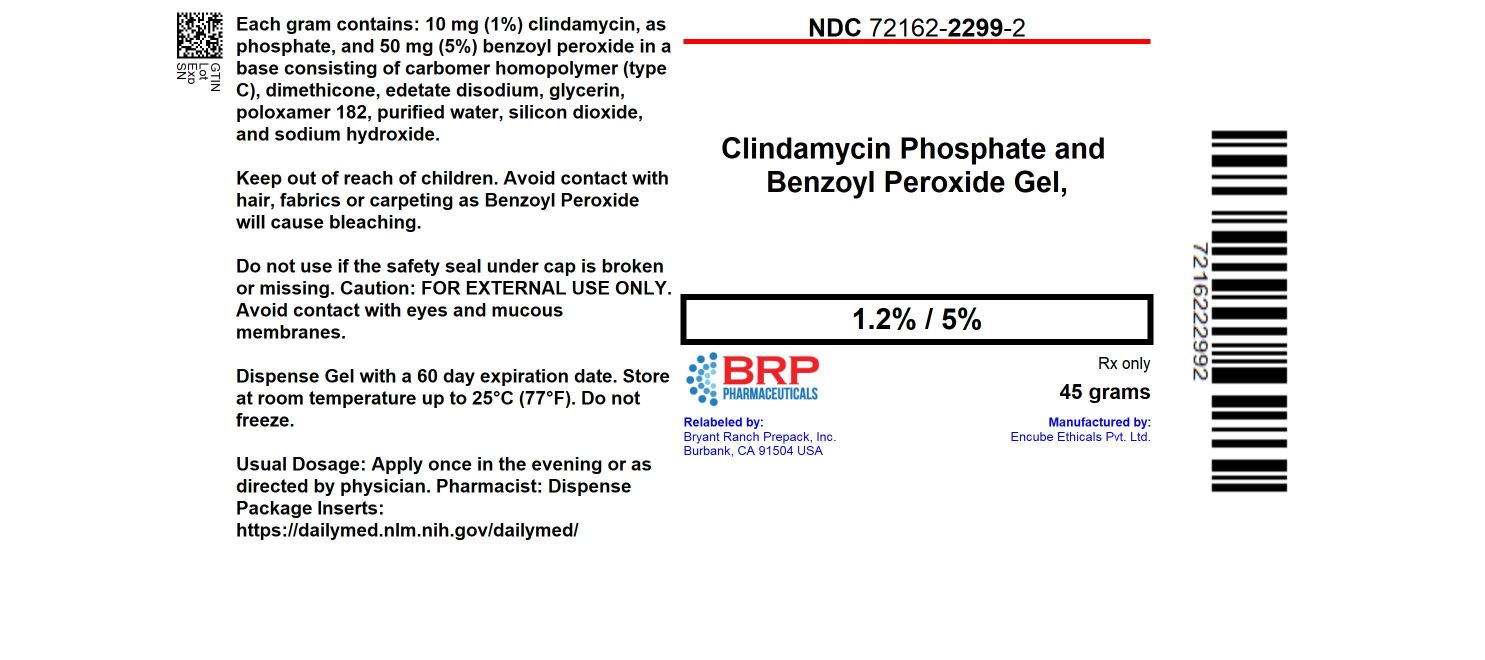
Clindamycin Phosphate and Benzoyl Peroxide 10 mg/g; 50 mg/g Gel — NDC 72162-2299-2 (Billing 72162-2299-02)
This is a package of Clindamycin Phosphate and Benzoyl Peroxide 10 mg/g; 50 mg/g Gel from Bryant Ranch Prepack, marketed since May 2021 and currently FDA-listed. It is this product's only package size.
NDC database record
One package, one record: these facts belong to NDC 72162-2299-2 alone.
- Record
- FDA NDC Directory package listing · Human prescription drug
- Code segments
- 72162 labeler · 2299 product · 2 package
- Package marketed since
- Apr 30, 2024
- Sample package
- No — commercial package
- Listing certified through
- Dec 31, 2026
- Barcode (UPC-A, from the NDC)
- 3 7216222992 7
- FDA record last changed
- Aug 27, 2026
Identity & classification
Regulatory identifiers FDA, NLM and CMS codes for this package
Drug-database identifiers Medi-Span GPI and First Databank GCN / HICL / AHFS classification
- GSN (GCN sequence number): 062456
- GCN: 98232
- HICL (First Databank): 017263
- AHFS class code: 08:12.28.20
- RxCUI (RxNorm): 1540241
Where does this data come from?
- FDA openFDA NDC Directory · synced Oct 8, 2026
- FDA label on DailyMed · label index refreshed Oct 6, 2026
- RxNorm (NLM RxNav) · catalog refreshed Oct 1, 2026
- Medi-Span GPI (licensed)
- First Databank (licensed) · refreshed Oct 8, 2026
RxNorm drug class
This medicine belongs to the Peroxides class.
Where does this data come from?
- RxClass (NLM) · catalog refreshed Oct 1, 2026
Clinical
The combination of clindamycin and benzoyl peroxide is used to treat acne. Clindamycin and benzoyl peroxide are in a class of medications called topical antibiotics. The combination of clindamycin and benzoyl peroxide works by killing the bacteria that cause acne.
Read the full MedlinePlus article ↗Patient education
Supplement & herbal interactions
Where does this data come from?
- MedlinePlus (NLM) · refreshed Oct 1, 2026
- FDA label on DailyMed · label index refreshed Oct 6, 2026
Ask a licensed pharmacist directly — free, answered by our team.
Pricing
A drug doesn't have one price. Each row is a different public payment system, and none is what you'd pay at the counter — that depends on your insurance. The ⓘ on each row explains what it measures.
| Price system | Per g | Per package |
|---|---|---|
| Retail pharmacies payNADAC · weekly | Not in the retail survey — common for institutional, discontinued, or low-volume packs. | |
| Medicaid paysCMS SDUD · 12 mo | No recent Medicaid claims on file for this NDC — rare and low-volume NDCs are suppressed in the public data. | |
| Medicare drug plans payPart D · quarterly | No Part D plan price is available for this NDC in our data. | |
Where does this data come from?
- CMS NADAC weekly file
- CMS ASP pricing files · refreshed Sep 20, 2026
- CMS Medicaid State Drug Utilization Data · refreshed Oct 8, 2026
- CMS Part D plan pricing files · refreshed Sep 24, 2026
- VA National Acquisition Center price file
Packaging — all sizes for this product
| Package NDC | Description | Marketing start | Marketing end | Status |
|---|---|---|---|---|
| 72162-2299-02 You're viewing this Main listing | 1 TUBE in 1 CARTON / 45 g in 1 TUBE | 2024-04-30 | — | Active |
Therapeutic equivalents
Where does this data come from?
- FDA openFDA NDC Directory · synced Oct 8, 2026
- FDA Orange Book · refreshed Oct 3, 2026
- CMS NADAC weekly file
Availability & generic status
This product is an FDA-approved generic. Other versions of the same drug are listed under Therapeutic equivalents, least expensive first.
Where does this data come from?
- FDA Orange Book · refreshed Oct 3, 2026
Inactive Ingredients / Excipients
Inactive ingredients, also called excipients, are components of the drug product other than the active ingredient. They may include fillers, dyes, coatings, preservatives, flavors, or other formulation ingredients.
💡 Tap an ingredient (hover on desktop) to see what it is and why it’s used.
-
UNII 4Q93RCW27E
A synthetic polymer made from acrylic acid that's crosslinked for stability. It acts as a thickener and gelling agent in creams and gels, helping the medicine spread evenly and maintain its texture.
-
UNII 92RU3N3Y1O
Dimethicone is a silicone-based oil that acts as an anti-foaming agent and lubricant in medicines. It reduces gas bubbles in liquid formulations and helps coat and protect the stomach lining when ingested.
-
UNII 7FLD91C86K
Edetate disodium is a chemical compound that binds and removes certain metal ions. In medicines, it acts as a preservative and stabilizer by preventing metals like calcium from interfering with the product's shelf life and consistency.
-
UNII PDC6A3C0OX
Glycerin is a clear, thick liquid derived from plant oils or fats. It acts as a humectant to retain moisture, a sweetener, and a solvent in medications.
-
UNII JX0HIX6OAG
Poloxamer 182 is a synthetic polymer made from ethylene oxide and propylene oxide. It acts as a solubilizer and emulsifier, helping mix water and oil-based ingredients together in liquid medications.
-
UNII ETJ7Z6XBU4
Silicon dioxide is a naturally occurring mineral used as a glidant and anti-caking agent. It helps powder ingredients flow smoothly and prevents clumping during manufacturing and storage.
-
UNII 55X04QC32I
A strong alkaline chemical used to adjust and maintain the pH balance of liquid medicines. It helps keep the medicine stable and ensures it stays effective during storage.
-
UNII 059QF0KO0R
Water is a liquid solvent that dissolves and mixes ingredients together in liquid medicines, syrups, and injections. It helps distribute the active drug evenly throughout the product.
8 inactive ingredients listed in the exact product block matched to this NDC.
Where does this data come from?
ingredient classCode="IACT" elements from the exact product block matched by this NDC. Label-section narrative from DailyMed / the openFDA label index is shown separately when available.- FDA label on DailyMed · label index refreshed Oct 6, 2026
- FDA openFDA NDC Directory · synced Oct 8, 2026
Inactive ingredient FAQ
Are inactive ingredients the same for every manufacturer?
Why might an inactive ingredient be missing?
Can inactive ingredients matter?
Manufacturer & labeler
More NDCs from Bryant Ranch Prepack labeler code 72162
- ESTRADIOL 1 mg/g Gel NDC 72162-2293-3
- Ivermectin 10 mg/g Cream NDC 72162-2294-2
- Adapalene Gel USP, 0.3% 3 mg/g Gel NDC 72162-2295-2
- Adapalene and Benzoyl Peroxide Gel, 0.1%/2.5% 1 mg/g; 25 mg/g Gel NDC 72162-2296-2
- Azelaic Acid Gel .15 g/g Gel NDC 72162-2297-2
- CICLOPIROX 80 mg/mL Solution NDC 72162-2298-2
- Clobetasol Propionate Cream USP, 0.05% .5 mg/g Cream NDC 72162-2300-2
- hydrocortisone valerate cream 2 mg/g Cream NDC 72162-2301-4
- Mesalamine 4 g/60mL Suspension NDC 72162-2302-2
- Tretinoin .8 mg/g Gel NDC 72162-2303-2
- Pregabalin 150 mg Capsule NDC 72162-2304-0
- Vancomycin Hydrochloride 125 mg Capsule NDC 72162-2305-4
Where does this data come from?
- FDA openFDA NDC Directory · synced Oct 8, 2026
- Drugs@FDA
Full prescribing information FDA SPL
🎯 Indications and Usage ▾
1 INDICATIONS AND USAGE Clindamycin Phosphate and Benzoyl Peroxide Gel, 1.2%/5% is a combination of clindamycin phosphate (a lincosamide antibacterial) and benzoyl peroxide indicated for the topical treatment of inflammatory acne vulgaris. ( 1.1 ) Limitation of Use: Clindamycin Phosphate and Benzoyl Peroxide Gel, 1.2%/5% has not been demonstrated to have any additional benefit when compared with benzoyl peroxide alone in the same vehicle when used for the treatment of non-inflammatory acne. ( 1.2 )
1.1Indication Clindamycin Phosphate and Benzoyl Peroxide Gel, 1.2%/5% is indicated for the topical treatment of inflammatory acne vulgaris in patients 12 years and older.
1.2Limitations of Use Clindamycin Phosphate and Benzoyl Peroxide Gel, 1.2%/5% has not been demonstrated to have any additional benefit when compared with benzoyl peroxide alone in the same vehicle when used for the treatment of non-inflammatory acne.
⏱️ Dosage and Administration ▾
2 DOSAGE AND ADMINISTRATION Apply a thin layer of Clindamycin Phosphate and Benzoyl Peroxide Gel, 1.2%/5% to the face once daily, in the evening or as directed by the physician. The skin should be gently washed, rinsed with warm water, and patted dry before applying Clindamycin Phosphate and Benzoyl Peroxide Gel, 1.2%/5%. Avoid the eyes, mouth, lips, mucous membranes, or areas of broken skin.
Clindamycin Phosphate and Benzoyl Peroxide Gel, 1.2%/5% is not for oral, ophthalmic, or intravaginal use. Apply a thin layer of Clindamycin Phosphate and Benzoyl Peroxide Gel, 1.2%/5% to the face once daily, in the evening. ( 2 ) Not for oral, ophthalmic, or intravaginal use.
( 2 )
💊 Dosage Forms and Strengths ▾
3 DOSAGE FORMS AND STRENGTHS Gel, 1.2%/5% Clindamycin Phosphate and Benzoyl Peroxide Gel, 1.2%/5% is a white to slightly yellow, opaque gel. Each gram of Clindamycin Phosphate and Benzoyl Peroxide Gel, 1.2%/5% contains 12 mg clindamycin phosphate (equivalent to 10 mg of clindamycin) and 50 mg benzoyl peroxide. Gel, 1.2%/5%: Each gram of Clindamycin Phosphate and Benzoyl Peroxide Gel, 1.2%/5% contains 12 mg clindamycin phosphate (equivalent to 10 mg of clindamycin) and 50 mg benzoyl peroxide.
( 3 )
⛔ Contraindications ▾
4 CONTRAINDICATIONS Clindamycin Phosphate and Benzoyl Peroxide Gel, 1.2%/5% is contraindicated in: Patients who have demonstrated hypersensitivity (e.g., anaphylaxis) to clindamycin, benzoyl peroxide, any components of the formulation, or lincomycin. (4) Patients with a history of regional enteritis, ulcerative colitis, or antibiotic-associated colitis (including pseudomembranous colitis). (4)
4.1Hypersensitivity Clindamycin Phosphate and Benzoyl Peroxide Gel, 1.2%/5% is contraindicated in those individuals who have shown hypersensitivity to clindamycin, benzoyl peroxide, any components of the formulation, or lincomycin. Anaphylaxis, as well as allergic reactions leading to hospitalization, has been reported in postmarketing use with Clindamycin Phosphate and Benzoyl Peroxide Gel, 1.2%/5%. [See Adverse Reactions ( 6.2 ).]
4.2Colitis/Enteritis Clindamycin Phosphate and Benzoyl Peroxide Gel, 1.2%/5% is contraindicated in those individuals with a history of regional enteritis, ulcerative colitis, pseudomembranous colitis, or antibiotic-associated colitis [see Warnings and Precautions ( 5.1 )].
⚠️ Warnings and Cautions ▾
5 WARNINGS AND PRECAUTIONS Colitis: Clindamycin can cause severe colitis, which may result in death. Diarrhea, bloody diarrhea, and colitis (including pseudomembranous colitis) have been reported with the use of clindamycin. Clindamycin Phosphate and Benzoyl Peroxide Gel, 1.2%/5% should be discontinued if significant diarrhea occurs.
( 5.1 ) Ultraviolet light and environmental exposure (including use of tanning beds or sun lamps): Minimize sun exposure following drug application. ( 5.2 )
5.1Colitis Systemic absorption of clindamycin has been demonstrated following topical use of clindamycin. Diarrhea, bloody diarrhea, and colitis (including pseudomembranous colitis) have been reported with the use of topical and systemic clindamycin. If significant diarrhea occurs, Clindamycin Phosphate and Benzoyl Peroxide Gel, 1.2%/5% should be discontinued.
Severe colitis has occurred following oral and parenteral administration of clindamycin with an onset of up to several weeks following cessation of therapy. Antiperistaltic agents such as opiates and diphenoxylate with atropine may prolong and/or worsen severe colitis. Severe colitis may result in death.
Studies indicate a toxin(s) produced by Clostridia is one primary cause of antibiotic-associated colitis. The colitis is usually characterized by severe persistent diarrhea and severe abdominal cramps and may be associated with the passage of blood and mucus. Stool cultures for Clostridium difficile and stool assay for C. difficile toxin may be helpful diagnostically.
5.2Ultraviolet Light and Environmental Exposure Benzoyl peroxide, a component of Clindamycin Phosphate and Benzoyl Peroxide Gel, 1.2%/5%, may cause increased sensitivity to sunlight. Minimize sun exposure (including use of tanning beds or sun lamps) following drug application. [See Nonclinical Toxicology ( 13.1 .)] Patients who may be required to have considerable sun exposure due to occupation and those with inherent sensitivity to the sun should exercise particular caution.
🤒 Adverse Reactions ▾
6 ADVERSE REACTIONS The following adverse reaction is described in more detail in the Warnings and Precautions section of the label: Colitis [see Warnings and Precautions ( 5.1 )]. The most common local adverse reactions (≥5%) are erythema, peeling, dryness and burning. ( 6.1 ) To report SUSPECTED ADVERSE REACTIONS, contact Encube Ethicals Private Limited at 1-833-285-4151 or FDA at 1-800-FDA-1088 or www.fda.gov/medwatch.
6.1Clinical Trials Experience Because clinical trials are conducted under widely varying conditions, adverse reaction rates observed in the clinical trials of a drug cannot be directly compared with rates in the clinical trials of another drug and may not reflect the rates observed in practice. During clinical trials, 397 subjects used Clindamycin Phosphate and Benzoyl Peroxide Gel, 1.2%/5% once daily for 11 weeks for the treatment of moderate to moderately severe facial acne vulgaris. All subjects were graded for facial local skin reactions (erythema, peeling, burning, and dryness) on the following scale: 0 = absent, 1 = mild, 2 = moderate, and 3 = severe.
The percentage of subjects that had symptoms present before treatment (at baseline) and during treatment is presented in Table 1. Table 1. Local Skin Reactions with Use of Clindamycin Phosphate and Benzoyl Peroxide Gel, 1.2%/5% Combined Results from Five Trials (n = 397) % of Subjects Using Clindamycin Phosphate and Benzoyl Peroxide Gel, 1.2%/5% with Symptom Present Before Treatment (Baseline) During Treatment Symptom Mild Moderate Severe Mild Moderate Severe Erythema 28% 3% 0 26% 5% 0 Peeling 6% <1% 0 17% 2% 0 Burning 3% <1% 0 5% <1% 0 Dryness 6% <1% 0 15% 1% 0 (Percentages derived by number of subjects receiving Clindamycin Phosphate and Benzoyl Peroxide Gel, 1.2%/5% with symptom score/number of enrolled subjects receiving Clindamycin Phosphate and Benzoyl Peroxide Gel, 1.2%/5%).
6.2Postmarketing Experience The following adverse reactions have been identified during postapproval use of Clindamycin Phosphate and Benzoyl Peroxide Gel, 1.2%/5%. Because these reactions are reported voluntarily from a population of uncertain size, it is not always possible to reliably estimate their frequency or establish a causal relationship to drug exposure. Anaphylaxis, as well as allergic reactions leading to hospitalization, has been reported in postmarketing use with Clindamycin Phosphate and Benzoyl Peroxide Gel, 1.2%/5%.
Urticaria, application site reactions, including discoloration have been reported.
🔄 Drug Interactions ▾
7 DRUG INTERACTIONS Clindamycin Phosphate and Benzoyl Peroxide Gel, 1.2%/5% should not be used in combination with erythromycin-containing products because of its clindamycin component. ( 7.1 )
7.1Erythromycin Avoid using Clindamycin Phosphate and Benzoyl Peroxide Gel, 1.2%/5% in combination with erythromycin-containing products due to its clindamycin component. In vitro studies have shown antagonism between erythromycin and clindamycin. The clinical significance of this in vitro antagonism is not known.
7.2Concomitant Topical Medications Concomitant topical acne therapies should be used with caution since a possible cumulative irritancy effect may occur, especially with the use of peeling, desquamating, or abrasive agents. If irritancy or dermatitis occurs, reduce frequency of application or temporarily interrupt treatment and resume once the irritation subsides. Treatment should be discontinued if the irritation persists.
7.3Neuromuscular Blocking Agents Clindamycin has been shown to have neuromuscular blocking properties that may enhance the action of other neuromuscular blocking agents. Clindamycin Phosphate and Benzoyl Peroxide Gel, 1.2%/5% should be used with caution in patients receiving such agents.
7.4Topical Sulfone Products Use of topical benzoyl-peroxide-containing preparations with topical sulfone products may cause skin and facial hair to temporarily change color (yellow/orange).
👥 Use in Specific Populations ▾
8 USE IN SPECIFIC POPULATIONS
8.1Pregnancy Pregnancy Category C. There are no adequate and well-controlled studies in pregnant women treated with Clindamycin Phosphate and Benzoyl Peroxide Gel, 1.2%/5%. Clindamycin Phosphate and Benzoyl Peroxide Gel, 1.2%/5% should be used during pregnancy only if the potential benefit justifies the potential risk to the fetus.
Developmental toxicity studies performed in rats and mice using oral doses of clindamycin up to 600 mg per kg per day (240 and 120 times the amount of clindamycin in the highest recommended adult human dose based on mg per m 2 , respectively) or subcutaneous doses of clindamycin up to 250 mg per kg per day (100 and 50 times the amount of clindamycin in the highest recommended adult human dose based on mg per m 2 , respectively) revealed no evidence of teratogenicity.
8.3Nursing Mothers It is not known whether Clindamycin Phosphate and Benzoyl Peroxide Gel, 1.2%/5% is excreted into human milk after topical application. However, orally and parenterally administered clindamycin has been reported to appear in breast milk. Because of the potential for serious adverse reactions in nursing infants, a decision should be made whether to discontinue nursing or to discontinue the drug, taking into account the importance of the drug to the mother.
Because many drugs are excreted in human milk, caution should be exercised when Clindamycin Phosphate and Benzoyl Peroxide Gel, 1.2%/5% is administered to a nursing woman.
8.4Pediatric Use Safety and effectiveness of Clindamycin Phosphate and Benzoyl Peroxide Gel, 1.2%/5% in pediatric patients below the age of 12 have not been established.
8.5Geriatric Use Clinical studies of Clindamycin Phosphate and Benzoyl Peroxide Gel, 1.2%/5% did not include sufficient numbers of subjects ages 65 and over to determine whether they respond differently from younger subjects.
🤰 Pregnancy ▾
8.1Pregnancy Pregnancy Category C. There are no adequate and well-controlled studies in pregnant women treated with Clindamycin Phosphate and Benzoyl Peroxide Gel, 1.2%/5%. Clindamycin Phosphate and Benzoyl Peroxide Gel, 1.2%/5% should be used during pregnancy only if the potential benefit justifies the potential risk to the fetus.
Developmental toxicity studies performed in rats and mice using oral doses of clindamycin up to 600 mg per kg per day (240 and 120 times the amount of clindamycin in the highest recommended adult human dose based on mg per m 2 , respectively) or subcutaneous doses of clindamycin up to 250 mg per kg per day (100 and 50 times the amount of clindamycin in the highest recommended adult human dose based on mg per m 2 , respectively) revealed no evidence of teratogenicity.
🧒 Pediatric Use ▾
8.4Pediatric Use Safety and effectiveness of Clindamycin Phosphate and Benzoyl Peroxide Gel, 1.2%/5% in pediatric patients below the age of 12 have not been established.
🧓 Geriatric Use ▾
8.5Geriatric Use Clinical studies of Clindamycin Phosphate and Benzoyl Peroxide Gel, 1.2%/5% did not include sufficient numbers of subjects ages 65 and over to determine whether they respond differently from younger subjects.
🧬 Clinical Pharmacology ▾
12 CLINICAL PHARMACOLOGY
12.1Mechanism of Action Clindamycin Clindamycin is a lincosamide antibacterial [see Clinical Pharmacology ( 12.4 )]. Benzoyl Peroxide Benzoyl peroxide is an oxidizing agent with bacteriocidal and keratolytic effects, but the precise mechanism of action is unknown.
12.3Pharmacokinetics A comparative trial of the pharmacokinetics of Clindamycin Phosphate and Benzoyl Peroxide Gel, 1.2%/5% and 1% clindamycin solution alone in 78 subjects indicated that mean plasma clindamycin levels during the 4-week dosing period were less than 0.5 ng per mL for both treatment groups. Benzoyl peroxide has been shown to be absorbed by the skin where it is converted to benzoic acid. Less than 2% of the dose enters systemic circulation as benzoic acid.
12.4Microbiology Clindamycin binds to the 50S ribosomal subunits of susceptible bacteria and prevents elongation of peptide chains by interfering with peptidyl transfer, thereby suppressing protein synthesis. In Vivo Activity No microbiology studies were conducted in the clinical trials with this product. In Vitro Activity The clindamycin and benzoyl peroxide components individually have been shown to have in vitro activity against Propionibacterium acnes , an organism which has been associated with acne vulgaris; however, the clinical significance of this in vitro activity is not known.
Drug Resistance There are reports of an increase of P. acnes resistance to clindamycin in the treatment of acne. In patients with P. acnes resistant to clindamycin, the clindamycin component may provide no additional benefit beyond benzoyl peroxide alone .
🧬 Mechanism of Action ▾
12.1Mechanism of Action Clindamycin Clindamycin is a lincosamide antibacterial [see Clinical Pharmacology ( 12.4 )]. Benzoyl Peroxide Benzoyl peroxide is an oxidizing agent with bacteriocidal and keratolytic effects, but the precise mechanism of action is unknown.
📦 How Supplied / Storage and Handling ▾
16 HOW SUPPLIED/STORAGE AND HANDLING
16.1How Supplied Clindamycin Phosphate and Benzoyl Peroxide Gel, 1.2%/5% is a white to slightly yellow, opaque gel. NDC: 72162-2299-2: 45 g in a TUBE
16.2Storage and Handling Pharmacist: Prior to Dispensing: Store in a cold place, preferably in a refrigerator, between 2°C and 8°C (36°F and 46°F). Do not freeze.
16.3Dispensing Instructions for the Pharmacist Dispense Clindamycin Phosphate and Benzoyl Peroxide Gel, 1.2%/5% with a 60 day expiration date. Specify “Store at room temperature up to 25°C (77°F). Do not freeze.” Keep tube tightly closed. Keep out of the reach of small children. Repackaged/Relabeled by: Bryant Ranch Prepack, Inc. Burbank, CA 91504
📋 Description ▾
11 DESCRIPTION Clindamycin Phosphate and Benzoyl Peroxide Gel, 1.2%/5% is a fixed combination product with two active ingredients in a white to slightly yellow, opaque, aqueous gel formulation. Clindamycin phosphate is a water soluble ester of the semi-synthetic antibiotic produced by a 7(S)-chloro-substitution of the 7(R)-hydroxyl group of the parent antibiotic lincomycin. Clindamycin phosphate is C 18 H 34 ClN 2 O 8 PS.
The structural formula for clindamycin phosphate is represented below: Clindamycin phosphate has a molecular weight of 504.97 and its chemical name is methyl 7-chloro-6,7,8-trideoxy-6-(1-methyl- trans -4-propyl-L-2-pyrrolidinecarboxamido)-1-thio-L- threo-α- D- galacto -octopyranoside 2-(dihydrogen phosphate). Benzoyl peroxide is C 14 H 14 O 4 . It has the following structural formula: Benzoyl Peroxide has a molecular weight of 242.23.
Each gram of Clindamycin Phosphate and Benzoyl Peroxide Gel, 1.2%/5% contains 10 mg (1%) clindamycin, as clindamycin phosphate, and 50 mg (5%) benzoyl peroxide in a base consisting of carbomer homopolymer (type C), dimethicone, edetate disodium, glycerin, poloxamer 182, purified water, silicon dioxide, and sodium hydroxide.
💬 Information for Patients ▾
17 PATIENT COUNSELING INFORMATION Advise the patient to read the FDA-approved patient labeling (Patient Information). Patients who develop allergic reactions such as severe swelling or shortness of breath should discontinue use and contact their physician immediately. Clindamycin Phosphate and Benzoyl Peroxide Gel, 1.2%/5% may cause irritation such as erythema, scaling, itching, or burning, especially when used in combination with other topical acne therapies.
Excessive or prolonged exposure to sunlight should be limited. To minimize exposure to sunlight, a hat or other clothing should be worn. Sunscreen may also be used.
Clindamycin Phosphate and Benzoyl Peroxide Gel, 1.2%/5% may bleach hair or colored fabric. Clindamycin Phosphate and Benzoyl Peroxide Gel, 1.2%/5% may cause skin and facial hair to temporarily change color (yellow/orange) when used with topical sulfone products. Manufactured by: Encube Ethicals Pvt.
Ltd. Plot No. C-1, Madkaim Industrial Estate, Madkaim, Post Mardol, Ponda, Goa-403 404, India.
Distributed by: Encube Ethicals , Inc. 200 Meredith Avenue, Suite 101A Durham, NC 27713 USA
🍼 Nursing Mothers ▾
8.3Nursing Mothers It is not known whether Clindamycin Phosphate and Benzoyl Peroxide Gel, 1.2%/5% is excreted into human milk after topical application. However, orally and parenterally administered clindamycin has been reported to appear in breast milk. Because of the potential for serious adverse reactions in nursing infants, a decision should be made whether to discontinue nursing or to discontinue the drug, taking into account the importance of the drug to the mother.
Because many drugs are excreted in human milk, caution should be exercised when Clindamycin Phosphate and Benzoyl Peroxide Gel, 1.2%/5% is administered to a nursing woman.
🧬 Pharmacokinetics ▾
12.3Pharmacokinetics A comparative trial of the pharmacokinetics of Clindamycin Phosphate and Benzoyl Peroxide Gel, 1.2%/5% and 1% clindamycin solution alone in 78 subjects indicated that mean plasma clindamycin levels during the 4-week dosing period were less than 0.5 ng per mL for both treatment groups. Benzoyl peroxide has been shown to be absorbed by the skin where it is converted to benzoic acid. Less than 2% of the dose enters systemic circulation as benzoic acid.
🔬 Clinical Studies ▾
14 CLINICAL STUDIES In five randomized, double-blind clinical trials of 1,319 subjects, 397 used Clindamycin Phosphate and Benzoyl Peroxide Gel, 1.2%/5%, 396 used benzoyl peroxide, 349 used clindamycin, and 177 used vehicle. Subjects were instructed to wash the face, wait 10 to 20 minutes, and then apply medication to the entire face, once daily in the evening before retiring. Clindamycin Phosphate and Benzoyl Peroxide Gel, 1.2%/5% applied once daily for 11 weeks was significantly more effective than vehicle, benzoyl peroxide, and clindamycin in the treatment of inflammatory lesions of moderate to moderately severe facial acne vulgaris in three of the five trials (Trials 1, 2, and 5).
Subjects were evaluated and acne lesions counted at each clinical visit at Weeks 2, 5, 8, 11. The primary efficacy measures were the lesion counts and the investigator's global assessment evaluated at Week 11. Percent reductions in inflammatory lesion counts after treatment for 11 weeks in these 5 trials are shown in Table 2.
Table 2. Mean Percent Reduction in Inflammatory Lesion Counts Treatment Trial 1 (n = 120) Trial 2 (n = 273) Trial 3 (n = 280) Trial 4 (n = 288) Trial 5 (n = 358) Clindamycin Phosphate and Benzoyl Peroxide Gel, 1.2%/5% 65% 56% 42% 57% 52% Benzoyl Peroxide 36% 37% 32% 57% 41% Clindamycin 34% 30% 38% 49% 33% Vehicle 19% -0.4% 29% 29% The group treated with Clindamycin Phosphate and Benzoyl Peroxide Gel, 1.2%/5% showed greater overall improvement in the investigator's global assessment than the benzoyl peroxide, clindamycin, and vehicle groups in three of the five trials (Trials 1, 2, and 5).
Clinical trials have not adequately demonstrated the effectiveness of Clindamycin Phosphate and Benzoyl Peroxide Gel, 1.2%/5% versus benzoyl peroxide alone in the treatment of non-inflammatory lesions of acne.
🧪 Nonclinical Toxicology ▾
13 NONCLINICAL TOXICOLOGY
13.1Carcinogenesis, Mutagenesis, Impairment Of Fertility Benzoyl peroxide has been shown to be a tumor promoter and progression agent in a number of animal studies. Benzoyl peroxide in acetone at doses of 5 and 10 mg administered twice per week induced squamous cell skin tumors in transgenic TgAC mice in a study using 20 weeks of topical treatment. The clinical significance of this is unknown.
In a 2-year dermal carcinogenicity study in mice, treatment with Clindamycin Phosphate and Benzoyl Peroxide Gel, 1.2%/5% at doses up to 8,000 mg per kg per day (16 times the highest recommended adult human dose of 2.5 g Clindamycin Phosphate and Benzoyl Peroxide Gel, 1.2%/5%, based on mg per m 2 ) did not cause an increase in skin tumors. However, topical treatment with another formulation containing 1% clindamycin and 5% benzoyl peroxide at doses of 100, 500, or 2,000 mg per kg per day caused a dose-dependent increase in the incidence of keratoacanthoma at the treated skin site of male rats in a 2-year dermal carcinogenicity study in rats.
In a 52-week photocarcinogenicity study in hairless mice (40 weeks of treatment followed by 12 weeks of observation), the median time to onset of skin tumor formation decreased and the number of tumors per mouse increased relative to controls following chronic concurrent topical treatment with Clindamycin Phosphate and Benzoyl Peroxide Gel, 1.2%/5% and exposure to ultraviolet radiation. Genotoxicity studies were not conducted with Clindamycin Phosphate and Benzoyl Peroxide Gel, 1.2%/5%. Clindamycin phosphate was not genotoxic in Salmonella typhimurium or in a rat micronucleus test.
Benzoyl peroxide has been found to cause DNA strand breaks in a variety of mammalian cell types, to be mutagenic in Salmonella typhimurium tests by some but not all investigators, and to cause sister chromatid exchanges in Chinese hamster ovary cells. Studies have not been performed with Clindamycin Phosphate and Benzoyl Peroxide Gel, 1.2%/5% or benzoyl peroxide to evaluate the effect on fertility. Fertility studies in rats treated orally with up to 300 mg per kg per day of clindamycin (approximately 120 times the amount of clindamycin in the highest recommended adult human dose of 2.5 g Clindamycin Phosphate and Benzoyl Peroxide Gel, 1.2%/5%, based on mg per m 2 ) revealed no effects on fertility or mating ability.
📄 Carcinogenesis, Mutagenesis, Impairment of Fertility ▾
13.1Carcinogenesis, Mutagenesis, Impairment Of Fertility Benzoyl peroxide has been shown to be a tumor promoter and progression agent in a number of animal studies. Benzoyl peroxide in acetone at doses of 5 and 10 mg administered twice per week induced squamous cell skin tumors in transgenic TgAC mice in a study using 20 weeks of topical treatment. The clinical significance of this is unknown.
In a 2-year dermal carcinogenicity study in mice, treatment with Clindamycin Phosphate and Benzoyl Peroxide Gel, 1.2%/5% at doses up to 8,000 mg per kg per day (16 times the highest recommended adult human dose of 2.5 g Clindamycin Phosphate and Benzoyl Peroxide Gel, 1.2%/5%, based on mg per m 2 ) did not cause an increase in skin tumors. However, topical treatment with another formulation containing 1% clindamycin and 5% benzoyl peroxide at doses of 100, 500, or 2,000 mg per kg per day caused a dose-dependent increase in the incidence of keratoacanthoma at the treated skin site of male rats in a 2-year dermal carcinogenicity study in rats.
In a 52-week photocarcinogenicity study in hairless mice (40 weeks of treatment followed by 12 weeks of observation), the median time to onset of skin tumor formation decreased and the number of tumors per mouse increased relative to controls following chronic concurrent topical treatment with Clindamycin Phosphate and Benzoyl Peroxide Gel, 1.2%/5% and exposure to ultraviolet radiation. Genotoxicity studies were not conducted with Clindamycin Phosphate and Benzoyl Peroxide Gel, 1.2%/5%. Clindamycin phosphate was not genotoxic in Salmonella typhimurium or in a rat micronucleus test.
Benzoyl peroxide has been found to cause DNA strand breaks in a variety of mammalian cell types, to be mutagenic in Salmonella typhimurium tests by some but not all investigators, and to cause sister chromatid exchanges in Chinese hamster ovary cells. Studies have not been performed with Clindamycin Phosphate and Benzoyl Peroxide Gel, 1.2%/5% or benzoyl peroxide to evaluate the effect on fertility. Fertility studies in rats treated orally with up to 300 mg per kg per day of clindamycin (approximately 120 times the amount of clindamycin in the highest recommended adult human dose of 2.5 g Clindamycin Phosphate and Benzoyl Peroxide Gel, 1.2%/5%, based on mg per m 2 ) revealed no effects on fertility or mating ability.
📄 Patient Package Insert ▾
PATIENT INFORMATION PHARMACIST – DETACH HERE AND GIVE INSTRUCTIONS TO PATIENT PATIENT INFORMATION Clindamycin Phosphate and Benzoyl Peroxide Gel, 1.2%/5% Important: For use on the skin only (topical use). Do not get Clindamycin Phosphate and Benzoyl Peroxide Gel, 1.2%/5% in your mouth, eyes, vagina or on your lips. Read this Patient Information before you start using Clindamycin Phosphate and Benzoyl Peroxide Gel, 1.2%/5% and each time you get a refill.
There may be new information. This information does not take the place of talking with your healthcare provider about your medical condition or your treatment. What is Clindamycin Phosphate and Benzoyl Peroxide Gel, 1.2%/5%?
Clindamycin Phosphate and Benzoyl Peroxide Gel, 1.2%/5% is a prescription medicine used on the skin (topical) to treat inflamed acne in people 12 years and older. Who should not use Clindamycin Phosphate and Benzoyl Peroxide Gel, 1.2%/5%? Do not use Clindamycin Phosphate and Benzoyl Peroxide Gel, 1.2%/5% if you have: had an allergic reaction to clindamycin, lincomycin, benzoyl peroxide, or any of the ingredients in Clindamycin Phosphate and Benzoyl Peroxide Gel, 1.2%/5%.
See the end of this leaflet for a complete list of ingredients in Clindamycin Phosphate and Benzoyl Peroxide Gel, 1.2%/5%. Crohn's disease or ulcerative colitis. had inflammation of the colon (colitis) with past antibiotic use. What should I tell my healthcare provider before using Clindamycin Phosphate and Benzoyl Peroxide Gel, 1.2%/5%?
Before using Clindamycin Phosphate and Benzoyl Peroxide Gel, 1.2%/5%, tell your healthcare provider about all of your medical conditions, including if you: plan to have surgery with general anesthesia. are sensitive to sunlight. are pregnant or plan to become pregnant.It is not known if Clindamycin Phosphate and Benzoyl Peroxide Gel, 1.2%/5% will harm your unborn baby. are breastfeeding or plan to breastfeed. It is not known if Clindamycin Phosphate and Benzoyl Peroxide Gel, 1.2%/5% passes into your breast milk. One of the medicines in Clindamycin Phosphate and Benzoyl Peroxide Gel, 1.2%/5% is clindamycin.
Clindamycin when taken by mouth or by injection has been reported to appear in breast milk. You and your healthcare provider should decide if you will use Clindamycin Phosphate and Benzoyl Peroxide Gel, 1.2%/5% while breastfeeding. Tell your healthcare provider about all the medicines you take, including prescription or over-the-counter medicines, vitamins, herbal supplements, and skin products you use.
Using other topical acne products may increase the irritation of your skin when used with Clindamycin Phosphate and Benzoyl Peroxide Gel, 1.2%/5%. Especially tell your healthcare provider if you take a medicine that contains erythromycin. Clindamycin Phosphate and Benzoyl Peroxide Gel, 1.2%/5% should not be used with products that contain erythromycin.
Clindamycin Phosphate and Benzoyl Peroxide Gel, 1.2%/5% may cause skin and facial hair to temporarily change color (yellow or orange) when used with topical products that contain sulfones. How should I use Clindamycin Phosphate and Benzoyl Peroxide Gel, 1.2%/5%? Use Clindamycin Phosphate and Benzoyl Peroxide Gel, 1.2%/5% exactly as your healthcare provider tells you to use it.
Before you apply Clindamycin Phosphate and Benzoyl Peroxide Gel, 1.2%/5%, wash your face gently with a mild soap, rinse with warm water, and pat the skin dry. Apply a thin layer of Clindamycin Phosphate and Benzoyl Peroxide Gel, 1.2%/5% to your face 1 time a day, in the evening or as directed by your healthcare provider. Wash your hands with soap and water after applying Clindamycin Phosphate and Benzoyl Peroxide Gel, 1.2%/5%.
Do not get Clindamycin Phosphate and Benzoyl Peroxide Gel, 1.2%/5% in your mouth, eyes, nose, vagina, or on your lips. Do not get Clindamycin Phosphate and Benzoyl Peroxide Gel, 1.2%/5% on cuts or open wounds. What should I avoid while using Clindamycin Phosphate and Benzoyl Peroxide Gel, 1.2%/5%?
Limit your time… [Excerpted — this section continues on DailyMed.]
📄 Package Label / Principal Display Panel ▾
Clindamycin Phosphate and Benzoyl Peroxide Gel, 1.2%/5% Extended Label Label Extended Label
About this NDC listing & data coverage
What data is (and isn’t) available for this NDC — tap to expand
| NDC identity (package / product / labeler codes) | ✓ Available |
| Labeler | ✓ Available |
| Product & package description | ✓ Available |
| Marketing category & status | ✓ Available |
| Active ingredient / dosage form / route | ✓ Available |
| FDA label (SPL via DailyMed) | ✓ Available |
| Package photos | ✓ Available |
| Inactive ingredients (structured) | ✓ Available |
| NADAC pharmacy acquisition price (CMS) | — Not published for this NDC CMS publishes NADAC only for NDCs reported in its retail-pharmacy survey. |
| Orange Book / therapeutic-equivalence data | ✓ Available |
| HCPCS J-code billing crosswalk | — Not published for this NDC Most self-administered / retail products have no J-code — that is normal. |
| Medicaid utilization (CMS SDUD) | — Not published for this NDC CMS reports utilization only for NDCs with Medicaid claims above its privacy threshold. |