
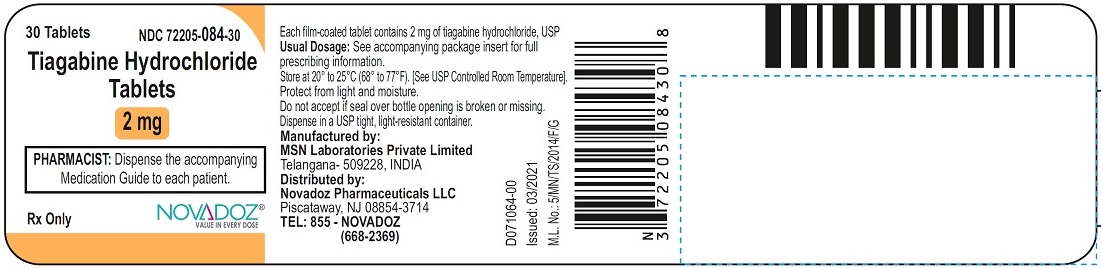
Tiagabine Hydrochloride 2 mg Tablet, 30-count — NDC 72205-084-30 (Billing 72205-0084-30)
This is a package of 30 tablets of Tiagabine Hydrochloride 2 mg Tablet from Novadoz Pharmaceuticals LLC, marketed since Nov 2021 and currently FDA-listed; retail pharmacies pay about $2.62 per tablet (NADAC). It is this product's only package size.
NDC database record
One package, one record: these facts belong to NDC 72205-084-30 alone.
- Record
- FDA NDC Directory package listing · Human prescription drug
- Code segments
- 72205 labeler · 084 product · 30 package
- Package marketed since
- Nov 23, 2021
- Sample package
- No — commercial package
- Listing certified through
- Dec 31, 2026
- Billing quantity
- 30 EA per package
- Barcode (UPC)
- 0372205086302, 0372205087309, 0372205085305, 0372205084308
- Medicaid fills, this package
- 472 prescriptions in the last four reported quarters
- FDA record last changed
- Jul 24, 2026
Identity & classification
Regulatory identifiers FDA, NLM and CMS codes for this package
Drug-database identifiers Medi-Span GPI and First Databank GCN / HICL / AHFS classification
- GSN (GCN sequence number): 044693
- GCN: 54681
- GPI-14 (Medi-Span): 72170070100302
- HICL (First Databank): 015773
- AHFS class code: 28:12.28.00
- RxCUI (RxNorm): 1299903
Where does this data come from?
- FDA openFDA NDC Directory · synced Oct 8, 2026
- FDA label on DailyMed · label index refreshed Oct 8, 2026
- RxNorm (NLM RxNav) · catalog refreshed Oct 1, 2026
- Medi-Span GPI (licensed)
- First Databank (licensed) · refreshed Oct 8, 2026
RxNorm drug class
This medicine belongs to the Anti-epileptic Agent class.
Where does this data come from?
- RxClass (NLM) · catalog refreshed Oct 1, 2026
Clinical
- It's an add-on medicine for partial seizures in adults and children 12 and older. You take it together with other seizure medicines, not by itself.
- Take it by mouth with food, usually split into two to four doses a day. Your doctor will increase your dose slowly. Follow your prescriber's directions exactly.
- Don't double up on the next one. Just take your next dose as scheduled. If you've missed several doses, call your doctor, since you may need to restart the build-up.
- No. Stopping suddenly can make seizures more frequent. If you need to stop, your doctor will lower the dose gradually.
Patient education
Supplement & herbal interactions
Tiagabine may be associated with lower levels of 1 nutrient — worth a chat with your pharmacist, not a cause for alarm.
Where does this data come from?
- MedlinePlus (NLM) · refreshed Oct 8, 2026
- FDA label on DailyMed · label index refreshed Oct 8, 2026
Ask a licensed pharmacist directly — free, answered by our team.
Pricing
A drug doesn't have one price. Each row is a different public payment system, and none is what you'd pay at the counter — that depends on your insurance. The ⓘ on each row explains what it measures.
| Price system | Per ea | Per package |
|---|---|---|
| Retail pharmacies payNADAC · weekly | $2.622 | $78.65 / 30 tablets |
| Medicaid paysCMS SDUD · 12 mo | $2.12 | $63.47 / 30 tablets |
| Medicare drug plans payPart D · Q2 2026 | $3.35 | $100.51 / 30 tablets |
Where does this data come from?
- CMS NADAC weekly file · file of Oct 7, 2026
- CMS ASP pricing files · refreshed Sep 20, 2026
- CMS Medicaid State Drug Utilization Data · through Q1 2026
- CMS Part D plan pricing files · refreshed Sep 24, 2026
- VA National Acquisition Center price file
Packaging — all sizes for this product
| Package NDC | Description | Marketing start | Marketing end | Status |
|---|---|---|---|---|
| 72205-0084-30 You're viewing this Main listing | 30 TABLET in 1 BOTTLE | 2021-11-23 | — | Active |
Therapeutic equivalents
| Product | Labeler | Pack | NADAC/unit | TE | Status | Price vs. this |
|---|---|---|---|---|---|---|
| Tiagabine Hydrochloride 2 mg 00093-5030-56 | Teva | 30 tablets | $2.622 | AB | Availability likely | — |
| Tiagabine Hydrochloride 2 mgthis 72205-0084-30 | Novadoz | 30 tablets | $2.622 | AB | Availability likely | — |
| Tiagabine Hydrochloride 2 mg 62756-0200-18 | Sun | 1000 tablets | — | — | FDA listed | — |
Where does this data come from?
- FDA openFDA NDC Directory · synced Oct 8, 2026
- FDA Orange Book · refreshed Oct 3, 2026
- CMS NADAC weekly file · file of Oct 7, 2026
Availability & generic status
This product is an FDA-approved generic. Other versions of the same drug are listed under Therapeutic equivalents, least expensive first.
Where does this data come from?
- FDA Orange Book · refreshed Oct 3, 2026
What it looks like
Where does this data come from?
- FDA label on DailyMed · label index refreshed Oct 8, 2026
Inactive Ingredients / Excipients
Inactive ingredients, also called excipients, are components of the drug product other than the active ingredient. They may include fillers, dyes, coatings, preservatives, flavors, or other formulation ingredients.
🧪 Avoiding an ingredient? See Tiagabine inactive ingredients by manufacturer: every current product's list side by side, so you can ask your pharmacy for the version that does not list it.
💡 Tap an ingredient (hover on desktop) to see what it is and why it’s used.
-
UNII 3SY5LH9PMK
Anhydrous lactose is a milk sugar with no water content. It acts as a filler and binder in tablets and capsules, adding bulk and helping ingredients stick together.
-
UNII REK4960K2U
Butylated hydroxyanisole is a synthetic preservative that prevents oils and fats in medicines from spoiling or becoming rancid. It keeps the medicine stable and extends its shelf life.
-
UNII OP1R32D61U
Microcrystalline cellulose is a purified form of cellulose, a natural fiber from plant sources. It acts as a binder and filler in tablets and capsules, helping hold ingredients together and give the medicine its shape and size.
-
UNII 68401960MK
Crospovidone is a synthetic polymer made from polyvinylpyrrolidone. It acts as a disintegrant, helping tablets break apart quickly in the stomach so the medicine dissolves and absorbs into the body.
-
UNII H77VEI93A8
A synthetic yellow dye used to color medications. It helps identify the drug and make it visually distinctive, with no effect on how the medicine works.
-
UNII Z82Y2C65EA
Hydrogenated cottonseed oil is a solid fat made by adding hydrogen to cottonseed oil. It's used in medicines as a binder and lubricant to help hold ingredients together and make tablets easier to compress and release.
-
UNII RFW2ET671P
Hydroxypropyl cellulose is a plant-derived thickening agent made from cellulose. It acts as a binder to hold tablet ingredients together and as a film-former to coat tablets or control how fast the medicine releases.
-
UNII 3NXW29V3WO
Hypromellose is a plant-based thickener made from cellulose. It's used in medicines as a binder to hold ingredients together, a coating for tablets, and a thickener for liquids.
-
UNII 70097M6I30
Magnesium stearate is a salt made from magnesium and stearic acid, a fatty substance. It's used in tablets and capsules as a lubricant and glidant to help ingredients flow smoothly during manufacturing and prevent sticking.
-
UNII ETJ7Z6XBU4
Silicon dioxide is a naturally occurring mineral used as a glidant and anti-caking agent. It helps powder ingredients flow smoothly and prevents clumping during manufacturing and storage.
-
UNII O8232NY3SJ
A plant-based carbohydrate derived from corn kernels. It acts as a filler to add bulk, a binder to hold ingredients together, and a disintegrant to help the tablet break apart in your stomach for absorption.
-
UNII 4ELV7Z65AP
Stearic acid is a fatty acid derived from plant or animal sources. It acts as a binder and lubricant in tablets and capsules, helping them hold together and flow smoothly during manufacturing.
-
UNII 15FIX9V2JP
Titanium dioxide is a bright white mineral powder commonly used as a colorant and opacifying agent. It makes pills and tablets white or lighter in color and helps make coatings non-transparent.
13 inactive ingredients listed in the exact product block matched to this NDC.
Where does this data come from?
ingredient classCode="IACT" elements from the exact product block matched by this NDC. Label-section narrative from DailyMed / the openFDA label index is shown separately when available.- FDA label on DailyMed · label index refreshed Oct 8, 2026
- FDA openFDA NDC Directory · synced Oct 8, 2026
Inactive ingredient FAQ
Are inactive ingredients the same for every manufacturer?
Why might an inactive ingredient be missing?
Can inactive ingredients matter?
Manufacturer & labeler
More NDCs from Novadoz Pharmaceuticals LLC labeler code 72205
- Pregabalin 165 mg Tablet, Film Coated, Extended Release NDC 72205-078-30
- Pregabalin 330 mg Tablet, Film Coated, Extended Release NDC 72205-079-30
- Erlotinib Hydrochloride 25 mg Tablet, Film Coated NDC 72205-080-30
- Erlotinib Hydrochloride 100 mg Tablet, Film Coated NDC 72205-081-30
- Erlotinib Hydrochloride 150 mg Tablet, Film Coated NDC 72205-082-30
- Fosaprepitant 150 mg/5mL Injection, Powder, Lyophilized, For Solution NDC 72205-083-01
- Tiagabine Hydrochloride 4 mg Tablet NDC 72205-085-30
- Tiagabine Hydrochloride 12 mg Tablet NDC 72205-086-30
- Tiagabine Hydrochloride 16 mg Tablet NDC 72205-087-30
- Doxepin Hydrochloride 10 mg Capsule NDC 72205-088-91
- Doxepin Hydrochloride 25 mg Capsule NDC 72205-089-91
- Doxepin Hydrochloride 50 mg Capsule NDC 72205-090-91
Where does this data come from?
- FDA openFDA NDC Directory · synced Oct 8, 2026
- Drugs@FDA
Full prescribing information FDA SPL
🎯 Indications and Usage ▾
INDICATIONS AND USAGE Tiagabine hydrochloride tablet is indicated as adjunctive therapy in adults and children 12 years and older in the treatment of partial seizures.
⏱️ Dosage and Administration ▾
DOSAGE AND ADMINISTRATION General: The blood level of tiagabine obtained after a given dose depends on whether the patient also is receiving a drug that induces the metabolism of tiagabine. The presence of an inducer means that the attained blood level will be substantially reduced. Dosing should take the presence of concomitant medications into account.
Tiagabine hydrochloride tablet is recommended as adjunctive therapy for the treatment of partial seizures in patients 12 years and older. The following dosing recommendations apply to all patients taking tiagabine hydrochloride tablets: Tiagabine hydrochloride tablet is given orally and should be taken with food. Do not use a loading dose of tiagabine hydrochloride tablets.
Dose titration: Rapid escalation and/or large dose increments of tiagabine hydrochloride tablets should not be used. Missed dose(s): If the patient forgets to take the prescribed dose of tiagabine hydrochloride tablets at the scheduled time, the patient should not attempt to make up for the missed dose by increasing the next dose. If a patient has missed multiple doses, patient should refer back to his or her physician for possible re-titration as clinically indicated.
Dosage adjustment of tiagabine hydrochloride tablets should be considered whenever a change in patient’s enzyme-inducing status occurs as a result of the addition, discontinuation, or dose change of the enzyme-inducing agent. Induced Adults and Adolescents 12 Years or Older: The following dosing recommendations apply to patients who are already taking enzyme-inducing antiepilepsy drugs (AEDs) (e.g., carbamazepine, phenytoin, primidone, and phenobarbital). Such patients are considered induced patients when administering tiagabine hydrochloride tablets.
In adolescents 12 to 18 years old, tiagabine hydrochloride tablets should be initiated at 4 mg once daily. Modification of concomitant antiepilepsy drugs is not necessary, unless clinically indicated. The total daily dose of tiagabine hydrochloride tablets may be increased by 4 mg at the beginning of Week 2.
Thereafter, the total daily dose may be increased by 4 to 8 mg at weekly intervals until clinical response is achieved or up to 32 mg/day. The total daily dose should be given in divided doses two to four times daily. Doses above 32 mg/day have been tolerated in a small number of adolescent patients for a relatively short duration.
In adults, tiagabine hydrochloride tablets should be initiated at 4 mg once daily. Modification of concomitant antiepilepsy drugs is not necessary, unless clinically indicated. The total daily dose of tiagabine hydrochloride tablets may be increased by 4 to 8 mg at weekly intervals until clinical response is achieved or, up to 56 mg/day.
The total daily dose should be given in divided doses two to four times daily. Doses above 56 mg/day have not been systematically evaluated in adequate and well-controlled clinical trials. Experience is limited in patients taking total daily doses above 32 mg/day using twice daily dosing.
A typical dosing titration regimen for patients taking enzyme-inducing AEDs (induced patients) is provided in Table 7. Table7: Typical Dosing Titration Regimen for Patients Already Taking Enzyme-Inducing AEDs Initiation and Titration Schedule Total Daily Dose Week 1 Initiate at 4 mg once daily 4 mg/day Week 2 Increase total daily dose by 4 mg 8 mg/day (in two divided doses) Week 3 Increase total daily dose by 4 mg 12 mg/day (in three divided doses) Week 4 Increase total daily dose by 4 mg 16 mg/day (in two to four divided doses) Week 5 Increase total daily dose by 4 to 8 mg 20 to 24 mg/day (in two to four divided doses) Week 6 Increase total daily dose by 4 to 8 mg 24 to 32 mg/day (in two to four divided doses) Usual Adult Maintenance Dose in Induced Patients: 32 to 56 mg/day in two to four divided doses Non-Induced Adults and Adolescents 12 Years or Older: The following dosing recommendations apply to patients who are taking only non-enzyme-indu… [Excerpted — this section continues on DailyMed.]
⛔ Contraindications ▾
CONTRAINDICATIONS Tiagabine hydrochloride is contraindicated in patients who have demonstrated hypersensitivity to the drug or its ingredients.
⚠️ Warnings ▾
WARNINGS Seizures in Patients Without Epilepsy: Post-marketing reports have shown that tiagabine hydrochloride use has been associated with new onset seizures and status epilepticus in patients without epilepsy. Dose may be an important predisposing factor in the development of seizures, although seizures have been reported in patients taking daily doses of tiagabine hydrochloride as low as 4 mg/day. In most cases, patients were using concomitant medications (antidepressants, antipsychotics, stimulants, narcotics) that are thought to lower the seizure threshold.
Some seizures occurred near the time of a dose increase, even after periods of prior stable dosing. The tiagabine hydrochloride dosing recommendations in current labeling for treatment of epilepsy were based on use in patients with partial seizures 12 years of age and older, most of whom were taking enzyme-inducing antiepileptic drugs (AEDs; e.g., carbamazepine, phenytoin, primidone and phenobarbital) which lower plasma levels of tiagabine hydrochloride by inducing its metabolism. Use of tiagabine hydrochloride without enzyme-inducing antiepileptic drugs results in blood levels about twice those attained in the studies on which current dosing recommendations are based (see DOSAGE AND ADMINISTRATION).
Safety and effectiveness of tiagabine hydrochloride have not been established for any indication other than as adjunctive therapy for partial seizures in adults and children 12 years and older. In nonepileptic patients who develop seizures while on tiagabine hydrochloride treatment, tiagabine hydrochloride should be discontinued and patients should be evaluated for an underlying seizure disorder. Seizures and status epilepticus are known to occur with tiagabine hydrochloride overdosage (see OVERDOSAGE).
Suicidal Behavior and Ideation: Antiepileptic drugs (AEDs), including tiagabine hydrochloride, increase the risk of suicidal thoughts or behavior in patients taking these drugs for any indication. Patients treated with any AED for any indication should be monitored for the emergence or worsening of depression, suicidal thoughts or behavior, and/or any unusual changes in mood or behavior. Pooled analyses of 199 placebo-controlled clinical trials (mono- and adjunctive therapy) of 11 different AEDs showed that patients randomized to one of the AEDs had approximately twice the risk (adjusted Relative Risk 1.8, 95% CI:1.2, 2.7) of suicidal thinking or behavior compared to patients randomized to placebo.
In these trials, which had a median treatment duration of 12 weeks, the estimated incidence rate of suicidal behavior or ideation among 27,863 AED-treated patients was 0.43%, compared to 0.24% among 16,029 placebo-treated patients, representing an increase of approximately one case of suicidal thinking or behavior for every 530 patients treated. There were four suicides in drug-treated patients in the trials and none in placebo-treated patients, but the number is too small to allow any conclusion about drug effect on suicide.
The increased risk of suicidal thoughts or behavior with AEDs was observed as early as one week after starting drug treatment with AEDs and persisted for the duration of treatment assessed. Because most trials included in the analysis did not extend beyond 24 weeks, the risk of suicidal thoughts or behavior beyond 24 weeks could not be assessed. The risk of suicidal thoughts or behavior was generally consistent among drugs in the data analyzed.
The finding of increased risk with AEDs of varying mechanisms of action and across a range of indications suggests that the risk applies to all AEDs used for any indication. The risk did not vary substantially by age (5-100 years) in the clinical trials analyzed. Table 4 shows absolute and relative risk by indication for all evaluated AEDs.
Table 4: Risk by Indication for Antiepileptic Drugs in the Pooled Analysis Indication Placebo Patients with Events per 1,000 Patients Drug Patients with Events per 1,000 Patients R… [Excerpted — this section continues on DailyMed.]
🤒 Adverse Reactions ▾
ADVERSE REACTIONS The most commonly observed adverse events in placebo-controlled, parallel-group, add-on epilepsy trials associated with the use of tiagabine hydrochloride in combination with other antiepilepsy drugs not seen at an equivalent frequency among placebo-treated patients were dizziness/light-headedness, asthenia/lack of energy, somnolence, nausea, nervousness/irritability, tremor, abdominal pain, and thinking abnormal/difficulty with concentration or attention. Approximately 21% of the 2531 patients who received tiagabine hydrochloride in clinical trials of epilepsy discontinued treatment because of an adverse event.
The adverse events most commonly associated with discontinuation were dizziness (1.7%), somnolence (1.6%), depression (1.3%), confusion (1.1%), and asthenia (1.1%). In Studies 1 and 2 (U.S. studies), the double-blind, placebo-controlled, parallel-group, add-on studies, the proportion of patients who discontinued treatment because of adverse events was 11% for the group treated with tiagabine hydrochloride and 6% for the placebo group. The most common adverse events considered the primary reason for discontinuation were confusion (1.2%), somnolence (1.0%), and ataxia (1.0%).
Adverse Event Incidence in Controlled Clinical Trials: Table 5 lists treatment-emergent signs and symptoms that occurred in at least 1% of patients treated with tiagabine hydrochloride for epilepsy participating in parallel-group, placebo-controlled trials and were numerically more common in the tiagabine hydrochloride group. In these studies, either tiagabine hydrochloride or placebo was added to the patient’s current antiepilepsy drug therapy. Adverse events were usually mild or moderate in intensity.
The prescriber should be aware that these figures, obtained when tiagabine hydrochloride was added to concurrent antiepilepsy drug therapy, cannot be used to predict the frequency of adverse events in the course of usual medical practice when patient characteristics and other factors may differ from those prevailing during clinical studies. Similarly, the cited frequencies cannot be directly compared with figures obtained from other clinical investigations involving different treatments, uses, or investigators. An inspection of these frequencies, however, does provide the prescribing physician with one basis to estimate the relative contribution of drug and non-drug factors to the adverse event incidences in the population studied.
Table 5: Treatment-Emergent Adverse Event1 Incidence in Parallel-Group, Placebo-Controlled, Add-On Trials (events in at least 1% of patients treated with Tiagabine Hydrochloride and numerically more frequent than in the placebo group) Body System/COSTART Tiagabine Hydrochloride N=494 % Placebo N=275 % Body as a Whole Abdominal Pain 7 3 Pain (Unspecified) 5 3 Cardiovascular Vasodilation 2 1 Digestive Nausea 11 9 Diarrhea 7 3 Vomiting 7 4 Increased Appetite 2 0 Mouth Ulceration 1 0 Musculoskeletal Myasthenia 1 0 Nervous System Dizziness 27 15 Asthenia 20 14 Somnolence 18 15 Nervousness 10 3 Tremor 9 3 Difficulty with Concentration/Attention* 6 2 Insomnia 6 4 Ataxia 5 3 Confusion 5 3 Speech Disorder 4 2 Difficulty with Memory* 4 3 Paresthesia 4 2 Depression 3 1 Emotional Lability 3 2 Abnormal Gait 3 2 Hostility 2 1 Nystagmus 2 1 Language Problems* 2 0 Agitation 1 0 Respiratory System Pharyngitis 7 4 Cough Increased 4 3 Skin and Appendages Rash 5 4 Pruritus 2 0 1 Patients in these add-on studies were receiving one to three concomitant enzyme-inducing antiepilepsy drugs in addition to tiagabine hydrochloride or placebo.
Patients may have reported multiple adverse experiences; thus, patients may be included in more than one category. *COSTART term substituted with a more clinically descriptive term. Other events reported by 1% or more of patients treated with tiagabine hydrochloride but equally or more frequent in the placebo group were: accidental injury, chest pain, constipation, flu syndrome, rhinitis, anor… [Excerpted — this section continues on DailyMed.]
🔄 Drug Interactions ▾
Drug Interactions In evaluating the potential for interactions among co-administered antiepilepsy drugs (AEDs), whether or not an AED induces or does not induce metabolic enzymes is an important consideration. Carbamazepine, phenytoin, primidone, and phenobarbital are generally classified as enzyme inducers; valproate and gabapentin are not. Tiagabine hydrochloride is considered to be a non-enzyme inducing AED (see PRECAUTIONS, General, Use in Non-Induced Patients ).
The drug interaction data described in this section were obtained from studies involving either healthy subjects or patients with epilepsy. Effects of Tiagabine Hydrochloride on other Antiepilepsy Drugs (AEDs): Phenytoin: Tiagabine had no effect on the steady-state plasma concentrations of phenytoin in patients with epilepsy. Carbamazepine: Tiagabine had no effect on the steady-state plasma concentrations of carbamazepine or its epoxide metabolite in patients with epilepsy.
Valproate: Tiagabine causes a slight decrease (about 10%) in steady-state valproate concentrations. Phenobarbital or Primidone: No formal pharmacokinetic studies have been performed examining the addition of tiagabine to regimens containing phenobarbital or primidone. The addition of tiagabine in a limited number of patients in three well-controlled studies caused no systematic changes in phenobarbital or primidone concentrations when compared to placebo.
Effects of other Antiepilepsy Drugs (AEDs) on Tiagabine Hydrochloride: Carbamazepine: Population pharmacokinetic analyses indicate that tiagabine clearance is 60% greater in patients taking carbamazepine with or without other enzyme-inducing AEDs. Phenytoin: Population pharmacokinetic analyses indicate that tiagabine clearance is 60% greater in patients taking phenytoin with or without other enzyme-inducing AEDs. Phenobarbital (Primidone): Population pharmacokinetic analyses indicate that tiagabine clearance is 60% greater in patients taking phenobarbital (primidone) with or without other enzyme-inducing AEDs.
Valproate: The addition of tiagabine to patients taking valproate chronically had no effect on tiagabine pharmacokinetics, but valproate significantly decreased tiagabine binding in vitro from 96.3 to 94.8%, which resulted in an increase of approximately 40% in the free tiagabine concentration. The clinical relevance of this in vitro finding is unknown. Interaction of Tiagabine Hydrochloride with Other Drugs: Cimetidine: Co-administration of cimetidine (800 mg/day) to patients taking tiagabine chronically had no effect on tiagabine pharmacokinetics.
Theophylline: A single 10 mg dose of tiagabine did not affect the pharmacokinetics of theophylline at steady state. Warfarin: No significant differences were observed in the steady-state pharmacokinetics of R-warfarin or S-warfarin with the addition of tiagabine given as a single dose. Prothrombin times were not affected by tiagabine.
Digoxin: Concomitant administration of tiagabine did not affect the steady-state pharmacokinetics of digoxin or the mean daily trough serum level of digoxin. Ethanol or Triazolam: No significant differences were observed in the pharmacokinetics of triazolam (0.125 mg) and tiagabine (10 mg) when given together as a single dose. The pharmacokinetics of ethanol were not affected by multiple-dose administration of tiagabine.
Tiagabine has shown no clinically important potentiation of the pharmacodynamic effects of triazolam or alcohol. Because of the possible additive effects of drugs that may depress the nervous system, ethanol or triazolam should be used cautiously in combination with tiagabine. Oral Contraceptives: Multiple dose administration of tiagabine (8 mg/day monotherapy) did not alter the pharmacokinetics of oral contraceptives in healthy women of child-bearing age.
Antipyrine: Antipyrine pharmacokinetics were not significantly different before and after tiagabine multiple-dose regimens. This indicates that tiagabine does not cause induction or inhibition… [Excerpted — this section continues on DailyMed.]
🤰 Pregnancy ▾
Pregnancy: Tiagabine has been shown to have adverse effects on embryo-fetal development, including teratogenic effects, when administered to pregnant rats and rabbits at doses greater than the human therapeutic dose. An increased incidence of malformed fetuses (various craniofacial, appendicular, and visceral defects) and decreased fetal weights were observed following oral administration of 100 mg/kg/day to pregnant rats during the period of organogenesis. This dose is approximately 16 times the maximum recommended human dose (MRHD) of 56 mg/day, based on body surface area (mg/m 2 ).
Maternal toxicity (transient weight loss/reduced maternal weight gain during gestation) was associated with this dose, but there is no evidence to suggest that the teratogenic effects were secondary to the maternal effects. No adverse maternal or embryo-fetal effects were seen at a dose of 20 mg/kg/day (3 times the MRHD on a mg/m 2 basis). Decreased maternal weight gain, increased resorption of embryos and increased incidences of fetal variations, but not malformations, were observed when pregnant rabbits were given 25 mg/kg/day (8 times the MRHD on a mg/m 2 basis) during organogenesis.
The no effect level for maternal and embryo-fetal toxicity in rabbits was 5 mg/kg/day (equivalent to the MRHD on a mg/m 2 basis). When female rats were given tiagabine 100 mg/kg/day during late gestation and throughout parturition and lactation, decreased maternal weight gain during gestation, an increase in stillbirths, and decreased postnatal offspring viability and growth were found. There are no adequate and well-controlled studies in pregnant women.
Tiagabine should be used during pregnancy only if clearly needed. To provide additional information regarding the effects of in utero exposure to tiagabine hydrochloride, physicians are advised to recommend that pregnant patients taking tiagabine hydrochloride enroll in the NAAED Pregnancy Registry. This can be done by calling the toll free number 1-888-233-2334, and must be done by patients themselves.
Information on the registry can also be found at the website http://www.aedpregnancyregistry.org/. Use in Nursing Mothers: Studies in rats have shown that tiagabine HCl and/or its metabolites are excreted in the milk of that species. Levels of excretion of tiagabine and/or its metabolites in human milk have not been determined and effects on the nursing infant are unknown.
Tiagabine hydrochloride should be used in women who are nursing only if the benefits clearly outweigh the risks.
🧒 Pediatric Use ▾
Pediatric Use: Safety and effectiveness in pediatric patients below the age of 12 have not been established. The pharmacokinetics of tiagabine were evaluated in pediatric patients age 3 to 10 years (see CLINICAL PHARMACOLOGY, Special Populations, Pediatric ).
🧓 Geriatric Use ▾
Geriatric Use: Because few patients over the age of 65 (approximately 20) were exposed to tiagabine hydrochloride during its clinical evaluation, no specific statements about the safety or effectiveness of tiagabine hydrochloride in this age group could be made.
🆘 Overdosage ▾
OVERDOSAGE Human Overdose Experience: Human experience of acute overdose with tiagabine hydrochloride is limited. Eleven patients in clinical trials took single doses of tiagabine hydrochloride up to 800 mg. All patients fully recovered, usually within one day.
The most common symptoms reported after overdose included somnolence, impaired consciousness, agitation, confusion, speech difficulty, hostility, depression, weakness, and myoclonus. One patient who ingested a single dose of 400 mg experienced generalized tonic-clonic status epilepticus, which responded to intravenous phenobarbital. From post-marketing experience, reports of overdose involving tiagabine hydrochloride alone have included cases in which patients required intubation and ventilatory support as part of the management of their status epilepticus.
Overdoses involving multiple drugs, including tiagabine hydrochloride, have resulted in fatal outcomes. Symptoms most often accompanying tiagabine hydrochloride overdose, alone or in combination with other drugs, have included: seizures including status epilepticus in patients with and without underlying seizure disorders, nonconvulsive status epilepticus, respiratory arrest, coma, loss of consciousness, ataxia, dizziness, confusion, somnolence, drowsiness, impaired speech, aggression, agitation, lethargy, myoclonus, spike wave stupor, encephalopathy, amnesia, dyskinesia, tremors, disorientation, psychotic disorder, vomiting, hostility, and temporary paralysis.
Respiratory depression was seen in a number of patients, including children, in the context of seizures. Management of Overdose: There is no specific antidote for overdose with tiagabine hydrochloride. If indicated, elimination of unabsorbed drug should be achieved by emesis or gastric lavage; usual precautions should be observed to maintain the airway.
General supportive care of the patient is indicated including monitoring of vital signs and observation of clinical status of the patient. Since tiagabine is mostly metabolized by the liver and is highly protein bound, dialysis is unlikely to be beneficial. A Certified Poison Control Center should be consulted for up to date information on the management of overdose with tiagabine hydrochloride.
🧬 Clinical Pharmacology ▾
CLINICAL PHARMACOLOGY Mechanism of Action The precise mechanism by which tiagabine exerts its antiseizure effect is unknown, although it is believed to be related to its ability, documented in in vitro experiments, to enhance the activity of gamma aminobutyric acid (GABA), the major inhibitory neurotransmitter in the central nervous system. These experiments have shown that tiagabine binds to recognition sites associated with the GABA uptake carrier. It is thought that, by this action, tiagabine blocks GABA uptake into presynaptic neurons, permitting more GABA to be available for receptor binding on the surfaces of post-synaptic cells.
Inhibition of GABA uptake has been shown for synaptosomes, neuronal cell cultures, and glial cell cultures. In rat-derived hippocampal slices, tiagabine has been shown to prolong GABA-mediated inhibitory post-synaptic potentials. Tiagabine increases the amount of GABA available in the extracellular space of the globus pallidus, ventral palladum, and substantia nigra in rats at the ED 50 and ED 85 doses for inhibition of pentylenetetrazol (PTZ)induced tonic seizures.
This suggests that tiagabine prevents the propagation of neural impulses that contribute to seizures by a GABA-ergic action. Tiagabine has shown efficacy in several animal models of seizures. It is effective against the tonic phase of subcutaneous PTZ-induced seizures in mice and rats, seizures induced by the proconvulsant DMCM in mice, audiogenic seizures in genetically epilepsy-prone rats (GEPR), and amygdala-kindled seizures in rats.
Tiagabine has little efficacy against maximal electroshock seizures in rats and is only partially effective against subcutaneous PTZ-induced clonic seizures in mice, picrotoxin-induced tonic seizures in the mouse, bicuculline-induced seizures in the rat, and photic seizures in photosensitive baboons. Tiagabine produces a biphasic dose-response curve against PTZ- and DMCM-induced convulsions, with attenuated effectiveness at higher doses. Based on in vitro binding studies, tiagabine does not significantly inhibit the uptake of dopamine, norepinephrine, serotonin, glutamate, or choline and shows little or no binding to dopamine D1 and D2, muscarinic, serotonin 5HT 1A , 5HT 2 , and 5HT 3 , beta-1 and 2 adrenergic, alpha-1 and alpha-2 adrenergic, histamine H2 and H3, adenosine A 1 and A 2 , opiate µ and K 1 , NMDA glutamate, and GABA A receptors at 100 µM.
It also lacks significant affinity for sodium or calcium channels. Tiagabine binds to histamine H1, serotonin 5HT 1B , benzodiazepine, and chloride channel receptors at concentrations 20 to 400 times those inhibiting the uptake of GABA. Pharmacokinetics Tiagabine is well absorbed, with food slowing absorption rate but not altering the extent of absorption.
The elimination half-life of tiagabine is 7 to 9 hours in normal volunteers. In epilepsy clinical trials, most patients were receiving hepatic enzyme-inducing agents (e.g., carbamazepine, phenytoin, primidone, and phenobarbital). The pharmacokinetic profile in induced patients is significantly different from the non-induced population (see PRECAUTIONS, General, Use in Non-Induced Patients ).
The systemic clearance of tiagabine in induced patients is approximately 60% greater resulting in considerably lower plasma concentrations and an elimination half-life of 2 to 5 hours. Given this difference in clearance, the systemic exposure after a dose of 32 mg/day in an induced population is expected to be comparable to the systemic exposure after a dose of 12 mg/day in a non-induced population. Similarly, the systemic exposure after a dose of 56 mg/day in an induced population is expected to be comparable to the systemic exposure after a dose of 22 mg/day in a non-induced population.
Absorption and Distribution: Absorption of tiagabine is rapid, with peak plasma concentrations occurring at approximately 45 minutes following an oral dose in the fasting state. Tiagabine is nearly completely absorbed (>95%), wi… [Excerpted — this section continues on DailyMed.]
📦 How Supplied / Storage and Handling ▾
HOW SUPPLIED Tiagabine hydrochloride tablets are available in four dosage strengths. 2 mg light orange-peach colored, round shaped, biconvex film-coated tablets debossed with “MT” on one side and “3” on the other side, are available in bottles of 30 (NDC 72205-084-30). 4 mg yellow colored, round shaped, biconvex film-coated tablets debossed with “MT” on one side and “4” on the other side, are available in bottles of 30 (NDC 72205-085-30).
12 mg green colored, capsule shaped, biconvex film-coated tablets debossed with “MT” on one side and “5” on the other side, are available in bottles of 30 (NDC 72205-086-30). 16 mg blue colored, capsule shaped, biconvex film-coated tablets debossed with “MT” on one side and “6” on the other side, are available in bottles of 30 (NDC 72205-087-30). Recommended Storage: Store at 20° to 25°C (68° to 77°F). [See USP Controlled Room Temperature].
Protect from light and moisture.
📋 Description ▾
DESCRIPTION Tiagabine hydrochloride USP is an antiepilepsy drug available as 2 mg, 4 mg, 12 mg, and 16 mg tablets for oral administration. Its chemical name is (-)-(R)-1-[4,4-Bis(3-methyl-2-thienyl)-3 butenyl]nipecotic acid hydrochloride, its molecular formula is C 20 H 25 NO 2 S 2 HCl, and its molecular weight is 412.01. Tiagabine HCl, USP is a white to off-white powder.
It is freely soluble in methanol and in alcohol, soluble in 5% Water in isopropanol, very slightly soluble in chloroform, sparingly soluble in water and practically insoluble in n-Heptane. The structural formula is: Inactive Ingredients Tiagabine hydrochloride tablets contain the following inactive ingredients: Butylated hydroxyanisole, colloidal silicon dioxide, crospovidone, hydrogenated vegetable oil (cottonseed oil), hydroxypropyl cellulose, hypromellose, lactose anhydrous, magnesium stearate, microcrystalline cellulose, pregelatinized starch, stearic acid and titanium dioxide.
In addition, individual tablets contain: 2 mg tablets: FD&C yellow No. 6 aluminum lake 4 mg tablets: D&C yellow No. 10 aluminum lake 12 mg tablets: D&C yellow No.
10 aluminum lake and FD&C Blue No. 1 aluminum lake 16 mg tablets: FD&C blue No. 2 aluminum lake tia-str
💬 Information for Patients ▾
Information for Patients Patients should be informed of the availability of a Medication Guide, and they should be instructed to read it prior to taking tiagabine hydrochloride. The complete text of the Medication Guide is provided at the end of this labeling. Suicidal Thinking and Behavior - Patients, their caregivers, and families should be counseled that AEDs, including tiagabine hydrochloride, may increase the risk of suicidal thoughts and behavior and should be advised of the need to be alert for the emergence or worsening of symptoms of depression, any unusual changes in mood or behavior, or the emergence of suicidal thoughts, behavior, or thoughts about self-harm.
Behaviors of concern should be reported immediately to healthcare providers. Patients should be advised that tiagabine hydrochloride may cause dizziness, somnolence, and other symptoms and signs of CNS depression. Accordingly, patients should be advised neither to drive nor to operate other complex machinery until they have gained sufficient experience on tiagabine hydrochloride to gauge whether or not it affects their mental and/or motor performance adversely.
Because of the possible additive depressive effects, caution should also be used when patients are taking other CNS depressants in combination with tiagabine hydrochloride. Because teratogenic effects were seen in the offspring of rats exposed to maternally toxic doses of tiagabine and because experience in humans is limited, patients should be advised to notify their physicians if they become pregnant or intend to become pregnant during therapy. Because of the possibility that tiagabine may be excreted in breast milk, patients should be advised to notify those providing care to themselves and their children if they intend to breast- feed or are breast-feeding an infant.
Patients should be encouraged to enroll in the North American Antiepileptic Drug (NAAED) Pregnancy Registry if they become pregnant. This registry is collecting information about the safety of antiepileptic drugs during pregnancy. To enroll, patients can call the toll free number 1-888-233-2334 (see PRECAUTIONS, Pregnancy ).
⚠️ Precautions ▾
PRECAUTIONS General Use in Non-Induced Patients: Virtually all experience with tiagabine hydrochloride has been obtained in patients with epilepsy receiving at least one concomitant enzyme-inducing antiepilepsy drug (AED), which lowers the plasma levels of tiagabine. Use in non-induced patients requires lower doses of tiagabine hydrochloride. These patients may also require a slower titration of tiagabine hydrochloride compared to that of induced patients (see DOSAGE AND ADMINISTRATION ).
Patients taking a combination of inducing and non-inducing agents (e.g., carbamazepine and valproate) should be considered to be induced. Patients not receiving hepatic enzyme-inducing agents are referred to as non-induced patients. Generalized Weakness: Moderately severe to incapacitating generalized weakness has been reported following administration of tiagabine hydrochloride in 28 of 2531 (approximately 1%) patients with epilepsy.
The weakness resolved in all cases after a reduction in dose or discontinuation of tiagabine hydrochloride. Binding in the Eye and Other Melanin-Containing Tissues: When dogs received a single dose of radiolabeled tiagabine, there was evidence of residual binding in the retina and uvea after 3 weeks (the latest time point measured). Although not directly measured, melanin binding is suggested.
The ability of available tests to detect potentially adverse consequences, if any, of the binding of tiagabine to melanin-containing tissue is unknown and there was no systematic monitoring for relevant ophthalmological changes during the clinical development of tiagabine hydrochloride. However, long term (up to one year) toxicological studies of tiagabine in dogs showed no treatment-related ophthalmoscopic changes and macro- and microscopic examinations of the eye were unremarkable. Accordingly, although there are no specific recommendations for periodic ophthalmologic monitoring, prescribers should be aware of the possibility of long-term ophthalmologic effects.
Use in Hepatically-Impaired Patients: Because the clearance of tiagabine is reduced in patients with liver disease, dosage reduction may be necessary in these patients. Serious Rash: Four patients treated with tiagabine during the product’s premarketing clinical testing developed what were considered to be serious rashes. In two patients, the rash was described as maculopapular; in one it was described as vesiculobullous; and in the 4th case, a diagnosis of Stevens Johnson syndrome was made.
In none of the 4 cases is it certain that tiagabine was the primary, or even a contributory, cause of the rash. Nevertheless, drug associated rash can, if extensive and serious, cause irreversible morbidity, even death. Information for Patients Patients should be informed of the availability of a Medication Guide, and they should be instructed to read it prior to taking tiagabine hydrochloride.
The complete text of the Medication Guide is provided at the end of this labeling. Suicidal Thinking and Behavior - Patients, their caregivers, and families should be counseled that AEDs, including tiagabine hydrochloride, may increase the risk of suicidal thoughts and behavior and should be advised of the need to be alert for the emergence or worsening of symptoms of depression, any unusual changes in mood or behavior, or the emergence of suicidal thoughts, behavior, or thoughts about self-harm. Behaviors of concern should be reported immediately to healthcare providers.
Patients should be advised that tiagabine hydrochloride may cause dizziness, somnolence, and other symptoms and signs of CNS depression. Accordingly, patients should be advised neither to drive nor to operate other complex machinery until they have gained sufficient experience on tiagabine hydrochloride to gauge whether or not it affects their mental and/or motor performance adversely. Because of the possible additive depressive effects, caution should also be used when patients are taking other CNS depressants in com… [Excerpted — this section continues on DailyMed.]
🔒 Drug Abuse and Dependence ▾
DRUG ABUSE AND DEPENDENCE The abuse and dependence potential of tiagabine hydrochloride have not been evaluated in human studies.
📄 Carcinogenesis, Mutagenesis, Impairment of Fertility ▾
Carcinogenesis, Mutagenesis, Impairment of Fertility Carcinogenesis: In rats, a study of the potential carcinogenicity associated with tiagabine HCl administration showed that 200 mg/kg/day (plasma exposure [AUC] 36 to 100 times that at the maximum recommended human dosage [MRHD] of 56 mg/day) for 2 years resulted in small, but statistically significant increases in the incidences of hepatocellular adenomas in females and Leydig cell tumors of the testis in males. The significance of these findings relative to the use of tiagabine hydrochloride in humans is unknown.
The no effect dosage for induction of tumors in this study was 100 mg/kg/day (17 to 50 times the exposure at the MRHD). No statistically significant increases in tumor formation were noted in mice at dosages up to 250 mg/kg/day (20 times the MRHD on a mg/m 2 basis). Mutagenesis: Tiagabine produced an increase in structural chromosome aberration frequency in human lymphocytes in vitro in the absence of metabolic activation.
No increase in chromosomal aberration frequencies was demonstrated in this assay in the presence of metabolic activation. No evidence of genetic toxicity was found in the in vitro bacterial gene mutation assays, the in vitro HGPRT forward mutation assay in Chinese hamster lung cells, the in vivo mouse micronucleus test, or an unscheduled DNA synthesis assay. Impairment of Fertility: Studies of male and female rats administered dosages of tiagabine HCl prior to and during mating, gestation, and lactation have shown no impairment of fertility at doses up to 100 mg/kg/day.
This dose represents approximately 16 times the maximum recommended human dose (MRHD) of 56 mg/day, based on body surface area (mg/m 2 ). Lowered maternal weight gain and decreased viability and growth in the rat pups were found at 100 mg/kg, but not at 20 mg/kg/day (3 times the MRHD on a mg/m 2 basis).
📄 Package Label / Principal Display Panel ▾
PACKAGE LABEL.PRINCIPAL DISPLAY PANEL Tiagabine hydrochloride tablets 2 mg bottles of 30 container Tiagabine hydrochloride tablets 4 mg bottles of 30 container Tiagabine hydrochloride tablets 12 mg bottles of 30 container Tiagabine hydrochloride tablets 16 mg bottles of 30 container 2mg-30s-cntr-label 4mg-30s-cntr-label 12mg-30s-cntr-label 16mg-30s-cntr-label