
PEDMARK SODIUM THIOSULFATE 12.5 g/100mL Injection, Solution — NDC 73077-010-01 (Billing 73077-0010-01)
This is a package of PEDMARK SODIUM THIOSULFATE 12.5 g/100mL Injection, Solution from Fennec Pharmaceuticals Inc., marketed since Oct 2022 and currently FDA-listed. It is this product's only package size.
NDC database record
One package, one record: these facts belong to NDC 73077-010-01 alone.
- Record
- FDA NDC Directory package listing · Human prescription drug
- Code segments
- 73077 labeler · 010 product · 01 package
- Package marketed since
- Oct 3, 2022
- Sample package
- No — commercial package
- Listing certified through
- Dec 31, 2026
- Barcode (UPC-A, from the NDC)
- 3 7307701001 3
- Medicaid fills, this package
- 42 prescriptions in the last four reported quarters
- FDA record last changed
- Jul 24, 2026
Identity & classification
Regulatory identifiers FDA, NLM and CMS codes for this package
Drug-database identifiers Medi-Span GPI and First Databank GCN / HICL / AHFS classification
- GSN (GCN sequence number): 083866
- GCN: 52939
- GPI-14 (Medi-Span): 21757375602020
- HICL (First Databank): 001108
- AHFS class code: 91:04.12.00
- RxCUI (RxNorm): 2618749
Where does this data come from?
- FDA openFDA NDC Directory · synced Oct 8, 2026
- FDA label on DailyMed · label index refreshed Oct 6, 2026
- RxNorm (NLM RxNav) · catalog refreshed Oct 1, 2026
- Medi-Span GPI (licensed)
- First Databank (licensed) · refreshed Oct 8, 2026
RxNorm drug class
This medicine belongs to the Antidotes class.
Where does this data come from?
- RxClass (NLM) · catalog refreshed Oct 1, 2026
Clinical
Patient education
Supplement & herbal interactions
Some supplements/herbs that may interact with Sodium Thiosulfate — tap one for details:
Where does this data come from?
- MedlinePlus (NLM) · refreshed Oct 1, 2026
- FDA label on DailyMed · label index refreshed Oct 6, 2026
Ask a licensed pharmacist directly — free, answered by our team.
Pricing
A drug doesn't have one price. Each row is a different public payment system, and none is what you'd pay at the counter — that depends on your insurance. The ⓘ on each row explains what it measures.
| Price system | Per mL | Per package |
|---|---|---|
| Retail pharmacies payNADAC · weekly | Not in the retail survey — common for institutional, discontinued, or low-volume packs. | |
| Medicaid paysCMS SDUD · 12 mo | $115.10 | $11,510.14 / 100 ml |
| Medicare drug plans payPart D · quarterly | No Part D plan price is available for this NDC in our data. | |
| Medicare Part B allowsASP · J0208 | No ASP payment limit on file for J0208 this quarter. | |
Where does this data come from?
- CMS NADAC weekly file
- CMS ASP pricing files · refreshed Sep 20, 2026
- CMS Medicaid State Drug Utilization Data · through Q1 2026
- CMS Part D plan pricing files · refreshed Sep 24, 2026
- VA National Acquisition Center price file
Billing & reimbursement
Where does this data come from?
- CMS ASP NDC-HCPCS crosswalk · refreshed Sep 22, 2026
- DMEPDAC NDC-HCPCS crosswalk
- openFDA NSDE billing units · refreshed Oct 7, 2026
Packaging — all sizes for this product
| Package NDC | Description | Marketing start | Marketing end | Status |
|---|---|---|---|---|
| 73077-0010-01 You're viewing this Main listing | 1 VIAL, SINGLE-DOSE in 1 BOX, UNIT-DOSE / 100 mL in 1 VIAL, SINGLE-DOSE | 2022-10-03 | — | Active |
Therapeutic equivalents
| Product | Labeler | Pack | NADAC/unit | TE | Status | Price vs. this |
|---|---|---|---|---|---|---|
| Pedmark 12.5 g/100mLthis 73077-0010-01 | Fennec | 1 vial | — | — | FDA listed | — |
Where does this data come from?
- FDA openFDA NDC Directory · synced Oct 8, 2026
- FDA Orange Book · refreshed Oct 3, 2026
- CMS NADAC weekly file
Availability & generic status
We did not find an FDA-approved generic match for this exact strength, form and route. Patent/protection dates below may affect future generic timing.
Why the date isn’t exact: Generic timing can change because patents may be challenged, settled, licensed, added, removed, or worked around with a narrower label — and FDA approval does not always mean a pharmacy can get the generic today.
🛈 What do these terms mean?
- Patent
- Legal protection listed in the Orange Book that may delay generic approval or launch. Issued by the U.S. Patent & Trademark Office.
- Substance patent
- Covers the active drug molecule itself — the hardest to design around. A generic generally can’t launch until it expires.
- Formulation (product) patent
- Covers a specific formulation or dosage form. A generic can sometimes work around it with a different formulation.
- Method-of-use patent
- A patent covering one specific approved use of the drug — not necessarily the whole molecule. A generic can sometimes launch with a “skinny label” that carves out the protected use and keeps the others.
- Skinny label
- A generic label that omits a still-patented use when the FDA allows it — letting a generic reach the market for the unprotected uses.
- Exclusivity
- FDA-granted marketing protection, separate from patents — e.g. 5-yr new chemical entity, 7-yr orphan drug, or a +6-month pediatric extension.
- Paragraph IV
- A generic applicant’s formal challenge to a listed patent. It can potentially lead to earlier generic entry, but often involves litigation or a settlement.
- RLD / RS
- Reference Listed Drug — the brand product the FDA uses as the reference for generic applications. Reference Standard — the product the FDA expects generics to compare against in bioequivalence testing.
- TE / AB rating
- FDA therapeutic-equivalence rating. An AB rating generally means the FDA considers a generic therapeutically equivalent to — and substitutable for — the brand.
- LOE (loss of exclusivity)
- The latest patent or exclusivity currently listed — the loss-of-exclusivity / latest-listed-protection date shown on this page. Paragraph-IV challenges and settlements can move the real date earlier; FDA approval and a manufacturer’s decision to market can move it later.
Built from the FDA Orange Book. The bars above are scaled to each protection’s expiry; the red LOE marker is the last one to lapse.
| Patent | Type | Use code | Expires |
|---|---|---|---|
| US 11998604 ↗ | Method of use | U-3952 | Jul 1, 2039 |
| US 11992530 ↗ | Method of use | U-3948 | Jul 1, 2039 |
| US 11964018 ↗ | Method of use | U-3898 | Jul 1, 2039 |
| US 10596190 ↗ delist req. | Method of use | U-3443 | Jan 5, 2038 |
| US 11617793 ↗ | Drug product | — | Jul 1, 2039 |
| US 11510984 ↗ | Drug product | — | Jul 1, 2039 |
| US 11291728 ↗ | Drug product | — | Jul 1, 2039 |
| Code | What it grants | Expires |
|---|---|---|
| ODE-384 | Orphan Drug Exclusivity (7-year) | Sep 20, 2029 |
Is there a generic version of PEDMARK 12.5 GRAM/100 ML VIAL?
The FDA approved a generic — why can’t I get it at my pharmacy yet?
Why do different websites show different generic release dates?
What does “FDA listed” mean?
What does a patent or protection date mean here?
What does “current Orange Book estimate” mean?
Can a generic come out before the last patent expires?
Can a generic come out after the listed dates?
What is the difference between patents and exclusivity?
Why are there multiple patent dates?
Where does this data come from?
- FDA Orange Book · refreshed Oct 3, 2026
Inactive Ingredients / Excipients
Inactive ingredients, also called excipients, are components of the drug product other than the active ingredient. They may include fillers, dyes, coatings, preservatives, flavors, or other formulation ingredients.
💡 Tap an ingredient (hover on desktop) to see what it is and why it’s used.
-
UNII R57ZHV85D4
Boric acid is a weak acid derived from boron. In medicines, it typically serves as a buffer to help maintain the product's pH level and may act as a preservative in certain formulations.
-
UNII QTT17582CB
A strong acid used to adjust and maintain the proper pH level in liquid medicines, ensuring stability and preventing breakdown of active ingredients.
-
UNII 55X04QC32I
A strong alkaline chemical used to adjust and maintain the pH balance of liquid medicines. It helps keep the medicine stable and ensures it stays effective during storage.
3 inactive ingredients listed in the exact product block matched to this NDC.
Where does this data come from?
ingredient classCode="IACT" elements from the exact product block matched by this NDC. Label-section narrative from DailyMed / the openFDA label index is shown separately when available.- FDA label on DailyMed · label index refreshed Oct 6, 2026
- FDA openFDA NDC Directory · synced Oct 8, 2026
Inactive ingredient FAQ
Are inactive ingredients the same for every manufacturer?
Why might an inactive ingredient be missing?
Can inactive ingredients matter?
Manufacturer & labeler
Where does this data come from?
- FDA openFDA NDC Directory · synced Oct 8, 2026
- Drugs@FDA
Full prescribing information FDA SPL
🎯 Indications and Usage ▾
1 INDICATIONS AND USAGE PEDMARK is indicated to reduce the risk of ototoxicity associated with cisplatin in pediatric patients 1 month of age and older with localized, non-metastatic solid tumors. Limitations of Use The safety and efficacy of PEDMARK have not been established when administered following cisplatin infusions longer than 6 hours. PEDMARK may not reduce the risk of ototoxicity when administered following longer cisplatin infusions, because irreversible ototoxicity may have already occurred.
PEDMARK is indicated to reduce the risk of ototoxicity associated with cisplatin in pediatric patients 1 month of age and older with localized, non-metastatic solid tumors. ( 1 ) Limitations of Use: The safety and efficacy of PEDMARK have not been established when administered following cisplatin infusions longer than 6 hours. PEDMARK may not reduce the risk of ototoxicity when administered following longer cisplatin infusions, because irreversible ototoxicity may have already occurred.
⏱️ Dosage and Administration ▾
2 DOSAGE AND ADMINISTRATION PEDMARK is not substitutable with other sodium thiosulfate products. ( 2 ) The recommended dose of PEDMARK is based on surface area according to actual body weight. Administer PEDMARK as an intravenous infusion over 15 minutes starting 6 hours after completion of cisplatin infusion.
For multiday cisplatin regimens, administer PEDMARK 6 hours after each cisplatin infusion but at least 10 hours before the next cisplatin infusion. Do not start PEDMARK if less than 10 hours before starting the next cisplatin infusion ( 2 ) Actual Body Weight PEDMARK Dose Less than 5 kg 10 g/m 2 5 to 10 kg 15 g/m 2 Greater than 10 kg 20 g/m 2
2.1Important Dosing Information PEDMARK is not substitutable with other sodium thiosulfate products. Ensure serum sodium level is within normal range prior to initiating PEDMARK [see Warnings and Precautions (5.2) ] .
2.2Recommended Dosage and Administration The recommended dose of PEDMARK is based on surface area according to actual body weight as summarized in Table 1. Table 1. Recommended Dose for PEDMARK Actual Body Weight PEDMARK Dose Less than 5 kg 10 g/m 2 5 to 10 kg 15 g/m 2 Greater than 10 kg 20 g/m 2 Administer PEDMARK as an intravenous infusion over 15 minutes, following cisplatin infusions that are 1 to 6 hours in duration [see Indications and Usage (1) ] .
Infuse PEDMARK as described below to minimize the potential interference with the antitumor activity of cisplatin [see Clinical Pharmacology (12.1) , Clinical Studies (14) ]. Administer PEDMARK 6 hours after completion of a cisplatin infusion. For multiday cisplatin regimens, administer PEDMARK 6 hours after completion of each cisplatin infusion and at least 10 hours before the next cisplatin infusion.
Do not administer PEDMARK if the next cisplatin infusion is scheduled to begin in less than 10 hours [see Clinical Pharmacology (12.3) , Clinical Studies (14) ].
2.3Recommended Premedications Administer antiemetics before each PEDMARK infusion [see Warnings and Precautions (5.3) ] . For patients who experience a hypersensitivity reaction, administer antihistamines and glucocorticoids (if appropriate) before each subsequent PEDMARK infusion [see Warnings and Precautions (5.1) ].
2.4Dosage Modifications for Adverse Reactions The recommended dosage modifications for adverse reactions are provided in Table 2. Table 2. Recommended PEDMARK Dosage Modifications for Adverse Reactions Adverse Reaction Severity Dosage Modification Hypersensitivity [see Warnings and Precautions (5.1) ] Grade 3 or 4 Permanently discontinue PEDMARK.
Hypernatremia [see Warnings and Precautions (5.2) ] >145 mmol/L Withhold PEDMARK until sodium is within normal limits. Resume at the same dose. Hypokalemia [see Warnings and Precautions (5.2) ] Grade 3 or 4 Withhold PEDMARK until potassium is within normal limits.
Resume at the same dose. Other Adverse Reactions [see Adverse Reactions (6.1) ] Grade 3 Withhold until ≤ Grade 1. Resume at the same dose.
Grade 4 Permanently discontinue PEDMARK.
2.5Preparation Calculate the dose (grams) and determine the number of vial(s) needed. Visually inspect the contents of the vial for particulate matter and discoloration. Discard the vial(s) if discolored or contains visible particulates.
Withdraw the calculated dose from the vial(s) into a syringe or transfer the calculated dose into an empty infusion bag. Use immediately after withdrawing into a syringe or transferring to an empty infusion bag. If not used immediately, PEDMARK can be stored in an infusion bag for no more than 18 hours at 20°C to 22°C (68°F to 72°F).
Discard unused portion. No incompatibilities have been observed between PEDMARK with infusion bags made of polyvinyl chloride, ethylene vinyl acetate, or polyolephin.
💊 Dosage Forms and Strengths ▾
3 DOSAGE FORMS AND STRENGTHS Injection: 12.5 grams/100 mL (125 mg/mL) clear, colorless solution in a single-dose vial Injection: 12.5 grams/100 mL in a single-dose vial. ( 3 )
⛔ Contraindications ▾
4 CONTRAINDICATIONS PEDMARK is contraindicated in patients with history of a severe hypersensitivity to sodium thiosulfate or any of its components [see Warnings and Precautions (5.1) ] . History of severe hypersensitivity to sodium thiosulfate or any components. ( 4 )
⚠️ Warnings and Cautions ▾
5 WARNINGS AND PRECAUTIONS Hypersensitivity : Immediately discontinue PEDMARK and institute appropriate care. Administer premedications before each subsequent dose. PEDMARK may contain sodium sulfite; patients with sulfite sensitivity may have hypersensitivity reactions.
( 5.1 ) Hypernatremia and Hypokalemia : PEDMARK is not indicated for use in pediatric patients less than 1 month of age. Monitor serum sodium and potassium at baseline and as clinically indicated. Withhold PEDMARK in patients with serum sodium greater than 145 mmol/L ( 5.2 ) Nausea and Vomiting : Administer antiemetics prior to each PEDMARK administration.
( 5.3 )
5.1Hypersensitivity Hypersensitivity reactions occurred in 8% to 13% of patients in clinical trials [see Adverse Reactions (6.1) ]. PEDMARK is contraindicated in patients with a history of severe hypersensitivity to sodium thiosulfate or its components [see Contraindications (4) ]. Monitor patients for hypersensitivity reactions.
Immediately discontinue PEDMARK and institute appropriate care if a hypersensitivity reaction occurs [see Dosage and Administration (2.4) ] . Administer antihistamines or glucocorticoids (if appropriate) before each subsequent administration of PEDMARK [see Dosage and Administration (2.3) ] . PEDMARK may contain sodium sulfite.
Sulfite exposure can cause hypersensitivity reactions, including anaphylactic symptoms and life-threatening or severe asthma episodes, in patients with sulfite sensitivity. The overall prevalence of sulfite sensitivity in the general population is unknown; sulfite sensitivity is seen more frequently in people with asthma compared to people without asthma.
5.2Hypernatremia and Hypokalemia At the recommended dosage of PEDMARK, a 20 g/m 2 dose delivers a sodium load of 162 mmol/m 2 , a 15 g/m 2 dose delivers a sodium load of 121 mmol/m 2 and a 10 g/m 2 dose delivers a sodium load of 81 mmol/m 2 . Hypernatremia occurred in 12% to 26% of patients in clinical trials, including a single Grade 3 case. Hypokalemia occurred in 15% to 27% of patients in clinical trials, with Grade 3 or 4 occurring in 9% to 27% [see Adverse Reactions (6.1) ].
Pediatric patients younger than 1 month have less well-developed sodium homeostasis compared to other pediatric patients. PEDMARK is not indicated and not recommended for use in pediatric patients younger than 1 month of age. Monitor serum sodium and potassium levels at baseline and as clinically indicated.
Do not initiate PEDMARK infusions in patients with baseline serum sodium greater than 145 mmol/L [see Clinical Pharmacology (12.2) , Dosage and Administration (2.3) ] . Withhold PEDMARK in patients with serum sodium greater than 145 mmol/L [see Clinical Pharmacology (12.2) , Dosage and Administration (2.4) ] . Monitor for signs and symptoms of hypernatremia and hypokalemia.
Provide supportive care and supplementation as appropriate.
5.3Nausea and Vomiting Nausea occurred in 8% to 40% of patients in clinical trials, with Grade 3 or 4 in 3.8 to 8%. Vomiting occurred in 7% to 85% of patients in clinical trials, with Grade 3 or 4 in 7% to 8% [see Adverse Reactions (6.1) ]. Administer antiemetics prior to each PEDMARK administration [see Dosage and Administration (2.3) ] . Provide additional antiemetics and supportive care as appropriate.
🤒 Adverse Reactions ▾
6 ADVERSE REACTIONS The following clinically significant adverse reactions are described elsewhere in the labeling: Hypersensitivity [see Warnings and Precautions (5.1) ] Hypernatremia and Hypokalemia [see Warnings and Precautions (5.2) ] Nausea and Vomiting [see Warnings and Precautions (5.3) ] Most common adverse reactions (≥ 25% with difference between arms of >5% compared to cisplatin alone) in SIOPEL 6 are vomiting, nausea, decreased hemoglobin, and hypernatremia. ( 6 ) Most common adverse reaction (≥25% with difference between arms of >5% compared to cisplatin alone) in COG ACCL0431 is hypokalemia.
( 6 ) To report SUSPECTED ADVERSE REACTIONS, contact Fennec Pharmaceuticals, Inc. at 1-833-336-6321, or FDA at 1-800-FDA-1088 or www.fda.gov/medwatch.
6.1Clinical Trials Experience Because clinical trials are conducted under widely varying conditions, adverse reaction rates observed in the clinical trials of a drug cannot be directly compared to rates in the clinical trials of another drug and may not reflect the rates observed in practice. SIOPEL 6 The safety of PEDMARK was evaluated in SIOPEL 6 [see Clinical Studies (14) ]. Patients received cisplatin-based chemotherapy with or without PEDMARK administered at a dose of 10 g/m 2 , 15 g/m 2 , or 20 g/m 2 (depending on body weight) as an intravenous infusion over 15 minutes starting 6 hours after completion of each cisplatin infusion.
Patients received PEDMARK for a median of 6 cycles (range: 2 to 8 cycles) during a median of 94 days (range: 2.1 to 5.2 months) of cisplatin-based chemotherapy. Serious adverse reactions occurred in 40% of patients who received PEDMARK in combination with cisplatin-based chemotherapy. Serious adverse reactions in >5% of patients who received PEDMARK included infection, decreased neutrophil count, and pyrexia.
PEDMARK was permanently discontinued due to an adverse reaction in 1 patient; this patient discontinued PEDMARK for Grade 2 hypersensitivity. The most common adverse reactions (≥25% with difference between arms of >5% compared to cisplatin alone) were vomiting, nausea, decreased hemoglobin, and hypernatremia. Table 3 summarizes the adverse reactions reported in SIOPEL 6.
Table 3. Adverse Reactions (≥10%) in Patients Who Received PEDMARK and Cisplatin with a Difference Between Arms of >5% Compared to Cisplatin Alone in SIOPEL 6 Adverse Reaction PEDMARK + Cisplatin (N = 53) Cisplatin Alone (N = 56) All Grades (%) Grade 3 or 4 (%) All Grades (%) Grade 3 or 4 (%) Gastrointestinal disorders Vomiting 85 8 54
3.6Nausea 40 3.8 30 5 Investigations Decreased Hemoglobin 34 19 29 16 Metabolism and nutrition disorders Hypernatremia 26 1.9 3.6 0 Hypokalemia 15 9 1.8 0 Hypophosphatemia 15 9 1.8 0 Hypermagnesemia 11 9 5
3.6General disorders Pyrexia 15 0 9 0 COG ACCL0431 The safety of PEDMARK was evaluated in COG ACCL0431 [see Clinical Studies (14) ]. Patients received cisplatin-based chemotherapy with or without PEDMARK, administered at a dose that is bioequivalent to the recommended dose as an intravenous infusion over 15 minutes starting 6 hours after completion of each cisplatin infusion. Patients who received PEDMARK were treated for a median of 3 cycles (range: 1 to 6) during a median of 15 weeks of cisplatin-based chemotherapy.
Serious adverse reactions occurred in 36% of patients who received PEDMARK in combination with cisplatin-based chemotherapy. Serious adverse reactions in >5% of patients who received PEDMARK included febrile neutropenia, decreased neutrophil count, decreased platelet count, decreased white blood cell count, anemia, stomatitis, infections, decreased lymphocyte count, and increased alanine aminotransferase (ALT). PEDMARK was permanently discontinued due to an adverse reaction in 1 patient; this patient discontinued PEDMARK for Grade 2 hypersensitivity.
The most common adverse reaction (≥25% with difference between arms of >5% compared to cisplatin alone) was hypokalemia. Table 4 summarizes the adverse reactions reported in COG… [Excerpted — this section continues on DailyMed.]
👥 Use in Specific Populations ▾
8 USE IN SPECIFIC POPULATIONS Renal Impairment : Monitor for signs and symptoms of hypernatremia and hypokalemia more closely if the glomerular filtration rate (GFR) falls below 60 mL/min/1.73m 2 . ( 5.2 , 8.6 )
8.1Pregnancy Risk Summary There are no available data on PEDMARK used in pregnant women to evaluate for a drug-associated risk. Oral or intravenous administration of sodium thiosulfate during the period of organogenesis resulted in no signs of malformations or lethality, but at doses and exposures that were lower than those in humans ( see Data ). PEDMARK is administered following cisplatin infusions, which can cause embryo-fetal harm.
Refer to cisplatin prescribing information for additional information. In the U.S. general population, the estimated background risk of major birth defects and miscarriage in clinically recognized pregnancies is 2% to 4% and 15% to 20%, respectively. Data Animal Data In animal studies, sodium thiosulfate was not embryotoxic or teratogenic in pregnant mice, rats, hamsters, or rabbits at daily (5 to 13 daily doses during the period of organogenesis) oral maternal doses of up to 550, 400, 400, and 580 mg/kg/day (0.08 to 0.35 times the highest clinical dose of 20 g/m 2 based on body surface area [BSA]), respectively, of sodium thiosulfate; exposure in these animals compared to humans may be much lower due to poor oral bioavailability.
Sodium thiosulfate was not embryotoxic or teratogenic in hamsters following a total daily dose of 1500 mg/kg (0.38 times the highest clinical dose of 20 g/m 2 based on BSA). Additionally, an intravenous pharmacokinetic study in gravid ewes indicated that sodium thiosulfate does not cross the placenta.
8.2Lactation There are no data on the presence of sodium thiosulfate in human milk or its effects on the breastfed child or on milk production. PEDMARK is administered in combination with cisplatin. Refer to cisplatin prescribing information for additional information.
8.4Pediatric Use The safety and effectiveness of PEDMARK have been established to reduce the risk of ototoxicity associated with cisplatin in pediatric patients 1 month of age and older with localized, non-metastatic solid tumors. The safety and effectiveness of PEDMARK have not been established in pediatric patients younger than 1 month old or in pediatric patients with metastatic cancer. PEDMARK is not recommended in pediatric patients younger than 1 month old due to the increased risk of hypernatremia [see Warnings and Precautions (5.2) ] .
8.6Renal Impairment Sodium thiosulfate is substantially excreted by the kidney [see Clinical Pharmacology (12.3) ] . No dose adjustment is recommended for patients with renal impairment or end-stage renal disease. Monitor for signs and symptoms of hypernatremia and hypokalemia more closely if the GFR falls below 60 mL/min/1.73 m 2 [see Warnings and Precautions (5.2) ] .
🤰 Pregnancy ▾
8.1Pregnancy Risk Summary There are no available data on PEDMARK used in pregnant women to evaluate for a drug-associated risk. Oral or intravenous administration of sodium thiosulfate during the period of organogenesis resulted in no signs of malformations or lethality, but at doses and exposures that were lower than those in humans ( see Data ). PEDMARK is administered following cisplatin infusions, which can cause embryo-fetal harm.
Refer to cisplatin prescribing information for additional information. In the U.S. general population, the estimated background risk of major birth defects and miscarriage in clinically recognized pregnancies is 2% to 4% and 15% to 20%, respectively. Data Animal Data In animal studies, sodium thiosulfate was not embryotoxic or teratogenic in pregnant mice, rats, hamsters, or rabbits at daily (5 to 13 daily doses during the period of organogenesis) oral maternal doses of up to 550, 400, 400, and 580 mg/kg/day (0.08 to 0.35 times the highest clinical dose of 20 g/m 2 based on body surface area [BSA]), respectively, of sodium thiosulfate; exposure in these animals compared to humans may be much lower due to poor oral bioavailability.
Sodium thiosulfate was not embryotoxic or teratogenic in hamsters following a total daily dose of 1500 mg/kg (0.38 times the highest clinical dose of 20 g/m 2 based on BSA). Additionally, an intravenous pharmacokinetic study in gravid ewes indicated that sodium thiosulfate does not cross the placenta.
🧒 Pediatric Use ▾
8.4Pediatric Use The safety and effectiveness of PEDMARK have been established to reduce the risk of ototoxicity associated with cisplatin in pediatric patients 1 month of age and older with localized, non-metastatic solid tumors. The safety and effectiveness of PEDMARK have not been established in pediatric patients younger than 1 month old or in pediatric patients with metastatic cancer. PEDMARK is not recommended in pediatric patients younger than 1 month old due to the increased risk of hypernatremia [see Warnings and Precautions (5.2) ] .
🧬 Clinical Pharmacology ▾
12 CLINICAL PHARMACOLOGY
12.1Mechanism of Action Cisplatin-induced ototoxicity is caused by irreversible damage to hair cells in the cochlea hypothesized to be due to a combination of reactive oxygen species (ROS) production and direct alkylation of DNA leading to cell death. Sodium thiosulfate interacts directly with cisplatin to produce an inactive platinum species. In addition, sodium thiosulfate can enter cells through the sodium sulfate cotransporter 2 and cause intracellular effects such as the increase in antioxidant glutathione levels and inhibition of intracellular oxidative stress.
Both activities may contribute to the ability of sodium thiosulfate to reduce the risk of ototoxicity. Concurrent incubation of sodium thiosulfate with cisplatin decreased the in vitro cytotoxicity of cisplatin to tumor cells; delaying the addition of sodium thiosulfate to these cultures prevented the protective effect.
12.2Pharmacodynamics Serum Sodium Level A 20 g/m 2 dose delivers a sodium load of 162 mmol/m 2 , a 15 g/m 2 dose delivers a sodium load of 121 mmol/m 2 , and a 10 g/m 2 dose delivers a sodium load of 81 mmol/m 2 . In SIOPEL 6, the recommended dosage resulted in an average transient increase in serum sodium levels of approximately 6 mmol/L at 1 hour after infusion [see Warnings and Precautions (5.2) ] and levels had returned to baseline by 18 hours or 24 hours after administration.
12.3Pharmacokinetics The pharmacokinetics (PK) of thiosulfate was assessed in pediatric patients. At the recommended dosage, the mean (±SD) maximum concentration (C max ) was 13 ± 1.2 mM. The C max of thiosulfate increased proportionally to dose over the range of 4 g/m 2 to 20 g/m 2 .
No accumulation of thiosulfate is expected following administration of PEDMARK on two consecutive days. Distribution Sodium thiosulfate does not bind to human plasma proteins. Sodium thiosulfate is an inorganic salt and thiosulfate anions do not readily cross cell membranes.
The mean volume of distribution of thiosulfate is
0.23L/kg. Elimination The mean half-life (t 1/2 ) of thiosulfate is approximately 20 minutes to 50 minutes. The mean total clearance of thiosulfate is 2.2 mL/min/kg in patients with fully developed renal function (age approximately 1 year).
Renal clearance accounts for approximately 50% of total clearance in patients with fully developed renal function. Metabolism Thiosulfate is an endogenous intermediate product of sulfur-containing amino acid metabolism. Thiosulfate is metabolized through thiosulfate sulfur transferase and thiosulfate reductase to sulfite, which is oxidized to sulfate.
Excretion After administration of sodium thiosulfate, approximately 50% of the administered sodium thiosulfate was excreted unchanged in urine and >95% of the dose excreted in urine occurs within the first 4 hours after administration. Specific Populations Patients with Renal Impairment Thiosulfate C max increased approximately 25% and AUC increased approximately 2-fold in subjects on hemodialysis (GFR 0 to 6 mL/min/1.72 m 2 , estimated by the modification of diet in renal disease [MDRD] equation) compared to subjects with normal renal function (GFR >70 mL/min/1.72 m 2 , MDRD).
Drug Interaction Studies In Vitro Studies Cytochrome P450 Enzymes: Sodium thiosulfate is an inducer of CYP2B6 but not of CYP1A2 or CYP3A4. Sodium thiosulfate is not an inhibitor of CYP1A2, CYP2B6, CYP2C8, CYP2C9, CYP2C19, CYP2D6 or CYP3A4 at clinically relevant concentrations.
🧬 Mechanism of Action ▾
12.1Mechanism of Action Cisplatin-induced ototoxicity is caused by irreversible damage to hair cells in the cochlea hypothesized to be due to a combination of reactive oxygen species (ROS) production and direct alkylation of DNA leading to cell death. Sodium thiosulfate interacts directly with cisplatin to produce an inactive platinum species. In addition, sodium thiosulfate can enter cells through the sodium sulfate cotransporter 2 and cause intracellular effects such as the increase in antioxidant glutathione levels and inhibition of intracellular oxidative stress.
Both activities may contribute to the ability of sodium thiosulfate to reduce the risk of ototoxicity. Concurrent incubation of sodium thiosulfate with cisplatin decreased the in vitro cytotoxicity of cisplatin to tumor cells; delaying the addition of sodium thiosulfate to these cultures prevented the protective effect.
📦 How Supplied / Storage and Handling ▾
16 HOW SUPPLIED/STORAGE AND HANDLING PEDMARK (sodium thiosulfate injection) is a clear, colorless, sterile solution in a Type 1 Plus borosilicate glass single-dose vial with rubber stopper and capped with aluminum overseal, supplied as: 12.5 grams/100 mL (125 mg/mL) single-dose vial, NDC 73077-010-01 Store at 20°C to 25°C (68°F to 77°F); excursions are permitted between 15°C and 30°C (59°F to 86°F).
📦 Storage and Handling ▾
Store at 20°C to 25°C (68°F to 77°F); excursions are permitted between 15°C and 30°C (59°F to 86°F).
📋 Description ▾
11 DESCRIPTION Sodium thiosulfate anhydrous is an inorganic salt with a molecular formula of Na 2 S 2 O 3 and a molecular weight of 158.11 g/mol. The structural formula is: It is a white to off-white crystalline solid that is soluble in water, but insoluble in alcohol. The aqueous solution has a pH ranging from 6.5 to 8.0.
PEDMARK (sodium thiosulfate injection) is a sterile, preservative-free, clear, colorless solution in a single-dose vial for intravenous use with a pH between 7 and 9. Each vial contains the equivalent of 12.5 grams of sodium thiosulfate pentahydrate (provided as sodium thiosulfate anhydrous 8 grams) in 100 mL solution (125 mg/mL). Each mL contains the equivalent of 125 mg of sodium thiosulfate pentahydrate (provided as sodium thiosulfate anhydrous 80 mg) and 0.25 mg boric acid.
Sodium hydroxide and hydrochloric acid may have been used for pH adjustment. Chemical Structure
💬 Information for Patients ▾
17 PATIENT COUNSELING INFORMATION Advise the patient to read the FDA-approved patient labeling (Patient Information). Hypersensitivity Inform patients and caregivers that PEDMARK can cause hypersensitivity reactions [see Warnings and Precautions (5.1) ]. Hypernatremia and Hypokalemia Inform patients and caregivers that PEDMARK can cause hypernatremia and hypokalemia, and to promptly report signs and symptoms consistent with these electrolyte abnormalities [see Warnings and Precautions (5.2) ].
Nausea and Vomiting Inform patients and caregivers that PEDMARK can cause nausea and vomiting [see Warnings and Precautions (5.3) ].
🧬 Pharmacokinetics ▾
12.3Pharmacokinetics The pharmacokinetics (PK) of thiosulfate was assessed in pediatric patients. At the recommended dosage, the mean (±SD) maximum concentration (C max ) was 13 ± 1.2 mM. The C max of thiosulfate increased proportionally to dose over the range of 4 g/m 2 to 20 g/m 2 .
No accumulation of thiosulfate is expected following administration of PEDMARK on two consecutive days. Distribution Sodium thiosulfate does not bind to human plasma proteins. Sodium thiosulfate is an inorganic salt and thiosulfate anions do not readily cross cell membranes.
The mean volume of distribution of thiosulfate is
0.23L/kg. Elimination The mean half-life (t 1/2 ) of thiosulfate is approximately 20 minutes to 50 minutes. The mean total clearance of thiosulfate is 2.2 mL/min/kg in patients with fully developed renal function (age approximately 1 year).
Renal clearance accounts for approximately 50% of total clearance in patients with fully developed renal function. Metabolism Thiosulfate is an endogenous intermediate product of sulfur-containing amino acid metabolism. Thiosulfate is metabolized through thiosulfate sulfur transferase and thiosulfate reductase to sulfite, which is oxidized to sulfate.
Excretion After administration of sodium thiosulfate, approximately 50% of the administered sodium thiosulfate was excreted unchanged in urine and >95% of the dose excreted in urine occurs within the first 4 hours after administration. Specific Populations Patients with Renal Impairment Thiosulfate C max increased approximately 25% and AUC increased approximately 2-fold in subjects on hemodialysis (GFR 0 to 6 mL/min/1.72 m 2 , estimated by the modification of diet in renal disease [MDRD] equation) compared to subjects with normal renal function (GFR >70 mL/min/1.72 m 2 , MDRD).
Drug Interaction Studies In Vitro Studies Cytochrome P450 Enzymes: Sodium thiosulfate is an inducer of CYP2B6 but not of CYP1A2 or CYP3A4. Sodium thiosulfate is not an inhibitor of CYP1A2, CYP2B6, CYP2C8, CYP2C9, CYP2C19, CYP2D6 or CYP3A4 at clinically relevant concentrations.
🧬 Pharmacodynamics ▾
12.2Pharmacodynamics Serum Sodium Level A 20 g/m 2 dose delivers a sodium load of 162 mmol/m 2 , a 15 g/m 2 dose delivers a sodium load of 121 mmol/m 2 , and a 10 g/m 2 dose delivers a sodium load of 81 mmol/m 2 . In SIOPEL 6, the recommended dosage resulted in an average transient increase in serum sodium levels of approximately 6 mmol/L at 1 hour after infusion [see Warnings and Precautions (5.2) ] and levels had returned to baseline by 18 hours or 24 hours after administration.
🔬 Clinical Studies ▾
14 CLINICAL STUDIES The efficacy of PEDMARK in reducing the risk of cisplatin-associated ototoxicity was evaluated in two multicenter studies: SIOPEL 6 and COG ACCL0431. SIOPEL 6 SIOPEL 6 (NCT00652132) was a multicenter, randomized, controlled, open-label study. Eligible patients were between 1 month and 18 years of age and were receiving cisplatin-based chemotherapy for standard-risk hepatoblastoma.
Patients were randomized 1:1 to receive 6 cycles of perioperative cisplatin-based chemotherapy without (cisplatin alone arm) or with PEDMARK (PEDMARK + cisplatin arm). Patients received PEDMARK at a dose based on body weight administered intravenously over 15 minutes, beginning 6 hours after completion of each cisplatin infusion. Doses of PEDMARK were 10 g/m 2 for patients weighing <5 kg; 15 g/m 2 for patients weighing 5 kg to 10 kg; and 20 g/m 2 for patients weighing >10 kg.
Randomization was stratified by country, age (above vs below 15 months), and PRETEXT (I and II vs III). The major efficacy outcome measure was hearing loss defined as a Brock Grade ≥1; hearing was assessed using pure tone audiometry after study treatment or at an age of at least 3.5 years, whichever was later. A total of 114 patients were randomized, 61 patients to the PEDMARK + cisplatin arm and 53 patients to the cisplatin alone arm.
The median age was 1.1 years (range: 1.2 months to 8.2 years); 55% were male; 60% were White, 11% were Asian, and 1.8% were Black or African American. The incidence of hearing loss was lower in the PEDMARK + cisplatin arm compared with the cisplatin alone arm. Efficacy results are provided in Table 5.
Table 5: Efficacy Results for SIOPEL 6 Patients Who Experienced Hearing Loss PEDMARK + Cisplatin (N = 61 6 patients who received PEDMARK + cisplatin and 7 patients who received cisplatin alone did not have hearing assessed and were assumed to have hearing loss. ) Cisplatin Alone (N = 53 ) Yes, n (%) 24 (39) 36 (68) No, n (%) 37 (61) 17 (32) Unadjusted relative risk (95% CI) 0.58 (0.40, 0.83) Adjusted relative risk (95% CI) From Cochran-Mantel-Haenszel test stratified by country group, age group, and PRETEXT group 0.58 (0.41, 0.81) COG ACCL0431 COG ACCL0431 (NCT00716976) was a multicenter, randomized, controlled, open-label study.
Eligible patients were between 1 and 18 years of age and were receiving a chemotherapy regimen that included a cumulative cisplatin dose of 200 mg/m 2 or higher, with individual cisplatin doses to be infused over 6 hours or less. Patients were randomized 1:1 to receive cisplatin-based chemotherapy without (cisplatin alone arm) or with PEDMARK (PEDMARK + cisplatin arm). Cisplatin was administered according to each site's disease-specific treatment protocols.
Patients received PEDMARK intravenously starting 6 hours after the completion of each cisplatin infusion, at a dose bioequivalent to the recommended dose. The PEDMARK infusion must have been completed at least 10 hours before the next cisplatin infusion if the treatment protocol required multiple daily doses of cisplatin. Randomization was stratified by prior cranial radiation (yes vs no); for patients without prior cranial radiation, randomization was further stratified by age (<5 years vs ≥5 years) and duration of cisplatin infusion (<2 hours vs ≥2 hours).
The major efficacy outcome measure was hearing loss assessed by American Speech-Language-Hearing Association (ASHA) criteria; hearing was assessed at baseline and 4 weeks after the final course of cisplatin. A total of 125 pediatric patients were randomized, 61 patients to the PEDMARK + cisplatin arm and 64 patients to the cisplatin alone arm. The efficacy was evaluated in patients with localized disease in the ITT population (n = 77).
The median age was 8 years (range: 1 to 18); 61% were male; 62% were White, 14% were Black or African American, and 2.6% were Asian. The median Karnofsky or Lansky performance status was 90 (range: 50 to 100). Underlying diagnosis included medulloblastoma (27%), oste… [Excerpted — this section continues on DailyMed.]
🧪 Nonclinical Toxicology ▾
13 NONCLINICAL TOXICOLOGY
13.1Carcinogenesis, Mutagenesis, Impairment of Fertility Long-term studies in animals have not been performed to evaluate the potential carcinogenicity of sodium thiosulfate. In an in vitro Bacterial Reverse Mutation Assay (Ames Assay), sodium thiosulfate was not mutagenic in the absence of metabolic activation in S. typhimurium strains TA98, TA100, TA1535, TA1537, or TA1538, nor in the presence of metabolic activation in strains TA98, TA1535, TA1537, or TA1538 or E. coli strain WP2. Sodium thiosulfate at up to 1000 µM did not increase the frequency of sister chromatid exchanges in human lymphocytes in vitro.
There are no animal studies examining the effects of sodium thiosulfate on fertility.
📄 Carcinogenesis, Mutagenesis, Impairment of Fertility ▾
13.1Carcinogenesis, Mutagenesis, Impairment of Fertility Long-term studies in animals have not been performed to evaluate the potential carcinogenicity of sodium thiosulfate. In an in vitro Bacterial Reverse Mutation Assay (Ames Assay), sodium thiosulfate was not mutagenic in the absence of metabolic activation in S. typhimurium strains TA98, TA100, TA1535, TA1537, or TA1538, nor in the presence of metabolic activation in strains TA98, TA1535, TA1537, or TA1538 or E. coli strain WP2. Sodium thiosulfate at up to 1000 µM did not increase the frequency of sister chromatid exchanges in human lymphocytes in vitro.
There are no animal studies examining the effects of sodium thiosulfate on fertility.
📄 Package Label / Principal Display Panel ▾
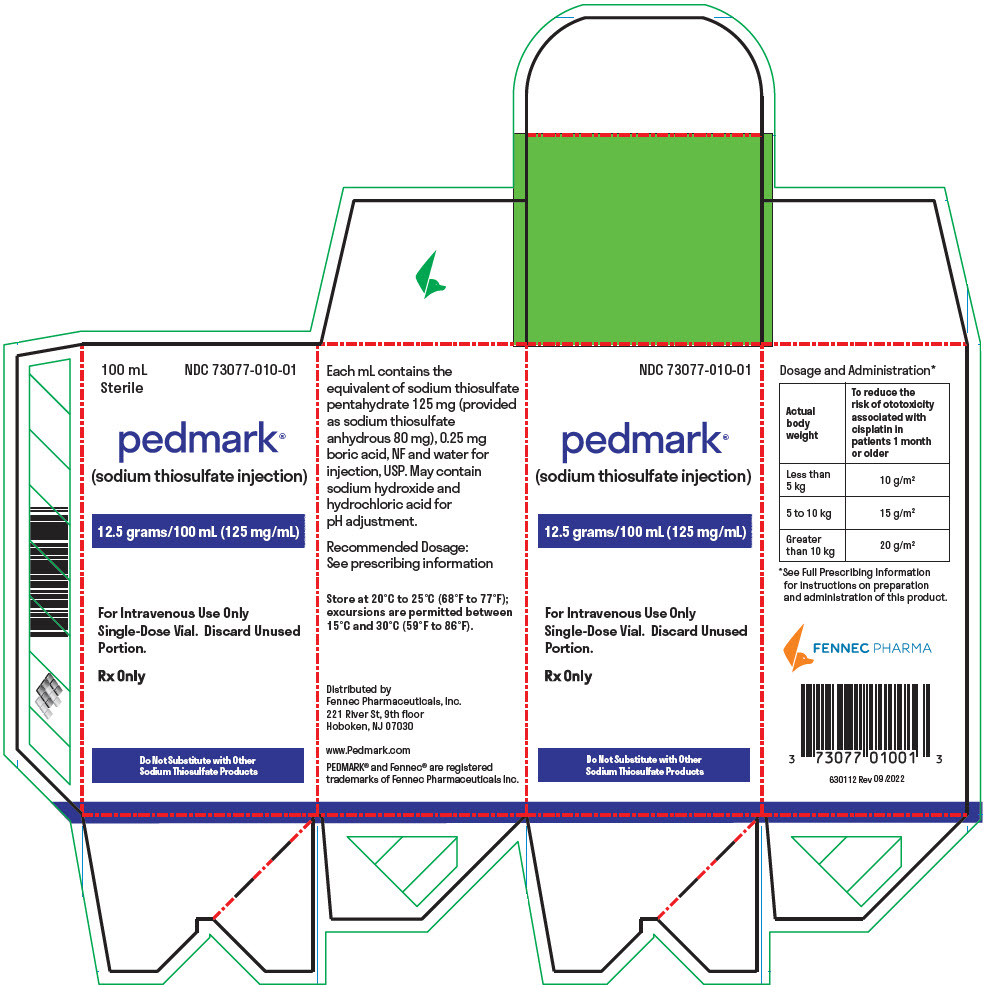
PRINCIPAL DISPLAY PANEL - 100 mL Vial Box 100 mL Sterile NDC 73077-010-01 pedmark ® (sodium thiosulfate injection) 12.5 grams/100 mL (125 mg/mL) For Intravenous Use Only Single-Dose Vial. Discard Unused Portion. Rx Only Do Not Substitute with Other Sodium Thiosulfate Products Principal Display Panel - 100 mL Vial Box
Medicaid utilization & spend
Reported adverse events (FAERS)
Top reported reactions
Age at onset
Reporter sex
Serious outcomes
Where does this data come from?
About this NDC listing & data coverage
What data is (and isn’t) available for this NDC — tap to expand
| NDC identity (package / product / labeler codes) | ✓ Available |
| Labeler | ✓ Available |
| Product & package description | ✓ Available |
| Marketing category & status | ✓ Available |
| Active ingredient / dosage form / route | ✓ Available |
| FDA label (SPL via DailyMed) | ✓ Available |
| Package photos | ✓ Available |
| Inactive ingredients (structured) | ✓ Available |
| NADAC pharmacy acquisition price (CMS) | — Not published for this NDC CMS publishes NADAC only for NDCs reported in its retail-pharmacy survey. |
| Orange Book / therapeutic-equivalence data | ✓ Available |
| HCPCS J-code billing crosswalk | ✓ Available |
| Medicaid utilization (CMS SDUD) | ✓ Available |