
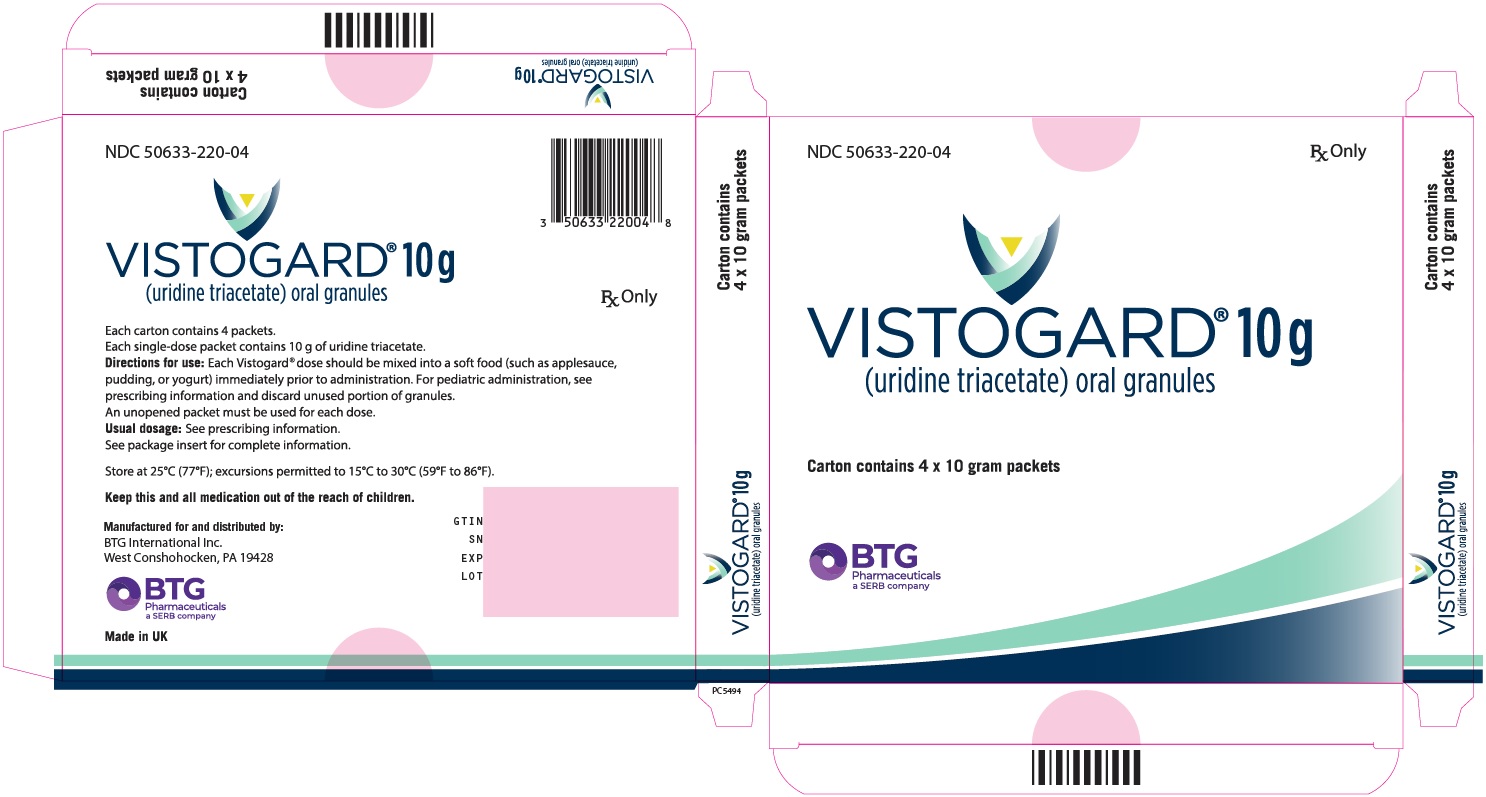
Vistogard uridine triacetate 951 mg/g Granule — NDC 50633-220-04 (Billing 50633-0220-04)
This is a package of Vistogard uridine triacetate 951 mg/g Granule from BTG International Inc, marketed since Jul 2024 and currently FDA-listed. It is the main listing for this product, which comes in 2 package sizes.
NDC database record
One package, one record: these facts belong to NDC 50633-220-04 alone.
- Record
- FDA NDC Directory package listing · Human prescription drug
- Code segments
- 50633 labeler · 220 product · 04 package
- Package marketed since
- Jul 31, 2024
- Sample package
- No — commercial package
- Listing certified through
- Dec 31, 2027
- Barcode (UPC)
- 0350633220109
- FDA record last changed
- Jul 24, 2026
Identity & classification
Regulatory identifiers FDA, NLM and CMS codes for this package
Drug-database identifiers Medi-Span GPI and First Databank GCN / HICL / AHFS classification
- GSN (GCN sequence number): 075268
- GCN: 40296
- GPI-14 (Medi-Span): 93000084203040
- HICL (First Databank): 042514
- AHFS class code: 91:04.32.00
- RxCUI (RxNorm): 1739794
Where does this data come from?
- FDA openFDA NDC Directory · synced Oct 8, 2026
- FDA label on DailyMed · label index refreshed Oct 8, 2026
- RxNorm (NLM RxNav) · catalog refreshed Oct 8, 2026
- Medi-Span GPI (licensed)
- First Databank (licensed) · refreshed Oct 8, 2026
RxNorm drug class
This medicine belongs to the Various alimentary tract and metabolism products class.
Where does this data come from?
- RxClass (NLM) · catalog refreshed Oct 8, 2026
Clinical
Uridine triacetate is used for the emergency treatment of children and adults who have either received too much of chemotherapy medications such as fluorouracil or capecitabine (Xeloda) or who develop certain severe or life-threatening toxicities within 4 days of receiving fluorouracil or capecitabine. Uridine triacetate is in a class of medications called pyrimidine analogs. It works by blocking cell damage from certain chemotherapy medications.
Read the full MedlinePlus article ↗- It depends on the product. Vistogard is an emergency treatment after an overdose of fluorouracil or capecitabine, or for severe early toxicity from them. Xuriden treats hereditary...
- Both come as granules that you mix with soft food like applesauce, pudding or yogurt. Don't chew the granules, and drink at least 4 ounces of water after. Vistogard is taken every...
- If you vomit within 2 hours of a dose, you need a full replacement dose as soon as possible. If you miss a dose, take it as soon as you can, then go back to your normal schedule.
- What if I vomit or miss a dose of Vistogard?
Patient education
Supplement & herbal interactions
Some supplements/herbs that may interact with Uridine Triacetate — tap one for details:
Where does this data come from?
- MedlinePlus (NLM) · refreshed Oct 8, 2026
- FDA label on DailyMed · label index refreshed Oct 8, 2026
Ask a licensed pharmacist directly — free, answered by our team.
Pricing
A drug doesn't have one price. Each row is a different public payment system, and none is what you'd pay at the counter — that depends on your insurance. The ⓘ on each row explains what it measures.
| Price system | Per g | Per package |
|---|---|---|
| Retail pharmacies payNADAC · weekly | Not in the retail survey — common for institutional, discontinued, or low-volume packs. | |
| Medicaid paysCMS SDUD · 12 mo | No recent Medicaid claims on file for this NDC — rare and low-volume NDCs are suppressed in the public data. | |
| Medicare drug plans payPart D · quarterly | No Part D plan price is available for this NDC in our data. | |
Where does this data come from?
- CMS NADAC weekly file
- CMS ASP pricing files · refreshed Sep 20, 2026
- CMS Medicaid State Drug Utilization Data · refreshed Oct 9, 2026
- CMS Part D plan pricing files · refreshed Sep 24, 2026
- VA National Acquisition Center price file
Packaging — all sizes for this product
| Package NDC | Description | Marketing start | Marketing end | Status |
|---|---|---|---|---|
| 50633-0220-04 You're viewing this Main listing | 4 PACKET in 1 CARTON / 10 g in 1 PACKET | 2024-07-31 | — | Active |
| 50633-0220-20 50633-220-20 | 20 PACKET in 1 CARTON / 10 g in 1 PACKET | 2024-07-31 | — | Active |
Pack size FAQ
What quantity is in this package?
What NDC number is used to bill for this package of Vistogard uridine triacetate 951 mg/g Granule?
Therapeutic equivalents
| Product | Labeler | Pack | NADAC/unit | TE | Status | Price vs. this |
|---|---|---|---|---|---|---|
| Vistogard 951 mg/gthis 50633-0220-04 | BTG | 4 packets | — | — | FDA listed | — |
| Xuriden 951 mg/g 50633-0330-30 | BTG | 30 packets | — | — | FDA listed | — |
Where does this data come from?
- FDA openFDA NDC Directory · synced Oct 8, 2026
- FDA Orange Book · refreshed Oct 9, 2026
- CMS NADAC weekly file
Availability & generic status
We did not find an FDA-approved generic match for this exact strength, form and route. Patent/protection dates below may affect future generic timing.
Why the date isn’t exact: Generic timing can change because patents may be challenged, settled, licensed, added, removed, or worked around with a narrower label — and FDA approval does not always mean a pharmacy can get the generic today.
Our estimate: August 2027 about 10 months away
How sure: Toss-up. Still unsettled. Just as likely to slip as to hold.
Why then: A patent that protects the brand runs out. After that, approved generics can be sold.
See the full forecast for generic Vistogard →🛈 What do these terms mean?
- Patent
- Legal protection listed in the Orange Book that may delay generic approval or launch. Issued by the U.S. Patent & Trademark Office.
- Substance patent
- Covers the active drug molecule itself — the hardest to design around. A generic generally can’t launch until it expires.
- Formulation (product) patent
- Covers a specific formulation or dosage form. A generic can sometimes work around it with a different formulation.
- Method-of-use patent
- A patent covering one specific approved use of the drug — not necessarily the whole molecule. A generic can sometimes launch with a “skinny label” that carves out the protected use and keeps the others.
- Skinny label
- A generic label that omits a still-patented use when the FDA allows it — letting a generic reach the market for the unprotected uses.
- Exclusivity
- FDA-granted marketing protection, separate from patents — e.g. 5-yr new chemical entity, 7-yr orphan drug, or a +6-month pediatric extension.
- Paragraph IV
- A generic applicant’s formal challenge to a listed patent. It can potentially lead to earlier generic entry, but often involves litigation or a settlement.
- RLD / RS
- Reference Listed Drug — the brand product the FDA uses as the reference for generic applications. Reference Standard — the product the FDA expects generics to compare against in bioequivalence testing.
- TE / AB rating
- FDA therapeutic-equivalence rating. An AB rating generally means the FDA considers a generic therapeutically equivalent to — and substitutable for — the brand.
- LOE (loss of exclusivity)
- The latest patent or exclusivity currently listed — the loss-of-exclusivity / latest-listed-protection date shown on this page. Paragraph-IV challenges and settlements can move the real date earlier; FDA approval and a manufacturer’s decision to market can move it later.
Built from the FDA Orange Book. The bars above are scaled to each protection’s expiry; the red LOE marker is the last one to lapse.
| Patent | Type | Use code | Expires |
|---|---|---|---|
| US 7776838 ↗ | Method of use | U-1791 | Aug 17, 2027 |
Is there a generic version of VISTOGARD 10 GRAM PACKET?
The FDA approved a generic — why can’t I get it at my pharmacy yet?
Why do different websites show different generic release dates?
What does “FDA listed” mean?
What does a patent or protection date mean here?
What does “current Orange Book estimate” mean?
Can a generic come out before the last patent expires?
Can a generic come out after the listed dates?
What is the difference between patents and exclusivity?
Why are there multiple patent dates?
Where does this data come from?
- FDA Orange Book · refreshed Oct 9, 2026
What it looks like
Where does this data come from?
- FDA label on DailyMed · label index refreshed Oct 8, 2026
Inactive Ingredients / Excipients
Inactive ingredients, also called excipients, are components of the drug product other than the active ingredient. They may include fillers, dyes, coatings, preservatives, flavors, or other formulation ingredients.
🧪 Avoiding an ingredient? See Uridine Triacetate inactive ingredients by manufacturer: every current product's list side by side, so you can ask your pharmacy for the version that does not list it.
💡 Tap an ingredient (hover on desktop) to see what it is and why it’s used.
-
UNII 7Z8S9VYZ4B
Ethylcellulose is a plant-derived thickener and film-former made by chemically modifying cellulose. It's used as a binder to hold tablet ingredients together, a coating to control how quickly medicine is released, or a thickener in liquid formulations.
-
UNII 3NXW29V3WO
Hypromellose is a plant-based thickener made from cellulose. It's used in medicines as a binder to hold ingredients together, a coating for tablets, and a thickener for liquids.
-
UNII 5A9KE2L9L3
A citrus fruit liquid used as a flavoring and vehicle in oral medicines. It adds natural taste, helps mask bitter drug flavors, and provides liquid volume for dissolving or suspending active ingredients.
-
UNII 3WJQ0SDW1A
Polyethylene glycol is a synthetic liquid or solid polymer used in medicines as a solvent, lubricant, and humectant. It helps dissolve active ingredients, reduces friction during manufacturing, and retains moisture in the final product.
4 inactive ingredients listed in the exact product block matched to this NDC.
Where does this data come from?
ingredient classCode="IACT" elements from the exact product block matched by this NDC. Label-section narrative from DailyMed / the openFDA label index is shown separately when available.- FDA label on DailyMed · label index refreshed Oct 8, 2026
- FDA openFDA NDC Directory · synced Oct 8, 2026
Inactive ingredient FAQ
Are inactive ingredients the same for every manufacturer?
Why might an inactive ingredient be missing?
Can inactive ingredients matter?
Manufacturer & labeler
More NDCs from BTG International Inc labeler code 50633
- CroFab ovine crotalidae venoms immune fab 1 g; 1 g; 1 g; 1 g Injection, Powder, Lyophilized, For Solution NDC 50633-110-12
- DigiFab ovine digoxin immune fab 40 mg Injection, Powder, Lyophilized, For Solution NDC 50633-120-11
- Voraxaze glucarpidase 1000 [USP'U]/1 Injection, Powder, For Solution NDC 50633-210-11
- DANYELZA Naxitamab 40 mg/10mL Injection NDC 50633-230-01
- Cyanokit Hydroxocobalamin 5 g/250mL Injection, Powder, Lyophilized, For Solution NDC 50633-310-11
- Xuriden uridine triacetate 951 mg/g Granule NDC 50633-330-30
- AURLUMYN ILOPROST 100 ug/mL Injection, Solution NDC 50633-340-01
- ThyroSafe Potassium Iodide 65 mg Tablet NDC 50633-910-20
- Thyrosafe Potassium iodide 130 mg Tablet NDC 50633-920-20
Where does this data come from?
- FDA openFDA NDC Directory · synced Oct 8, 2026
- Drugs@FDA
Full prescribing information FDA SPL
🎯 Indications and Usage ▾
1 INDICATIONS AND USAGE VISTOGARD ® is indicated for the emergency treatment of adult and pediatric patients: following a fluorouracil or capecitabine overdose regardless of the presence of symptoms, or who exhibit early-onset, severe or life-threatening toxicity affecting the cardiac or central nervous system, and/or early-onset, unusually severe adverse reactions (e.g., gastrointestinal toxicity and/or neutropenia) within 96 hours following the end of fluorouracil or capecitabine administration. VISTOGARD ® is a pyrimidine analog indicated for the emergency treatment of adult and pediatric patients: following a fluorouracil or capecitabine overdose regardless of the presence of symptoms, or who exhibit early-onset, severe or life-threatening toxicity affecting the cardiac or central nervous system, and/or early-onset, unusually severe adverse reactions (e.g., gastrointestinal toxicity and/or neutropenia) within 96 hours following the end of fluorouracil or capecitabine administration.
( 1 ) Limitations of use: VISTOGARD is not recommended for the non-emergent treatment of adverse reactions associated with fluorouracil or capecitabine because it may diminish the efficacy of these drugs. ( 1 ) The safety and efficacy of VISTOGARD initiated more than 96 hours following the end of fluorouracil or capecitabine administration have not been established. ( 1 ) Limitations of Use VISTOGARD is not recommended for the non-emergent treatment of adverse reactions associated with fluorouracil or capecitabine because it may diminish the efficacy of these drugs.
The safety and efficacy of VISTOGARD initiated more than 96 hours following the end of fluorouracil or capecitabine administration have not been established.
⏱️ Dosage and Administration ▾
2 DOSAGE AND ADMINISTRATION Recommended Dosage Adults : 10 grams (1 packet) orally every 6 hours for 20 doses, without regard to meals. ( 2.1 ) Pediatric : 6.2 grams/m 2 of body surface area (not to exceed 10 grams per dose) orally every 6 hours for 20 doses, without regard to meals. See the full prescribing information for body surface area-based dosing.
( 2.1 ) Preparation and Administration Pediatric : Measure the dose using either a scale accurate to at least 0.1 gram, or a graduated teaspoon accurate to ¼ teaspoon. ( 2.1 ) Mix each VISTOGARD dose with 3 to 4 ounces of soft foods such as applesauce, pudding or yogurt and ingest within 30 minutes of mixing. Do not chew the VISTOGARD granules.
Drink at least 4 ounces of water. ( 2.2 ) If a patient vomits within 2 hours of taking a dose of VISTOGARD, initiate another complete dose as soon as possible after the vomiting episode. Administer the next dose at the regularly scheduled time.
( 2.2 ) If a patient misses a dose at the scheduled time, administer that dose of VISTOGARD as soon as possible. Administer the next dose at the regularly scheduled time. ( 2.2 ) Administer VISTOGARD via a nasogastric tube (NG tube) or gastrostomy tube (G-Tube) when necessary (e.g., severe mucositis or coma).
( 2.2 )
2.1Recommended Dosage Adults: 10 grams (1 packet) orally every 6 hours for 20 doses, without regard to meals. Pediatric: 6.2 grams/m 2 of body surface area (not to exceed 10 grams per dose) orally every 6 hours for 20 doses, without regard to meals. The VISTOGARD dose to be administered at 6.2 grams/m 2 is presented in Table 1.
Measure the dose using either a scale accurate to at least 0.1 gram, or a graduated teaspoon accurate to ¼ teaspoon. Discard any unused portion of granules. Do not use granules left in the open packet for subsequent dosing.
Table 1 VISTOGARD Pediatric Dose Based on Body Surface Area (m 2 ) Patient Body Surface Area (m 2 ) Table 1 VISTOGARD 6.2 grams/m 2 /dose Dose by body surface area category in this table was rounded to achieve the approximate dose. Each dose is administered every 6 hours for 20 doses. Dose in Grams Dose in Graduated Teaspoons 0.34 to 0.44 2.1 to 2.7 1 0.45 to 0.55 2.8 to 3.4 1 ¼ 0.56 to 0.66 3.5 to 4.1 1 ½ 0.67 to 0.77 4.2 to 4.8 1 ¾ 0.78 to 0.88 4.9 to 5.4 2 0.89 to 0.99 5.5 to 6.1 2 ¼ 1.00 to 1.10 6.2 to 6.8 2 ½ 1.11 to 1.21 6.9 to 7.5 2 ¾ 1.22 to 1.32 7.6 to 8.1 3 1.33 to 1.43 8.2 to 8.8 3 ¼ 1.44 and above May use 1 entire 10 g packet without weighing or measuring.
Do not exceed 10 grams/dose. 10.0 1 full packet Administer VISTOGARD as soon as possible after an overdose or early-onset toxicity within 96 hours following the end of fluorouracil or capecitabine administration. Administer full course of VISTOGARD (20 doses) as directed.
2.2Preparation and Administration Mix each VISTOGARD dose with 3 to 4 ounces of soft foods such as applesauce, pudding or yogurt and ingest within 30 minutes. Do not chew the VISTOGARD granules. Drink at least 4 ounces of water.
If a patient vomits within 2 hours of taking a dose of VISTOGARD, initiate another complete dose as soon as possible after the vomiting episode. Administer the next dose at the regularly scheduled time. If a patient misses a dose at the scheduled time, administer that dose of VISTOGARD as soon as possible.
Administer the next dose at the regularly scheduled time. Administer VISTOGARD via a nasogastric tube (NG tube) or gastrostomy tube (G-Tube) when necessary (eg, severe mucositis or coma). Follow the instructions below for each dose administration: Prepare approximately 4 fluid ounces (about 100 mL) of a food starch-based thickening product in water and stir briskly until the thickener has dissolved.
Crush the contents of one full 10 gram packet of VISTOGARD granules to a fine powder. Add the crushed VISTOGARD granules to 4 ounces (about 100 mL) of the reconstituted food starch-based thickening product. For pediatric patients receiving less than 10 grams, prepare the mixture at a… [Excerpted — this section continues on DailyMed.]
💊 Dosage Forms and Strengths ▾
3 DOSAGE FORMS AND STRENGTHS Oral granules: 10 grams of orange-flavored, white-to-off-white, oral granules (95% w/w) in single-dose packets. Oral granules: 10 gram packets ( 3 )
⛔ Contraindications ▾
4 CONTRAINDICATIONS None. None. ( 4 )
⚠️ Warnings and Cautions ▾
5 WARNINGS AND PRECAUTIONS None. None. ( 5 )
🤒 Adverse Reactions ▾
6 ADVERSE REACTIONS Adverse reactions occurring in >2% of patients receiving VISTOGARD included vomiting, nausea, and diarrhea. ( 6 ) To report SUSPECTED ADVERSE REACTIONS, contact BTG International Inc at (1-877-377-3784) or FDA at 1-800-FDA-1088 or www.fda.gov/medwatch.
6.1Clinical Trials Experience Because clinical trials are conducted under widely varying conditions and using a wide range of doses, adverse reaction rates observed in the clinical trials of a drug cannot be directly compared to rates in the clinical trials of another drug and may not reflect the rates observed in practice. The safety of VISTOGARD was assessed in 135 patients (median age 59 years, 56% male) treated in 2 single-arm, open-label, multi-center trials. VISTOGARD was administered at 10 grams orally every 6 hours for 20 doses or at a body surface area adjusted dosage of 6.2 grams/m 2 /dose for 20 doses in four patients between 1 and 7 years of age.
The median duration of exposure was 4.8 days, with a median of 20 doses (range 1 to 23). VISTOGARD was discontinued for adverse reactions in two (1.4%) patients. Serious adverse reactions and Grade ≥3 adverse reactions were seen in one patient receiving VISTOGARD (Grade 3 nausea and vomiting).
Table 2 summarizes the adverse reactions that occurred in greater than 2% of patients in Studies 1 and 2 combined. Table 2 Adverse Reactions in > 2% of Patients Receiving VISTOGARD in Studies 1 and 2 Adverse Reaction N=135 Patients Vomiting 13 (10%) Nausea 7 (5%) Diarrhea 4 (3%)
👥 Use in Specific Populations ▾
8 USE IN SPECIFIC POPULATIONS
8.1Pregnancy Risk Summary Limited case reports of uridine triacetate use during pregnancy are insufficient to inform a drug-associated risk of birth defects and miscarriage. When administered orally to pregnant rats during the period of organogenesis, uridine triacetate at doses of one-half the maximum recommended human dose (MRHD) of 40 grams per day was not teratogenic and did not produce adverse effects on embryo-fetal development [see Data ] . The background risk of major birth defects and miscarriage for the indicated population are unknown.
In the U.S. general population, the estimated background risk of major birth defects and miscarriage in clinically recognized pregnancies is 2% to 4% and 15% to 20%, respectively. Data Animal Data In an embryo-fetal development study, uridine triacetate was administered orally to pregnant rats during the period of organogenesis at doses up to 2000 mg/kg per day (about one-half the maximum recommended human dose (MRHD) of 40 grams per day on a body surface area basis). There was no evidence of teratogenicity or harm to the fetus and no effect on maternal body weight and overall health.
8.2Lactation Risk Summary There are no data on the presence of uridine triacetate in human milk, the effect on the breastfed infant or the effect on milk production. The development and health benefits of breastfeeding should be considered along with the mother's clinical need for VISTOGARD and any potential adverse effects on the breastfed infant from VISTOGARD or from the underlying maternal condition.
8.4Pediatric Use The safety and effectiveness of VISTOGARD have been established in pediatric patients. Use of VISTOGARD in pediatric patients is supported by an open-label clinical study of adults (Study 1) and a second open-label clinical study which included 6 pediatric patients ranging in age from 1 to 16 years (Study 2). Four of these pediatric patients were between 1 to 7 years of age and received a body-surface area adjusted dosage of 6.2 grams/m 2 /dose for 20 doses.
The clinical response and safety in adult and pediatric patients treated with VISTOGARD were similar; however, clinical data are limited [see Clinical Studies (14) ].
8.5Geriatric Use Of the 135 patients in clinical studies with VISTOGARD, 30% were 65 and over, including 11% that were 75 and over. Clinical studies of VISTOGARD did not include sufficient numbers of subjects aged 65 and over to determine whether they respond differently from younger subjects.
🤰 Pregnancy ▾
8.1Pregnancy Risk Summary Limited case reports of uridine triacetate use during pregnancy are insufficient to inform a drug-associated risk of birth defects and miscarriage. When administered orally to pregnant rats during the period of organogenesis, uridine triacetate at doses of one-half the maximum recommended human dose (MRHD) of 40 grams per day was not teratogenic and did not produce adverse effects on embryo-fetal development [see Data ] . The background risk of major birth defects and miscarriage for the indicated population are unknown.
In the U.S. general population, the estimated background risk of major birth defects and miscarriage in clinically recognized pregnancies is 2% to 4% and 15% to 20%, respectively. Data Animal Data In an embryo-fetal development study, uridine triacetate was administered orally to pregnant rats during the period of organogenesis at doses up to 2000 mg/kg per day (about one-half the maximum recommended human dose (MRHD) of 40 grams per day on a body surface area basis). There was no evidence of teratogenicity or harm to the fetus and no effect on maternal body weight and overall health.
🧒 Pediatric Use ▾
8.4Pediatric Use The safety and effectiveness of VISTOGARD have been established in pediatric patients. Use of VISTOGARD in pediatric patients is supported by an open-label clinical study of adults (Study 1) and a second open-label clinical study which included 6 pediatric patients ranging in age from 1 to 16 years (Study 2). Four of these pediatric patients were between 1 to 7 years of age and received a body-surface area adjusted dosage of 6.2 grams/m 2 /dose for 20 doses.
The clinical response and safety in adult and pediatric patients treated with VISTOGARD were similar; however, clinical data are limited [see Clinical Studies (14) ].
🧓 Geriatric Use ▾
8.5Geriatric Use Of the 135 patients in clinical studies with VISTOGARD, 30% were 65 and over, including 11% that were 75 and over. Clinical studies of VISTOGARD did not include sufficient numbers of subjects aged 65 and over to determine whether they respond differently from younger subjects.
🧬 Clinical Pharmacology ▾
12 CLINICAL PHARMACOLOGY
12.1Mechanism of Action Uridine triacetate is an acetylated pro-drug of uridine. Following oral administration, uridine triacetate is deacetylated by nonspecific esterases present throughout the body, yielding uridine in the circulation. Uridine competitively inhibits cell damage and cell death caused by fluorouracil.
Fluorouracil is a cytotoxic antimetabolite that interferes with nucleic acid metabolism in normal and cancer cells. Cells anabolize fluorouracil to the cytotoxic intermediates 5-fluoro-2'-deoxyuridine-5'-monophosphate (FdUMP) and 5-fluorouridine triphosphate (FUTP). FdUMP inhibits thymidylate synthase, blocking thymidine synthesis.
Thymidine is required for DNA replication and repair. Uridine is not found in DNA. The second source of fluorouracil cytotoxicity is the incorporation of its metabolite, FUTP, into RNA.
This incorporation of FUTP into RNA is proportional to systemic fluorouracil exposure. Excess circulating uridine derived from VISTOGARD is converted into uridine triphosphate (UTP), which competes with FUTP for incorporation into RNA.
12.3Pharmacokinetics Absorption VISTOGARD delivers 4- to 6-fold more uridine into the systemic circulation compared to equimolar doses of uridine itself. Maximum concentrations of uridine in plasma following oral VISTOGARD are generally achieved within 2 to 3 hours, and the half-life ranges from approximately 2 to 2.5 hours. Studies 1 and 2 included an assessment of plasma uridine in a subgroup of patients who were overdosed with fluorouracil or experiencing early-onset of serious fluorouracil toxicities.
Samples were obtained prior to VISTOGARD treatment and at 1 to 4 hours following the first and final doses of VISTOGARD given at 10 g (adults) or 6.2 grams/m 2 (pediatric) every 6 hours for up to 20 doses. Plasma uridine concentrations are summarized in Table 3. Table 3 Plasma Uridine Concentrations (µM) in Studies 1 and 2 Study Predose Post First Dose Post Final Dose Study 1 Values shown are mean (standard deviation) for plasma uridine (µM) 8 (33) 99 (64) 160 (81) N = 49 N = 49 N = 40 Study 2 5 (17) 119 (59) 153 (68) N = 27 N = 26 N = 24 Food Effect on Uridine PK: A study in healthy adult subjects receiving a slightly different formulation of uridine triacetate granules (6 gram dose) under fed and fasted conditions showed no difference in the overall rate and extent of uridine exposure.
Distribution Circulating uridine is taken up into mammalian cells via specific nucleoside transporters, and also crosses the blood brain barrier. Excretion Uridine can be excreted via the kidneys, but is also metabolized by normal pyrimidine catabolic pathways present in most tissues. Drug Interaction Studies In vitro enzyme inhibition data did not reveal meaningful inhibitory effects of uridine triacetate or uridine on CYP3A4, CYP1A2, CYP2C8, CYP2C9, CYP2C19, CYP2D6, and CYP2E1.
In vitro enzyme induction data did not reveal an inducing effect of uridine triacetate or uridine on CYP1A2, CYP2B6, or CYP3A4. In vitro data showed that uridine triacetate was a weak substrate for P-glycoprotein. Uridine triacetate inhibited the transport of a known P-glycoprotein substrate, digoxin, with an IC50 of 344 µM.
Due to the potential for high local (gut) concentrations of the drug after dosing, the interaction of VISTOGARD with orally administered P-gp substrate drugs cannot be ruled out. In vivo data in humans are not available. Specific Populations Sex Pharmacokinetics analyses showed that sex did not have a significant effect on uridine pharmacokinetics.
Age Pharmacokinetic analysis showed that within the age range evaluated (20 to 83 years), age did not have a significant effect on uridine pharmacokinetics. Body Size Pharmacokinetic analyses showed no clinically meaningful effect of body surface area on uridine PK in adults.
🧬 Mechanism of Action ▾
12.1Mechanism of Action Uridine triacetate is an acetylated pro-drug of uridine. Following oral administration, uridine triacetate is deacetylated by nonspecific esterases present throughout the body, yielding uridine in the circulation. Uridine competitively inhibits cell damage and cell death caused by fluorouracil.
Fluorouracil is a cytotoxic antimetabolite that interferes with nucleic acid metabolism in normal and cancer cells. Cells anabolize fluorouracil to the cytotoxic intermediates 5-fluoro-2'-deoxyuridine-5'-monophosphate (FdUMP) and 5-fluorouridine triphosphate (FUTP). FdUMP inhibits thymidylate synthase, blocking thymidine synthesis.
Thymidine is required for DNA replication and repair. Uridine is not found in DNA. The second source of fluorouracil cytotoxicity is the incorporation of its metabolite, FUTP, into RNA.
This incorporation of FUTP into RNA is proportional to systemic fluorouracil exposure. Excess circulating uridine derived from VISTOGARD is converted into uridine triphosphate (UTP), which competes with FUTP for incorporation into RNA.
📦 How Supplied / Storage and Handling ▾
16 HOW SUPPLIED/STORAGE AND HANDLING VISTOGARD orange-flavored oral granules (95% w/w) are available in single-dose packets containing 10 grams of uridine triacetate. NDC Number Package Configuration 50633-220-20 Course of therapy package: 1 carton containing 20 single-dose packets of VISTOGARD 50633-220-04 24-Hour Pack: 1 carton containing 4 single-dose packets of VISTOGARD Store at USP controlled room temperature, 25°C (77°F); excursions permitted to 15° to 30 °C (59° to 86°F).
📦 Storage and Handling ▾
Store at USP controlled room temperature, 25°C (77°F); excursions permitted to 15° to 30 °C (59° to 86°F).
📋 Description ▾
11 DESCRIPTION VISTOGARD oral granules contain the active ingredient uridine triacetate which is a pyrimidine analog. The chemical name for uridine triacetate is (2',3',5'-tri-O-acetyl-β-D-ribofuranosyl)-2,4(1H,3H)-pyrimidinedione. The molecular weight is 370.3 grams/mole and it has an empirical formula of C 15 H 18 N 2 O 9 .
The structural formula is: Each single-dose 10 gram packet of VISTOGARD orange-flavored oral granules (95% w/w) contains 10 grams of uridine triacetate and the following inactive ingredients: ethylcellulose (0.309 grams), Opadry ® Clear [proprietary dispersion of hydroxypropylmethylcellulose and Macrogol] (0.077 grams), and natural orange juice flavor (0.131 grams). Chemical Structure
💬 Information for Patients ▾
17 PATIENT COUNSELING INFORMATION Advise the patient or caregiver to read the FDA-approved patient labeling (Patient Information) Dosing Instructions [see Dosage and Administration (2.1) and (2.2) ] Advise the patient or caregiver: The importance of taking all 20 doses, even if they feel well. That VISTOGARD can be taken mixed in food (applesauce, pudding or yogurt). That the VISTOGARD granules should not be chewed.
That if the patient vomits within 2 hours of taking a dose of VISTOGARD to take another complete dose as soon as possible after vomiting. Take the next dose at the regularly scheduled time. That if the patient misses a dose at the scheduled time, to take that dose of VISTOGARD as soon as possible.
Then take the next dose at the regularly scheduled time.
🧬 Pharmacokinetics ▾
12.3Pharmacokinetics Absorption VISTOGARD delivers 4- to 6-fold more uridine into the systemic circulation compared to equimolar doses of uridine itself. Maximum concentrations of uridine in plasma following oral VISTOGARD are generally achieved within 2 to 3 hours, and the half-life ranges from approximately 2 to 2.5 hours. Studies 1 and 2 included an assessment of plasma uridine in a subgroup of patients who were overdosed with fluorouracil or experiencing early-onset of serious fluorouracil toxicities.
Samples were obtained prior to VISTOGARD treatment and at 1 to 4 hours following the first and final doses of VISTOGARD given at 10 g (adults) or 6.2 grams/m 2 (pediatric) every 6 hours for up to 20 doses. Plasma uridine concentrations are summarized in Table 3. Table 3 Plasma Uridine Concentrations (µM) in Studies 1 and 2 Study Predose Post First Dose Post Final Dose Study 1 Values shown are mean (standard deviation) for plasma uridine (µM) 8 (33) 99 (64) 160 (81) N = 49 N = 49 N = 40 Study 2 5 (17) 119 (59) 153 (68) N = 27 N = 26 N = 24 Food Effect on Uridine PK: A study in healthy adult subjects receiving a slightly different formulation of uridine triacetate granules (6 gram dose) under fed and fasted conditions showed no difference in the overall rate and extent of uridine exposure.
Distribution Circulating uridine is taken up into mammalian cells via specific nucleoside transporters, and also crosses the blood brain barrier. Excretion Uridine can be excreted via the kidneys, but is also metabolized by normal pyrimidine catabolic pathways present in most tissues. Drug Interaction Studies In vitro enzyme inhibition data did not reveal meaningful inhibitory effects of uridine triacetate or uridine on CYP3A4, CYP1A2, CYP2C8, CYP2C9, CYP2C19, CYP2D6, and CYP2E1.
In vitro enzyme induction data did not reveal an inducing effect of uridine triacetate or uridine on CYP1A2, CYP2B6, or CYP3A4. In vitro data showed that uridine triacetate was a weak substrate for P-glycoprotein. Uridine triacetate inhibited the transport of a known P-glycoprotein substrate, digoxin, with an IC50 of 344 µM.
Due to the potential for high local (gut) concentrations of the drug after dosing, the interaction of VISTOGARD with orally administered P-gp substrate drugs cannot be ruled out. In vivo data in humans are not available. Specific Populations Sex Pharmacokinetics analyses showed that sex did not have a significant effect on uridine pharmacokinetics.
Age Pharmacokinetic analysis showed that within the age range evaluated (20 to 83 years), age did not have a significant effect on uridine pharmacokinetics. Body Size Pharmacokinetic analyses showed no clinically meaningful effect of body surface area on uridine PK in adults.
🔬 Clinical Studies ▾
14 CLINICAL STUDIES The efficacy of VISTOGARD was assessed in 135 patients who were treated in two open-label trials, Study 1 (n=60) and Study 2 (n=75). The patients in both studies had either received an overdose of fluorouracil or capecitabine, or presented with severe or life-threatening toxicities within 96 hours following the end of fluorouracil or capecitabine administration. Overdose was defined as administration of fluorouracil at a dose, or infusion rate, greater than the intended dose or maximum tolerated dose for the patient's intended regimen of fluorouracil.
VISTOGARD was administered at 10 grams orally every 6 hours for 20 doses or at a body surface area adjusted dosage of 6.2 grams/m 2 /dose for 20 doses for four patients between 1 and 7 years of age. The major efficacy outcome was survival at 30 days or until the resumption of chemotherapy if prior to 30 days. In Study 1 and Study 2 combined, the median age of the patients was 59 years (range: 1 to 83), 56% were male, 72% were white, 9% were Black/African American, 6% were Hispanic, 4% were Asian, and 95% had a cancer diagnosis.
Of the 135 patients, 117 were treated with VISTOGARD following an overdose of fluorouracil (n=112) or capecitabine (n=5), and 18 were treated after exhibiting severe or life-threatening fluorouracil toxicities within 96 hours following the end of fluorouracil administration. The severe or life-threatening toxicities involved the central nervous system (such as encephalopathy, acute mental status change), cardiovascular system, gastrointestinal system (such as mucositis), and bone marrow. A total of six pediatric patients were administered VISTOGARD.
Four patients initiated VISTOGARD more than 96 hours following the end of fluorouracil or capecitabine administration. Of the 112 patients overdosed with fluorouracil, 105 (94%) were overdosed by infusion rate only (range 1.3 to 720 times the planned infusion rate), four (4%) were overdosed by dose only, and three (3%) were overdosed by both dose and rate. The survival results are shown in Table 4.
Of the 135 patients who were treated with VISTOGARD in Studies 1 and 2 there were five deaths due to fluorouracil or capecitabine toxicity (4%). Of the five patients who died, two were treated after 96 hours following the end of fluorouracil administration. In the patients treated with VISTOGARD for an overdose of fluorouracil or capecitabine in Studies 1 and 2 combined (n=117), survival at 30 days was 97% (n=114).
In the patients receiving VISTOGARD for early-onset severe or life-threatening toxicity in Studies 1 and 2 combined (n=18), the survival at 30 days was 89% (n=16). In these studies 33% of patients (n=45) resumed chemotherapy in less than 30 days. Based on retrospective historical case reports of 25 patients who were overdosed with fluorouracil and received supportive care only, all were overdosed by rate with a range 1.9 to 64 times the planned infusion rate, and 84% died.
Table 4 Combined Efficacy: All Patients in Study 1 and Study 2 Overdose Early-Onset Overall Total Enrolled 117 18 135 Survival Survival includes patients who survived at 30 days or patients who resumed chemotherapy prior to 30 days. 114 (97%) 16 (89%) 130 (96%) Death 3 (3%) 2 (11%) 5 (4%)
🧪 Nonclinical Toxicology ▾
13 NONCLINICAL TOXICOLOGY
13.1Carcinogenesis, Mutagenesis, Impairment of Fertility Long-term studies in animals have not been performed to evaluate the carcinogenic potential of uridine triacetate. Uridine triacetate was not genotoxic in the Ames test, the mouse lymphoma assay and the mouse micronucleus test. Orally administered uridine triacetate did not affect fertility or general reproductive performance in male and female rats at doses up to 2000 mg/kg per day (about one-half the maximum recommend human dose (MRHD) of 40 grams per day on a body surface area basis).
13.2Animal Toxicology and/or Pharmacology In mice given a sub-lethal dose of fluorouracil, the administration of oral uridine triacetate diminished hematological toxicity as a function of increasing dose, but did not completely prevent hematological toxicity. In mice given a lethal dose of fluorouracil, administration of oral uridine triacetate increased survival to 90% when given within 24 hours. Survival diminished with increasing interval between the fluorouracil dose and uridine triacetate treatment demonstrating that earlier administration of uridine triacetate is more beneficial.
In similar experiments in mice, uridine triacetate treatment diminished damage to the intestinal mucosa caused by fluorouracil treatment.
📄 Carcinogenesis, Mutagenesis, Impairment of Fertility ▾
13.1Carcinogenesis, Mutagenesis, Impairment of Fertility Long-term studies in animals have not been performed to evaluate the carcinogenic potential of uridine triacetate. Uridine triacetate was not genotoxic in the Ames test, the mouse lymphoma assay and the mouse micronucleus test. Orally administered uridine triacetate did not affect fertility or general reproductive performance in male and female rats at doses up to 2000 mg/kg per day (about one-half the maximum recommend human dose (MRHD) of 40 grams per day on a body surface area basis).
📄 Patient Package Insert ▾
This Patient Information has been approved by the U.S. Food and Drug Administration Issued: 10/2023 Patient Information VISTOGARD (VIS-toe-gard) (uridine triacetate) oral granules What is VISTOGARD? VISTOGARD is a prescription medicine that contains uridine, a substance that is normally found in your body.
VISTOGARD is used for emergency treatment of adults and children: after an overdose of fluorouracil or capecitabine with or without symptoms, or who have early signs of severe or life-threatening side effects that affect the heart, or early signs of severe or life threatening neurologic (central nervous system) problems, or certain unusually severe side effects within 4 days (96 hours) after receiving treatment with fluorouracil or capecitabine VISTOGARD should only be used for the emergency treatment of side effects of fluorouracil or capecitabine, because it may decrease the effectiveness of these medicines.
It is not known if VISTOGARD is safe and effective if started more than 4 days (96 hours) after the end of a dose of fluorouracil or capecitabine. Before taking VISTOGARD, tell your healthcare provider about all your medical conditions, including if you: are pregnant or plan to become pregnant. It is not known if VISTOGARD will harm your unborn baby. are breastfeeding or plan to breastfeed.
It is not known if VISTOGARD passes into your breast milk. Talk to your healthcare provider about the best way to feed your baby if you take VISTOGARD. Tell your healthcare provider about all the medicines you take, including prescription and over-the-counter medicines, vitamins, and herbal supplements.
How should I take VISTOGARD? Take VISTOGARD exactly as prescribed by your healthcare provider. It is important that you take all 20 doses of VISTOGARD even if you feel well.
VISTOGARD comes in single-dose packets that contain 10 grams of orange-flavored granules. If your healthcare provider decides that you can give VISTOGARD to your child at home, it is important that you follow your healthcare provider's instructions. Your healthcare provider will prescribe VISTOGARD to your child based on your child's weight.
The usual adult dose of VISTOGARD is 1 packet taken by mouth every 6 hours for a total of 20 doses. If you vomit within 2 hours of taking a dose of VISTOGARD, take another full dose as soon as possible. Then take your next VISTOGARD dose at your next regularly scheduled time.
If you miss a dose of VISTOGARD at the scheduled time, take the missed dose as soon as possible. Then take the next dose at the regularly scheduled time. Preparing and taking a dose of VISTOGARD: Mix each packet of VISTOGARD granules with 3 to 4 ounces of soft food such as applesauce, pudding or yogurt in a small container.
Take all of the VISTOGARD granules mixed with food within 30 minutes of mixing. Do not chew the VISTOGARD granules. Drink at least 4 ounces of water to make sure that you swallow all of the medicine.
What are the possible side effects of VISTOGARD? Common side effects of VISTOGARD include: vomiting, nausea, and diarrhea. These are not all the possible side effects of VISTOGARD.
Call your doctor for medical advice about side effects. You may report side effects to FDA at 1-800-FDA-1088. How should I store VISTOGARD?
Store VISTOGARD at room temperature between 68°F to 77°F (20°C to 25°C) Keep VISTOGARD and all medicines out of the reach of children. General information about the safe and effective use of VISTOGARD. Medicines are sometimes prescribed for purposes other than those listed in a Patient Information leaflet.
Do not use VISTOGARD for a condition for which it was not prescribed. Do not give VISTOGARD to other people, even if they have the same symptoms that you have. It may harm them.
You can ask your pharmacist or healthcare provider for information about VISTOGARD that is written for health professionals. What are the ingredients of VISTOGARD? Active Ingredient: uridine triacetate Inactive Ingredients: ethylcellulose, Opadry… [Excerpted — this section continues on DailyMed.]
📄 Package Label / Principal Display Panel ▾
PRINCIPAL DISPLAY PANEL - 20 Count - 10 g Packet Carton NDC 50633-220-20 Rx Only VISTOGARD ® 10 g (uridine triacetate) oral granules Carton contains 20 x 10 gram packets BTG Pharmaceuticals PRINCIPAL DISPLAY PANEL - 10 g Packet Carton
PRINCIPAL DISPLAY PANEL - 4 Count 10 g Packet Carton NDC 50633-220-04 Rx Only VISTOGARD ® 10 g (uridine triacetate) oral granules Carton contains 4 x 10 gram packets BTG Pharmaceuticals PRINCIPAL DISPLAY PANEL - 10 g Packet Carton
PRINCIPAL DISPLAY PANEL - 10 g Single Dose Sachet Foil NDC 50633-220-10 Rx Only VISTOGARD ® 10 g (uridine triacetate) oral granules Single-Dose Packets BTG Pharmaceuticals PRINCIPAL DISPLAY PANEL - 10 g Sachet Foil
Reported adverse events (FAERS)
Top reported reactions
Age at onset
Reporter sex
Serious outcomes
Where does this data come from?
About this NDC listing & data coverage
What data is (and isn’t) available for this NDC — tap to expand
| NDC identity (package / product / labeler codes) | ✓ Available |
| Labeler | ✓ Available |
| Product & package description | ✓ Available |
| Marketing category & status | ✓ Available |
| Active ingredient / dosage form / route | ✓ Available |
| FDA label (SPL via DailyMed) | ✓ Available |
| Package photos | ✓ Available |
| Inactive ingredients (structured) | ✓ Available |
| NADAC pharmacy acquisition price (CMS) | — Not published for this NDC CMS publishes NADAC only for NDCs reported in its retail-pharmacy survey. |
| Orange Book / therapeutic-equivalence data | ✓ Available |
| HCPCS J-code billing crosswalk | — Not published for this NDC Most self-administered / retail products have no J-code — that is normal. |
| Medicaid utilization (CMS SDUD) | — Not published for this NDC CMS reports utilization only for NDCs with Medicaid claims above its privacy threshold. |