
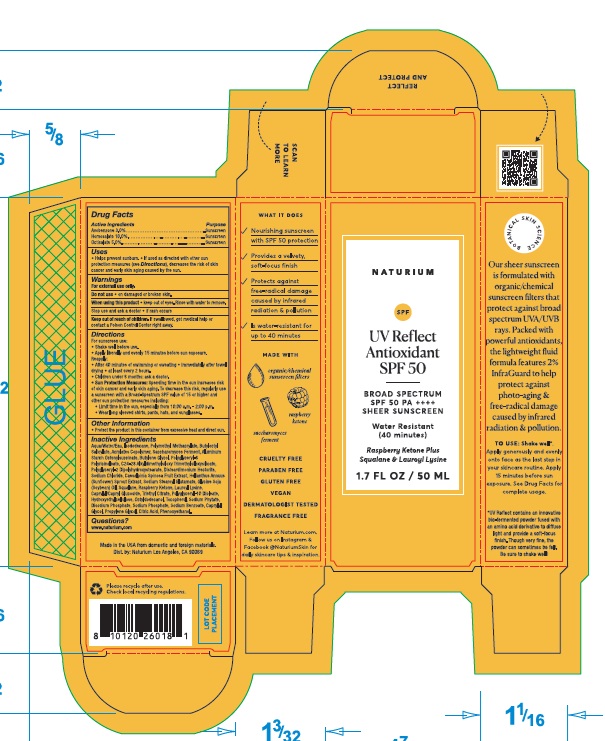
Naturium UV Reflect Antioxidant SPF 50 Homosalate, Octisalate, Avobenzone 30 mg/mL; 100 mg/mL; 50 mg/mL Lotion
🆔 Identity & classification
Where does this data come from?
🏭 Manufacturer & labeler
Where does this data come from?
🩺 Clinical
Naturium UV Reflect Antioxidant SPF 50 is a topical lotion that contains three active ingredients commonly used as ultraviolet (UV) filters in sunscreen products. Homosalate, octisalate, and avobenzone are typically used together to help absorb and scatter UVA and UVB radiation from the sun. This is an over-the-counter monograph drug, meaning it is marketed under FDA's established rules for sunscreen ingredients rather than as an individually reviewed product.
Patient education
Supplement & herbal interactions
Where does this data come from?
Ask a licensed pharmacist directly — free, answered by our team.
🧪 Inactive Ingredients / Excipients
Inactive ingredients, also called excipients, are components of the drug product other than the active ingredient. They may include fillers, dyes, coatings, preservatives, flavors, or other formulation ingredients.
💡 Tap an ingredient (hover on desktop) to see what it is and why it’s used.
-
UNII 7QY1MH15BG
A synthetic organic compound used as a flavoring agent in medicines. It provides a mild, pleasant taste to mask bitter drug flavors and improve patient acceptance of oral formulations.
-
UNII I9PJ0O6294
A modified starch derived from corn or potato starch with aluminum salt and octenylsuccinic acid added. It acts as a binder to hold tablet ingredients together and as a thickening agent in liquid formulations.
-
UNII 3XUS85K0RA
Butylene glycol is a clear liquid derived from petroleum or plants that acts as a humectant, solvent, and preservative booster in medicines. It helps keep formulations stable, dissolve active ingredients, and maintain moisture in topical products.
-
UNII 2EH13UN8D3
A synthetic compound used as a solvent and penetration enhancer in topical formulations. It helps dissolve active ingredients and allows them to penetrate the skin more effectively.
-
UNII 00YIU5438U
Caprylyl glycol is a clear liquid derived from coconut oil. In medicines, it acts as a humectant to retain moisture, a preservative booster to prevent microbial growth, and a solvent to help dissolve or mix other ingredients.
-
UNII E00JL9G9K0
A plant-derived cleaning agent made from coconut oil and natural sugars. It works as a solubilizer and emulsifier to help mix water and oil-based ingredients together in the medicine.
-
UNII 2968PHW8QP
A weak organic acid derived from citrus fruits or made through fermentation. It works as a buffer to control pH, a preservative to extend shelf life, and a flavoring agent in medications.
-
UNII X687XDK09L
A clay mineral processed to carry positive charges, used as a thickener and suspending agent in liquid medicines. It helps keep solid particles evenly distributed throughout the product.
-
UNII 4P26HG1S5W
A plant extract from sunflower sprouts used in formulations as an antioxidant and preservative to help maintain product stability and prevent degradation of active ingredients.
-
UNII T4V6TWG28D
A plant-derived thickening agent made from cellulose. It increases viscosity and helps form a gel or paste consistency in medications, and may serve as a binder or coating material in various formulations.
-
UNII A8289P68Y2
Isododecane is a lightweight liquid hydrocarbon used as a solvent and spreadability agent in topical formulations. It helps dissolve active ingredients and makes the product easier to apply and absorb into the skin.
-
UNII 113171Q70B
Lauroyl lysine is a compound made by combining an amino acid (lysine) with a fatty acid (lauric acid). It works as a glidant and lubricant to help powder particles flow smoothly during manufacturing and tablet compression.
-
UNII 461N1O614Y
A synthetic oily liquid used as an emollient and solvent in medications. It helps dissolve active ingredients and improves how the medicine spreads or absorbs through the skin.
-
UNII HIE492ZZ3T
Phenoxyethanol is a synthetic preservative and antimicrobial agent used to prevent bacterial and fungal growth in medicines and cosmetic products, extending shelf life and maintaining product safety.
-
UNII 88496G1ERL
Sodium phytate is a plant-derived salt used in medications as a chelating agent and preservative. It helps stabilize formulations and may improve how the body absorbs certain minerals in the medicine.
-
UNII Z47NNT4J11
A synthetic plastic polymer used as a film-coating material on tablets and capsules. It helps protect the medicine, control how fast it dissolves, and improve appearance by creating a smooth, glossy outer layer.
-
UNII 598RES7AXX
A synthetic emulsifier derived from glycerin and oleic acid. It helps mix oil and water components in formulations, improving texture and stability of creams, lotions, or suspensions.
-
UNII 9229XJ4V12
A synthetic emulsifier made from glycerin and fatty acids. It helps blend oil and water-based ingredients in formulations, keeping them mixed and preventing separation.
-
UNII YPM0ZOC2HR
A synthetic emulsifier derived from glycerin and castor oil. It helps mix oil and water-based ingredients together in the formulation to create a uniform product and improve texture.
-
UNII 6DC9Q167V3
Propylene glycol is a clear liquid derived from petroleum or vegetable sources. It acts as a solvent, humectant, and preservative in medicines, helping dissolve active ingredients and maintain product stability.
-
UNII OJ245FE5EU
Sodium benzoate is a salt derived from benzoic acid, a preservative. It's added to medicines to prevent growth of bacteria, fungi, and other microorganisms that could spoil the product.
-
UNII 451W47IQ8X
Sodium chloride is common table salt. It's used in medicines as a buffer to maintain proper pH, as a filler to add bulk, or to adjust the osmotic balance in liquid formulations.
-
UNII SE337SVY37
A mineral salt used as a buffer to help maintain the medicine's pH level and prevent breakdown of active ingredients. It also acts as a thickening agent in liquid formulations.
-
UNII 22ADO53M6F
A mineral salt derived from phosphoric acid, used as a buffer to maintain the pH balance of the medication and help stabilize the active ingredients.
-
UNII 65A9F4P024
A synthetic compound derived from the amino acid glutamate and stearic acid. It acts as an emulsifier and surfactant to help mix oil and water-based ingredients, keeping the medicine uniform throughout.
-
UNII 241ATL177A
Soybean oil is a natural plant oil derived from soybean seeds. It's used in medicines as a solvent and carrier to help dissolve or suspend active ingredients and improve how the body absorbs them.
-
UNII GW89575KF9
Squalane is a lightweight oil derived from plant sources or synthesized. It acts as an emollient and lubricant in formulations, helping ingredients blend smoothly and improving product texture and spreadability.
-
UNII R0ZB2556P8
Tocopherol is a form of vitamin E derived from plant oils. It acts as an antioxidant in medicines to prevent oils and fats from breaking down and spoiling during storage.
-
UNII 8Z96QXD6UM
Triethyl citrate is a clear liquid derived from citric acid. It acts as a plasticizer and solvent in tablet coatings and film formulations, helping the coating remain flexible and adhere properly to the medicine.
-
UNII 059QF0KO0R
Water is a liquid solvent that dissolves and mixes ingredients together in liquid medicines, syrups, and injections. It helps distribute the active drug evenly throughout the product.
30 inactive ingredients listed in the exact product block matched to this NDC.
Label-section wording can be broader than the structured product block and may mention additional formulation ingredients.
Where does this data come from?
ingredient classCode="IACT" elements from the exact product block matched by this NDC. Label-section narrative from DailyMed / the openFDA label index is shown separately when available.Inactive ingredient FAQ
Are inactive ingredients the same for every manufacturer?
Why might an inactive ingredient be missing?
Can inactive ingredients matter?
💲 Pricing
A drug doesn't have one price. Each row is a different public payment system, and none is what you'd pay at the counter — that depends on your insurance. The ⓘ on each row explains what it measures.
| Price system | Per g | Per package |
|---|---|---|
| Retail pharmacies payNADAC · weekly | Not in the retail survey — common for institutional, discontinued, or low-volume packs. | |
| Medicaid paysCMS SDUD · 12 mo | No recent Medicaid claims on file for this NDC — rare and low-volume NDCs are suppressed in the public data. | |
| Medicare drug plans payPart D · quarterly | No Part D plan price is available for this NDC in our data. | |
Where does this data come from?
🔁 Therapeutic equivalents
| Product | Labeler | Pack | NADAC/unit | TE | Status | Price vs. this |
|---|---|---|---|---|---|---|
| Naturium UV Reflect Antioxidant SPF 50 30 mg/mL; 100 mg/mL; 50 mg/mLthis 76354-0125-01 | e.l.f. | 1 tube | — | — | FDA listed | — |
Where does this data come from?
⏳ Availability & generic status
We did not find an FDA-approved generic match for this exact strength, form and route.
Where does this data come from?
📦 Packaging — all sizes for this product
| Package NDC | Description | Marketing start | Status |
|---|---|---|---|
| 76354-0125-01 You're viewing this | 1 TUBE in 1 CARTON (76354-125-01) / 50 mL in 1 TUBE | 2023-04-10 | Active |
🧭 About this NDC listing & data coverage
What data is (and isn’t) available for this NDC — tap to expand
| NDC identity (package / product / labeler codes) | ✓ Available |
| Labeler | ✓ Available |
| Product & package description | ✓ Available |
| Marketing category & status | ✓ Available |
| Active ingredient / dosage form / route | ✓ Available |
| FDA label (SPL via DailyMed) | ✓ Available |
| Package photos | ✓ Available |
| Inactive ingredients (structured) | ✓ Available |
| NADAC pharmacy acquisition price (CMS) | — Not published for this NDC CMS publishes NADAC only for NDCs reported in its retail-pharmacy survey. |
| Orange Book / therapeutic-equivalence data | — Not published for this NDC Applies only to products approved under an NDA/ANDA; many listings are out of scope. |
| HCPCS J-code billing crosswalk | — Not published for this NDC Most self-administered / retail products have no J-code — that is normal. |
| Medicaid utilization (CMS SDUD) | — Not published for this NDC CMS reports utilization only for NDCs with Medicaid claims above its privacy threshold. |
Questions about this listing
Is this NDC FDA-approved?
Why is there no price listed?
Is the NDC printed on the package the same as the 11-digit billing NDC?
What do the three segments of this NDC mean?
Is this package still being marketed?
Who lists this product with the FDA?
Do I need a prescription for this product?
Where does this data come from?
📄 FDA label — Drug Facts FDA SPL
🎯 Indications and Usage ▾
Uses Helps prevent sunburn. If used as directed with other sun protection measures (see Directions ), decreases the risk of skin cancer and early skin aging caused by the sun.
⏱️ Dosage and Administration ▾
Directions For sunscreen use: Shake well before use. Apply liberally and evenly 15 minutes before sun exposure. Reapply: After 40 minutes of swimming or sweating immediately after towel drying at least every 2 hours.
Children under 6 months: ask a doctor. Sun Protection Measures : Spending time in the sun increases risk of skin cancer and early aging. To decrease this risk, regularly use a sunscreen with a Broad-Spectrum SPF value of 15 or higher and other sun protection measures including: Limit time in the sun, especially from 10:00 a.m. - 2:00 p.m.
Wear long sleeved shirts, pants, hats, and sunglasses.
⚠️ Warnings ▾
Warnings For external use only. Do not use on damaged or broken skin. When using this product keep out of eyes. Rinse with water to remove. Stop use and ask a doctor if rash occurs Keep out of reach of children. If swallowed, get medical help or contact a Poison Control Center right away.
🧪 Active Ingredient ▾
Active Ingredients Avobenzone 3.0% Homosalate 10.0% Octisalate 5.0%
🧪 Inactive Ingredients ▾
Inactive Ingredients Aqua/Water/Eau, Isododecane, Polymethyl Methacryate, Butyloctyl Salicylate, Acrylates Copolymer, Saccharomyces Ferment, Aluminum Starch Octenylsuccinate, Butylene Glycol, Polyglyceryl-6 Polyricinoleate, C24-28 Alkyldimethylsiloxy Trimethylsiloxysilicate, Polyglyceryl-2 Dipolyhydroxystearate, Disteardimonium Hectorite, Sodium Chloride, Caesalpinia Spinosa Fruit Extract, Helianthus Annuus (Sunflower) Sprout Extract, Sodium Stearoyl Glutamate, Glycine Soja (Soybean) Oil, Squalane, Raspberry Ketone, Lauroyl Lysine, Caprylyl/Capryl Glucoside, Triethyl Citrate, Polyglyceryl-10 Dioleate, Hydroxyethylcellulose, Octyldodecanol, Tocopherol, Sodium Phytate, Disodium Phosphate, Sodium Phosphate, Sodium Benzoate, Caprylyl Glycol, Propylene Glycol, Citric Acid, Phenoxyethanol.
🎯 Purpose ▾
Purpose Sunscreen