
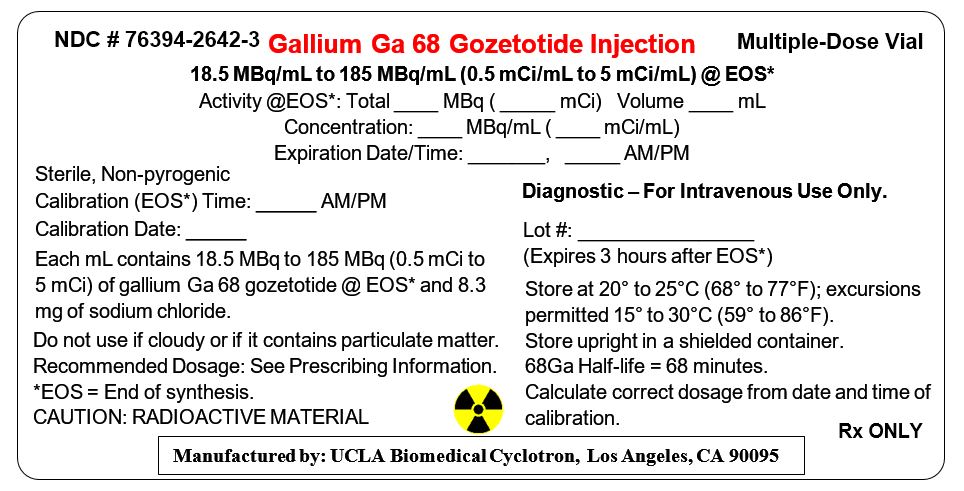
Gallium Ga-68 PSMA-11 GALLIUM GA-68 GOZETOTIDE 5 mCi/mL Injection, Solution, 12 mL
🆔 Identity & classification
Where does this data come from?
🏭 Manufacturer & labeler
Where does this data come from?
🩺 Clinical
Patient education
Supplement & herbal interactions
Where does this data come from?
Ask a licensed pharmacist directly — free, answered by our team.
🧪 Inactive Ingredients / Excipients
Inactive ingredients, also called excipients, are components of the drug product other than the active ingredient. They may include fillers, dyes, coatings, preservatives, flavors, or other formulation ingredients.
💡 Tap an ingredient (hover on desktop) to see what it is and why it’s used.
-
UNII 3K9958V90M
A liquid solvent derived from fermentation or chemical synthesis. In medicines, alcohol dissolves active ingredients, helps preserve the product, and improves how the body absorbs certain drugs.
-
UNII 451W47IQ8X
Sodium chloride is common table salt. It's used in medicines as a buffer to maintain proper pH, as a filler to add bulk, or to adjust the osmotic balance in liquid formulations.
2 inactive ingredients listed in the exact product block matched to this NDC.
Where does this data come from?
ingredient classCode="IACT" elements from the exact product block matched by this NDC. Label-section narrative from DailyMed / the openFDA label index is shown separately when available.Inactive ingredient FAQ
Are inactive ingredients the same for every manufacturer?
Why might an inactive ingredient be missing?
Can inactive ingredients matter?
💲 Pricing
A drug doesn't have one price. Each row is a different public payment system, and none is what you'd pay at the counter — that depends on your insurance. The ⓘ on each row explains what it measures.
| Price system | Per mL | Per package |
|---|---|---|
| Retail pharmacies payNADAC · weekly | Not in the retail survey — common for institutional, discontinued, or low-volume packs. | |
| Medicaid paysCMS SDUD · 12 mo | No recent Medicaid claims on file for this NDC — rare and low-volume NDCs are suppressed in the public data. | |
| Medicare drug plans payPart D · quarterly | No Part D plan price is available for this NDC in our data. | |
Where does this data come from?
🔁 Therapeutic equivalents
| Product | Labeler | Pack | NADAC/unit | TE | Status | Price vs. this |
|---|---|---|---|---|---|---|
| Gallium Ga-68 PSMA-11 5 mCi/mLthis 76394-2642-03 | UCLA | 12 ml | — | — | FDA listed | — |
| Gallium Ga-68 PSMA-11 5 mCi/mL 24275-0525-01 | UCSF | 11 ml | — | AP | FDA listed | — |
| Gallium Ga-68 PSMA-11 5 mCi/mL 71162-0201-10 | Ionetix | 9 ml | — | AP | FDA listed | — |
Where does this data come from?
⏳ Availability & generic status
The FDA lists approved generic versions of this medicine, but that does not always mean a pharmacy can get one today. Patent rules, launch agreements, supply and pricing can affect when generics actually arrive.
Where does this data come from?
📦 Packaging — all sizes for this product
| Package NDC | Description | Marketing start | Status |
|---|---|---|---|
| 76394-2642-03 You're viewing this | 12 mL in 1 VIAL, MULTI-DOSE (76394-2642-3) | 2020-12-09 | Active |
🧭 About this NDC listing & data coverage
What data is (and isn’t) available for this NDC — tap to expand
| NDC identity (package / product / labeler codes) | ✓ Available |
| Labeler | ✓ Available |
| Product & package description | ✓ Available |
| Marketing category & status | ✓ Available |
| Active ingredient / dosage form / route | ✓ Available |
| FDA label (SPL via DailyMed) | ✓ Available |
| Package photos | ✓ Available |
| Inactive ingredients (structured) | ✓ Available |
| NADAC pharmacy acquisition price (CMS) | — Not published for this NDC CMS publishes NADAC only for NDCs reported in its retail-pharmacy survey. |
| Orange Book / therapeutic-equivalence data | — Not published for this NDC Applies only to products approved under an NDA/ANDA; many listings are out of scope. |
| HCPCS J-code billing crosswalk | — Not published for this NDC Most self-administered / retail products have no J-code — that is normal. |
| Medicaid utilization (CMS SDUD) | — Not published for this NDC CMS reports utilization only for NDCs with Medicaid claims above its privacy threshold. |
Questions about this listing
Why is there no price listed?
Is the NDC printed on the package the same as the 11-digit billing NDC?
What do the three segments of this NDC mean?
Is this package still being marketed?
Who lists this product with the FDA?
Do I need a prescription for this product?
Where does this data come from?
📄 Full prescribing information FDA SPL
🎯 Indications and Usage ▾
1 INDICATIONS AND USAGE Gallium Ga 68 Gozetotide Injection is indicated for positron emission tomography (PET) of prostate-specific membrane antigen (PSMA) positive lesions in men with prostate cancer: with suspected metastasis who are candidates for initial definitive therapy. with suspected recurrence based on elevated serum prostate-specific antigen (PSA) level. Gallium Ga 68 Gozetotide Injection is a radioactive diagnostic agent indicated for positron emission tomography (PET) of prostate-specific membrane antigen (PSMA) positive lesions in men with prostate cancer: with suspected metastasis who are candidates for initial definitive therapy. with suspected recurrence based on elevated serum prostate-specific antigen (PSA) level.
(1 )
⏱️ Dosage and Administration ▾
2 DOSAGE AND ADMINISTRATION Use appropriate aseptic technique and radiation safety handling measures to maintain sterility during all operations involved in the manipulation and administration of Gallium Ga 68 Gozetotide Injection. ( 2.1 ) The recommended adult dose is 111 MBq to 259 MBq (3 mCi to 7 mCi) as a bolus intravenous injection. ( 2.2 ) A diuretic expected to act within the uptake time period may be administered at the time of radiotracer injection.
( 2.2 ) Initiate imaging 50 to 100 minutes after administration. The patient should void immediately prior to initiation of imaging. Scan should begin caudally and proceed cranially.
( 2.4 ) See full prescribing information for additional preparation, administration, imaging, and radiation dosimetry information. ( 2 )
2.1Radiation Safety – Drug Handling Handle Gallium Ga 68 Gozetotide Injection with appropriate safety measures to minimize radiation exposure [see Warnings and Precautions (5.2) ] . Use waterproof gloves, effective radiation shielding, and other appropriate safety measures when preparing and handling Gallium Ga 68 Gozetotide Injection. Radiopharmaceuticals should be used by or under the control of physicians who are qualified by specific training and experience in the safe use and handling of radionuclides, and whose experience and training have been approved by the appropriate governmental agency authorized to license the use of radionuclides.
2.2Recommended Dosage and Administration Instructions Recommended Dosage In adults, the recommended amount of radioactivity to be administered for PET is 111 MBq to 259 MBq (3 mCi to 7 mCi) administered as an intravenous bolus injection. Administration Use aseptic technique and radiation shielding when withdrawing and administering Gallium Ga 68 Gozetotide Injection. Calculate the necessary volume to administer based on calibration time and required dose.
Inspect Gallium Ga 68 Gozetotide Injection visually for particulate matter and discoloration before administration. Do not use the drug if the solution contains particulate matter or is discolored. Gallium Ga 68 Gozetotide Injection may be diluted with sterile 0.9% Sodium Chloride Injection, USP.
Assay the final dose immediately before administration to the patient in a dose calibrator. After injection of Gallium Ga 68 Gozetotide Injection, administer an intravenous flush of sterile 0.9% Sodium Chloride Injection, USP to ensure full delivery of the dose. Dispose of any unused drug in a safe manner in compliance with applicable regulations.
Unless contraindicated, a diuretic expected to act within the uptake time period may be administered at the time of radiotracer injection to potentially decrease artifact from radiotracer accumulation in the urinary bladder and ureters.
2.3Patient Preparation Prior to PET Imaging Instruct patients to drink a sufficient amount of water to ensure adequate hydration prior to administration of Gallium Ga 68 Gozetotide Injection and to continue to drink and void frequently following administration to reduce radiation exposure, particularly during the first hour after administration [see Warnings and Precautions (5.2) ] .
2.4Image Acquisition Position the patient supine with arms above the head. Begin PET scanning 50 to 100 minutes after the intravenous administration of Gallium Ga 68 Gozetotide Injection. Patients should void immediately prior to image acquisition and that image acquisition should begin at the proximal thighs and proceed cranially to the skull base or skull vertex.
Adapt imaging technique according to the equipment used and patient characteristics in order to obtain the best image quality possible.
2.5Image Interpretation Gallium Ga 68 Gozetotide binds to prostate-specific membrane antigen (PSMA). Based on the intensity of the signals, PET images obtained using Gallium Ga 68 Gozetotide Injection indicate the presence of PSMA in tissues. Lesions should be considered suspicious if uptake is greater than physiologic up…
💊 Dosage Forms and Strengths ▾
3 DOSAGE FORMS AND STRENGTHS Injection: supplied as a clear, colorless solution in a multiple-dose vial containing
18.5MBq/mL to 185 MBq/mL (0.5 mCi/mL to 5 mCi/mL) of gallium Ga 68 gozetotide in approximately 12 mL at calibration time. Injection: clear, colorless solution in a multiple-dose vial containing
18.5MBq/mL to 185 MBq/mL (0.5 mCi/mL to 5 mCi/mL) gallium Ga 68 gozetotide in approximately 12 mL at calibration time ( 3 )
⛔ Contraindications ▾
4 CONTRAINDICATIONS None None ( 4 )
⚠️ Warnings and Cautions ▾
5 WARNINGS AND PRECAUTIONS Risk for misdiagnosis: Gallium Ga 68 gozetotide uptake can be seen in a variety of tumor types and in non-malignant processes. Image interpretation errors can occur with gallium Ga 68 gozetotide PET. ( 5.1 ) Radiation risk: Ensure safe handling to protect patients and health care workers from unintentional radiation exposure. ( 2.1 , 5.2 )
5.1Risk for Misdiagnosis Image interpretation errors can occur with gallium Ga 68 gozetotide PET. A negative image does not rule out the presence of prostate cancer and a positive image does not confirm the presence of prostate cancer. The performance of Gallium Ga 68 Gozetotide Injection for imaging of biochemically recurrent prostate cancer seems to be affected by serum PSA levels and by site of disease [See Clinical Studies (14) ] .
The performance of Gallium Ga 68 Gozetotide Injection for imaging of metastatic pelvic lymph nodes prior to initial definitive therapy seems to be affected by Gleason score [See Clinical Studies (14) ] . Gallium Ga 68 gozetotide uptake is not specific for prostate cancer and may occur with other types of cancer as well as non-malignant processes such as Paget's disease, fibrous dysplasia, and osteophytosis. Clinical correlation, which may include histopathological evaluation of the suspected prostate cancer site, is recommended.
5.2Radiation Risks Gallium Ga 68 Gozetotide Injection contributes to a patient's overall long-term cumulative radiation exposure. Long-term cumulative radiation exposure is associated with an increased risk for cancer. Ensure safe handling to minimize radiation exposure to the patient and health care workers.
Advise patients to hydrate before and after administration and to void frequently after administration [see Dosage and Administration (2.1 , 2.3) ] .
🤒 Adverse Reactions ▾
6 ADVERSE REACTIONS The most commonly reported adverse reactions include nausea, diarrhea, and dizziness. ( 6 ) To report SUSPECTED ADVERSE REACTIONS, contact UCLA Nuclear Medicine at 1-844-963-1855 or FDA at 1-800-FDA-1088 or www.fda.gov/medwatch. Clinical Trials Experience Because clinical trials are conducted under widely varying conditions, adverse reaction rates observed in the clinical trials of a drug cannot be directly compared to rates in the clinical trials of another drug and may not reflect the rates observed in practice.
The safety of Gallium Ga 68 Gozetotide Injection was evaluated in 960 patients, each receiving one dose of Gallium Ga 68 Gozetotide Injection. The average injected activity was 188.7 ±
40.7MBq (5.1 ± 1.1 mCi). The most commonly reported adverse reactions were nausea, diarrhea, and dizziness, occurring at a rate of < 1%.
🔄 Drug Interactions ▾
7 DRUG INTERACTIONS Androgen deprivation therapy and other therapies targeting the androgen pathway Androgen deprivation therapy (ADT) and other therapies targeting the androgen pathway, such as androgen receptor antagonists, can result in changes in uptake of gallium Ga 68 gozetotide in prostate cancer. The effect of these therapies on performance of gallium Ga 68 gozetotide PET has not been established.
👥 Use in Specific Populations ▾
8 USE IN SPECIFIC POPULATIONS
8.1Pregnancy Risk Summary Gallium Ga 68 Gozetotide Injection is not indicated for use in females. There are no available data with Gallium Ga 68 Gozetotide Injection use in pregnant women to evaluate for a drug-associated risk of major birth defects, miscarriage, or adverse maternal or fetal outcomes. All radiopharmaceuticals, including Gallium Ga 68 Gozetotide Injection, have the potential to cause fetal harm depending on the fetal stage of development and the magnitude of the radiation dose.
Animal reproduction studies have not been conducted with gallium Ga 68 gozetotide.
8.2Lactation Risk Summary Gallium Ga 68 Gozetotide Injection is not indicated for use in females. There are no data on the presence of gallium Ga 68 gozetotide in human milk, the effect on the breastfed infant, or the effect on milk production.
8.4Pediatric Use The safety and effectiveness of Gallium Ga 68 Gozetotide Injection have not been established in pediatric patients.
8.5Geriatric Use The efficacy of Gallium Ga 68 Gozetotide Injection in geriatric patients with prostate cancer is based on data from two prospective studies [see Clinical Studies (14) ] . Of the total number of subjects in these studies of Gallium Ga 68 Gozetotide Injection, 691 of 960 (72%) were 65 years of age and older (72%), While 195 (20%) were 75 years of age and older. The efficacy and safety profiles of Gallium Ga 68 Gozetotide Injection appear similar in younger adult and geriatric patients with prostate cancer, although the number of younger adult patients in the trials was not large enough to allow definitive comparison.
🤰 Pregnancy ▾
8.1Pregnancy Risk Summary Gallium Ga 68 Gozetotide Injection is not indicated for use in females. There are no available data with Gallium Ga 68 Gozetotide Injection use in pregnant women to evaluate for a drug-associated risk of major birth defects, miscarriage, or adverse maternal or fetal outcomes. All radiopharmaceuticals, including Gallium Ga 68 Gozetotide Injection, have the potential to cause fetal harm depending on the fetal stage of development and the magnitude of the radiation dose.
Animal reproduction studies have not been conducted with gallium Ga 68 gozetotide.
🧒 Pediatric Use ▾
8.4Pediatric Use The safety and effectiveness of Gallium Ga 68 Gozetotide Injection have not been established in pediatric patients.
🧓 Geriatric Use ▾
8.5Geriatric Use The efficacy of Gallium Ga 68 Gozetotide Injection in geriatric patients with prostate cancer is based on data from two prospective studies [see Clinical Studies (14) ] . Of the total number of subjects in these studies of Gallium Ga 68 Gozetotide Injection, 691 of 960 (72%) were 65 years of age and older (72%), While 195 (20%) were 75 years of age and older. The efficacy and safety profiles of Gallium Ga 68 Gozetotide Injection appear similar in younger adult and geriatric patients with prostate cancer, although the number of younger adult patients in the trials was not large enough to allow definitive comparison.
🆘 Overdosage ▾
10 OVERDOSAGE In the event of an overdose of Gallium Ga 68 Gozetotide Injection, reduce the radiation absorbed dose to the patient where possible by increasing the elimination of the drug from the body using hydration and frequent bladder voiding. A diuretic might also be considered. If possible, an estimate of the radiation effective dose given to the patient should be made.
🧬 Clinical Pharmacology ▾
12 CLINICAL PHARMACOLOGY
12.1Mechanism of Action Gallium Ga 68 gozetotide binds to prostate-specific membrane antigen (PSMA). It binds to cells that express PSMA, including malignant prostate cancer cells, which usually overexpress PSMA. Gallium-68 (Ga 68) is a β+ emitting radionuclide that allows positron emission tomography (PET).
12.2Pharmacodynamics The relationship between gallium Ga 68 gozetotide plasma concentrations and successful imaging was not explored in clinical trials.
12.3Pharmacokinetics Distribution Intravenously injected gallium Ga 68 gozetotide is cleared from the blood and is accumulated preferentially in the liver (15%), kidneys (7%), spleen (2%), and salivary glands (0.5%). Gallium Ga 68 gozetotide uptake is also seen in the adrenals and prostate. There is no uptake in the cerebral cortex or in the heart, and usually lung uptake is low.
Elimination A total of 14% of the injected dose is excreted in urine in the first 2 hours post-injection.
🧬 Mechanism of Action ▾
12.1Mechanism of Action Gallium Ga 68 gozetotide binds to prostate-specific membrane antigen (PSMA). It binds to cells that express PSMA, including malignant prostate cancer cells, which usually overexpress PSMA. Gallium-68 (Ga 68) is a β+ emitting radionuclide that allows positron emission tomography (PET).
📦 How Supplied / Storage and Handling ▾
16 HOW SUPPLIED/STORAGE AND HANDLING How Supplied Gallium Ga 68 Gozetotide Injection (NDC 76394-2642-3) is a clear, colorless solution, supplied in a capped glass vial containing
18.5MBq/mL to 185 MBq/mL (0.5 mCi/mL to 5 mCi/mL) of gallium 68 gozetotide at calibration time, in approximately 12 mL. The contents of each vial are sterile, pyrogen-free and preservative-free. The expiration date and time are provided on the container label.
Use Gallium Ga 68 Gozetotide Injection within 3 hours of calibration time. Storage and Handling Store Gallium Ga 68 Gozetotide Injection upright in a lead shielded container at 25°C (77°F); excursions are permitted from 15°C to 30°C (59°F to 86°F). Store Gallium Ga 68 Gozetotide Injection within the original container in radiation shielding.
Receipt, transfer, handling, possession, or use of this product is subject to the radioactive material regulations and licensing requirements of the U.S. Nuclear Regulatory Commission, Agreement States, or Licensing States as appropriate.
📦 Storage and Handling ▾
Storage and Handling Store Gallium Ga 68 Gozetotide Injection upright in a lead shielded container at 25°C (77°F); excursions are permitted from 15°C to 30°C (59°F to 86°F). Store Gallium Ga 68 Gozetotide Injection within the original container in radiation shielding. Receipt, transfer, handling, possession, or use of this product is subject to the radioactive material regulations and licensing requirements of the U.S.
Nuclear Regulatory Commission, Agreement States, or Licensing States as appropriate.
📋 Description ▾
11 DESCRIPTION
11.1Chemical Characteristics Gallium Ga 68 Gozetotide Injection is a radioactive diagnostic agent for intravenous administration. It contains 5 mcg gozetotide,
18.5MBq/mL to 185 MBq/mL (0.5 mCi/mL to 5 mCi/mL) of gallium Ga 68 gozetotide at calibration time, 1 mL ethanol, 1 mL water for injection, and 10 mL of 0.9% sodium chloride solution (approximately 12 mL total volume). Gallium Ga 68 Gozetotide Injection is provided as a sterile, pyrogen free, clear, colorless solution for intravenous use, with a pH between 4.0 and 7.0. Gozetotide is also known as PSMA-11.
Gallium Ga 68 gozetotide is a urea based peptidomimetic that has a covalently bound chelator (HBED-CC). The peptide has the amino acid sequence Glu-NH-CO-NH-Lys(Ahx)-HBED-CC. Gallium Ga 68 gozetotide has a molecular weight of 1011.91 g/mol and its chemical structure is shown in Figure 1.
Figure 1: Chemical Structure of Gallium Ga 68 Gozetotide Chemical Structure
11.2Physical Characteristics Gallium-68 (Ga 68) decays with a half-life of 68 minutes to stable zinc-68. Table 2 and Table 3 display the principal radiation emission data and physical decay of Ga 68. Table 2: Principal Radiation Emission Data (>1%) for Gallium Ga 68 Radiation/ Emission % Disintegration Mean Energy (MeV) beta+ 88% 0.8360 beta+ 1.1% 0.3526 gamma 178% 0.5110 gamma 3.0% 1.0770 X-ray 2.8% 0.0086 X-ray 1.4% 0.0086 Table 3: Physical Decay Chart for Gallium Ga 68 Minutes Fraction Remaining 0 1 15 0.858 30 0.736 60 0.541 90 0.398 120 0.293 180 0.158 240 0.086 360 0.025
11.3External Radiation Table 4 displays the radiation attenuation by lead shielding of Ga 68. Table 4: Radiation Attenuation of 511 keV Photons by Lead (Pb) Shielding Shield Thickness (Pb) mm Coefficient of Attenuation 6 0.5 12 0.25 17 0.1 34 0.01 51 0.001
💬 Information for Patients ▾
17 PATIENT COUNSELING INFORMATION Adequate Hydration Instruct patients to drink a sufficient amount of water to ensure adequate hydration before their PET study and urge them to drink and urinate as often as possible during the first hours following the administration of Gallium Ga 68 Gozetotide Injection, in order to reduce radiation exposure [see Dosage and Administration (2.3) and Warnings and Precautions (5.2) ] .