
Active B Complex by Carotec Ingredients, Side Effects and Drug Interactions
Dietary Supplement Capsule Vitamin
UPC 6 71891 82076 5 Match it to the barcode on your bottle

Medically reviewed by Dr. Brian Staiger, PharmD, BCPS
Also reviewed by the HelloPharmacist Editorial Team
Updated Details about this page
- Label on file from the NIH Dietary Supplement Label Database, dated Jan 23, 2025.
- The interaction, evidence and safety records come from the Natural Medicines database, which we license, read against this label by our own system; the pharmacy team’s sections are written from those records.
- Dr. Brian Staiger, PharmD, BCPS, is a clinical pharmacist and pharmacotherapy specialist.
- Editorial policy Our sources
AI is used only to summarize verified clinical information, never the open internet. Our AI policy
Summary: The HelloPharmacist Team’s Take
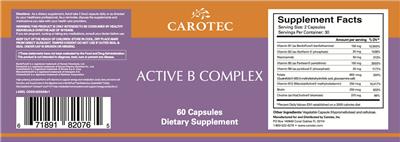
- Form
- Capsule
- Serving Size
- 2 Capsules
- Servings
- 30 per container
- Container Holds
- 60 Capsules
What’s in it, whether it interacts with your drugs, its side effects, whether it works, and what our pharmacists would want you to know before you start it.
- What is Active B Complex?A supplement from Carotec with nine active ingredients, in capsule form.
- Active Ingredients Vitamin B1 150 mgVitamin B2 20 mgNiacinamide 50 mgVitamin B5 150 mgVitamin B6 20 mgFolate 800 mcgVitamin B12 250 mcgBiotin 250 mcgCholine 370 mg Nine active ingredients. Each one can interact with drugs or cause side effects on its own, so we check every one. The full Supplement Facts
- Drug Interactions 385 drugs have a documented interaction with this supplement; the most serious is rated moderate. Of those, 219 are single drugs and 166 are combination products (two or more drugs in one), each listed under its own name. Based on the 7 of its 9 ingredients we could check. Ask your pharmacist first if you take a drug in any of these categories, the most serious of the 16 on record:
- Moderate · 172 drugs
- Moderate · 122 drugs
- Phenobarbital (Luminal)Moderate · 28 drugs
- Moderate · 20 drugs
- Possible Side EffectsNausea 5 ingredientsStomach upset 4 ingredientsDiarrhea 2 ingredientsHeadache 2 ingredientsAbdominal painA fishy body odor +18 moreCombined from six of its nine active ingredients. Not studied in this exact product.
- Well documented Why
Does Active B Complex work?
Strong This product doesn't appear to be marketed for a specific use, so we graded its ingredients' overall clinical evidence instead.It is not marketed for one specific use, so this is what its ingredients have been studied for, strongest research first:
- Ariboflavinosis Riboflavin
- Vitamin B6 deficiency Vitamin B6
- Folate deficiency Folic Acid
- Pellagra Niacinamide
- Hyperhomocysteinemia Vitamin B6
- Neural tube birth defects Folic Acid
These grades are for each ingredient, not this exact product, and never a promise it will work for you.
And 11 more graded uses, in what the research says- Full Why
- AllergensNone of its ingredient names point to a major food allergen, and the label text we have carries no allergen statement
- Barcode (UPC)6 71891 82076 5Match it to the barcode on your bottle to be sure this is your product. Not your product? Search for it here
Who Might Consider It
- People who want it for ariboflavinosis, vitamin B6 deficiency, folate deficiency, pellagra or another graded use: the uses with research behind them. See each grade
- This product may suit someone who wants a combination of B vitamins and has talked it over with their own doctor or pharmacist.
Who Should Be Careful
- People taking warfarin, seizure medicines, blood pressure medicines, amiodarone, levodopa, metformin, or tetracycline antibiotics should be especially careful.
- Anyone with liver or kidney disease, diabetes, or who is pregnant should talk with their own healthcare provider before starting.
More Before You Take It Show both answersHide Pregnancy and Breastfeeding The Label’s Directions
-
Pregnant or breastfeeding?
- Pregnancy Vitamin B6
- ! When used orally in excessive doses.
- Breastfeeding Vitamin B6
- When used orally in doses not exceeding the tolerable upper intake level (UL) of vitamin B6 in the form of pyridoxine 80 mg daily for those aged 14-18 years and 100 mg daily for those 19 years and older.
- Pregnancy and Breastfeeding Riboflavin
- When used orally and appropriately in dietary amounts.
- Pregnancy and Breastfeeding Niacinamide
- When used orally in amounts that do not exceed the tolerable upper intake level (UL) for niacinamide.
-
How does the label say to take it?
“Directions: As a dietary supplement, adult take 2 (two) capsule daily or as directed by your healthcare professional. As a reminder, discuss the supplements and medications you take with your health care providers.”
The maker’s words. Your pharmacist or doctor may advise differently.
Everything the label says
From the label dated Jan 23, 2025: 7 of its 9 active ingredients were checked against our records; the other two are not in them yet. A summary of what is known, not a grade or a test of the product. How these ratings are computed
Ask Anything About This Supplement
Name a drug you take, or ask about side effects, ingredients or pregnancy.
AI answers come from this label and our own records, never the open internet. AI can make mistakes, so always check with your doctor or pharmacist. How we use AI
Ask the Pharmacist
A licensed pharmacist will answer your question by email — free, usually within 24 hours.
Got it — thank you!
A licensed pharmacist will answer within 24 hours. Keep an eye on your email (worth checking spam, just in case).
What’s Inside Active B Complex by Carotec
Nine Active Ingredients, Each Checked on Its Own
A supplement is often several ingredients in one bottle, and each one can interact with drugs or cause side effects on its own. We check every one of them against our records.
- Vitamin B1Not in our interaction records yet
- Vitamin B2Drug interactions on record, most serious: Moderate
- NiacinamideDrug interactions on record, most serious: Moderate
- Vitamin B5Not in our interaction records yet
- Vitamin B6Drug interactions on record, most serious: Moderate
- FolateDrug interactions on record, most serious: Moderate
- Vitamin B12No drug interactions on record
- BiotinNo drug interactions on record
And 1 more, each with its own card below.
Why this rating?
The label gives an exact amount for every one of its nine active ingredients, so you know how much of each you get in each serving. This rates what the label tells you, not the quality of the product.
Supplement Facts
| Amount Per Serving | % Daily Value | |
|---|---|---|
| Vitamin B1 | 150 mg | 12500% |
| Vitamin B2 | 20 mg | 1538% |
| Niacinamide | 50 mg | 313% |
| Vitamin B5 | 150 mg | 3000% |
| Vitamin B6 | 20 mg | 1177% |
| Folate | 800 mcg | 200% |
| Vitamin B12 | 250 mcg | 10417% |
| Biotin | 250 mcg | 833% |
| Choline | 370 mg | 66% |
Other ingredients: Hypromellose, Cellulose
Daily Values for adults and children 4 or more years of age.
As the label prints it, from the NIH Dietary Supplement Label Database.
Each Ingredient and Its Drug Interactions
Tap one for more about it and its full guide. A drug can interact with this supplement through any one of them.
Active B Complex contains nine active ingredients: biotin, niacinamide, vitamin B6, folate, vitamin B2, vitamin B1, vitamin B5, vitamin B12, and choline.
- Our data ties biotin, niacinamide, vitamin B6, vitamin B2, and vitamin B12 to specific uses, mostly deficiency and related conditions.
- We have no information on the role of folate, vitamin B1, vitamin B5, or choline beyond their effectiveness ratings.
-
Vitamin B1 150 mg We know this ingredient, but hold no drug interaction record for it yet, so it was not checked
Form on the label: BenfoPure
-
Vitamin B2 20 mg Interacts with 20 drugs
Form on the label: Riboflavin 5-Phosphate
Riboflavin (vitamin B2) is an essential nutrient your body needs to turn food into energy and to keep skin, eyes, and nerves healthy.
- It is generally very safe at typical doses, and the strongest evidence supports its use for treating deficiency, with some supportive (but not definitive) evidence for preventing migraines.
The full Riboflavin guide: uses, dosage and safety Every Riboflavin drug interaction
-
Niacinamide 50 mg Interacts with 124 drugs
Niacinamide (also called nicotinamide) is a form of vitamin B3 used in supplements and skin-care products.
- It is well established for preventing and treating vitamin B3 deficiency, and there is moderate evidence for some skin uses, but many popular claims are still being studied.
- It is generally well tolerated at usual doses, but high amounts should be discussed with your doctor or pharmacist.
The full Niacinamide guide: uses, dosage and safety Every Niacinamide drug interaction
-
Vitamin B5 150 mg We know this ingredient, but hold no drug interaction record for it yet, so it was not checked
Form on the label: Pantesin Pantethine
-
Vitamin B6 20 mg Interacts with 210 drugs
Form on the label: Pyridoxal 5-Phosphate
Vitamin B6 (pyridoxine) is an essential water-soluble vitamin that your body needs for metabolism, brain function, and making red blood cells.
- It is best known for helping with pregnancy-related nausea and may help some people with PMS, but taking very high doses for long periods can cause nerve damage.
- Get most of your B6 from food, and check with a pharmacist or doctor before taking high-dose supplements.
The full Vitamin B6 guide: uses, dosage and safety Every Vitamin B6 drug interaction
-
Folate 800 mcg Interacts with 40 drugs
Form on the label: Quatrefolic
Folic acid is the man-made form of vitamin B9 and is one of the most well-studied supplements, especially for preventing serious birth defects when taken before and during early pregnancy.
- It is widely available, inexpensive, and generally safe at recommended doses, but you should still check with your pharmacist or doctor about the right amount for you.
The full Folic Acid guide: uses, dosage and safety Every Folic Acid drug interaction
-
Vitamin B12 250 mcg Interacts with 20 drugs
Form on the label: Mecobalactive
Vitamin B12 (cobalamin) is an essential nutrient your body needs to make red blood cells, keep nerves healthy, and support DNA.
- Supplements are very helpful for people who are deficient — such as vegans, older adults, and those with absorption problems — but taking extra B12 when you are not deficient is unlikely to boost energy or health.
- Talk to your pharmacist or doctor if you think you may be low.
The full Vitamin B12 guide: uses, dosage and safety Every Vitamin B12 drug interaction
-
Biotin 250 mcg No known drug interactions
Biotin (vitamin B7) is a water-soluble vitamin your body needs to turn food into energy and to support healthy hair, skin, and nails.
- Most people get plenty from a normal diet, and true deficiency is rare.
- Supplements are widely sold for hair and nail health, but solid evidence for these benefits is limited in people who are not deficient, and high doses can interfere with certain lab tests.
-
Choline 370 mg Interacts with 16 drugs
Form on the label: Vitacholine
Choline is an essential nutrient your body needs for liver function, brain health, and nerve signaling, and many people get enough from foods like eggs, meat, and fish.
- Supplements may help people who are deficient or who have higher needs (such as during pregnancy), but they are not proven cure-alls and very high doses can cause side effects.
- Check with your pharmacist or doctor before starting a supplement.
The full Choline guide: uses, dosage and safety Every Choline drug interaction
Other Ingredients (Inactive)
The capsule or tablet itself, fillers, coatings and flavors. Not part of the drug interaction check; the allergen check below reads them.
- Hypromellose
- Cellulose
Allergens in Active B Complex
None of its ingredient names point to a major food allergen, and the label text we have carries no allergen statement.
Not named in the ingredients
- Milk
- Egg
- Fish
- Shellfish
- Tree nuts
- Peanuts
- Wheat or other gluten grains
- Soy
- Sesame
From the label text and ingredient names on file; we do not test products. With a serious allergy, check your bottle and ask the maker or your pharmacist.
What the Label Says
The maker’s own words, from the label. We do not verify or endorse them.
- Storage
-
“Store in cool, dry place away from direct sunlight.”
- Brand IP Statement(s)
-
“BenfoPure is a registered trademark of Hamari Chemicals, Ltd. Pantesin is a registered trademark of Kyowa Pharma Chemical Co., Ltd. Quatrefolic is a registered trademark of Gnosis S.p.A. Corp. MecobalActive is a registered trademark of Interquim S.A. Vitacholine is a registered trademark of Balchem Corporation.”
- FDA Statement of Identity
-
“Dietary Supplement”
- Formulation
-
“High-potency, activated forms of B vitamins to support energy and metabolism, brain, liver, and nerve cell function, and muscle tone in the digestive tract. BenfoPure benfotiamine, Quatrefolic folate, MeCobalActive, Pantesin and P-5-P help metabolize homocysteine and support energy production.”
The Active B Complex Label on File
The label scan on file at the NIH Dietary Supplement Label Database, dated January 2025. Always read the label on the bottle you have.
Product Facts
Is this label outdated? Report a formula or label change and our pharmacy team will review it.
Active B Complex by Carotec Side Effects
Why this rating?
We look for three kinds of safety information on each ingredient: side effects reported in studies, a pregnancy and breastfeeding rating, and a safety write-up from our pharmacy team. All three are on file for each of the seven ingredients we could check.
So this rates how much is known, not whether Active B Complex is right for you.
Reported with seven of its ingredients
- Most often
- Nausea, stomach upset, diarrhea, headache, abdominal pain and A fishy body odor
- !Rare but serious
- Sensory neuropathy (high doses), liver cirrhosis and cancer (long-term use) See details
HelloPharmacist Team Summary: Active B Complex by Carotec Side Effects
Most people taking Active B Complex will likely notice stomach upset or nausea, and the choline in your capsule can cause a fishy body odor, especially at higher doses.
- Diarrhea and more frequent urination have also been reported.
- Dizziness can occur at very high choline doses, so see how you feel before driving.
- Serious allergic reactions to vitamin B12 are rare but possible, and signs such as rash, swelling, or trouble breathing need emergency care.
- If you have liver or kidney problems, diabetes, or other chronic conditions, talk with your own doctor or pharmacist before starting.
Side Effects, Ingredient by Ingredient
A supplement’s side effects come from its ingredients. Here is what is reported with each one.
Riboflavin
Most reported
- Diarrhea
- Increase in urination
Niacinamide
Most reported
- Stomach upset
- Nausea
- Headache
Vitamin B6
Most reported
- Abdominal pain
- Allergic reactions
- Headache
- Heartburn
- Loss of appetite
- Nausea
- Somnolence
- Vomiting
From the Natural Medicines database, which we license.
Every reported effect, in the Vitamin B6 guideFolic Acid
Most reported
- Stomach upset
- Nausea
- Bloating
- Gas
Biotin
Most reported
- Stomach upset
- Nausea
- Digestive discomfort
Choline
Most reported
- A fishy body odor
- Nausea, stomach upset, or diarrhea
- Sweating
- Drop in blood pressure or dizziness (mainly at very high doses)
Vitamin B12 has side-effect reports, but no list of the most common ones. Read them in the Vitamin B12 guide
Active B Complex Warnings: Who Should Be Careful
Active B Complex has nine active ingredients, and each can carry warnings of its own. We checked the seven in our ingredient guides, and each warning below names the ingredient it comes from. Vitamin B1 and Vitamin B5 are not in our guides yet, so ask your pharmacist about them. If any of these apply to you, talk to your doctor or pharmacist before you start it.
- Riboflavin1 warning below
- Niacinamide2 warnings below
- Vitamin B62 warnings below
- Folic Acid2 warnings below
- Vitamin B121 warning below
- Biotin1 warning below
- Choline2 warnings below
- Vitamin B1Not in our guides yet
- Vitamin B5Not in our guides yet
-
Bleeding Problems or Surgery
- Vitamin B12Older adults, people with stomach or bowel conditions, those who have had weight-loss or stomach surgery, and people on long-term acid-reducing medicines may absorb B12 poorly and should ask about testing.
-
Diabetes or Low Blood Sugar
- NiacinamidePeople with liver problems, diabetes, gallbladder disease, gout, or kidney disease should be especially careful and check with their healthcare provider before taking high doses, because vitamin B3 forms can affect blood sugar, liver enzymes, and uric acid.
-
Liver Disease
- CholinePeople with liver or kidney conditions, or certain rare metabolic disorders, should talk to a healthcare provider before taking choline supplements.
-
Kidney Disease or Kidney Stones
- Vitamin B6People with kidney problems or other chronic conditions should talk to a clinician before using supplements.
-
Iron Deficiency or Anemia
- Folic AcidAnyone with a history of anemia should have the cause checked rather than just taking folic acid on their own.
-
Other Cautions
- RiboflavinIf you are thinking about higher-dose supplements (for example, for migraine), check with your provider first.
- NiacinamideWhen in doubt, choose caution.
- Vitamin B6Avoid high doses.
- Folic AcidOne important caution: high doses of folic acid can mask a vitamin B12 deficiency.
Show 2 more
- BiotinAnyone with an existing medical condition, or who is having lab work done, should check with a pharmacist or doctor first.
- CholineAnyone with a known body odor (fishy smell) reaction to choline should avoid high doses.
-
What the Label Warns
- “Warning: This product is only intended to be consumed by healthy individuals over the age of 18 years.”
- “If you are pregnant, nursing or taking any medications, consult your doctor before use.”
- “Keep out of the reach of children.”
- “Tamper evident: Do not use if outer seal & seal under cap is broken or missing.”
The maker’s wording, from the product label.
-
Pregnant or Breastfeeding
Each ingredient’s rating for pregnancy and for breastfeeding, and what it covers.
Pregnancy
-
When used orally and appropriately.
A special sustained-release product providing vitamin B6 (pyridoxine) 75 mg daily is FDA-approved for use in pregnancy.
3 more points on this rating
- Vitamin B6 (pyridoxine) is also considered a first-line treatment for nausea and vomiting in pregnancy by the American College of Obstetrics and Gynecology.
- However, it should not be used long-term or without medical supervision and close monitoring.
- The tolerable upper intake level (UL) refers to vitamin B6 in the form of pyridoxine and is 80 mg daily for those aged 14-18 years and 100 mg daily for 19 years and older.
-
When used orally in excessive doses.
There is some concern that high-dose maternal vitamin B6 (pyridoxine) can cause neonatal seizures.
Breastfeeding
-
When used orally in doses not exceeding the tolerable upper intake level (UL) of vitamin B6 in the form of pyridoxine 80 mg daily for those aged 14-18 years and 100 mg daily for those 19 years and older.
The recommended dietary allowance (RDA) in lactating women is 2 mg daily.
There is insufficient reliable information available about the safety of vitamin B6 when used in higher doses in breast-feeding women.
Pregnancy and Breastfeeding The record rates both the same
-
When used orally and appropriately in dietary amounts.
A tolerable upper intake level (UL) has not been established.
Show 5 more ingredients
Pregnancy and Breastfeeding The record rates both the same
-
When used orally in amounts that do not exceed the tolerable upper intake level (UL) for niacinamide.
The UL of niacinamide during pregnancy and lactation is 30 mg daily for those 14-18 years of age and 35 mg daily for those 19 years and older.
There is insufficient reliable information available about the safety of larger oral doses of niacinamide or topical niacinamide; avoid using.
Pregnancy and Breastfeeding The record rates both the same
-
When used orally and appropriately.
Folic acid 300-400 mcg is commonly used during pregnancy for prevention of neural tube defects.
3 more points on this rating
- Miscarriage rates and negative impacts on fetal growth have not been shown to increase with peri-conception supplemental folic acid intakes of 4 mg per day.
- However, other research shows that taking more than 5 mg per day during pregnancy may reduce development of cognitive, emotional, and motor skills in infants.
- Also, the tolerable upper intake level (UL) of folic acid for pregnant or lactating women is 800 mcg daily for those 14-18 years of age and 1000 mcg daily for those 19 years and older.
-
When L-5-methyltetrahydrofolate (L-5-MTHF), the reduced form of folate, is used orally and appropriately, short-term.
L-5-MTHF has been used with apparent safety at a dose of 416 mcg daily for 16 weeks during lactation.
Compared to folic acid, this form seems to further increase the folate concentration of red blood cells, but not breast milk.
Pregnancy
-
When used orally in amounts that do not exceed the recommended dietary allowance (RDA).
The RDA for vitamin B12 during pregnancy is 2.6 mcg daily.
There is insufficient reliable information available about the safety of larger amounts of vitamin B12 during pregnancy.
Breastfeeding
-
When used orally in amounts that do not exceed the recommended dietary allowance (RDA).
The RDA of vitamin B12 during lactation is 2.8 mcg daily.
There is insufficient reliable information available about the safety of larger amounts of vitamin B12 while breastfeeding.
Pregnancy and Breastfeeding The record rates both the same
-
When used orally and appropriately.
Biotin has been safely used at the adequate intake (AI) dose of 30 mcg daily during pregnancy and 35 mcg daily during lactation.
2 more points on this rating
- It has also been used in supplemental doses of up to 300 mcg daily.
- A tolerable upper intake level (UL) has not been established.
Pregnancy and Breastfeeding The record rates both the same
-
When used orally and appropriately.
Choline is safe when taken in doses below the tolerable upper intake level (UL), which is 3 grams daily during pregnancy and lactation in those up to 18 years of age and 3.5 grams daily for those 19 years and older.
There is insufficient reliable information available about the safety of choline used in higher doses during pregnancy and lactation.
Our pharmacy team’s notes
- Vitamin B6Vitamin B6 has a Likely Safe rating for pregnancy and breastfeeding, but also a Possibly Unsafe pregnancy rating, so the safety data advises against using it during pregnancy unless your doctor directs you.
- Folic AcidWe have no pregnancy or lactation information for folate, vitamin B1, or vitamin B5.
Ratings and the words beside them are from the Natural Medicines database, which we license.
-
Rare but Serious Side Effects
-
!
Riboflavin
Serious side effects are uncommon.
-
!
Vitamin B6
Orally or by injection: Sensory neuropathy (high doses).
Orally: Liver cirrhosis, hepatocellular carcinoma (high doses of pyridoxal-5'-phosphate).
-
!
Folic Acid
Allergic reactions are uncommon but possible.
Orally: Cancer (long-term use), cardiovascular complications, liver injury, seizures.
Allergic reactions such as bronchospasm and anaphylactic shock.
-
!
Vitamin B12
Serious allergic reactions are rare but possible; signs include rash, swelling, or trouble breathing, which need emergency care.
-
!
Biotin
Serious side effects are rare.
When to get help: a serious allergic reaction, with trouble breathing or swelling of the face, lips or throat, needs emergency care: call 911. For any other side effect that worries you, call your doctor or pharmacist.
These reports describe each ingredient, not studies of this exact product. Not medical advice: a side effect you notice after starting a supplement is worth a word with your pharmacist or doctor.
Active B Complex by Carotec Drug Interactions
We checked all nine active ingredients in this supplement against every drug in our records. A drug can interact with it through any one of them. Vitamin B1 and Vitamin B5 are not in our interaction records yet.
A moderate interaction on record
2 of 3, on a scale from Minor or none to Major.Why this rating?
We rate this by the most serious interaction on record, not by how many there are. For Choline, Vitamin B12, Vitamin B6, Riboflavin and Folic Acid, the most serious is rated moderate, which means it calls for caution, and sometimes monitoring or a change in timing or dose. Some involve kinds of drugs where a small change can matter, such as blood thinners and Parkinson’s drugs.
385 drugs are on the full list. What matters is whether one you take is on it, so check yours with the interaction checker on this page.
Six of its nine active ingredients have drug interactions on record: Riboflavin, Niacinamide, Vitamin B6, Folic Acid, Vitamin B12 and Choline. We have no interaction records for Vitamin B1, Vitamin B5 and Biotin.
- Interacts with
- 20 drugs
- Most serious
- Moderate
- Vitamin B2 may weaken tetracycline antibiotics (Moderate), though this has not been reported in humans.
- Interacts with
- 124 drugs
- Most serious
- Moderate
- The most serious interaction on record is niacinamide with warfarin, a blood thinner (anticoagulant).
- Niacinamide may increase warfarin's anticoagulant effects, and one case report describes a patient's INR rising to 8.4 after niacinamide, though the evidence is limited.
- Interacts with
- 210 drugs
- Most serious
- Moderate
- Vitamin B6 may speed up levodopa's breakdown when taken alone, a Parkinson's medicine (Minor).
Show three more ingredients
- Interacts with
- 40 drugs
- Most serious
- Moderate
- We could not check folate, vitamin B1, or vitamin B5.
- Interacts with
- 20 drugs
- Most serious
- Minor
- Metformin, a diabetes medicine, has been linked to lower vitamin B12 levels with long-term use (Minor).
- Interacts with
- 16 drugs
- Most serious
- Minor
- Choline may reduce the effects of atropine (Minor).
From the HelloPharmacist Team
Stepping back from the single ingredients, here is the picture across the whole supplement.
- Active B Complex from Carotec can interact with several medications, through its niacinamide, vitamin B6, vitamin B2, vitamin B12, and choline content.
- This is rated Moderate.
- Other Moderate interactions involve several drug types.
Summarized by the HelloPharmacist pharmacy team from the interaction records below. How it is written How we use AI
Why Active B Complex Interacts, Ingredient by Ingredient
A product interacts through its ingredients. Each card: how many drugs, the most serious rating, and the kinds of drugs it affects most (tap a kind for what it means).
The ingredients driving the most interactions
-
Vitamin B6 210 drugs
Most serious: Moderate5 interaction records on file
The kinds of drugs it affects most
- 172 drugs
- Phenobarbital (Luminal) 28 drugs
- Phenytoin (Dilantin) 5 drugs
- 5 drugs
Every Vitamin B6 drug interaction, 5 records The Vitamin B6 records cite 33 references, listed in the Vitamin B6 guide.
-
Niacinamide 124 drugs
Most serious: Moderate4 interaction records on file
The kinds of drugs it affects most
- 122 drugs
- 2 drugs
- Carbamazepine (Tegretol) 1 drug
- Primidone (Mysoline) 1 drug
Every Niacinamide drug interaction, 4 records The Niacinamide records cite 22 references, listed in the Niacinamide guide.
-
Folate 40 drugs
Most serious: Moderate7 interaction records on file
The kinds of drugs it affects most
- Phenobarbital (Luminal) 28 drugs
- Phenytoin (Dilantin) 5 drugs
- 5-Fluorouracil 2 drugs
- 2 drugs
Every Folic Acid drug interaction, 7 records The Folic Acid records cite 56 references, listed in the Folic Acid guide.
-
Vitamin B2 20 drugs
Most serious: Moderate1 interaction record on file
The kinds of drugs it affects most
- 20 drugs
Every Riboflavin drug interaction, 1 record The Riboflavin records cite 5 references, listed in the Riboflavin guide.
-
Vitamin B12 20 drugs
Most serious: Minor1 interaction record on file
The kinds of drugs it affects most
- 20 drugs
Every Vitamin B12 drug interaction, 1 record The Vitamin B12 records cite 34 references, listed in the Vitamin B12 guide.
-
Choline 16 drugs
Most serious: Minor1 interaction record on file
The kinds of drugs it affects most
- Atropine 16 drugs
Every Choline drug interaction, 1 record The Choline records cite 15 references, listed in the Choline guide.
The Breakdown by Severity
Each drug counted once, at its most serious rating. Tap a tile to list those drugs.
Find Your Drug
Type a drug or brand name to see whether it is on the list.
- Only drugs with a documented interaction are listed, the most serious first.
- A drug with no known interaction is not listed, but searching its name tells you so.
- Open a drug to see which ingredient is responsible. Of those, 219 are single drugs and 166 are combination products (two or more drugs in one), each listed under its own name.
-
ArgatrobanArgatroban Moderate
The ingredient responsible:
-
Niacinamide Moderate Argatroban is in the Anticoagulant/Antiplatelet Drugs category.
Theoretically, niacinamide may have additive effects when used with anticoagulant or antiplatelet drugs, especially in patients on hemodialysis.
The full Niacinamide + Argatroban interaction
-
-
MethazolamideNeptazane Moderate
The ingredient responsible:
-
Vitamin B6 Moderate Methazolamide is in the Antihypertensive Drugs category.
Theoretically, vitamin B6 may have additive effects when used with antihypertensive drugs.
The full Vitamin B6 + Methazolamide interaction
-
-
CilazaprilInhibace Moderate
The ingredient responsible:
-
Vitamin B6 Moderate Cilazapril is in the Antihypertensive Drugs category.
Theoretically, vitamin B6 may have additive effects when used with antihypertensive drugs.
The full Vitamin B6 + Cilazapril interaction
-
-
TrandolaprilMavik Moderate
The ingredient responsible:
-
Vitamin B6 Moderate Trandolapril is in the Antihypertensive Drugs category.
Theoretically, vitamin B6 may have additive effects when used with antihypertensive drugs.
The full Vitamin B6 + Trandolapril interaction
-
-
Defibrotide SodiumDefitelio Moderate
The ingredient responsible:
-
Niacinamide Moderate Defibrotide Sodium is in the Anticoagulant/Antiplatelet Drugs category.
Theoretically, niacinamide may have additive effects when used with anticoagulant or antiplatelet drugs, especially in patients on hemodialysis.
The full Niacinamide + Defibrotide Sodium interaction
-
-
RescinnamineModeril Moderate
The ingredient responsible:
-
Vitamin B6 Moderate Rescinnamine is in the Antihypertensive Drugs category.
Theoretically, vitamin B6 may have additive effects when used with antihypertensive drugs.
The full Vitamin B6 + Rescinnamine interaction
-
-
HydralazineApresoline, Apresoline Injection, Dralzine, Hydralazine, Hylazin Moderate
The ingredient responsible:
-
Vitamin B6 Moderate Hydralazine is in the Antihypertensive Drugs category.
Theoretically, vitamin B6 may have additive effects when used with antihypertensive drugs.
The full Vitamin B6 + Hydralazine interaction
-
-
NitroprussideNitropress Moderate
The ingredient responsible:
-
Vitamin B6 Moderate Nitroprusside is in the Antihypertensive Drugs category.
Theoretically, vitamin B6 may have additive effects when used with antihypertensive drugs.
The full Vitamin B6 + Nitroprusside interaction
-
-
AmilorideAmilamont, Midamor Moderate
The ingredient responsible:
-
Vitamin B6 Moderate Amiloride is in the Antihypertensive Drugs category.
Theoretically, vitamin B6 may have additive effects when used with antihypertensive drugs.
The full Vitamin B6 + Amiloride interaction
-
-
EptifibatideIntegrilin Moderate
The ingredient responsible:
-
Niacinamide Moderate Eptifibatide is in the Anticoagulant/Antiplatelet Drugs category.
Theoretically, niacinamide may have additive effects when used with anticoagulant or antiplatelet drugs, especially in patients on hemodialysis.
The full Niacinamide + Eptifibatide interaction
-
-
EprosartanTeveten Moderate
The ingredient responsible:
-
Vitamin B6 Moderate Eprosartan is in the Antihypertensive Drugs category.
Theoretically, vitamin B6 may have additive effects when used with antihypertensive drugs.
The full Vitamin B6 + Eprosartan interaction
-
-
PhenobarbitalLuminal, Phenobarbital, Solfoton Moderate
The 2 ingredients responsible:
-
Vitamin B6 Moderate
High doses of vitamin B6 may reduce the levels and clinical effects of phenobarbital.
The full Vitamin B6 + Phenobarbital interaction -
Folate Moderate
Folic acid might have antagonistic effects on phenobarbital and increase the risk for seizures.
The full Folate + Phenobarbital interaction
-
-
FelodipinePlendil, Renedil Moderate
The ingredient responsible:
-
Vitamin B6 Moderate Felodipine is in the Antihypertensive Drugs category.
Theoretically, vitamin B6 may have additive effects when used with antihypertensive drugs.
The full Vitamin B6 + Felodipine interaction
-
-
AprocitentanTryvio Moderate
The ingredient responsible:
-
Vitamin B6 Moderate Aprocitentan is in the Antihypertensive Drugs category.
Theoretically, vitamin B6 may have additive effects when used with antihypertensive drugs.
The full Vitamin B6 + Aprocitentan interaction
-
-
Sitaxsentan SodiumThelin Moderate
The ingredient responsible:
-
Vitamin B6 Moderate Sitaxsentan Sodium is in the Antihypertensive Drugs category.
Theoretically, vitamin B6 may have additive effects when used with antihypertensive drugs.
The full Vitamin B6 + Sitaxsentan Sodium interaction
-
-
EravacyclineXerava Moderate
The ingredient responsible:
-
Vitamin B2 Moderate Eravacycline is in the Tetracycline Antibiotics category.
Theoretically, taking riboflavin with tetracycline antibiotics may decrease the potency of these antibiotics.
The full Vitamin B2 + Eravacycline interaction
-
-
Fosphenytoin SodiumSesquient Moderate
The 2 ingredients responsible:
-
Vitamin B6 Moderate It contains phenytoin, the drug this record is about.
High doses of vitamin B6 may reduce the levels and clinical effects of phenytoin.
The full Vitamin B6 + Fosphenytoin Sodium interaction -
Folate Moderate It contains phenytoin, the drug this record is about.
Folic acid might reduce serum levels of phenytoin in some patients.
The full Folate + Fosphenytoin Sodium interaction
-
-
Anacaulase-bcdbNexoBrid Moderate
The ingredient responsible:
-
Niacinamide Moderate Anacaulase-bcdb is in the Anticoagulant/Antiplatelet Drugs category.
Theoretically, niacinamide may have additive effects when used with anticoagulant or antiplatelet drugs, especially in patients on hemodialysis.
The full Niacinamide + Anacaulase-bcdb interaction
-
-
Bumetanide (oral)Bumex Moderate
The ingredient responsible:
-
Vitamin B6 Moderate Bumetanide (oral) is in the Antihypertensive Drugs category.
Theoretically, vitamin B6 may have additive effects when used with antihypertensive drugs.
The full Vitamin B6 + Bumetanide (oral) interaction
-
-
EpoprostenolFlolan Moderate
The ingredient responsible:
-
Vitamin B6 Moderate Epoprostenol is in the Antihypertensive Drugs category.
Theoretically, vitamin B6 may have additive effects when used with antihypertensive drugs.
The full Vitamin B6 + Epoprostenol interaction
-
-
FosinoprilMonopril Moderate
The ingredient responsible:
-
Vitamin B6 Moderate Fosinopril is in the Antihypertensive Drugs category.
Theoretically, vitamin B6 may have additive effects when used with antihypertensive drugs.
The full Vitamin B6 + Fosinopril interaction
-
-
FenoldopamCorlopam Moderate
The ingredient responsible:
-
Vitamin B6 Moderate Fenoldopam is in the Antihypertensive Drugs category.
Theoretically, vitamin B6 may have additive effects when used with antihypertensive drugs.
The full Vitamin B6 + Fenoldopam interaction
-
-
TerazosinHytrin, Terazosin Moderate
The ingredient responsible:
-
Vitamin B6 Moderate Terazosin is in the Antihypertensive Drugs category.
Theoretically, vitamin B6 may have additive effects when used with antihypertensive drugs.
The full Vitamin B6 + Terazosin interaction
-
-
Treprostinil (inh)Tyvaso Moderate
The 2 ingredients responsible:
-
Niacinamide Moderate Treprostinil (inh) is in the Anticoagulant/Antiplatelet Drugs category.
Theoretically, niacinamide may have additive effects when used with anticoagulant or antiplatelet drugs, especially in patients on hemodialysis.
The full Niacinamide + Treprostinil (inh) interaction -
Vitamin B6 Moderate Treprostinil (inh) is in the Antihypertensive Drugs category.
Theoretically, vitamin B6 may have additive effects when used with antihypertensive drugs.
The full Vitamin B6 + Treprostinil (inh) interaction
-
-
MethyclothiazideAquatensen, Enduron Moderate
The ingredient responsible:
-
Vitamin B6 Moderate Methyclothiazide is in the Antihypertensive Drugs category.
Theoretically, vitamin B6 may have additive effects when used with antihypertensive drugs.
The full Vitamin B6 + Methyclothiazide interaction
-
-
BenzthiazideExna Moderate
The ingredient responsible:
-
Vitamin B6 Moderate Benzthiazide is in the Antihypertensive Drugs category.
Theoretically, vitamin B6 may have additive effects when used with antihypertensive drugs.
The full Vitamin B6 + Benzthiazide interaction
-
-
TrichlormethiazideAq 4B Aquazide, Marazide II, Metahydrin, Naqua Moderate
The ingredient responsible:
-
Vitamin B6 Moderate Trichlormethiazide is in the Antihypertensive Drugs category.
Theoretically, vitamin B6 may have additive effects when used with antihypertensive drugs.
The full Vitamin B6 + Trichlormethiazide interaction
-
-
AnisindioneMiradon Moderate
The ingredient responsible:
-
Niacinamide Moderate Anisindione is in the Anticoagulant/Antiplatelet Drugs category.
Theoretically, niacinamide may have additive effects when used with anticoagulant or antiplatelet drugs, especially in patients on hemodialysis.
The full Niacinamide + Anisindione interaction
-
-
NisoldipineSular Moderate
The ingredient responsible:
-
Vitamin B6 Moderate Nisoldipine is in the Antihypertensive Drugs category.
Theoretically, vitamin B6 may have additive effects when used with antihypertensive drugs.
The full Vitamin B6 + Nisoldipine interaction
-
-
MoxonidinePhysiotens Moderate
The ingredient responsible:
-
Vitamin B6 Moderate Moxonidine is in the Antihypertensive Drugs category.
Theoretically, vitamin B6 may have additive effects when used with antihypertensive drugs.
The full Vitamin B6 + Moxonidine interaction
-
Does It Work? Active B Complex by Carotec
How it rates in the research so far, then each ingredient on its own. A grade is the research so far, never an endorsement.
This product doesn't appear to be marketed for a specific use, so we graded its ingredients' overall clinical evidence instead.
Why this rating?
It is not marketed for one specific use, so we looked at what its ingredients have been studied for instead.
The strongest: Riboflavin is graded “Effective” for ariboflavinosis. That means strong studies support it.
We did not count sideroblastic anemia and methotrexate toxicity: they are treated by a doctor or in a hospital. Nor pyridoxine-dependent epilepsy and imerslund-Grasbeck disease: the research there is for the ingredient used a different way than this product, such as by injection.
The Evidence, Ingredient by Ingredient
Each card holds our notes on one ingredient, then its uses graded effective, likely effective or possibly effective.
Choline
Our pharmacy team’s notes on Choline
- Choline is rated Possibly Ineffective for athletic performance, and Insufficient Reliable Evidence To Rate for conditions such as Alzheimer disease.
No use is graded effective, likely effective or possibly effective for it yet.
Every graded use, in the Choline guideNiacinamide
From our Niacinamide guide
- The strongest evidence for niacinamide is for preventing and treating pellagra, the disease caused by vitamin B3 deficiency.
- As an essential vitamin, it clearly works for this purpose.
Research suggests a benefit for
- Pellagra
- Diabetes and osteoarthritis
Not counted here: one graded use is for Niacinamide injected or put on the skin (acne), not for a product like this one. One more is for a condition treated by a doctor or in a hospital (hyperphosphatemia).
Every graded use, in the Niacinamide guideRiboflavin
Our pharmacy team’s notes on Riboflavin
- Vitamin B2 is rated Effective for ariboflavinosis and Possibly Effective for migraine headache.
Research suggests a benefit for
- Ariboflavinosis
- Migraine headache and hyperhomocysteinemia
Vitamin B6
From our Vitamin B6 guide
- Morning sickness (nausea and vomiting in pregnancy): This is one of the better-supported uses.
- Vitamin B6 is commonly recommended by doctors, sometimes combined with the medication doxylamine, to help reduce nausea.
Research suggests a benefit for
- Vitamin B6 deficiency
- Hyperhomocysteinemia
- Premenstrual syndrome (PMS), kidney stones (nephrolithiasis), pregnancy-induced nausea and vomiting and antipsychotic-induced hyperprolactinemia
Not counted here: one graded use is for Vitamin B6 injected or put on the skin (pyridoxine-dependent epilepsy), not for a product like this one. One more is for a condition treated by a doctor or in a hospital (sideroblastic anemia).
Every graded use, in the Vitamin B6 guideFolic Acid
Our pharmacy team’s notes on Folic Acid
- We have no effectiveness ratings for folate, vitamin B1, or vitamin B5.
Research suggests a benefit for
- Folate deficiency
- Neural tube birth defects
- Depression, vitiligo and oral clefts
Not counted here: one graded use is for Folic Acid injected or put on the skin (phenytoin-induced gingival hyperplasia), not for a product like this one. Four more are for conditions treated by a doctor or in a hospital (congenital heart disease, methotrexate toxicity, kidney failure and others).
Every graded use, in the Folic Acid guideVitamin B12
From our Vitamin B12 guide
- The strongest and clearest use of B12 is to treat and prevent B12 deficiency.
- When a person is truly low, replacing B12 can correct anemia, reverse certain nerve symptoms (like tingling or numbness), and improve fatigue caused by the deficiency.
Research suggests a benefit for
- Vitamin B12 deficiency
- Canker sores and hyperhomocysteinemia
Not counted here: three graded uses are for Vitamin B12 injected or put on the skin (imerslund-Grasbeck disease, cyanide poisoning and postherpetic neuralgia), not for a product like this one.
Every graded use, in the Vitamin B12 guideBiotin
From our Biotin guide
- The clearest, best-supported use of biotin is treating biotin deficiency.
- Deficiency is uncommon but can happen with certain genetic disorders, long-term use of some medicines, very heavy alcohol use, or eating large amounts of raw egg whites.
Research suggests a benefit for
- Biotin deficiency
The grades are the Natural Medicines database’s, which we license; tap a grade for what it means. They are about each ingredient, not this exact product.
About Carotec
Manufacturer and brand details for Active B Complex, from the product label.
Carotec has 41 products in our supplement database, all of them on the market, with labels on file since 2023. Our database is built from the NIH’s Dietary Supplement Label Database and our pharmacy team’s own additions, so it covers the labels filed there, not every product the brand sells.
- Name
- Carotec, Inc.
- Street Address
- PO Box 140940
- City
- Coral Gables
- State
- FL
- ZipCode
- 33114
- Phone Number
- 1-800-522-4279
- Web Address
- www.carotec.com
Active B Complex by Carotec: Common Questions
Does Active B Complex by Carotec interact with any drugs?
What are the side effects of Active B Complex by Carotec?
Who should be careful taking Active B Complex by Carotec?
Can Active B Complex by Carotec affect the liver?
Can Active B Complex by Carotec affect the kidneys?
How can Active B Complex by Carotec interact with so many drugs?
Where does the information about Active B Complex by Carotec come from?
Does biotin in Active B Complex by Carotec work?
Can I take Active B Complex by Carotec while pregnant?
Does Active B Complex by Carotec contain fillers?
What should I do if I have a severe allergic reaction?
Written and reviewed by the HelloPharmacist Editorial Team. Our editorial policy
Still Have a Question About Active B Complex?
Our pharmacists answer drug and supplement questions, free, by email.
Label information is sourced from the NIH Dietary Supplement Label Database and reflects the product version on file; always read your actual product label. This page is for education only and is not a substitute for professional medical advice. Confirm with your pharmacist or doctor before combining supplements and drugs.
Who Reviews This Page
The pharmacist behind it, and how it is checked.
Dr. Brian Staiger, PharmD, BCPS
Clinical pharmacist and founder of HelloPharmacist
A licensed pharmacist for more than 13 years, he built the system behind this page: it reads the label on file, matches each active ingredient to its record in the Natural Medicines database, checks those records against every drug we cover, and our pharmacy team writes the take and the interaction summary from those records.
- 13+ Years in PharmacyRetail and clinical pharmacy, medication safety and healthcare administration.
- Board Certified (BCPS)A pharmacotherapy specialist, certified by the Board of Pharmacy Specialties.
- Herbalist TrainingCertificates in medical ethnobotany, for the herbs and supplements people take.
Where This Page Comes From
Active B Complex’s label data comes from the NIH Dietary Supplement Label Database; the ingredient interaction data is from the Natural Medicines database, reviewed by our pharmacists.
- NIH Dietary Supplement Label Database (DSLD)
- The official product label on file for this supplement.
- Natural Medicines (Therapeutic Research Center)
- The evidence-graded clinical reference behind the ingredient interaction, evidence and safety records, which we license.
- HelloPharmacist Editorial Team
- Content is reviewed by the HelloPharmacist Editorial Team, the pharmacists on our staff and those we contract. See our data sources and editorial standards for how this information is built and checked.
- The Pharmacy Team’s Take and Summaries
- Generated from HelloPharmacist’s pharmacist-curated databases and editorial rules. Clinical methodology reviewed by Dr. Brian Staiger, PharmD, BCPS. Last generated Oct 31, 2026. How we use AI
- The ratings in the Quick Summary
- They summarize available label information, ingredient evidence and known drug-safety records: a summary of what is known, not a grade of the product itself. They do not verify product identity, purity, potency, contamination or manufacturing quality. How these ratings are computed
The References Behind the Interaction Records
Every citation the ingredients’ records rest on is listed in that ingredient’s guide, in context: Riboflavin, 5 references; Niacinamide, 22 references; Vitamin B6, 33 references; Folic Acid, 56 references; Vitamin B12, 34 references; Biotin, 4 references; Choline, 15 references .
Parts of this content are provided by the Therapeutic Research Center, LLC.
DISCLAIMER: Currently this does not check for drug-drug interactions. This is not an all-inclusive comprehensive list of potential interactions and is for informational purposes only. Not all interactions are known or well-reported in the scientific literature, and new interactions are continually being reported. Input is needed from a qualified healthcare provider including a pharmacist before starting any therapy. Application of clinical judgment is necessary.
© 2021 Therapeutic Research Center, LLC
Keep Exploring
- Supplement interaction checkerCheck any supplement or product against your drugs
- Drug–drug interactionsCheck two or more of your drugs against each other
- Browse drugs A to ZEvery drug we have checked against herbs and supplements
- NDC and pricing lookupFind a drug’s NDCs, packaging and costs
- Ask a pharmacistA free, personal answer from our licensed team