
Artemisiacom Ingredients & Drug Interactions
by Energique
What is this page for?
First and foremost: checking Artemisiacom against your medications. The heart of this page is the interaction checker and the full interaction report — how this product’s ingredients may interact with prescription and over-the-counter medicines you may be taking.
Around that, we add a pharmacist’s high-level view of the product as a whole — what’s inside, the evidence for its stated use, how transparent the label is, and what safety data exists — so you can see the full picture in one place. It’s educational information from our licensed clinical databases and the clinical staff at HelloPharmacist — not medical advice — and we don’t sell or endorse products. Our editorial policy
Artemisiacom is a dietary supplement by Energique with 7 active ingredients. Its ingredients are commonly taken for short-term constipation relief, bowel cleansing before procedures, occasional irregularity.Based on those ingredients, 878 medications have a known interaction with it, the most serious rated major. The ingredients most likely to interact are Fennel, Senna, Culver's Root. Use the checker below to test your specific medication, or read the full HelloPharmacist Interaction Report.
Check Your Meds Against Artemisiacom by Energique
Ask about any prescription or over-the-counter medication and we check it for interactions with Artemisiacom by Energique — and tell you which ingredient is responsible.
AI summaries are generated from our interaction database for education only — always confirm with your pharmacist. How we use AI
Ask the Pharmacist
A licensed pharmacist will answer your question by email — free, usually within 24 hours.
Got it — thank you!
A licensed pharmacist will answer within 24 hours. Keep an eye on your email (worth checking spam, just in case).
HelloPharmacist Scorecard of Artemisiacom by Energique
Our pharmacy team’s full take, with four database checks built into the cards below — a summary of what is known, not a grade of the product itself.
What’s inside
Low disclosure
Artemisiacom contains 7 active herbal ingredients in a proprietary blend: senna, fennel, black walnut, pumpkin, wormwood, culver's root, and tansy. The product is delivered as a liquid in a base of purified water and ethanol.
Each of these herbs has traditional or research-supported roles — senna as a laxative, fennel for digestive comfort, pumpkin for urinary health, and others for various herbal purposes — but the exact amounts in the proprietary blend are not disclosed on the label.
Does it work?
Strong evidence
Senna is likely effective for constipation and possibly effective for bowel preparation. Fennel is possibly effective for period pain (dysmenorrhea).
Pumpkin is possibly effective for benign prostate enlargement. For the other ingredients and uses — including wormwood for biliary or digestive disorders, black walnut for heart health, and culver's root — the evidence in our data is insufficient to rate their effectiveness.
Tansy has no established effectiveness rating in our records.
How safe is it?
Well-documented data
Senna is generally well tolerated short-term but not for long-term daily use without medical guidance; common side effects are abdominal pain, cramps, diarrhea, nausea, and stomach discomfort. Fennel is well tolerated as a food but concentrated medicinal doses are less studied; gastrointestinal upset, light sensitivity, and allergic reactions are possible.
Pumpkin products are generally well tolerated; mild abdominal discomfort, diarrhea, nausea, and vomiting have been reported. Wormwood contains thujone, a neurotoxin; medicinal amounts may cause muscle aches, nausea, vomiting, and in rare cases kidney damage or seizures.
Black Walnut (especially leaf, bark, and hull) can cause stomach upset and skin irritation due to tannin content. Culver's Root can cause abdominal pain, cramps, drowsiness, headache, nausea, and vomiting.
Tansy contains thujone and is discouraged for internal use; poisoning symptoms include rapid heartbeat, vomiting, and organ damage. Pregnancy and breastfeeding: Senna is possibly safe in both.
Fennel is possibly unsafe in pregnancy and lactation due to hormone-like effects. Black Walnut is possibly unsafe during pregnancy and lactation, and the leaf/bark/hull form is unsafe.
Pumpkin data on concentrated supplements is not on file for pregnancy or lactation. Wormwood may stimulate the uterus and is unsafe in pregnancy; safety while breastfeeding is not established.
Culver's Root is possibly unsafe in pregnancy and data are not on file for lactation. Tansy is likely unsafe in both pregnancy and lactation.
Meds to double-check
Major interaction found
Before taking this product, check with your pharmacist if you take alcohol (major interaction with tansy), blood thinners or antiplatelet drugs (senna, fennel, culver's root), water pills (senna, culver's root), heart medications like digoxin (senna, culver's root), seizure medications (wormwood), birth control or hormone therapy (fennel), antibiotics like ciprofloxacin (fennel), warfarin (senna, culver's root), lithium (pumpkin), or tamoxifen (fennel).
The bottom line
Scorecard at a glanceFormula with limited ingredient disclosure with clinical evidence supporting its stated purpose. Major medication interactions have been identified, and safety information is well characterized.
This herbal blend is designed for digestive and urinary support, but it carries real medication interactions — especially with blood thinners, heart drugs, water pills, seizure meds, birth control, and alcohol. If you take any prescription or over-the-counter medications, or drink alcohol regularly, check with your pharmacist before using it.
Pregnant or breastfeeding people should talk to their doctor first.
Educational only — not medical advice; always confirm with your pharmacist. Our editorial policy · How we use AI
Assessment coverage: 7 of 7 active ingredients matched to our full ingredient reviews (monographs). Based on the product label dated Aug 22, 2024.
This Scorecard evaluates available label information, ingredient evidence, and known medication-safety considerations. It does not independently verify product identity, purity, potency, contamination, or manufacturing quality. How these ratings are computed
General information
Key facts about Artemisiacom, straight from the product label.
Everything in this section is reproduced from the manufacturer’s own product label — it’s the label speaking, not HelloPharmacist. We show it so you can see exactly what the maker states; we don’t verify or endorse those statements.
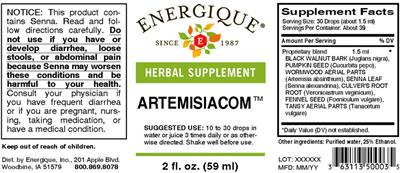
Supplement Facts
The label details for Artemisiacom by Energique, sourced from the NIH Dietary Supplement Label Database.
Supplement Facts
| Ingredient | Amount | % DV |
|---|---|---|
| Proprietary Blend | 1.5 mL | -- |
| Senna | 0 NP | -- |
| Fennel | 0 NP | -- |
| Black Walnut | 0 NP | -- |
| Pumpkin | 0 NP | -- |
| Wormwood | 0 NP | -- |
| Culver's Root | 0 NP | -- |
| Tansy | 0 NP | -- |
Other ingredients: Water, Purified, Ethanol
Tap any ingredient to jump to its full detail below.
These statements are the manufacturer’s wording, reproduced from the product label — the label is saying it, not HelloPharmacist. We don’t verify or endorse them.
Precautions
Notice: This product contains Senna. Read and follow directions carefully. Do not use if you have or develop diarrhea, loose stools, or abdominal pain because Senna may worsen these conditions and be harmful to your health. Consult you physician if you have frequent diarrhea or is you are pregnant, nursing, taking medication, or have a medical condition.
Consult you physician if you have frequent diarrhea or is you are pregnant, nursing, taking medication, or have a medical condition.
Keep out of reach of children.
Brand IP Statement(s)
Energique Since 1987
FDA Statement of Identity
Herbal Supplement
Suggested/Recommended/Usage/Directions
Suggested use: 10 to 30 drops in water or juice 3 times daily or as otherwise directed. Shake well before use.
Is this label outdated? Report a formula or label change and our pharmacy team will review it.
Artemisiacom by Energique label
The label scan from the NIH Dietary Supplement Label Database. Tap to enlarge.
Label images are published by the NIH Dietary Supplement Label Database for the version of this product on file. Always read your actual product label.
View the full label (PDF)The Ingredients in Artemisiacom by Energique
These are the 7 active ingredients this product is made of. Select any to open its full monograph.
Serving size0.5 mL Dosage formLiquid Servings per container39 Amounts shown are per serving.
Most supplement products combine several ingredients, and a medication can interact with the product through any one of them. Each ingredient below shows whether it has known drug interactions.
Proprietary Blend
- › Senna
- › Fennel
- › Black Walnut
- › Pumpkin
- › Wormwood
- › Culver's Root
- › Tansy
Other (inactive) ingredients: Water, Purified, Ethanol. These complete the product’s ingredient list but are not active constituents.
Artemisiacom by Energique Drug Interactions
HelloPharmacist Interaction Report
Artemisiacom by Energique is a liquid herbal blend that interacts with multiple medication types.
The single most serious interaction is with alcohol — tansy, one of the ingredients, contains thujone, which can increase and alter alcohol's effects with Major severity.
Read the full breakdown — every affected drug type, severity by severity
Moderate interactions span several drug categories. Senna (a stimulant laxative in the blend) may reduce estrogen absorption, increase potassium loss when combined with water pills, and worsen bleeding risk with warfarin or digoxin.
Fennel can interfere with birth control and hormone therapy through estrogenic activity, may increase bleeding risk with blood thinners, and could reduce antibiotic (ciprofloxacin) effectiveness. Pumpkin may raise lithium levels.
Culver's Root (black root) carries the same warfarin and digoxin concerns as senna, plus potassium-loss risk with diuretics. Wormwood may interfere with seizure medications.
Black Walnut was checked and shows no documented interactions.
Altogether, these interactions span 866 individual medications. Check your exact prescriptions with the search tool on this page before starting.
Check your own medications below · Editorial policy · How we use AI
Want to check YOUR meds against Artemisiacom?
Ask about interactions with your drugs in plain English — “Can I take it with lisinopril?” — and we find you the answer in seconds, ingredient by ingredient.
Go to the checkerIngredients driving the most interactions
Individual Drug Interactions
The ingredients in Artemisiacom interact with 878 drugs. Click any drug to see the details.
6 of the 7 ingredients in Artemisiacom interact with drugs. Each result below shows which ingredient is responsible. Fennel Senna Culver's Root Wormwood Pumpkin Tansy
EthanolEthanol
How Ethanol interacts with Artemisiacom — through 1 ingredient. Tap an ingredient for the detail:
TansyAlcohol (ethanol) Major
Interaction Summary
Thujone, a constituent of tansy, can increase and alter the effects of alcohol.
Read the full Tansy + Ethanol interactionAdo-trastuzumab EmtansineKadcyla
How Ado-trastuzumab Emtansine interacts with Artemisiacom — through 1 ingredient. Tap an ingredient for the detail:
FennelCytochrome P450 3a4 (cyp3a4) Substrates Moderate
Interaction Summary
Theoretically, fennel might increase levels of drugs metabolized by CYP3A4.
Read the full Fennel + Ado-trastuzumab Emtansine interactionAbciximabReoPro
How Abciximab interacts with Artemisiacom — through 1 ingredient. Tap an ingredient for the detail:
FennelAnticoagulant/antiplatelet Drugs Moderate
Interaction Summary
Theoretically, fennel might increase the risk of bleeding when used with antiplatelet or anticoagulant drugs.
Read the full Fennel + Abciximab interactionAbemaciclibVerzenio
How Abemaciclib interacts with Artemisiacom — through 1 ingredient. Tap an ingredient for the detail:
FennelCytochrome P450 3a4 (cyp3a4) Substrates Moderate
Interaction Summary
Theoretically, fennel might increase levels of drugs metabolized by CYP3A4.
Read the full Fennel + Abemaciclib interactionAbiraterone
How Abiraterone interacts with Artemisiacom — through 1 ingredient. Tap an ingredient for the detail:
FennelCytochrome P450 3a4 (cyp3a4) Substrates Moderate
Interaction Summary
Theoretically, fennel might increase levels of drugs metabolized by CYP3A4.
Read the full Fennel + Abiraterone interactionAbiraterone AcetateYonsa, Zytiga
How Abiraterone Acetate interacts with Artemisiacom — through 1 ingredient. Tap an ingredient for the detail:
FennelCytochrome P450 3a4 (cyp3a4) Substrates Moderate
Interaction Summary
Theoretically, fennel might increase levels of drugs metabolized by CYP3A4.
Read the full Fennel + Abiraterone Acetate interactionAbrocitinibCibinqo
How Abrocitinib interacts with Artemisiacom — through 1 ingredient. Tap an ingredient for the detail:
FennelAnticoagulant/antiplatelet Drugs Moderate
Interaction Summary
Theoretically, fennel might increase the risk of bleeding when used with antiplatelet or anticoagulant drugs.
Read the full Fennel + Abrocitinib interactionAcalabrutinibCalquence
How Acalabrutinib interacts with Artemisiacom — through 1 ingredient. Tap an ingredient for the detail:
FennelCytochrome P450 3a4 (cyp3a4) Substrates Moderate
Interaction Summary
Theoretically, fennel might increase levels of drugs metabolized by CYP3A4.
Read the full Fennel + Acalabrutinib interactionAcenocoumarolSintrom
How Acenocoumarol interacts with Artemisiacom — through 1 ingredient. Tap an ingredient for the detail:
FennelAnticoagulant/antiplatelet Drugs Moderate
Interaction Summary
Theoretically, fennel might increase the risk of bleeding when used with antiplatelet or anticoagulant drugs.
Read the full Fennel + Acenocoumarol interactionAcetaminophen, AspirinGemnisyn
How Acetaminophen, Aspirin interacts with Artemisiacom — through 1 ingredient. Tap an ingredient for the detail:
FennelAnticoagulant/antiplatelet Drugs Moderate
Interaction Summary
Theoretically, fennel might increase the risk of bleeding when used with antiplatelet or anticoagulant drugs.
Read the full Fennel + Acetaminophen, Aspirin interactionAcetaminophen, Aspirin, CaffeineExcedrin, Excedrin Extra Strength, Excedrin Migraine
How Acetaminophen, Aspirin, Caffeine interacts with Artemisiacom — through 1 ingredient. Tap an ingredient for the detail:
FennelAnticoagulant/antiplatelet Drugs, Cytochrome P450 3a4 (cyp3a4) Substrates Moderate
Interaction Summary
Theoretically, fennel might increase the risk of bleeding when used with antiplatelet or anticoagulant drugs.
Read the full Fennel + Acetaminophen, Aspirin, Caffeine interactionAcetaminophen, Butalbital, CaffeineEsgic, Esgic Plus, Fiogesic, Fioricet, Repan, Tecnal +1 more
How Acetaminophen, Butalbital, Caffeine interacts with Artemisiacom — through 1 ingredient. Tap an ingredient for the detail:
FennelCytochrome P450 3a4 (cyp3a4) Substrates Moderate
Interaction Summary
Theoretically, fennel might increase levels of drugs metabolized by CYP3A4.
Read the full Fennel + Acetaminophen, Butalbital, Caffeine interactionAcetaminophen, Butalbital, Caffeine, CodeineEsgic with Codeine, Fioricet w/ Codeine
How Acetaminophen, Butalbital, Caffeine, Codeine interacts with Artemisiacom — through 1 ingredient. Tap an ingredient for the detail:
FennelCytochrome P450 3a4 (cyp3a4) Substrates Moderate
Interaction Summary
Theoretically, fennel might increase levels of drugs metabolized by CYP3A4.
Read the full Fennel + Acetaminophen, Butalbital, Caffeine, Codeine interactionAcetaminophen, Caffeine, Chlorpheniramine, Hydrocodone, PhenylephrineHycomine Compound
How Acetaminophen, Caffeine, Chlorpheniramine, Hydrocodone, Phenylephrine interacts with Artemisiacom — through 1 ingredient. Tap an ingredient for the detail:
FennelCytochrome P450 3a4 (cyp3a4) Substrates Moderate
Interaction Summary
Theoretically, fennel might increase levels of drugs metabolized by CYP3A4.
Read the full Fennel + Acetaminophen, Caffeine, Chlorpheniramine, Hydrocodone, Phenylephrine interactionAcetaminophen, Caffeine, CodeineGesic C15, Gesic C30, Gesic C8, Lenoltec 1, Lenoltec 2, Lenoltec 3 +1 more
How Acetaminophen, Caffeine, Codeine interacts with Artemisiacom — through 1 ingredient. Tap an ingredient for the detail:
FennelCytochrome P450 3a4 (cyp3a4) Substrates Moderate
Interaction Summary
Theoretically, fennel might increase levels of drugs metabolized by CYP3A4.
Read the full Fennel + Acetaminophen, Caffeine, Codeine interactionAcetaminophen, Caffeine, Codeine, SalicylamideCodalan No.1, Codalan No.2, Codalan No.3
How Acetaminophen, Caffeine, Codeine, Salicylamide interacts with Artemisiacom — through 1 ingredient. Tap an ingredient for the detail:
FennelCytochrome P450 3a4 (cyp3a4) Substrates Moderate
Interaction Summary
Theoretically, fennel might increase levels of drugs metabolized by CYP3A4.
Read the full Fennel + Acetaminophen, Caffeine, Codeine, Salicylamide interactionAcetaminophen, Caffeine, DihydrocodeineDHC Plus, Panlor DC, Panlor SS
How Acetaminophen, Caffeine, Dihydrocodeine interacts with Artemisiacom — through 1 ingredient. Tap an ingredient for the detail:
FennelCytochrome P450 3a4 (cyp3a4) Substrates Moderate
Interaction Summary
Theoretically, fennel might increase levels of drugs metabolized by CYP3A4.
Read the full Fennel + Acetaminophen, Caffeine, Dihydrocodeine interactionAcetaminophen, Caffeine, IsomethepteneMigralam
How Acetaminophen, Caffeine, Isometheptene interacts with Artemisiacom — through 1 ingredient. Tap an ingredient for the detail:
FennelCytochrome P450 3a4 (cyp3a4) Substrates Moderate
Interaction Summary
Theoretically, fennel might increase levels of drugs metabolized by CYP3A4.
Read the full Fennel + Acetaminophen, Caffeine, Isometheptene interactionAcetaminophen, Caffeine, PyrilamineMidol Max Strength Menstrual
How Acetaminophen, Caffeine, Pyrilamine interacts with Artemisiacom — through 3 ingredients. Tap an ingredient for the detail:
FennelCytochrome P450 3a4 (cyp3a4) Substrates Moderate
Interaction Summary
Theoretically, fennel might increase levels of drugs metabolized by CYP3A4.
Read the full Fennel + Acetaminophen, Caffeine, Pyrilamine interactionCulver's RootDiuretic Drugs Moderate
Interaction Summary
Overuse of black root might compound diuretic-induced potassium loss.There is some concern that people taking black root along with potassium depleting diuretics might have an increased risk for hypokalemia.
Read the full Culver's Root + Acetaminophen, Caffeine, Pyrilamine interactionSennaDiuretic Drugs Moderate
Interaction Summary
Theoretically, senna might increase the risk of hypokalemia when taken with diuretic drugs.
Read the full Senna + Acetaminophen, Caffeine, Pyrilamine interactionAcetaminophen, Chlorpheniramine Maleate, Dextromethorphan HbrVicks Formula 44M Cough, Cold & Flu Relief
How Acetaminophen, Chlorpheniramine Maleate, Dextromethorphan Hbr interacts with Artemisiacom — through 1 ingredient. Tap an ingredient for the detail:
FennelCytochrome P450 3a4 (cyp3a4) Substrates Moderate
Interaction Summary
Theoretically, fennel might increase levels of drugs metabolized by CYP3A4.
Read the full Fennel + Acetaminophen, Chlorpheniramine Maleate, Dextromethorphan Hbr interactionAcetaminophen, Chlorpheniramine, Codeine, PhenylephrineColrex
How Acetaminophen, Chlorpheniramine, Codeine, Phenylephrine interacts with Artemisiacom — through 1 ingredient. Tap an ingredient for the detail:
FennelCytochrome P450 3a4 (cyp3a4) Substrates Moderate
Interaction Summary
Theoretically, fennel might increase levels of drugs metabolized by CYP3A4.
Read the full Fennel + Acetaminophen, Chlorpheniramine, Codeine, Phenylephrine interactionAcetaminophen, Chlorpheniramine, DextromethorphanCoricidin II Extra Strength Cold and Flu
How Acetaminophen, Chlorpheniramine, Dextromethorphan interacts with Artemisiacom — through 1 ingredient. Tap an ingredient for the detail:
FennelCytochrome P450 3a4 (cyp3a4) Substrates Moderate
Interaction Summary
Theoretically, fennel might increase levels of drugs metabolized by CYP3A4.
Read the full Fennel + Acetaminophen, Chlorpheniramine, Dextromethorphan interactionAcetaminophen, Chlorpheniramine, Dextromethorphan HydrobromideCoricidin HBP Maximum Strength Flu
How Acetaminophen, Chlorpheniramine, Dextromethorphan Hydrobromide interacts with Artemisiacom — through 1 ingredient. Tap an ingredient for the detail:
FennelCytochrome P450 3a4 (cyp3a4) Substrates Moderate
Interaction Summary
Theoretically, fennel might increase levels of drugs metabolized by CYP3A4.
Read the full Fennel + Acetaminophen, Chlorpheniramine, Dextromethorphan Hydrobromide interactionAcetaminophen, Chlorpheniramine, Dextromethorphan, PhenylpropanolamineMulti Symptom Cold Relief
How Acetaminophen, Chlorpheniramine, Dextromethorphan, Phenylpropanolamine interacts with Artemisiacom — through 1 ingredient. Tap an ingredient for the detail:
FennelCytochrome P450 3a4 (cyp3a4) Substrates Moderate
Interaction Summary
Theoretically, fennel might increase levels of drugs metabolized by CYP3A4.
Read the full Fennel + Acetaminophen, Chlorpheniramine, Dextromethorphan, Phenylpropanolamine interactionAcetaminophen, Chlorpheniramine, Dextromethorphan, PseudoephedrineChildren's Tylenol Cold Plus Cough, Tylenol Cold Ex Strength
How Acetaminophen, Chlorpheniramine, Dextromethorphan, Pseudoephedrine interacts with Artemisiacom — through 1 ingredient. Tap an ingredient for the detail:
FennelCytochrome P450 3a4 (cyp3a4) Substrates Moderate
Interaction Summary
Theoretically, fennel might increase levels of drugs metabolized by CYP3A4.
Read the full Fennel + Acetaminophen, Chlorpheniramine, Dextromethorphan, Pseudoephedrine interactionAcetaminophen, Chlorpheniramine, Guaifenesin, Phenylephrine, SalicylamideRhinogesic GG
How Acetaminophen, Chlorpheniramine, Guaifenesin, Phenylephrine, Salicylamide interacts with Artemisiacom — through 1 ingredient. Tap an ingredient for the detail:
FennelCytochrome P450 3a4 (cyp3a4) Substrates Moderate
Interaction Summary
Theoretically, fennel might increase levels of drugs metabolized by CYP3A4.
Read the full Fennel + Acetaminophen, Chlorpheniramine, Guaifenesin, Phenylephrine, Salicylamide interactionAcetaminophen, Chlorpheniramine, PhenylephrineAlka-Seltzer PLUS, Histex SR, Protid
How Acetaminophen, Chlorpheniramine, Phenylephrine interacts with Artemisiacom — through 1 ingredient. Tap an ingredient for the detail:
FennelCytochrome P450 3a4 (cyp3a4) Substrates Moderate
Interaction Summary
Theoretically, fennel might increase levels of drugs metabolized by CYP3A4.
Read the full Fennel + Acetaminophen, Chlorpheniramine, Phenylephrine interactionAcetaminophen, Chlorpheniramine, Phenylephrine, SalicylamideRhinogesic, Rhinogesic JR
How Acetaminophen, Chlorpheniramine, Phenylephrine, Salicylamide interacts with Artemisiacom — through 1 ingredient. Tap an ingredient for the detail:
FennelCytochrome P450 3a4 (cyp3a4) Substrates Moderate
Interaction Summary
Theoretically, fennel might increase levels of drugs metabolized by CYP3A4.
Read the full Fennel + Acetaminophen, Chlorpheniramine, Phenylephrine, Salicylamide interactionAcetaminophen, Chlorpheniramine, PhenylpropanolamineAlumadrine, Conex, Sinadrin Max Strength, Sinulin
How Acetaminophen, Chlorpheniramine, Phenylpropanolamine interacts with Artemisiacom — through 1 ingredient. Tap an ingredient for the detail:
FennelCytochrome P450 3a4 (cyp3a4) Substrates Moderate
Interaction Summary
Theoretically, fennel might increase levels of drugs metabolized by CYP3A4.
Read the full Fennel + Acetaminophen, Chlorpheniramine, Phenylpropanolamine interactionAcetaminophen, Chlorpheniramine, Phenylpropanolamine, OpiumHista-Derfule
How Acetaminophen, Chlorpheniramine, Phenylpropanolamine, Opium interacts with Artemisiacom — through 1 ingredient. Tap an ingredient for the detail:
FennelCytochrome P450 3a4 (cyp3a4) Substrates Moderate
Interaction Summary
Theoretically, fennel might increase levels of drugs metabolized by CYP3A4.
Read the full Fennel + Acetaminophen, Chlorpheniramine, Phenylpropanolamine, Opium interactionEach ingredient & the kinds of drugs it affects
For each ingredient in Artemisiacom with known interactions, here are the types of medications they can affect. Open any type for the detail — or search your exact drug in the checker above.
Fennel
Anticoagulant/Antiplatelet Drugs
Theoretically, fennel might increase the risk of bleeding when used with antiplatelet or anticoagulant drugs.
Animal research suggests that fennel oil has antithrombotic and antiplatelet effects.
Ciprofloxacin (Cipro)
Theoretically, fennel might decrease the levels and clinical effects of ciprofloxacin.
Animal research shows that fennel reduces ciprofloxacin bioavailability by nearly 50%, possibly due to the metal cations such as calcium, iron, and magnesium contained in fennel. This study also found that fennel increased tissue distribution and slowed elimination of ciprofloxacin.
Contraceptive Drugs
Theoretically, taking large amounts of fennel might decrease the effects of contraceptive drugs due to competition for estrogen receptors.
Some constituents of fennel have estrogenic activity.
Cytochrome P450 3A4 (Cyp3A4) Substrates
Theoretically, fennel might increase levels of drugs metabolized by CYP3A4.
In vitro research suggests that fennel inhibits CYP3A4 enzyme activity. This effect has not been reported in humans.
Estrogens
Theoretically, taking large amounts of fennel might interfere with hormone replacement therapy due to competition for estrogen receptors.
Some constituents of fennel have estrogenic activity.
Tamoxifen (Nolvadex)
Theoretically, taking large amounts of fennel might decrease the antiestrogenic effect of tamoxifen.
Some constituents of fennel have estrogenic activity, which may interfere with the antiestrogenic activity of tamoxifen.
Senna
Digoxin (Lanoxin)
Theoretically, senna might increase the risk of adverse effects when taken with digoxin.
Overuse/abuse of senna increases the risk of adverse effects from cardiac glycosides, such as digoxin, due to potassium depletion.
Diuretic Drugs
Theoretically, senna might increase the risk of hypokalemia when taken with diuretic drugs.
Overuse of senna might compound diuretic-induced potassium loss and increase the risk for hypokalemia.
Estrogens
Theoretically, taking senna may interfere with the absorption of exogenous estrogens.
Some preliminary clinical evidence suggests that senna reduces the absorption of estradiol and decreases serum concentrations of estrone and estrone sulfate by decreasing intestinal transit time.
Stimulant Laxatives
Theoretically, senna might increase the risk for fluid and electrolyte loss when taken with other stimulant laxatives.
Senna is a stimulant laxative; concomitant use with other stimulant laxatives might compound fluid and electrolyte loss.
Warfarin (Coumadin)
Theoretically, excessive use of senna might increase the effects of warfarin.
Senna has stimulant laxative effects and can cause diarrhea. Diarrhea can increase the effects of warfarin, increase international normalized ratio (INR), and increase the risk of bleeding. In one case report, excessive use of senna for 3 weeks resulted in diarrhea, bloody stools, and an elevated INR of 11.9.
Culver's Root
Digoxin (Lanoxin)
Theoretically, the overuse or abuse of black root can increase the risk of adverse effects of cardiac glycoside drugs. Black root chemically binds with the glycosides while in the gastrointestinal (GI) tract, which may reduce their effectiveness if used concomitantly.
Diuretic Drugs
Overuse of black root might compound diuretic-induced potassium loss.There is some concern that people taking black root along with potassium depleting diuretics might have an increased risk for hypokalemia. Initiation of potassium supplementation or an increase in potassium supplement dose may be necessary for some patients. Some diuretics that can deplete potassium include chlorothiazide (Diuril), chlorthalidone (Thalitone), furosemide (Lasix), hydrochlorothiazide (HCTZ, Hydrodiuril, Microzide), and others.
Warfarin (Coumadin)
Black root has stimulant laxative effects. In some people black root can cause diarrhea. Diarrhea can increase the effects of warfarin, increase international normalized ratio (INR), and increase the risk of bleeding. Advise patients who take warfarin not to take excessive amounts of black root.
Wormwood
Anticonvulsants
Theoretically, taking wormwood might interfere with the effects of anticonvulsant drugs.
Thujone, a constituent of wormwood, has convulsant effects.
Pumpkin
Lithium
Pumpkin might reduce excretion and increase levels of lithium.
Pumpkin is thought to have diuretic properties. Theoretically, this might reduce excretion and increase levels of lithium. The dose of lithium might need to be decreased.
Tansy
Alcohol (Ethanol)
Thujone, a constituent of tansy, can increase and alter the effects of alcohol.
Brand information
Manufacturer and brand details for Artemisiacom, from the product label.
Energique
See all Energique products- Name
- Energique Inc
- Street Address
- 201 Apple Blvd
- City
- Woodbine
- State
- IA
- ZipCode
- 51579
- Phone Number
- 800.869.8078
Artemisiacom by Energique: Common Questions
Does Artemisiacom by Energique interact with any medications?
How can one product interact with so many drugs?
Where does this information come from?
Is this safe to take long-term?
Can I take this if I'm pregnant or breastfeeding?
What does each ingredient do in this blend?
Will this make me have diarrhea?
Does this product contain alcohol?
Can I take this with my birth control?
Written and reviewed by the HelloPharmacist editorial staff. Our editorial policy
Not sure if Artemisiacom is safe with your meds?
Our pharmacists answer your medication & supplement questions — free.
Label information is sourced from the NIH Dietary Supplement Label Database and reflects the product version on file; always read your actual product label. This page is for education only and is not a substitute for professional medical advice. Confirm with your pharmacist or doctor before combining supplements and medications.
The Full Monographs Behind Artemisiacom’s Ingredients
Every ingredient we hold a full HelloPharmacist monograph for — uses, evidence, safety, and the complete interaction list.
Senna
Interacts with 140 drugsSenna is a plant-based stimulant laxative that is widely used and generally effective for short-term relief of constipation. It is best used occasionally and for only a few days at a time, s...
Read the full Senna monograph → Herb & supplement monographFennel
Interacts with 742 drugsFennel is a Mediterranean herb widely used as a food and spice, and traditionally taken for digestive complaints, colic, and menstrual cramps. Some small studies suggest possible benefit for...
Read the full Fennel monograph → Herb & supplement monographBlack Walnut
Black walnut is a tree whose green hulls are traditionally used as a natural antiparasitic and digestive remedy, but solid human evidence for these uses is lacking. It contains a compound ca...
Read the full Black Walnut monograph → Herb & supplement monographPumpkin
Interacts with 1 drugPumpkin is a nutritious squash, and its seeds and seed oil are the parts most often used as supplements, mainly for urinary and prostate symptoms. The evidence for these uses is limited and...
Read the full Pumpkin monograph → Herb & supplement monographWormwood
Interacts with 50 drugsWormwood is a very bitter herb traditionally used to stimulate appetite and ease digestion, and it has early research interest in Crohn's disease. It contains thujone, which can be toxic in...
Read the full Wormwood monograph → Herb & supplement monographBlack Root
Interacts with 78 drugsBlack Root is a traditional North American herb that was historically used as a strong laxative and to support digestion and liver function. There is very little modern scientific evidence t...
Read the full Black Root monograph → Herb & supplement monographTansy
Interacts with 1 drugTansy is a traditional bitter herb that contains thujone, a compound that can be toxic in higher amounts. Because of real safety concerns and very limited modern evidence, most people should...
Read the full Tansy monograph →Sources & How We Checked
Artemisiacom's label data comes from the NIH Dietary Supplement Label Database; the ingredient interaction data is from the Natural Medicines database, reviewed by our pharmacists.
- NIH Dietary Supplement Label Database (DSLD) — The official product label on file for this supplement.
- Natural Medicines (Therapeutic Research Center) — Evidence-graded clinical reference behind the ingredient interaction data.
Content is written and reviewed by licensed HelloPharmacist pharmacists. See our data sources and editorial standards for how this information is built and checked.
The 93 references behind this product’s interaction data
Every citation that drives the interaction findings for this product’s ingredients, from the evidence-graded Natural Medicines (TRC Healthcare) database. Open an ingredient to browse its citations — links open the study on PubMed or the publisher’s site.
Senna 42 references
- McGuffin M, Hobbs C, Upton R, Goldberg A, eds. American Herbal Products Association's Botanical Safety Handbook. Boca Raton, FL: CRC Press, LLC 1997.
- Brinker F. Herb Contraindications and Drug Interactions. 2nd ed. Sandy, OR: Eclectic Medical Publications, 1998.
- American Academy of Pediatrics. The transfer of drugs and other chemicals into human milk. Pediatrics 2001;108:776-89. PubMed
- Nusko G, Schneider B, Schneider I, et al. Anthranoid laxative use is not a risk factor for colorectal neoplasia: results of a prospective case control study. Gut 2000;46:651-5. PubMed
- Seybold U, Landauer N, Hillebrand S, Goebel FD. Senna-induced hepatitis in a poor metabolizer. Ann Intern Med 2004;141:650-1. PubMed
- Vanderperren B, Rizzo M, Angenot L, et al. Acute liver failure with renal impairment related to the abuse of senna anthraquinone glycosides. Ann Pharmacother 2005;39:1353-7. PubMed
- Xing JH, Soffer EE. Adverse effects of laxatives. Dis Colon Rectum 2001;44:1201-9. PubMed
- Prior J, White I. Tetany and clubbing in patient who ingested large quantities of senna. Lancet 1978;2:947. PubMed
- Langmead L, Rampton DS. Review article: herbal treatment in gastrointestinal and liver disease--benefits and dangers. Aliment Pharmacol Ther 2001;15:1239-52. PubMed
- Joo JS, Ehrenpreis ED, Gonzalez L, et al. Alterations in colonic anatomy induced by chronic stimulant laxatives: the cathartic colon revisited. J Clin Gastroenterol 1998;26:283-6. PubMed
- Godding EW. Laxatives and the special role of senna. Pharmacology 1988;36:230-6. PubMed
- van Os FH. Anthraquinone derivatives in vegetable laxatives. Pharmacology 1976;14:7-17. PubMed
- Sondheimer JM, Gervaise EP. Lubricant versus laxative in the treatment of chronic functional constipation of children: a comparative study. J Pediatr Gastroenterol Nutr 1982;1:223-6. DOI
- Perkin JM. Constipation in childhood: a controlled comparison between lactulose and standardized senna. Curr Med Res Opin 1977;4:540-3. PubMed
- Shelton MG. Standardized senna in the management of constipation in the puerperium: A clinical trial. S Afr Med J 1980;57:78-80.
- [No authors listed] Senna in the puerperium. Pharmacology 1992;44:23-5. PubMed
- Passmore AP, Davies KW, Flanagan PG, et al. A comparison of Agiolax and lactulose in elderly patients with chronic constipation. Pharmacology 1993;47:249-52. PubMed
- Passmore AP, Wilson-Davies K, Stoker C, Scott ME. Chronic constipation in long stay elderly patients: a comparison of lactulose and a senna-fibre combination. BMJ 1993;307:769-71. PubMed
- MacLennan WJ, Pooler AFWM. A comparison of sodium picosulphate ("Laxoberal") with standardised senna ("Senokot") in geriatric patients. Curr Med Res Opin. 1974;2:641-7. PubMed
- Kittisupamongkol W, Nilaratanakul V, Kulwichit W. Near-fatal bleeding, senna, and the opposite of lettuce. Lancet 2008;371:784. PubMed
- Prather CM. Pregnancy-related constipation. Curr Gastroenterol Rep 2004;6:402-4. PubMed
- Werthmann WM Jr, Krees SV. Quantitative excretion of Senokot in human breast milk. Med Ann Dist Columbia 1973;42:4-5.
- Hagemann TM. Gastrointestinal medications and breastfeeding. J Hum Lact 1998;14:259-62. PubMed
- Faber P, Strenge-Hesse A. Senna-containing laxatives: excretion in the breast milk? Geburtshilfe Frauenheilkd 1989;49:958-62.
- Faber P, Strenge-Hesse A. Relevance of rhein excretion into breast milk. Pharmacology 1988;36 Suppl 1:212-20. PubMed
- Duncan AS. Standardized senna as a laxative in the puerperium; a clinical assessment. Br Med J 1957;1:439-41. PubMed
- Stickel, F. and Schuppan, D. Herbal medicine in the treatment of liver diseases. Dig.Liver Dis. 2007;39(4):293-304. PubMed
- BALDWIN, W. F. CLINICAL STUDY OF SENNA ADMINISTRATION TO NURSING MOTHERS: ASSESSMENT OF EFFECTS ON INFANT BOWEL HABITS. Can.Med Assoc.J 9-14-1963;89:566-568. DOI
- Sonmez, A., Yilmaz, M. I., Mas, R., Ozcan, A., Celasun, B., Dogru, T., Taslipinar, A., and Kocar, I. H. Subacute cholestatic hepatitis likely related to the use of senna for chronic constipation. Acta Gastroenterol.Belg. 2005;68(3):385-387.
- Beuers, U., Spengler, U., and Pape, G. R. Hepatitis after chronic abuse of senna. Lancet 2-9-1991;337(8737):372-373. PubMed
- Lim, A. K., Hooke, D. H., and Kerr, P. G. Anorexia nervosa and senna misuse: nephrocalcinosis, digital clubbing and hypertrophic osteoarthropathy. Med J Aust. 1-21-2008;188(2):121-122. PubMed
- McLaughlin, A. F. Anorexia nervosa and senna misuse: nephrocalcinosis, digital clubbing and hypertrophic osteoarthropathy. Med J Aust. 9-15-2008;189(6):348. PubMed
- Soyuncu, S., Cete, Y., and Nokay, A. E. Portal vein thrombosis related to Cassia angustifolia. Clin.Toxicol.(Phila) 2008;46(8):774-777.
- Levine, D., Goode, A. W., and Wingate, D. L. Purgative abuse associated with reversible cachexia, hypogammaglobulinaemia, and finger clubbing. Lancet 4-25-1981;1(8226):919-920. PubMed
- Malmquist, J., Ericsson, B., Hulten-Nosslin, M. B., Jeppsson, J. O., and Ljungberg, O. Finger clubbing and aspartylglucosamine excretion in a laxative-abusing patient. Postgrad.Med J 1980;56(662):862-864. PubMed
- Lewis, S. J., Heaton, K. W., Oakey, R. E., and McGarrigle, H. H. Lower serum oestrogen concentrations associated with faster intestinal transit. Br.J Cancer 1997;76(3):395-400. PubMed
- Lewis, S. J., Oakey, R. E., and Heaton, K. W. Intestinal absorption of oestrogen: the effect of altering transit-time. Eur.J Gastroenterol.Hepatol. 1998;10(1):33-39. PubMed
- Vilanova-Sanchez A, Gasior AC, Toocheck N, et al. Are Senna based laxatives safe when used as long term treatment for constipation in children? J Pediatr Surg 2018;53(4):722-7. PubMed
- Cogley K, Echevarria A, Correa C, De la Torre-Mondragón L. Contact Burn with Blister Formation in Children Treated with Sennosides. Pediatr Dermatol 2017;34(2):e85-e88. PubMed
- Coskun Y, Yuksel I. Polyethylene glycol versus split high-dose senna for bowel preparation: A comparative prospective randomized study. J Gastroenterol Hepatol 2020;35(11):1923-1929.
- Haoudar A, Chekhlabi N, El Kettani C, Dini N. Acute Hepatitis and Pancytopenia in a Child With Chronic Abuse of Senna. Cureus 2021;13(1):e12436. PubMed
- Irazábal B, Sánchez de Vicente J, Galán C, et al. Anaphylaxis Due to Senna (Cassia angustifolia). J Investig Allergol Clin Immunol 2021;31(1):71-73. PubMed
Fennel 17 references
- Leung AY, Foster S. Encyclopedia of Common Natural Ingredients Used in Food, Drugs and Cosmetics. 2nd ed. New York, NY: John Wiley & Sons, 1996.
- Brinker F. Herb Contraindications and Drug Interactions. 2nd ed. Sandy, OR: Eclectic Medical Publications, 1998.
- Zhu M, Wong PY, Li RC. Effect of oral administration of fennel (Foeniculum vulgare) on ciprofloxacin absorption and disposition in the rat. J Pharm Pharmacol 1999;51:1391-6.
- Gral N, Beani JC, Bonnot D, et al. [Plasma levels of psoralens after celery ingestion]. Ann Dermatol Venereol 1993;120:599-603.
- Burkhard PR, Burkhardt K, Haenggeli CA, Landis T. Plant-induced seizures: reappearance of an old problem. J Neurol 1999;246:667-70. PubMed
- Rosti L, Nardini A, Bettinelli ME, Rosti D. Toxic effects of a herbal tea mixture in two newborns. Acta Paediatrica 1994;83:683. PubMed
- Cuzzolin L, Zaffani S, and Benoni G. Safety implications regarding use of phytomedicines. Eur.J Clin Pharmacol. 2006;62:37-42. PubMed
- Tognolini, M., Ballabeni, V., Bertoni, S., Bruni, R., Impicciatore, M., and Barocelli, E. Protective effect of Foeniculum vulgare essential oil and anethole in an experimental model of thrombosis. Pharmacol.Res 2007;56(3):254-260. PubMed
- Subehan, Usia, T., Iwata, H., Kadota, S., and Tezuka, Y. Mechanism-based inhibition of CYP3A4 and CYP2D6 by Indonesian medicinal plants. J Ethnopharmacol. 5-24-2006;105(3):449-455. PubMed
- Tognolini, M., Barocelli, E., Ballabeni, V., Bruni, R., Bianchi, A., Chiavarini, M., and Impicciatore, M. Comparative screening of plant essential oils: phenylpropanoid moiety as basic core for antiplatelet activity. Life Sci. 2-23-2006;78(13):1419-1432. PubMed
- Subehan, Zaidi, S. F., Kadota, S., and Tezuka, Y. Inhibition on human liver cytochrome P450 3A4 by constituents of fennel (Foeniculum vulgare): identification and characterization of a mechanism-based inactivator. J Agric.Food Chem. 12-12-2007;55(25):101 PubMed
- LEVY, S. B. Bronchial asthma due to ingestion of fennel and fennel seed. Ann.Allergy 1948;6(4):415.
- Ottolenghi, A., De Chiara, A., Arrigoni, S., Terracciano, L., and De Amici, M. [Diagnosis of food allergy caused by fruit and vegetables in children with atopic dermatitis]. Pediatr Med Chir 1995;17(6):525-530.
- Trabace L, Tucci P, Ciuffreda L, et al. "Natural" relief of pregnancy-related symptoms and neonatal outcomes: above all do no harm. J Ethnopharmacol. 2015;174:396-402. PubMed
- Denaxa D, Arkwright PD. Fennel as a cause of immediate hypersensitivity to toothpaste. Ann Allergy Asthma Immunol. 2020;125(1):99-100. PubMed
- Lee HW, Ang L, Lee MS, Alimoradi Z, Kim E. Fennel for reducing pain in primary dysmenorrhea: a systematic review and meta-analysis of randomized controlled trials. Nutrients 2020;12(11):3438. PubMed
- Mathew T, John SK, Javali M, Vasireddy M, Nadig R, Sarma GRK. Substance use related cluster headache: A case series. Headache 2022;62(7):908-910. PubMed
Black Walnut 3 references
- Blumenthal M, ed. The Complete German Commission E Monographs: Therapeutic Guide to Herbal Medicines. Trans. S. Klein. Boston, MA: American Botanical Council, 1998.
- McGuffin M, Hobbs C, Upton R, Goldberg A, eds. American Herbal Products Association's Botanical Safety Handbook. Boca Raton, FL: CRC Press, LLC 1997.
- Food and Drug Administration. Food Allergen Labeling and Consumer Protection Act of 2004 (FALCPA); Public Law 108-282, Title II. Accessed on May 19, 2021. Available at: https://www.fda.gov/food/food-allergensgluten-free-guidance-documents-regulatory-infor
Pumpkin 5 references
- Marks L, Partin AW, Epstein JI, et al. Effects of a saw palmetto herbal blend in men with symptomatic benign prostatic hyperplasia. J Urol 2000;163:1451-6. DOI
- Cho YH, Lee SY, Jeong DW, et al. Effect of pumpkin seed oil on hair growth in men with androgenetic alopecia: a randomized, double-blind, placebo-controlled trial. Evid Based Complement Alternat Med 2014;2014:549721. PubMed
- Vahlensieck W, Theurer C, Pfitzer E, Patz B, Banik N, Engelmann U. Effects of pumpkin seed in men with lower urinary tract symptoms due to benign prostatic hyperplasia in the one-year, randomized, placebo-controlled GRANU study. Urol Int 2015;94(3):286-95 PubMed
- Assouly P. Hair loss associated with cucurbit poisoning. JAMA Dermatol. 2018 May 1;154(5):617-618. PubMed
- Gawryjolek J, Ludwig H, Zbikowska-Götz M, Bartuzi Z, Krogulska A. Anaphylaxis after consumption of pumpkin seeds in a 2-y-old child tolerant to its pulp: A case study. Nutrition 2021;89:111272. PubMed
Wormwood 10 references
- Weisbord SD, Soule JB, Kimmel PL. Poison on line-acute renal failure caused by oil of wormwood purchased through the internet. N Engl J Med 1997;337:825-7. PubMed
- Gambelunghe C, Melai P. Absinthe: enjoying a new popularity among young people? Forensic Sci Int 2002;130:183-6.
- Hold KM, Sirisoma NS, Casida JE. Detoxification of alpha- and beta-Thujones (the active ingredients of absinthe): site specificity and species differences in cytochrome P450 oxidation in vitro and in vivo. Chem Res Toxicol 2001;14:589-95.
- Lachenmeier DW, Walch SG, Padosch SA, Kroner LU. Absinthe--a review. Crit Rev Food Sci Nutr 2006;46:365-77.
- Padosch SA, Lachenmeier DW, Kroner LU. Absinthism: a fictitious 19th century syndrome with present impact. Subst Abuse Treat Prev Policy 2006;1:14. PubMed
- Lachenmeier DW, Emmert J, Kuballa T, Sartor G. Thujone--cause of absinthism? Forensic Sci Int 2006;158:1-8. PubMed
- Dettling, A., Grass, H., Schuff, A., Skopp, G., Strohbeck-Kuehner, P., and Haffner, H. T. Absinthe: attention performance and mood under the influence of thujone. J Stud.Alcohol 2004;65(5):573-581. PubMed
- Benezet-Mazuecos, J. and de la Fuente, A. Electrocardiographic findings after acute absinthe intoxication. Int J Cardiol. 11-10-2006;113(2):e48-e50. PubMed
- El Makrini NI, Hassam B. Artemisia absinthium: burning plant! Pan Afr Med J. 2016 Jan 22;23:10. PubMed
- Kocaoglu C, Ozel A. Persistent metabolic acidosis and severe diarrhoea due to Artemisia absinthium poisoning. J Pak Med Assoc. 2014 Sep;64(9):1081-3.
Black Root 2 references
- Brinker F. Herb Contraindications and Drug Interactions. 2nd ed. Sandy, OR: Eclectic Medical Publications, 1998.
- Fetrow CW, Avila JR. Professional's Handbook of Complementary & Alternative Medicines. 1st ed. Springhouse, PA: Springhouse Corp., 1999.
Tansy 14 references
- Blumenthal M, ed. The Complete German Commission E Monographs: Therapeutic Guide to Herbal Medicines. Trans. S. Klein. Boston, MA: American Botanical Council, 1998.
- Newall CA, Anderson LA, Philpson JD. Herbal Medicine: A Guide for Healthcare Professionals. London, UK: The Pharmaceutical Press, 1996.
- The Review of Natural Products by Facts and Comparisons. St. Louis, MO: Wolters Kluwer Co., 1999.
- Schulz V, Hansel R, Tyler VE. Rational Phytotherapy: A Physician's Guide to Herbal Medicine. Terry C. Telger, transl. 3rd ed. Berlin, GER: Springer, 1998.
- McGuffin M, Hobbs C, Upton R, Goldberg A, eds. American Herbal Products Association's Botanical Safety Handbook. Boca Raton, FL: CRC Press, LLC 1997.
- Gruenwald J, Brendler T, Jaenicke C. PDR for Herbal Medicines. 1st ed. Montvale, NJ: Medical Economics Company, Inc., 1998.
- Brinker F. Herb Contraindications and Drug Interactions. 2nd ed. Sandy, OR: Eclectic Medical Publications, 1998.
- Jovanovic, M. and Poljacki, M. [Compositae dermatitis]. Med Pregl. 2003;56(1-2):43-49. PubMed
- Guin, J. D. and Skidmore, G. Compositae dermatitis in childhood. Arch Dermatol. 1987;123(4):500-502. DOI
- Jovanovic, M., Poljacki, M., Duran, V., Vujanovic, L., Sente, R., and Stojanovic, S. Contact allergy to Compositae plants in patients with atopic dermatitis. Med Pregl. 2004;57(5-6):209-218. PubMed
- Mark, K. A., Brancaccio, R. R., Soter, N. A., and Cohen, D. E. Allergic contact and photoallergic contact dermatitis to plant and pesticide allergens. Arch Dermatol. 1999;135(1):67-70. PubMed
- McGuffin M and et al. American Herbal Products Association's Botanical Safety Handbook. 1997.
- The Review of Natural Products by Facts and Comparisons. 1999.
- Blumenthal, M and et al. The Complete German Commission E Monographs: Therapeutic Guide to Herbal Medicines. 1998;
Parts of this content are provided by the Therapeutic Research Center, LLC.
DISCLAIMER: Currently this does not check for drug-drug interactions. This is not an all-inclusive comprehensive list of potential interactions and is for informational purposes only. Not all interactions are known or well-reported in the scientific literature, and new interactions are continually being reported. Input is needed from a qualified healthcare provider including a pharmacist before starting any therapy. Application of clinical judgment is necessary.
© 2021 Therapeutic Research Center, LLC