
ATP-Fuel Natural Peppermint Vanilla Flavor Ingredients & Drug Interactions
by VitaMist
What is this page for?
First and foremost: checking ATP-Fuel Natural Peppermint Vanilla Flavor against your medications. The heart of this page is the interaction checker and the full interaction report — how this product’s ingredients may interact with prescription and over-the-counter medicines you may be taking.
Around that, we add a pharmacist’s high-level view of the product as a whole — what’s inside, the evidence for its stated use, how transparent the label is, and what safety data exists — so you can see the full picture in one place. It’s educational information from our licensed clinical databases and the clinical staff at HelloPharmacist — not medical advice — and we don’t sell or endorse products. Our editorial policy
ATP-Fuel Natural Peppermint Vanilla Flavor is a dietary supplement by VitaMist with 4 active ingredients. Its ingredients are commonly taken for energy and fatigue, athletic performance and recovery, fibromyalgia symptoms.Based on those ingredients, 229 medications have a known interaction with it, the most serious rated moderate. The ingredients most likely to interact are Niacin, D-Ribose, L-Carnitine. Use the checker below to test your specific medication, or read the full HelloPharmacist Interaction Report.
Check Your Meds Against ATP-Fuel Natural Peppermint Vanilla Flavor by VitaMist
Ask about any prescription or over-the-counter medication and we check it for interactions with ATP-Fuel Natural Peppermint Vanilla Flavor by VitaMist — and tell you which ingredient is responsible.
AI summaries are generated from our interaction database for education only — always confirm with your pharmacist. How we use AI
Ask the Pharmacist
A licensed pharmacist will answer your question by email — free, usually within 24 hours.
Got it — thank you!
A licensed pharmacist will answer within 24 hours. Keep an eye on your email (worth checking spam, just in case).
HelloPharmacist Scorecard of ATP-Fuel Natural Peppermint Vanilla Flavor by VitaMist
Our pharmacy team’s full take, with four database checks built into the cards below — a summary of what is known, not a grade of the product itself.
What’s inside
Full disclosure
ATP-Fuel has four active ingredients. D-Ribose is a simple sugar your cells use for energy, especially during physical activity.
L-Carnitine helps transport fatty acids into cells so your body can burn them for fuel. Thiamin (vitamin B1) supports energy metabolism and nerve function.
Niacin (as niacinamide) is another B vitamin involved in energy production and cell repair. Together, they're meant to support energy and athletic performance.
The product also contains inactive ingredients—water, cane sugar, natural flavors, potassium sorbate as a preservative, and stevia as a sweetener.
Does it work?
Strong evidence
The evidence for ATP-Fuel's ingredients is mixed. D-Ribose shows insufficient evidence for most of its claimed uses—athletic performance, muscle soreness, and heart conditions don't have reliable proof it works, and it's actually rated possibly ineffective for athletic performance and McArdle disease.
L-Carnitine is effective for L-carnitine deficiency itself and possibly effective for high cholesterol, heart failure, and angina. Thiamin is effective for thiamin deficiency and Wernicke-Korsakoff syndrome (a serious neurological condition from alcohol-related thiamin loss) and possibly effective for period pain, but possibly ineffective as a mosquito repellent.
Niacinamide is likely effective for pellagra (a thiamin-deficiency disease) and possibly effective for acne, high phosphate levels, osteoarthritis, and diabetes, but possibly ineffective for brain tumors. If you're looking for an energy boost in healthy people without a documented deficiency, the evidence here is thin.
How safe is it?
Well-documented data
D-Ribose is generally well tolerated short-term but can cause diarrhea, nausea, gastrointestinal discomfort, headache, or low blood sugar (hypoglycemia). Lowering the dose may reduce nausea and anxiety.
Long-term safety isn't well studied. L-Carnitine is generally well tolerated at typical doses, though high doses can cause stomach upset and a fish-like body odor; seizures are rare.
Thiamin is very safe at normal amounts and rarely causes allergic skin reactions. Niacinamide is well tolerated at recommended doses but high doses can cause dizziness, drowsiness, itching, headache, rash, nausea, and gastrointestinal upset.
For pregnancy: D-Ribose should be avoided (not enough safety data); L-Carnitine and niacinamide are likely safe; thiamin is needed and likely safe. For breastfeeding: D-Ribose should be avoided; L-Carnitine and thiamin need more data (use only at recommended amounts under provider guidance); niacinamide is likely safe.
Meds to double-check
Moderate interaction found
Before you take ATP-Fuel, double-check these medication types with your pharmacist: blood thinners like warfarin or acenocoumarol (Moderate-severity risk from L-Carnitine and niacinamide); insulin and antidiabetes drugs (Moderate risk from D-Ribose); thyroid hormone replacement (Moderate risk from L-Carnitine); seizure medicines carbamazepine and primidone (Moderate risk from niacinamide); and trimethoprim (Minor risk from thiamin). If you're on any of these, get a personalized go-ahead from your pharmacist.
The bottom line
Scorecard at a glanceFully disclosed formula with strong clinical evidence behind its ingredients' uses. Moderate medication interactions have been identified, and safety information is well characterized.
ATP-Fuel is a liquid energy supplement with mixed evidence—some ingredients work for specific deficiencies, but proof they boost athletic performance or energy in healthy people is weak. If you take blood thinners, antidiabetes drugs, insulin, or thyroid medication, talk to your pharmacist or doctor before starting this product, since several ingredients can interact with these drugs.
Check your exact medications on this page before you buy.
Educational only — not medical advice; always confirm with your pharmacist. Our editorial policy · How we use AI
Assessment coverage: 4 of 4 active ingredients matched to our full ingredient reviews (monographs). Based on the product label dated Mar 22, 2024.
This Scorecard evaluates available label information, ingredient evidence, and known medication-safety considerations. It does not independently verify product identity, purity, potency, contamination, or manufacturing quality. How these ratings are computed
General information
Key facts about ATP-Fuel Natural Peppermint Vanilla Flavor, straight from the product label.
| Brand | VitaMist |
|---|---|
| Barcode (UPC) | 850023245045 |
| Net contents | 0.47 Fluid Ounce(s); 14 mL |
| Market status | On market |
| Date entered into DSLD | Mar 22, 2024 |
| DSLD ID | 306845 |
| Product type | Other Combinations |
| Supplement form | Liquid |
| Dietary claims / uses | All Other, Structure/Function |
| Intended target group(s) | Adult (18 - 50 Years) |
Everything in this section is reproduced from the manufacturer’s own product label — it’s the label speaking, not HelloPharmacist. We show it so you can see exactly what the maker states; we don’t verify or endorse those statements.
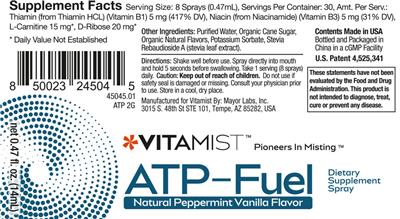
Supplement Facts
The label details for ATP-Fuel Natural Peppermint Vanilla Flavor by VitaMist, sourced from the NIH Dietary Supplement Label Database.
Supplement Facts
| Ingredient | Amount | % DV |
|---|---|---|
| D-Ribose | 20 mg | -- |
| L-Carnitine | 15 mg | -- |
| Thiamin | 5 mg | 417% |
| Niacin | 5 mg | 31% |
Other ingredients: Water, Purified, Cane Sugar, Natural Flavors, Potassium Sorbate, Stevia Rebaudioside A
Tap any ingredient to jump to its full detail below.
These statements are the manufacturer’s wording, reproduced from the product label — the label is saying it, not HelloPharmacist. We don’t verify or endorse them.
Suggested/Recommended/Usage/Directions
Directions: Shake well before use. Spray directly into mouth and hold 5 seconds before swallowing. Take 1 serving (8 sprays) daily.
Precautions
Caution: Keep out of reach of children.
Do not use if safety seal is damaged or missing. Consult your physician prior to use.
Storage
Store in a cool, dry place.
Formulation
Contents Made in USA Bottled and Packaged in China in a cGMP Facility
Brand IP Statement(s)
U.S. Patent 4,525,341
Vitamist Pioneers in Misting
FDA Disclaimer Statement
These statements have not been evaluated by the Food and Drug Administration. This product is not intended to diagnose, treat, cure or prevent any disease.
FDA Statement of Identity
Dietary Supplement Spray
Is this label outdated? Report a formula or label change and our pharmacy team will review it.
ATP-Fuel Natural Peppermint Vanilla Flavor by VitaMist label
The label scan from the NIH Dietary Supplement Label Database. Tap to enlarge.
Label images are published by the NIH Dietary Supplement Label Database for the version of this product on file. Always read your actual product label.
View the full label (PDF)The Ingredients in ATP-Fuel Natural Peppermint Vanilla Flavor by VitaMist
These are the 4 active ingredients this product is made of. Select any to open its full monograph.
Serving size0.47 mL Dosage formLiquid Servings per container30 Amounts shown are per serving.
Most supplement products combine several ingredients, and a medication can interact with the product through any one of them. Each ingredient below shows whether it has known drug interactions.
D-Ribose
Interacts with86 drugs
Ribose (D-ribose) is a simple sugar your body makes naturally and uses to build energy molecules like ATP. Some people take it for fatigue, fibromyalg...
D-Ribose monograph & interactionsL-Carnitine
Interacts with19 drugs
L-carnitine is a compound your body makes naturally and also gets from foods like meat. It helps cells turn fat into energy, and supplements are most...
L-Carnitine monograph & interactionsThiamin
Interacts with3 drugs
Thiamine (vitamin B1) is an essential nutrient your body needs to turn food into energy and to keep your nerves and heart healthy. Most people get eno...
Thiamin monograph & interactionsNiacin
Interacts with124 drugs
Niacinamide (also called nicotinamide) is a form of vitamin B3 used in supplements and skin-care products. It is well established for preventing and t...
Niacin monograph & interactionsOther (inactive) ingredients: Water, Purified, Cane Sugar, Natural Flavors, Potassium Sorbate, Stevia Rebaudioside A. These complete the product’s ingredient list but are not active constituents.
ATP-Fuel Natural Peppermint Vanilla Flavor by VitaMist Drug Interactions
HelloPharmacist Interaction Report
ATP-Fuel Natural Peppermint Vanilla by VitaMist contains four active ingredients, and together they interact with a significant number of medications.
The most serious concern is D-Ribose, which can lower blood sugar—a Moderate-severity interaction with both insulin and antidiabetes drugs (like metformin or sulfonylureas). If you take either of these to manage blood sugar, ribose could push your levels too low.
Read the full breakdown — every affected drug type, severity by severity
L-Carnitine carries Moderate-severity interactions with blood thinners: it may increase the effect of warfarin (Coumadin) and acenocoumarol (Sintrom), raising your bleeding risk. It also theoretically weakens thyroid hormone replacement therapy.
Niacinamide (the form of niacin in this product) has Moderate interactions with other blood thinners and antiplatelet drugs, seizure medications (carbamazepine and primidone), and warfarin as well. Thiamin interacts only with trimethoprim (Proloprim), a Minor interaction that may raise thiamin blood levels.
Altogether, these interactions span 228 individual medications. Check your exact prescriptions with the search tool on this page before you start.
Check your own medications below · Editorial policy · How we use AI
Want to check YOUR meds against ATP-Fuel Natural Peppermint Vanilla Flavor?
Ask about interactions with your drugs in plain English — “Can I take it with lisinopril?” — and we find you the answer in seconds, ingredient by ingredient.
Go to the checkerIngredients driving the most interactions
Individual Drug Interactions
The ingredients in ATP-Fuel Natural Peppermint Vanilla Flavor interact with 229 drugs. Click any drug to see the details.
4 of the 4 ingredients in ATP-Fuel Natural Peppermint Vanilla Flavor interact with drugs. Each result below shows which ingredient is responsible. Niacin D-Ribose L-Carnitine Thiamin
AbciximabReoPro
How Abciximab interacts with ATP-Fuel Natural Peppermint Vanilla Flavor — through 1 ingredient. Tap an ingredient for the detail:
NiacinAnticoagulant/antiplatelet Drugs Moderate
Interaction Summary
Theoretically, niacinamide may have additive effects when used with anticoagulant or antiplatelet drugs, especially in patients on hemodialysis.
Read the full Niacin + Abciximab interactionAbrocitinibCibinqo
How Abrocitinib interacts with ATP-Fuel Natural Peppermint Vanilla Flavor — through 1 ingredient. Tap an ingredient for the detail:
NiacinAnticoagulant/antiplatelet Drugs Moderate
Interaction Summary
Theoretically, niacinamide may have additive effects when used with anticoagulant or antiplatelet drugs, especially in patients on hemodialysis.
Read the full Niacin + Abrocitinib interactionAcarboseGlucobay, Prandase, Precose
How Acarbose interacts with ATP-Fuel Natural Peppermint Vanilla Flavor — through 1 ingredient. Tap an ingredient for the detail:
D-riboseAntidiabetes Drugs Moderate
Interaction Summary
Theoretically, taking ribose in combination with antidiabetes drugs might increase the risk of hypoglycemia.
Read the full D-ribose + Acarbose interactionAcenocoumarolSintrom
How Acenocoumarol interacts with ATP-Fuel Natural Peppermint Vanilla Flavor — through 2 ingredients. Tap an ingredient for the detail:
L-carnitineAcenocoumarol (sintrom) Moderate
Interaction Summary
Theoretically, L-carnitine might increase the anticoagulant effects of acenocoumarol.
Read the full L-carnitine + Acenocoumarol interactionNiacinAnticoagulant/antiplatelet Drugs Moderate
Interaction Summary
Theoretically, niacinamide may have additive effects when used with anticoagulant or antiplatelet drugs, especially in patients on hemodialysis.
Read the full Niacin + Acenocoumarol interactionAcetaminophen, AspirinGemnisyn
How Acetaminophen, Aspirin interacts with ATP-Fuel Natural Peppermint Vanilla Flavor — through 1 ingredient. Tap an ingredient for the detail:
NiacinAnticoagulant/antiplatelet Drugs Moderate
Interaction Summary
Theoretically, niacinamide may have additive effects when used with anticoagulant or antiplatelet drugs, especially in patients on hemodialysis.
Read the full Niacin + Acetaminophen, Aspirin interactionAcetaminophen, Aspirin, CaffeineExcedrin, Excedrin Extra Strength, Excedrin Migraine
How Acetaminophen, Aspirin, Caffeine interacts with ATP-Fuel Natural Peppermint Vanilla Flavor — through 1 ingredient. Tap an ingredient for the detail:
NiacinAnticoagulant/antiplatelet Drugs Moderate
Interaction Summary
Theoretically, niacinamide may have additive effects when used with anticoagulant or antiplatelet drugs, especially in patients on hemodialysis.
Read the full Niacin + Acetaminophen, Aspirin, Caffeine interactionAcetaminophen, IbuprofenCombogesic
How Acetaminophen, Ibuprofen interacts with ATP-Fuel Natural Peppermint Vanilla Flavor — through 1 ingredient. Tap an ingredient for the detail:
NiacinAnticoagulant/antiplatelet Drugs Moderate
Interaction Summary
Theoretically, niacinamide may have additive effects when used with anticoagulant or antiplatelet drugs, especially in patients on hemodialysis.
Read the full Niacin + Acetaminophen, Ibuprofen interactionAcetohexamideDymelor
How Acetohexamide interacts with ATP-Fuel Natural Peppermint Vanilla Flavor — through 1 ingredient. Tap an ingredient for the detail:
D-riboseAntidiabetes Drugs Moderate
Interaction Summary
Theoretically, taking ribose in combination with antidiabetes drugs might increase the risk of hypoglycemia.
Read the full D-ribose + Acetohexamide interactionAcetylsalicylic AcidEntrophen
How Acetylsalicylic Acid interacts with ATP-Fuel Natural Peppermint Vanilla Flavor — through 1 ingredient. Tap an ingredient for the detail:
NiacinAnticoagulant/antiplatelet Drugs Moderate
Interaction Summary
Theoretically, niacinamide may have additive effects when used with anticoagulant or antiplatelet drugs, especially in patients on hemodialysis.
Read the full Niacin + Acetylsalicylic Acid interactionAlbiglutideTanzeum
How Albiglutide interacts with ATP-Fuel Natural Peppermint Vanilla Flavor — through 1 ingredient. Tap an ingredient for the detail:
D-riboseAntidiabetes Drugs Moderate
Interaction Summary
Theoretically, taking ribose in combination with antidiabetes drugs might increase the risk of hypoglycemia.
Read the full D-ribose + Albiglutide interactionAlogliptinNesina
How Alogliptin interacts with ATP-Fuel Natural Peppermint Vanilla Flavor — through 1 ingredient. Tap an ingredient for the detail:
D-riboseAntidiabetes Drugs Moderate
Interaction Summary
Theoretically, taking ribose in combination with antidiabetes drugs might increase the risk of hypoglycemia.
Read the full D-ribose + Alogliptin interactionAlogliptin, MetforminKazano
How Alogliptin, Metformin interacts with ATP-Fuel Natural Peppermint Vanilla Flavor — through 1 ingredient. Tap an ingredient for the detail:
D-riboseAntidiabetes Drugs Moderate
Interaction Summary
Theoretically, taking ribose in combination with antidiabetes drugs might increase the risk of hypoglycemia.
Read the full D-ribose + Alogliptin, Metformin interactionAlogliptin, PioglitazoneOseni
How Alogliptin, Pioglitazone interacts with ATP-Fuel Natural Peppermint Vanilla Flavor — through 1 ingredient. Tap an ingredient for the detail:
D-riboseAntidiabetes Drugs Moderate
Interaction Summary
Theoretically, taking ribose in combination with antidiabetes drugs might increase the risk of hypoglycemia.
Read the full D-ribose + Alogliptin, Pioglitazone interactionAlteplase, TpaActilyse, Activase
How Alteplase, Tpa interacts with ATP-Fuel Natural Peppermint Vanilla Flavor — through 1 ingredient. Tap an ingredient for the detail:
NiacinAnticoagulant/antiplatelet Drugs Moderate
Interaction Summary
Theoretically, niacinamide may have additive effects when used with anticoagulant or antiplatelet drugs, especially in patients on hemodialysis.
Read the full Niacin + Alteplase, Tpa interactionAluminum Hydroxide, Aspirin, Codeine Phosphate, Magnesium HydroxideAscriptin Codeine #2
How Aluminum Hydroxide, Aspirin, Codeine Phosphate, Magnesium Hydroxide interacts with ATP-Fuel Natural Peppermint Vanilla Flavor — through 1 ingredient. Tap an ingredient for the detail:
NiacinAnticoagulant/antiplatelet Drugs Moderate
Interaction Summary
Theoretically, niacinamide may have additive effects when used with anticoagulant or antiplatelet drugs, especially in patients on hemodialysis.
Read the full Niacin + Aluminum Hydroxide, Aspirin, Codeine Phosphate, Magnesium Hydroxide interactionAluminum Hydroxide, Aspirin, Magnesium HydroxideAscriptin
How Aluminum Hydroxide, Aspirin, Magnesium Hydroxide interacts with ATP-Fuel Natural Peppermint Vanilla Flavor — through 1 ingredient. Tap an ingredient for the detail:
NiacinAnticoagulant/antiplatelet Drugs Moderate
Interaction Summary
Theoretically, niacinamide may have additive effects when used with anticoagulant or antiplatelet drugs, especially in patients on hemodialysis.
Read the full Niacin + Aluminum Hydroxide, Aspirin, Magnesium Hydroxide interactionAnacaulase-bcdbNexoBrid
How Anacaulase-bcdb interacts with ATP-Fuel Natural Peppermint Vanilla Flavor — through 1 ingredient. Tap an ingredient for the detail:
NiacinAnticoagulant/antiplatelet Drugs Moderate
Interaction Summary
Theoretically, niacinamide may have additive effects when used with anticoagulant or antiplatelet drugs, especially in patients on hemodialysis.
Read the full Niacin + Anacaulase-bcdb interactionAnagrelideAgrylin
How Anagrelide interacts with ATP-Fuel Natural Peppermint Vanilla Flavor — through 1 ingredient. Tap an ingredient for the detail:
NiacinAnticoagulant/antiplatelet Drugs Moderate
Interaction Summary
Theoretically, niacinamide may have additive effects when used with anticoagulant or antiplatelet drugs, especially in patients on hemodialysis.
Read the full Niacin + Anagrelide interactionAnisindioneMiradon
How Anisindione interacts with ATP-Fuel Natural Peppermint Vanilla Flavor — through 1 ingredient. Tap an ingredient for the detail:
NiacinAnticoagulant/antiplatelet Drugs Moderate
Interaction Summary
Theoretically, niacinamide may have additive effects when used with anticoagulant or antiplatelet drugs, especially in patients on hemodialysis.
Read the full Niacin + Anisindione interactionAntidiabetes, Dipeptidyl Peptidase-4 (dpp-iv) InhibitorGlyxambi
How Antidiabetes, Dipeptidyl Peptidase-4 (dpp-iv) Inhibitor interacts with ATP-Fuel Natural Peppermint Vanilla Flavor — through 1 ingredient. Tap an ingredient for the detail:
D-riboseAntidiabetes Drugs Moderate
Interaction Summary
Theoretically, taking ribose in combination with antidiabetes drugs might increase the risk of hypoglycemia.
Read the full D-ribose + Antidiabetes, Dipeptidyl Peptidase-4 (dpp-iv) Inhibitor interactionAntithrombin IiiThrombate III
How Antithrombin Iii interacts with ATP-Fuel Natural Peppermint Vanilla Flavor — through 1 ingredient. Tap an ingredient for the detail:
NiacinAnticoagulant/antiplatelet Drugs Moderate
Interaction Summary
Theoretically, niacinamide may have additive effects when used with anticoagulant or antiplatelet drugs, especially in patients on hemodialysis.
Read the full Niacin + Antithrombin Iii interactionApixabanEliquis
How Apixaban interacts with ATP-Fuel Natural Peppermint Vanilla Flavor — through 1 ingredient. Tap an ingredient for the detail:
NiacinAnticoagulant/antiplatelet Drugs Moderate
Interaction Summary
Theoretically, niacinamide may have additive effects when used with anticoagulant or antiplatelet drugs, especially in patients on hemodialysis.
Read the full Niacin + Apixaban interactionArgatrobanArgatroban
How Argatroban interacts with ATP-Fuel Natural Peppermint Vanilla Flavor — through 1 ingredient. Tap an ingredient for the detail:
NiacinAnticoagulant/antiplatelet Drugs Moderate
Interaction Summary
Theoretically, niacinamide may have additive effects when used with anticoagulant or antiplatelet drugs, especially in patients on hemodialysis.
Read the full Niacin + Argatroban interactionAspirinAngettes 75, ASA, Asaphen, Aspirin, Caprin, Cartia +8 more
How Aspirin interacts with ATP-Fuel Natural Peppermint Vanilla Flavor — through 1 ingredient. Tap an ingredient for the detail:
NiacinAnticoagulant/antiplatelet Drugs Moderate
Interaction Summary
Theoretically, niacinamide may have additive effects when used with anticoagulant or antiplatelet drugs, especially in patients on hemodialysis.
Read the full Niacin + Aspirin interactionAspirin, Aluminum Hydroxide, Codeine Phosphate, Magnesium HydroxideAscriptin Codeine #3
How Aspirin, Aluminum Hydroxide, Codeine Phosphate, Magnesium Hydroxide interacts with ATP-Fuel Natural Peppermint Vanilla Flavor — through 1 ingredient. Tap an ingredient for the detail:
NiacinAnticoagulant/antiplatelet Drugs Moderate
Interaction Summary
Theoretically, niacinamide may have additive effects when used with anticoagulant or antiplatelet drugs, especially in patients on hemodialysis.
Read the full Niacin + Aspirin, Aluminum Hydroxide, Codeine Phosphate, Magnesium Hydroxide interactionAspirin, ButalbitalAxotal
How Aspirin, Butalbital interacts with ATP-Fuel Natural Peppermint Vanilla Flavor — through 1 ingredient. Tap an ingredient for the detail:
NiacinAnticoagulant/antiplatelet Drugs Moderate
Interaction Summary
Theoretically, niacinamide may have additive effects when used with anticoagulant or antiplatelet drugs, especially in patients on hemodialysis.
Read the full Niacin + Aspirin, Butalbital interactionAspirin, Butalbital, CaffeineFiorinal
How Aspirin, Butalbital, Caffeine interacts with ATP-Fuel Natural Peppermint Vanilla Flavor — through 1 ingredient. Tap an ingredient for the detail:
NiacinAnticoagulant/antiplatelet Drugs Moderate
Interaction Summary
Theoretically, niacinamide may have additive effects when used with anticoagulant or antiplatelet drugs, especially in patients on hemodialysis.
Read the full Niacin + Aspirin, Butalbital, Caffeine interactionAspirin, Butalbital, Caffeine, Codeine PhosphateFiorinal w/ Codeine
How Aspirin, Butalbital, Caffeine, Codeine Phosphate interacts with ATP-Fuel Natural Peppermint Vanilla Flavor — through 1 ingredient. Tap an ingredient for the detail:
NiacinAnticoagulant/antiplatelet Drugs Moderate
Interaction Summary
Theoretically, niacinamide may have additive effects when used with anticoagulant or antiplatelet drugs, especially in patients on hemodialysis.
Read the full Niacin + Aspirin, Butalbital, Caffeine, Codeine Phosphate interactionAspirin, Butalbital, Caffeine, PhenacetinMarnal
How Aspirin, Butalbital, Caffeine, Phenacetin interacts with ATP-Fuel Natural Peppermint Vanilla Flavor — through 1 ingredient. Tap an ingredient for the detail:
NiacinAnticoagulant/antiplatelet Drugs Moderate
Interaction Summary
Theoretically, niacinamide may have additive effects when used with anticoagulant or antiplatelet drugs, especially in patients on hemodialysis.
Read the full Niacin + Aspirin, Butalbital, Caffeine, Phenacetin interactionAspirin, CaffeineAnacin
How Aspirin, Caffeine interacts with ATP-Fuel Natural Peppermint Vanilla Flavor — through 1 ingredient. Tap an ingredient for the detail:
NiacinAnticoagulant/antiplatelet Drugs Moderate
Interaction Summary
Theoretically, niacinamide may have additive effects when used with anticoagulant or antiplatelet drugs, especially in patients on hemodialysis.
Read the full Niacin + Aspirin, Caffeine interactionEach ingredient & the kinds of drugs it affects
For each ingredient in ATP-Fuel Natural Peppermint Vanilla Flavor with known interactions, here are the types of medications they can affect. Open any type for the detail — or search your exact drug in the checker above.
Niacin
Anticoagulant/Antiplatelet Drugs
Theoretically, niacinamide may have additive effects when used with anticoagulant or antiplatelet drugs, especially in patients on hemodialysis.
Several cases of thrombocytopenia have been reported for hemodialysis patients treated with niacinamide 1 gram daily. Hemodialysis patients receiving niacinamide had almost a three-fold higher risk of developing thrombocytopenia when compared with those receiving placebo.
Carbamazepine (Tegretol)
Niacinamide might increase the levels and adverse effects of carbamazepine.
Plasma levels of carbamazepine were increased in two children given high-dose niacinamide, 60-80 mg/kg/day. This might be due to inhibition of the cytochrome P450 enzymes involved in carbamazepine metabolism. There is not enough data to determine the clinical significance of this interaction.
Primidone (Mysoline)
Niacinamide might increase the levels and adverse effects of primidone.
Case reports in children suggest niacinamide 60-100 mg/kg/day reduces hepatic metabolism of primidone to phenobarbital, and reduces the overall clearance rate of primidone; however, there is not enough data to determine the clinical significance of this potential interaction.
Warfarin (Coumadin)
There is limited evidence that niacinamide may increase the anticoagulant effects of warfarin.
In a case report, a patient on warfarin developed an elevated international normalized ratio (INR) of 8.4 after taking niacinamide 500 mg twice daily for 10 days. The patient's INR was previously stable, ranging between 2 and 3, with no other changes to current medications or diet reported. The elevated INR returned to the therapeutic range after receiving vitamin K and discontinuing niacinamide.
D-Ribose
Antidiabetes Drugs
Theoretically, taking ribose in combination with antidiabetes drugs might increase the risk of hypoglycemia.
In clinical research, ribose decreases serum glucose levels in a dose-dependent manner.
Insulin
Theoretically, taking ribose with insulin could increase the hypoglycemic effect of insulin.
In clinical pharmacokinetic studies, oral administration of ribose modestly increased serum insulin levels.
L-Carnitine
Acenocoumarol (Sintrom)
Theoretically, L-carnitine might increase the anticoagulant effects of acenocoumarol.
L-carnitine might enhance the anticoagulant effects of acenocoumarol, an oral anticoagulant similar to warfarin, but shorter-acting. There are at least two case reports of INR elevation with concomitant use. In one case, a 33-year-old male with a previously stable INR had an elevated INR of 4.65 after L-carnitine was started and continued for 10 weeks. INR normalized after discontinuation of the L-carnitine-containing product.
Thyroid Hormone
Theoretically, L-carnitine might decrease the effectiveness of thyroid hormone replacement.
L-carnitine appears to act as a peripheral thyroid hormone antagonist by inhibiting entry of thyroid hormone into the nucleus of cells. Taking L-carnitine also seems to diminish some of the symptoms of hyperthyroidism.
Warfarin (Coumadin)
Theoretically, L-carnitine might increase the anticoagulant effects of warfarin.
L-carnitine might increase the anticoagulant effects of acenocoumarol, a shorter-acting oral anticoagulant similar to warfarin. There is not enough information to know whether this interaction occurs with L-carnitine and warfarin.
Thiamin
Trimethoprim (Proloprim)
Trimethoprim might increase blood levels of thiamine.
In vitro, animal, and clinical research suggest that trimethoprim inhibits intestinal thiamine transporter ThTR-2, hepatic transporter OCT1, and renal transporters OCT2, MATE1, and MATE2, resulting in paradoxically increased thiamine plasma concentrations.
Brand information
Manufacturer and brand details for ATP-Fuel Natural Peppermint Vanilla Flavor, from the product label.
ATP-Fuel Natural Peppermint Vanilla Flavor by VitaMist: Common Questions
Does ATP-Fuel Natural Peppermint Vanilla Flavor by VitaMist interact with any medications?
How can one product interact with so many drugs?
Where does this information come from?
Can I take ATP-Fuel if I'm pregnant or breastfeeding?
Does ATP-Fuel really boost athletic performance?
What side effects should I watch for?
What is D-Ribose and what's it supposed to do?
Is this safe to use long-term?
Why does L-Carnitine interact with blood thinners?
Written and reviewed by the HelloPharmacist editorial staff. Our editorial policy
Not sure if ATP-Fuel Natural Peppermint Vanilla Flavor is safe with your meds?
Our pharmacists answer your medication & supplement questions — free.
Label information is sourced from the NIH Dietary Supplement Label Database and reflects the product version on file; always read your actual product label. This page is for education only and is not a substitute for professional medical advice. Confirm with your pharmacist or doctor before combining supplements and medications.
The Full Monographs Behind ATP-Fuel Natural Peppermint Vanilla Flavor’s Ingredients
Every ingredient we hold a full HelloPharmacist monograph for — uses, evidence, safety, and the complete interaction list.
Ribose
Interacts with 86 drugsRibose (D-ribose) is a simple sugar your body makes naturally and uses to build energy molecules like ATP. Some people take it for fatigue, fibromyalgia, exercise recovery, or heart conditio...
Read the full Ribose monograph → Herb & supplement monographL-carnitine
Interacts with 19 drugsL-carnitine is a compound your body makes naturally and also gets from foods like meat. It helps cells turn fat into energy, and supplements are most clearly useful for people with a true ca...
Read the full L-carnitine monograph → Herb & supplement monographThiamine
Interacts with 3 drugsThiamine (vitamin B1) is an essential nutrient your body needs to turn food into energy and to keep your nerves and heart healthy. Most people get enough from food, but supplements are clear...
Read the full Thiamine monograph → Herb & supplement monographNiacinamide
Interacts with 124 drugsNiacinamide (also called nicotinamide) is a form of vitamin B3 used in supplements and skin-care products. It is well established for preventing and treating vitamin B3 deficiency, and there...
Read the full Niacinamide monograph →Sources & How We Checked
ATP-Fuel Natural Peppermint Vanilla Flavor's label data comes from the NIH Dietary Supplement Label Database; the ingredient interaction data is from the Natural Medicines database, reviewed by our pharmacists.
- NIH Dietary Supplement Label Database (DSLD) — The official product label on file for this supplement.
- Natural Medicines (Therapeutic Research Center) — Evidence-graded clinical reference behind the ingredient interaction data.
Content is written and reviewed by licensed HelloPharmacist pharmacists. See our data sources and editorial standards for how this information is built and checked.
The 78 references behind this product’s interaction data
Every citation that drives the interaction findings for this product’s ingredients, from the evidence-graded Natural Medicines (TRC Healthcare) database. Open an ingredient to browse its citations — links open the study on PubMed or the publisher’s site.
Ribose 8 references
- Segal S, Foley J. The metabolism of D-ribose in man. J Clin Invest 1958;37:719-35. PubMed
- Perlmutter NS, Wilson RA, Angello DA, et al. Ribose facilitates thallium-201 redistribution in patients with coronary artery disease. J Nucl Med 1991;32:193-200.
- Hegewald MG, Palac RT, Angello DA, et al. Ribose infusion accelerates thallium redistribution with early imaging compared with late 24-hour imaging without ribose. J Am Coll Cardiol 1991;18:1671-81. PubMed
- Pliml W, von Arnim T, Stalein A, et al. Effects of ribose on excercise-induced ischaemia in stable coronary artery disease. Lancet 1992;340:507-10.
- Burke ER. D-Ribose What You Need To Know. Garden City Park, NY: Avery Publishing Group 1999;1-43.
- Gross M, Reiter S, Zollner N. Metabolism of D-ribose administered continuously to healthy persons and to patients with myoadenylate deaminase deficiency. Klin Wochenschr 1989;67:1205-13. PubMed
- Teitelbaum JE, Johnson C, St Cyr J. The use of D-ribose in chronic fatigue syndrome and fibromyalgia: a pilot study. J Altern Complement Med 2006;12:857-62. PubMed
- Thompson J, Neutel J, Homer K, Tempero K, Shah A, Khankari R. Evaluation of D-ribose pharmacokinetics, dose proportionality, food effect, and pharmacodynamics after oral solution administration in healthy male and female subjects. J Clin Pharmacol 2014;54 PubMed
L-carnitine 41 references
- Ellaway CM, Williams K, Leonard H, et al. Rett syndrome: randomized controlled trial of L-carnitine. J Child Neurol 1999;14:162-7. PubMed
- Anon. Carnitor (levocarnitine) package insert. Sigma-Tau Pharmaceuticals Inc, Gaithersburg, MD. December 1999.
- Cherchi A, Lai C, Angelino F, et al. Effects of L-carnitine on exercise tolerance in chronic stable angina: a multicenter, double-blind, randomized, placebo-controlled, crossover study. Int J Clin Pharmacol Ther Toxicol 1985;23:569-72.
- Plioplys AV, Plioplys S. Amantadine and L-carnitine treatment of Chronic Fatigue Syndrome. Neuropsychobiology 1997;35:16-23. PubMed
- Benvenga S, Ruggeri RM, Russo A, et al. Usefulness of L-carnitine, a naturally occurring peripheral antagonist of thyroid hormone action, in iatrogenic hyperthyroidism: a randomized, double-blind, placebo-controlled clinical trial. J Clin Endocrinol Meta
- Martinez E, Domingo P, Roca-Cusachs A. Potentiation of acenocoumarol action by L-carnitine. J Intern Med 1993;233:94.
- Bachmann HU, Hoffmann A. Interaction of food supplement L-carnitine with oral anticoagulant acenocoumarol. Swiss Med Wkly 2004;134:385. PubMed
- Evans AM, Fornasini G. Pharmacokinetics of L-carnitine. Clin Pharmacokinet 2003;42:941-67. PubMed
- 12761 Benvenga S, Amato A, Calvani M, Trimarchi F. Effects of carnitine on thyroid hormone action. Ann N Y Acad Sci 2004;1033:158-67. PubMed
- Ciacci C, Peluso G, Iannoni E, et al. L-Carnitine in the treatment of fatigue in adult celiac disease patients: a pilot study. Dig Liver Dis 2007;39:922-8. PubMed
- Cruciani RA, Dvorkin E, Homel P, et al. Safety, tolerability and symptom outcomes associated with L-carnitine supplementation in patients with cancer, fatigue, and carnitine deficiency: a phase I/II study. J Pain Symptom Manage 2006;32:551-9. PubMed
- Lebrun C, Alchaar H, Candito M, et al. Levocarnitine administration in multiple sclerosis patients with immunosuppressive therapy-induced fatigue. Mult Scler 2006;12:321-4. PubMed
- Malaguarnera M, Cammalleri L, Gargante MP, et al. L-Carnitine treatment reduces severity of physical and mental fatigue and increases cognitive functions in centenarians: a randomized and controlled clinical trial. Am J Clin Nutr 2007;86:1738-44. PubMed
- Mantovani G, Maccio A, Madeddu C, et al. Randomized phase III clinical trial of five different arms of treatment in 322 patients with cancer cachexia. Oncologist 2010;15:200-11.
- Angelova-Fischer I, Rippke F, Fischer TW, Neufang G, Zillikens D. A double-blind, randomized, vehicle-controlled efficacy assessment study of a skin care formulation for improvement of mild to moderately severe acne. J Eur Acad Dermatol Venereol. 2013 Jul PubMed
- Hatamkhani S, Khalili H, Karimzadeh I, Dashti-Khavidaki S, Abdollahi A, Jafari S. Carnitine for prevention of antituberculosis drug-induced hepatotoxicity: a randomized, clinical trial. J Gastroenterol. Hepatol. 2014 May;29(5):997-1004. PubMed
- Boehm G, Stahl B. Oligosaccharides from milk. J Nutr 2007;137(3 Suppl 2):847S-849S.
- Van Oudheusden, L. J. and Scholte, H. R. Efficacy of carnitine in the treatment of children with attention-deficit hyperactivity disorder. Prostaglandins Leukot.Essent.Fatty Acids 2002;67(1):33-38. PubMed
- Derosa, G., Cicero, A. F., Gaddi, A., Mugellini, A., Ciccarelli, L., and Fogari, R. The effect of L-carnitine on plasma lipoprotein(a) levels in hypercholesterolemic patients with type 2 diabetes mellitus. Clin Ther 2003;25(5):1429-1439. PubMed
- Foitzik, K., Hoting, E., Heinrich, U., Tronnier, H., and Paus, R. Indications that topical L-carnitin-L-tartrate promotes human hair growth in vivo. J Dermatol.Sci 2007;48(2):141-144. PubMed
- Kumar, A., Singh, R. B., Saxena, M., Niaz, M. A., Josh, S. R., Chattopadhyay, P., Mechirova, V., Pella, D., and Fedacko, J. Effect of carni Q-gel (ubiquinol and carnitine) on cytokines in patients with heart failure in the Tishcon study. Acta Cardiol. 20
- Cruciani, R. A., Dvorkin, E., Homel, P., Culliney, B., Malamud, S., Lapin, J., Portenoy, R. K., and Esteban-Cruciani, N. L-carnitine supplementation in patients with advanced cancer and carnitine deficiency: a double-blind, placebo-controlled study. J Pa PubMed
- Malaguarnera, M., Vacante, M., Avitabile, T., Malaguarnera, M., Cammalleri, L., and Motta, M. L-Carnitine supplementation reduces oxidized LDL cholesterol in patients with diabetes. Am J Clin.Nutr 2009;89(1):71-76. PubMed
- Alvarez, T. M., Guardiola, P. D., Roldan, J. O., Elviro, R., Wevers, R., and Guijarro, G. [Primary trimethylaminuria: the fish odor syndrome]. Endocrinol.Nutr. 2009;56(6):337-340.
- Wu, Z. M., Lu, X., Wang, Y. W., Sun, J., Tao, J. W., Yin, F. H., and Cheng, H. J. [Short-term medication of L-carnitine before intracytoplasmic sperm injection for infertile men with oligoasthenozoospermia]. Zhonghua Nan.Ke.Xue 2012;18(3):253-256.
- Tarighat, Esfanjani A., Mahdavi, R., Ebrahimi, Mameghani M., Talebi, M., Nikniaz, Z., and Safaiyan, A. The effects of magnesium, L-carnitine, and concurrent magnesium-L-carnitine supplementation in migraine prophylaxis. Biol.Trace Elem.Res 2012;150(1-3): PubMed
- DiNicolantonio, J. J., Lavie, C. J., Fares, H., Menezes, A. R., and O'Keefe, J. H. L-carnitine in the secondary prevention of cardiovascular disease: systematic review and meta-analysis. Mayo Clin Proc. 2013;88(6):544-551. PubMed
- Huang, W. W., Wang, M. Y., Shi, H. M., Peng, Y., Peng, C. S., Zhang, M., Li, Y., Lu, J., and Li, X. B. Comparative study of bioactive constituents in crude and processed Glycyrrhizae radix and their respective metabolic profiles in gastrointestinal tract
- Madsen KL, Preisler N, Orngreen MC, Andersen SP, Olesen JH, Lund AM, Vissing J. Patients with medium-chain acyl-coenzyme a dehydrogenase deficiency have impaired oxidation of fat during exercise but no effect of L-carnitine supplementation. J Clin Endocri
- Prohaska ES, Muzyk AJ, Rivelli SK. Levocarnitine-induced hypophosphatemia in a hemodialysis patient with acute valproic acid toxicity. J Neuropsychiatry Clin Neurosci. 2012 Winter;24(1):E18-9. PubMed
- Shang R, Sun Z, Li H. Effective dosing of L-carnitine in the secondary prevention of cardiovascular disease: a systematic review and meta-analysis. BMC Cardiovasc Disord. 2014 Jul 21;14:88. PubMed
- Zhang JJ, Wu ZB, Cai YJ, Ke B, Huang YJ, Qiu CP, Yang YB, Shi LY, Qin J. L-carnitine ameliorated fasting-induced fatigue, hunger, and metabolic abnormalities in patients with metabolic syndrome: a randomized controlled study. Nutr J. 2014 Nov 26;13:110. PubMed
- Koeth RA, Wang Z, Levison BS, Buffa JA, Org E, Sheehy BT, Britt EB, Fu X, Wu Y, Li L, Smith JD, DiDonato JA, Chen J, Li H, Wu GD, Lewis JD, Warrier M, Brown JM, Krauss RM, Tang WH, Bushman FD, Lusis AJ, Hazen SL. Intestinal microbiota metabolism of L-carn
- Jun DW, Kim BI, Cho YK, Kim HJ, Kwon YO, Park SY, Han SY, Baek YH, Jung YJ, Kim HY, Kim W, Heo J, Woo HY, Hwang SG, Rim KS, Choi JY, Bae SH, Lee YS, Lim YS,Cheong JY, Cho SW, Lee BS, Kim SH, Sohn JH, Kim TY, Paik YH, Kim JK, Lee KS. Efficacy and safety of
- An JH, Kim YJ, Kim KJ, et al. L-carnitine supplementation for the management of fatigue in patients with hypothyroidism on levothyroxine treatment: a randomized, double-blind, placebo-controlled trial. Endocr J. 2016;63(10):885-95. PubMed
- Chen N, Yang M, Zhou M, Xiao J, Guo J, He L. L-carnitine for cognitive enhancement in people without cognitive impairment. Cochrane Database Syst Rev. 2017;3:CD009374. PubMed
- Khajeh B, Dashti-Khavidaki S, Nasiri-Toosi M, Mohammadi K, Jafari A. Effects of pre-transplant L-carnitine supplementation on primary graft dysfunction in liver transplant recipients: a pilot, randomized, placebo-controlled clinical trial. Res Pharm Sci. PubMed
- Kubota K, Uojima H, Shao X, et al. Additional L-carnitine Reduced the Risk of Hospitalization in Patients with Overt Hepatic Encephalopathy on Rifaximin. Dig Dis 2021. PubMed
- Amini L, Yaghini O, Ghazavi M, Aslani N. L-carnitine versus propranolol for pediatric migraine prophylaxis. Iran J Child Neurol 2021;15(2):77-86.
- Shakibaei F, Jelvani D. Effect of adding l -carnitine to risperidone on behavioral, cognitive, social, and physical symptoms in children and adolescents with autism: A randomized double-blinded placebo-controlled clinical trial. Clin Neuropharmacol 2023;4 PubMed
- Moustafa I, Connolly C, Anis M, Mustafa H, Oosthuizen F, Viljoen M. A prospective study to evaluate the efficacy and safety of vitamin E and levocarnitine prophylaxis against doxorubicin-induced cardiotoxicity in adult breast cancer patients. J Oncol Phar PubMed
Thiamine 7 references
- McEvoy GK, ed. AHFS Drug Information. Bethesda, MD: American Society of Health-System Pharmacists, 1998.
- Yates AA, Schlicker SA, Suitor CW. Dietary reference intakes: The new basis for recommendations for calcium and related nutrients, B vitamins, and choline. J Am Diet Assoc 1998;98:699-706. PubMed
- Food and Nutrition Board, Institute of Medicine. Dietary Reference Intakes for Thiamin, Riboflavin, Niacin, Vitamin B6, Folate, Vitamin B12, Pantothenic Acid, Biotin, and Choline (2000). Washington, DC: National Academy Press, 2000. Available at: http://b
- Rogovik, A. L., Vohra, S., and Goldman, R. D. Safety considerations and potential interactions of vitamins: should vitamins be considered drugs? Ann.Pharmacother. 2010;44(2):311-324. PubMed
- Arruti N, Bernedo N, Audicana MT, Villarreal O, Uriel O, Muñoz D. Systemic allergic dermatitis caused by thiamine after iontophoresis. Contact Dermatitis. 2013 Dec;69(6):375-6. PubMed
- Thiamine hydrochloride injection package insert. Lake Zurich, IL: Fresenius Kabi, LLC; September 2019.
- Vora B, Wen A, Yee SW, et al. The Effect of Trimethoprim on Thiamine Absorption: A Transporter-Mediated Drug-Nutrient Interaction. Clin Pharmacol Ther 2023;114(2):381-392.
Niacinamide 22 references
- Pozzilli P, Browne PD, Kolb H. Meta-analysis of nicotinamide treatment in patients with recent-onset IDDM. The Nicotinamide Trialists. Diabetes Care 1996;19:1357-63. PubMed
- Greenbaum CJ, Kahn SE, Palmer JP. Nicotinamide's effects on glucose metabolism in subjects at risk for IDDM. Diabetes 1996;45:1631-4. DOI
- Food and Nutrition Board, Institute of Medicine. Dietary Reference Intakes for Thiamin, Riboflavin, Niacin, Vitamin B6, Folate, Vitamin B12, Pantothenic Acid, Biotin, and Choline (2000). Washington, DC: National Academy Press, 2000. Available at: http://b
- Anon. Niacinamide Monograph. Alt Med Rev 2002;7:525-9.
- Miralbell R, Mornex F, Greiner R, et al. Accelerated radiotherapy, carbogen, and nicotinamide in glioblastoma multiforme: report of European Organization for Research and Treatment of Cancer trial 22933. J Clin Oncol 1999;17:3143-9. PubMed
- Fatigante L, Ducci F, Cartei F, et al. Carbogen and nicotinamide combined with unconventional radiotherapy in glioblastoma multiforme: a new modality treatment. Int J Radiat Oncol Biol Phys 1997;37:499-504. PubMed
- Hoskin PJ, Stratford MR, Saunders MI, et al. Administration of nicotinamide during chart: pharmacokinetics, dose escalation, and clinical toxicity. Int J Radiat Oncol Biol Phys 1995;32:1111-9. PubMed
- Papa CM. Niacinamide and acanthosis nigricans (letter). Arch Dermatol 1984;120:1281. DOI
- Bourgeois BF, Dodson WE, Ferrendelli JA. Interactions between primidone, carbamazepine, and nicotinamide. Neurology 1982;32:1122-6.
- Visalli N, Cavallo MG, Signore A, et al. A multi-centre randomized trial of two different doses of nicotinamide in patients with recent-onset type 1 diabetes (the IMDIAB VI). Diabetes Metab Res Rev 1999;15:181-5. DOI
- Rottembourg JB, Launay-Vacher V, Massard J. Thrombocytopenia induced by nicotinamide in hemodialysis patients. Kidney Int. 2005;68(6):2911-2. PubMed
- Fabbrocini G, Cantelli M, Monfrecola G. Topical nicotinamide for seborrheic dermatitis: an open randomized study. J Dermatolog Treat. 2014 Jun;25(3):241-5. PubMed
- Khodaeiani E, Fouladi RF, Amirnia M, Saeidi M, Karimi ER. Topical 4% nicotinamide vs. 1% clindamycin in moderate inflammatory acne vulgaris. Int J Dermatol. 2013 Aug;52(8):999-1004. PubMed
- Zhang Y, Ma T, Zhang P. Efficacy and safety of nicotinamide on phosphorus metabolism in hemodialysis patients: A systematic review and meta-analysis. Medicine (Baltimore). 2018;97(41):e12731. PubMed
- Ketteler M, Wiecek A, Rosenkranz AR, et al. Efficacy and Safety of a Novel Nicotinamide Modified-Release Formulation in the Treatment of Refractory Hyperphosphatemia in Patients Receiving Hemodialysis-A Randomized Clinical Trial. Kidney Int Rep 2020;6(3): PubMed
- Mainville L, Smilga AS, Fortin PR. Effect of Nicotinamide in Skin Cancer and Actinic Keratoses Chemoprophylaxis, and Adverse Effects Related to Nicotinamide: A Systematic Review and Meta-Analysis. J Cutan Med Surg 2022;26(3):297-308. PubMed
- Nouh AH, Elshahid AR, Kadah AS, Zeyada YA. Topical niacinamide (Nicotinamide) treatment for discoid lupus erythematosus (DLE): A prospective pilot study. J Cosmet Dermatol 2023.
- El-Khalawany M, Nouh AH, Kadah AS, Elsheikh M, Said M. Evaluation of safety and efficacy of topical 4% nicotinamide in treatment of psoriasis; among a representative sample of Egyptians (an analytical observational study). Dermatol Ther 2022;35(9):e15734. PubMed
- Zhang H, George-Washburn EA, Hashemi KB, et al. Oral Nicotinamide for Actinic Keratosis Prevention in Kidney Transplant Recipients: A Pilot Double-Blind, Randomized, Placebo-Controlled Trial. Transplant Proc 2023;55(9):2079-2084. PubMed
- Oh HJ, Bae SC, Oh IJ, et al. Nicotinamide in Combination with EGFR-TKIs for the Treatment of Stage IV Lung Adenocarcinoma with EGFR Mutations: A Randomized Double-Blind (Phase IIb) Trial. Clin Cancer Res 2024;30(8):1478-1487. PubMed
- Schepers L, Jans I, Pot GK, Smilde AJ, Hofstra JM, de Roos NM. The Effect of Niacinamide Supplementation on Phosphate Concentrations in Dutch Dialysis Patients: A Randomized Crossover Trial. J Ren Nutr 2024;34(5):454-462. PubMed
- Markham DJ, Barbosa NS, Degesys CA. Elevated International Normalized Ratio After Initiation of Niacin and Niacinamide Chemoprophylaxis for Patients on Warfarin. Dermatol Surg 2024;50(7):690-692. PubMed
Parts of this content are provided by the Therapeutic Research Center, LLC.
DISCLAIMER: Currently this does not check for drug-drug interactions. This is not an all-inclusive comprehensive list of potential interactions and is for informational purposes only. Not all interactions are known or well-reported in the scientific literature, and new interactions are continually being reported. Input is needed from a qualified healthcare provider including a pharmacist before starting any therapy. Application of clinical judgment is necessary.
© 2021 Therapeutic Research Center, LLC