
Bao He Teapills Ingredients & Drug Interactions
by Plum Flower
What is this page for?
First and foremost: checking Bao He Teapills against your medications. The heart of this page is the interaction checker and the full interaction report — how this product’s ingredients may interact with prescription and over-the-counter medicines you may be taking.
Around that, we add a pharmacist’s high-level view of the product as a whole — what’s inside, the evidence for its stated use, how transparent the label is, and what safety data exists — so you can see the full picture in one place. It’s educational information from our licensed clinical databases and the clinical staff at HelloPharmacist — not medical advice — and we don’t sell or endorse products. Our editorial policy
Bao He Teapills is a dietary supplement by Plum Flower with 8 active ingredients. Its ingredients are commonly taken for source of vitamin c, digestive support, aromatherapy and relaxation.Based on those ingredients, 1,451 medications have a known interaction with it, the most serious rated major. The ingredients most likely to interact are Citrus reticulata Peel Extract, Poria cocos Sclerotium Extract, Pinellia ternata Rhizome Extract. Use the checker below to test your specific medication, or read the full HelloPharmacist Interaction Report.
Check Your Meds Against Bao He Teapills by Plum Flower
Ask about any prescription or over-the-counter medication and we check it for interactions with Bao He Teapills by Plum Flower — and tell you which ingredient is responsible.
AI summaries are generated from our interaction database for education only — always confirm with your pharmacist. How we use AI
Ask the Pharmacist
A licensed pharmacist will answer your question by email — free, usually within 24 hours.
Got it — thank you!
A licensed pharmacist will answer within 24 hours. Keep an eye on your email (worth checking spam, just in case).
HelloPharmacist Scorecard of Bao He Teapills by Plum Flower
Our pharmacy team’s full take, with four database checks built into the cards below — a summary of what is known, not a grade of the product itself.
What’s inside
Low disclosure
Bao He Teapills contains 14 ingredients, including a proprietary extract blend and masa fermentata (a fermented grain preparation), plus active extracts: tangerine peel, poria mushroom, pinellia ternata rhizome, sweet annie, forsythia fruit, barley, hawthorn fruit, radish seed, wheat bran, smartweed, siberian cocklebur, apricot seed, and vigna umbellata seed. The inactive ingredients are maltose, hydrated magnesium silicate, and china wax.
Does it work?
Moderate evidence
Evidence for Bao He Teapills' active ingredients is mixed. Barley shows strong evidence—it's likely effective for lowering cholesterol and supporting heart health.
Wheat bran is possibly effective for constipation, hemorrhoids, and irritable bowel syndrome. Sweet annie is possibly effective for hay fever.
Most other ingredients in this formula—including hawthorn, radish, poria mushroom, pinellia ternata, tangerine, forsythia, smartweed, siberian cocklebur, and apricot—have insufficient reliable evidence to establish whether they work for their intended purposes.
How safe is it?
Well-documented data
Generally well tolerated, but with important cautions. Sweet annie can cause nausea and vomiting, and rarely hepatitis (liver inflammation).
Pinellia ternata contains alkaloids that may raise blood pressure, speed heart rate, and potentially trigger heart attack or stroke; raw pinellia is toxic and only properly processed material should be used. Barley and wheat bran contain gluten and may cause bloating, flatulence, or allergic reactions in sensitive people.
Siberian cocklebur is considered generally unsafe—it carries risk of serious poisoning with liver and kidney damage, severe low blood sugar, and heart problems. Radish may cause throat tightness or rash in those with allergy, and large amounts can irritate your stomach.
Hawthorn is generally well tolerated in studies but needs medical supervision for heart conditions. Pregnancy and breastfeeding: siberian cocklebur is likely unsafe during pregnancy; poria mushroom, pinellia ternata, sweet annie, forsythia, radish, and smartweed should be avoided during pregnancy and breastfeeding due to lack of safety data.
Wheat bran is likely safe in pregnancy. Barley and apricot fruit as food are fine, but concentrated supplements lack safety data.
There isn't enough information on file for tangerine concentrate, hawthorn, or other ingredients during pregnancy and breastfeeding—talk with your doctor.
Meds to double-check
Major interaction found
Before taking Bao He Teapills, check your medications against these drug types: any drug that affects kidney or liver function (Siberian cocklebur); antidiabetes medications including insulin and sulfonylureas (Siberian cocklebur); blood thinners like warfarin, heparin, and antiplatelet drugs (hawthorn, forsythia, smartweed); blood pressure and heart medications including nitrates, phosphodiesterase-5 inhibitors, beta-blockers, and calcium channel blockers (hawthorn); digoxin (hawthorn); sedatives and benzodiazepines (pinellia ternata, poria mushroom); and drugs metabolized by CYP3A4 or CYP2B6 (sweet annie). Use the medication checker below with your exact drug names and doses.
The bottom line
Scorecard at a glanceFormula with limited ingredient disclosure with some supporting evidence for its stated purpose. Major medication interactions have been identified, and safety information is well characterized.
This is a traditional Chinese herbal formula with mixed evidence and real interaction risks. If you take blood thinners, blood pressure medications, diabetes drugs, sedatives, or any medication processed by your liver, check with your pharmacist first.
Siberian cocklebur's documented toxicity is a serious concern. It's not for pregnant or breastfeeding people.
Educational only — not medical advice; always confirm with your pharmacist. Our editorial policy · How we use AI
Assessment coverage: 13 of 14 active ingredients matched to our full ingredient reviews (monographs). Based on the product label dated Aug 22, 2025.
This Scorecard evaluates available label information, ingredient evidence, and known medication-safety considerations. It does not independently verify product identity, purity, potency, contamination, or manufacturing quality. How these ratings are computed
General information
Key facts about Bao He Teapills, straight from the product label.
| Brand | Plum Flower |
|---|---|
| Barcode (UPC) | 739934836477 |
| Net contents | 200 Pill(s); 1.2 Ounce(s); 34 Gram(s) |
| Market status | On market |
| Date entered into DSLD | Aug 22, 2025 |
| DSLD ID | 336445 |
| Product type | Botanical |
| Supplement form | Tablet Or Pill |
| Dietary claims / uses | All Other |
| Intended target group(s) | Adult (18 - 50 Years) |
Everything in this section is reproduced from the manufacturer’s own product label — it’s the label speaking, not HelloPharmacist. We show it so you can see exactly what the maker states; we don’t verify or endorse those statements.
Supplement Facts
The label details for Bao He Teapills by Plum Flower, sourced from the NIH Dietary Supplement Label Database.
Supplement Facts
| Ingredient | Amount | % DV |
|---|---|---|
| Proprietary Extract Blend | 1360 mg | -- |
| Citrus reticulata Peel Extract | 0 NP | -- |
| Poria cocos Sclerotium Extract | 0 NP | -- |
| Pinellia ternata Rhizome Extract | 0 NP | -- |
| Artemisia annua | 0 NP | -- |
| Forsythia suspensa Fruit Extract | 0 NP | -- |
| Hordeum vulgare Fruit Extract | 0 NP | -- |
| Crataegus pinnatifida fruit extract | 0 NP | -- |
| Raphanus sativus Seed Extract | 0 NP | -- |
| Massa Fermentata | 0 NP | -- |
| Wheat Bran Extract | 0 NP | -- |
| Wheat Flour Extract | 0 NP | -- |
| Polygonum hydropiper Herb Extract | 0 NP | -- |
| Xanthium sibiricum Herb Extract | 0 NP | -- |
| Prunus armeniaca Seed Extract | 0 NP | -- |
| Vigna umbellata Seed Extract | 0 NP | -- |
Other ingredients: Maltose, Magnesium Silicate, Hydrated, China Wax
Tap any ingredient to jump to its full detail below.
These statements are the manufacturer’s wording, reproduced from the product label — the label is saying it, not HelloPharmacist. We don’t verify or endorse them.
General Statements
Bao He Wan
Foci Pharmaceutical 1929
FDA Statement of Identity
Herbal Supplement
Precautions
Contains wheat
Caution during pregnancy
Keep out of reach of children
Suggested/Recommended/Usage/Directions
Take 8 pills 3 times daily or as directed by your health care practitioner
Seals/Symbols
Plum Flower Guarantee Sourced sustainably FDA Registered cGMP Compliant Made in a cGMP Certified Facility Lab Tested Quality Verified Species Verified
Formulation
US owned & operated since 1969. Made in China in partnership with the award-winning Lanzhou Foci Pharmaceutical Co. Ltd.
Is this label outdated? Report a formula or label change and our pharmacy team will review it.
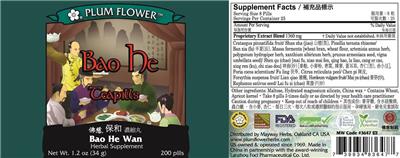
Bao He Teapills by Plum Flower label
The label scan from the NIH Dietary Supplement Label Database. Tap to enlarge.
Label images are published by the NIH Dietary Supplement Label Database for the version of this product on file. Always read your actual product label.
View the full label (PDF)The Ingredients in Bao He Teapills by Plum Flower
These are the 8 active ingredients this product is made of. Select any to open its full monograph.
Serving size8 Pill(s) Dosage formTablet Or Pill Servings per container25 Amounts shown are per serving.
Most supplement products combine several ingredients, and a medication can interact with the product through any one of them. Each ingredient below shows whether it has known drug interactions.
Proprietary Extract Blend
Other (inactive) ingredients: Maltose, Magnesium Silicate, Hydrated, China Wax. These complete the product’s ingredient list but are not active constituents.
Bao He Teapills by Plum Flower Drug Interactions
HelloPharmacist Interaction Report
Bao He Teapills by Plum Flower contains multiple ingredients with documented interactions, so you'll want to check your exact medications before starting.
The most serious concern is Siberian cocklebur extract, which can damage your kidneys and liver. If you take any drug that affects kidney or liver function—or any blood sugar medication—this product needs careful review with your pharmacist.
Read the full breakdown — every affected drug type, severity by severity
Several other ingredients carry Moderate-severity interactions: hawthorn can interact with blood pressure and heart medications (including nitrates, phosphodiesterase-5 inhibitors like sildenafil, beta-blockers, and calcium channel blockers), blood thinners, and digoxin; sweet annie may alter how your liver processes certain medications (CYP3A4 and CYP2B6 substrates); pinellia ternata can boost the effects of sedatives and benzodiazepines; forsythia may increase bleeding risk with blood thinners; and radish extract might lower blood sugar too far with diabetes medications. Smartweed contains vitamin K and could reduce warfarin's effectiveness.
Tangerine extract shows only a Minor interaction with midazolam in humans. Altogether, these interactions span 1,414 individual medications.
Wheat bran extract was checked and shows no interactions documented in our data, and apricot seed extract also has no known interactions. We could not check wheat flour extract or vigna umbellata seed extract—no data is on file for those.
Run your medications through the checker on this page to see if any apply to you.
Check your own medications below · Editorial policy · How we use AI
Want to check YOUR meds against Bao He Teapills?
Ask about interactions with your drugs in plain English — “Can I take it with lisinopril?” — and we find you the answer in seconds, ingredient by ingredient.
Go to the checkerIngredients driving the most interactions
Individual Drug Interactions
The ingredients in Bao He Teapills interact with 1,451 drugs. Click any drug to see the details.
7 of the 8 ingredients in Bao He Teapills interact with drugs. Each result below shows which ingredient is responsible. Citrus reticulata Peel Extract Poria cocos Sclerotium Extract Pinellia ternata Rhizome Extract Crataegus pinnatifida fruit extract Forsythia suspensa Fruit Extract Raphanus sativus Seed Extract Hordeum vulgare Fruit Extract
6-mercaptopurinePurinethol
How 6-mercaptopurine interacts with Bao He Teapills — through 2 ingredients. Tap an ingredient for the detail:
Xanthium Sibiricum Herb ExtractHepatotoxic Drugs Major
Interaction Summary
Siberian cocklebur can adversely affect the liver.
Read the full Xanthium Sibiricum Herb Extract + 6-mercaptopurine interactionArtemisia AnnuaHepatotoxic Drugs Moderate
Interaction Summary
Theoretically, concomitant use might have additive adverse hepatotoxic effects.
Read the full Artemisia Annua + 6-mercaptopurine interactionAbacavir Sulfate, Dolutegravir, LamivudineTriumeq
How Abacavir Sulfate, Dolutegravir, Lamivudine interacts with Bao He Teapills — through 2 ingredients. Tap an ingredient for the detail:
Xanthium Sibiricum Herb ExtractHepatotoxic Drugs Major
Interaction Summary
Siberian cocklebur can adversely affect the liver.
Read the full Xanthium Sibiricum Herb Extract + Abacavir Sulfate, Dolutegravir, Lamivudine interactionArtemisia AnnuaHepatotoxic Drugs Moderate
Interaction Summary
Theoretically, concomitant use might have additive adverse hepatotoxic effects.
Read the full Artemisia Annua + Abacavir Sulfate, Dolutegravir, Lamivudine interactionAbacavir, LamivudineEpzicom
How Abacavir, Lamivudine interacts with Bao He Teapills — through 2 ingredients. Tap an ingredient for the detail:
Xanthium Sibiricum Herb ExtractHepatotoxic Drugs Major
Interaction Summary
Siberian cocklebur can adversely affect the liver.
Read the full Xanthium Sibiricum Herb Extract + Abacavir, Lamivudine interactionArtemisia AnnuaHepatotoxic Drugs Moderate
Interaction Summary
Theoretically, concomitant use might have additive adverse hepatotoxic effects.
Read the full Artemisia Annua + Abacavir, Lamivudine interactionAbiraterone
How Abiraterone interacts with Bao He Teapills — through 3 ingredients. Tap an ingredient for the detail:
Xanthium Sibiricum Herb ExtractHepatotoxic Drugs Major
Interaction Summary
Siberian cocklebur can adversely affect the liver.
Read the full Xanthium Sibiricum Herb Extract + Abiraterone interactionArtemisia AnnuaCytochrome P450 3a4 (cyp3a4) Substrates, Hepatotoxic Drugs Moderate
Interaction Summary
Sweet Annie may alter plasma levels and clinical effects of drugs metabolized by CYP3A4.
Read the full Artemisia Annua + Abiraterone interactionCitrus Reticulata Peel ExtractCytochrome P450 3a4 (cyp3a4) Substrates Minor
Interaction Summary
In vitro, tangeretin, a constituent of tangerine, induces a 52% increase in the metabolism of midazolam by cytochrome P450 3A4 (CYP3A4).
Read the full Citrus Reticulata Peel Extract + Abiraterone interactionAbiraterone AcetateYonsa, Zytiga
How Abiraterone Acetate interacts with Bao He Teapills — through 3 ingredients. Tap an ingredient for the detail:
Xanthium Sibiricum Herb ExtractHepatotoxic Drugs Major
Interaction Summary
Siberian cocklebur can adversely affect the liver.
Read the full Xanthium Sibiricum Herb Extract + Abiraterone Acetate interactionArtemisia AnnuaCytochrome P450 3a4 (cyp3a4) Substrates, Hepatotoxic Drugs Moderate
Interaction Summary
Sweet Annie may alter plasma levels and clinical effects of drugs metabolized by CYP3A4.
Read the full Artemisia Annua + Abiraterone Acetate interactionCitrus Reticulata Peel ExtractCytochrome P450 3a4 (cyp3a4) Substrates Minor
Interaction Summary
In vitro, tangeretin, a constituent of tangerine, induces a 52% increase in the metabolism of midazolam by cytochrome P450 3A4 (CYP3A4).
Read the full Citrus Reticulata Peel Extract + Abiraterone Acetate interactionAcarboseGlucobay, Prandase, Precose
How Acarbose interacts with Bao He Teapills — through 4 ingredients. Tap an ingredient for the detail:
Xanthium Sibiricum Herb ExtractAntidiabetes Drugs, Hepatotoxic Drugs Major
Interaction Summary
Siberian cocklebur seedlings and seeds have caused severe hypoglycemia in humans.
Read the full Xanthium Sibiricum Herb Extract + Acarbose interactionWheat Flour ExtractAntidiabetes Drugs Moderate
Interaction Summary
Theoretically, taking wheatgrass with antidiabetes drugs might lower blood glucose levels and increase the risk of hypoglycemia.
Read the full Wheat Flour Extract + Acarbose interactionArtemisia AnnuaHepatotoxic Drugs Moderate
Interaction Summary
Theoretically, concomitant use might have additive adverse hepatotoxic effects.
Read the full Artemisia Annua + Acarbose interactionRaphanus Sativus Seed ExtractAntidiabetes Drugs Moderate
Interaction Summary
Theoretically, radish might increase the risk of hypoglycemia when taken with antidiabetes drugs.
Read the full Raphanus Sativus Seed Extract + Acarbose interactionAcebutololRhotral, Sectral
How Acebutolol interacts with Bao He Teapills — through 3 ingredients. Tap an ingredient for the detail:
Xanthium Sibiricum Herb ExtractHepatotoxic Drugs Major
Interaction Summary
Siberian cocklebur can adversely affect the liver.
Read the full Xanthium Sibiricum Herb Extract + Acebutolol interactionCrataegus Pinnatifida Fruit ExtractBeta-blockers Moderate
Interaction Summary
Theoretically, concomitant use might cause additive effects on blood pressure and heart rate.
Read the full Crataegus Pinnatifida Fruit Extract + Acebutolol interactionArtemisia AnnuaHepatotoxic Drugs Moderate
Interaction Summary
Theoretically, concomitant use might have additive adverse hepatotoxic effects.
Read the full Artemisia Annua + Acebutolol interactionAcetaminophenChildren's Tylenol, Children's Tylenol Meltaways, Tylenol, Tylenol Ex Strength
How Acetaminophen interacts with Bao He Teapills — through 3 ingredients. Tap an ingredient for the detail:
Xanthium Sibiricum Herb ExtractHepatotoxic Drugs, Nephrotoxic Drugs Major
Interaction Summary
Siberian cocklebur can adversely affect the liver.
Read the full Xanthium Sibiricum Herb Extract + Acetaminophen interactionWheat Flour ExtractCytochrome P450 1a2 (cyp1a2) Substrates Moderate
Interaction Summary
Theoretically, wheatgrass might decrease the levels and clinical effects of CYP1A2 substrates.
Read the full Wheat Flour Extract + Acetaminophen interactionArtemisia AnnuaHepatotoxic Drugs Moderate
Interaction Summary
Theoretically, concomitant use might have additive adverse hepatotoxic effects.
Read the full Artemisia Annua + Acetaminophen interactionAcetaminophen, AspirinGemnisyn
How Acetaminophen, Aspirin interacts with Bao He Teapills — through 5 ingredients. Tap an ingredient for the detail:
Xanthium Sibiricum Herb ExtractNephrotoxic Drugs, Hepatotoxic Drugs Major
Interaction Summary
Siberian cocklebur can adversely affect the kidney.
Read the full Xanthium Sibiricum Herb Extract + Acetaminophen, Aspirin interactionArtemisia AnnuaHepatotoxic Drugs Moderate
Interaction Summary
Theoretically, concomitant use might have additive adverse hepatotoxic effects.
Read the full Artemisia Annua + Acetaminophen, Aspirin interactionCrataegus Pinnatifida Fruit ExtractAnticoagulant/antiplatelet Drugs Moderate
Interaction Summary
Theoretically, hawthorn may increase the risk of bleeding if used with anticoagulant or antiplatelet drugs.
Read the full Crataegus Pinnatifida Fruit Extract + Acetaminophen, Aspirin interactionWheat Flour ExtractCytochrome P450 1a2 (cyp1a2) Substrates Moderate
Interaction Summary
Theoretically, wheatgrass might decrease the levels and clinical effects of CYP1A2 substrates.
Read the full Wheat Flour Extract + Acetaminophen, Aspirin interactionForsythia Suspensa Fruit ExtractAnticoagulant/antiplatelet Drugs Moderate
Interaction Summary
Theoretically, taking forsythia with anticoagulant or antiplatelet drugs might increase the risk of bleeding due to decreased platelet aggregation.
Read the full Forsythia Suspensa Fruit Extract + Acetaminophen, Aspirin interactionAcetaminophen, Aspirin, CaffeineExcedrin, Excedrin Extra Strength, Excedrin Migraine
How Acetaminophen, Aspirin, Caffeine interacts with Bao He Teapills — through 6 ingredients. Tap an ingredient for the detail:
Xanthium Sibiricum Herb ExtractHepatotoxic Drugs, Nephrotoxic Drugs Major
Interaction Summary
Siberian cocklebur can adversely affect the liver.
Read the full Xanthium Sibiricum Herb Extract + Acetaminophen, Aspirin, Caffeine interactionCrataegus Pinnatifida Fruit ExtractAnticoagulant/antiplatelet Drugs Moderate
Interaction Summary
Theoretically, hawthorn may increase the risk of bleeding if used with anticoagulant or antiplatelet drugs.
Read the full Crataegus Pinnatifida Fruit Extract + Acetaminophen, Aspirin, Caffeine interactionArtemisia AnnuaHepatotoxic Drugs, Cytochrome P450 3a4 (cyp3a4) Substrates Moderate
Interaction Summary
Theoretically, concomitant use might have additive adverse hepatotoxic effects.
Read the full Artemisia Annua + Acetaminophen, Aspirin, Caffeine interactionForsythia Suspensa Fruit ExtractAnticoagulant/antiplatelet Drugs Moderate
Interaction Summary
Theoretically, taking forsythia with anticoagulant or antiplatelet drugs might increase the risk of bleeding due to decreased platelet aggregation.
Read the full Forsythia Suspensa Fruit Extract + Acetaminophen, Aspirin, Caffeine interactionWheat Flour ExtractCytochrome P450 1a2 (cyp1a2) Substrates Moderate
Interaction Summary
Theoretically, wheatgrass might decrease the levels and clinical effects of CYP1A2 substrates.
Read the full Wheat Flour Extract + Acetaminophen, Aspirin, Caffeine interactionCitrus Reticulata Peel ExtractCytochrome P450 3a4 (cyp3a4) Substrates Minor
Interaction Summary
In vitro, tangeretin, a constituent of tangerine, induces a 52% increase in the metabolism of midazolam by cytochrome P450 3A4 (CYP3A4).
Read the full Citrus Reticulata Peel Extract + Acetaminophen, Aspirin, Caffeine interactionAcetaminophen, Brompheniramine, PhenylpropanolamineDimetapp Cold and Flu
How Acetaminophen, Brompheniramine, Phenylpropanolamine interacts with Bao He Teapills — through 3 ingredients. Tap an ingredient for the detail:
Xanthium Sibiricum Herb ExtractNephrotoxic Drugs, Hepatotoxic Drugs Major
Interaction Summary
Siberian cocklebur can adversely affect the kidney.
Read the full Xanthium Sibiricum Herb Extract + Acetaminophen, Brompheniramine, Phenylpropanolamine interactionWheat Flour ExtractCytochrome P450 1a2 (cyp1a2) Substrates Moderate
Interaction Summary
Theoretically, wheatgrass might decrease the levels and clinical effects of CYP1A2 substrates.
Read the full Wheat Flour Extract + Acetaminophen, Brompheniramine, Phenylpropanolamine interactionArtemisia AnnuaHepatotoxic Drugs Moderate
Interaction Summary
Theoretically, concomitant use might have additive adverse hepatotoxic effects.
Read the full Artemisia Annua + Acetaminophen, Brompheniramine, Phenylpropanolamine interactionAcetaminophen, ButalbitalAxocet, Bancap, Bucet, Butex Forte, Esgic CF, Orbivan CF +5 more
How Acetaminophen, Butalbital interacts with Bao He Teapills — through 4 ingredients. Tap an ingredient for the detail:
Xanthium Sibiricum Herb ExtractHepatotoxic Drugs, Nephrotoxic Drugs Major
Interaction Summary
Siberian cocklebur can adversely affect the liver.
Read the full Xanthium Sibiricum Herb Extract + Acetaminophen, Butalbital interactionArtemisia AnnuaHepatotoxic Drugs Moderate
Interaction Summary
Theoretically, concomitant use might have additive adverse hepatotoxic effects.
Read the full Artemisia Annua + Acetaminophen, Butalbital interactionWheat Flour ExtractCytochrome P450 1a2 (cyp1a2) Substrates Moderate
Interaction Summary
Theoretically, wheatgrass might decrease the levels and clinical effects of CYP1A2 substrates.
Read the full Wheat Flour Extract + Acetaminophen, Butalbital interactionPinellia Ternata Rhizome ExtractBarbiturates Moderate
Interaction Summary
Evidence from animal research shows that a Pinellia ternata preparation decreases activity and increases sleeping time.
Read the full Pinellia Ternata Rhizome Extract + Acetaminophen, Butalbital interactionAcetaminophen, Butalbital, CaffeineEsgic, Esgic Plus, Fiogesic, Fioricet, Repan, Tecnal +1 more
How Acetaminophen, Butalbital, Caffeine interacts with Bao He Teapills — through 5 ingredients. Tap an ingredient for the detail:
Xanthium Sibiricum Herb ExtractNephrotoxic Drugs, Hepatotoxic Drugs Major
Interaction Summary
Siberian cocklebur can adversely affect the kidney.
Read the full Xanthium Sibiricum Herb Extract + Acetaminophen, Butalbital, Caffeine interactionArtemisia AnnuaHepatotoxic Drugs, Cytochrome P450 3a4 (cyp3a4) Substrates Moderate
Interaction Summary
Theoretically, concomitant use might have additive adverse hepatotoxic effects.
Read the full Artemisia Annua + Acetaminophen, Butalbital, Caffeine interactionPinellia Ternata Rhizome ExtractBarbiturates Moderate
Interaction Summary
Evidence from animal research shows that a Pinellia ternata preparation decreases activity and increases sleeping time.
Read the full Pinellia Ternata Rhizome Extract + Acetaminophen, Butalbital, Caffeine interactionWheat Flour ExtractCytochrome P450 1a2 (cyp1a2) Substrates Moderate
Interaction Summary
Theoretically, wheatgrass might decrease the levels and clinical effects of CYP1A2 substrates.
Read the full Wheat Flour Extract + Acetaminophen, Butalbital, Caffeine interactionCitrus Reticulata Peel ExtractCytochrome P450 3a4 (cyp3a4) Substrates Minor
Interaction Summary
In vitro, tangeretin, a constituent of tangerine, induces a 52% increase in the metabolism of midazolam by cytochrome P450 3A4 (CYP3A4).
Read the full Citrus Reticulata Peel Extract + Acetaminophen, Butalbital, Caffeine interactionAcetaminophen, Butalbital, Caffeine, CodeineEsgic with Codeine, Fioricet w/ Codeine
How Acetaminophen, Butalbital, Caffeine, Codeine interacts with Bao He Teapills — through 6 ingredients. Tap an ingredient for the detail:
Xanthium Sibiricum Herb ExtractHepatotoxic Drugs, Nephrotoxic Drugs Major
Interaction Summary
Siberian cocklebur can adversely affect the liver.
Read the full Xanthium Sibiricum Herb Extract + Acetaminophen, Butalbital, Caffeine, Codeine interactionPinellia Ternata Rhizome ExtractBarbiturates, Cns Depressants Moderate
Interaction Summary
Evidence from animal research shows that a Pinellia ternata preparation decreases activity and increases sleeping time.
Read the full Pinellia Ternata Rhizome Extract + Acetaminophen, Butalbital, Caffeine, Codeine interactionWheat Flour ExtractCytochrome P450 1a2 (cyp1a2) Substrates Moderate
Interaction Summary
Theoretically, wheatgrass might decrease the levels and clinical effects of CYP1A2 substrates.
Read the full Wheat Flour Extract + Acetaminophen, Butalbital, Caffeine, Codeine interactionArtemisia AnnuaCytochrome P450 3a4 (cyp3a4) Substrates, Hepatotoxic Drugs Moderate
Interaction Summary
Sweet Annie may alter plasma levels and clinical effects of drugs metabolized by CYP3A4.
Read the full Artemisia Annua + Acetaminophen, Butalbital, Caffeine, Codeine interactionPoria Cocos Sclerotium ExtractCns Depressants Moderate
Interaction Summary
Theoretically, taking poria mushroom extract may enhance the therapeutic and adverse effects of sedatives.
Read the full Poria Cocos Sclerotium Extract + Acetaminophen, Butalbital, Caffeine, Codeine interactionCitrus Reticulata Peel ExtractCytochrome P450 3a4 (cyp3a4) Substrates Minor
Interaction Summary
In vitro, tangeretin, a constituent of tangerine, induces a 52% increase in the metabolism of midazolam by cytochrome P450 3A4 (CYP3A4).
Read the full Citrus Reticulata Peel Extract + Acetaminophen, Butalbital, Caffeine, Codeine interactionAcetaminophen, Butalbital, CodeineBancap w/ Codeine
How Acetaminophen, Butalbital, Codeine interacts with Bao He Teapills — through 5 ingredients. Tap an ingredient for the detail:
Xanthium Sibiricum Herb ExtractNephrotoxic Drugs, Hepatotoxic Drugs Major
Interaction Summary
Siberian cocklebur can adversely affect the kidney.
Read the full Xanthium Sibiricum Herb Extract + Acetaminophen, Butalbital, Codeine interactionPoria Cocos Sclerotium ExtractCns Depressants Moderate
Interaction Summary
Theoretically, taking poria mushroom extract may enhance the therapeutic and adverse effects of sedatives.
Read the full Poria Cocos Sclerotium Extract + Acetaminophen, Butalbital, Codeine interactionArtemisia AnnuaHepatotoxic Drugs Moderate
Interaction Summary
Theoretically, concomitant use might have additive adverse hepatotoxic effects.
Read the full Artemisia Annua + Acetaminophen, Butalbital, Codeine interactionWheat Flour ExtractCytochrome P450 1a2 (cyp1a2) Substrates Moderate
Interaction Summary
Theoretically, wheatgrass might decrease the levels and clinical effects of CYP1A2 substrates.
Read the full Wheat Flour Extract + Acetaminophen, Butalbital, Codeine interactionPinellia Ternata Rhizome ExtractCns Depressants Moderate
Interaction Summary
Evidence from animal research shows that a Pinellia ternata preparation decreases activity and increases sleeping time.
Read the full Pinellia Ternata Rhizome Extract + Acetaminophen, Butalbital, Codeine interactionAcetaminophen, Butalbital, Codeine PhosphatePhrenilin #3
How Acetaminophen, Butalbital, Codeine Phosphate interacts with Bao He Teapills — through 5 ingredients. Tap an ingredient for the detail:
Xanthium Sibiricum Herb ExtractNephrotoxic Drugs, Hepatotoxic Drugs Major
Interaction Summary
Siberian cocklebur can adversely affect the kidney.
Read the full Xanthium Sibiricum Herb Extract + Acetaminophen, Butalbital, Codeine Phosphate interactionArtemisia AnnuaHepatotoxic Drugs Moderate
Interaction Summary
Theoretically, concomitant use might have additive adverse hepatotoxic effects.
Read the full Artemisia Annua + Acetaminophen, Butalbital, Codeine Phosphate interactionPoria Cocos Sclerotium ExtractCns Depressants Moderate
Interaction Summary
Theoretically, taking poria mushroom extract may enhance the therapeutic and adverse effects of sedatives.
Read the full Poria Cocos Sclerotium Extract + Acetaminophen, Butalbital, Codeine Phosphate interactionPinellia Ternata Rhizome ExtractCns Depressants Moderate
Interaction Summary
Evidence from animal research shows that a Pinellia ternata preparation decreases activity and increases sleeping time.
Read the full Pinellia Ternata Rhizome Extract + Acetaminophen, Butalbital, Codeine Phosphate interactionWheat Flour ExtractCytochrome P450 1a2 (cyp1a2) Substrates Moderate
Interaction Summary
Theoretically, wheatgrass might decrease the levels and clinical effects of CYP1A2 substrates.
Read the full Wheat Flour Extract + Acetaminophen, Butalbital, Codeine Phosphate interactionAcetaminophen, Caffeine, Chlorpheniramine, Hydrocodone, PhenylephrineHycomine Compound
How Acetaminophen, Caffeine, Chlorpheniramine, Hydrocodone, Phenylephrine interacts with Bao He Teapills — through 6 ingredients. Tap an ingredient for the detail:
Xanthium Sibiricum Herb ExtractHepatotoxic Drugs, Nephrotoxic Drugs Major
Interaction Summary
Siberian cocklebur can adversely affect the liver.
Read the full Xanthium Sibiricum Herb Extract + Acetaminophen, Caffeine, Chlorpheniramine, Hydrocodone, Phenylephrine interactionWheat Flour ExtractCytochrome P450 1a2 (cyp1a2) Substrates Moderate
Interaction Summary
Theoretically, wheatgrass might decrease the levels and clinical effects of CYP1A2 substrates.
Read the full Wheat Flour Extract + Acetaminophen, Caffeine, Chlorpheniramine, Hydrocodone, Phenylephrine interactionPinellia Ternata Rhizome ExtractCns Depressants Moderate
Interaction Summary
Evidence from animal research shows that a Pinellia ternata preparation decreases activity and increases sleeping time.
Read the full Pinellia Ternata Rhizome Extract + Acetaminophen, Caffeine, Chlorpheniramine, Hydrocodone, Phenylephrine interactionPoria Cocos Sclerotium ExtractCns Depressants, Anticholinergic Drugs Moderate
Interaction Summary
Theoretically, taking poria mushroom extract may enhance the therapeutic and adverse effects of sedatives.
Read the full Poria Cocos Sclerotium Extract + Acetaminophen, Caffeine, Chlorpheniramine, Hydrocodone, Phenylephrine interactionArtemisia AnnuaHepatotoxic Drugs, Cytochrome P450 3a4 (cyp3a4) Substrates Moderate
Interaction Summary
Theoretically, concomitant use might have additive adverse hepatotoxic effects.
Read the full Artemisia Annua + Acetaminophen, Caffeine, Chlorpheniramine, Hydrocodone, Phenylephrine interactionCitrus Reticulata Peel ExtractCytochrome P450 3a4 (cyp3a4) Substrates Minor
Interaction Summary
In vitro, tangeretin, a constituent of tangerine, induces a 52% increase in the metabolism of midazolam by cytochrome P450 3A4 (CYP3A4).
Read the full Citrus Reticulata Peel Extract + Acetaminophen, Caffeine, Chlorpheniramine, Hydrocodone, Phenylephrine interactionAcetaminophen, Caffeine, CodeineGesic C15, Gesic C30, Gesic C8, Lenoltec 1, Lenoltec 2, Lenoltec 3 +1 more
How Acetaminophen, Caffeine, Codeine interacts with Bao He Teapills — through 6 ingredients. Tap an ingredient for the detail:
Xanthium Sibiricum Herb ExtractNephrotoxic Drugs, Hepatotoxic Drugs Major
Interaction Summary
Siberian cocklebur can adversely affect the kidney.
Read the full Xanthium Sibiricum Herb Extract + Acetaminophen, Caffeine, Codeine interactionArtemisia AnnuaCytochrome P450 3a4 (cyp3a4) Substrates, Hepatotoxic Drugs Moderate
Interaction Summary
Sweet Annie may alter plasma levels and clinical effects of drugs metabolized by CYP3A4.
Read the full Artemisia Annua + Acetaminophen, Caffeine, Codeine interactionPoria Cocos Sclerotium ExtractCns Depressants Moderate
Interaction Summary
Theoretically, taking poria mushroom extract may enhance the therapeutic and adverse effects of sedatives.
Read the full Poria Cocos Sclerotium Extract + Acetaminophen, Caffeine, Codeine interactionPinellia Ternata Rhizome ExtractCns Depressants Moderate
Interaction Summary
Evidence from animal research shows that a Pinellia ternata preparation decreases activity and increases sleeping time.
Read the full Pinellia Ternata Rhizome Extract + Acetaminophen, Caffeine, Codeine interactionWheat Flour ExtractCytochrome P450 1a2 (cyp1a2) Substrates Moderate
Interaction Summary
Theoretically, wheatgrass might decrease the levels and clinical effects of CYP1A2 substrates.
Read the full Wheat Flour Extract + Acetaminophen, Caffeine, Codeine interactionCitrus Reticulata Peel ExtractCytochrome P450 3a4 (cyp3a4) Substrates Minor
Interaction Summary
In vitro, tangeretin, a constituent of tangerine, induces a 52% increase in the metabolism of midazolam by cytochrome P450 3A4 (CYP3A4).
Read the full Citrus Reticulata Peel Extract + Acetaminophen, Caffeine, Codeine interactionAcetaminophen, Caffeine, Codeine, SalicylamideCodalan No.1, Codalan No.2, Codalan No.3
How Acetaminophen, Caffeine, Codeine, Salicylamide interacts with Bao He Teapills — through 6 ingredients. Tap an ingredient for the detail:
Xanthium Sibiricum Herb ExtractHepatotoxic Drugs, Nephrotoxic Drugs Major
Interaction Summary
Siberian cocklebur can adversely affect the liver.
Read the full Xanthium Sibiricum Herb Extract + Acetaminophen, Caffeine, Codeine, Salicylamide interactionArtemisia AnnuaHepatotoxic Drugs, Cytochrome P450 3a4 (cyp3a4) Substrates Moderate
Interaction Summary
Theoretically, concomitant use might have additive adverse hepatotoxic effects.
Read the full Artemisia Annua + Acetaminophen, Caffeine, Codeine, Salicylamide interactionPoria Cocos Sclerotium ExtractCns Depressants Moderate
Interaction Summary
Theoretically, taking poria mushroom extract may enhance the therapeutic and adverse effects of sedatives.
Read the full Poria Cocos Sclerotium Extract + Acetaminophen, Caffeine, Codeine, Salicylamide interactionPinellia Ternata Rhizome ExtractCns Depressants Moderate
Interaction Summary
Evidence from animal research shows that a Pinellia ternata preparation decreases activity and increases sleeping time.
Read the full Pinellia Ternata Rhizome Extract + Acetaminophen, Caffeine, Codeine, Salicylamide interactionWheat Flour ExtractCytochrome P450 1a2 (cyp1a2) Substrates Moderate
Interaction Summary
Theoretically, wheatgrass might decrease the levels and clinical effects of CYP1A2 substrates.
Read the full Wheat Flour Extract + Acetaminophen, Caffeine, Codeine, Salicylamide interactionCitrus Reticulata Peel ExtractCytochrome P450 3a4 (cyp3a4) Substrates Minor
Interaction Summary
In vitro, tangeretin, a constituent of tangerine, induces a 52% increase in the metabolism of midazolam by cytochrome P450 3A4 (CYP3A4).
Read the full Citrus Reticulata Peel Extract + Acetaminophen, Caffeine, Codeine, Salicylamide interactionAcetaminophen, Caffeine, DihydrocodeineDHC Plus, Panlor DC, Panlor SS
How Acetaminophen, Caffeine, Dihydrocodeine interacts with Bao He Teapills — through 6 ingredients. Tap an ingredient for the detail:
Xanthium Sibiricum Herb ExtractNephrotoxic Drugs, Hepatotoxic Drugs Major
Interaction Summary
Siberian cocklebur can adversely affect the kidney.
Read the full Xanthium Sibiricum Herb Extract + Acetaminophen, Caffeine, Dihydrocodeine interactionWheat Flour ExtractCytochrome P450 1a2 (cyp1a2) Substrates Moderate
Interaction Summary
Theoretically, wheatgrass might decrease the levels and clinical effects of CYP1A2 substrates.
Read the full Wheat Flour Extract + Acetaminophen, Caffeine, Dihydrocodeine interactionPinellia Ternata Rhizome ExtractCns Depressants Moderate
Interaction Summary
Evidence from animal research shows that a Pinellia ternata preparation decreases activity and increases sleeping time.
Read the full Pinellia Ternata Rhizome Extract + Acetaminophen, Caffeine, Dihydrocodeine interactionPoria Cocos Sclerotium ExtractCns Depressants Moderate
Interaction Summary
Theoretically, taking poria mushroom extract may enhance the therapeutic and adverse effects of sedatives.
Read the full Poria Cocos Sclerotium Extract + Acetaminophen, Caffeine, Dihydrocodeine interactionArtemisia AnnuaHepatotoxic Drugs, Cytochrome P450 3a4 (cyp3a4) Substrates Moderate
Interaction Summary
Theoretically, concomitant use might have additive adverse hepatotoxic effects.
Read the full Artemisia Annua + Acetaminophen, Caffeine, Dihydrocodeine interactionCitrus Reticulata Peel ExtractCytochrome P450 3a4 (cyp3a4) Substrates Minor
Interaction Summary
In vitro, tangeretin, a constituent of tangerine, induces a 52% increase in the metabolism of midazolam by cytochrome P450 3A4 (CYP3A4).
Read the full Citrus Reticulata Peel Extract + Acetaminophen, Caffeine, Dihydrocodeine interactionAcetaminophen, Caffeine, IsomethepteneMigralam
How Acetaminophen, Caffeine, Isometheptene interacts with Bao He Teapills — through 4 ingredients. Tap an ingredient for the detail:
Xanthium Sibiricum Herb ExtractHepatotoxic Drugs, Nephrotoxic Drugs Major
Interaction Summary
Siberian cocklebur can adversely affect the liver.
Read the full Xanthium Sibiricum Herb Extract + Acetaminophen, Caffeine, Isometheptene interactionArtemisia AnnuaCytochrome P450 3a4 (cyp3a4) Substrates, Hepatotoxic Drugs Moderate
Interaction Summary
Sweet Annie may alter plasma levels and clinical effects of drugs metabolized by CYP3A4.
Read the full Artemisia Annua + Acetaminophen, Caffeine, Isometheptene interactionWheat Flour ExtractCytochrome P450 1a2 (cyp1a2) Substrates Moderate
Interaction Summary
Theoretically, wheatgrass might decrease the levels and clinical effects of CYP1A2 substrates.
Read the full Wheat Flour Extract + Acetaminophen, Caffeine, Isometheptene interactionCitrus Reticulata Peel ExtractCytochrome P450 3a4 (cyp3a4) Substrates Minor
Interaction Summary
In vitro, tangeretin, a constituent of tangerine, induces a 52% increase in the metabolism of midazolam by cytochrome P450 3A4 (CYP3A4).
Read the full Citrus Reticulata Peel Extract + Acetaminophen, Caffeine, Isometheptene interactionAcetaminophen, Caffeine, PyrilamineMidol Max Strength Menstrual
How Acetaminophen, Caffeine, Pyrilamine interacts with Bao He Teapills — through 5 ingredients. Tap an ingredient for the detail:
Xanthium Sibiricum Herb ExtractNephrotoxic Drugs, Hepatotoxic Drugs Major
Interaction Summary
Siberian cocklebur can adversely affect the kidney.
Read the full Xanthium Sibiricum Herb Extract + Acetaminophen, Caffeine, Pyrilamine interactionArtemisia AnnuaHepatotoxic Drugs, Cytochrome P450 3a4 (cyp3a4) Substrates Moderate
Interaction Summary
Theoretically, concomitant use might have additive adverse hepatotoxic effects.
Read the full Artemisia Annua + Acetaminophen, Caffeine, Pyrilamine interactionPoria Cocos Sclerotium ExtractAnticholinergic Drugs Moderate
Interaction Summary
Theoretically, poria mushroom might decrease the clinical effects of anticholinergic drugs.
Read the full Poria Cocos Sclerotium Extract + Acetaminophen, Caffeine, Pyrilamine interactionWheat Flour ExtractCytochrome P450 1a2 (cyp1a2) Substrates Moderate
Interaction Summary
Theoretically, wheatgrass might decrease the levels and clinical effects of CYP1A2 substrates.
Read the full Wheat Flour Extract + Acetaminophen, Caffeine, Pyrilamine interactionCitrus Reticulata Peel ExtractCytochrome P450 3a4 (cyp3a4) Substrates Minor
Interaction Summary
In vitro, tangeretin, a constituent of tangerine, induces a 52% increase in the metabolism of midazolam by cytochrome P450 3A4 (CYP3A4).
Read the full Citrus Reticulata Peel Extract + Acetaminophen, Caffeine, Pyrilamine interactionAcetaminophen, Chlorpheniramine Maleate, Dextromethorphan HbrVicks Formula 44M Cough, Cold & Flu Relief
How Acetaminophen, Chlorpheniramine Maleate, Dextromethorphan Hbr interacts with Bao He Teapills — through 5 ingredients. Tap an ingredient for the detail:
Xanthium Sibiricum Herb ExtractNephrotoxic Drugs, Hepatotoxic Drugs Major
Interaction Summary
Siberian cocklebur can adversely affect the kidney.
Read the full Xanthium Sibiricum Herb Extract + Acetaminophen, Chlorpheniramine Maleate, Dextromethorphan Hbr interactionWheat Flour ExtractCytochrome P450 1a2 (cyp1a2) Substrates Moderate
Interaction Summary
Theoretically, wheatgrass might decrease the levels and clinical effects of CYP1A2 substrates.
Read the full Wheat Flour Extract + Acetaminophen, Chlorpheniramine Maleate, Dextromethorphan Hbr interactionPoria Cocos Sclerotium ExtractAnticholinergic Drugs Moderate
Interaction Summary
Theoretically, poria mushroom might decrease the clinical effects of anticholinergic drugs.
Read the full Poria Cocos Sclerotium Extract + Acetaminophen, Chlorpheniramine Maleate, Dextromethorphan Hbr interactionArtemisia AnnuaHepatotoxic Drugs, Cytochrome P450 3a4 (cyp3a4) Substrates Moderate
Interaction Summary
Theoretically, concomitant use might have additive adverse hepatotoxic effects.
Read the full Artemisia Annua + Acetaminophen, Chlorpheniramine Maleate, Dextromethorphan Hbr interactionCitrus Reticulata Peel ExtractCytochrome P450 3a4 (cyp3a4) Substrates Minor
Interaction Summary
In vitro, tangeretin, a constituent of tangerine, induces a 52% increase in the metabolism of midazolam by cytochrome P450 3A4 (CYP3A4).
Read the full Citrus Reticulata Peel Extract + Acetaminophen, Chlorpheniramine Maleate, Dextromethorphan Hbr interactionAcetaminophen, Chlorpheniramine, Codeine, PhenylephrineColrex
How Acetaminophen, Chlorpheniramine, Codeine, Phenylephrine interacts with Bao He Teapills — through 6 ingredients. Tap an ingredient for the detail:
Xanthium Sibiricum Herb ExtractNephrotoxic Drugs, Hepatotoxic Drugs Major
Interaction Summary
Siberian cocklebur can adversely affect the kidney.
Read the full Xanthium Sibiricum Herb Extract + Acetaminophen, Chlorpheniramine, Codeine, Phenylephrine interactionPoria Cocos Sclerotium ExtractAnticholinergic Drugs, Cns Depressants Moderate
Interaction Summary
Theoretically, poria mushroom might decrease the clinical effects of anticholinergic drugs.
Read the full Poria Cocos Sclerotium Extract + Acetaminophen, Chlorpheniramine, Codeine, Phenylephrine interactionArtemisia AnnuaHepatotoxic Drugs, Cytochrome P450 3a4 (cyp3a4) Substrates Moderate
Interaction Summary
Theoretically, concomitant use might have additive adverse hepatotoxic effects.
Read the full Artemisia Annua + Acetaminophen, Chlorpheniramine, Codeine, Phenylephrine interactionWheat Flour ExtractCytochrome P450 1a2 (cyp1a2) Substrates Moderate
Interaction Summary
Theoretically, wheatgrass might decrease the levels and clinical effects of CYP1A2 substrates.
Read the full Wheat Flour Extract + Acetaminophen, Chlorpheniramine, Codeine, Phenylephrine interactionPinellia Ternata Rhizome ExtractCns Depressants Moderate
Interaction Summary
Evidence from animal research shows that a Pinellia ternata preparation decreases activity and increases sleeping time.
Read the full Pinellia Ternata Rhizome Extract + Acetaminophen, Chlorpheniramine, Codeine, Phenylephrine interactionCitrus Reticulata Peel ExtractCytochrome P450 3a4 (cyp3a4) Substrates Minor
Interaction Summary
In vitro, tangeretin, a constituent of tangerine, induces a 52% increase in the metabolism of midazolam by cytochrome P450 3A4 (CYP3A4).
Read the full Citrus Reticulata Peel Extract + Acetaminophen, Chlorpheniramine, Codeine, Phenylephrine interactionAcetaminophen, Chlorpheniramine, DextromethorphanCoricidin II Extra Strength Cold and Flu
How Acetaminophen, Chlorpheniramine, Dextromethorphan interacts with Bao He Teapills — through 5 ingredients. Tap an ingredient for the detail:
Xanthium Sibiricum Herb ExtractNephrotoxic Drugs, Hepatotoxic Drugs Major
Interaction Summary
Siberian cocklebur can adversely affect the kidney.
Read the full Xanthium Sibiricum Herb Extract + Acetaminophen, Chlorpheniramine, Dextromethorphan interactionPoria Cocos Sclerotium ExtractAnticholinergic Drugs Moderate
Interaction Summary
Theoretically, poria mushroom might decrease the clinical effects of anticholinergic drugs.
Read the full Poria Cocos Sclerotium Extract + Acetaminophen, Chlorpheniramine, Dextromethorphan interactionArtemisia AnnuaCytochrome P450 3a4 (cyp3a4) Substrates, Hepatotoxic Drugs Moderate
Interaction Summary
Sweet Annie may alter plasma levels and clinical effects of drugs metabolized by CYP3A4.
Read the full Artemisia Annua + Acetaminophen, Chlorpheniramine, Dextromethorphan interactionWheat Flour ExtractCytochrome P450 1a2 (cyp1a2) Substrates Moderate
Interaction Summary
Theoretically, wheatgrass might decrease the levels and clinical effects of CYP1A2 substrates.
Read the full Wheat Flour Extract + Acetaminophen, Chlorpheniramine, Dextromethorphan interactionCitrus Reticulata Peel ExtractCytochrome P450 3a4 (cyp3a4) Substrates Minor
Interaction Summary
In vitro, tangeretin, a constituent of tangerine, induces a 52% increase in the metabolism of midazolam by cytochrome P450 3A4 (CYP3A4).
Read the full Citrus Reticulata Peel Extract + Acetaminophen, Chlorpheniramine, Dextromethorphan interactionAcetaminophen, Chlorpheniramine, Dextromethorphan HydrobromideCoricidin HBP Maximum Strength Flu
How Acetaminophen, Chlorpheniramine, Dextromethorphan Hydrobromide interacts with Bao He Teapills — through 5 ingredients. Tap an ingredient for the detail:
Xanthium Sibiricum Herb ExtractHepatotoxic Drugs, Nephrotoxic Drugs Major
Interaction Summary
Siberian cocklebur can adversely affect the liver.
Read the full Xanthium Sibiricum Herb Extract + Acetaminophen, Chlorpheniramine, Dextromethorphan Hydrobromide interactionWheat Flour ExtractCytochrome P450 1a2 (cyp1a2) Substrates Moderate
Interaction Summary
Theoretically, wheatgrass might decrease the levels and clinical effects of CYP1A2 substrates.
Read the full Wheat Flour Extract + Acetaminophen, Chlorpheniramine, Dextromethorphan Hydrobromide interactionArtemisia AnnuaHepatotoxic Drugs, Cytochrome P450 3a4 (cyp3a4) Substrates Moderate
Interaction Summary
Theoretically, concomitant use might have additive adverse hepatotoxic effects.
Read the full Artemisia Annua + Acetaminophen, Chlorpheniramine, Dextromethorphan Hydrobromide interactionPoria Cocos Sclerotium ExtractAnticholinergic Drugs Moderate
Interaction Summary
Theoretically, poria mushroom might decrease the clinical effects of anticholinergic drugs.
Read the full Poria Cocos Sclerotium Extract + Acetaminophen, Chlorpheniramine, Dextromethorphan Hydrobromide interactionCitrus Reticulata Peel ExtractCytochrome P450 3a4 (cyp3a4) Substrates Minor
Interaction Summary
In vitro, tangeretin, a constituent of tangerine, induces a 52% increase in the metabolism of midazolam by cytochrome P450 3A4 (CYP3A4).
Read the full Citrus Reticulata Peel Extract + Acetaminophen, Chlorpheniramine, Dextromethorphan Hydrobromide interactionAcetaminophen, Chlorpheniramine, Dextromethorphan, PhenylpropanolamineMulti Symptom Cold Relief
How Acetaminophen, Chlorpheniramine, Dextromethorphan, Phenylpropanolamine interacts with Bao He Teapills — through 5 ingredients. Tap an ingredient for the detail:
Xanthium Sibiricum Herb ExtractHepatotoxic Drugs, Nephrotoxic Drugs Major
Interaction Summary
Siberian cocklebur can adversely affect the liver.
Read the full Xanthium Sibiricum Herb Extract + Acetaminophen, Chlorpheniramine, Dextromethorphan, Phenylpropanolamine interactionArtemisia AnnuaCytochrome P450 3a4 (cyp3a4) Substrates, Hepatotoxic Drugs Moderate
Interaction Summary
Sweet Annie may alter plasma levels and clinical effects of drugs metabolized by CYP3A4.
Read the full Artemisia Annua + Acetaminophen, Chlorpheniramine, Dextromethorphan, Phenylpropanolamine interactionPoria Cocos Sclerotium ExtractAnticholinergic Drugs Moderate
Interaction Summary
Theoretically, poria mushroom might decrease the clinical effects of anticholinergic drugs.
Read the full Poria Cocos Sclerotium Extract + Acetaminophen, Chlorpheniramine, Dextromethorphan, Phenylpropanolamine interactionWheat Flour ExtractCytochrome P450 1a2 (cyp1a2) Substrates Moderate
Interaction Summary
Theoretically, wheatgrass might decrease the levels and clinical effects of CYP1A2 substrates.
Read the full Wheat Flour Extract + Acetaminophen, Chlorpheniramine, Dextromethorphan, Phenylpropanolamine interactionCitrus Reticulata Peel ExtractCytochrome P450 3a4 (cyp3a4) Substrates Minor
Interaction Summary
In vitro, tangeretin, a constituent of tangerine, induces a 52% increase in the metabolism of midazolam by cytochrome P450 3A4 (CYP3A4).
Read the full Citrus Reticulata Peel Extract + Acetaminophen, Chlorpheniramine, Dextromethorphan, Phenylpropanolamine interactionAcetaminophen, Chlorpheniramine, Dextromethorphan, PseudoephedrineChildren's Tylenol Cold Plus Cough, Tylenol Cold Ex Strength
How Acetaminophen, Chlorpheniramine, Dextromethorphan, Pseudoephedrine interacts with Bao He Teapills — through 5 ingredients. Tap an ingredient for the detail:
Xanthium Sibiricum Herb ExtractNephrotoxic Drugs, Hepatotoxic Drugs Major
Interaction Summary
Siberian cocklebur can adversely affect the kidney.
Read the full Xanthium Sibiricum Herb Extract + Acetaminophen, Chlorpheniramine, Dextromethorphan, Pseudoephedrine interactionArtemisia AnnuaHepatotoxic Drugs, Cytochrome P450 3a4 (cyp3a4) Substrates Moderate
Interaction Summary
Theoretically, concomitant use might have additive adverse hepatotoxic effects.
Read the full Artemisia Annua + Acetaminophen, Chlorpheniramine, Dextromethorphan, Pseudoephedrine interactionPoria Cocos Sclerotium ExtractAnticholinergic Drugs Moderate
Interaction Summary
Theoretically, poria mushroom might decrease the clinical effects of anticholinergic drugs.
Read the full Poria Cocos Sclerotium Extract + Acetaminophen, Chlorpheniramine, Dextromethorphan, Pseudoephedrine interactionWheat Flour ExtractCytochrome P450 1a2 (cyp1a2) Substrates Moderate
Interaction Summary
Theoretically, wheatgrass might decrease the levels and clinical effects of CYP1A2 substrates.
Read the full Wheat Flour Extract + Acetaminophen, Chlorpheniramine, Dextromethorphan, Pseudoephedrine interactionCitrus Reticulata Peel ExtractCytochrome P450 3a4 (cyp3a4) Substrates Minor
Interaction Summary
In vitro, tangeretin, a constituent of tangerine, induces a 52% increase in the metabolism of midazolam by cytochrome P450 3A4 (CYP3A4).
Read the full Citrus Reticulata Peel Extract + Acetaminophen, Chlorpheniramine, Dextromethorphan, Pseudoephedrine interactionAcetaminophen, Chlorpheniramine, Guaifenesin, Phenylephrine, SalicylamideRhinogesic GG
How Acetaminophen, Chlorpheniramine, Guaifenesin, Phenylephrine, Salicylamide interacts with Bao He Teapills — through 5 ingredients. Tap an ingredient for the detail:
Xanthium Sibiricum Herb ExtractNephrotoxic Drugs, Hepatotoxic Drugs Major
Interaction Summary
Siberian cocklebur can adversely affect the kidney.
Read the full Xanthium Sibiricum Herb Extract + Acetaminophen, Chlorpheniramine, Guaifenesin, Phenylephrine, Salicylamide interactionWheat Flour ExtractCytochrome P450 1a2 (cyp1a2) Substrates Moderate
Interaction Summary
Theoretically, wheatgrass might decrease the levels and clinical effects of CYP1A2 substrates.
Read the full Wheat Flour Extract + Acetaminophen, Chlorpheniramine, Guaifenesin, Phenylephrine, Salicylamide interactionArtemisia AnnuaCytochrome P450 3a4 (cyp3a4) Substrates, Hepatotoxic Drugs Moderate
Interaction Summary
Sweet Annie may alter plasma levels and clinical effects of drugs metabolized by CYP3A4.
Read the full Artemisia Annua + Acetaminophen, Chlorpheniramine, Guaifenesin, Phenylephrine, Salicylamide interactionPoria Cocos Sclerotium ExtractAnticholinergic Drugs Moderate
Interaction Summary
Theoretically, poria mushroom might decrease the clinical effects of anticholinergic drugs.
Read the full Poria Cocos Sclerotium Extract + Acetaminophen, Chlorpheniramine, Guaifenesin, Phenylephrine, Salicylamide interactionCitrus Reticulata Peel ExtractCytochrome P450 3a4 (cyp3a4) Substrates Minor
Interaction Summary
In vitro, tangeretin, a constituent of tangerine, induces a 52% increase in the metabolism of midazolam by cytochrome P450 3A4 (CYP3A4).
Read the full Citrus Reticulata Peel Extract + Acetaminophen, Chlorpheniramine, Guaifenesin, Phenylephrine, Salicylamide interactionAcetaminophen, Chlorpheniramine, PhenylephrineAlka-Seltzer PLUS, Histex SR, Protid
How Acetaminophen, Chlorpheniramine, Phenylephrine interacts with Bao He Teapills — through 5 ingredients. Tap an ingredient for the detail:
Xanthium Sibiricum Herb ExtractHepatotoxic Drugs, Nephrotoxic Drugs Major
Interaction Summary
Siberian cocklebur can adversely affect the liver.
Read the full Xanthium Sibiricum Herb Extract + Acetaminophen, Chlorpheniramine, Phenylephrine interactionArtemisia AnnuaHepatotoxic Drugs, Cytochrome P450 3a4 (cyp3a4) Substrates Moderate
Interaction Summary
Theoretically, concomitant use might have additive adverse hepatotoxic effects.
Read the full Artemisia Annua + Acetaminophen, Chlorpheniramine, Phenylephrine interactionPoria Cocos Sclerotium ExtractAnticholinergic Drugs Moderate
Interaction Summary
Theoretically, poria mushroom might decrease the clinical effects of anticholinergic drugs.
Read the full Poria Cocos Sclerotium Extract + Acetaminophen, Chlorpheniramine, Phenylephrine interactionWheat Flour ExtractCytochrome P450 1a2 (cyp1a2) Substrates Moderate
Interaction Summary
Theoretically, wheatgrass might decrease the levels and clinical effects of CYP1A2 substrates.
Read the full Wheat Flour Extract + Acetaminophen, Chlorpheniramine, Phenylephrine interactionCitrus Reticulata Peel ExtractCytochrome P450 3a4 (cyp3a4) Substrates Minor
Interaction Summary
In vitro, tangeretin, a constituent of tangerine, induces a 52% increase in the metabolism of midazolam by cytochrome P450 3A4 (CYP3A4).
Read the full Citrus Reticulata Peel Extract + Acetaminophen, Chlorpheniramine, Phenylephrine interactionEach ingredient & the kinds of drugs it affects
For each ingredient in Bao He Teapills with known interactions, here are the types of medications they can affect. Open any type for the detail — or search your exact drug in the checker above.
Citrus reticulata Peel Extract
Cytochrome P450 3A4 (Cyp3A4) Substrates
In vitro, tangeretin, a constituent of tangerine, induces a 52% increase in the metabolism of midazolam by cytochrome P450 3A4 (CYP3A4). This suggests that tangeretin may stimulate CYP3A4 activity. However, in humans, drinking tangerine juice 200 mL slightly delayed the absorption, but did not affect the metabolism, of midazolam, a CYP3A4 substrate. Theoretically, tangerine juice might increase CYP3A4 activity and decrease levels of drugs metabolized by this enzyme. However, this effect is unlikely.
Some drugs metabolized by CYP3A4 include amitriptyline (Elavil), amiodarone (Cordarone), citalopram (Celexa), felodipine (Plendil), lansoprazole (Prevacid), ondansetron (Zofran), prednisone (Deltasone, Orasone), sertraline (Zoloft), sibutramine (Meridia), and many others.
Midazolam (Versed)
In vitro, tangeretin, a constituent of tangerine, appears to increase the metabolism of midazolam in human liver microsomes by up to 52%. However, in humans, drinking tangerine juice 200 mL slightly delayed the absorption, but did not affect the metabolism, of midazolam. Theoretically, tangerine juice might increase the metabolism and reduce the effects of midazolam. However, this effect is unlikely.
Poria cocos Sclerotium Extract
Anticholinergic Drugs
Theoretically, poria mushroom might decrease the clinical effects of anticholinergic drugs.
In animal research, poria mushroom essential oil reduces acetylcholinesterase activity. This interaction has not been shown in humans.
Cholinergic Drugs
Theoretically, poria mushroom might have additive effects when used with cholinergic drugs.
In animal research, poria mushroom essential oil reduces acetylcholinesterase activity. This interaction has not been shown in humans.
Cns Depressants
Theoretically, taking poria mushroom extract may enhance the therapeutic and adverse effects of sedatives.
Animal research shows that poria mushroom extract has sedative properties. This interaction has not been shown in humans.
Pinellia ternata Rhizome Extract
Barbiturates
Evidence from animal research shows that a Pinellia ternata preparation decreases activity and increases sleeping time. Theoretically, Pinellia ternata can potentiate the therapeutic effect of barbiturates. Some of these sedative medications include pentobarbital (Nembutal), phenobarbital (Luminal), secobarbital (Seconal), and others.
Benzodiazepines
Evidence from animal research shows that a Pinellia ternata preparation decreases activity and increases sleeping time. Theoretically, Pinellia ternata can potentiate the therapeutic effect of benzodiazepines. Some benzodiazepines include lorazepam (Ativan), alprazolam (Xanax), diazepam (Valium), midazolam (Versed), and others.
Cns Depressants
Evidence from animal research shows that a Pinellia ternata preparation decreases activity and increases sleeping time. Theoretically, Pinellia ternata can potentiate the therapeutic effect of CNS depressants. Some of these medications include antihistamines, barbiturates, benzodiazepines, tricyclic antidepressants, and others.
Crataegus pinnatifida fruit extract
Nitrates
Theoretically, concomitant use might cause additive coronary vasodilatory effects.
Some evidence shows that hawthorn might lower blood pressure due to vasodilatory effects.
Phosphodiesterase-5 Inhibitors
Theoretically, concomitant use might result in additive vasodilation and hypotension.
Hawthorn might inhibit PDE-5 and cause vasodilation.
Anticoagulant/Antiplatelet Drugs
Theoretically, hawthorn may increase the risk of bleeding if used with anticoagulant or antiplatelet drugs.
In vitro and animal research shows that hawthorn can inhibit platelet aggregation. However, its effect in humans is unclear. One observational study shows that patients taking hawthorn shortly before undergoing coronary artery bypass graft (CABG) surgery or valve replacement surgery have a 10% incidence of postoperative bleeding, compared with 1% in those who never consumed hawthorn extract. However, clinical research shows that taking a specific preparation of dried hawthorn leaves and flowers (Crataesor, Soria Natural Lab) 800 mg three times daily for 15 days does not affect platelet aggregation or levels of thromboxane B2, the metabolite of thromboxane A2, in healthy humans.
Beta-Blockers
Theoretically, concomitant use might cause additive effects on blood pressure and heart rate.
Some evidence shows that hawthorn might lower blood pressure and heart rate.
Calcium Channel Blockers
Theoretically, concomitant use might cause additive coronary vasodilation and hypotensive effects.
Some evidence shows that hawthorn might lower blood pressure due to vasodilatory effects.
Digoxin (Lanoxin)
Theoretically, hawthorn might potentiate the effects and adverse effects of digoxin.
Hawthorn appears to improve cardiac output; however, hawthorn does not appear to affect digoxin pharmacokinetics. Case reports suggest that at least one species of hawthorn root extract (Crataegus mexicana) may produce adverse effects similar to digoxin and can cross-react with digoxin assays, leading to falsely elevated plasma digoxin levels.
Forsythia suspensa Fruit Extract
Anticoagulant/Antiplatelet Drugs
Theoretically, taking forsythia with anticoagulant or antiplatelet drugs might increase the risk of bleeding due to decreased platelet aggregation. Forsythia might reduce platelet aggregation by inhibiting platelet activating factor. Some of these drugs include aspirin, clopidogrel (Plavix), dalteparin (Fragmin), enoxaparin (Lovenox), heparin, ticlopidine (Ticlid), warfarin (Coumadin), and others.
Azithromycin (Zithromax)
Theoretically, taking forsythia with azithromycin might increase the risk of adverse effects. Animal research in rats shows that taking a single dose of forsythia with azithromycin decreases the clearance and increases the area under the curve of both forsythiaside, a constituent of forsythia, and azithromycin. The mechanism of this interaction is not well understood.
Raphanus sativus Seed Extract
Antidiabetes Drugs
Theoretically, radish might increase the risk of hypoglycemia when taken with antidiabetes drugs.
Animal research shows that radish extract, juice, and sprouts can reduce glucose levels. Animal research also shows that radish root juice 300 mg/kg reduces fasting and postprandial blood glucose in a rat model of diabetes, with effects similar to glibenclamide.
Hordeum vulgare Fruit Extract
Triclabendazole (Egaten)
Theoretically, barley might decrease the clinical effects of triclabendazole.
Animal research suggests that a diet supplemented with barley can reduce the bioavailability of triclabendazole when taken concomitantly. This effect has not been shown in humans.
Brand information
Manufacturer and brand details for Bao He Teapills, from the product label.
Plum Flower
- Name
- Mayway Herbs
- City
- Oakland
- State
- CA
- Web Address
- www.plumflowerherbs.com
Bao He Teapills by Plum Flower: Common Questions
Does Bao He Teapills by Plum Flower interact with any medications?
How can one product interact with so many drugs?
Where does this information come from?
Does this work for digestion or stomach issues?
Can I take this if I'm pregnant or breastfeeding?
What are the most common side effects?
Is this safe if I have liver or kidney disease?
What's pinellia ternata and why is it a concern?
Does this contain gluten?
Written and reviewed by the HelloPharmacist editorial staff. Our editorial policy
Not sure if Bao He Teapills is safe with your meds?
Our pharmacists answer your medication & supplement questions — free.
Label information is sourced from the NIH Dietary Supplement Label Database and reflects the product version on file; always read your actual product label. This page is for education only and is not a substitute for professional medical advice. Confirm with your pharmacist or doctor before combining supplements and medications.
The Full Monographs Behind Bao He Teapills’s Ingredients
Every ingredient we hold a full HelloPharmacist monograph for — uses, evidence, safety, and the complete interaction list.
Tangerine
Interacts with 643 drugsTangerine is a sweet citrus fruit that is a good source of vitamin C and other nutrients, and is widely enjoyed as food. While the peel and essential oil are used in traditional medicine and...
Read the full Tangerine monograph → Herb & supplement monographPoria Mushroom
Interacts with 417 drugsPoria mushroom (Fu Ling) is a fungus long used in Traditional Chinese Medicine, mainly as a mild diuretic and digestive and calming aid. Modern scientific evidence in humans is very limited,...
Read the full Poria Mushroom monograph → Herb & supplement monographPinellia Ternata
Interacts with 256 drugsPinellia ternata is a tuber used in traditional Chinese medicine, most often for nausea, vomiting, and phlegmy coughs, and almost always as part of multi-herb formulas. The raw plant is toxi...
Read the full Pinellia Ternata monograph → Herb & supplement monographForsythia
Interacts with 123 drugsForsythia is a traditional Chinese herb, used mainly for cold and flu symptoms and as part of multi-herb formulas. Most evidence comes from laboratory, animal, and traditional use rather tha...
Read the full Forsythia monograph → Herb & supplement monographBarley
Interacts with 1 drugBarley is a nutritious whole grain that is a good source of soluble fiber called beta-glucan, which has solid evidence for modestly lowering LDL ('bad') cholesterol when eaten regularly. It...
Read the full Barley monograph → Herb & supplement monographHawthorn
Interacts with 191 drugsHawthorn is a plant traditionally used for heart-related complaints, and some studies suggest it may modestly help symptoms of mild heart failure when added to standard care. However, the ev...
Read the full Hawthorn monograph → Herb & supplement monographRadish
Interacts with 86 drugsRadish is a common edible root vegetable that is nutritious and generally safe to eat as food. Some people use radish (especially black radish) and its extracts for digestion and liver suppo...
Read the full Radish monograph →Sources & How We Checked
Bao He Teapills's label data comes from the NIH Dietary Supplement Label Database; the ingredient interaction data is from the Natural Medicines database, reviewed by our pharmacists.
- NIH Dietary Supplement Label Database (DSLD) — The official product label on file for this supplement.
- Natural Medicines (Therapeutic Research Center) — Evidence-graded clinical reference behind the ingredient interaction data.
Content is written and reviewed by licensed HelloPharmacist pharmacists. See our data sources and editorial standards for how this information is built and checked.
The 85 references behind this product’s interaction data
Every citation that drives the interaction findings for this product’s ingredients, from the evidence-graded Natural Medicines (TRC Healthcare) database. Open an ingredient to browse its citations — links open the study on PubMed or the publisher’s site.
Tangerine 3 references
- Yuan, J. M., Wang, X. L., Xiang, Y. B., Gao, Y. T., Ross, R. K., and Yu, M. C. Preserved foods in relation to risk of nasopharyngeal carcinoma in Shanghai, China. Int J Cancer 2000;85(3):358-363. DOI
- Backman, J. T., Maenpaa, J., Belle, D. J., Wrighton, S. A., Kivisto, K. T., and Neuvonen, P. J. Lack of correlation between in vitro and in vivo studies on the effects of tangeretin and tangerine juice on midazolam hydroxylation. Clin Pharmacol Ther 2000; PubMed
- Vilaplana, J. and Romaguera, C. Contact dermatitis from the essential oil of tangerine in fragrance. Contact Dermatitis 2002;46(2):108. PubMed
Poria Mushroom 3 references
- McGuffin M, Hobbs C, Upton R, Goldberg A, eds. American Herbal Products Association's Botanical Safety Handbook. Boca Raton, FL: CRC Press, LLC 1997.
- Kim H, Park I, Park K, Park S, Kim YI, Park BG. The positive effects of Poria cocos extract on quality of sleep in insomnia rat models. Int J Environ Res Public Health 2022;19(11):6629. PubMed
- Lv Q, Di X, Bian B, Li K, Guo J. Neuroprotective effects of Poria cocos (Agaricomycetes) essential oil on Aß1-40-induced learning and memory deficit in rats. Int J Med Mushrooms 2022;24(10):73-82.
Pinellia Ternata 4 references
- Kim SH, Jeong H, Kim YK, et al. IgE-mediated occupational asthma induced by herbal medicine, Bahna (Pinellia ternata). Clin Exp Allergy 2000;31:779-81.
- FDA, HHS. Final rule declaring dietary supplements containing ephedrine alkaloids adulterated because they present an unreasonable risk. Fed Regist 2004;69:6787-6854.
- Lin S, Nie B, Yao G, Yang H, Ye R, Yuan Z. Pinellia ternata (Thunb.) makino preparation promotes sleep by increasing REM sleep. Nat Prod Res. 2019;33(22):3326-3329. PubMed
- Lin YH, Chen C, Zhao X, et al. Efficacy and Safety of Banxia Formulae for Insomnia: A Systematic Review and Meta-Analysis of High-Quality Randomized Controlled Trials. Evid Based Complement Alternat Med 2021;2021:8833168. PubMed
Sweet Annie 11 references
- Mueller MS, Karhagomba IB, Hirt HM, Wemakor E. The potential of Artemisia annua L. as a locally produced remedy for malaria in the tropics: agricultural, chemical and clinical aspects. J Ethnopharmacol 2000;73:487-93. PubMed
- Rath K, Taxis K, Walz G, et al. Pharmacokinetic study of artemisinin after oral intake of a traditional preparation of Artemisia annua L. (annual wormwood). Am J Trop Med Hyg 2004;70:128-32. DOI
- Centers for Disease Control and Prevention (CDC). Hepatitis temporally associated with an herbal supplement containing artemisinin-Washington, 2008. MMWR Morb Mortal Wkly Rep 2009;58:854-8.
- Xing J, Kirby BJ, Whittington D, et al. Evaluation of P450 inhibition and induction by artemisinin antimalarials in human liver microsomes and primary human hepatocytes. Drug Metabl Dispos 2012;40(9):1757-64. PubMed
- Savage RL, Hill GR, Barnes J, Kenyon SH, Tatley MV. Suspected hepatotoxicity with a supercritical carbon dioxide extract of Artemisia annua in grapeseed oil used in New Zealand. Front Pharmacol. 2019;10:1448. PubMed
- Ruperti-Repilado FJ, Haefliger S, Rehm S, et al. Danger of herbal tea: a case of acute cholestatic hepatitis due to Artemisia annua tea. Front Med (Lausanne). 2019;6:221. PubMed
- Yang J, Shen Z, Liu L, et al. Clinical efficacy and safety of Artesimia annua-Sublingual immunotherapy in seasonal allergic rhinitis patients based on different intervention time. Int Arch Allergy Immunol 2022;183(8):852-859.
- Kane NF, Kiani BH, Desrosiers MR, Towler MJ, Weathers PJ. Artemisia extracts differ from artemisinin effects on human hepatic CYP450s 2B6 and 3A4 in vitro. J Ethnopharmacol 2022. DOI
- Feng Y, Cao Y, Liu Y, et al. Clinical efficacy and safety of coseasonal initiation of Artemisia annua sublingual immunotherapy on patients with Artemisia-induced rhinoconjunctivitis. Am J Otolaryngol 2023;44(5):103942. PubMed
- Yang J, Wang W, Shen Z, et al. Efficacy and safety of Artemisia annua sublingual immunotherapy in patients with seasonal allergic rhinoconjunctivitis over two pollen seasons. Eur Arch Otorhinolaryngol. 2023;280(11):4939-4947. PubMed
- Shen Z, Zhang P, Kang W, et al. Clinical efficacy in one-year treatment with Artemisia annua-SLIT drops in monosensitized and polysensitized individuals. Am J Otolaryngol 2023;44(6):104002. PubMed
Forsythia 3 references
- Kong XT, Fang HT, Jiang GQ, et al. Treatment of acute bronchiolitis with Chinese herbs. Arch Dis Child 1993;68:468-71. PubMed
- Iwakami S, Wu JB, Ebizuka Y, Sankawa U. Platelet activating factor (PAF) antagonists contained in medicinal plants: lignans and sesquiterpenes. Chem Pharm Bull (Tokyo) 1992;40:1196-8. PubMed
- Li XG, Ni J, Shen S, Wang XP, Tian JC. Pharmacokinetic interaction of Forsythia suspensa extract and azithromycin injection after single and co-intravenous administration in rats. Chin J Nat Med 2020;18(3):234-240. PubMed
Barley 15 references
- Brinker F. Herb Contraindications and Drug Interactions. 2nd ed. Sandy, OR: Eclectic Medical Publications, 1998.
- Fernandez-Anaya S, Crespo JF, Rodriguez JR, et al. Beer anaphylaxis. J Allergy Clin Immunol 1999;103:959-60.
- Lembo A, Camilleri M. Chronic constipation. N Engl J Med 2003;349:1360-8. . PubMed
- Ferre, I., Giraldez, F. J., Alvarez-Bujidos, M. L., and Mantecon, A. R. Influence of barley supplement on plasma concentration of triclabendazole metabolites in sheep. Vet.Rec. 11-22-1997;141(21):549-551. PubMed
- Curioni, A., Santucci, B., Cristaudo, A., Canistraci, C., Pietravalle, M., Simonato, B., and Giannattasio, M. Urticaria from beer: an immediate hypersensitivity reaction due to a 10- kDa protein derived from barley. Clin Exp Allergy 1999;29(3):407-413. PubMed
- Fernandez-Anaya, S., Crespo, J. F., Rodriguez, J. R., Daroca, P., Carmona, E., Herraez, L., and Lopez-Rubio, A. Beer anaphylaxis. J Allergy Clin Immunol. 1999;103(5 Pt 1):959-960.
- Cronin, E. Contact dermatitis from barley dust. Contact Dermatitis 1979;5(3):196. PubMed
- Block, G., Tse, K. S., Kijek, K., Chan, H., and Chan-Yeung, M. Baker's asthma. Studies of the cross-antigenicity between different cereal grains. Clin Allergy 1984;14(2):177-185.
- van Ketel, W. G. Immediate type allergy to malt in beer. Contact Dermatitis 1980;6(4):297-298. PubMed
- Ellis, H. J., Doyle, A. P., Day, P., Wieser, H., and Ciclitira, P. J. Demonstration of the presence of coeliac-activating gliadin-like epitopes in malted barley. Int Arch Allergy Immunol. 1994;104(3):308-310. PubMed
- Vidal, C. and Gonzalez-Quintela, A. Food-induced and occupational asthma due to barley flour. Ann Allergy Asthma Immunol. 1995;75(2):121-124.
- Gutgesell, C. and Fuchs, T. Contact urticaria from beer. Contact Dermatitis 1995;33(6):436-437. PubMed
- Baker, P. G. and Read, A. E. Oats and barley toxicity in coeliac patients. Postgrad.Med J 1976;52(607):264-268. PubMed
- Nakase, M., Usui, Y., Alvarez-Nakase, A. M., Adachi, T., Urisu, A., Nakamura, R., Aoki, N., Kitajima, K., and Matsuda, T. Cereal allergens: rice-seed allergens with structural similarity to wheat and barley allergens. Allergy 1998;53(46 Suppl):55-57. PubMed
- Pereira, F., Rafael, M., and Lacerda, M. H. Contact dermatitis from barley. Contact Dermatitis 1998;39(5):261-262. PubMed
Hawthorn 25 references
- Tauchert M. Efficacy and safety of crataegus extract WS 1442 in comparison with placebo in patients with chronic stable New York Heart Association class-III heart failure. Am Heart J 2002;143:910-5. PubMed
- Pittler MH, Schmidt K, Ernst E. Hawthorn extract for treating chronic heart failure: meta-analysis of randomized trials. Am J Med 2003;114:665-74.. PubMed
- Chang Q, Zuo Z, Harrison F, Chow MS. Hawthorn. J Clin Pharmacol 2002;42:605-12.
- Holubarsch CJ, Colucci WS, Meinertz T, et al. The efficacy and safety of Crataegus extract WS 1442 in patients with heart failure: the SPICE trial. Eur J Heart Fail 2008;10:1255-63. PubMed
- Pittler MH, Guo R, and Ernst E. Hawthorn extract for treating chronic heart failure. Cochrane.Database.Syst Rev 2008:CD005312. PubMed
- Zick SM, Vautaw BM, Gillespie B, Aaronson KD. Hawthorn Extract Randomized Blinded Chronic Heart Failure (HERB CHF) trial. Eur J Heart Fail. 2009;11:990-99. PubMed
- Werner NS, Duschek S, and Schandry R. D-camphor-crataegus berry extract combination increases blood pressure and cognitive functioning in the elderly - a randomized, placebo controlled double blind study. Phytomedicine. 2009;16:1077-82. PubMed
- Dalli E, Colomer E, Tormos MC, et al. Crataegus laevigata decreases neutrophil elastase and has hypolipidemic effect: a randomized, double-blind, placebo-controlled trial. Phytomedicine. 6-15-2011;18:769-75. PubMed
- Maek-a-nantawat W, Phonrat B, Dhitavat J, et al. Safety and efficacy of CKBM-A01, a Chinese herbal medicine, among asymptomatic HIV patients. Southeast Asian J Trop.Med Public Health 2009;40:494-501.
- Asher GN, Viera AJ, Weaver MA, et al. Effect of hawthorn standardized extract on flow mediated dilation in prehypertensive and mildly hypertensive adults: a randomized, controlled cross-over trial. BMC.Complement Altern.Med 2012;12:26. PubMed
- Walker AF, Marakis G, Simpson E, et al. Hypotensive effects of hawthorn for patients with diabetes taking prescription drugs: a randomised controlled trial. Br J Gen.Pract 2006;56:437-43.
- Daniele C, Mazzanti G, Pittler MH, et al. Adverse-event profile of Crataegus spp.: a systematic review. Drug Saf 2006;29:523-35. PubMed
- Tankanow R, Tamer HR, Streetman DS, et al. Interaction study between digoxin and a preparation of hawthorn (Crataegus oxyacantha). J.Clin.Pharmacol. 2003;43:637-42. DOI
- Tauchert, M., Gildor, A., and Lipinski, J. [High-dose Crataegus extract WS 1442 in the treatment of NYHA stage II heart failure]. Herz 1999;24(6):465-474.
- Horoz, M., Gok, E., Genctoy, G., Ozcan, T., Olmaz, R., Akca, M., Kiykim, A., and Gurses, I. Crataegus orientalis associated multiorgan hypersensitivity reaction and acute renal failure. Intern.Med 2008;47(23):2039-2042. PubMed
- Dalli, E., Valles, J., Cosin-Sales, J., Santos, M. T., Moscardo, A., Milara, J., and Sotillo, J. F. Effects of hawthorn (Crataegus laevigata) on platelet aggregation in healthy volunteers. Thromb.Res 2011;128(4):398-400. PubMed
- Rogov VD. [Toxiderma due to the fruits of the hawthorn]. Vestn Dermatol Venerol 1984;7(7):46-47.
- Loew D, Albrecht M, and Podzuweit H. Efficacy and tolerability of a Hawthorn preparation in patients with heart failure Stage I and II according to NYHA - a surveillance study. Phytomedicine 1996;3(Suppl 1):92.
- Rababa'h AM, Altarabsheh SE, Haddad O, Deo SV, Obeidat Y, Al-Azzam S. Hawthorn Herb Increases the Risk of Bleeding after Cardiac Surgery: An Evidence-Based Approach. Heart Surg Forum 2016;19(4):E175-9. PubMed
- Shatoor AS, Soliman H, Al-Hashem F, Gamal BE, Othman A, El-Menshaw N. Effect of hawthorn (Crataegus aronia syn. Azarolus (L)) on platelet function in albino wistar rats. Thromb Res 2012;130(1):75-80. PubMed
- Vibes J, Lasserre B, Gleye J, Declume C. Inhibition of thromboxane A2 biosynthesis in vitro by the main components of Crataegus oxyacantha (hawthorn) flower heads. Prostaglandins Leukot Essent Fatty Acids 1994;50(4):173-5. PubMed
- Rogers KL, Grice ID, Griffiths LR. Inhibition of platelet aggregation and 5-HT release by extracts of Australian plants used traditionally as headache treatments. Eur J Pharm Sci 2000;9(4):355-63. PubMed
- Zhou CC, Huang XX, Gao PY, et al. Two new compounds from Crataegus pinnatifida and their antithrombotic activities. J Asian Nat Prod Res 2014;16(2):169-74.
- Palmer KG, Lebin JA, Cronin MT, Mazor SS, Burns RA. Crataegus mexicana (Tejocote) Exposure Associated with Cardiotoxicity and a Falsely Elevated Digoxin Level. J Med Toxicol. 2019;15(4):295-298. PubMed
- Espinosa J, Bassett R, Lucerna A, Finn D. Hawthorne root (Crataegus mexicana) toxicity. Am J Emerg Med. 2024;78:242.e5-242.e6. PubMed
Radish 5 references
- Gruenwald J, Brendler T, Jaenicke C. PDR for Herbal Medicines. 1st ed. Montvale, NJ: Medical Economics Company, Inc., 1998.
- Damiani E, Aloia AM, Priore MG, Nardulli S, Ferrannini A. Generalized urticaria after ingestion of Raphanus sativus. Ann Allergy Asthma Immunol. 2011 Feb;106(2):168. PubMed
- Evans M, Paterson E, Barnes DM. An open label pilot study to evaluate the efficacy of Spanish black radish on the induction of phase I and phase II enzymes in healthy male subjects. BMC Complement Altern Med. 2014 Dec 9;14:475. PubMed
- Banihani SA. Radish (Raphanus sativus) and diabetes. Nutrients. 2017;9(9). pii: E1014. PubMed
- Shukla S, Chatterji S, Mehta S, Rai PK, Singh RK, Yadav DK, Watal G. Antidiabetic effect of Raphanus sativus root juice. Pharm Biol. 2011 Jan;49(1):32-7.
Wheat Bran 4 references
- Foster S, Tyler VE. Tyler's Honest Herbal: A Sensible Guide to the Use of Herbs and Related Remedies. 3rd ed., Binghamton, NY: Haworth Herbal Press, 1993.
- McRorie J, Kesler J, Bishop L, et al. Effects of wheat bran and Olestra on objective measures of stool and subjective reports of GI symptoms. Am J Gastroenterol 2000;95:1244-52. PubMed
- Food and Drug Administration. Food Allergen Labeling and Consumer Protection Act of 2004 (FALCPA); Public Law 108-282, Title II. Accessed on May 19, 2021. Available at: https://www.fda.gov/food/food-allergensgluten-free-guidance-documents-regulatory-infor
- Dalile B, La Torre D, Kalc P, et al. Extruded Wheat Bran Consumption Increases Serum Short-Chain Fatty Acids but Does Not Modulate Psychobiological Functions in Healthy Men: A Randomized, Placebo-Controlled Trial. Front Nutr 2022;9:896154. PubMed
Wheatgrass 5 references
- Ben-Arye E, Golden E, Wengrower D, et al. Wheat grass juice in the treatment of active distal ulcerative colitis a randomized double-blind placebo-controlled trial. Scand J Gastroenterol 2002;4:444-9.. PubMed
- Mohan Y, Jesuthankaraj GN1, Ramasamy Thangavelu N. Antidiabetic and antioxidant properties of Triticum aestivum in streptozotocin-induced diabetic rats. Adv Pharmacol Sci 2013;2013:716073.
- Shakya G, Randhi PK, Pajaniradje S, Mohankumar K, Rajagopalan R. Hypoglycaemic role of wheatgrass and its effect on carbohydrate metabolic enzymes in type II diabetic rats. Toxicol Ind Health 2016;32(6):1026-32. PubMed
- Food and Drug Administration. Food Allergen Labeling and Consumer Protection Act of 2004 (FALCPA); Public Law 108-282, Title II. Accessed on May 19, 2021. Available at: https://www.fda.gov/food/food-allergensgluten-free-guidance-documents-regulatory-infor
- Haron MH, Dale O, Martin K, et al. Evaluation of the Herb-Drug Interaction Potential of Commonly Used Botanicals on the US Market with Regard to PXR- and AhR-Mediated Influences on CYP3A4 and CYP1A2. J Diet Suppl 2022. PubMed
Smartweed 2 references
- Gruenwald J, Brendler T, Jaenicke C. PDR for Herbal Medicines. 1st ed. Montvale, NJ: Medical Economics Company, Inc., 1998.
- Brinker F. Herb Contraindications and Drug Interactions. 2nd ed. Sandy, OR: Eclectic Medical Publications, 1998.
Siberian Cocklebur 4 references
- Wu, M. L., Wang, C. P., and Deng, J. F. Fatal hepatic failure due to fructus xanthii in a child. Abstracts of the 2005 North American Congress of Clinical Toxicology Annual Meeting. Clin Toxicol 2005;43:639. DOI
- Gurley ES, Rahman M, Hossain MJ, et al. Fatal outbreak from consuming Xanthium strumarium seedlings during time of food scarcity in northeastern Bangladesh. PLoS One 2010 Mar 18;5(3):e9756. PubMed
- Turgut M, Alhan CC, Gurgoze M, et al. Carboxyatractyloside poisoning in humans. Ann Trop Paediatr 2005;25(2):125-34. PubMed
- Karabiber H, Almis H, Selimoglu MA, Yakinci C, Yilmaz S. Xanthium strumarium poisoning requiring liver transplantation. J Pediatr Gastroenterol Nutr. 2014;58(1):e6-9.
Apricot 1 reference
- Dietary Supplements - What You Need to Know — NIH Office of Dietary Supplements Source
Parts of this content are provided by the Therapeutic Research Center, LLC.
DISCLAIMER: Currently this does not check for drug-drug interactions. This is not an all-inclusive comprehensive list of potential interactions and is for informational purposes only. Not all interactions are known or well-reported in the scientific literature, and new interactions are continually being reported. Input is needed from a qualified healthcare provider including a pharmacist before starting any therapy. Application of clinical judgment is necessary.
© 2021 Therapeutic Research Center, LLC