
Body Comfort Ingredients & Drug Interactions
What is this page for?
First and foremost: checking Body Comfort against your medications. The heart of this page is the interaction checker and the full interaction report — how this product’s ingredients may interact with prescription and over-the-counter medicines you may be taking.
Around that, we add a pharmacist’s high-level view of the product as a whole — what’s inside, the evidence for its stated use, how transparent the label is, and what safety data exists — so you can see the full picture in one place. It’s educational information from our licensed clinical databases and the clinical staff at HelloPharmacist — not medical advice — and we don’t sell or endorse products. Our editorial policy
Body Comfort is a dietary supplement by Meehan Formulations with 5 active ingredients. Its ingredients are commonly taken for muscle recovery and sports performance, gut health and 'leaky gut', recovery from severe illness or injury.Based on those ingredients, 1,282 medications have a known interaction with it, the most serious rated major. The ingredients most likely to interact are Kava Kava, Powder, Gamma-Aminobutyric Acid, Vitamin B6. Use the checker below to test your specific medication, or read the full HelloPharmacist Interaction Report.
Check Your Meds Against Body Comfort by Meehan Formulations
Ask about any prescription or over-the-counter medication and we check it for interactions with Body Comfort by Meehan Formulations — and tell you which ingredient is responsible.
AI summaries are generated from our interaction database for education only — always confirm with your pharmacist. How we use AI
Ask the Pharmacist
A licensed pharmacist will answer your question by email — free, usually within 24 hours.
Got it — thank you!
A licensed pharmacist will answer within 24 hours. Keep an eye on your email (worth checking spam, just in case).
HelloPharmacist Scorecard of Body Comfort by Meehan Formulations
Our pharmacy team’s full take, with four database checks built into the cards below — a summary of what is known, not a grade of the product itself.
What’s inside
Full disclosure
Body Comfort contains five active ingredients: L-glutamine, vitamin B6, gamma-aminobutyric acid (GABA), DL-phenylalanine, and kava kava powder. L-glutamine is an amino acid; vitamin B6 is a B vitamin that helps your nervous system and metabolism; GABA is a neurotransmitter your body makes naturally; DL-phenylalanine is an amino acid form; and kava is a plant extract traditionally used for relaxation.
The product also contains cellulose as an inactive ingredient (a filler and capsule material).
Does it work?
Not established
The evidence for this product's ingredients varies widely. Vitamin B6 is established as effective for certain types of anemia and for treating B6 deficiency, and possibly effective for pregnancy-related nausea.
L-glutamine is effective for sickle cell disease and possibly effective for recovery after surgery and wasting in HIV/AIDS, though we hold no evidence rating specific to the broad "body comfort" claim. For GABA, kava, and DL-phenylalanine, the evidence we hold either doesn't support their use (kava for generalized anxiety disorder is rated possibly ineffective) or isn't established — meaning we don't have enough reliable data to say whether they work for their intended purposes.
How safe is it?
Well-documented data
L-glutamine is generally well tolerated orally, though people with kidney or liver disease should use it only under medical supervision. Common side effects include belching, bloating, constipation, diarrhea, gas, nausea, and headache.
Vitamin B6 is safe at normal dietary amounts and standard supplement doses, but high doses over time can damage nerves (sensory neuropathy). The safety data on vitamin B6 in pregnancy is mixed — it's rated likely safe at recommended levels but also possibly unsafe, so use only under a doctor's guidance if you're pregnant.
GABA is often well tolerated short-term but long-term safety isn't well studied; avoid it unless your doctor advises otherwise, and avoid it while breastfeeding. Kava has been linked to rare but serious liver injury (over 100 reported cases worldwide) and is banned or restricted in some countries; avoid it entirely during pregnancy and breastfeeding.
We hold no pregnancy or breastfeeding safety data for DL-phenylalanine.
Meds to double-check
Major interaction found
Check your medications if you take CNS depressants (sleep aids, anti-anxiety drugs, pain relievers) — kava is a Major concern. Also double-check if you're on blood pressure medication, seizure medication (phenobarbital, phenytoin), the heart drug amiodarone, drugs metabolized by liver enzymes (CYP2C19, CYP2C9, CYP2E1 substrates), haloperidol, ropinirole, or hepatotoxic medications.
Use the tool on this page to check your exact drugs.
The bottom line
Scorecard at a glanceFully disclosed formula with no established evidence rating for its marketed use. Major medication interactions have been identified, and safety information is well characterized.
If you take any blood pressure medication, seizure medication, CNS depressants (including sleep aids), or medications metabolized by your liver, run this product through the interaction checker below before taking it — kava and several other ingredients carry documented risks. People with liver or kidney disease should talk to their doctor or pharmacist first.
Pregnant or breastfeeding? Speak with your clinician; safety data is limited or conflicting for several ingredients here.
Educational only — not medical advice; always confirm with your pharmacist. Our editorial policy · How we use AI
Assessment coverage: 4 of 5 active ingredients matched to our full ingredient reviews (monographs). Based on the product label dated Oct 24, 2024.
This Scorecard evaluates available label information, ingredient evidence, and known medication-safety considerations. It does not independently verify product identity, purity, potency, contamination, or manufacturing quality. How these ratings are computed
General information
Key facts about Body Comfort, straight from the product label.
| Brand | Meehan Formulations |
|---|---|
| Barcode (UPC) | 859630004113 |
| Net contents | 120 Capsule(s) |
| Market status | On market |
| Date entered into DSLD | Oct 24, 2024 |
| DSLD ID | 319863 |
| Product type | Other Combinations |
| Supplement form | Capsule |
| Dietary claims / uses | All Other, Structure/Function |
| Intended target group(s) | Vegetarian, Adult (18 - 50 Years), Women (not pregnant or lactating), Gluten Free |
Everything in this section is reproduced from the manufacturer’s own product label — it’s the label speaking, not HelloPharmacist. We show it so you can see exactly what the maker states; we don’t verify or endorse those statements.
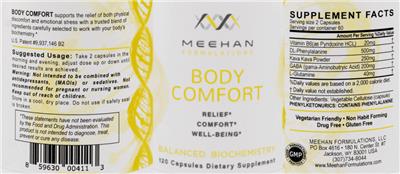
Supplement Facts
The label details for Body Comfort by Meehan Formulations, sourced from the NIH Dietary Supplement Label Database.
Supplement Facts
| Ingredient | Amount | % DV |
|---|---|---|
| L-Glutamine | 40 mg | -- |
| Vitamin B6 | 20 mg | -- |
| Gamma-Aminobutyric Acid | 200 mg | -- |
| DL-Phenylalanine | 500 mg | -- |
| Kava Kava, Powder | 250 mg | -- |
Other ingredients: Cellulose
Tap any ingredient to jump to its full detail below.
These statements are the manufacturer’s wording, reproduced from the product label — the label is saying it, not HelloPharmacist. We don’t verify or endorse them.
Formulation
Body Comfort supports the relief of both physical discomfort and emotional stress with a trusted blend of ingredients carefully selected to work with your body's biochemistry.
Relief Comfort Well-being Balanced biochemistry
Vegetarian friendly
Non habit forming
Drug free Gluten free
Brand IP Statement(s)
U.S. Patent #9,937,146 B2
Suggested/Recommended/Usage/Directions
Suggested Usage: Take 2 capsules in the morning and evening, adjust dose up or down until desired results are achieved.
Precautions
Warning: Not intended to be combined with antidepressants, (MAOIs) or sedatives. Not recommended for pregnant or nursing women.
Keep out of reach of children.
Do not use if safety seal is broken.
Phenylketonurics: Contains Phenylalanine
Storage
Store in a cool, dry place.
FDA Disclaimer Statement
These statements have not been evaluated by the Food and Drug Administration. This product is not intended to diagnose, treat, prevent or cure any disease.
FDA Statement of Identity
Dietary Supplement
Seals/Symbols
Good Manufacturing Practice GMP
Is this label outdated? Report a formula or label change and our pharmacy team will review it.
Body Comfort by Meehan Formulations label
The label scan from the NIH Dietary Supplement Label Database. Tap to enlarge.
Label images are published by the NIH Dietary Supplement Label Database for the version of this product on file. Always read your actual product label.
View the full label (PDF)The Ingredients in Body Comfort by Meehan Formulations
These are the 5 active ingredients this product is made of. Select any to open its full monograph.
Serving size2 Capsule(s) Dosage formCapsule Servings per container60 Amounts shown are per serving.
Most supplement products combine several ingredients, and a medication can interact with the product through any one of them. Each ingredient below shows whether it has known drug interactions.
L-Glutamine
Interacts with50 drugs
Glutamine is the most abundant amino acid in the body and is usually made in your muscles. A prescription form is FDA-approved to help reduce sickle c...
L-Glutamine monograph & interactionsVitamin B6
Interacts with210 drugs
Vitamin B6 (pyridoxine) is an essential water-soluble vitamin that your body needs for metabolism, brain function, and making red blood cells. It is b...
Vitamin B6 monograph & interactionsGamma-Aminobutyric Acid
Interacts with419 drugs
GABA is a calming chemical messenger (neurotransmitter) that your body makes on its own, and it is sold as a supplement for stress, anxiety, and sleep...
Gamma-Aminobutyric Acid monograph & interactionsDL-Phenylalanine
Kava Kava, Powder
Interacts with1,167 drugs
Kava is a Pacific Island plant traditionally used to promote relaxation and ease anxiety, and some studies suggest it may help mild anxiety. However,...
Kava Kava, Powder monograph & interactionsOther (inactive) ingredients: Cellulose. These complete the product’s ingredient list but are not active constituents.
Body Comfort by Meehan Formulations Drug Interactions
HelloPharmacist Interaction Report
Body Comfort by Meehan Formulations contains five ingredients, and interaction data exists for four of them.
The most serious documented interactions come from kava kava, which has Major-severity effects with CNS depressants (sedating medications like sleep aids, anti-anxiety drugs, and pain relievers). Combining kava with these drugs increases drowsiness and can slow your reflexes dangerously.
Read the full breakdown — every affected drug type, severity by severity
Vitamin B6 has Moderate interactions with blood pressure medications, the heart drug amiodarone, and two seizure medications (phenobarbital and phenytoin). High doses of B6 might reduce how well those seizure drugs work.
L-glutamine theoretically may interfere with anticonvulsant medications at a Moderate level, though no human cases have been reported yet. Kava also carries Moderate concerns with drugs metabolized by liver enzymes (CYP2C19, CYP2C9, CYP2E1 substrates), a few specific medications like haloperidol and ropinirole, and hepatotoxic (liver-damaging) drugs.
GABA has Moderate theoretical effects with blood pressure medications and Minor effects with CNS depressants.
We could not check one ingredient, DL-phenylalanine, for interactions. Altogether, these interactions span 1,282 individual medications.
Use the search tool below to look up your specific medications before starting this product.
Check your own medications below · Editorial policy · How we use AI
Want to check YOUR meds against Body Comfort?
Ask about interactions with your drugs in plain English — “Can I take it with lisinopril?” — and we find you the answer in seconds, ingredient by ingredient.
Go to the checkerIngredients driving the most interactions
Individual Drug Interactions
The ingredients in Body Comfort interact with 1,282 drugs. Click any drug to see the details.
4 of the 5 ingredients in Body Comfort interact with drugs. Each result below shows which ingredient is responsible. Kava Kava, Powder Gamma-Aminobutyric Acid Vitamin B6 L-Glutamine
AcepromazineAtravet
How Acepromazine interacts with Body Comfort — through 2 ingredients. Tap an ingredient for the detail:
Kava Kava, PowderCns Depressants Major
Interaction Summary
Combining kava with CNS depressants can have additive sedative effects.
Read the full Kava Kava, Powder + Acepromazine interactionGamma-aminobutyric AcidCns Depressants Minor
Interaction Summary
Theoretically, GABA might have additive sedative effects when used in conjunction with CNS depressants.
Read the full Gamma-aminobutyric Acid + Acepromazine interactionAcetaminophen, Butalbital, Caffeine, CodeineEsgic with Codeine, Fioricet w/ Codeine
How Acetaminophen, Butalbital, Caffeine, Codeine interacts with Body Comfort — through 2 ingredients. Tap an ingredient for the detail:
Kava Kava, PowderHepatotoxic Drugs, Cytochrome P450 1a2 (cyp1a2) Substrates +4 Major
Interaction Summary
Theoretically, using kava with hepatotoxic drugs might increase the risk of liver damage.
Read the full Kava Kava, Powder + Acetaminophen, Butalbital, Caffeine, Codeine interactionGamma-aminobutyric AcidCns Depressants Minor
Interaction Summary
Theoretically, GABA might have additive sedative effects when used in conjunction with CNS depressants.
Read the full Gamma-aminobutyric Acid + Acetaminophen, Butalbital, Caffeine, Codeine interactionAcetaminophen, Butalbital, CodeineBancap w/ Codeine
How Acetaminophen, Butalbital, Codeine interacts with Body Comfort — through 2 ingredients. Tap an ingredient for the detail:
Kava Kava, PowderCns Depressants, Hepatotoxic Drugs +3 Major
Interaction Summary
Combining kava with CNS depressants can have additive sedative effects.
Read the full Kava Kava, Powder + Acetaminophen, Butalbital, Codeine interactionGamma-aminobutyric AcidCns Depressants Minor
Interaction Summary
Theoretically, GABA might have additive sedative effects when used in conjunction with CNS depressants.
Read the full Gamma-aminobutyric Acid + Acetaminophen, Butalbital, Codeine interactionAcetaminophen, Butalbital, Codeine PhosphatePhrenilin #3
How Acetaminophen, Butalbital, Codeine Phosphate interacts with Body Comfort — through 2 ingredients. Tap an ingredient for the detail:
Kava Kava, PowderCytochrome P450 2d6 (cyp2d6) Substrates, Cns Depressants +3 Major
Interaction Summary
It is unclear if kava inhibits CYP1A2; research is conflicting.
Read the full Kava Kava, Powder + Acetaminophen, Butalbital, Codeine Phosphate interactionGamma-aminobutyric AcidCns Depressants Minor
Interaction Summary
Theoretically, GABA might have additive sedative effects when used in conjunction with CNS depressants.
Read the full Gamma-aminobutyric Acid + Acetaminophen, Butalbital, Codeine Phosphate interactionAcetaminophen, Caffeine, Chlorpheniramine, Hydrocodone, PhenylephrineHycomine Compound
How Acetaminophen, Caffeine, Chlorpheniramine, Hydrocodone, Phenylephrine interacts with Body Comfort — through 2 ingredients. Tap an ingredient for the detail:
Kava Kava, PowderCytochrome P450 1a2 (cyp1a2) Substrates, Cytochrome P450 2d6 (cyp2d6) Substrates +4 Major
Interaction Summary
It is unclear if kava inhibits CYP1A2; research is conflicting.
Read the full Kava Kava, Powder + Acetaminophen, Caffeine, Chlorpheniramine, Hydrocodone, Phenylephrine interactionGamma-aminobutyric AcidCns Depressants Minor
Interaction Summary
Theoretically, GABA might have additive sedative effects when used in conjunction with CNS depressants.
Read the full Gamma-aminobutyric Acid + Acetaminophen, Caffeine, Chlorpheniramine, Hydrocodone, Phenylephrine interactionAcetaminophen, Caffeine, CodeineGesic C15, Gesic C30, Gesic C8, Lenoltec 1, Lenoltec 2, Lenoltec 3 +1 more
How Acetaminophen, Caffeine, Codeine interacts with Body Comfort — through 2 ingredients. Tap an ingredient for the detail:
Kava Kava, PowderCytochrome P450 3a4 (cyp3a4) Substrates, Cytochrome P450 2e1 (cyp2e1) Substrates +4 Major
Interaction Summary
It is unclear if kava inhibits CYP3AA; research is conflicting.
Read the full Kava Kava, Powder + Acetaminophen, Caffeine, Codeine interactionGamma-aminobutyric AcidCns Depressants Minor
Interaction Summary
Theoretically, GABA might have additive sedative effects when used in conjunction with CNS depressants.
Read the full Gamma-aminobutyric Acid + Acetaminophen, Caffeine, Codeine interactionAcetaminophen, Caffeine, Codeine, SalicylamideCodalan No.1, Codalan No.2, Codalan No.3
How Acetaminophen, Caffeine, Codeine, Salicylamide interacts with Body Comfort — through 2 ingredients. Tap an ingredient for the detail:
Kava Kava, PowderCytochrome P450 1a2 (cyp1a2) Substrates, Cytochrome P450 3a4 (cyp3a4) Substrates +4 Major
Interaction Summary
It is unclear if kava inhibits CYP1A2; research is conflicting.
Read the full Kava Kava, Powder + Acetaminophen, Caffeine, Codeine, Salicylamide interactionGamma-aminobutyric AcidCns Depressants Minor
Interaction Summary
Theoretically, GABA might have additive sedative effects when used in conjunction with CNS depressants.
Read the full Gamma-aminobutyric Acid + Acetaminophen, Caffeine, Codeine, Salicylamide interactionAcetaminophen, Caffeine, DihydrocodeineDHC Plus, Panlor DC, Panlor SS
How Acetaminophen, Caffeine, Dihydrocodeine interacts with Body Comfort — through 2 ingredients. Tap an ingredient for the detail:
Kava Kava, PowderCytochrome P450 2d6 (cyp2d6) Substrates, Cytochrome P450 1a2 (cyp1a2) Substrates +4 Major
Interaction Summary
It is unclear if kava inhibits CYP1A2; research is conflicting.
Read the full Kava Kava, Powder + Acetaminophen, Caffeine, Dihydrocodeine interactionGamma-aminobutyric AcidCns Depressants Minor
Interaction Summary
Theoretically, GABA might have additive sedative effects when used in conjunction with CNS depressants.
Read the full Gamma-aminobutyric Acid + Acetaminophen, Caffeine, Dihydrocodeine interactionAcetaminophen, Chlorpheniramine, Codeine, PhenylephrineColrex
How Acetaminophen, Chlorpheniramine, Codeine, Phenylephrine interacts with Body Comfort — through 2 ingredients. Tap an ingredient for the detail:
Kava Kava, PowderCytochrome P450 2e1 (cyp2e1) Substrates, Cns Depressants +4 Major
Interaction Summary
Kava might increase levels of CYP2E1 substrates.
Read the full Kava Kava, Powder + Acetaminophen, Chlorpheniramine, Codeine, Phenylephrine interactionGamma-aminobutyric AcidCns Depressants Minor
Interaction Summary
Theoretically, GABA might have additive sedative effects when used in conjunction with CNS depressants.
Read the full Gamma-aminobutyric Acid + Acetaminophen, Chlorpheniramine, Codeine, Phenylephrine interactionAcetaminophen, Chlorpheniramine, Phenylpropanolamine, OpiumHista-Derfule
How Acetaminophen, Chlorpheniramine, Phenylpropanolamine, Opium interacts with Body Comfort — through 2 ingredients. Tap an ingredient for the detail:
Kava Kava, PowderHepatotoxic Drugs, Cns Depressants +3 Major
Interaction Summary
Theoretically, using kava with hepatotoxic drugs might increase the risk of liver damage.
Read the full Kava Kava, Powder + Acetaminophen, Chlorpheniramine, Phenylpropanolamine, Opium interactionGamma-aminobutyric AcidCns Depressants Minor
Interaction Summary
Theoretically, GABA might have additive sedative effects when used in conjunction with CNS depressants.
Read the full Gamma-aminobutyric Acid + Acetaminophen, Chlorpheniramine, Phenylpropanolamine, Opium interactionAcetaminophen, Chlorzoxazone, CodeineAcetazone Forte C8, Parafon Forte C8
How Acetaminophen, Chlorzoxazone, Codeine interacts with Body Comfort — through 2 ingredients. Tap an ingredient for the detail:
Kava Kava, PowderCytochrome P450 2e1 (cyp2e1) Substrates, Hepatotoxic Drugs +3 Major
Interaction Summary
Kava might increase levels of CYP2E1 substrates.
Read the full Kava Kava, Powder + Acetaminophen, Chlorzoxazone, Codeine interactionGamma-aminobutyric AcidCns Depressants Minor
Interaction Summary
Theoretically, GABA might have additive sedative effects when used in conjunction with CNS depressants.
Read the full Gamma-aminobutyric Acid + Acetaminophen, Chlorzoxazone, Codeine interactionAcetaminophen, CodeineTylenol No.3, Tylenol w/ Codeine
How Acetaminophen, Codeine interacts with Body Comfort — through 2 ingredients. Tap an ingredient for the detail:
Kava Kava, PowderCytochrome P450 1a2 (cyp1a2) Substrates, Cytochrome P450 2d6 (cyp2d6) Substrates +3 Major
Interaction Summary
It is unclear if kava inhibits CYP1A2; research is conflicting.
Read the full Kava Kava, Powder + Acetaminophen, Codeine interactionGamma-aminobutyric AcidCns Depressants Minor
Interaction Summary
Theoretically, GABA might have additive sedative effects when used in conjunction with CNS depressants.
Read the full Gamma-aminobutyric Acid + Acetaminophen, Codeine interactionAcetaminophen, Codeine, DoxylamineMersyndol
How Acetaminophen, Codeine, Doxylamine interacts with Body Comfort — through 2 ingredients. Tap an ingredient for the detail:
Kava Kava, PowderCytochrome P450 2e1 (cyp2e1) Substrates, Cytochrome P450 2d6 (cyp2d6) Substrates +3 Major
Interaction Summary
Kava might increase levels of CYP2E1 substrates.
Read the full Kava Kava, Powder + Acetaminophen, Codeine, Doxylamine interactionGamma-aminobutyric AcidCns Depressants Minor
Interaction Summary
Theoretically, GABA might have additive sedative effects when used in conjunction with CNS depressants.
Read the full Gamma-aminobutyric Acid + Acetaminophen, Codeine, Doxylamine interactionAcetaminophen, Codeine, MethocarbamolAcetaminophen, Codeine, Methocarbamol, Robaxacet 8
How Acetaminophen, Codeine, Methocarbamol interacts with Body Comfort — through 2 ingredients. Tap an ingredient for the detail:
Kava Kava, PowderCns Depressants, Cytochrome P450 1a2 (cyp1a2) Substrates +3 Major
Interaction Summary
Combining kava with CNS depressants can have additive sedative effects.
Read the full Kava Kava, Powder + Acetaminophen, Codeine, Methocarbamol interactionGamma-aminobutyric AcidCns Depressants Minor
Interaction Summary
Theoretically, GABA might have additive sedative effects when used in conjunction with CNS depressants.
Read the full Gamma-aminobutyric Acid + Acetaminophen, Codeine, Methocarbamol interactionAcetaminophen, Dichloralantipyrine, IsomethepteneAmidrine, Midchlor, Migquin, Migratine
How Acetaminophen, Dichloralantipyrine, Isometheptene interacts with Body Comfort — through 2 ingredients. Tap an ingredient for the detail:
Kava Kava, PowderCytochrome P450 1a2 (cyp1a2) Substrates, Cns Depressants +2 Major
Interaction Summary
It is unclear if kava inhibits CYP1A2; research is conflicting.
Read the full Kava Kava, Powder + Acetaminophen, Dichloralantipyrine, Isometheptene interactionGamma-aminobutyric AcidCns Depressants Minor
Interaction Summary
Theoretically, GABA might have additive sedative effects when used in conjunction with CNS depressants.
Read the full Gamma-aminobutyric Acid + Acetaminophen, Dichloralantipyrine, Isometheptene interactionAcetaminophen, Dichloralphenazone, IsomethepteneMidrin
How Acetaminophen, Dichloralphenazone, Isometheptene interacts with Body Comfort — through 2 ingredients. Tap an ingredient for the detail:
Kava Kava, PowderHepatotoxic Drugs, Cns Depressants +2 Major
Interaction Summary
Theoretically, using kava with hepatotoxic drugs might increase the risk of liver damage.
Read the full Kava Kava, Powder + Acetaminophen, Dichloralphenazone, Isometheptene interactionGamma-aminobutyric AcidCns Depressants Minor
Interaction Summary
Theoretically, GABA might have additive sedative effects when used in conjunction with CNS depressants.
Read the full Gamma-aminobutyric Acid + Acetaminophen, Dichloralphenazone, Isometheptene interactionAcetaminophen, Dichlorophenazone, IsometheptaneIsocom
How Acetaminophen, Dichlorophenazone, Isometheptane interacts with Body Comfort — through 2 ingredients. Tap an ingredient for the detail:
Kava Kava, PowderCytochrome P450 2e1 (cyp2e1) Substrates, Cns Depressants +2 Major
Interaction Summary
Kava might increase levels of CYP2E1 substrates.
Read the full Kava Kava, Powder + Acetaminophen, Dichlorophenazone, Isometheptane interactionGamma-aminobutyric AcidCns Depressants Minor
Interaction Summary
Theoretically, GABA might have additive sedative effects when used in conjunction with CNS depressants.
Read the full Gamma-aminobutyric Acid + Acetaminophen, Dichlorophenazone, Isometheptane interactionAcetaminophen, DiphenhydramineTylenol PM, Tylenol PM Ex Strength
How Acetaminophen, Diphenhydramine interacts with Body Comfort — through 2 ingredients. Tap an ingredient for the detail:
Kava Kava, PowderCytochrome P450 1a2 (cyp1a2) Substrates, Hepatotoxic Drugs +2 Major
Interaction Summary
It is unclear if kava inhibits CYP1A2; research is conflicting.
Read the full Kava Kava, Powder + Acetaminophen, Diphenhydramine interactionGamma-aminobutyric AcidCns Depressants Minor
Interaction Summary
Theoretically, GABA might have additive sedative effects when used in conjunction with CNS depressants.
Read the full Gamma-aminobutyric Acid + Acetaminophen, Diphenhydramine interactionAcetaminophen, Diphenhydramine, PseudoephedrineChildren's Tylenol Allergy, Cold Control, Contac Night Allergy Relief
How Acetaminophen, Diphenhydramine, Pseudoephedrine interacts with Body Comfort — through 2 ingredients. Tap an ingredient for the detail:
Kava Kava, PowderHepatotoxic Drugs, Cytochrome P450 1a2 (cyp1a2) Substrates +2 Major
Interaction Summary
Theoretically, using kava with hepatotoxic drugs might increase the risk of liver damage.
Read the full Kava Kava, Powder + Acetaminophen, Diphenhydramine, Pseudoephedrine interactionGamma-aminobutyric AcidCns Depressants Minor
Interaction Summary
Theoretically, GABA might have additive sedative effects when used in conjunction with CNS depressants.
Read the full Gamma-aminobutyric Acid + Acetaminophen, Diphenhydramine, Pseudoephedrine interactionAcetaminophen, HydrocodoneAnexsia, Anodynos DHC, Azdone, Co-Gesic, Doucet, Lorcet +9 more
How Acetaminophen, Hydrocodone interacts with Body Comfort — through 2 ingredients. Tap an ingredient for the detail:
Kava Kava, PowderCytochrome P450 1a2 (cyp1a2) Substrates, Cytochrome P450 2e1 (cyp2e1) Substrates +4 Major
Interaction Summary
It is unclear if kava inhibits CYP1A2; research is conflicting.
Read the full Kava Kava, Powder + Acetaminophen, Hydrocodone interactionGamma-aminobutyric AcidCns Depressants Minor
Interaction Summary
Theoretically, GABA might have additive sedative effects when used in conjunction with CNS depressants.
Read the full Gamma-aminobutyric Acid + Acetaminophen, Hydrocodone interactionAcetaminophen, MeperidineDemerol APAP
How Acetaminophen, Meperidine interacts with Body Comfort — through 2 ingredients. Tap an ingredient for the detail:
Kava Kava, PowderCytochrome P450 2d6 (cyp2d6) Substrates, Cytochrome P450 1a2 (cyp1a2) Substrates +3 Major
Interaction Summary
It is unclear if kava inhibits CYP1A2; research is conflicting.
Read the full Kava Kava, Powder + Acetaminophen, Meperidine interactionGamma-aminobutyric AcidCns Depressants Minor
Interaction Summary
Theoretically, GABA might have additive sedative effects when used in conjunction with CNS depressants.
Read the full Gamma-aminobutyric Acid + Acetaminophen, Meperidine interactionAcetaminophen, OxycodonePercocet, Roxicet, Tylox, Xartemis XR
How Acetaminophen, Oxycodone interacts with Body Comfort — through 2 ingredients. Tap an ingredient for the detail:
Kava Kava, PowderHepatotoxic Drugs, Cytochrome P450 2e1 (cyp2e1) Substrates +3 Major
Interaction Summary
Theoretically, using kava with hepatotoxic drugs might increase the risk of liver damage.
Read the full Kava Kava, Powder + Acetaminophen, Oxycodone interactionGamma-aminobutyric AcidCns Depressants Minor
Interaction Summary
Theoretically, GABA might have additive sedative effects when used in conjunction with CNS depressants.
Read the full Gamma-aminobutyric Acid + Acetaminophen, Oxycodone interactionAcetaminophen, PentazocineTalacen
How Acetaminophen, Pentazocine interacts with Body Comfort — through 2 ingredients. Tap an ingredient for the detail:
Kava Kava, PowderCytochrome P450 1a2 (cyp1a2) Substrates, Hepatotoxic Drugs +2 Major
Interaction Summary
It is unclear if kava inhibits CYP1A2; research is conflicting.
Read the full Kava Kava, Powder + Acetaminophen, Pentazocine interactionGamma-aminobutyric AcidCns Depressants Minor
Interaction Summary
Theoretically, GABA might have additive sedative effects when used in conjunction with CNS depressants.
Read the full Gamma-aminobutyric Acid + Acetaminophen, Pentazocine interactionAcetaminophen, PropoxypheneDarvocet-N 100, Darvocet-N 50, E-Lor, Wygesic
How Acetaminophen, Propoxyphene interacts with Body Comfort — through 2 ingredients. Tap an ingredient for the detail:
Kava Kava, PowderCytochrome P450 2e1 (cyp2e1) Substrates, Hepatotoxic Drugs +3 Major
Interaction Summary
Kava might increase levels of CYP2E1 substrates.
Read the full Kava Kava, Powder + Acetaminophen, Propoxyphene interactionGamma-aminobutyric AcidCns Depressants Minor
Interaction Summary
Theoretically, GABA might have additive sedative effects when used in conjunction with CNS depressants.
Read the full Gamma-aminobutyric Acid + Acetaminophen, Propoxyphene interactionAcetazolamideAk-Zol, Diamox
How Acetazolamide interacts with Body Comfort — through 4 ingredients. Tap an ingredient for the detail:
Kava Kava, PowderCns Depressants Major
Interaction Summary
Combining kava with CNS depressants can have additive sedative effects.
Read the full Kava Kava, Powder + Acetazolamide interactionGamma-aminobutyric AcidAntihypertensive Drugs, Cns Depressants Moderate
Interaction Summary
Theoretically, taking GABA with antihypertensive drugs might increase the risk of hypotension.
Read the full Gamma-aminobutyric Acid + Acetazolamide interactionL-glutamineAnticonvulsants Moderate
Interaction Summary
Theoretically, glutamine might antagonize the effects of anticonvulsant medications.
Read the full L-glutamine + Acetazolamide interactionVitamin B6Antihypertensive Drugs Moderate
Interaction Summary
Theoretically, vitamin B6 may have additive effects when used with antihypertensive drugs.
Read the full Vitamin B6 + Acetazolamide interactionAlfentanilAlfenta
How Alfentanil interacts with Body Comfort — through 2 ingredients. Tap an ingredient for the detail:
Kava Kava, PowderCns Depressants, Cytochrome P450 3a4 (cyp3a4) Substrates Major
Interaction Summary
Combining kava with CNS depressants can have additive sedative effects.
Read the full Kava Kava, Powder + Alfentanil interactionGamma-aminobutyric AcidCns Depressants Minor
Interaction Summary
Theoretically, GABA might have additive sedative effects when used in conjunction with CNS depressants.
Read the full Gamma-aminobutyric Acid + Alfentanil interactionAlprazolamNiravam, Xanax
How Alprazolam interacts with Body Comfort — through 2 ingredients. Tap an ingredient for the detail:
Kava Kava, PowderCytochrome P450 3a4 (cyp3a4) Substrates, Cns Depressants Major
Interaction Summary
It is unclear if kava inhibits CYP3AA; research is conflicting.
Read the full Kava Kava, Powder + Alprazolam interactionGamma-aminobutyric AcidCns Depressants Minor
Interaction Summary
Theoretically, GABA might have additive sedative effects when used in conjunction with CNS depressants.
Read the full Gamma-aminobutyric Acid + Alprazolam interactionAluminum Hydroxide, Aspirin, Codeine Phosphate, Magnesium HydroxideAscriptin Codeine #2
How Aluminum Hydroxide, Aspirin, Codeine Phosphate, Magnesium Hydroxide interacts with Body Comfort — through 2 ingredients. Tap an ingredient for the detail:
Kava Kava, PowderCns Depressants, Cytochrome P450 2d6 (cyp2d6) Substrates Major
Interaction Summary
Combining kava with CNS depressants can have additive sedative effects.
Read the full Kava Kava, Powder + Aluminum Hydroxide, Aspirin, Codeine Phosphate, Magnesium Hydroxide interactionGamma-aminobutyric AcidCns Depressants Minor
Interaction Summary
Theoretically, GABA might have additive sedative effects when used in conjunction with CNS depressants.
Read the full Gamma-aminobutyric Acid + Aluminum Hydroxide, Aspirin, Codeine Phosphate, Magnesium Hydroxide interactionAminoglutethimideCytadren
How Aminoglutethimide interacts with Body Comfort — through 2 ingredients. Tap an ingredient for the detail:
Kava Kava, PowderCns Depressants Major
Interaction Summary
Combining kava with CNS depressants can have additive sedative effects.
Read the full Kava Kava, Powder + Aminoglutethimide interactionGamma-aminobutyric AcidCns Depressants Minor
Interaction Summary
Theoretically, GABA might have additive sedative effects when used in conjunction with CNS depressants.
Read the full Gamma-aminobutyric Acid + Aminoglutethimide interactionAminophylline, Amobarbital, EphedrineAmesec
How Aminophylline, Amobarbital, Ephedrine interacts with Body Comfort — through 3 ingredients. Tap an ingredient for the detail:
Kava Kava, PowderCns Depressants Major
Interaction Summary
Combining kava with CNS depressants can have additive sedative effects.
Read the full Kava Kava, Powder + Aminophylline, Amobarbital, Ephedrine interactionL-glutamineAnticonvulsants Moderate
Interaction Summary
Theoretically, glutamine might antagonize the effects of anticonvulsant medications.
Read the full L-glutamine + Aminophylline, Amobarbital, Ephedrine interactionGamma-aminobutyric AcidCns Depressants Minor
Interaction Summary
Theoretically, GABA might have additive sedative effects when used in conjunction with CNS depressants.
Read the full Gamma-aminobutyric Acid + Aminophylline, Amobarbital, Ephedrine interactionEach ingredient & the kinds of drugs it affects
For each ingredient in Body Comfort with known interactions, here are the types of medications they can affect. Open any type for the detail — or search your exact drug in the checker above.
Kava Kava, Powder
Cns Depressants
Combining kava with CNS depressants can have additive sedative effects.
Kava has CNS depressant effects. Concomitant use of kava with other CNS depressants can increase the risk of drowsiness and motor reflex depression. Clinical practice guidelines from a joint taskforce of the World Federation of Societies of Biological Psychiatry (WFSBP) and the Canadian Network for Mood and Anxiety Treatments (CANMAT) recommend that CNS depressants, including alcohol and benzodiazepines, not be used with kava.
Alcohol (Ethanol)
Combining kava with alcohol may increase the risk of sedation and/or hepatotoxicity.
Kava has CNS depressant effects. Concomitant use of kava with other CNS depressants can increase the risk of drowsiness and motor reflex depression. Additionally, kava has been associated with over 100 cases of hepatotoxicity. There is some concern that kava can adversely affect the liver, especially when used in combination with hepatotoxic drugs. Clinical practice guidelines from a joint taskforce of the World Federation of Societies of Biological Psychiatry (WFSBP) and the Canadian Network for Mood and Anxiety Treatments (CANMAT) recommend that alcohol not be used with kava.
Cytochrome P450 2C19 (Cyp2C19) Substrates
Theoretically, kava might increase levels of CYP2C19 substrates.
In vitro research shows that kava significantly inhibits CYP2C19 enzymes. This effect has not yet been reported in humans.
Cytochrome P450 2C9 (Cyp2C9) Substrates
Theoretically, kava might increase levels of CYP2C9 substrates.
In vitro research shows that kava significantly inhibits CYP2C9 enzymes. This effect has not yet been reported in humans.
Cytochrome P450 2E1 (Cyp2E1) Substrates
Kava might increase levels of CYP2E1 substrates.
In a clinical study in healthy volunteers, taking kava 1000 mg twice daily (containing a daily dose of 138 mg kavalactones) for 28 days inhibited the metabolism of CYP2E1 substrates.
Haloperidol (Haldol)
Combining kava and haloperidol might increase the risk of cardiovascular adverse effects and hypoxia.
Atrial flutter and hypoxia has been reported for a patient who received intramuscular injections of haloperidol and lorazepam after using kava orally. The side effects were attributed to kava-induced inhibition of CYP2D6, but might also have been related to additive adverse effects with the concomitant use of haloperidol, lorazepam, and kava.
Hepatotoxic Drugs
Theoretically, using kava with hepatotoxic drugs might increase the risk of liver damage.
Kava has been linked with over 100 cases of hepatotoxicity. Most cases occur with excessive and prolonged use. There is some concern that kava can adversely affect the liver, especially when used in combination with hepatotoxic drugs.
P-Glycoprotein Substrates
It is unclear if kava inhibits P-glycoprotein (P-gp); research is conflicting.
In vitro research shows that kava can inhibit P-gp efflux. However, a clinical study in healthy volunteers shows that taking kava standardized to provide 225 mg kavalactones daily for 14 days does not affect the pharmacokinetics of digoxin, a P-gp substrate. It is possible that the use of other P-gp substrates or higher doses of kava might still inhibit P-gp.
Ropinirole (Requip)
Taking kava with ropinirole might increase the risk for dopaminergic toxicity.
A case of visual hallucinations and paranoid delusions has been reported for a patient who used kava in combination with ropinirole. The adverse effects were attributed to kava-induced inhibition of CYP1A2, which may have reduced the metabolism of ropinirole, resulting in excessive dopaminergic stimulation.
Cytochrome P450 1A2 (Cyp1A2) Substrates
It is unclear if kava inhibits CYP1A2; research is conflicting.
Although in vitro research and a case report suggest that kava inhibits CYP1A2, more robust clinical evidence shows that kava has no effect on CYP1A2. In a clinical study in healthy volunteers, taking kava 1000 mg twice daily (containing a daily dose of 138 mg kavalactones) for 28 days had no effect on CYP1A2 activity.
Cytochrome P450 2D6 (Cyp2D6) Substrates
It is unclear if kava inhibits CYP1A2; research is conflicting.
In vitro research shows that kava extract significantly inhibits CYP2D6. However, clinical research shows that kava does not affect the metabolism of CYP2D6 substrates in humans.
Cytochrome P450 3A4 (Cyp3A4) Substrates
It is unclear if kava inhibits CYP3AA; research is conflicting.
Although in vitro research suggests that kava inhibits CYP3A4, more robust clinical evidence shows that kava has no effect on CYP3A4. In a clinical study in healthy volunteers, taking kava 1000 mg twice daily (containing a daily dose of 138 mg kavalactones) for 28 days had no effect on CYP3A4 activity.
Gamma-Aminobutyric Acid
Antihypertensive Drugs
Theoretically, taking GABA with antihypertensive drugs might increase the risk of hypotension.
Some clinical research shows that GABA can decrease blood pressure in patients with hypertension.
Cns Depressants
Theoretically, GABA might have additive sedative effects when used in conjunction with CNS depressants. However, it is unclear if this concern is clinically relevant.
Endogenous GABA has well-established relaxant effects and GABA(A) receptors have an established physiological role in sleep. However, the effects of GABA supplements are unclear, as it is unknown whether exogenous GABA crosses the blood-brain barrier. Although there have been limited reports of drowsiness or tiredness with GABA supplements, these effects have not been widely reported in clinical studies. Additionally, intravenous GABA 0.1-1 mg/kg has been shown to induce anxiety in a dose-dependent manner.
Vitamin B6
Amiodarone (Cordarone)
Theoretically, vitamin B6 might increase the photosensitivity caused by amiodarone.
Despite initial case reports suggesting that pyridoxine may have a protective effect against amiodarone-induced photosensitivity, preliminary clinical research suggests that pyridoxine may actually exacerbate this adverse effect.
Antihypertensive Drugs
Theoretically, vitamin B6 may have additive effects when used with antihypertensive drugs.
Research in hypertensive rats shows that vitamin B6 can decrease systolic blood pressure. Similarly, clinical research in patients with hypertension shows that taking high doses of vitamin B6 may reduce systolic and diastolic blood pressure, possibly by reducing plasma levels of epinephrine and norepinephrine.
Phenobarbital (Luminal)
High doses of vitamin B6 may reduce the levels and clinical effects of phenobarbital.
Preliminary clinical evidence suggests that vitamin B6 200 mg daily can reduce plasma levels of phenobarbital, possibly by increasing metabolism. It is not known whether lower doses have any effect. Advise people taking phenobarbital to avoid high doses of vitamin B6.
Phenytoin (Dilantin)
High doses of vitamin B6 may reduce the levels and clinical effects of phenytoin.
Preliminary clinical evidence suggests that vitamin B6 200 mg daily can reduce plasma levels of phenytoin, possibly by increasing metabolism. It is not known whether lower doses have any effect. Advise people taking phenytoin to avoid high doses of vitamin B6.
Levodopa
Vitamin B6 may increase the metabolism of levodopa when taken alone, but not when taken in conjunction with carbidopa.
Vitamin B6 (pyridoxine) enhances the metabolism of levodopa, reducing its clinical effects. However, this interaction does not occur when carbidopa is used concurrently with levodopa (Sinemet). Therefore, it is not likely to be a problem in most people.
L-Glutamine
Anticonvulsants
Theoretically, glutamine might antagonize the effects of anticonvulsant medications.
Glutamine is metabolized to the excitatory neurotransmitter glutamate. Glutamate might have antagonistic effects with anticonvulsant drugs. However, this interaction has not yet been reported in humans.
Brand information
Manufacturer and brand details for Body Comfort, from the product label.
Meehan Formulations
See all Meehan Formulations products- Name
- Meehan Formulations, LLC
- Street Address
- PO Box 4616 180 N. Center St. #7
- City
- Jackson
- State
- WY
- ZipCode
- 83001
- Phone Number
- (307) 734-8044
- Web Address
- www.meehanformulations.com
Body Comfort by Meehan Formulations: Common Questions
Does Body Comfort by Meehan Formulations interact with any medications?
How can one product interact with so many drugs?
Where does this information come from?
Is it safe to take Body Comfort while I'm pregnant?
Can I breastfeed while taking Body Comfort?
What are the most common side effects?
Does Body Comfort actually work for anxiety or stress?
Is kava safe to use long-term?
Why does this product have so many ingredients?
Written and reviewed by the HelloPharmacist editorial staff. Our editorial policy
Not sure if Body Comfort is safe with your meds?
Our pharmacists answer your medication & supplement questions — free.
Label information is sourced from the NIH Dietary Supplement Label Database and reflects the product version on file; always read your actual product label. This page is for education only and is not a substitute for professional medical advice. Confirm with your pharmacist or doctor before combining supplements and medications.
The Full Monographs Behind Body Comfort’s Ingredients
Every ingredient we hold a full HelloPharmacist monograph for — uses, evidence, safety, and the complete interaction list.
Glutamine
Interacts with 50 drugsGlutamine is the most abundant amino acid in the body and is usually made in your muscles. A prescription form is FDA-approved to help reduce sickle cell disease complications, but for most...
Read the full Glutamine monograph → Herb & supplement monographVitamin B6
Interacts with 210 drugsVitamin B6 (pyridoxine) is an essential water-soluble vitamin that your body needs for metabolism, brain function, and making red blood cells. It is best known for helping with pregnancy-rel...
Read the full Vitamin B6 monograph → Herb & supplement monographGamma-aminobutyric Acid (gaba)
Interacts with 419 drugsGABA is a calming chemical messenger (neurotransmitter) that your body makes on its own, and it is sold as a supplement for stress, anxiety, and sleep. The science behind oral GABA supplemen...
Read the full Gamma-aminobutyric Acid (gaba) monograph → Herb & supplement monographKava
Interacts with 1,167 drugsKava is a Pacific Island plant traditionally used to promote relaxation and ease anxiety, and some studies suggest it may help mild anxiety. However, kava has been linked to rare but serious...
Read the full Kava monograph →Sources & How We Checked
Body Comfort's label data comes from the NIH Dietary Supplement Label Database; the ingredient interaction data is from the Natural Medicines database, reviewed by our pharmacists.
- NIH Dietary Supplement Label Database (DSLD) — The official product label on file for this supplement.
- Natural Medicines (Therapeutic Research Center) — Evidence-graded clinical reference behind the ingredient interaction data.
Content is written and reviewed by licensed HelloPharmacist pharmacists. See our data sources and editorial standards for how this information is built and checked.
The 124 references behind this product’s interaction data
Every citation that drives the interaction findings for this product’s ingredients, from the evidence-graded Natural Medicines (TRC Healthcare) database. Open an ingredient to browse its citations — links open the study on PubMed or the publisher’s site.
Glutamine 11 references
- Miller AL. Therapeutic considerations of L-glutamine: a review of the literature. Altern Med Rev 1999;4:239-48..
- Bozzetti F, Biganzoli L, Gavazzi C, et al. Glutamine supplementation in cancer patients receiving chemotherapy: a double-blind randomized study. Nutrition 1997;13:748-51.. PubMed
- Mebane AH. L-Glutamine and mania. Am J Psychiatry 984;141:1302-3.
- Meldrum BS. Glutamate as a neurotransmitter in the brain: review of physiology and pathology. J Nutr 2000;130:1007S-15S.. PubMed
- Garlick PJ. Assessment of the safety of glutamine and other amino acids. J Nutr 2001;131:2556S-61S.. PubMed
- Chapman AG. Glutamate and epilepsy. J Nutr 2000;130:1043S-5S.. PubMed
- Ziegler TR. Glutamine supplementation in cancer patients receiving bone marrow transplantation and high dose chemotherapy. J Nutr 2001;131:2578S-84S.. PubMed
- Laviano A, Molfino A, Lacaria MT, Canelli A, De Leo S, Preziosa I, Rossi Fanelli F. Glutamine supplementation favors weight loss in nondieting obese female patients. A pilot study. Eur J Clin Nutr. 2014 Nov;68(11):1264-6. PubMed
- Endari (l-glutamine) [package insert]. Torrance, CA: Emmaus Medical,Inc; 2017.
- Niihara Y, Miller ST, Kanter J, et al. A Phase 3 Trial of l-Glutamine in Sickle Cell Disease. N Engl J Med 2018;379(3):226-35. doi: 10.1056/NEJMoa1715971.
- Ogden HB, Child RB, Fallowfield JL, et al. Gastrointestinal Tolerance of Low, Medium and High Dose Acute Oral l-Glutamine Supplementation in Healthy Adults: A Pilot Study. Nutrients. 2020;12(10):2953. PubMed
Vitamin B6 32 references
- Hansten PD, Horn JR. Drug Interactions Analysis and Management. Vancouver, WA: Applied Therapeutics Inc., 1997 and updates.
- Yates AA, Schlicker SA, Suitor CW. Dietary reference intakes: The new basis for recommendations for calcium and related nutrients, B vitamins, and choline. J Am Diet Assoc 1998;98:699-706. PubMed
- Geerling BJ, Dagnelie PC, Badart-Smook A, et al. Diet as a risk factor for the development of ulcerative colitis. Am J Gastroenterol 2000;95:1008-13. PubMed
- South M. Neonatal seizures after pyridoxine use -- reply. Lancet 1999;354:2083. PubMed
- Food and Nutrition Board, Institute of Medicine. Dietary Reference Intakes for Thiamin, Riboflavin, Niacin, Vitamin B6, Folate, Vitamin B12, Pantothenic Acid, Biotin, and Choline (2000). Washington, DC: National Academy Press, 2000. Available at: http://b
- Baxter P, Aicardi J. Neonatal seizures after pyridoxine use. Lancet 1999;354:2082-3. PubMed
- Bendich A, Cohen M. Vitamin B6 safety issues. Ann N Y Acad Sci 1990;585:321-30.
- Schaumburg H, Kaplan J, Windebank A. Sensory neuropathy from pyridoxine abuse. A new megavitamin syndrome. N Engl J Med 1983;309:445-8. PubMed
- Gordon N. Pyridoxine dependency: an update. Dev Med Child Neurol 1997;39:63-5. PubMed
- Lewis PJ. Pain in the hand and wrist. Pyridoxine supplements may help patients with carpal tunnel syndrome. BMJ 1995;310:1534. PubMed
- Kaufman G. Pyridoxine against amiodarone-induced photosensitivity (letter). Lancet 1984;1:51-2. PubMed
- Mulrow JP, Mulrow CD, McKenna WJ. Pyridoxine and amiodarone-induced photosensitivity. Ann Intern Med 1985;103:68-9. PubMed
- Kawada A, Kashima A, Shiraishi H, et al. Pyridoxine-induced photosensitivity and hypophosphatasia. Dermatology 2000;201:356-60.. PubMed
- Vasile A, Goldberg R, Kornberg B. Pyridoxine toxicity: report of a case. J Am Osteopath Assoc 1984;83:790-1. DOI
- Hansson O, Sillanpaa M. Pyridoxine and serum concentration of phenytoin and phenobarbitone. Lancet 1976;1:256. DOI
- Jansen T, Romiti R, Kreuter A, Altmeyer P. Rosacea fulminans triggered by high-dose vitamins B6 and B12. J Eur Acad Dermatol Venereol 2001;15:484-5..
- Chittumma P, Kaewkiattikun K, Wiriyasiriwach B. Comparison of the effectiveness of ginger and vitamin B6 for treatment of nausea and vomiting in early pregnancy: a randomized double-blind controlled trial. J Med Assoc Thai 2007;90:15-20.
- Hatzitolios, A., Iliadis, F., Katsiki, N., and Baltatzi, M. Is the anti-hypertensive effect of dietary supplements via aldehydes reduction evidence based? A systematic review. Clin Exp.Hypertens. 2008;30(7):628-639. PubMed
- Vasdev, S., Ford, C. A., Parai, S., Longerich, L., and Gadag, V. Dietary vitamin B6 supplementation attenuates hypertension in spontaneously hypertensive rats. Mol.Cell Biochem. 1999;200(1-2):155-162.
- de, Vogel S., Dindore, V., van, Engeland M., Goldbohm, R. A., van den Brandt, P. A., and Weijenberg, M. P. Dietary folate, methionine, riboflavin, and vitamin B-6 and risk of sporadic colorectal cancer. J Nutr 2008;138(12):2372-2378. PubMed
- Hagen, I., Nesheim, B. I., and Tuntland, T. No effect of vitamin B-6 against premenstrual tension. A controlled clinical study. Acta Obstet.Gynecol.Scand. 1985;64(8):667-670. PubMed
- Aybak, M., Sermet, A., Ayyildiz, M. O., and Karakilcik, A. Z. Effect of oral pyridoxine hydrochloride supplementation on arterial blood pressure in patients with essential hypertension. Arzneimittelforschung. 1995;45(12):1271-1273.
- Lal, K. J., Dakshinamurti, K., and Thliveris, J. The effect of vitamin B6 on the systolic blood pressure of rats in various animal models of hypertension. J Hypertens. 1996;14(3):355-363. PubMed
- Lauritzen CH, Reuter HD, Repges R, Bohnert K, and Schmidt U. Treatment of premenstrual tension syndrome with Vitex agnus castus. Controlled, double-blind study versus pyridoxine. Phytomed 1997;4(3):183-189. PubMed
- Fonseca VA, Lavery LA, Thethi TK, et al. Metanx in type 2 diabetes with peripheral neuropathy: A randomized trial. Am J Med 2013;126(2):141-9. PubMed
- Hankey GJ, Eikelboom JW, Yi Q, et al. Treatment with B vitamins and incidence of cancer in patients with previous stroke or transient ischemic attack: Results of a randomized placebo-controlled trial. Stroke 2012;43(6):1572-7. PubMed
- Hoyer-Kuhn H, Kohbrok S, Volland R, Franklin J, Hero B, Beck BB, Hoppe B. Vitamin B6 in primary hyperoxaluria I: first prospective trial after 40 years of practice. Clin J Am Soc Nephrol. 2014 Mar;9(3):468-77. PubMed
- Mahmoud A, Tabassum S, Al Enazi S, et al. Amelioration of levetiracetam-induced behavioral side effects by pyridoxine. A randomized double blind controlled study. Pediatr Neurol 2021;119:15-21. PubMed
- Gupta M, Gallante B, Bamberger JN, et al. Prospective randomized evaluation of idiopathic hyperoxaluria treatments. J Endourol 2021;35(12):1844-1851. PubMed
- Li H, Chen M, Liang S, et al. Excessive vitamin B6 during treatment is related to poor prognosis of patients with nasopharyngeal carcinoma: A U-shaped distribution suggests low dose supplement. Clin Nutr 2021;40(4):2293-2300. PubMed
- Tanigawa J, Nabatame S, Tominaga K, et al. High-dose pyridoxine treatment for inherited glycosylphosphatidylinositol deficiency. Brain Dev 2021;43(6):680-687. PubMed
- Committee on Practice Bulletins-Obstetrics. ACOG Practice Bulletin No. 189: Nausea And Vomiting Of Pregnancy. Obstet Gynecol. 2018;131(1):e15-e30. PubMed
Gamma-aminobutyric Acid (gaba) 12 references
- Cavagnini F, Invitti C, Pinto M, et al. Effect of acute and repeated administration of gamma aminobutyric acid (GABA) on growth hormone and prolactin secretion in man. Acta Endocrinol (Copenh) 1980;93:149-54.
- Nurnberger JI Jr, Berrettini WH, Simmons-Alling S, et al. Intravenous GABA administration is anxiogenic in man. Psychiatry Res 1986;19:113-7. PubMed
- Gershman RN, Vasilenko MA, Iliushina GG, et al. [Gammalon in the rehabilitation in infantile cerebral palsy]. Pediatr.Akus.Ginekol. 1977;(6):26-7.
- Loeb C, Benassi E, Bo, GP, et al. Preliminary evaluation of the effect of GABA and phosphatidylserine in epileptic patients. Epilepsy Res. 1987;1:209-12 . PubMed
- Inoue K, Shirai T, Ochiai H, et al. Blood-pressure-lowering effect of a novel fermented milk containing gamma-aminobutyric acid (GABA) in mild hypertensives. Eur J Clin Nutr 2003;57:490-95.
- ELLIOTT, K. A. and JASPER, H. H. Gammaaminobutyric acid. Physiol Rev. 1959;39(2):383-406.
- Winsky-Sommerer, R. Role of GABAA receptors in the physiology and pharmacology of sleep. Eur.J.Neurosci. 2009;29(9):1779-1794.
- Meldrum, B. S. GABAergic mechanisms in the pathogenesis and treatment of epilepsy. Br.J.Clin.Pharmacol. 1989;27 Suppl 1:3S-11S. PubMed
- Loeb, C., Marinari, U. M., Benassi, E., Besio, G., Cottalasso, D., Cupello, A., Maffini, M., Mainardi, P., Pronzato, M. A., and Scotto, P. A. Phosphatidylserine increases in vivo the synaptosomal uptake of exogenous GABA in rats. Exp.Neurol. 1988;99(2):4 PubMed
- Melis, G. B., Paoletti, A. M., Mais, V., and Fioretti, P. Interference of dopamine infusion on gamma-amino butyric acid (GABA)-stimulated prolactin increase. J.Endocrinol.Invest 1980;3(4):445-448.
- Boonstra E, de Kleijn R, Colzato LS, Alkemade A, Forstmann BU, Nieuwenhuis S. Neurotransmitters as food supplements: the effects of GABA on brain and behavior. Front Psychol. 2015 Oct 6;6:1520. doi: 10.3389/fpsyg.2015.01520. eCollection 2015. PubMed
- de Bie TH, Witkamp RF, Balvers MG, Jongsma MA. Effects of ?-aminobutyric acid supplementation on glucose control in adults with prediabetes: A double-blind, randomized, placebo-controlled trial. Am J Clin Nutr 2023;118(3):708-719. PubMed
See these in context on the Gamma-aminobutyric Acid (gaba) monograph →
Kava 69 references
- Brinker F. Herb Contraindications and Drug Interactions. 2nd ed. Sandy, OR: Eclectic Medical Publications, 1998.
- Strahl S, Ehret V, Dahm HH, Maier KP. [Necrotizing hepatitis after taking herbal medication]. Dtsch Med Wochenschr 1998;123:1410-4.
- Spillane PK, et al. Neurological manifestations of kava intoxication. Med J Aust 1997;167:172-3. PubMed
- Swensen JN. Man convicted of driving under the influence of kava. Salt Lake City, UT: Deseret News, 1996.
- Pittler MH, Ernst E. Efficacy of kava extract for treating anxiety: systematic review and meta-analysis. J Clin Psychopharmacol 2000;20:84-9. PubMed
- Volz HP, Kieser M. Kava-kava extract WS 1490 versus placebo in anxiety disorders--a randomized placebo-controlled 25-week outpatient trial. Pharmacopsychiatry 1997;30:1-5. PubMed
- Heinze HJ, Munthe TF, Steitz J, Matzke M. Pharmacopsychological effects of oxazepam and kava-extract in a visual search paradigm assessed with event-related potentials. Pharmacopsychiatry 1994;27:224-30. PubMed
- Munte TF, Heinze HJ, Matzke M, Steitz J. Effects of oxazepam and an extract of kava roots (Piper methysticum) on event-related potentials in a word recognition task. Neuropsychobiology 1993;27:46-53.
- Wheatley D. Stress-induced insomnia treated with kava and valerian: singly and in combination. Hum Psychopharmacol 2001;16:353-6. PubMed
- Schelosky L, Raffaup C, Jendroska K, Poewe W. Kava and dopamine antagonism. J Neurol Neurosurg Psychiatry 1995;58:639-40. PubMed
- Norton SA, Ruze P. Kava dermopathy. J Am Acad Dermatol 1994;31:89-97.
- Pizzorno JE, Murray MT, eds. Textbook of Natural Medicine. 2nd ed. Edinburgh:Churchill Livingstone, 1999.
- Mathews JD, Riley MD, Fejo L, et al. Effects of heavy usage of kava on physical health: Summary of a pilot survey in an aboriginal community. Med J Aust 1988;148:548-55.
- Escher M, Desmeules J, Giostra E, Mentha G. Hepatitis associated with Kava, a herbal remedy for anxiety. BMJ 2001;322:139.
- Russmann S, Lauterburg BH, Helbling A. Kava hepatotoxicity [letter]. Ann Intern Med 2001;135:68-9.
- Liver Toxicity With Kava. Pharmacist's Letter/Prescriber's Letter. January 2001.
- Consultation letter MLX 286: Proposals to prohibit the herbal ingredient Kava-Kava (Piper methysticum) in unlicensed medicines. Medicines Control Agency, United Kingdom, July 19, 2002.
- Meseguer E, Taboada R, Sanchez V, et al. Life-threatening parkinsonism induced by kava-kava. Mov Disord 2002;17:195-6. PubMed
- Ruze P. Kava-induced dermopathy: a niacin deficiency? Lancet 1990;335:1442-5. PubMed
- Singh YN. Kava: an overview. J Ethnopharmacol 1992;37:13-45.
- Bilia AR, Gallori S, Vincieri FF. Kava-kava and anxiety: growing knowledge about the efficacy and safety. Life Sci 2002;70:2581-97. PubMed
- Wooltorton E. Herbal kava: reports of liver toxicity. CMAJ 2002;166:777.
- Mathews JM, Etheridge AS, Black SR. Inhibition of human cytochrome P450 activities by kava extract and kavalactones. Drug Metab Dispos 2002;30:1153-7. PubMed
- Logan JL, Ahmed J. Critical hypokalemic renal tubular acidosis due to Sjogren's syndrome: association with the purported immune stimulant echinacea. Clin Rheumatol 2003;22:158-9.
- Teschke R, Gaus W, Loew D. Kava extracts: safety and risks including rare hepatotoxicity. Phytomedicine 2003;10:440-6. PubMed
- Schmidt P, Boehncke WH. Delayed-type hypersensitivity reaction to kava-kava extract. Contact Dermatitis 2000;42:363-4.
- Schulze J, Raasch W, Siegers CP. Toxicity of kava pyrones, drug safety and precautions--a case study. Phytomedicine 2003;10:68-73.. PubMed
- Pittler MH, Ernst E. Kava extract for treating anxiety. Cochrane Database Syst Rev 2003;(1):CD003383.
- Cairney S, Maruff P, Clough AR, et al. Saccade and cognitive impairment associated with kava intoxication. Hum Psychopharmacol 2003;18:525-33. PubMed
- Moulds RF, Malani J. Kava: herbal panacea or liver poison? Med J Aust 2003;178:451-3. PubMed
- Gow PJ, Connelly NJ, Hill RL, et al. Fatal fulminant hepatic failure induced by a natural therapy containing kava. Med J Aust 2003;178:442-3. PubMed
- Unger M, Frank A. Simultaneous determination of the inhibitory potency of herbal extracts on the activity of six major cytochrome P450 enzymes using liquid chromatography/mass spectrometry and automated online extraction. Rapid Commun Mass Spectrom 2004;1 PubMed
- Gurley BJ, Gardner SF, Hubbard MA, et al. In vivo effects of goldenseal, kava kava, black cohosh, and valerian on human cytochrome P450 1A2, 2D6, 2E1, and 3A4/5 phenotypes. Clin Pharmacol Ther 2005;77:415-26. PubMed
- Weiss J, Sauer A, Frank A, Unger M. Extracts and kavalactones of Piper methysticum G. Forst (kava-kava) inhibit P-glycoprotein in vitro. Drug Metab Dispos 2005;33:1580-3. PubMed
- Gurley BJ, Swain A, Barone GW, et al. Effect of goldenseal (Hydrastis canadensis) and kava kava (Piper methysticum) supplementation on digoxin pharmacokinetics in humans. Drug Metab Dispos 2007;35:240-5. PubMed
- Gurley BJ, Swain A, Hubbard MA, et al. Clinical assessement of CYP2D6-mediated herb-drug interactions in humans: Effects of milk-thistle, black cohosh, goldenseal, kava kava, St. John's wort, and Echinacea. Mol Nutr Food Res 2008;52:755-63.
- Li XZ, Ramzan I. Role of ethanol in kava hepatotoxicity. Phytother Res 2010;24:475-80. PubMed
- Bodkin R, Schneider S, Rekkerth D, et al. Rhabdomyolysis associated with kava ingestion. Am J Emerg Med 2012;30:635.el-3. PubMed
- Donadio V, Bonsi P, Zele I, et al. Myoglobinuria after ingestion of extracts of guarana, Ginkgo biloba and kava. Ginkgo biloba and kava. Neurol Sci 2000;21:124. PubMed
- Sarris J, Kavanagh DJ, Byrne G, et al. The Kava Anxiety Depression Spectrum Study (KADSS): a randomized, placebo-controlled crossover trial using an aqueous extract of Piper methysticum. Psychopharmacology 2009;205:399-407. PubMed
- Hannam S, Murray M, Romani L, Tuicakau M, J Whitfeld M. Kava dermopathy in Fiji: an acquired ichthyosis? Int J Dermatol 2014;53(12):1490-4. PubMed
- Teschke R, Sarris J, Schweitzer I. Kava hepatotoxicity in traditional and modern use: the presumed Pacific kava paradox hypothesis revisited. Br J Clin Pharmacol 2012;73(2):170-4. PubMed
- Scherer, J. Kava-kava extract in anxiety disorders: an outpatient observational study. Adv.Ther. 1998;15(4):261-269.
- Humberston, C. L., Akhtar, J., and Krenzelok, E. P. Acute hepatitis induced by kava kava. J Toxicol.Clin Toxicol. 2003;41(2):109-113. PubMed
- Schmidt, M. Are kavalactones the hepatotoxic principle of kava extracts? The pitfalls of the glutathione theory. J Altern Complement Med 2003;9(2):183-187. PubMed
- Stickel, F., Baumuller, H. M., Seitz, K., Vasilakis, D., Seitz, G., Seitz, H. K., and Schuppan, D. Hepatitis induced by Kava (Piper methysticum rhizoma). J Hepatol. 2003;39(1):62-67. PubMed
- Christl, S. U., Seifert, A., and Seeler, D. Toxic hepatitis after consumption of traditional kava preparation. J.Travel.Med. 2009;16(1):55-56. PubMed
- Teschke, R., Genthner, A., and Wolff, A. Kava hepatotoxicity: comparison of aqueous, ethanolic, acetonic kava extracts and kava-herbs mixtures. J.Ethnopharmacol. 6-25-2009;123(3):378-384. PubMed
- Cawte, J. Parameters of kava used as a challenge to alcohol. Aust.N.Z.J Psychiatry 1986;20(1):70-76. PubMed
- Gessner B and Cnota P. Extract of the kava-kava rhizome in comparison with diazepam and placebo. Z Phytother 1994;15(1):30-37.
- Johnson D, Frauendorf A, Stecker K, and et al. Neurophysiological active profile and tolerance of kava extract WS 1490, A pilot study with randomized evaluation. TW Neurolgie Psychiatrie 1991;5(6):349-354.
- Keller F and Klohs M. A review of the chemistry and pharmacology of the constituents of Piper methysticum. Lloydia 1963;26:1-15.
- Siegers CP, Honold E, Krall B, and et al. Results of the drug monitoring L 1090 with Laitan capsules. Arztl Forsch 1992;39:7-11.
- Chanwai, L. G. Kava toxicity. Emergency Medicine 2002;12:142-145.
- Leung, N. Acute urinary retention secondary to kava ingestion. Emerg Med Australas 2004;16(1):94. PubMed
- Teschke R. Kava hepatotoxicity: pathogenetic aspects and prospective considerations. Liver Int 2010;30(9):1270-9. PubMed
- Toohey TP, Lu BY, Wada C. Toxic effects of psychotropics related to possible p450 enzyme inhibition by kava:report of 2 cases. Prim Care Companion CNS Disord 2013;15(5). PubMed
- Ostermayer D. News: Kava, Popular as Alcohol Alternative, May Cause Toxicity. Emerg Med News. 2016;38(1B).
- Kuchta K, Schmidt M, Nahrstedt A. German Kava Ban Lifted by Court: The Alleged Hepatotoxicity of Kava (Piper methysticum) as a Case of Ill-Defined Herbal Drug Identity, Lacking Quality Control, and Misguided Regulatory Politics. Planta Med. 2015;81(18):16 PubMed
- Schmidt M. German Court Ruling Reverses Kava Ban; German Regulatory Authority Appeals Decision. HerbalEGram. 2014;11(7).
- Wainiqolo I, Kool B, Nosa V, Ameratunga S. Is driving under the influence of kava associated with motor vehicle crashes? A systematic review of the epidemiological literature. Aust N Z J Public Health 2015;39(5):495-9. PubMed
- Wainiqolo I, Kafoa B, Kool B, et al. Driving following kava use and road traffic injuries: a population-based case-control study in Fiji (TRIP 14). PLoS One 2016;11(3):e0149719. PubMed
- Asher GN, Corbett AH, Hawke RL. Common Herbal Dietary Supplement-Drug Interactions. Am Fam Physician. 2017;96(2):101-107.
- Sarris J, Byrne GJ, Bousman CA, et al. Kava for generalised anxiety disorder: A 16-week double-blind, randomised, placebo-controlled study. Aust N Z J Psychiatry. 2020 Mar;54(3):288-297. PubMed
- Aporosa AS, Atkins M, Brunton R. Kava drinking in traditional settings: towards understanding effects on cognitive function. Hum Psychopharmacol. 2020;35(2):e2725. PubMed
- Sarris J, Ravindran A, Yatham LN, et al. Clinician guidelines for the treatment of psychiatric disorders with nutraceuticals and phytoceuticals: The World Federation of Societies of Biological Psychiatry (WFSBP) and Canadian Network for Mood and Anxiety T
- Aporosa S', Ballard H, Pandey R, McCarthy MJ. The impact of traditional kava (Piper methysticum) use on cognition: Implications for driver fitness. J Ethnopharmacol 2022;291:115080. PubMed
- Savage K, Sarris J, Hughes M, et al. Neuroimaging insights: Kava's (Piper methysticum) effect on dorsal anterior cingulate cortex GABA in generalized anxiety disorder. Nutrients 2023;15(21):4586. PubMed
- du Plessis Nisbet J, Xie D, Thompson R, Wark K, Lamrock E, Scurry J. Kava-induced dermatitis: A detailed histopathological analysis. Australas J Dermatol 2024. PubMed
Parts of this content are provided by the Therapeutic Research Center, LLC.
DISCLAIMER: Currently this does not check for drug-drug interactions. This is not an all-inclusive comprehensive list of potential interactions and is for informational purposes only. Not all interactions are known or well-reported in the scientific literature, and new interactions are continually being reported. Input is needed from a qualified healthcare provider including a pharmacist before starting any therapy. Application of clinical judgment is necessary.
© 2021 Therapeutic Research Center, LLC