
Cataplex E2 by SP Standard Process Ingredients, Side Effects and Drug Interactions
Dietary Supplement Tablet or Pill Other Combinations
Cataplex E2 by SP Standard Process is a dietary supplement with eleven active ingredients: 2 vitamins, 2 minerals, 2 plant ingredients and 5 others. It is marketed for cardiovascular health.
UPC 8 12122 01082 5 Match it to the barcode on your bottle

Medically reviewed by Dr. Brian Staiger, PharmD, BCPS
Also reviewed by the HelloPharmacist Editorial Team
Updated Details about this page
- Label on file from the NIH Dietary Supplement Label Database, dated Sep 25, 2025.
- The interaction, evidence and safety records come from the Natural Medicines database, which we license, read against this label by our own system; the pharmacy team’s sections are written from those records.
- Dr. Brian Staiger, PharmD, BCPS, is a clinical pharmacist and pharmacotherapy specialist.
- Editorial policy Our sources
AI is used only to summarize verified clinical information, never the open internet. Our AI policy
Summary: The HelloPharmacist Team’s Take
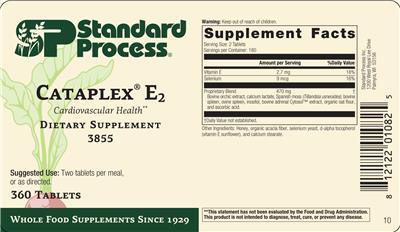
This summary is for Cataplex E2 by SP Standard Process
- Form
- Tablet or Pill
- Serving Size
- 2 Tablets
- Servings
- 180 per container
- Container Holds
- 360 Tablets
- What is Cataplex E2?A supplement from SP Standard Process with eleven active ingredients, in tablet form.
- Active Ingredients 2 vitamins, 2 minerals, 2 plant ingredients and 5 others: Vitamin E 2.7 mgSelenium 9 mcgBovine Orchic extractCalcium LactateSpanish MossBovine SpleenOvine SpleenInositolCytosol Bovine Adrenal ExtractOat FlourAscorbic Acid Eleven active ingredients. Each one can interact with drugs or cause side effects on its own, so we check every one. The full Supplement Facts
- Drug Interactions 1,148 drugs have a documented interaction with this supplement; the most serious is rated major. Of those, 751 are single drugs and 397 are combination products (two or more drugs in one), each listed under its own name. Based on the 7 of its 11 ingredients we could check. Ask your pharmacist first if you take a drug in any of these categories, the most serious of the 38 on record:
- Dolutegravir (Tivicay)Major · 3 drugs
- Elvitegravir (Vitekta)Major · 3 drugs
- Ceftriaxone (Rocephin)Major · 1 drug
- Moderate · 645 drugs
- Possible Side EffectsBloating 3 ingredientsGas 3 ingredientsNausea 3 ingredientsHeadache 2 ingredientsStomach upset 2 ingredientsGastric discomfort +11 moreCombined from six of its eleven active ingredients. Not studied in this exact product.
- Well documented Why
Does Cataplex E2 work?
What It Is Marketed For
Cardiovascular health
From the claims on the product’s label.
The Closest Use the Research Grades
Oats
Good studies support it.
Its ingredients have stronger research for other uses:
- Calcium
- Calcium
- Calcium
- Vitamin E
- Autoimmune thyroiditis Selenium
- Inositol
These grades are for each ingredient, not this exact product, and never a promise it will work for you.
And 6 more graded uses, in what the research says- AllergensNone of its ingredient names point to a major food allergen, and the label text we have carries no allergen statement
- Barcode (UPC)8 12122 01082 5Match it to the barcode on your bottle to be sure this is your product. Not your product? Search for it here
Who Might Consider It
- People looking for cardiovascular health, which is what it is marketed for. The closest use the research grades is coronary heart disease (CHD), rated Likely Effective.
- People who want it for dyspepsia, osteoporosis, premenstrual syndrome (PMS), dysmenorrhea or another graded use: the other uses with research behind them. See each grade
- This product may be worth considering if its vitamin, selenium, calcium, or oat ingredients match a purpose you're looking at, and if none of your medications appear on the interaction list.
Who Should Be Careful
- Be especially careful if you take HIV medicines, warfarin or other blood thinners, diabetes medicine or insulin, or levothyroxine, or if you have kidney disease, kidney stones, or hemochromatosis.
- Talk it over with your own doctor or pharmacist before starting, especially if you are pregnant or breastfeeding.
More Before You Take It Show both answersHide Pregnancy and Breastfeeding The Label’s Directions
-
Pregnant or breastfeeding?
- Pregnancy Vitamin E
- When used orally and appropriately.
- Breastfeeding Vitamin E
- ! When used orally in amounts that exceed the UL due to increased risk of adverse effects.
- Pregnancy Selenium
- ! When used orally in excessive doses.
- Breastfeeding Selenium
- ! When used orally in excessive doses.
- Pregnancy and Breastfeeding Calcium
- ! When used orally in excessive doses.
-
How does the label say to take it?
“Suggested Use: Two tablets per meal, or as directed.”
The maker’s words. Your pharmacist or doctor may advise differently.
Everything the label says
From the label dated Sep 25, 2025: 7 of its 11 active ingredients were checked against our records; the other four are not in them yet. A summary of what is known, not a grade or a test of the product. How these ratings are computed
Ask Anything About This Supplement
Name a drug you take, or ask about side effects, ingredients or pregnancy.
There’s a lot of information about this supplement on this page! Ask anything in plain English for a quick answer drawn from it.
AI answers come from this label and our own records, never the open internet. AI can make mistakes, so always check with your doctor or pharmacist. How we use AI
Ask the Pharmacist
A licensed pharmacist will answer your question by email — free, as soon as they can.
Got it — thank you!
A licensed pharmacist will answer as soon as they can. Keep an eye on your email (worth checking spam, just in case).
What’s Inside Cataplex E2 by SP Standard Process
Eleven Active Ingredients
In the order the label lists them, each with its own card below.
The label gives an exact amount for 2 of its 11 active ingredients. The other nine are inside one proprietary blend, “Proprietary Blend”, and the label gives one total for it, not how much of each ingredient is in it.
- 2 state an exact amount
- 9 have no amount of their own
- Proprietary Blend 470 mg in total · 9 ingredients, no amount for each
This rates what the label tells you, not the quality of the product.
Supplement Facts
| Amount Per Serving | % Daily Value | |
|---|---|---|
| Vitamin E | 2.7 mg | 18% |
| Selenium | 9 mcg | 16% |
| Proprietary Blend | 470 mg | † |
| Bovine Orchic extract | † | |
| Calcium Lactate | † | |
| Spanish Moss | † | |
| Bovine Spleen | † | |
| Ovine Spleen | † | |
| Inositol | † | |
| Cytosol Bovine Adrenal Extract | † | |
| Oat Flour | † | |
| Ascorbic Acid | † | |
Other ingredients: Honey, Acacia Fiber, Selenium Yeast, D-Alpha Tocopherol, Calcium Stearate
† Daily Value not established.
Daily Values for adults and children 4 or more years of age.
As the label prints it, from the NIH Dietary Supplement Label Database.
Each Ingredient and Its Drug Interactions
Tap one for more about it and its full guide. A drug can interact with this supplement through any one of them.
Cataplex E2 lists vitamin C (ascorbic acid), vitamin E, selenium, inositol, oat flour, calcium lactate, and bovine orchic extract as active ingredients, along with Spanish moss, bovine spleen, ovine spleen, bovine adrenal extract, and a proprietary blend whose contents aren't broken out.
- These are not counted among the active ingredients above.
-
Vitamin E 2.7 mg Vitamin C and vitamin E are described as having antioxidant effects, inositol is studied for conditions such as polycystic ovary syndrome, and oat flour provides fiber. Interacts with 766 drugs
Vitamin E is an essential fat-soluble vitamin and antioxidant that most people get in adequate amounts from a normal diet.
- Supplements can help correct a true deficiency, but high-dose vitamin E has not been clearly proven to prevent heart disease or cancer and may carry risks.
- Talk to your pharmacist or doctor before taking high doses.
The full Vitamin E guide: uses, dosage and safety Every Vitamin E drug interaction
-
Selenium 9 mcg Interacts with 321 drugs
Selenium is an essential trace mineral your body needs in small amounts for thyroid function, antioxidant defense, and immune health.
- Most people who eat a varied diet get enough, and supplements are mainly useful for those who are deficient.
- Because too much selenium can be toxic, stick to recommended amounts and check with your pharmacist or doctor before supplementing.
The full Selenium guide: uses, dosage and safety Every Selenium drug interaction
-
Proprietary Blend 470 mg Nine ingredients inside it, each checked on its own
- Bovine Orchic extract
- Calcium Lactate 168 drugs
- Spanish Moss
- Bovine Spleen
- Ovine Spleen
- Inositol 86 drugs
- Cytosol Bovine Adrenal Extract
- Oat Flour 86 drugs
- Ascorbic Acid 207 drugs
Other Ingredients (Inactive)
The capsule or tablet itself, fillers, coatings and flavors. Not part of the drug interaction check; the allergen check below reads them.
- Honey
- Acacia Fiber
- Selenium Yeast
- D-Alpha Tocopherol
- Calcium Stearate
Allergens in Cataplex E2
None of its ingredient names point to a major food allergen, and the label text we have carries no allergen statement.
Not named in the ingredients
- Milk
- Egg
- Fish
- Shellfish
- Tree nuts
- Peanuts
- Wheat or other gluten grains
- Soy
- Sesame
From the label text and ingredient names on file; we do not test products. With a serious allergy, check your bottle and ask the maker or your pharmacist.
What the Label Says
The maker’s own words, from the label. We do not verify or endorse them.
- Formulation
-
“Cardiovascular Health”
- FDA Statement of Identity
-
“Dietary Supplement”
- General statements
-
“Whole food supplements since 1929”
The Cataplex E2 Label on File
The label scan on file at the NIH Dietary Supplement Label Database, dated September 2025. Always read the label on the bottle you have.
Product Facts
- Brand
- SP Standard Process
- Barcode (UPC)
- 812122010825
- Net contents
- 360 Tablets
- Market status
- On market
- Date entered into DSLD
- Sep 25, 2025
- DSLD ID
- 340149
- Product type
- Other Combinations
- Supplement form
- Tablet or Pill
- Dietary claims / uses
- All Other, Structure/Function
- Intended target group(s)
- Adult (18 - 50 Years)
Is this label outdated? Report a formula or label change and our pharmacy team will review it.
HelloPharmacist Score Cataplex E2 by SP Standard Process
Up to 10 points for research, amount, label and outside testing. Not a safety rating. How this one adds up
for coronary heart disease (CHD)
It is marketed for cardiovascular health. There is no graded research on that exact use, so we scored the closest one: good research suggests oats, one of its ingredients, helps with coronary heart disease (CHD).
- Research3 of 5 points
- Amount0 of 2 points
- Label0 of 2 points
- Outside testing0 of 1 point
Major drug interactions. The score does not count drug interactions. Check them against any drugs you take. See them
How It Earns Its 3
Score: 3 out of 10. Supported for coronary heart disease (CHD).
Research
Good research on oats for coronary heart disease (CHD).
Graded “Likely Effective” in the Natural Medicines database, which we license. A related use, not the one it is marketed for, counts for at most 3 of 5 research points.
3 of 5 points
Amount
The label does not say how much oats is in it.
0 of 2 points
Label
It states the amount of two of its 11 active ingredients; nine are inside blends that give only a total.
0 of 2 points
Outside testing
We found no mark from an outside testing program, such as USP Verified or NSF Certified, on the label we have on file.
0 of 1 point
Cataplex E2 by SP Standard Process Side Effects
Why this rating?
We look for three kinds of safety information on each ingredient: side effects reported in studies, a pregnancy and breastfeeding rating, and a safety write-up from our pharmacy team. All three are on file for each of the seven ingredients we could check.
So this rates how much is known, not whether Cataplex E2 is right for you.
Reported with seven of its ingredients
- Most often
- Bloating, gas, nausea, headache, stomach upset and gastric discomfort
- !Rare but serious
- Bleeding, hemorrhagic stroke and cardiovascular complications See details
HelloPharmacist Team Summary: Cataplex E2 by SP Standard Process Side Effects
The ingredients in Cataplex E2 are generally well tolerated at normal amounts, and most people notice only mild digestive changes.
- The effects most likely to show up are gas and bloating, which tend to come from the oat fiber, and upset stomach.
- The rare but serious concerns are kidney stones with high-dose vitamin C and bleeding with high-dose vitamin E, so call your doctor right away if you notice unusual bleeding or severe pain.
- If you have kidney disease, diabetes, or a history of kidney stones, or you are pregnant or breastfeeding, talk with your own doctor or pharmacist before starting.
Side Effects, Ingredient by Ingredient
A supplement’s side effects come from its ingredients. Here is what is reported with each one.
Selenium
Most reported
- Gastric discomfort
- Headache
- Rash
From the Natural Medicines database, which we license.
Every reported effect, in the Selenium guideOrchic Extract
Most reported
- Digestive upset
- Nausea
- Allergic reactions
Calcium
Most reported
- Constipation
- Gas
- Bloating
Inositol
Most reported
- Nausea
- Gas
- Bloating
- Stomach upset
Oats
Most reported
- Gas
- Bloating
- Changes in bowel habits
Vitamin C
Most reported
- Upset stomach, nausea, or stomach cramps
- Diarrhea
- Heartburn
- Headache
Vitamin E has side-effect reports, but no list of the most common ones. Read them in the Vitamin E guide
Cataplex E2 Warnings: Who Should Be Careful
Cataplex E2 has eleven active ingredients, and each can carry warnings of its own. We checked the seven in our ingredient guides, and each warning below names the ingredient it comes from. Spanish Moss, Bovine Spleen and Ovine Spleen and one more are not in our guides yet, so ask your pharmacist about them. If any of these apply to you, talk to your doctor or pharmacist before you start it.
- Vitamin E2 warnings below
- Selenium1 warning below
- Orchic Extract2 warnings below
- Calcium3 warnings below
- Inositol2 warnings below
- Oats3 warnings below
- Vitamin C3 warnings below
- Spanish MossNot in our guides yet
- Bovine SpleenNot in our guides yet
- Ovine SpleenNot in our guides yet
- Cytosol Bovine Adrenal ExtractNot in our guides yet
-
Bleeding Problems or Surgery
- Vitamin EThe concern is mainly with high-dose supplements taken over a long time, which may increase the risk of bleeding and, in some studies, has been linked to other risks.
- High-dose vitamin C is linked to kidney stones, high-dose long-term vitamin E may raise bleeding risk, and excess selenium can be toxic.
-
Diabetes or Low Blood Sugar
- InositolBecause it can affect insulin and blood sugar signaling, people with diabetes or blood sugar problems should monitor closely and talk with their healthcare provider.
-
Kidney Disease or Kidney Stones
- CalciumTaking very high amounts over a long time can raise the risk of kidney stones in some people and may cause too much calcium in the blood.
- CalciumPeople with kidney disease, kidney stones, parathyroid problems, or high blood calcium should talk with a doctor before taking calcium supplements.
- Vitamin CVery high doses (often several grams a day) are more likely to cause side effects and may raise the risk of kidney stones in some people.
- Vitamin CPeople with kidney disease, a history of kidney stones, or a condition called hemochromatosis (iron overload) should be cautious and talk to a doctor before taking high doses.
-
Heart Conditions
- CalciumSome research has raised questions about whether high-dose calcium supplements could affect heart health, so it is wise to avoid taking more than you need and to favor calcium from food when possible.
-
Stomach or Bowel Problems
- OatsPeople with swallowing problems or a history of bowel narrowing should be careful with large amounts of bran.
-
Hormone-Sensitive Conditions
- Orchic ExtractPeople with hormone-sensitive conditions, prostate problems, or any chronic illness should be especially cautious and speak with a doctor first.
-
Children
- Orchic ExtractChildren and teenagers should not use it.
-
Other Cautions
- Vitamin EPeople with certain health conditions should check with a doctor first.
- InositolAs with any supplement, choose reputable brands, and let your pharmacist or doctor know what you are taking, especially if you have an existing health condition.
- OatsPeople with celiac disease or gluten sensitivity should choose products labeled certified gluten-free.
- OatsConcentrated oat straw supplements have not been well studied in these groups, so it is best to stick to food forms or check with your doctor or pharmacist before using supplements.
- Vitamin CPeople with a rare condition called G6PD deficiency should also use caution with very high doses.
-
What the Label Warns
- “Warning: Keep out of reach of children.”
The maker’s wording, from the product label.
-
Pregnant or Breastfeeding
Each ingredient’s rating for pregnancy and for breastfeeding, and what it covers.
Pregnancy
-
When used orally and appropriately.
The tolerable upper intake level (UL) during pregnancy is 800 mg for those 14-18 years of age and 1000 mg for those 19 years and older.
6 more points on this rating
- However, maternal supplementation is not generally recommended unless dietary vitamin E falls below the RDA.
- No serious adverse effects were reported with oral intake of 400 IU per day starting at weeks 9-22 of pregnancy in healthy patients or those at high risk for pre-eclampsia, or with 600-900 IU daily during the last two months of pregnancy.
- However, some preliminary evidence suggests that taking vitamin E supplements might be harmful when taken in early pregnancy.
- A case-control study found that taking a vitamin E supplement during the first 8 weeks of pregnancy is associated with a 1.7-9-fold increase in odds of congenital heart defects.
- However, the exact amount of vitamin E consumed during pregnancy in this study is unclear.
- Until more is known, advise patients to avoid taking a vitamin E supplement in early pregnancy unless needed for an appropriate medical indication.
Breastfeeding
-
When used orally in amounts that do not exceed the tolerable upper intake level (UL).
The UL during lactation is 800 mg for those 14-18 years of age and 1000 mg for those 19 years and older.
-
When used orally in amounts that exceed the UL due to increased risk of adverse effects.
Pregnancy
-
When used orally and appropriately.
Selenium appears to be safe when used short-term in amounts that do not exceed the tolerable upper intake level (UL) of 400 mcg daily; however, there is concern that long-term use might not be safe.
-
When used orally in excessive doses.
Doses above 400 mcg daily may cause significant toxicity.
Breastfeeding
-
When used orally and appropriately.
Selenium appears to be safe when used short-term in amounts that do not exceed the tolerable upper intake level (UL) of 400 mcg daily when taken short-term; however, there is concern that long-term use might not be safe.
-
When used orally in excessive doses.
Doses above 400 mcg daily may cause significant toxicity.
-
When used orally in HIV-positive women.
Selenium supplementation in HIV-positive women not taking highly active antiretroviral therapy may increase HIV-1 levels in breast milk.
Show 5 more ingredients
Pregnancy and Breastfeeding The record rates both the same
-
When used orally and appropriately.
The World Health Organization (WHO) recommends prescribing oral calcium supplementation 1.5-2 grams daily during pregnancy to those with low dietary calcium intake to prevent pre-eclampsia.
-
When used orally in excessive doses.
The Institute of Medicine sets the same daily tolerable upper intake level (UL) for calcium according to age independent of pregnancy status: 9-18 years, 3000 mg; 19-50 years, 2500 mg.
2 more points on this rating
- Doses over these amounts might increase the risk of neonatal hypocalcemia-induced seizures possibly caused by transient neonatal hypoparathyroidism in the setting of excessive calcium supplementation during pregnancy, especially during the third trimester.
- Neonatal hypocalcemia is a risk factor for neonatal seizures.
Pregnancy and Breastfeeding The record rates both the same
-
When used orally and appropriately.
-
When used orally in excessive doses.
Tell patients over age 19 not to use doses exceeding the UL of 2000 mg daily when pregnant or breast-feeding and for those 14-18 years of age not to use doses exceeding 1800 mg daily when pregnant or breast-feeding.
2 more points on this rating
- Higher doses can cause osmotic diarrhea and gastrointestinal upset.
- Large doses of vitamin C during pregnancy can also cause newborn scurvy; avoid using.
Pregnancy and Breastfeeding The record rates both the same
-
Insufficient reliable information available; avoid using.
Pregnancy
-
When used orally and appropriately, short-term.
Myo-inositol has been used with apparent safety in amounts up to 4000 mg daily during pregnancy.
Breastfeeding
-
Insufficient reliable information available; avoid using.
Breast milk is rich in endogenous inositol; however, the effects of exogenously administered inositol are not known.
Pregnancy and Breastfeeding The record rates both the same
-
When used orally in food amounts.
Our pharmacy team’s notes
- Pregnancy and breastfeeding ratings differ by ingredient.
- Oat flour is rated Likely Safe in pregnancy and breastfeeding, and vitamin E and inositol are rated Possibly Safe in pregnancy.
Ratings and the words beside them are from the Natural Medicines database, which we license.
-
Rare but Serious Side Effects
-
!
Vitamin E
The most serious concern with high doses is an increased risk of bleeding, including, in rare cases, bleeding in the brain (hemorrhagic stroke).
Orally: Bleeding, hemorrhagic stroke, cardiovascular complications.
-
!
Selenium
In severe cases of overdose, more serious effects on the nervous system, kidneys, and heart can occur.
Orally: Excessive ingestion has led to cases of multi-organ failure and death.
-
!
Orchic Extract
Reported or possible effects with glandular supplements include digestive upset, nausea, and allergic reactions, especially in people sensitive to animal proteins.
-
!
Calcium
Taking too much calcium can lead to more serious problems such as kidney stones or high blood calcium (hypercalcemia), which can cause nausea, confusion, excessive thirst, frequent urination, and an irregular heartbeat.
Orally: Case reports have raised concerns about calciphylaxis and kidney stones.
-
!
Oats
Topical oatmeal products are generally gentle, but as with any skin product, a small number of people may have irritation or an allergic reaction.
-
!
Vitamin C
Rare but more serious concerns with very high or long-term high doses include kidney stones and, in people with iron-overload conditions, too much iron buildup.
Orally: There have been rare case reports of carotid inner wall thickening after large doses of vitamin C.
When to get help: a serious allergic reaction, with trouble breathing or swelling of the face, lips or throat, needs emergency care: call 911. For any other side effect that worries you, call your doctor or pharmacist.
These reports describe each ingredient, not studies of this exact product. Not medical advice: a side effect you notice after starting a supplement is worth a word with your pharmacist or doctor.
Cataplex E2 by SP Standard Process Drug Interactions
We checked all eleven active ingredients in this supplement against every drug in our records. A drug can interact with it through any one of them. Four of them are not in our interaction records yet.
A major interaction on record
3 of 3, on a scale from Minor or none to Major.Why this rating?
We rate this by the most serious interaction on record, not by how many there are. For Inositol, Calcium, Oats, Vitamin E and Vitamin C, the most serious is rated major, which means the combination is best avoided, or used only under close supervision. Some involve kinds of drugs where a small change can matter, such as blood thinners, transplant drugs and cancer treatments.
1,149 drugs are on the full list. What matters is whether one you take is on it, so check yours with the interaction checker on this page.
From the HelloPharmacist Team
A few things worth knowing about the supplement as a whole.
- Cataplex E2 from SP Standard Process does interact with several medications, through its vitamin C, vitamin E, selenium, inositol, oat flour, and calcium lactate content.
- Other interactions are Moderate-rated.
- Blood thinners (anticoagulants and antiplatelet drugs) and warfarin can see bleeding risk raised by vitamin E and selenium, and warfarin's effect may shift with high-dose vitamin C.
Six of its eleven active ingredients have drug interactions on record: Vitamin E, Selenium, Calcium, Inositol, Oats and Vitamin C.
- Interacts with
- 168 drugs
- Most serious
- Major
- The most serious finding is Major-rated and comes from calcium lactate: calcium can lower blood levels of the HIV medicines dolutegravir and elvitegravir, and intravenous calcium can form a precipitate with the antibiotic ceftriaxone.
- Calcium can also reduce how well levothyroxine, sotalol, diltiazem, and raltegravir work.
- Interacts with
- 766 drugs
- Most serious
- Moderate
- Most of its records involve Cytochrome P450 3A4 (CYP3A4) Substrates, Anticoagulant/Antiplatelet Drugs and Alkylating Agents.
- Interacts with
- 321 drugs
- Most serious
- Moderate
- Most of its records involve Anticoagulant/Antiplatelet Drugs, Immunosuppressants and Barbiturates.
Show three more ingredients
- Interacts with
- 207 drugs
- Most serious
- Moderate
- Most of its records involve Acetaminophen (Tylenol, others), Estrogens and Aspirin.
- Interacts with
- 86 drugs
- Most serious
- Moderate
- Most of its records involve Antidiabetes Drugs.
- Interacts with
- 86 drugs
- Most serious
- Moderate
- Most of its records involve Antidiabetes Drugs and Insulin.
Summarized by the HelloPharmacist pharmacy team from the interaction records below. How it is written How we use AI
Why Cataplex E2 Interacts, Ingredient by Ingredient
A product interacts through its ingredients. Each card: how many drugs, the most serious rating, and the kinds of drugs it affects most (tap a kind for what it means).
The ingredients driving the most interactions
-
Vitamin E 766 drugs
Most serious: Moderate8 interaction records on file
The kinds of drugs it affects most
- 645 drugs
- 122 drugs
- 24 drugs
- Antitumor Antibiotics 15 drugs
Every Vitamin E drug interaction, 8 records The Vitamin E records cite 64 references, listed in the Vitamin E guide.
-
Selenium 321 drugs
Most serious: Moderate6 interaction records on file
The kinds of drugs it affects most
- 122 drugs
- 121 drugs
- 49 drugs
- 30 drugs
Every Selenium drug interaction, 6 records The Selenium records cite 36 references, listed in the Selenium guide.
-
Ascorbic Acid 207 drugs
Most serious: Moderate13 interaction records on file
The kinds of drugs it affects most
- 69 drugs
- 41 drugs
- 35 drugs
- 24 drugs
Every Vitamin C drug interaction, 13 records The Vitamin C records cite 51 references, listed in the Vitamin C guide.
-
Calcium Lactate 168 drugs
Most serious: Major18 interaction records on file
The kinds of drugs it affects most
- 56 drugs
- 22 drugs
- 21 drugs
- 20 drugs
Every Calcium drug interaction, 18 records The Calcium records cite 62 references, listed in the Calcium guide.
-
Inositol 86 drugs
Most serious: Moderate1 interaction record on file
The kinds of drugs it affects most
- 86 drugs
Every Inositol drug interaction, 1 record The Inositol records cite 14 references, listed in the Inositol guide.
-
Oat Flour 86 drugs
Most serious: Moderate2 interaction records on file
The kinds of drugs it affects most
- 86 drugs
- 13 drugs
Every Oats drug interaction, 2 records The Oats records cite 13 references, listed in the Oats guide.
The Breakdown by Severity
Each drug counted once, at its most serious rating. Tap a tile to list those drugs.
Find Your Drug
Type a drug or brand name to see whether it is on the list.
- Only drugs with a documented interaction are listed, the most serious first.
- A drug with no known interaction is not listed, but searching its name tells you so.
- Open a drug to see which ingredient is responsible. Of those, 751 are single drugs and 397 are combination products (two or more drugs in one), each listed under its own name.
-
Antidiabetes and Dipeptidyl Peptidase-4 (dpp-iv) InhibitorGlyxambi Moderate
The 2 ingredients responsible:
-
Oat Flour Moderate Antidiabetes and Dipeptidyl Peptidase-4 (dpp-iv) Inhibitor is in the Antidiabetes Drugs category.
Theoretically, oats may have additive effects with antidiabetic agents and might increase the risk of hypoglycemia.
The full Oat Flour + Antidiabetes and Dipeptidyl Peptidase-4 (dpp-iv) Inhibitor interaction -
Inositol Moderate Antidiabetes and Dipeptidyl Peptidase-4 (dpp-iv) Inhibitor is in the Antidiabetes Drugs category.
Theoretically, taking inositol with antidiabetes drugs might increase the risk of hypoglycemia.
The full Inositol + Antidiabetes and Dipeptidyl Peptidase-4 (dpp-iv) Inhibitor interaction
-
-
Letrozole and Ribociclib SuccinateKisqali Femara Co-Pack Moderate
The ingredient responsible:
-
Vitamin E Moderate Letrozole and Ribociclib Succinate is in the Cytochrome P450 3A4 (CYP3A4) Substrates category.
Theoretically, vitamin E might induce metabolism of CYP3A4, possibly reducing the levels CYP3A4 substrates.
The full Vitamin E + Letrozole and Ribociclib Succinate interaction
-
-
Acetaminophen, Chlorpheniramine, Guaifenesin, Phenylephrine, and SalicylamideRhinogesic GG Moderate
The 2 ingredients responsible:
-
Vitamin E Moderate Acetaminophen, Chlorpheniramine, Guaifenesin, Phenylephrine, and Salicylamide is in the Cytochrome P450 3A4 (CYP3A4) Substrates category.
Theoretically, vitamin E might induce metabolism of CYP3A4, possibly reducing the levels CYP3A4 substrates.
The full Vitamin E + Acetaminophen, Chlorpheniramine, Guaifenesin, Phenylephrine, and Salicylamide interaction -
Ascorbic Acid Minor It contains acetaminophen, the drug this record is about.
High-dose vitamin C might slightly prolong the clearance of acetaminophen.
The full Ascorbic Acid + Acetaminophen, Chlorpheniramine, Guaifenesin, Phenylephrine, and Salicylamide interaction
-
-
Naproxen and SumatriptanTreximet Moderate
The 2 ingredients responsible:
-
Selenium Moderate Naproxen and Sumatriptan is in the Anticoagulant/Antiplatelet Drugs category.
Selenium may have antiplatelet effects and may increase the risk of bleeding if used with anticoagulant or antiplatelet drugs.
The full Selenium + Naproxen and Sumatriptan interaction -
Vitamin E Moderate Naproxen and Sumatriptan is in the Anticoagulant/Antiplatelet Drugs category.
Concomitant use of vitamin E and anticoagulant or antiplatelet agents might increase the risk of bleeding.
The full Vitamin E + Naproxen and Sumatriptan interaction
-
-
Aspirin, Carisoprodol, and Codeine PhosphateSoma Compound w/ Codeine Moderate
The 3 ingredients responsible:
-
Vitamin E Moderate Aspirin, Carisoprodol, and Codeine Phosphate is in the Anticoagulant/Antiplatelet Drugs category.
Concomitant use of vitamin E and anticoagulant or antiplatelet agents might increase the risk of bleeding.
The full Vitamin E + Aspirin, Carisoprodol, and Codeine Phosphate interaction -
Selenium Moderate Aspirin, Carisoprodol, and Codeine Phosphate is in the Anticoagulant/Antiplatelet Drugs category.
Selenium may have antiplatelet effects and may increase the risk of bleeding if used with anticoagulant or antiplatelet drugs.
The full Selenium + Aspirin, Carisoprodol, and Codeine Phosphate interaction -
Ascorbic Acid Minor It contains aspirin, the drug this record is about.
Acidification of the urine by vitamin C might increase aspirin levels.
The full Ascorbic Acid + Aspirin, Carisoprodol, and Codeine Phosphate interaction
-
-
Alogliptin and MetforminKazano Moderate
The 2 ingredients responsible:
-
Oat Flour Moderate Alogliptin and Metformin is in the Antidiabetes Drugs category.
Theoretically, oats may have additive effects with antidiabetic agents and might increase the risk of hypoglycemia.
The full Oat Flour + Alogliptin and Metformin interaction -
Inositol Moderate Alogliptin and Metformin is in the Antidiabetes Drugs category.
Theoretically, taking inositol with antidiabetes drugs might increase the risk of hypoglycemia.
The full Inositol + Alogliptin and Metformin interaction
-
-
Glyburide and MetforminGlucovance Moderate
The 2 ingredients responsible:
-
Oat Flour Moderate Glyburide and Metformin is in the Antidiabetes Drugs category.
Theoretically, oats may have additive effects with antidiabetic agents and might increase the risk of hypoglycemia.
The full Oat Flour + Glyburide and Metformin interaction -
Inositol Moderate Glyburide and Metformin is in the Antidiabetes Drugs category.
Theoretically, taking inositol with antidiabetes drugs might increase the risk of hypoglycemia.
The full Inositol + Glyburide and Metformin interaction
-
-
Acetaminophen, Chlorpheniramine, Phenylpropanolamine, and PhenyltoloxamineNorel Plus Moderate
The 2 ingredients responsible:
-
Vitamin E Moderate Acetaminophen, Chlorpheniramine, Phenylpropanolamine, and Phenyltoloxamine is in the Cytochrome P450 3A4 (CYP3A4) Substrates category.
Theoretically, vitamin E might induce metabolism of CYP3A4, possibly reducing the levels CYP3A4 substrates.
The full Vitamin E + Acetaminophen, Chlorpheniramine, Phenylpropanolamine, and Phenyltoloxamine interaction -
Ascorbic Acid Minor It contains acetaminophen, the drug this record is about.
High-dose vitamin C might slightly prolong the clearance of acetaminophen.
The full Ascorbic Acid + Acetaminophen, Chlorpheniramine, Phenylpropanolamine, and Phenyltoloxamine interaction
-
-
Aspirin, Caffeine, and OrphenadrineInvagesic, Invagesic Forte, Norgesic, Norgesic Forte, Orphengesic and 1 more Moderate
The 3 ingredients responsible:
-
Selenium Moderate Aspirin, Caffeine, and Orphenadrine is in the Anticoagulant/Antiplatelet Drugs category.
Selenium may have antiplatelet effects and may increase the risk of bleeding if used with anticoagulant or antiplatelet drugs.
The full Selenium + Aspirin, Caffeine, and Orphenadrine interaction -
Vitamin E Moderate Aspirin, Caffeine, and Orphenadrine is in these Cytochrome P450 3A4 (CYP3A4) Substrates, Anticoagulant/Antiplatelet Drugs categories.
Theoretically, vitamin E might induce metabolism of CYP3A4, possibly reducing the levels CYP3A4 substrates.
The full Vitamin E + Aspirin, Caffeine, and Orphenadrine interaction -
Ascorbic Acid Minor It contains aspirin, the drug this record is about.
Acidification of the urine by vitamin C might increase aspirin levels.
The full Ascorbic Acid + Aspirin, Caffeine, and Orphenadrine interaction
-
-
Naproxen and PseudoephedrineAleve Cold and Sinus Moderate
The 2 ingredients responsible:
-
Vitamin E Moderate Naproxen and Pseudoephedrine is in the Anticoagulant/Antiplatelet Drugs category.
Concomitant use of vitamin E and anticoagulant or antiplatelet agents might increase the risk of bleeding.
The full Vitamin E + Naproxen and Pseudoephedrine interaction -
Selenium Moderate Naproxen and Pseudoephedrine is in the Anticoagulant/Antiplatelet Drugs category.
Selenium may have antiplatelet effects and may increase the risk of bleeding if used with anticoagulant or antiplatelet drugs.
The full Selenium + Naproxen and Pseudoephedrine interaction
-
-
Ethinyl Estradiol and LevonorgestrelAlesse, Alesse 21, Alesse 28, Aviane, Enpresse and 19 more Moderate
The 3 ingredients responsible:
-
Ascorbic Acid Moderate Ethinyl Estradiol and Levonorgestrel is in the Estrogens category.
Vitamin C might increase blood levels of estrogens.
The full Ascorbic Acid + Ethinyl Estradiol and Levonorgestrel interaction -
Vitamin E Moderate Ethinyl Estradiol and Levonorgestrel is in the Cytochrome P450 3A4 (CYP3A4) Substrates category.
Theoretically, vitamin E might induce metabolism of CYP3A4, possibly reducing the levels CYP3A4 substrates.
The full Vitamin E + Ethinyl Estradiol and Levonorgestrel interaction -
Selenium Minor Ethinyl Estradiol and Levonorgestrel is in the Contraceptive Drugs category.
Contraceptive drugs might increase levels of selenium, although the clinical significance of this effect is unclear.
The full Selenium + Ethinyl Estradiol and Levonorgestrel interaction
-
-
Norethindrone Acetate, Ethinyl Estradiol, and Ferrous FumarateLoMinastrin FE, Minastrin 24 FE Moderate
The 3 ingredients responsible:
-
Ascorbic Acid Moderate Norethindrone Acetate, Ethinyl Estradiol, and Ferrous Fumarate is in the Estrogens category.
Vitamin C might increase blood levels of estrogens.
The full Ascorbic Acid + Norethindrone Acetate, Ethinyl Estradiol, and Ferrous Fumarate interaction -
Vitamin E Moderate Norethindrone Acetate, Ethinyl Estradiol, and Ferrous Fumarate is in the Cytochrome P450 3A4 (CYP3A4) Substrates category.
Theoretically, vitamin E might induce metabolism of CYP3A4, possibly reducing the levels CYP3A4 substrates.
The full Vitamin E + Norethindrone Acetate, Ethinyl Estradiol, and Ferrous Fumarate interaction -
Selenium Minor Norethindrone Acetate, Ethinyl Estradiol, and Ferrous Fumarate is in the Contraceptive Drugs category.
Contraceptive drugs might increase levels of selenium, although the clinical significance of this effect is unclear.
The full Selenium + Norethindrone Acetate, Ethinyl Estradiol, and Ferrous Fumarate interaction
-
-
Aspirin, Codeine Phosphate, and MethocarbamolRobaxisal C Moderate
The 3 ingredients responsible:
-
Vitamin E Moderate Aspirin, Codeine Phosphate, and Methocarbamol is in the Anticoagulant/Antiplatelet Drugs category.
Concomitant use of vitamin E and anticoagulant or antiplatelet agents might increase the risk of bleeding.
The full Vitamin E + Aspirin, Codeine Phosphate, and Methocarbamol interaction -
Selenium Moderate Aspirin, Codeine Phosphate, and Methocarbamol is in the Anticoagulant/Antiplatelet Drugs category.
Selenium may have antiplatelet effects and may increase the risk of bleeding if used with anticoagulant or antiplatelet drugs.
The full Selenium + Aspirin, Codeine Phosphate, and Methocarbamol interaction -
Ascorbic Acid Minor It contains aspirin, the drug this record is about.
Acidification of the urine by vitamin C might increase aspirin levels.
The full Ascorbic Acid + Aspirin, Codeine Phosphate, and Methocarbamol interaction
-
-
Metformin and RosiglitazoneAvandamet Moderate
The 2 ingredients responsible:
-
Oat Flour Moderate Metformin and Rosiglitazone is in the Antidiabetes Drugs category.
Theoretically, oats may have additive effects with antidiabetic agents and might increase the risk of hypoglycemia.
The full Oat Flour + Metformin and Rosiglitazone interaction -
Inositol Moderate Metformin and Rosiglitazone is in the Antidiabetes Drugs category.
Theoretically, taking inositol with antidiabetes drugs might increase the risk of hypoglycemia.
The full Inositol + Metformin and Rosiglitazone interaction
-
-
Acetaminophen, Chlorpheniramine, and PseudoephedrineAlka-Seltzer PLUS Liquid Gels, Children's Tylenol Cold, Codimal, Comtrex, Extra Strength Tylenol Allergy Sinus and 4 more Moderate
The 2 ingredients responsible:
-
Vitamin E Moderate Acetaminophen, Chlorpheniramine, and Pseudoephedrine is in the Cytochrome P450 3A4 (CYP3A4) Substrates category.
Theoretically, vitamin E might induce metabolism of CYP3A4, possibly reducing the levels CYP3A4 substrates.
The full Vitamin E + Acetaminophen, Chlorpheniramine, and Pseudoephedrine interaction -
Ascorbic Acid Minor It contains acetaminophen, the drug this record is about.
High-dose vitamin C might slightly prolong the clearance of acetaminophen.
The full Ascorbic Acid + Acetaminophen, Chlorpheniramine, and Pseudoephedrine interaction
-
-
Ethinyl Estradiol and DrospirenoneYaz Moderate
The 3 ingredients responsible:
-
Ascorbic Acid Moderate Ethinyl Estradiol and Drospirenone is in the Estrogens category.
Vitamin C might increase blood levels of estrogens.
The full Ascorbic Acid + Ethinyl Estradiol and Drospirenone interaction -
Vitamin E Moderate Ethinyl Estradiol and Drospirenone is in the Cytochrome P450 3A4 (CYP3A4) Substrates category.
Theoretically, vitamin E might induce metabolism of CYP3A4, possibly reducing the levels CYP3A4 substrates.
The full Vitamin E + Ethinyl Estradiol and Drospirenone interaction -
Selenium Minor Ethinyl Estradiol and Drospirenone is in the Contraceptive Drugs category.
Contraceptive drugs might increase levels of selenium, although the clinical significance of this effect is unclear.
The full Selenium + Ethinyl Estradiol and Drospirenone interaction
-
-
Hydrochlorothiazide and MetoprololLopressor HCT Moderate
The ingredient responsible:
-
Calcium Lactate Moderate Hydrochlorothiazide and Metoprolol is in the Thiazide Diuretics category.
Taking calcium along with thiazides might increase the risk of hypercalcemia and renal failure.
The full Calcium Lactate + Hydrochlorothiazide and Metoprolol interaction
-
-
Acetaminophen, Phenylephrine, and ChlorpheniramineSuper Cold Tabs Moderate
The 2 ingredients responsible:
-
Vitamin E Moderate Acetaminophen, Phenylephrine, and Chlorpheniramine is in the Cytochrome P450 3A4 (CYP3A4) Substrates category.
Theoretically, vitamin E might induce metabolism of CYP3A4, possibly reducing the levels CYP3A4 substrates.
The full Vitamin E + Acetaminophen, Phenylephrine, and Chlorpheniramine interaction -
Ascorbic Acid Minor It contains acetaminophen, the drug this record is about.
High-dose vitamin C might slightly prolong the clearance of acetaminophen.
The full Ascorbic Acid + Acetaminophen, Phenylephrine, and Chlorpheniramine interaction
-
-
Amitriptyline and PerphenazineEtrafon, Etrafon-A, Etrafon-Forte, Triavil Moderate
The ingredient responsible:
-
Vitamin E Moderate Amitriptyline and Perphenazine is in the Cytochrome P450 3A4 (CYP3A4) Substrates category.
Theoretically, vitamin E might induce metabolism of CYP3A4, possibly reducing the levels CYP3A4 substrates.
The full Vitamin E + Amitriptyline and Perphenazine interaction
-
-
Acetaminophen, Chlorpheniramine, Phenylpropanolamine, and OpiumHista-Derfule Moderate
The 2 ingredients responsible:
-
Vitamin E Moderate Acetaminophen, Chlorpheniramine, Phenylpropanolamine, and Opium is in the Cytochrome P450 3A4 (CYP3A4) Substrates category.
Theoretically, vitamin E might induce metabolism of CYP3A4, possibly reducing the levels CYP3A4 substrates.
The full Vitamin E + Acetaminophen, Chlorpheniramine, Phenylpropanolamine, and Opium interaction -
Ascorbic Acid Minor It contains acetaminophen, the drug this record is about.
High-dose vitamin C might slightly prolong the clearance of acetaminophen.
The full Ascorbic Acid + Acetaminophen, Chlorpheniramine, Phenylpropanolamine, and Opium interaction
-
-
Ibuprofen and OxycodoneCombunox Moderate
The 2 ingredients responsible:
-
Vitamin E Moderate Ibuprofen and Oxycodone is in these Cytochrome P450 3A4 (CYP3A4) Substrates, Anticoagulant/Antiplatelet Drugs categories.
Theoretically, vitamin E might induce metabolism of CYP3A4, possibly reducing the levels CYP3A4 substrates.
The full Vitamin E + Ibuprofen and Oxycodone interaction -
Selenium Moderate Ibuprofen and Oxycodone is in the Anticoagulant/Antiplatelet Drugs category.
Selenium may have antiplatelet effects and may increase the risk of bleeding if used with anticoagulant or antiplatelet drugs.
The full Selenium + Ibuprofen and Oxycodone interaction
-
-
Aspirin and DipyridamoleAggrenox, Asasantin Retard Moderate
The 3 ingredients responsible:
-
Selenium Moderate Aspirin and Dipyridamole is in the Anticoagulant/Antiplatelet Drugs category.
Selenium may have antiplatelet effects and may increase the risk of bleeding if used with anticoagulant or antiplatelet drugs.
The full Selenium + Aspirin and Dipyridamole interaction -
Vitamin E Moderate Aspirin and Dipyridamole is in the Anticoagulant/Antiplatelet Drugs category.
Concomitant use of vitamin E and anticoagulant or antiplatelet agents might increase the risk of bleeding.
The full Vitamin E + Aspirin and Dipyridamole interaction -
Ascorbic Acid Minor
Acidification of the urine by vitamin C might increase aspirin levels.
The full Ascorbic Acid + Aspirin and Dipyridamole interaction
-
-
Ibuprofen and PseudoephedrineDristan Moderate
The 2 ingredients responsible:
-
Vitamin E Moderate Ibuprofen and Pseudoephedrine is in the Anticoagulant/Antiplatelet Drugs category.
Concomitant use of vitamin E and anticoagulant or antiplatelet agents might increase the risk of bleeding.
The full Vitamin E + Ibuprofen and Pseudoephedrine interaction -
Selenium Moderate Ibuprofen and Pseudoephedrine is in the Anticoagulant/Antiplatelet Drugs category.
Selenium may have antiplatelet effects and may increase the risk of bleeding if used with anticoagulant or antiplatelet drugs.
The full Selenium + Ibuprofen and Pseudoephedrine interaction
-
-
Bisoprolol and HydrochlorothiazideZiac Moderate
The ingredient responsible:
-
Calcium Lactate Moderate Bisoprolol and Hydrochlorothiazide is in the Thiazide Diuretics category.
Taking calcium along with thiazides might increase the risk of hypercalcemia and renal failure.
The full Calcium Lactate + Bisoprolol and Hydrochlorothiazide interaction
-
-
Emtricitabine, Rilpivirine, and Tenofovir AlafenamideOdefsey Moderate
The 2 ingredients responsible:
-
Vitamin E Moderate Emtricitabine, Rilpivirine, and Tenofovir Alafenamide is in the Cytochrome P450 3A4 (CYP3A4) Substrates category.
Theoretically, vitamin E might induce metabolism of CYP3A4, possibly reducing the levels CYP3A4 substrates.
The full Vitamin E + Emtricitabine, Rilpivirine, and Tenofovir Alafenamide interaction -
Calcium Lactate Moderate
Calcium might decrease levels of bictegravir/emtricitabine/tenofovir alafenamide by reducing its absorption when taken in a fasting state.
The full Calcium Lactate + Emtricitabine, Rilpivirine, and Tenofovir Alafenamide interaction
-
-
Acetaminophen, Caffeine, and PyrilamineMidol Max Strength Menstrual Moderate
The 2 ingredients responsible:
-
Vitamin E Moderate Acetaminophen, Caffeine, and Pyrilamine is in the Cytochrome P450 3A4 (CYP3A4) Substrates category.
Theoretically, vitamin E might induce metabolism of CYP3A4, possibly reducing the levels CYP3A4 substrates.
The full Vitamin E + Acetaminophen, Caffeine, and Pyrilamine interaction -
Ascorbic Acid Minor It contains acetaminophen, the drug this record is about.
High-dose vitamin C might slightly prolong the clearance of acetaminophen.
The full Ascorbic Acid + Acetaminophen, Caffeine, and Pyrilamine interaction
-
-
Acetaminophen, Dextromethorphan, Phenylpropanolamine, and PyrilamineTheracaps Moderate
The 2 ingredients responsible:
-
Vitamin E Moderate Acetaminophen, Dextromethorphan, Phenylpropanolamine, and Pyrilamine is in the Cytochrome P450 3A4 (CYP3A4) Substrates category.
Theoretically, vitamin E might induce metabolism of CYP3A4, possibly reducing the levels CYP3A4 substrates.
The full Vitamin E + Acetaminophen, Dextromethorphan, Phenylpropanolamine, and Pyrilamine interaction -
Ascorbic Acid Minor It contains acetaminophen, the drug this record is about.
High-dose vitamin C might slightly prolong the clearance of acetaminophen.
The full Ascorbic Acid + Acetaminophen, Dextromethorphan, Phenylpropanolamine, and Pyrilamine interaction
-
-
Aspirin, Ethoheptazine, and MeprobamateEquagesic Moderate
The 3 ingredients responsible:
-
Vitamin E Moderate Aspirin, Ethoheptazine, and Meprobamate is in the Anticoagulant/Antiplatelet Drugs category.
Concomitant use of vitamin E and anticoagulant or antiplatelet agents might increase the risk of bleeding.
The full Vitamin E + Aspirin, Ethoheptazine, and Meprobamate interaction -
Selenium Moderate Aspirin, Ethoheptazine, and Meprobamate is in the Anticoagulant/Antiplatelet Drugs category.
Selenium may have antiplatelet effects and may increase the risk of bleeding if used with anticoagulant or antiplatelet drugs.
The full Selenium + Aspirin, Ethoheptazine, and Meprobamate interaction -
Ascorbic Acid Minor It contains aspirin, the drug this record is about.
Acidification of the urine by vitamin C might increase aspirin levels.
The full Ascorbic Acid + Aspirin, Ethoheptazine, and Meprobamate interaction
-
-
Belladonna, Caffeine, Ergotamine, and PentobarbitalMicomp PB Moderate
The 2 ingredients responsible:
-
Selenium Moderate Belladonna, Caffeine, Ergotamine, and Pentobarbital is in the Barbiturates category.
Theoretically, selenium might prolong the sedating effects of barbiturates.
The full Selenium + Belladonna, Caffeine, Ergotamine, and Pentobarbital interaction -
Vitamin E Moderate Belladonna, Caffeine, Ergotamine, and Pentobarbital is in the Cytochrome P450 3A4 (CYP3A4) Substrates category.
Theoretically, vitamin E might induce metabolism of CYP3A4, possibly reducing the levels CYP3A4 substrates.
The full Vitamin E + Belladonna, Caffeine, Ergotamine, and Pentobarbital interaction
-
-
Glipizide and MetforminMetaglip Moderate
The 2 ingredients responsible:
-
Oat Flour Moderate Glipizide and Metformin is in the Antidiabetes Drugs category.
Theoretically, oats may have additive effects with antidiabetic agents and might increase the risk of hypoglycemia.
The full Oat Flour + Glipizide and Metformin interaction -
Inositol Moderate Glipizide and Metformin is in the Antidiabetes Drugs category.
Theoretically, taking inositol with antidiabetes drugs might increase the risk of hypoglycemia.
The full Inositol + Glipizide and Metformin interaction
-
Does It Work? Cataplex E2 by SP Standard Process
What the research says for what it is marketed for, then its ingredients’ other uses and each ingredient on its own. A grade is the research so far, never an endorsement.
What the Research Supports
First for what it is marketed for, then the other uses its ingredients are graded for, strongest research first.
Marketed for cardiovascular health
- Dyslipidemia Oats
- Oats
- Vitamin C
- Vitamin C
Other uses its ingredients are graded for
- Calcium
- Calcium
- Calcium
- Corticosteroid-induced osteoporosis Calcium
- Vitamin E
- Exercise-induced muscle damage Vitamin E
- Autoimmune thyroiditis Selenium
- Tooth retention Calcium
- Fetal bone mineralization Calcium
- Inositol
- Inositol
- Oats
- Vitamin C
- Exercise-induced respiratory infections Vitamin C
HelloPharmacist Team Summary: Does Cataplex E2 by SP Standard Process Work?
Ratings vary by ingredient.
- Selenium is rated likely effective for selenium deficiency, and oat flour is rated likely effective for dyslipidemia and coronary heart disease (CHD).
- Inositol is rated possibly effective for polycystic ovary syndrome (PCOS) and metabolic syndrome, but possibly ineffective for anxiety, diabetic neuropathy, and depression.
- Selenium is rated possibly ineffective for dyslipidemia.
- We have no effectiveness ratings for orchic extract, the spleen and adrenal extracts, or Spanish moss.
The Evidence, Ingredient by Ingredient
The detail behind the list above: our notes on each ingredient and its graded uses.
Vitamin E
From our Vitamin E guide
- Vitamin E is best known as an antioxidant, and many people take it for general health.
- However, the science behind most supplement uses is mixed or weak.
Research suggests a benefit for
- Ataxia with vitamin E deficiency (AVED) and vitamin E deficiency
- Dysmenorrhea, premenstrual syndrome (PMS) and exercise-induced muscle damage
Not counted here: seven graded uses are for conditions treated by a doctor or in a hospital (Alzheimer disease, beta-thalassemia, glucose-6-phosphate dehydrogenase (G6PD) deficiency and others).
Every graded use, in the Vitamin E guideSelenium
From our Selenium guide
- Selenium is best known and best supported as a treatment for true selenium deficiency.
- When someone is genuinely low in selenium, supplementing clearly helps restore healthy levels.
Research suggests a benefit for
- Selenium deficiency
- Autoimmune thyroiditis
Not counted here: two graded uses are for conditions treated by a doctor or in a hospital (pre-eclampsia and kashin-Beck disease).
Every graded use, in the Selenium guideOrchic Extract
From our Orchic Extract guide
- People most commonly take orchic extract hoping to raise testosterone, boost libido and sexual performance, or improve energy and muscle gains.
- These uses come from tradition and marketing, not from solid science.
No use is graded effective, likely effective or possibly effective for it yet.
Every graded use, in the Orchic Extract guideCalcium
From our Calcium guide
- Calcium is most strongly supported for preventing and treating calcium deficiency and for supporting bone health.
- Getting enough calcium, often along with vitamin D, is widely recommended to help maintain bone strength and lower the risk of bone thinning (osteoporosis), especially in older adults and postmenopausal women.
Research suggests a benefit for
- Dyspepsia
- Osteoporosis, premenstrual syndrome (PMS) and corticosteroid-induced osteoporosis
- Rickets, osteomalacia, tooth retention and fetal bone mineralization
Not counted here: one graded use is for Calcium injected or put on the skin (hyperkalemia), not for a product like this one. Six more are for conditions treated by a doctor or in a hospital (colorectal cancer, hyperparathyroidism, pregnancy-induced hypertension and others).
Every graded use, in the Calcium guideInositol
From our Inositol guide
- PCOS: This is the use with the most supporting research.
- Several studies suggest myo-inositol may help improve some markers tied to PCOS, such as insulin sensitivity, hormone balance, and menstrual regularity.
Research suggests a benefit for
- Metabolic syndrome and polycystic ovary syndrome (PCOS)
Not counted here: one graded use is for a condition treated by a doctor or in a hospital (preterm labor).
Every graded use, in the Inositol guideOats
From our Oats guide
- The strongest evidence for oats is for lowering cholesterol.
- The soluble fiber in oats, called beta-glucan, has been shown in many studies to modestly lower LDL ("bad") cholesterol when eaten regularly.
Research suggests a benefit for
- Coronary heart disease (CHD) (the use on its label) and dyslipidemia
- Diabetes
Not counted here: one graded use is for a condition treated by a doctor or in a hospital (gastric cancer).
Every graded use, in the Oats guideVitamin C
From our Vitamin C guide
- Preventing and treating scurvy: This is the clearest, best-proven use.
- Scurvy is a disease caused by vitamin C deficiency.
Research suggests a benefit for
- Vitamin C deficiency
- Hypercholesterolemia, hypertension, cataracts and exercise-induced respiratory infections
Not counted here: two graded uses are for Vitamin C injected or put on the skin (wrinkled skin and laser skin resurfacing), not for a product like this one. Seven more are for conditions treated by a doctor or in a hospital (anemia of chronic disease, atrial fibrillation, nitrate tolerance and others).
Every graded use, in the Vitamin C guideThe grades are the Natural Medicines database’s, which we license; tap a grade for what it means. They are about each ingredient, not this exact product.
About SP Standard Process
Manufacturer and brand details for Cataplex E2, from the product label.
SP Standard Process has 199 products in our supplement database, 197 of them on the market, with labels on file since 2013. Our database is built from the NIH’s Dietary Supplement Label Database and our pharmacy team’s own additions, so it covers the labels filed there, not every product the brand sells.
- Name
- Standard Process Inc.
- Street Address
- 1200 West Royal Lee Drive
- City
- Palmyra
- State
- WI
- ZipCode
- 53156
Cataplex E2 by SP Standard Process: Common Questions
Does Cataplex E2 by SP Standard Process interact with any drugs?
What are the side effects of Cataplex E2 by SP Standard Process?
Who should be careful taking Cataplex E2 by SP Standard Process?
Can Cataplex E2 by SP Standard Process affect the kidneys?
How can Cataplex E2 by SP Standard Process interact with so many drugs?
Where does the information about Cataplex E2 by SP Standard Process come from?
Does Cataplex E2 by SP Standard Process work?
What is inositol in Cataplex E2 by SP Standard Process for?
Is the oat flour in Cataplex E2 by SP Standard Process useful for cholesterol?
Can I take Cataplex E2 by SP Standard Process while pregnant?
Written and reviewed by the HelloPharmacist Editorial Team. Our editorial policy
Still Have a Question About Cataplex E2?
Our pharmacists answer drug and supplement questions, free, by email.
Label information is sourced from the NIH Dietary Supplement Label Database and reflects the product version on file; always read your actual product label. This page is for education only and is not a substitute for professional medical advice. Confirm with your pharmacist or doctor before combining supplements and drugs.
Who Reviews This Page
The pharmacist behind it, and how it is checked.
Dr. Brian Staiger, PharmD, BCPS
Clinical pharmacist and founder of HelloPharmacist
A licensed pharmacist for more than 13 years, he built the system behind this page: it reads the label on file, matches each active ingredient to its record in the Natural Medicines database, checks those records against every drug we cover, and our pharmacy team writes the take and the interaction summary from those records.
- 13+ Years in PharmacyRetail and clinical pharmacy, medication safety and healthcare administration.
- Board Certified (BCPS)A pharmacotherapy specialist, certified by the Board of Pharmacy Specialties.
- Herbalist TrainingCertificates in medical ethnobotany, for the herbs and supplements people take.
Where This Page Comes From
Cataplex E2’s label data comes from the NIH Dietary Supplement Label Database; the ingredient interaction data is from the Natural Medicines database, reviewed by our pharmacists.
- NIH Dietary Supplement Label Database (DSLD)
- The official product label on file for this supplement.
- Natural Medicines (Therapeutic Research Center)
- The evidence-graded clinical reference behind the ingredient interaction, evidence and safety records, which we license.
- HelloPharmacist Editorial Team
- Content is reviewed by the HelloPharmacist Editorial Team, the pharmacists on our staff and those we contract. See our data sources and editorial standards for how this information is built and checked.
- The Pharmacy Team’s Take and Summaries
- Generated from HelloPharmacist’s pharmacist-curated databases and editorial rules. Clinical methodology reviewed by Dr. Brian Staiger, PharmD, BCPS. Last generated Oct 31, 2026. How we use AI
- The ratings in the Quick Summary
- They summarize available label information, ingredient evidence and known drug-safety records: a summary of what is known, not a grade of the product itself. They do not verify product identity, purity, potency, contamination or manufacturing quality. How these ratings are computed
The References Behind the Interaction Records
Every citation the ingredients’ records rest on is listed in that ingredient’s guide, in context: Vitamin E, 64 references; Selenium, 36 references; Orchic Extract, 2 references; Calcium, 62 references; Inositol, 14 references; Oats, 13 references; Vitamin C, 51 references .
Parts of this content are provided by the Therapeutic Research Center, LLC.
DISCLAIMER: Currently this does not check for drug-drug interactions. This is not an all-inclusive comprehensive list of potential interactions and is for informational purposes only. Not all interactions are known or well-reported in the scientific literature, and new interactions are continually being reported. Input is needed from a qualified healthcare provider including a pharmacist before starting any therapy. Application of clinical judgment is necessary.
© 2021 Therapeutic Research Center, LLC
Keep Exploring
- Supplement interaction checkerCheck any supplement or product against your drugs
- Drug–drug interactionsCheck two or more of your drugs against each other
- Browse drugs A to ZEvery drug we have checked against herbs and supplements
- NDC and pricing lookupFind a drug’s NDCs, packaging and costs
- Ask a pharmacistA free, personal answer from our licensed team