
Celandine Grain-Free Alcohol Ingredients & Drug Interactions
What is this page for?
First and foremost: checking Celandine Grain-Free Alcohol against your medications. The heart of this page is the interaction checker and the full interaction report — how this product’s ingredients may interact with prescription and over-the-counter medicines you may be taking.
Around that, we add a pharmacist’s high-level view of the product as a whole — what’s inside, the evidence for its stated use, how transparent the label is, and what safety data exists — so you can see the full picture in one place. It’s educational information from our licensed clinical databases and the clinical staff at HelloPharmacist — not medical advice — and we don’t sell or endorse products. Our editorial policy
Celandine Grain-Free Alcohol is a dietary supplement by Eclectic Herb with 1 active ingredient. Its ingredients are commonly taken for digestive and gallbladder complaints, stomach cramps and bloating, topical use for warts and skin growths.Based on those ingredients, 625 medications have a known interaction with it, the most serious rated moderate. The ingredients most likely to interact are Celandine. Use the checker below to test your specific medication, or read the full HelloPharmacist Interaction Report.
Check Your Meds Against Celandine Grain-Free Alcohol by Eclectic Herb
Ask about any prescription or over-the-counter medication and we check it for interactions with Celandine Grain-Free Alcohol by Eclectic Herb — and tell you which ingredient is responsible.
AI summaries are generated from our interaction database for education only — always confirm with your pharmacist. How we use AI
Ask the Pharmacist
A licensed pharmacist will answer your question by email — free, usually within 24 hours.
Got it — thank you!
A licensed pharmacist will answer within 24 hours. Keep an eye on your email (worth checking spam, just in case).
HelloPharmacist Scorecard of Celandine Grain-Free Alcohol by Eclectic Herb
Our pharmacy team’s full take, with four database checks built into the cards below — a summary of what is known, not a grade of the product itself.
What’s inside
Low disclosure
This product contains one active ingredient: celandine (also called greater celandine), delivered in a grain-free liquid form. The celandine is suspended in alcohol and filtered water as inactive ingredients.
Does it work?
Moderate evidence
The evidence on celandine is limited. It's considered possibly effective for dyspepsia (indigestion and stomach discomfort), though the data isn't robust.
For cancer, there simply isn't enough reliable evidence to know one way or the other.
How safe is it?
Well-documented data
Celandine is a significant safety concern. Oral use has been linked to serious, sometimes severe liver damage in dozens of reported cases — the damage appears unpredictable and doesn't depend on how much you take.
Cases typically show jaundice and severely elevated liver enzymes. A single case of hemolytic anemia (destruction of red blood cells) has also been reported, leading to blood clots and kidney failure.
Topically, it can cause a rash. Due to known toxicity and lack of safety data, celandine is advised against during pregnancy and breastfeeding.
If you're pregnant, planning pregnancy, or breastfeeding, talk with your pharmacist or doctor before using this product.
Meds to double-check
Moderate interaction found
Before you take this, double-check if you're on any drugs metabolized by the liver enzyme CYP2D6 (including certain antidepressants and opioids), other medications that stress the liver, immunosuppressants, or monoamine oxidase inhibitors (MAOIs). All of these have moderate interaction concerns with celandine.
The bottom line
Scorecard at a glanceFormula with limited ingredient disclosure with some supporting evidence for its stated purpose. Moderate medication interactions have been identified, and safety information is well characterized.
Celandine interacts with a large number of medications across several categories, and it carries a notable risk of liver damage with oral use. If you're on any prescription medication — especially antidepressants, blood pressure or heart drugs, or immunosuppressants — check with us before starting.
Pregnant or breastfeeding people should avoid it altogether.
Educational only — not medical advice; always confirm with your pharmacist. Our editorial policy · How we use AI
Assessment coverage: 1 of 1 active ingredient matched to our full ingredient reviews (monographs). Based on the product label dated Sep 25, 2024.
This Scorecard evaluates available label information, ingredient evidence, and known medication-safety considerations. It does not independently verify product identity, purity, potency, contamination, or manufacturing quality. How these ratings are computed
General information
Key facts about Celandine Grain-Free Alcohol, straight from the product label.
| Brand | Eclectic Herb |
|---|---|
| Barcode (UPC) | 023363102341 |
| Net contents | 2 Fluid Ounce(s); 60 Milliliter(s) |
| Market status | On market |
| Date entered into DSLD | Sep 25, 2024 |
| DSLD ID | 316754 |
| Product type | Botanical |
| Supplement form | Liquid |
| Dietary claims / uses | All Other, Structure/Function |
| Intended target group(s) | Adult (18 - 50 Years), Kosher, Organic, Gluten Free |
Everything in this section is reproduced from the manufacturer’s own product label — it’s the label speaking, not HelloPharmacist. We show it so you can see exactly what the maker states; we don’t verify or endorse those statements.
Supplement Facts
The label details for Celandine Grain-Free Alcohol by Eclectic Herb, sourced from the NIH Dietary Supplement Label Database.
Tap any ingredient to jump to its full detail below.
These statements are the manufacturer’s wording, reproduced from the product label — the label is saying it, not HelloPharmacist. We don’t verify or endorse them.
Formulation
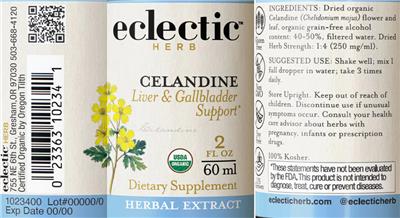
Certified Organic by Oregon Tilth
Liver & Gallbladder support
USDA Organic
Gluten free Non GMO Soy Free
US Grown
Seals/Symbols
USDA Organic
FDA Statement of Identity
Dietary Supplement
Formula
Herbal Extract
100% Kosher
Suggested/Recommended/Usage/Directions
Suggested Use: Shake well; mix 1 full dropper in water; take 3 times daily.
Storage
Store upright.
Precautions
Keep out of reach of children. Consult your health care advisor about herbs with pregnancy, infants or prescription drugs.
Discontinue use if unusual symptoms occur.
Consult your health care advisor about herbs with pregnancy, infants or prescription drugs.
FDA Disclaimer Statement
These statements have not been evaluated by the FDA. This product is not intended to diagnose, treat, cure or prevent diseases.
General Statements
@eclecticherb
Is this label outdated? Report a formula or label change and our pharmacy team will review it.
Celandine Grain-Free Alcohol by Eclectic Herb label
The label scan from the NIH Dietary Supplement Label Database. Tap to enlarge.
Label images are published by the NIH Dietary Supplement Label Database for the version of this product on file. Always read your actual product label.
View the full label (PDF)The Ingredients in Celandine Grain-Free Alcohol by Eclectic Herb
This is the 1 active ingredient this product is made of. Select it to open its full monograph.
Serving size1 Dropper(s) Dosage formLiquid Amounts shown are per serving.
Celandine
Interacts with625 drugs
Greater celandine is a traditional herb most often promoted for digestive and gallbladder complaints, but solid human evidence for any use is lacking....
Celandine monograph & interactionsOther (inactive) ingredients: Alcohol, Water, Filtered. These complete the product’s ingredient list but are not active constituents.
Celandine Grain-Free Alcohol by Eclectic Herb Drug Interactions
HelloPharmacist Interaction Report
Celandine Grain-Free Alcohol by Eclectic Herb does interact with medications.
The most serious concern is its effect on drugs metabolized by the liver enzyme CYP2D6 — a group that includes certain antidepressants (amitriptyline, desipramine), antipsychotics (clozapine), and opioids (codeine). Research shows that celandine's chelidonine constituent can slow how your body clears these drugs, raising their levels in your bloodstream.
Read the full breakdown — every affected drug type, severity by severity
Celandine also poses a moderate risk with hepatotoxic drugs — medications that can stress the liver, such as certain diabetes and heart medications. Because celandine itself has been linked to liver damage in dozens of reported cases, combining it with other liver-stressing drugs could increase that risk further.
Additionally, it may reduce the effectiveness of immunosuppressant medications used after transplants or for certain autoimmune conditions. Finally, pairing it with monoamine oxidase inhibitors (MAOIs), an older class of antidepressants, could theoretically raise the risk of serotonin syndrome.
Altogether, these interactions span 608 individual medications. You'll want to run your exact medications through the checker on this page before starting celandine.
Check your own medications below · Editorial policy · How we use AI
Want to check YOUR meds against Celandine Grain-Free Alcohol?
Ask about interactions with your drugs in plain English — “Can I take it with lisinopril?” — and we find you the answer in seconds, ingredient by ingredient.
Go to the checkerIngredients driving the most interactions
Individual Drug Interactions
The ingredients in Celandine Grain-Free Alcohol interact with 625 drugs. Click any drug to see the details.
1 of the 1 ingredient in Celandine Grain-Free Alcohol interact with drugs. Each result below shows which ingredient is responsible. Celandine
6-mercaptopurinePurinethol
How 6-mercaptopurine interacts with Celandine Grain-Free Alcohol — through 1 ingredient. Tap an ingredient for the detail:
CelandineImmunosuppressants, Hepatotoxic Drugs Moderate
Interaction Summary
Preliminary clinical research suggests that taking a specific semi-synthetic derivative of the greater celandine constituent chelidonine (Ukrain; not available in North America) might stimulate immune responses in cancer patients.
Read the full Celandine + 6-mercaptopurine interactionAbacavir Sulfate, Dolutegravir, LamivudineTriumeq
How Abacavir Sulfate, Dolutegravir, Lamivudine interacts with Celandine Grain-Free Alcohol — through 1 ingredient. Tap an ingredient for the detail:
CelandineHepatotoxic Drugs Moderate
Interaction Summary
There is some concern that greater celandine can adversely affect the liver.
Read the full Celandine + Abacavir Sulfate, Dolutegravir, Lamivudine interactionAbacavir, LamivudineEpzicom
How Abacavir, Lamivudine interacts with Celandine Grain-Free Alcohol — through 1 ingredient. Tap an ingredient for the detail:
CelandineHepatotoxic Drugs Moderate
Interaction Summary
There is some concern that greater celandine can adversely affect the liver.
Read the full Celandine + Abacavir, Lamivudine interactionAbiraterone
How Abiraterone interacts with Celandine Grain-Free Alcohol — through 1 ingredient. Tap an ingredient for the detail:
CelandineHepatotoxic Drugs Moderate
Interaction Summary
There is some concern that greater celandine can adversely affect the liver.
Read the full Celandine + Abiraterone interactionAbiraterone AcetateYonsa, Zytiga
How Abiraterone Acetate interacts with Celandine Grain-Free Alcohol — through 1 ingredient. Tap an ingredient for the detail:
CelandineHepatotoxic Drugs Moderate
Interaction Summary
There is some concern that greater celandine can adversely affect the liver.
Read the full Celandine + Abiraterone Acetate interactionAbrocitinibCibinqo
How Abrocitinib interacts with Celandine Grain-Free Alcohol — through 1 ingredient. Tap an ingredient for the detail:
CelandineImmunosuppressants Moderate
Interaction Summary
Preliminary clinical research suggests that taking a specific semi-synthetic derivative of the greater celandine constituent chelidonine (Ukrain; not available in North America) might stimulate immune responses in cancer patients.
Read the full Celandine + Abrocitinib interactionAcarboseGlucobay, Prandase, Precose
How Acarbose interacts with Celandine Grain-Free Alcohol — through 1 ingredient. Tap an ingredient for the detail:
CelandineHepatotoxic Drugs Moderate
Interaction Summary
There is some concern that greater celandine can adversely affect the liver.
Read the full Celandine + Acarbose interactionAcebutololRhotral, Sectral
How Acebutolol interacts with Celandine Grain-Free Alcohol — through 1 ingredient. Tap an ingredient for the detail:
CelandineHepatotoxic Drugs Moderate
Interaction Summary
There is some concern that greater celandine can adversely affect the liver.
Read the full Celandine + Acebutolol interactionAcetaminophenChildren's Tylenol, Children's Tylenol Meltaways, Tylenol, Tylenol Ex Strength
How Acetaminophen interacts with Celandine Grain-Free Alcohol — through 1 ingredient. Tap an ingredient for the detail:
CelandineHepatotoxic Drugs Moderate
Interaction Summary
There is some concern that greater celandine can adversely affect the liver.
Read the full Celandine + Acetaminophen interactionAcetaminophen, AspirinGemnisyn
How Acetaminophen, Aspirin interacts with Celandine Grain-Free Alcohol — through 1 ingredient. Tap an ingredient for the detail:
CelandineHepatotoxic Drugs Moderate
Interaction Summary
There is some concern that greater celandine can adversely affect the liver.
Read the full Celandine + Acetaminophen, Aspirin interactionAcetaminophen, Aspirin, CaffeineExcedrin, Excedrin Extra Strength, Excedrin Migraine
How Acetaminophen, Aspirin, Caffeine interacts with Celandine Grain-Free Alcohol — through 1 ingredient. Tap an ingredient for the detail:
CelandineHepatotoxic Drugs Moderate
Interaction Summary
There is some concern that greater celandine can adversely affect the liver.
Read the full Celandine + Acetaminophen, Aspirin, Caffeine interactionAcetaminophen, Brompheniramine, PhenylpropanolamineDimetapp Cold and Flu
How Acetaminophen, Brompheniramine, Phenylpropanolamine interacts with Celandine Grain-Free Alcohol — through 1 ingredient. Tap an ingredient for the detail:
CelandineHepatotoxic Drugs Moderate
Interaction Summary
There is some concern that greater celandine can adversely affect the liver.
Read the full Celandine + Acetaminophen, Brompheniramine, Phenylpropanolamine interactionAcetaminophen, ButalbitalAxocet, Bancap, Bucet, Butex Forte, Esgic CF, Orbivan CF +5 more
How Acetaminophen, Butalbital interacts with Celandine Grain-Free Alcohol — through 1 ingredient. Tap an ingredient for the detail:
CelandineHepatotoxic Drugs Moderate
Interaction Summary
There is some concern that greater celandine can adversely affect the liver.
Read the full Celandine + Acetaminophen, Butalbital interactionAcetaminophen, Butalbital, CaffeineEsgic, Esgic Plus, Fiogesic, Fioricet, Repan, Tecnal +1 more
How Acetaminophen, Butalbital, Caffeine interacts with Celandine Grain-Free Alcohol — through 1 ingredient. Tap an ingredient for the detail:
CelandineHepatotoxic Drugs Moderate
Interaction Summary
There is some concern that greater celandine can adversely affect the liver.
Read the full Celandine + Acetaminophen, Butalbital, Caffeine interactionAcetaminophen, Butalbital, Caffeine, CodeineEsgic with Codeine, Fioricet w/ Codeine
How Acetaminophen, Butalbital, Caffeine, Codeine interacts with Celandine Grain-Free Alcohol — through 1 ingredient. Tap an ingredient for the detail:
CelandineHepatotoxic Drugs, Cytochrome P450 2d6 (cyp2d6) Substrates Moderate
Interaction Summary
There is some concern that greater celandine can adversely affect the liver.
Read the full Celandine + Acetaminophen, Butalbital, Caffeine, Codeine interactionAcetaminophen, Butalbital, CodeineBancap w/ Codeine
How Acetaminophen, Butalbital, Codeine interacts with Celandine Grain-Free Alcohol — through 1 ingredient. Tap an ingredient for the detail:
CelandineCytochrome P450 2d6 (cyp2d6) Substrates, Hepatotoxic Drugs Moderate
Interaction Summary
Research in vitro shows that chelidonine, a constituent of greater celandine, inhibits cytochrome P450 2D6 (CYP2D6) enzyme activity.
Read the full Celandine + Acetaminophen, Butalbital, Codeine interactionAcetaminophen, Butalbital, Codeine PhosphatePhrenilin #3
How Acetaminophen, Butalbital, Codeine Phosphate interacts with Celandine Grain-Free Alcohol — through 1 ingredient. Tap an ingredient for the detail:
CelandineHepatotoxic Drugs, Cytochrome P450 2d6 (cyp2d6) Substrates Moderate
Interaction Summary
There is some concern that greater celandine can adversely affect the liver.
Read the full Celandine + Acetaminophen, Butalbital, Codeine Phosphate interactionAcetaminophen, Caffeine, Chlorpheniramine, Hydrocodone, PhenylephrineHycomine Compound
How Acetaminophen, Caffeine, Chlorpheniramine, Hydrocodone, Phenylephrine interacts with Celandine Grain-Free Alcohol — through 1 ingredient. Tap an ingredient for the detail:
CelandineCytochrome P450 2d6 (cyp2d6) Substrates, Hepatotoxic Drugs Moderate
Interaction Summary
Research in vitro shows that chelidonine, a constituent of greater celandine, inhibits cytochrome P450 2D6 (CYP2D6) enzyme activity.
Read the full Celandine + Acetaminophen, Caffeine, Chlorpheniramine, Hydrocodone, Phenylephrine interactionAcetaminophen, Caffeine, CodeineGesic C15, Gesic C30, Gesic C8, Lenoltec 1, Lenoltec 2, Lenoltec 3 +1 more
How Acetaminophen, Caffeine, Codeine interacts with Celandine Grain-Free Alcohol — through 1 ingredient. Tap an ingredient for the detail:
CelandineCytochrome P450 2d6 (cyp2d6) Substrates, Hepatotoxic Drugs Moderate
Interaction Summary
Research in vitro shows that chelidonine, a constituent of greater celandine, inhibits cytochrome P450 2D6 (CYP2D6) enzyme activity.
Read the full Celandine + Acetaminophen, Caffeine, Codeine interactionAcetaminophen, Caffeine, Codeine, SalicylamideCodalan No.1, Codalan No.2, Codalan No.3
How Acetaminophen, Caffeine, Codeine, Salicylamide interacts with Celandine Grain-Free Alcohol — through 1 ingredient. Tap an ingredient for the detail:
CelandineCytochrome P450 2d6 (cyp2d6) Substrates, Hepatotoxic Drugs Moderate
Interaction Summary
Research in vitro shows that chelidonine, a constituent of greater celandine, inhibits cytochrome P450 2D6 (CYP2D6) enzyme activity.
Read the full Celandine + Acetaminophen, Caffeine, Codeine, Salicylamide interactionAcetaminophen, Caffeine, DihydrocodeineDHC Plus, Panlor DC, Panlor SS
How Acetaminophen, Caffeine, Dihydrocodeine interacts with Celandine Grain-Free Alcohol — through 1 ingredient. Tap an ingredient for the detail:
CelandineHepatotoxic Drugs, Cytochrome P450 2d6 (cyp2d6) Substrates Moderate
Interaction Summary
There is some concern that greater celandine can adversely affect the liver.
Read the full Celandine + Acetaminophen, Caffeine, Dihydrocodeine interactionAcetaminophen, Caffeine, IsomethepteneMigralam
How Acetaminophen, Caffeine, Isometheptene interacts with Celandine Grain-Free Alcohol — through 1 ingredient. Tap an ingredient for the detail:
CelandineHepatotoxic Drugs Moderate
Interaction Summary
There is some concern that greater celandine can adversely affect the liver.
Read the full Celandine + Acetaminophen, Caffeine, Isometheptene interactionAcetaminophen, Caffeine, PyrilamineMidol Max Strength Menstrual
How Acetaminophen, Caffeine, Pyrilamine interacts with Celandine Grain-Free Alcohol — through 1 ingredient. Tap an ingredient for the detail:
CelandineHepatotoxic Drugs Moderate
Interaction Summary
There is some concern that greater celandine can adversely affect the liver.
Read the full Celandine + Acetaminophen, Caffeine, Pyrilamine interactionAcetaminophen, Chlorpheniramine Maleate, Dextromethorphan HbrVicks Formula 44M Cough, Cold & Flu Relief
How Acetaminophen, Chlorpheniramine Maleate, Dextromethorphan Hbr interacts with Celandine Grain-Free Alcohol — through 1 ingredient. Tap an ingredient for the detail:
CelandineHepatotoxic Drugs, Cytochrome P450 2d6 (cyp2d6) Substrates Moderate
Interaction Summary
There is some concern that greater celandine can adversely affect the liver.
Read the full Celandine + Acetaminophen, Chlorpheniramine Maleate, Dextromethorphan Hbr interactionAcetaminophen, Chlorpheniramine, Codeine, PhenylephrineColrex
How Acetaminophen, Chlorpheniramine, Codeine, Phenylephrine interacts with Celandine Grain-Free Alcohol — through 1 ingredient. Tap an ingredient for the detail:
CelandineCytochrome P450 2d6 (cyp2d6) Substrates, Hepatotoxic Drugs Moderate
Interaction Summary
Research in vitro shows that chelidonine, a constituent of greater celandine, inhibits cytochrome P450 2D6 (CYP2D6) enzyme activity.
Read the full Celandine + Acetaminophen, Chlorpheniramine, Codeine, Phenylephrine interactionAcetaminophen, Chlorpheniramine, DextromethorphanCoricidin II Extra Strength Cold and Flu
How Acetaminophen, Chlorpheniramine, Dextromethorphan interacts with Celandine Grain-Free Alcohol — through 1 ingredient. Tap an ingredient for the detail:
CelandineCytochrome P450 2d6 (cyp2d6) Substrates, Hepatotoxic Drugs Moderate
Interaction Summary
Research in vitro shows that chelidonine, a constituent of greater celandine, inhibits cytochrome P450 2D6 (CYP2D6) enzyme activity.
Read the full Celandine + Acetaminophen, Chlorpheniramine, Dextromethorphan interactionAcetaminophen, Chlorpheniramine, Dextromethorphan HydrobromideCoricidin HBP Maximum Strength Flu
How Acetaminophen, Chlorpheniramine, Dextromethorphan Hydrobromide interacts with Celandine Grain-Free Alcohol — through 1 ingredient. Tap an ingredient for the detail:
CelandineHepatotoxic Drugs, Cytochrome P450 2d6 (cyp2d6) Substrates Moderate
Interaction Summary
There is some concern that greater celandine can adversely affect the liver.
Read the full Celandine + Acetaminophen, Chlorpheniramine, Dextromethorphan Hydrobromide interactionAcetaminophen, Chlorpheniramine, Dextromethorphan, PhenylpropanolamineMulti Symptom Cold Relief
How Acetaminophen, Chlorpheniramine, Dextromethorphan, Phenylpropanolamine interacts with Celandine Grain-Free Alcohol — through 1 ingredient. Tap an ingredient for the detail:
CelandineCytochrome P450 2d6 (cyp2d6) Substrates, Hepatotoxic Drugs Moderate
Interaction Summary
Research in vitro shows that chelidonine, a constituent of greater celandine, inhibits cytochrome P450 2D6 (CYP2D6) enzyme activity.
Read the full Celandine + Acetaminophen, Chlorpheniramine, Dextromethorphan, Phenylpropanolamine interactionAcetaminophen, Chlorpheniramine, Dextromethorphan, PseudoephedrineChildren's Tylenol Cold Plus Cough, Tylenol Cold Ex Strength
How Acetaminophen, Chlorpheniramine, Dextromethorphan, Pseudoephedrine interacts with Celandine Grain-Free Alcohol — through 1 ingredient. Tap an ingredient for the detail:
CelandineHepatotoxic Drugs, Cytochrome P450 2d6 (cyp2d6) Substrates Moderate
Interaction Summary
There is some concern that greater celandine can adversely affect the liver.
Read the full Celandine + Acetaminophen, Chlorpheniramine, Dextromethorphan, Pseudoephedrine interactionAcetaminophen, Chlorpheniramine, Guaifenesin, Phenylephrine, SalicylamideRhinogesic GG
How Acetaminophen, Chlorpheniramine, Guaifenesin, Phenylephrine, Salicylamide interacts with Celandine Grain-Free Alcohol — through 1 ingredient. Tap an ingredient for the detail:
CelandineHepatotoxic Drugs Moderate
Interaction Summary
There is some concern that greater celandine can adversely affect the liver.
Read the full Celandine + Acetaminophen, Chlorpheniramine, Guaifenesin, Phenylephrine, Salicylamide interactionEach ingredient & the kinds of drugs it affects
For each ingredient in Celandine Grain-Free Alcohol with known interactions, here are the types of medications it can affect. Open any type for the detail — or search your exact drug in the checker above.
Celandine
Cytochrome P450 2D6 (Cyp2D6) Substrates
Research in vitro shows that chelidonine, a constituent of greater celandine, inhibits cytochrome P450 2D6 (CYP2D6) enzyme activity. Theoretically, greater celandine might increase levels of drugs metabolized by CYP2D6.
Some drugs metabolized by CYP2D6 include amitriptyline (Elavil), clozapine (Clozaril), codeine, desipramine (Norpramin), donepezil (Aricept), fentanyl (Duragesic), flecainide (Tambocor), fluoxetine (Prozac), meperidine (Demerol), methadone (Dolophine), metoprolol (Lopressor, Toprol XL), olanzapine (Zyprexa), ondansetron (Zofran), tramadol (Ultram), trazodone (Desyrel), and many others.
Hepatotoxic Drugs
There is some concern that greater celandine can adversely affect the liver. Greater celandine has been linked to many cases of hepatotoxicity. Theoretically, concomitant use with other potentially hepatotoxic drugs might increase the risk of developing liver damage. Some of these drugs include acarbose (Precose, Prandase), amiodarone (Cordarone), atorvastatin (Lipitor), azathioprine (Imuran), carbamazepine (Tegretol), cerivastatin (Baycol), diclofenac (Voltaren), felbamate (Felbatol), fenofibrate (TriCor), fluvastatin (Lescol), gemfibrozil (Lopid), isoniazid, itraconazole, (Sporanox), ketoconazole (Nizoral), leflunomide (Arava), lovastatin (Mevacor), methotrexate (Rheumatrex), nevirapine (Viramune), niacin, nitrofurantoin (Macrodantin), pioglitazone (Actos), pravastatin (Pravachol), pyrazinamide, rifampin (Rifadin), ritonavir (Norvir), rosiglitazone (Avandia), simvastatin (Zocor), tacrine (Cognex), tamoxifen, terbinafine (Lamisil), valproic acid, and zileuton (Zyflo).
Immunosuppressants
Preliminary clinical research suggests that taking a specific semi-synthetic derivative of the greater celandine constituent chelidonine (Ukrain; not available in North America) might stimulate immune responses in cancer patients. Theoretically, taking greater celandine might decrease the effects of immunosuppressive therapy. Immunosuppressant drugs include azathioprine (Imuran), basiliximab (Simulect), cyclosporine (Neoral, Sandimmune), daclizumab (Zenapax), muromonab-CD3 (OKT3, Orthoclone OKT3), mycophenolate (CellCept), tacrolimus (FK506, Prograf), sirolimus (Rapamune), prednisone (Deltasone, Orasone), and other corticosteroids (glucocorticoids).
Monoamine Oxidase Inhibitors (Maois)
Theoretically taking monoamine oxidase inhibitors (MAOIs) with greater celandine might increase the risk of serotonergic side effects including serotonin syndrome. In vitro research shows that chelerythrine, an isoquinoline alkaloid in greater celandine, strongly, selectively, and reversibly inhibits an isoform of recombinant human monoamine oxidase-A (MAO-A). It was also a weak but selective inhibitor of monoamine oxidase-B (MAO-B). Some MAOIs include phenelzine (Nardil), tranylcypromine (Parnate), and others.
Brand information
Manufacturer and brand details for Celandine Grain-Free Alcohol, from the product label.
Eclectic Herb
See all Eclectic Herb products- Name
- Eclectic Herb
- Street Address
- 755 NE 6th St.
- City
- Gresham
- State
- OR
- ZipCode
- 97030
- Phone Number
- 503-668-4120
- Web Address
- eclecticherb.com
Celandine Grain-Free Alcohol by Eclectic Herb: Common Questions
Does Celandine Grain-Free Alcohol by Eclectic Herb interact with any medications?
How can one product interact with so many drugs?
Where does this information come from?
Is celandine safe to use?
Can I take this while pregnant or breastfeeding?
What is celandine actually used for?
What side effects has celandine caused?
Does celandine interact with blood pressure or antidepressant medications?
Written and reviewed by the HelloPharmacist editorial staff. Our editorial policy
Not sure if Celandine Grain-Free Alcohol is safe with your meds?
Our pharmacists answer your medication & supplement questions — free.
Label information is sourced from the NIH Dietary Supplement Label Database and reflects the product version on file; always read your actual product label. This page is for education only and is not a substitute for professional medical advice. Confirm with your pharmacist or doctor before combining supplements and medications.
The Full Monographs Behind Celandine Grain-Free Alcohol’s Ingredients
Every ingredient we hold a full HelloPharmacist monograph for — uses, evidence, safety, and the complete interaction list.
Sources & How We Checked
Celandine Grain-Free Alcohol's label data comes from the NIH Dietary Supplement Label Database; the ingredient interaction data is from the Natural Medicines database, reviewed by our pharmacists.
- NIH Dietary Supplement Label Database (DSLD) — The official product label on file for this supplement.
- Natural Medicines (Therapeutic Research Center) — Evidence-graded clinical reference behind the ingredient interaction data.
Content is written and reviewed by licensed HelloPharmacist pharmacists. See our data sources and editorial standards for how this information is built and checked.
The 25 references behind this product’s interaction data
Every citation that drives the interaction findings for this product’s ingredients, from the evidence-graded Natural Medicines (TRC Healthcare) database. Open an ingredient to browse its citations — links open the study on PubMed or the publisher’s site.
Greater Celandine 25 references
- Benninger J, Schneider HT, Schuppan D, et al. Acute hepatitis induced by greater celandine (Chelidonium majus). Gastroenterology 1999;117:1234-7. PubMed
- Holtmann G, Madisch A, Juergen H, et al. A double-blind, randomized, placebo-controlled trial on the effects of an herbal preparation in patients with functional dyspepsia [Abstract]. Ann Mtg Digestive Disease Week 1999 May.
- Madisch A, Holtmann G, Mayr G, et al. Treatment of functional dyspepsia with a herbal preparation. A double-blind, randomized, placebo-controlled, multicenter trial. Digestion 2004;69:45-52. PubMed
- Melzer J, Rosch W, Reichling J, et al. Meta-analysis: phytotherapy of functional dyspepsia with the herbal drug preparation STW 5 (Iberogast). Aliment Pharmacol Ther 2004;20:1279-87. PubMed
- Ernst E, Schmidt K. Ukrain - a new cancer cure? A systematic review of randomised clinical trials. BMC Cancer 2005;5:69. PubMed
- Stickel F, Poschl G, Seitz HK, et al. Acute hepatitis induced by Greater Celandine (Chelidonium majus). Scand J Gastroenterol 2003;38:565-8.
- Etxenagusia MA, Anda M, Gonzalez-Mahave I, et al. Contact dermatitis from Chelidonium majus (greater celandine). Contact Dermatitis 2000;43:47.
- Panzer A, Joubert AM, Bianchi PC, Seegers JC. The antimitotic effects of Ukrain, a Chelidonium majus alkaloid derivative, are reversible in vitro. Cancer Lett 2000;150:85-92. PubMed
- Moro PA, Cassetti F, Giugliano G, et al. Hepatitis from greater celandine (Chelidonium majus L.): Review of literature and report of a new case. J Ethnopharmacol 2009;124:328-32. PubMed
- Stickel, F., Seitz, H. K., Hahn, E. G., and Schuppan, D. [Liver toxicity of drugs of plant origin]. Z.Gastroenterol. 2001;39(3):225-227.
- Gansauge, F., Ramadani, M., Pressmar, J., Gansauge, S., Muehling, B., Stecker, K., Cammerer, G., Leder, G., and Beger, H. G. NSC-631570 (Ukrain) in the palliative treatment of pancreatic cancer. Results of a phase II trial. Langenbecks Arch.Surg. 2002;38 PubMed
- Nowicky, J. W., Manolakis, G., Meijer, D., Vatanasapt, V., and Brzosko, W. J. Ukrain both as an anti cancer and immunoregulatory agent. Drugs Exp.Clin Res 1992;18 Suppl:51-54.
- Staniszewski, A., Slesak, B., Kolodziej, J., Harlozinska-Szmyrka, A., and Nowicky, J. W. Lymphocyte subsets in patients with lung cancer treated with thiophosphoric acid alkaloid derivatives from Chelidonium majus L. (Ukrain). Drugs Exp.Clin Res 1992;18
- Nowicky, J. W., Staniszewski, A., Zbroja-Sontag, W., Slesak, B., Nowicky, W., and Hiesmayr, W. Evaluation of thiophosphoric acid alkaloid derivatives from Chelidonium majus L. ("Ukrain") as an immunostimulant in patients with various carcinomas. Drugs Ex
- Gansauge, F., Ramadani, M., Schwarz, M., Beger, H. G., Lotspeich, E., and Poch, B. The clinical efficacy of adjuvant systemic chemotherapy with gemcitabine and NSC-631570 in advanced pancreatic cancer. Hepatogastroenterology 2007;54(75):917-920.
- Hardeman, E., Van, Overbeke L., Ilegems, S., and Ferrante, M. Acute hepatitis induced by greater celandine (Chelidonium majus). Acta Gastroenterol.Belg. 2008;71(2):281-282.
- Gilca, M., Gaman, L., Panait, E., Stoian, I., and Atanasiu, V. Chelidonium majus--an integrative review: traditional knowledge versus modern findings. Forsch.Komplementmed. 2010;17(5):241-248. PubMed
- Teschke, R., Glass, X., and Schulze, J. Herbal hepatotoxicity by Greater Celandine (Chelidonium majus): causality assessment of 22 spontaneous reports. Regul.Toxicol.Pharmacol. 2011;61(3):282-291. PubMed
- Teschke, R., Glass, X., Schulze, J., and Eickhoff, A. Suspected Greater Celandine hepatotoxicity: liver-specific causality evaluation of published case reports from Europe. Eur.J Gastroenterol.Hepatol. 2012;24(3):270-280. PubMed
- Pinto, Garcia, V, Vicente, P. R., Barez, A., Soto, I., Candas, M. A., and Coma, A. [Hemolytic anemia induced by Chelidonium majus. Clinical case]. Sangre (Barc.) 1990;35(5):401-403.
- Teschke, R., Frenzel, C., Glass, X., Schulze, J., and Eickhoff, A. Greater Celandine hepatotoxicity: a clinical review. Ann.Hepatol. 2012;11(6):838-848. DOI
- Xian, M. S., Hayashi, K., Lu, J. P., and Awai, M. Efficacy of traditional Chinese herbs on squamous cell carcinoma of the esophagus: histopathologic analysis of 240 cases. Acta Med.Okayama 1989;43(6):345-351.
- Pantano F, Mannocchi G, Marinelli E, Gentili S, Graziano S, Busardò FP, di Luca NM. Hepatotoxicity induced by greater celandine (Chelidonium majus L.): a review of the literature. Eur Rev Med Pharmacol Sci. 2017 Mar;21(1 Suppl):46-52.
- Baek SC, Ryu HW, Kang MG, et al. Selective inhibition of monoamine oxidase A by chelerythrine, an isoquinoline alkaloid. Bioorg Med Chem Lett. 2018;28(14):2403-2407. PubMed
- Liu Y, Cui T, Peng Y, Ji M, Zheng J. Mechanism-based inactivation of cytochrome P450 2D6 by chelidonine. J Biochem Mol Toxicol. 2019;33(2):e22251. PubMed
Parts of this content are provided by the Therapeutic Research Center, LLC.
DISCLAIMER: Currently this does not check for drug-drug interactions. This is not an all-inclusive comprehensive list of potential interactions and is for informational purposes only. Not all interactions are known or well-reported in the scientific literature, and new interactions are continually being reported. Input is needed from a qualified healthcare provider including a pharmacist before starting any therapy. Application of clinical judgment is necessary.
© 2021 Therapeutic Research Center, LLC