
Chaga 1000 mg Ingredients & Drug Interactions
What is this page for?
First and foremost: checking Chaga 1000 mg against your medications. The heart of this page is the interaction checker and the full interaction report — how this product’s ingredients may interact with prescription and over-the-counter medicines you may be taking.
Around that, we add a pharmacist’s high-level view of the product as a whole — what’s inside, the evidence for its stated use, how transparent the label is, and what safety data exists — so you can see the full picture in one place. It’s educational information from our licensed clinical databases and the clinical staff at HelloPharmacist — not medical advice — and we don’t sell or endorse products. Our editorial policy
Chaga 1000 mg is a dietary supplement by Double Wood Supplements with 1 active ingredient. Its ingredients are commonly taken for immune support, antioxidant support, general wellness/tonic.Based on those ingredients, 327 medications have a known interaction with it, the most serious rated moderate. The ingredients most likely to interact are Chaga Mushroom. Use the checker below to test your specific medication, or read the full HelloPharmacist Interaction Report.
Check Your Meds Against Chaga 1000 mg by Double Wood Supplements
Ask about any prescription or over-the-counter medication and we check it for interactions with Chaga 1000 mg by Double Wood Supplements — and tell you which ingredient is responsible.
AI summaries are generated from our interaction database for education only — always confirm with your pharmacist. How we use AI
Ask the Pharmacist
A licensed pharmacist will answer your question by email — free, usually within 24 hours.
Got it — thank you!
A licensed pharmacist will answer within 24 hours. Keep an eye on your email (worth checking spam, just in case).
HelloPharmacist Scorecard of Chaga 1000 mg by Double Wood Supplements
Our pharmacy team’s full take, with four database checks built into the cards below — a summary of what is known, not a grade of the product itself.
What’s inside
Full disclosure
This supplement contains one active ingredient: chaga mushroom at 1,000 mg per capsule. The rest of what's in the capsule — hypromellose, rice flour, and microcrystalline cellulose — are inactive fillers that hold the capsule together.
Does it work?
Couldn't assess
The evidence we hold doesn't establish that chaga works for cardiovascular disease, diabetes, or COVID-19. For each of these, the data on file rates it insufficient reliable evidence to rate — meaning the research so far isn't robust enough to say whether it helps or doesn't.
How safe is it?
Well-documented data
Chaga is generally used in foods and teas, but human safety data are limited and a few risks have been reported. There have been two cases of kidney failure and one case of acute kidney injury linked to heavy chaga use, tied to its high oxalate content — something to keep in mind if you have kidney issues or a family history of kidney stones.
Safety data aren't strong enough during pregnancy or breastfeeding; the advice is to avoid it during both unless you've talked it through with your doctor or pharmacist.
Meds to double-check
Moderate interaction found
If you take blood thinners (anticoagulants or antiplatelets like warfarin or aspirin), immune-suppressing drugs, or diabetes medications, check with your doctor or pharmacist before starting chaga. The supplement is theoretically linked to increased bleeding risk, interference with immune therapy, and lower blood sugar — none confirmed in people, but worth a conversation with your own healthcare provider.
The bottom line
Scorecard at a glanceFully disclosed formula with no assessable stated purpose. Moderate medication interactions have been identified, and safety information is well characterized.
Chaga might be worth considering if you're interested in general immune support and you're not on blood thinners, immune-suppressing drugs, or diabetes medications. If you take any of those, or if you have a history of kidney problems, talk it over with your doctor or pharmacist first.
They can help you decide whether it's right for you and whether it's safe to use alongside what you're already taking.
Educational only — not medical advice; always confirm with your pharmacist. Our editorial policy · How we use AI
Assessment coverage: 1 of 1 active ingredient matched to our full ingredient reviews (monographs). Based on the product label dated Jul 25, 2024.
This Scorecard evaluates available label information, ingredient evidence, and known medication-safety considerations. It does not independently verify product identity, purity, potency, contamination, or manufacturing quality. How these ratings are computed
General information
Key facts about Chaga 1000 mg, straight from the product label.
| Brand | Double Wood Supplements |
|---|---|
| Barcode (UPC) | 850033272161 |
| Net contents | 120 Capsule(s) |
| Market status | On market |
| Date entered into DSLD | Jul 25, 2024 |
| DSLD ID | 315596 |
| Product type | Botanical |
| Supplement form | Capsule |
| Dietary claims / uses | Nutrient, All Other, Structure/Function |
| Intended target group(s) | Adult (18 - 50 Years), Women (not pregnant or lactating), Gluten Free |
Everything in this section is reproduced from the manufacturer’s own product label — it’s the label speaking, not HelloPharmacist. We show it so you can see exactly what the maker states; we don’t verify or endorse those statements.
Supplement Facts
The label details for Chaga 1000 mg by Double Wood Supplements, sourced from the NIH Dietary Supplement Label Database.
Supplement Facts
| Ingredient | Amount | % DV |
|---|---|---|
| Chaga Mushroom | 1000 mg | -- |
Other ingredients: Hypromellose, Rice Flour, Microcrystalline Cellulose
Tap any ingredient to jump to its full detail below.
These statements are the manufacturer’s wording, reproduced from the product label — the label is saying it, not HelloPharmacist. We don’t verify or endorse them.
Formula
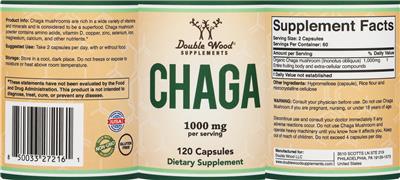
Product Info: Chaga mushrooms are rich in a wide variety of vitamins and minerals and is considered to be a superfood. Chaga mushroom powder contains amino acids, vitamin D, copper, zinc, selenium, iron, magnesium, calcium, and other nutrients.
Chaga 1000 mg per serving
Suggested/Recommended/Usage/Directions
Suggested Use: Take 2 capsules per day, with or without food.
Storage
Storage: Store in a cool, dark place. Do not freeze or expose to moisture or heat above room temperature.
FDA Disclaimer Statement
These statements have not been evaluated by the Food and Drug Administration. This product is not intended to diagnose, treat, cure, or prevent any disease.
Seals/Symbols
Proudly Made In USA
Formulation
Made with Non-GMO Ingredients Gluten Free
FDA Statement of Identity
Dietary Supplement
Precautions
Warning: Consult your physician before use.
Do not use Chaga Mushroom if you are pregnant, nursing, or under 18 years of age.
Do not use Chaga Mushroom if you are pregnant, nursing, or under 18 years of age.
Discontinue use and consult your doctor immediately if any adverse reactions occur. Do not use Chaga Mushroom and operate heavy machinery until you know how it affects you.
Keep out of reach of children.
Do not exceed 4 capsules per day.
Is this label outdated? Report a formula or label change and our pharmacy team will review it.
Chaga 1000 mg by Double Wood Supplements label
The label scan from the NIH Dietary Supplement Label Database. Tap to enlarge.
Label images are published by the NIH Dietary Supplement Label Database for the version of this product on file. Always read your actual product label.
View the full label (PDF)The Ingredients in Chaga 1000 mg by Double Wood Supplements
This is the 1 active ingredient this product is made of. Select it to open its full monograph.
Serving size2 Capsule(s) Dosage formCapsule Servings per container60 Amounts shown are per serving.
Chaga Mushroom
Interacts with327 drugs
Chaga is a fungus that grows mostly on birch trees and is used as a tea or supplement, mainly for immune and antioxidant support. Human evidence for i...
Chaga Mushroom monograph & interactionsOther (inactive) ingredients: Hypromellose, Rice Flour, Microcrystalline Cellulose. These complete the product’s ingredient list but are not active constituents.
Chaga 1000 mg by Double Wood Supplements Drug Interactions
HelloPharmacist Interaction Report
Chaga 1000 mg from Double Wood Supplements has documented interactions with blood thinners (anticoagulants and antiplatelets), immune-suppressing drugs, and diabetes medications — all rated Moderate severity.
Altogether, these interactions span 327 individual medications.
Read the full breakdown — every affected drug type, severity by severity
With blood thinners like warfarin or aspirin, chaga may theoretically raise your bleeding risk. Lab and animal studies hint that chaga can slow down how platelets clump together, though this hasn't been observed in people yet.
Chaga might also interfere with immune-suppressing drugs (used after transplants or for certain autoimmune conditions) by stimulating immune function, and could theoretically lower blood sugar too much if you're on diabetes medications. Again, these effects are suggested by lab work and animal studies, not human data.
Before you start this supplement, run your exact medications through the search tool on this page — especially if you take blood thinners, immune suppressants, or diabetes drugs.
Check your own medications below · Editorial policy · How we use AI
Want to check YOUR meds against Chaga 1000 mg?
Ask about interactions with your drugs in plain English — “Can I take it with lisinopril?” — and we find you the answer in seconds, ingredient by ingredient.
Go to the checkerIngredients driving the most interactions
Individual Drug Interactions
The ingredients in Chaga 1000 mg interact with 327 drugs. Click any drug to see the details.
1 of the 1 ingredient in Chaga 1000 mg interact with drugs. Each result below shows which ingredient is responsible. Chaga Mushroom
6-mercaptopurinePurinethol
How 6-mercaptopurine interacts with Chaga 1000 mg — through 1 ingredient. Tap an ingredient for the detail:
Chaga MushroomImmunosuppressants Moderate
Interaction Summary
Theoretically, chaga might interfere with immunosuppressive therapy.
Read the full Chaga Mushroom + 6-mercaptopurine interactionAbciximabReoPro
How Abciximab interacts with Chaga 1000 mg — through 1 ingredient. Tap an ingredient for the detail:
Chaga MushroomAnticoagulant/antiplatelet Drugs Moderate
Interaction Summary
Theoretically, chaga may increase the risk of bleeding if used with anticoagulant or antiplatelet drugs.
Read the full Chaga Mushroom + Abciximab interactionAbrocitinibCibinqo
How Abrocitinib interacts with Chaga 1000 mg — through 1 ingredient. Tap an ingredient for the detail:
Chaga MushroomAnticoagulant/antiplatelet Drugs, Immunosuppressants Moderate
Interaction Summary
Theoretically, chaga may increase the risk of bleeding if used with anticoagulant or antiplatelet drugs.
Read the full Chaga Mushroom + Abrocitinib interactionAcarboseGlucobay, Prandase, Precose
How Acarbose interacts with Chaga 1000 mg — through 1 ingredient. Tap an ingredient for the detail:
Chaga MushroomAntidiabetes Drugs Moderate
Interaction Summary
Theoretically, taking chaga with antidiabetes drugs might increase the risk of hypoglycemia.
Read the full Chaga Mushroom + Acarbose interactionAcenocoumarolSintrom
How Acenocoumarol interacts with Chaga 1000 mg — through 1 ingredient. Tap an ingredient for the detail:
Chaga MushroomAnticoagulant/antiplatelet Drugs Moderate
Interaction Summary
Theoretically, chaga may increase the risk of bleeding if used with anticoagulant or antiplatelet drugs.
Read the full Chaga Mushroom + Acenocoumarol interactionAcetaminophen, AspirinGemnisyn
How Acetaminophen, Aspirin interacts with Chaga 1000 mg — through 1 ingredient. Tap an ingredient for the detail:
Chaga MushroomAnticoagulant/antiplatelet Drugs Moderate
Interaction Summary
Theoretically, chaga may increase the risk of bleeding if used with anticoagulant or antiplatelet drugs.
Read the full Chaga Mushroom + Acetaminophen, Aspirin interactionAcetaminophen, Aspirin, CaffeineExcedrin, Excedrin Extra Strength, Excedrin Migraine
How Acetaminophen, Aspirin, Caffeine interacts with Chaga 1000 mg — through 1 ingredient. Tap an ingredient for the detail:
Chaga MushroomAnticoagulant/antiplatelet Drugs Moderate
Interaction Summary
Theoretically, chaga may increase the risk of bleeding if used with anticoagulant or antiplatelet drugs.
Read the full Chaga Mushroom + Acetaminophen, Aspirin, Caffeine interactionAcetaminophen, IbuprofenCombogesic
How Acetaminophen, Ibuprofen interacts with Chaga 1000 mg — through 1 ingredient. Tap an ingredient for the detail:
Chaga MushroomAnticoagulant/antiplatelet Drugs Moderate
Interaction Summary
Theoretically, chaga may increase the risk of bleeding if used with anticoagulant or antiplatelet drugs.
Read the full Chaga Mushroom + Acetaminophen, Ibuprofen interactionAcetohexamideDymelor
How Acetohexamide interacts with Chaga 1000 mg — through 1 ingredient. Tap an ingredient for the detail:
Chaga MushroomAntidiabetes Drugs Moderate
Interaction Summary
Theoretically, taking chaga with antidiabetes drugs might increase the risk of hypoglycemia.
Read the full Chaga Mushroom + Acetohexamide interactionAcetylsalicylic AcidEntrophen
How Acetylsalicylic Acid interacts with Chaga 1000 mg — through 1 ingredient. Tap an ingredient for the detail:
Chaga MushroomAnticoagulant/antiplatelet Drugs Moderate
Interaction Summary
Theoretically, chaga may increase the risk of bleeding if used with anticoagulant or antiplatelet drugs.
Read the full Chaga Mushroom + Acetylsalicylic Acid interactionAdalimumabHumira
How Adalimumab interacts with Chaga 1000 mg — through 1 ingredient. Tap an ingredient for the detail:
Chaga MushroomImmunosuppressants Moderate
Interaction Summary
Theoretically, chaga might interfere with immunosuppressive therapy.
Read the full Chaga Mushroom + Adalimumab interactionAdalimumab-adazHyrimoz
How Adalimumab-adaz interacts with Chaga 1000 mg — through 1 ingredient. Tap an ingredient for the detail:
Chaga MushroomImmunosuppressants Moderate
Interaction Summary
Theoretically, chaga might interfere with immunosuppressive therapy.
Read the full Chaga Mushroom + Adalimumab-adaz interactionAdalimumab-adbmCyltezo
How Adalimumab-adbm interacts with Chaga 1000 mg — through 1 ingredient. Tap an ingredient for the detail:
Chaga MushroomImmunosuppressants Moderate
Interaction Summary
Theoretically, chaga might interfere with immunosuppressive therapy.
Read the full Chaga Mushroom + Adalimumab-adbm interactionAdalimumab-afzbAbrilada
How Adalimumab-afzb interacts with Chaga 1000 mg — through 1 ingredient. Tap an ingredient for the detail:
Chaga MushroomImmunosuppressants Moderate
Interaction Summary
Theoretically, chaga might interfere with immunosuppressive therapy.
Read the full Chaga Mushroom + Adalimumab-afzb interactionAdalimumab-attoAmjevita
How Adalimumab-atto interacts with Chaga 1000 mg — through 1 ingredient. Tap an ingredient for the detail:
Chaga MushroomImmunosuppressants Moderate
Interaction Summary
Theoretically, chaga might interfere with immunosuppressive therapy.
Read the full Chaga Mushroom + Adalimumab-atto interactionAdalimumab-bwwdHadlima
How Adalimumab-bwwd interacts with Chaga 1000 mg — through 1 ingredient. Tap an ingredient for the detail:
Chaga MushroomImmunosuppressants Moderate
Interaction Summary
Theoretically, chaga might interfere with immunosuppressive therapy.
Read the full Chaga Mushroom + Adalimumab-bwwd interactionAdalimumab-fkjpHulio
How Adalimumab-fkjp interacts with Chaga 1000 mg — through 1 ingredient. Tap an ingredient for the detail:
Chaga MushroomImmunosuppressants Moderate
Interaction Summary
Theoretically, chaga might interfere with immunosuppressive therapy.
Read the full Chaga Mushroom + Adalimumab-fkjp interactionAlbiglutideTanzeum
How Albiglutide interacts with Chaga 1000 mg — through 1 ingredient. Tap an ingredient for the detail:
Chaga MushroomAntidiabetes Drugs Moderate
Interaction Summary
Theoretically, taking chaga with antidiabetes drugs might increase the risk of hypoglycemia.
Read the full Chaga Mushroom + Albiglutide interactionAlefaceptAmevive
How Alefacept interacts with Chaga 1000 mg — through 1 ingredient. Tap an ingredient for the detail:
Chaga MushroomImmunosuppressants Moderate
Interaction Summary
Theoretically, chaga might interfere with immunosuppressive therapy.
Read the full Chaga Mushroom + Alefacept interactionAlemtuzumabCampath
How Alemtuzumab interacts with Chaga 1000 mg — through 1 ingredient. Tap an ingredient for the detail:
Chaga MushroomImmunosuppressants Moderate
Interaction Summary
Theoretically, chaga might interfere with immunosuppressive therapy.
Read the full Chaga Mushroom + Alemtuzumab interactionAlogliptinNesina
How Alogliptin interacts with Chaga 1000 mg — through 1 ingredient. Tap an ingredient for the detail:
Chaga MushroomAntidiabetes Drugs Moderate
Interaction Summary
Theoretically, taking chaga with antidiabetes drugs might increase the risk of hypoglycemia.
Read the full Chaga Mushroom + Alogliptin interactionAlogliptin, MetforminKazano
How Alogliptin, Metformin interacts with Chaga 1000 mg — through 1 ingredient. Tap an ingredient for the detail:
Chaga MushroomAntidiabetes Drugs Moderate
Interaction Summary
Theoretically, taking chaga with antidiabetes drugs might increase the risk of hypoglycemia.
Read the full Chaga Mushroom + Alogliptin, Metformin interactionAlogliptin, PioglitazoneOseni
How Alogliptin, Pioglitazone interacts with Chaga 1000 mg — through 1 ingredient. Tap an ingredient for the detail:
Chaga MushroomAntidiabetes Drugs Moderate
Interaction Summary
Theoretically, taking chaga with antidiabetes drugs might increase the risk of hypoglycemia.
Read the full Chaga Mushroom + Alogliptin, Pioglitazone interactionAlteplase, TpaActilyse, Activase
How Alteplase, Tpa interacts with Chaga 1000 mg — through 1 ingredient. Tap an ingredient for the detail:
Chaga MushroomAnticoagulant/antiplatelet Drugs Moderate
Interaction Summary
Theoretically, chaga may increase the risk of bleeding if used with anticoagulant or antiplatelet drugs.
Read the full Chaga Mushroom + Alteplase, Tpa interactionAluminum Hydroxide, Aspirin, Codeine Phosphate, Magnesium HydroxideAscriptin Codeine #2
How Aluminum Hydroxide, Aspirin, Codeine Phosphate, Magnesium Hydroxide interacts with Chaga 1000 mg — through 1 ingredient. Tap an ingredient for the detail:
Chaga MushroomAnticoagulant/antiplatelet Drugs Moderate
Interaction Summary
Theoretically, chaga may increase the risk of bleeding if used with anticoagulant or antiplatelet drugs.
Read the full Chaga Mushroom + Aluminum Hydroxide, Aspirin, Codeine Phosphate, Magnesium Hydroxide interactionAluminum Hydroxide, Aspirin, Magnesium HydroxideAscriptin
How Aluminum Hydroxide, Aspirin, Magnesium Hydroxide interacts with Chaga 1000 mg — through 1 ingredient. Tap an ingredient for the detail:
Chaga MushroomAnticoagulant/antiplatelet Drugs Moderate
Interaction Summary
Theoretically, chaga may increase the risk of bleeding if used with anticoagulant or antiplatelet drugs.
Read the full Chaga Mushroom + Aluminum Hydroxide, Aspirin, Magnesium Hydroxide interactionAnacaulase-bcdbNexoBrid
How Anacaulase-bcdb interacts with Chaga 1000 mg — through 1 ingredient. Tap an ingredient for the detail:
Chaga MushroomAnticoagulant/antiplatelet Drugs Moderate
Interaction Summary
Theoretically, chaga may increase the risk of bleeding if used with anticoagulant or antiplatelet drugs.
Read the full Chaga Mushroom + Anacaulase-bcdb interactionAnagrelideAgrylin
How Anagrelide interacts with Chaga 1000 mg — through 1 ingredient. Tap an ingredient for the detail:
Chaga MushroomAnticoagulant/antiplatelet Drugs Moderate
Interaction Summary
Theoretically, chaga may increase the risk of bleeding if used with anticoagulant or antiplatelet drugs.
Read the full Chaga Mushroom + Anagrelide interactionAnifrolumab-fniaSaphnelo
How Anifrolumab-fnia interacts with Chaga 1000 mg — through 1 ingredient. Tap an ingredient for the detail:
Chaga MushroomImmunosuppressants Moderate
Interaction Summary
Theoretically, chaga might interfere with immunosuppressive therapy.
Read the full Chaga Mushroom + Anifrolumab-fnia interactionAnisindioneMiradon
How Anisindione interacts with Chaga 1000 mg — through 1 ingredient. Tap an ingredient for the detail:
Chaga MushroomAnticoagulant/antiplatelet Drugs Moderate
Interaction Summary
Theoretically, chaga may increase the risk of bleeding if used with anticoagulant or antiplatelet drugs.
Read the full Chaga Mushroom + Anisindione interactionEach ingredient & the kinds of drugs it affects
For each ingredient in Chaga 1000 mg with known interactions, here are the types of medications it can affect. Open any type for the detail — or search your exact drug in the checker above.
Chaga Mushroom
Anticoagulant/Antiplatelet Drugs
Theoretically, chaga may increase the risk of bleeding if used with anticoagulant or antiplatelet drugs.
In vitro and animal research suggests that chaga extract can inhibit platelet aggregation. This effect has not been reported in humans.
Antidiabetes Drugs
Theoretically, taking chaga with antidiabetes drugs might increase the risk of hypoglycemia.
Animal research suggests that chaga might decrease blood glucose levels and increase insulin levels. This has not been reported in humans.
Immunosuppressants
Theoretically, chaga might interfere with immunosuppressive therapy.
In vitro research suggests that certain constituents of chaga stimulate immune function. This has not been reported in humans.
Brand information
Manufacturer and brand details for Chaga 1000 mg, from the product label.
Double Wood Supplements
See all Double Wood Supplements products- Name
- Double Wood LLC
- Street Address
- 3510 Scotts Ln Ste 219
- City
- Philadelphia
- State
- PA
- ZipCode
- 19129-15173
- Web Address
- www.doublewoodsupplements.com
Chaga 1000 mg by Double Wood Supplements: Common Questions
Does Chaga 1000 mg by Double Wood Supplements interact with any medications?
How can one product interact with so many drugs?
Where does this information come from?
Can I take this if I have kidney problems?
Is chaga safe during pregnancy or breastfeeding?
Does chaga actually help with diabetes or heart disease?
What exactly is chaga, and why is it in this supplement?
Are there any side effects I should know about?
Written and reviewed by the HelloPharmacist editorial staff. Our editorial policy
Not sure if Chaga 1000 mg is safe with your meds?
Our pharmacists answer your medication & supplement questions — free.
Label information is sourced from the NIH Dietary Supplement Label Database and reflects the product version on file; always read your actual product label. This page is for education only and is not a substitute for professional medical advice. Confirm with your pharmacist or doctor before combining supplements and medications.
The Full Monographs Behind Chaga 1000 mg’s Ingredients
Every ingredient we hold a full HelloPharmacist monograph for — uses, evidence, safety, and the complete interaction list.
Sources & How We Checked
Chaga 1000 mg's label data comes from the NIH Dietary Supplement Label Database; the ingredient interaction data is from the Natural Medicines database, reviewed by our pharmacists.
- NIH Dietary Supplement Label Database (DSLD) — The official product label on file for this supplement.
- Natural Medicines (Therapeutic Research Center) — Evidence-graded clinical reference behind the ingredient interaction data.
Content is written and reviewed by licensed HelloPharmacist pharmacists. See our data sources and editorial standards for how this information is built and checked.
The 9 references behind this product’s interaction data
Every citation that drives the interaction findings for this product’s ingredients, from the evidence-graded Natural Medicines (TRC Healthcare) database. Open an ingredient to browse its citations — links open the study on PubMed or the publisher’s site.
Chaga 9 references
- Sun JE, Ao ZH, Lu ZM, et al. Antihyperglycemic and antilipidperoxidative effects of dry matter of culture broth of Inonotus obliquus in submerged culture on normal and alloxan-diabetes mice. J Ethnopharmacol 2008;118(1):7-13. PubMed
- Hyun KW, Jeong SC, Lee DH, et al. Isolation and characterization of a novel platelet aggregation inhibitory peptide from the medicinal mushroom, Inonotus obliquus. Peptides 2006;27(6):1173-8. PubMed
- Kim YO, Han SB, Lee HW, et al. Immuno-stimulating effect of the endo-polysaccharide produced by submerged culture of Inonotus obliquus. Life Sci 2005;77(19):2438-56. PubMed
- Kikuchi Y, Seta K, Ogawa Y, et al. Chaga mushroom-induced oxalate nephropathy. Clin Nephrol 2014;81(6):440-4. PubMed
- Lee S, Lee HY, Park Y, et al. Development of end stage renal disease after long-term ingestion of chaga mushroom: case report and review of literature. J Korean Med Sci. 2020;35(19):e122.
- Kwon O, Kim Y, Paek JH, et al. Chaga mushroom-induced oxalate nephropathy that clinically manifested as nephrotic syndrome: A case report. Medicine (Baltimore) 2022;101(10):e28997. PubMed
- Su L, Xin C, Yang J, et al. A polysaccharide from Inonotus obliquus ameliorates intestinal barrier dysfunction in mice with type 2 diabetes mellitus. Int J Biol Macromol 2022;214:312-323. PubMed
- Chen S, Ma Y, Li H, et al. Anti-diabetic e?ects of Inonotus obliquus extract in high fat diet combined streptozotocin-induced type 2 diabetic mice. Nutr Hosp 2022;39(6):1256-1263. PubMed
- Ye X, Wu K, Xu L, et al. Methanol extract of Inonotus obliquus improves type 2 diabetes mellitus through modifying intestinal flora. Front Endocrinol (Lausanne) 2023;13:1103972. PubMed
Parts of this content are provided by the Therapeutic Research Center, LLC.
DISCLAIMER: Currently this does not check for drug-drug interactions. This is not an all-inclusive comprehensive list of potential interactions and is for informational purposes only. Not all interactions are known or well-reported in the scientific literature, and new interactions are continually being reported. Input is needed from a qualified healthcare provider including a pharmacist before starting any therapy. Application of clinical judgment is necessary.
© 2021 Therapeutic Research Center, LLC