
Cholester-Reg II Ingredients & Drug Interactions
What is this page for?
First and foremost: checking Cholester-Reg II against your medications. The heart of this page is the interaction checker and the full interaction report — how this product’s ingredients may interact with prescription and over-the-counter medicines you may be taking.
Around that, we add a pharmacist’s high-level view of the product as a whole — what’s inside, the evidence for its stated use, how transparent the label is, and what safety data exists — so you can see the full picture in one place. It’s educational information from our licensed clinical databases and the clinical staff at HelloPharmacist — not medical advice — and we don’t sell or endorse products. Our editorial policy
Cholester-Reg II is a dietary supplement by Nature's Sunshine with 5 active ingredients. Its ingredients are commonly taken for high cholesterol, heart and blood vessel health, leg pain from poor circulation (intermittent claudication).Based on those ingredients, 1,077 medications have a known interaction with it, the most serious rated moderate. The ingredients most likely to interact are Japanese Knotweed Root Extract, Artichoke, Policosanol. Use the checker below to test your specific medication, or read the full HelloPharmacist Interaction Report.
Check Your Meds Against Cholester-Reg II by Nature's Sunshine
Ask about any prescription or over-the-counter medication and we check it for interactions with Cholester-Reg II by Nature's Sunshine — and tell you which ingredient is responsible.
AI summaries are generated from our interaction database for education only — always confirm with your pharmacist. How we use AI
Ask the Pharmacist
A licensed pharmacist will answer your question by email — free, usually within 24 hours.
Got it — thank you!
A licensed pharmacist will answer within 24 hours. Keep an eye on your email (worth checking spam, just in case).
HelloPharmacist Scorecard of Cholester-Reg II by Nature's Sunshine
Our pharmacy team’s full take, with four database checks built into the cards below — a summary of what is known, not a grade of the product itself.
What’s inside
Low disclosure
Cholester-Reg II contains five active ingredients designed to support cholesterol and circulatory health. Policosanol is a plant-derived compound that may help with walking distance in circulation issues.
Japanese Knotweed Root Extract (hu zhang) is a traditional herb containing resveratrol. Inositol nicotinate is a form of niacin that converts to niacin in your body.
Artichoke leaf extract is included for its potential effects on cholesterol and digestion. The product also includes a proprietary blend (meaning the exact doses of some ingredients aren't listed separately).
Inactive ingredients—capsule materials, cellulose, magnesium stearate, stearic acid, silicon dioxide, gelatin, and water—are fillers and binders that hold the supplement together.
Does it work?
Moderate evidence
Policosanol is likely effective for intermittent claudication (difficulty walking due to poor leg circulation), based on clinical research. The evidence for policosanol in coronary heart disease and familial high cholesterol is insufficient to rate.
Artichoke leaf extract is possibly effective for high cholesterol and indigestion (dyspepsia), with limited clinical evidence. Inositol nicotinate is possibly effective for Raynaud syndrome (a condition affecting blood flow to the fingers), though evidence for other conditions is insufficient.
Japanese Knotweed Root Extract has insufficient evidence for the conditions listed in our data—hepatitis, rheumatoid arthritis, wound healing, gout, osteoarthritis, and unstable angina. Phytosterols' effectiveness data is not on file.
How safe is it?
Well-documented data
Policosanol is generally well tolerated in studies, though real-world benefit is uncertain and quality varies between brands. Uncommon side effects include headache, dizziness, sleepiness, irritability, insomnia, and weight loss; nausea and upset stomach may also occur.
Pregnancy and breastfeeding safety data for policosanol are insufficient—the safety data advises against use during pregnancy and while breastfeeding. Japanese Knotweed Root Extract is traditionally used but has limited human safety data; its emodin content may cause digestive upset.
Pregnancy and breastfeeding safety are not established. Inositol nicotinate is generally tolerated short-term but evidence is limited; high-dose niacin compounds can affect the liver.
Pregnancy and breastfeeding safety have not been established. Artichoke is generally well tolerated but quality and dosing vary by product.
Common side effects are abdominal pain, diarrhea, gas, and nausea. Rare severe reactions (anaphylaxis) have been reported in people sensitive to inulin; those allergic to ragweed, daisies, and related plants face higher risk.
Pregnancy and breastfeeding safety data are not established.
Meds to double-check
Moderate interaction found
Before taking Cholester-Reg II, check with your doctor or pharmacist if you take any of these: blood pressure medications (especially beta-blockers like propranolol), blood thinners or antiplatelet drugs (including warfarin), diabetes medications, cholesterol-lowering statins, drugs metabolized by liver enzymes (CYP1A2, CYP2C19, CYP3A4, CYP2E1, CYP2B6, or CYP2B6 substrates), estrogen replacement therapy, transdermal nicotine patches, or carbamazepine. These are the primary medication types with documented or theoretical interactions at Moderate or Minor severity.
The bottom line
Scorecard at a glanceFormula with limited ingredient disclosure with some supporting evidence for its stated purpose. Moderate medication interactions have been identified, and safety information is well characterized.
Cholester-Reg II may be worth considering if you have high cholesterol or poor leg circulation and want to explore plant-based options—policosanol has the strongest evidence for walking distance in circulation issues, and artichoke may help with cholesterol and digestion. However, this product interacts with numerous medications, especially blood pressure drugs, blood thinners, diabetes medications, and cholesterol-lowering statins.
Before you start, run your medications through the checker on this page and talk with your doctor or pharmacist to make sure it's safe for you.
Educational only — not medical advice; always confirm with your pharmacist. Our editorial policy · How we use AI
Assessment coverage: 4 of 5 active ingredients matched to our full ingredient reviews (monographs). Based on the product label dated Oct 24, 2022.
This Scorecard evaluates available label information, ingredient evidence, and known medication-safety considerations. It does not independently verify product identity, purity, potency, contamination, or manufacturing quality. How these ratings are computed
General information
Key facts about Cholester-Reg II, straight from the product label.
| Brand | Nature's Sunshine |
|---|---|
| Barcode (UPC) | 099904005570 |
| Net contents | 90 Capsule(s) |
| Market status | On market |
| Date entered into DSLD | Oct 24, 2022 |
| DSLD ID | 278058 |
| Product type | Other Combinations |
| Supplement form | Capsule |
| Dietary claims / uses | All Other, Structure/Function |
| Intended target group(s) | Adult (18 - 50 Years), Women (not pregnant or lactating) |
Everything in this section is reproduced from the manufacturer’s own product label — it’s the label speaking, not HelloPharmacist. We show it so you can see exactly what the maker states; we don’t verify or endorse those statements.
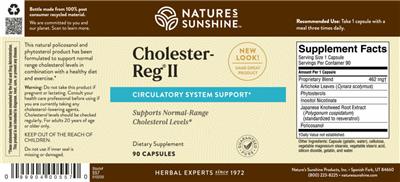
Supplement Facts
The label details for Cholester-Reg II by Nature's Sunshine, sourced from the NIH Dietary Supplement Label Database.
Supplement Facts
| Ingredient | Amount | % DV |
|---|---|---|
| Phytosterols | 0 NP | -- |
| Policosanol | 0 NP | -- |
| Japanese Knotweed Root Extract | 0 NP | -- |
| Proprietary Blend | 462 mg | -- |
| Inositol Nicotinate | 0 NP | -- |
| Artichoke | 0 NP | -- |
Other ingredients: Capsule, Cellulose, Magnesium Stearate, Stearic Acid, Silicon Dioxide, Gelatin, Water
Tap any ingredient to jump to its full detail below.
These statements are the manufacturer’s wording, reproduced from the product label — the label is saying it, not HelloPharmacist. We don’t verify or endorse them.
FDA Disclaimer Statement
These statements have not been evaluated by the Food and Drug Administration. This product is not intended to diagnose, treat, cure, or prevent any disease.
General Statements
Bottle made from 100% post consumer recycled material. We are committed to you and our planet. Scan to learn more.
New look! Same great product
Formula
This natural policosanol and phytosterol product has been formulated to support normal range cholesterol levels in combination with a healthy diet and exercise.
Precautions
Warning: Do not take this product if pregnant or lactating. Consult your health care professional before using if you are currently taking any cholesterol-lowering agents.
Cholesterol levels should be checked regularly. For adults 20 years of age or older only.
Keep out of the reach of children.
Do not use if inner seal is missing or damaged.
Formulation
Circulatory system support Supports normal-range cholesterol levels
Guaranteed pure
FDA Statement of Identity
Dietary Supplement
Brand IP Statement(s)
Natures Sunshine Herbal experts since 1972
Suggested/Recommended/Usage/Directions
Recommended Use: Take 1 capsule with a meal three times daily.
Is this label outdated? Report a formula or label change and our pharmacy team will review it.
Cholester-Reg II by Nature's Sunshine label
The label scan from the NIH Dietary Supplement Label Database. Tap to enlarge.
Label images are published by the NIH Dietary Supplement Label Database for the version of this product on file. Always read your actual product label.
View the full label (PDF)The Ingredients in Cholester-Reg II by Nature's Sunshine
These are the 5 active ingredients this product is made of. Select any to open its full monograph.
Serving size1 Capsule(s) Dosage formCapsule Servings per container90 Amounts shown are per serving.
Most supplement products combine several ingredients, and a medication can interact with the product through any one of them. Each ingredient below shows whether it has known drug interactions.
Proprietary Blend
- › Phytosterols
- › Policosanol
- › Japanese Knotweed Root Extract
- › Inositol Nicotinate
- › Artichoke
Other (inactive) ingredients: Capsule, Cellulose, Magnesium Stearate, Stearic Acid, Silicon Dioxide, Gelatin, Water. These complete the product’s ingredient list but are not active constituents.
Cholester-Reg II by Nature's Sunshine Drug Interactions
HelloPharmacist Interaction Report
Cholester-Reg II by Nature's Sunshine contains ingredients with documented interactions affecting multiple medication types.
The most serious concern involves policosanol, which can lower blood pressure additively with beta-blockers (including propranolol), potentially causing excessive blood pressure drop at Moderate severity. Policosanol also theoretically increases bleeding risk with blood thinners and antiplatelet drugs (anticoagulants like warfarin), and may raise low blood sugar risk with diabetes medications.
Read the full breakdown — every affected drug type, severity by severity
Japanese Knotweed Root Extract and inositol nicotinate add further considerations. Japanese Knotweed may increase levels of drugs broken down by several liver enzymes (CYP1A2, CYP2C19, CYP3A4, and CYP2E1 substrates)—a Moderate concern in theory, though not yet reported in people.
It also theoretically raises bleeding risk with blood thinners and may interfere with estrogen replacement therapy. Inositol nicotinate carries similar bleeding concerns and may worsen blood sugar control or interact with cholesterol-lowering statin drugs (raising myopathy risk).
Artichoke leaf extract may lower blood pressure further with blood pressure medications and blood sugar further with diabetes drugs, both Moderate severity, and may increase levels of drugs metabolized by CYP2C19 and CYP2B6 enzymes.
Phytosterols could not be checked against our interaction data. Altogether, these interactions span 1,076 individual medications.
Use the medication checker on this page to look up your exact drugs before starting, and talk with your doctor or pharmacist about whether this product fits safely with your current prescriptions.
Check your own medications below · Editorial policy · How we use AI
Want to check YOUR meds against Cholester-Reg II?
Ask about interactions with your drugs in plain English — “Can I take it with lisinopril?” — and we find you the answer in seconds, ingredient by ingredient.
Go to the checkerIngredients driving the most interactions
Individual Drug Interactions
The ingredients in Cholester-Reg II interact with 1,077 drugs. Click any drug to see the details.
4 of the 5 ingredients in Cholester-Reg II interact with drugs. Each result below shows which ingredient is responsible. Japanese Knotweed Root Extract Artichoke Policosanol Inositol Nicotinate
Ado-trastuzumab EmtansineKadcyla
How Ado-trastuzumab Emtansine interacts with Cholester-Reg II — through 1 ingredient. Tap an ingredient for the detail:
Japanese Knotweed Root ExtractCytochrome P450 3a4 (cyp3a4) Substrates Moderate
Interaction Summary
Theoretically, hu zhang might increase levels of drugs metabolized by CYP3A4.
Read the full Japanese Knotweed Root Extract + Ado-trastuzumab Emtansine interactionAbciximabReoPro
How Abciximab interacts with Cholester-Reg II — through 3 ingredients. Tap an ingredient for the detail:
Japanese Knotweed Root ExtractAnticoagulant/antiplatelet Drugs Moderate
Interaction Summary
Theoretically, hu zhang might increase the risk of bleeding when taken with anticoagulant or antiplatelet drugs.
Read the full Japanese Knotweed Root Extract + Abciximab interactionInositol NicotinateAnticoagulant/antiplatelet Drugs Moderate
Interaction Summary
Theoretically, concomitant use of inositol nicotinate with anticoagulant or antiplatelet drugs might increase the risk of bleeding.
Read the full Inositol Nicotinate + Abciximab interactionPolicosanolAnticoagulant/antiplatelet Drugs Moderate
Interaction Summary
Theoretically, taking policosanol with other antiplatelet or anticoagulant drugs might increase the risk of bruising and bleeding.
Read the full Policosanol + Abciximab interactionAbemaciclibVerzenio
How Abemaciclib interacts with Cholester-Reg II — through 1 ingredient. Tap an ingredient for the detail:
Japanese Knotweed Root ExtractCytochrome P450 3a4 (cyp3a4) Substrates Moderate
Interaction Summary
Theoretically, hu zhang might increase levels of drugs metabolized by CYP3A4.
Read the full Japanese Knotweed Root Extract + Abemaciclib interactionAbiraterone
How Abiraterone interacts with Cholester-Reg II — through 1 ingredient. Tap an ingredient for the detail:
Japanese Knotweed Root ExtractCytochrome P450 3a4 (cyp3a4) Substrates Moderate
Interaction Summary
Theoretically, hu zhang might increase levels of drugs metabolized by CYP3A4.
Read the full Japanese Knotweed Root Extract + Abiraterone interactionAbiraterone AcetateYonsa, Zytiga
How Abiraterone Acetate interacts with Cholester-Reg II — through 1 ingredient. Tap an ingredient for the detail:
Japanese Knotweed Root ExtractCytochrome P450 3a4 (cyp3a4) Substrates Moderate
Interaction Summary
Theoretically, hu zhang might increase levels of drugs metabolized by CYP3A4.
Read the full Japanese Knotweed Root Extract + Abiraterone Acetate interactionAbrocitinibCibinqo
How Abrocitinib interacts with Cholester-Reg II — through 4 ingredients. Tap an ingredient for the detail:
PolicosanolAnticoagulant/antiplatelet Drugs Moderate
Interaction Summary
Theoretically, taking policosanol with other antiplatelet or anticoagulant drugs might increase the risk of bruising and bleeding.
Read the full Policosanol + Abrocitinib interactionInositol NicotinateAnticoagulant/antiplatelet Drugs Moderate
Interaction Summary
Theoretically, concomitant use of inositol nicotinate with anticoagulant or antiplatelet drugs might increase the risk of bleeding.
Read the full Inositol Nicotinate + Abrocitinib interactionArtichokeCytochrome P450 2c19 (cyp2c19) Substrates Moderate
Interaction Summary
Theoretically, artichoke might increase serum levels of drugs metabolized by CYP2C19.
Read the full Artichoke + Abrocitinib interactionJapanese Knotweed Root ExtractAnticoagulant/antiplatelet Drugs, Cytochrome P450 2c19 (cyp2c19) Substrates Moderate
Interaction Summary
Theoretically, hu zhang might increase the risk of bleeding when taken with anticoagulant or antiplatelet drugs.
Read the full Japanese Knotweed Root Extract + Abrocitinib interactionAcalabrutinibCalquence
How Acalabrutinib interacts with Cholester-Reg II — through 1 ingredient. Tap an ingredient for the detail:
Japanese Knotweed Root ExtractCytochrome P450 3a4 (cyp3a4) Substrates Moderate
Interaction Summary
Theoretically, hu zhang might increase levels of drugs metabolized by CYP3A4.
Read the full Japanese Knotweed Root Extract + Acalabrutinib interactionAcarboseGlucobay, Prandase, Precose
How Acarbose interacts with Cholester-Reg II — through 3 ingredients. Tap an ingredient for the detail:
Inositol NicotinateAntidiabetes Drugs Moderate
Interaction Summary
Theoretically, inositol nicotinate might increase blood glucose levels and may diminish the effects of antidiabetes drugs.
Read the full Inositol Nicotinate + Acarbose interactionPolicosanolAntidiabetes Drugs Moderate
Interaction Summary
Theoretically, policosanol might have additive effects with antidiabetes drugs and increase the risk of hypoglycemia.
Read the full Policosanol + Acarbose interactionArtichokeAntidiabetes Drugs Moderate
Interaction Summary
Theoretically, artichoke leaf extract may increase the risk of hypoglycemia when taken with antidiabetes drugs.
Read the full Artichoke + Acarbose interactionAcebutololRhotral, Sectral
How Acebutolol interacts with Cholester-Reg II — through 2 ingredients. Tap an ingredient for the detail:
PolicosanolBeta-blockers Moderate
Interaction Summary
Concomitant use of policosanol with beta-blockers can cause additive blood pressure-lowering effects.
Read the full Policosanol + Acebutolol interactionArtichokeAntihypertensive Drugs Moderate
Interaction Summary
Theoretically, artichoke leaf extract may increase the risk of hypotension when taken with antihypertensive drugs.
Read the full Artichoke + Acebutolol interactionAcenocoumarolSintrom
How Acenocoumarol interacts with Cholester-Reg II — through 3 ingredients. Tap an ingredient for the detail:
Japanese Knotweed Root ExtractAnticoagulant/antiplatelet Drugs Moderate
Interaction Summary
Theoretically, hu zhang might increase the risk of bleeding when taken with anticoagulant or antiplatelet drugs.
Read the full Japanese Knotweed Root Extract + Acenocoumarol interactionInositol NicotinateAnticoagulant/antiplatelet Drugs Moderate
Interaction Summary
Theoretically, concomitant use of inositol nicotinate with anticoagulant or antiplatelet drugs might increase the risk of bleeding.
Read the full Inositol Nicotinate + Acenocoumarol interactionPolicosanolAnticoagulant/antiplatelet Drugs Moderate
Interaction Summary
Theoretically, taking policosanol with other antiplatelet or anticoagulant drugs might increase the risk of bruising and bleeding.
Read the full Policosanol + Acenocoumarol interactionAcetaminophenChildren's Tylenol, Children's Tylenol Meltaways, Tylenol, Tylenol Ex Strength
How Acetaminophen interacts with Cholester-Reg II — through 1 ingredient. Tap an ingredient for the detail:
Japanese Knotweed Root ExtractCytochrome P450 2e1 (cyp2e1) Substrates, Cytochrome P450 1a2 (cyp1a2) Substrates Moderate
Interaction Summary
Theoretically, hu zhang might increase levels of drugs metabolized by CYP2E1.
Read the full Japanese Knotweed Root Extract + Acetaminophen interactionAcetaminophen, AspirinGemnisyn
How Acetaminophen, Aspirin interacts with Cholester-Reg II — through 3 ingredients. Tap an ingredient for the detail:
Japanese Knotweed Root ExtractAnticoagulant/antiplatelet Drugs, Cytochrome P450 2e1 (cyp2e1) Substrates +1 Moderate
Interaction Summary
Theoretically, hu zhang might increase the risk of bleeding when taken with anticoagulant or antiplatelet drugs.
Read the full Japanese Knotweed Root Extract + Acetaminophen, Aspirin interactionPolicosanolAnticoagulant/antiplatelet Drugs Moderate
Interaction Summary
Theoretically, taking policosanol with other antiplatelet or anticoagulant drugs might increase the risk of bruising and bleeding.
Read the full Policosanol + Acetaminophen, Aspirin interactionInositol NicotinateAnticoagulant/antiplatelet Drugs Moderate
Interaction Summary
Theoretically, concomitant use of inositol nicotinate with anticoagulant or antiplatelet drugs might increase the risk of bleeding.
Read the full Inositol Nicotinate + Acetaminophen, Aspirin interactionAcetaminophen, Aspirin, CaffeineExcedrin, Excedrin Extra Strength, Excedrin Migraine
How Acetaminophen, Aspirin, Caffeine interacts with Cholester-Reg II — through 3 ingredients. Tap an ingredient for the detail:
Inositol NicotinateAnticoagulant/antiplatelet Drugs Moderate
Interaction Summary
Theoretically, concomitant use of inositol nicotinate with anticoagulant or antiplatelet drugs might increase the risk of bleeding.
Read the full Inositol Nicotinate + Acetaminophen, Aspirin, Caffeine interactionPolicosanolAnticoagulant/antiplatelet Drugs Moderate
Interaction Summary
Theoretically, taking policosanol with other antiplatelet or anticoagulant drugs might increase the risk of bruising and bleeding.
Read the full Policosanol + Acetaminophen, Aspirin, Caffeine interactionJapanese Knotweed Root ExtractCytochrome P450 2e1 (cyp2e1) Substrates, Anticoagulant/antiplatelet Drugs +2 Moderate
Interaction Summary
Theoretically, hu zhang might increase levels of drugs metabolized by CYP2E1.
Read the full Japanese Knotweed Root Extract + Acetaminophen, Aspirin, Caffeine interactionAcetaminophen, Brompheniramine, PhenylpropanolamineDimetapp Cold and Flu
How Acetaminophen, Brompheniramine, Phenylpropanolamine interacts with Cholester-Reg II — through 1 ingredient. Tap an ingredient for the detail:
Japanese Knotweed Root ExtractCytochrome P450 2e1 (cyp2e1) Substrates, Cytochrome P450 1a2 (cyp1a2) Substrates Moderate
Interaction Summary
Theoretically, hu zhang might increase levels of drugs metabolized by CYP2E1.
Read the full Japanese Knotweed Root Extract + Acetaminophen, Brompheniramine, Phenylpropanolamine interactionAcetaminophen, ButalbitalAxocet, Bancap, Bucet, Butex Forte, Esgic CF, Orbivan CF +5 more
How Acetaminophen, Butalbital interacts with Cholester-Reg II — through 1 ingredient. Tap an ingredient for the detail:
Japanese Knotweed Root ExtractCytochrome P450 1a2 (cyp1a2) Substrates, Cytochrome P450 2e1 (cyp2e1) Substrates Moderate
Interaction Summary
Theoretically, hu zhang might increase levels of drugs metabolized by CYP1A2.
Read the full Japanese Knotweed Root Extract + Acetaminophen, Butalbital interactionAcetaminophen, Butalbital, CaffeineEsgic, Esgic Plus, Fiogesic, Fioricet, Repan, Tecnal +1 more
How Acetaminophen, Butalbital, Caffeine interacts with Cholester-Reg II — through 1 ingredient. Tap an ingredient for the detail:
Japanese Knotweed Root ExtractCytochrome P450 2e1 (cyp2e1) Substrates, Cytochrome P450 3a4 (cyp3a4) Substrates +1 Moderate
Interaction Summary
Theoretically, hu zhang might increase levels of drugs metabolized by CYP2E1.
Read the full Japanese Knotweed Root Extract + Acetaminophen, Butalbital, Caffeine interactionAcetaminophen, Butalbital, Caffeine, CodeineEsgic with Codeine, Fioricet w/ Codeine
How Acetaminophen, Butalbital, Caffeine, Codeine interacts with Cholester-Reg II — through 1 ingredient. Tap an ingredient for the detail:
Japanese Knotweed Root ExtractCytochrome P450 2e1 (cyp2e1) Substrates, Cytochrome P450 3a4 (cyp3a4) Substrates +1 Moderate
Interaction Summary
Theoretically, hu zhang might increase levels of drugs metabolized by CYP2E1.
Read the full Japanese Knotweed Root Extract + Acetaminophen, Butalbital, Caffeine, Codeine interactionAcetaminophen, Butalbital, CodeineBancap w/ Codeine
How Acetaminophen, Butalbital, Codeine interacts with Cholester-Reg II — through 1 ingredient. Tap an ingredient for the detail:
Japanese Knotweed Root ExtractCytochrome P450 1a2 (cyp1a2) Substrates, Cytochrome P450 2e1 (cyp2e1) Substrates Moderate
Interaction Summary
Theoretically, hu zhang might increase levels of drugs metabolized by CYP1A2.
Read the full Japanese Knotweed Root Extract + Acetaminophen, Butalbital, Codeine interactionAcetaminophen, Butalbital, Codeine PhosphatePhrenilin #3
How Acetaminophen, Butalbital, Codeine Phosphate interacts with Cholester-Reg II — through 1 ingredient. Tap an ingredient for the detail:
Japanese Knotweed Root ExtractCytochrome P450 2e1 (cyp2e1) Substrates, Cytochrome P450 1a2 (cyp1a2) Substrates Moderate
Interaction Summary
Theoretically, hu zhang might increase levels of drugs metabolized by CYP2E1.
Read the full Japanese Knotweed Root Extract + Acetaminophen, Butalbital, Codeine Phosphate interactionAcetaminophen, Caffeine, Chlorpheniramine, Hydrocodone, PhenylephrineHycomine Compound
How Acetaminophen, Caffeine, Chlorpheniramine, Hydrocodone, Phenylephrine interacts with Cholester-Reg II — through 1 ingredient. Tap an ingredient for the detail:
Japanese Knotweed Root ExtractCytochrome P450 2e1 (cyp2e1) Substrates, Cytochrome P450 1a2 (cyp1a2) Substrates +1 Moderate
Interaction Summary
Theoretically, hu zhang might increase levels of drugs metabolized by CYP2E1.
Read the full Japanese Knotweed Root Extract + Acetaminophen, Caffeine, Chlorpheniramine, Hydrocodone, Phenylephrine interactionAcetaminophen, Caffeine, CodeineGesic C15, Gesic C30, Gesic C8, Lenoltec 1, Lenoltec 2, Lenoltec 3 +1 more
How Acetaminophen, Caffeine, Codeine interacts with Cholester-Reg II — through 1 ingredient. Tap an ingredient for the detail:
Japanese Knotweed Root ExtractCytochrome P450 3a4 (cyp3a4) Substrates, Cytochrome P450 1a2 (cyp1a2) Substrates +1 Moderate
Interaction Summary
Theoretically, hu zhang might increase levels of drugs metabolized by CYP3A4.
Read the full Japanese Knotweed Root Extract + Acetaminophen, Caffeine, Codeine interactionAcetaminophen, Caffeine, Codeine, SalicylamideCodalan No.1, Codalan No.2, Codalan No.3
How Acetaminophen, Caffeine, Codeine, Salicylamide interacts with Cholester-Reg II — through 1 ingredient. Tap an ingredient for the detail:
Japanese Knotweed Root ExtractCytochrome P450 2e1 (cyp2e1) Substrates, Cytochrome P450 1a2 (cyp1a2) Substrates +1 Moderate
Interaction Summary
Theoretically, hu zhang might increase levels of drugs metabolized by CYP2E1.
Read the full Japanese Knotweed Root Extract + Acetaminophen, Caffeine, Codeine, Salicylamide interactionAcetaminophen, Caffeine, DihydrocodeineDHC Plus, Panlor DC, Panlor SS
How Acetaminophen, Caffeine, Dihydrocodeine interacts with Cholester-Reg II — through 1 ingredient. Tap an ingredient for the detail:
Japanese Knotweed Root ExtractCytochrome P450 3a4 (cyp3a4) Substrates, Cytochrome P450 2e1 (cyp2e1) Substrates +1 Moderate
Interaction Summary
Theoretically, hu zhang might increase levels of drugs metabolized by CYP3A4.
Read the full Japanese Knotweed Root Extract + Acetaminophen, Caffeine, Dihydrocodeine interactionAcetaminophen, Caffeine, IsomethepteneMigralam
How Acetaminophen, Caffeine, Isometheptene interacts with Cholester-Reg II — through 1 ingredient. Tap an ingredient for the detail:
Japanese Knotweed Root ExtractCytochrome P450 1a2 (cyp1a2) Substrates, Cytochrome P450 3a4 (cyp3a4) Substrates +1 Moderate
Interaction Summary
Theoretically, hu zhang might increase levels of drugs metabolized by CYP1A2.
Read the full Japanese Knotweed Root Extract + Acetaminophen, Caffeine, Isometheptene interactionAcetaminophen, Caffeine, PyrilamineMidol Max Strength Menstrual
How Acetaminophen, Caffeine, Pyrilamine interacts with Cholester-Reg II — through 1 ingredient. Tap an ingredient for the detail:
Japanese Knotweed Root ExtractCytochrome P450 2e1 (cyp2e1) Substrates, Cytochrome P450 1a2 (cyp1a2) Substrates +1 Moderate
Interaction Summary
Theoretically, hu zhang might increase levels of drugs metabolized by CYP2E1.
Read the full Japanese Knotweed Root Extract + Acetaminophen, Caffeine, Pyrilamine interactionAcetaminophen, Chlorpheniramine Maleate, Dextromethorphan HbrVicks Formula 44M Cough, Cold & Flu Relief
How Acetaminophen, Chlorpheniramine Maleate, Dextromethorphan Hbr interacts with Cholester-Reg II — through 1 ingredient. Tap an ingredient for the detail:
Japanese Knotweed Root ExtractCytochrome P450 2e1 (cyp2e1) Substrates, Cytochrome P450 1a2 (cyp1a2) Substrates +1 Moderate
Interaction Summary
Theoretically, hu zhang might increase levels of drugs metabolized by CYP2E1.
Read the full Japanese Knotweed Root Extract + Acetaminophen, Chlorpheniramine Maleate, Dextromethorphan Hbr interactionAcetaminophen, Chlorpheniramine, Codeine, PhenylephrineColrex
How Acetaminophen, Chlorpheniramine, Codeine, Phenylephrine interacts with Cholester-Reg II — through 1 ingredient. Tap an ingredient for the detail:
Japanese Knotweed Root ExtractCytochrome P450 3a4 (cyp3a4) Substrates, Cytochrome P450 1a2 (cyp1a2) Substrates +1 Moderate
Interaction Summary
Theoretically, hu zhang might increase levels of drugs metabolized by CYP3A4.
Read the full Japanese Knotweed Root Extract + Acetaminophen, Chlorpheniramine, Codeine, Phenylephrine interactionAcetaminophen, Chlorpheniramine, DextromethorphanCoricidin II Extra Strength Cold and Flu
How Acetaminophen, Chlorpheniramine, Dextromethorphan interacts with Cholester-Reg II — through 1 ingredient. Tap an ingredient for the detail:
Japanese Knotweed Root ExtractCytochrome P450 2e1 (cyp2e1) Substrates, Cytochrome P450 3a4 (cyp3a4) Substrates +1 Moderate
Interaction Summary
Theoretically, hu zhang might increase levels of drugs metabolized by CYP2E1.
Read the full Japanese Knotweed Root Extract + Acetaminophen, Chlorpheniramine, Dextromethorphan interactionAcetaminophen, Chlorpheniramine, Dextromethorphan HydrobromideCoricidin HBP Maximum Strength Flu
How Acetaminophen, Chlorpheniramine, Dextromethorphan Hydrobromide interacts with Cholester-Reg II — through 1 ingredient. Tap an ingredient for the detail:
Japanese Knotweed Root ExtractCytochrome P450 1a2 (cyp1a2) Substrates, Cytochrome P450 2e1 (cyp2e1) Substrates +1 Moderate
Interaction Summary
Theoretically, hu zhang might increase levels of drugs metabolized by CYP1A2.
Read the full Japanese Knotweed Root Extract + Acetaminophen, Chlorpheniramine, Dextromethorphan Hydrobromide interactionAcetaminophen, Chlorpheniramine, Dextromethorphan, PhenylpropanolamineMulti Symptom Cold Relief
How Acetaminophen, Chlorpheniramine, Dextromethorphan, Phenylpropanolamine interacts with Cholester-Reg II — through 1 ingredient. Tap an ingredient for the detail:
Japanese Knotweed Root ExtractCytochrome P450 2e1 (cyp2e1) Substrates, Cytochrome P450 1a2 (cyp1a2) Substrates +1 Moderate
Interaction Summary
Theoretically, hu zhang might increase levels of drugs metabolized by CYP2E1.
Read the full Japanese Knotweed Root Extract + Acetaminophen, Chlorpheniramine, Dextromethorphan, Phenylpropanolamine interactionEach ingredient & the kinds of drugs it affects
For each ingredient in Cholester-Reg II with known interactions, here are the types of medications they can affect. Open any type for the detail — or search your exact drug in the checker above.
Japanese Knotweed Root Extract
Anticoagulant/Antiplatelet Drugs
Theoretically, hu zhang might increase the risk of bleeding when taken with anticoagulant or antiplatelet drugs.
Hu zhang contains the constituent resveratrol. Resveratrol seems to have antiplatelet effects.
Cytochrome P450 1A2 (Cyp1A2) Substrates
Theoretically, hu zhang might increase levels of drugs metabolized by CYP1A2.
Hu zhang contains the constituent resveratrol. In vitro research shows that resveratrol might inhibit the CYP1A2 enzyme. This interaction has not been reported in humans.
Cytochrome P450 2C19 (Cyp2C19) Substrates
Theoretically, hu zhang might increase levels of drugs metabolized by CYP2C19.
Hu zhang contains the constituent resveratrol. In vitro research shows that resveratrol might inhibit the CYP2C19 enzyme. This interaction has not been reported in humans.
Cytochrome P450 2E1 (Cyp2E1) Substrates
Theoretically, hu zhang might increase levels of drugs metabolized by CYP2E1.
Hu zhang contains the constituent resveratrol. In vitro research shows that resveratrol might inhibit the CYP2E1 enzyme. Also, a pharmacokinetic study shows that taking resveratrol 500 mg daily for 10 days prior to taking a single dose of chlorzoxazone 250 mg increases the maximum concentration of chlorzoxazone by about 54%, the area under the curve of chlorzoxazone by about 72%, and the half-life of chlorzoxazone by about 35%. Chlorzoxazone is used as a probe drug for CYP2E1.
Cytochrome P450 3A4 (Cyp3A4) Substrates
Theoretically, hu zhang might increase levels of drugs metabolized by CYP3A4.
Hu zhang contains the constituent resveratrol. In vitro research shows that resveratrol might inhibit the CYP3A4 enzyme. However, a clinical study in adults with NAFLD found that adding resveratrol 3000 mg daily for 8 weeks did not necessitate dose adjustments to any established medications metabolized by CYP3A4.
Estrogens
Theoretically, hu zhang might competitively inhibit the effects of estrogen replacement therapy.
In vitro research shows that hu zhang might have estrogenic activity.
Carbamazepine (Tegretol)
Theoretically, hu zhang might increase the effects and adverse effects of carbamazepine.
In animals, blood and tissue levels of carbamazepine were increased when given in combination with hu zhang. It is thought that increased levels of carbamazepine are due to cytochrome P450 3A4 (CYP3A4) inhibition. This interaction has not been reported in humans.
Artichoke
Antidiabetes Drugs
Theoretically, artichoke leaf extract may increase the risk of hypoglycemia when taken with antidiabetes drugs.
A meta-analysis of small clinical studies shows that taking artichoke leaf extract for 8-12 weeks can modestly reduce fasting plasma glucose when compared with placebo.
Antihypertensive Drugs
Theoretically, artichoke leaf extract may increase the risk of hypotension when taken with antihypertensive drugs.
A meta-analysis of small clinical studies in patients with hypertension shows that taking artichoke can reduce systolic blood pressure by around 3 mmHg and diastolic blood pressure by around 2 mmHg when compared with placebo.
Cytochrome P450 2B6 (Cyp2B6) Substrates
Theoretically, artichoke might increase serum levels of drugs metabolized by CYP2B6.
In vitro research shows that artichoke leaf extract inhibits CYP2B6 activity. However, this interaction has not been reported in humans.
Cytochrome P450 2C19 (Cyp2C19) Substrates
Theoretically, artichoke might increase serum levels of drugs metabolized by CYP2C19.
In vitro research shows that artichoke leaf extract inhibits CYP2C19 activity. However, this interaction has not been reported in humans.
Policosanol
Anticoagulant/Antiplatelet Drugs
Theoretically, taking policosanol with other antiplatelet or anticoagulant drugs might increase the risk of bruising and bleeding.
Some clinical research shows that taking policosanol 10-50 mg daily for 7-15 days can inhibit platelet aggregation in healthy patients. Although, one clinical trial shows that taking policosanol 10 mg twice daily for 2 weeks prior to warfarin dosing does not affect warfarin pharmacokinetics or warfarin response. Furthermore, a study in patients undergoing percutaneous coronary intervention with a drug-eluting stent found that taking policosanol 40 mg plus clopidogrel and aspirin daily for 30 days modestly reduced the risk for minor bleeding events when compared with taking clopidogrel and aspirin alone. Until more is known, use with caution.
Antidiabetes Drugs
Theoretically, policosanol might have additive effects with antidiabetes drugs and increase the risk of hypoglycemia.
Clinical research shows that policosanol can lower blood glucose levels.
Beta-Blockers
Concomitant use of policosanol with beta-blockers can cause additive blood pressure-lowering effects.
Clinical research shows that policosanol 5 mg daily can have additive blood pressure-lowering effects in patients with hypertension who are taking beta-blockers. Also, animal research shows that policosanol can increase the blood-pressure lowering effects of propranolol.
Nitroprusside (Nitropress)
Theoretically, concomitant use of policosanol with nitroprusside might cause additive blood pressure-lowering effects.
Animal research shows that taking policosanol along with nitroprusside can increase the blood pressure-lowering effects of nitroprusside.
Propranolol (Inderal)
Animal research shows that taking policosanol along with propranolol can increase the blood pressure-lowering effects of propranolol.
Warfarin (Coumadin)
Theoretically, taking policosanol with warfarin might increase the risk of bruising and bleeding.
Some clinical research shows that taking policosanol 10-50 mg daily for 7-15 days can inhibit platelet aggregation in healthy patients. However, one clinical trial shows that taking policosanol 10 mg twice daily for 2 weeks prior to warfarin dosing does not affect warfarin pharmacokinetics or warfarin response.
Inositol Nicotinate
Anticoagulant/Antiplatelet Drugs
Theoretically, concomitant use of inositol nicotinate with anticoagulant or antiplatelet drugs might increase the risk of bleeding.
Inositol nicotinate has fibrinolytic effects, which may increase the risk of bleeding when used concomitantly with anticoagulant/antiplatelet drugs.
Antidiabetes Drugs
Theoretically, inositol nicotinate might increase blood glucose levels and may diminish the effects of antidiabetes drugs.
Inositol nicotinate is metabolized to niacin in the body. Niacin can cause hyperglycemia, abnormal glucose tolerance, and glycosuria. Increased blood glucose monitoring may be necessary, particularly early in the course of treatment.
Hmg-Coa Reductase Inhibitors ("Statins")
Theoretically, concomitant use of inositol nicotinate and statins might increase the risk of myopathy and rhabdomyolysis.
Inositol nicotinate is metabolized to niacin in the body. Some case reports have raised concerns that niacin might increase the risk of myopathy and rhabdomyolysis when combined with statins However, a significantly increased risk of myopathy has not been demonstrated in clinical trials.
Transdermal Nicotine (Nicoderm)
Theoretically, concomitant use of inositol nicotinate and transdermal nicotine might increase the risk of flushing and dizziness.
Inositol nicotinate is metabolized to niacin in the body. Inositol nicotinate and nicotine can both cause flushing and dizziness.
Brand information
Manufacturer and brand details for Cholester-Reg II, from the product label.
Nature's Sunshine
See all Nature's Sunshine products- Name
- Nature's Sunshine Products, Inc
- City
- Spanish Fork
- State
- Utah
- ZipCode
- 84660
- Phone Number
- 1-800-223-8225
- Web Address
- www.naturessunshine.com
Cholester-Reg II by Nature's Sunshine: Common Questions
Does Cholester-Reg II by Nature's Sunshine interact with any medications?
How can one product interact with so many drugs?
Where does this information come from?
Is policosanol safe to take if I'm on a blood pressure medication?
What side effects might I notice from policosanol?
Can I take this if I'm on a blood thinner like warfarin?
Is Cholester-Reg II safe during pregnancy or while breastfeeding?
Does this product actually lower cholesterol?
Are there any fillers or other inactive ingredients I should know about?
Written and reviewed by the HelloPharmacist editorial staff. Our editorial policy
Not sure if Cholester-Reg II is safe with your meds?
Our pharmacists answer your medication & supplement questions — free.
Label information is sourced from the NIH Dietary Supplement Label Database and reflects the product version on file; always read your actual product label. This page is for education only and is not a substitute for professional medical advice. Confirm with your pharmacist or doctor before combining supplements and medications.
The Full Monographs Behind Cholester-Reg II’s Ingredients
Every ingredient we hold a full HelloPharmacist monograph for — uses, evidence, safety, and the complete interaction list.
Policosanol
Interacts with 242 drugsPolicosanol is a mix of waxy alcohols (mostly octacosanol) made from sugar cane or other plant waxes, and it is often marketed as a natural way to lower cholesterol. Early studies from Cuba...
Read the full Policosanol monograph → Herb & supplement monographHu Zhang
Interacts with 828 drugsHu Zhang (Japanese knotweed root) is a traditional Chinese herb that is one of the richest natural sources of resveratrol and emodin. Some lab and early human research looks interesting for...
Read the full Hu Zhang monograph → Herb & supplement monographInositol Nicotinate
Interacts with 223 drugsInositol nicotinate is a 'no-flush' form of niacin marketed for cholesterol and circulation. Evidence that it works as well as regular niacin is weak and inconsistent, and it is not a proven...
Read the full Inositol Nicotinate monograph → Herb & supplement monographArtichoke
Interacts with 364 drugsArtichoke leaf extract is a generally well-tolerated supplement that may have a mild cholesterol-lowering effect and is often used for indigestion, though the evidence is modest. It is not a...
Read the full Artichoke monograph →Sources & How We Checked
Cholester-Reg II's label data comes from the NIH Dietary Supplement Label Database; the ingredient interaction data is from the Natural Medicines database, reviewed by our pharmacists.
- NIH Dietary Supplement Label Database (DSLD) — The official product label on file for this supplement.
- Natural Medicines (Therapeutic Research Center) — Evidence-graded clinical reference behind the ingredient interaction data.
Content is written and reviewed by licensed HelloPharmacist pharmacists. See our data sources and editorial standards for how this information is built and checked.
The 71 references behind this product’s interaction data
Every citation that drives the interaction findings for this product’s ingredients, from the evidence-graded Natural Medicines (TRC Healthcare) database. Open an ingredient to browse its citations — links open the study on PubMed or the publisher’s site.
Policosanol 15 references
- Carbajal D, Arruzazabala ML, Valdes S, Mas R. Effect of policosanol on platelet aggregation and serum levels of arachidonic acid metabolites in healthy volunteers. Prostaglandins Leukot Essent Fatty Acids 1998;58:61-4.
- Arruzazabala ML, Valdes S, Mas R, et al. Comparative study of policosanol, aspirin and the combination therapy policosanol-aspirin on platelet aggregation in healthy volunteers. Pharmacol Res 1997;36:293-7. PubMed
- Valdes S, Arruzazabala ML, Fernandez L. Effect of policosanol on platelet aggregation in healthy volunteers. Int J Clin Pharmacol Res 1996;16:67-72.
- Greyling A, De Witt C, Oosthuizen W, Jerling JC. Effects of a policosanol supplement on serum lipid concentrations in hypercholesterolaemic and heterozygous familial hypercholesterolaemic subjects. Br J Nutr 2006;95:968-75. PubMed
- Abdul MI, Jiang X, Williams KM, et al. Pharmacokinetic and pharmacodynamic interactions of echinacea and policosanol with warfarin in healthy subjects. Br J Clin.Pharmacol. 2010;69:508-15. PubMed
- Molina, Cuevas, V, Arruzazabala, M. L., Carbajal, Quintana D., Mas, Ferreiro R., and Valdes, Garcia S. Effect of policosanol on arterial blood pressure in rats. Study of the pharmacological interaction with nifedipine and propranolol. Arch Med Res 1998;29
- Castano G, Fernandez L, Mas R, et al. Comparison of the efficacy, safety and tolerability of original policosanol versus other mixtures of higher aliphatic primary alcohols in patients with type II hypercholesterolemia. Int.J.Clin.Pharmacol.Res. 2002;22:5
- Arruzazabala, M. L., Carbajal, D., Mas, R., Valdes, S., and Molina, V. Pharmacological Interaction Between Policosanol and Nitroprusside in Rats. J Med Food 2001;4(2):67-70. PubMed
- Castano G, Mas R, Gamez R, et al. Concomitant use of policosanol and beta-blockers in older patients. Int J Clin Pharmacol.Res 2004;24:65-77.
- Francini-Pesenti F, Brocadello F, Beltramolli D, et al. Sugar cane policosanol failed to lower plasma cholesterol in primitive, diet-resistant hypercholesterolaemia: A double blind, controlled study. Complement Ther Med 2008;16:61-65. PubMed
- Castaño G, Fernández L, Mas R, Illnait J, Mesa M, Fernández JC. Comparison of the effects of policosanol and atorvastatin on lipid profile and platelet aggregation in patients with dyslipidaemia and type 2 diabetes mellitus. Clin Drug Investig. 2003;23(10 PubMed
- Fernandez L, Mas R, Illnait J, Fernandez JC. Policosanol: results of a postmarketing surveillance study of 27,879 patients. Curr Ther Res 1998;59(10):717-22. DOI
- Wang HY, Jiao QP, Chen SY, et al. Efficacy and safety of policosanol plus fenofibrate combination therapy in elderly patients with mixed dyslipidemia: A randomized, controlled clinical study. Am J Med Sci. 2018;356(3):254-261. PubMed
- Xu K, Liu X, Li Y, Wang Y, Zang H, Guo L, et al. Safety and efficacy of policosanol in patients with high on-treatment platelet reactivity after drug-eluting stent implantation: two-year follow-up results. Cardiovasc Ther. 2016 Oct;34(5):337-42. doi: 10.1 PubMed
- Li C, Ding Y, Si Q, Li K, Xu K. Multiple functions of policosanol in elderly patients with dyslipidemia. J Int Med Res. 2020;48(7):300060520936082. PubMed
Hu Zhang 19 references
- Pace-Asciak CR, Rounova O, Hahn SE, et al. Wines and grape juices as modulators of platelet aggregation in healthy human subjects. Clin Chim Acta 1996;246:163-82. PubMed
- Bertelli AA, Giovannini L, Bernini W, et al. Antiplatelet activity of cis-resveratrol. Drugs Exp Clin Res 1996;22:61-3.
- Pace-Asciak CR, Hahn S, Diamandis EP, et al. The red wine phenolics trans-resveratrol and quercetin block human platelet aggregation and eicosanoid synthesis: implications for protection against coronary heart disease. Clin Chim Acta 1995;235:207-19.
- Bertelli A, Bertelli AA, Gozzini A, Giovannini L. Plasma and tissue resveratrol concentrations and pharmacological activity. Drugs Exp Clin Res 1998;24:133-8.
- Bertelli AA, Giovannini L, Giannessi D, et al. Antiplatelet activity of synthetic and natural resveratrol in red wine. Int J Tissue React 1995;17:1-3.
- Piver B, Berthou F, Dreano Y, Lucas D. Inhibition of CYP3A, CYP1A and CYP2E1 activities by resveratrol and other non volatile red wine components. Toxicol Lett 2001;125:83-91. PubMed
- Matsuda H, Shimoda H, Morikawa T, Yoshikawa M. Phytoestrogens from the roots of Polygonum cuspidatum (Polygonaceae): structure-requirement of hydroxyanthraquinones for estrogenic activity. Bioorg Med Chem Lett 2001;11:1839-42. PubMed
- Zhang CZ, Wang SX, Zhang Y, et al. In vitro estrogenic activities of Chinese medicinal plants traditionally used for the management of menopausal symptoms. J Ethnopharmacol 2005;98:295-300. PubMed
- Chang, T. K., Chen, J., and Lee, W. B. Differential inhibition and inactivation of human CYP1 enzymes by trans-resveratrol: evidence for mechanism-based inactivation of CYP1A2. J.Pharmacol.Exp.Ther. 2001;299(3):874-882.
- Dobrydneva, Y., Williams, R. L., and Blackmore, P. F. trans-Resveratrol inhibits calcium influx in thrombin-stimulated human platelets. Br.J.Pharmacol. 1999;128(1):149-157.
- Kirk, R. I., Deitch, J. A., Wu, J. M., and Lerea, K. M. Resveratrol decreases early signaling events in washed platelets but has little effect on platalet in whole food. Blood Cells Mol.Dis. 2000;26(2):144-150.
- Zbikowska, H. M. and Olas, B. Antioxidants with carcinostatic activity (resveratrol, vitamin E and selenium) in modulation of blood platelet adhesion. J Physiol Pharmacol. 2000;51(3):513-520.
- Olas, B., Wachowicz, B., Saluk-Juszczak, J., and Zielinski, T. Effect of resveratrol, a natural polyphenolic compound, on platelet activation induced by endotoxin or thrombin. Thromb.Res 8-15-2002;107(3-4):141-145. PubMed
- Yu, C., Shin, Y. G., Kosmeder, J. W., Pezzuto, J. M., and van Breemen, R. B. Liquid chromatography/tandem mass spectrometric determination of inhibition of human cytochrome P450 isozymes by resveratrol and resveratrol-3-sulfate. Rapid Commun.Mass Spectro PubMed
- Ma, Z. H. and Ma, Q. Y. Resveratrol: a medical drug for acute pancreatitis. World J Gastroenterol. 6-7-2005;11(21):3171-3174. PubMed
- Pendurthi, U. R., Williams, J. T., and Rao, L. V. Resveratrol, a polyphenolic compound found in wine, inhibits tissue factor expression in vascular cells : A possible mechanism for the cardiovascular benefits associated with moderate consumption of wine. PubMed
- Chachay VS, Macdonald GA, Martin JH, Whitehead JP, O'Moore-Sullivan TM, Lee P, Franklin M, Klein K, Taylor PJ, Ferguson M, Coombes JS, Thomas GP, Cowin GJ, Kirkpatrick CM, Prins JB, Hickman IJ. Resveratrol does not benefit patients with nonalcoholic fatty
- Bedada SK, Neerati P. Resveratrol Pretreatment Affects CYP2E1 Activity of Chlorzoxazone in Healthy Human Volunteers. Phytother Res. 2016;30(3):463-8. PubMed
- Chi YC, Lin SP, Hou YC. A new herb-drug interaction of Polygonum cuspidatum, a resveratrol-rich nutraceutical, with carbamazepine in rats. Toxicol Appl Pharmacol 2012;263(3):315-22. PubMed
Inositol Nicotinate 21 references
- Anon. Inositol hexaniacinate. Altern Med Rev 1998;3:222-3.
- Holti G. An experimentally controlled evaluation of the effect of inositol nicotinate upon the digital blood flow in patients with Raynaud's phenomenon. J Int Med Res 1979;7:473-83. PubMed
- Knodel LC, Talbert RL. Adverse effects of hypolipidaemic drugs. Med Toxicol 1987;2:10-32. PubMed
- Gibbons LW, Gonzalez V, Gordon N, Grundy S. The prevalence of side effects with regular and sustained-release nicotinic acid. Am J Med 1995;99:378-85. PubMed
- Crouse JR III. New developments in the use of niacin for treatment of hyperlipidemia: new considerations in the use of an old drug. Coron Artery Dis 1996;7:321-6. PubMed
- Garg A, Grundy SM. Nicotinic acid as therapy for dyslipidemia in non-insulin-dependent diabetes mellitus. JAMA 1990;264:723-6. DOI
- American Society of Health-System Pharmacists. ASHP Therapeutic Position Statement on the safe use of niacin in the management of dyslipidemias. Am J Health Syst Pharm 1997;54:2815-9. DOI
- Guyton JR, Goldberg AC, Kreisberg RA, et al. Effectiveness of once-nightly dosing of extended-release niacin alone and in combination for hypercholesterolemia. Am J Cardiol 1998;82:737-43.
- Food and Nutrition Board, Institute of Medicine. Dietary Reference Intakes for Thiamin, Riboflavin, Niacin, Vitamin B6, Folate, Vitamin B12, Pantothenic Acid, Biotin, and Choline (2000). Washington, DC: National Academy Press, 2000. Available at: http://b
- Brown BG, Zhao XQ, Chait A, et al. Simvastatin and niacin, antioxidant vitamins, or the combination for the prevention of coronary disease. N Engl J Med 2001;345:1583-93. DOI
- Bays HE, Dujovne CA. Drug interactions of lipid-altering drugs. Drug Saf 1998;19:355-71. PubMed
- Figge HL, Figge J, Souney PF, et al. Nicotinic acid: a review of its clinical use in the treatment of lipid disorders. Pharmacotherapy 1988;8:287-94. PubMed
- McKenney J. New perspectives on the use of niacin in the treatment of lipid disorders. Arch Intern Med 2004;164:697-705. PubMed
- Reaven P, Witztum JL. Lovastatin, nicotinic acid and rhabdomyolysis (letter). Ann Int Med 1988;109:597-8. PubMed
- Ito MK. Advances in the understanding and management of dyslipidemia: using niacin-based therapies. Am J Health-Syst Pharm 2003;60(suppl 2):s15-21. PubMed
- Garnett WR. Interactions with hydroxymethylglutaryl-coenzyme A reductase inhibitors. Am J Health Syst Pharm. 1995;52(15):1639-45. PubMed
- Andersson RG, Aberg G, Brattsand R, Ericsson E, Lundholm L. Studies on the mechanism of flush induced by nicotinic acid. Acta Pharmacol Toxicol (Copenh). 1977 Jul;41(1):1-10. PubMed
- Brown WV. Niacin for lipid disorders. Indications, effectiveness, and safety. Postgrad Med. 1995 Aug;98(2):185-9, 192-3. PubMed
- Aramwit P, Srisawadwong R, Supasyndh O. Effectiveness and safety of extended-release nicotinic acid for reducing serum phosphorus in hemodialysis patients. J Nephrol. 2012 May-Jun;25(3):354-62. PubMed
- He YM, Feng L, Huo DM, Yang ZH, Liao YH. Benefits and harm of niacin and its analog for renal dialysis patients: a systematic review and meta-analysis. Int Urol Nephrol. 2014 Feb;46(2):433-42. PubMed
- Schandelmaier S, Briel M, Saccilotto R, Olu KK, Arpagaus A, Hemkens LG, Nordmann AJ. Niacin for primary and secondary prevention of cardiovascular events. Cochrane Database Syst Rev. 2017 Jun 14;6:CD009744. PubMed
Artichoke 16 references
- Leung AY, Foster S. Encyclopedia of Common Natural Ingredients Used in Food, Drugs and Cosmetics. 2nd ed. New York, NY: John Wiley & Sons, 1996.
- Walker AF, Middleton RW, Petrowicz O. Artichoke leaf extract reduces symptoms of irritable bowel syndrome in a post-marketing surveillance study. Phytother Res 2001;15:58-61. PubMed
- Pittler MH, White AR, Stevinson C, Ernst E. Effectiveness of artichoke extract in preventing alcohol-induced hangovers: a randomized controlled trial. CMAJ 2003;169:1269-73.
- Romano, C., Ferrara, A., and Falagiani, P. A case of allergy to globe artichoke and other clinical cases of rare food allergy. J Investig.Allergol.Clin Immunol. 2000;10(2):102-104.
- Miralles, J. C., Garcia-Sells, J., Bartolome, B., and Negro, J. M. Occupational rhinitis and bronchial asthma due to artichoke (Cynara scolymus). Ann Allergy Asthma Immunol. 2003;91(1):92-95. PubMed
- Franck, P., Moneret-Vautrin, D. A., Morisset, M., Kanny, G., Megret-Gabeaux, M. L., and Olivier, J. L. Anaphylactic reaction to inulin: first identification of specific IgEs to an inulin protein compound. Int Arch Allergy Immunol 2005;136(2):155-158. PubMed
- Meding, B. Allergic contact dermatitis from artichoke, Cynara scolymus. Contact Dermatitis 1983;9(4):314.
- Quirce, S., Tabar, A. I., Olaguibel, J. M., and Cuevas, M. Occupational contact urticaria syndrome caused by globe artichoke (Cynara scolymus). J Allergy Clin Immunol. 1996;97(2):710-711. PubMed
- Held C. Von der 1. Deutsche-Ungarischen Phytopharmakon-Konferenz, Budapest, 20. November 1991. Z Klin Med 1992;47:92-93.
- Barrat E, Zaïr Y, Ogier N, et al. A combined natural supplement lowers LDL cholesterol in subjects with moderate untreated hypercholesterolemia: a randomized placebo-controlled trial. Int J Food Sci Nutr. 2013;64(7):882-9. PubMed
- Huber R, Müller M, Naumann J, Schenk T, Lüdtke R. Artichoke leave extract for chronic hepatitis C - a pilot study. Phytomedicine. 2009 Sep;16(9):801-4. PubMed
- Caputo F, Barranco R, Bonsignore A, Fraternali Orcioni G, Ventura F. A rare case of fatal bowel obstruction secondary to a colonic bezoar. Am J Forensic Med Pathol. 2018;39(1):38-40. PubMed
- Elsebai MF, Abass K, Hakkola J, Atawia AR, Farag MA. The wild Egyptian artichoke as a promising functional food for the treatment of hepatitis C virus as revealed via UPLC-MS and clinical trials. Food Funct. 2016;7(7):3006-16. PubMed
- Moradi M, Sohrabi G, Golbidi M, et al. Effects of artichoke on blood pressure: a systematic review and meta-analysis. Complement Ther Med 2021;57:102668. PubMed
- Jalili C, Moradi S, Babaei A, et al. Effects of Cynara scolymus L. on glycemic indices: a systematic review and meta-analysis of randomized clinical trials. Complement Ther Med 2020;52:102496. PubMed
- Gallo R, Oddenino G, Trave I, Gasparini G, Guadagno A, Parodi A. Contact sensitivity to sesquiterpene lactone mix and artichoke in a patient with severe recurrent dermatitis: A puzzling case. Contact Dermatitis 2023;88(2):156-158. PubMed
Parts of this content are provided by the Therapeutic Research Center, LLC.
DISCLAIMER: Currently this does not check for drug-drug interactions. This is not an all-inclusive comprehensive list of potential interactions and is for informational purposes only. Not all interactions are known or well-reported in the scientific literature, and new interactions are continually being reported. Input is needed from a qualified healthcare provider including a pharmacist before starting any therapy. Application of clinical judgment is necessary.
© 2021 Therapeutic Research Center, LLC