
Cold-Pressed Flaxseed Oil 1,000 mg Ingredients & Drug Interactions
What is this page for?
First and foremost: checking Cold-Pressed Flaxseed Oil 1,000 mg against your medications. The heart of this page is the interaction checker and the full interaction report — how this product’s ingredients may interact with prescription and over-the-counter medicines you may be taking.
Around that, we add a pharmacist’s high-level view of the product as a whole — what’s inside, the evidence for its stated use, how transparent the label is, and what safety data exists — so you can see the full picture in one place. It’s educational information from our licensed clinical databases and the clinical staff at HelloPharmacist — not medical advice — and we don’t sell or endorse products. Our editorial policy
Cold-Pressed Flaxseed Oil 1,000 mg is a dietary supplement by Spring Valley with 1 active ingredient. Its ingredients are commonly taken for source of omega-3 (ala) fatty acids, heart and cholesterol health, dry skin and inflammation.Based on those ingredients, 379 medications have a known interaction with it, the most serious rated moderate. The ingredients most likely to interact are organic Flaxseed Oil. Use the checker below to test your specific medication, or read the full HelloPharmacist Interaction Report.
Check Your Meds Against Cold-Pressed Flaxseed Oil 1,000 mg by Spring Valley
Ask about any prescription or over-the-counter medication and we check it for interactions with Cold-Pressed Flaxseed Oil 1,000 mg by Spring Valley — and tell you which ingredient is responsible.
AI summaries are generated from our interaction database for education only — always confirm with your pharmacist. How we use AI
Ask the Pharmacist
A licensed pharmacist will answer your question by email — free, usually within 24 hours.
Got it — thank you!
A licensed pharmacist will answer within 24 hours. Keep an eye on your email (worth checking spam, just in case).
HelloPharmacist Scorecard of Cold-Pressed Flaxseed Oil 1,000 mg by Spring Valley
Our pharmacy team’s full take, with four database checks built into the cards below — a summary of what is known, not a grade of the product itself.
What’s inside
Full disclosure
This softgel contains 5 active ingredients, primarily fats from cold-pressed flaxseed oil. The notable component is oleic acid, a monounsaturated fat also found in olive oil.
You'll also get polyunsaturated fat, linoleic acid, alpha-linolenic acid, and other fatty acids. The capsule itself is made from gelatin, glycerin, and caramel color — these are inactive ingredients (excipients) that help deliver the oil.
Does it work?
Moderate evidence
The oleic acid in this product is rated possibly effective for high cholesterol (hypercholesterolemia) and coronary heart disease (CHD). We hold no effectiveness data for the other fatty acids in this product.
How safe is it?
Some data gaps
Oleic acid in normal food amounts like those in olive oil is generally recognized as safe. However, concentrated supplements haven't been well studied in pregnancy or while breastfeeding — the safety data we hold is limited to food-level doses.
If you're pregnant, nursing, or planning to be, talk with your pharmacist or doctor before taking this supplement.
Meds to double-check
Moderate interaction found
If you take any antidiabetes drug (a medication that lowers blood sugar), double-check it below — oleic acid in this product may increase how strongly the drug works.
The bottom line
Scorecard at a glanceFully disclosed formula with some supporting evidence for its stated purpose. Moderate medication interactions have been identified, and some safety-information gaps remain.
This flaxseed oil supplement delivers oleic acid, which may help with cholesterol and heart health. If you take antidiabetes medication, check your specific drugs with the tool below — oleic acid can increase their effects.
Pregnant or nursing? Run it by your pharmacist first, since concentrated supplement doses haven't been well studied in those situations.
Educational only — not medical advice; always confirm with your pharmacist. Our editorial policy · How we use AI
Assessment coverage: 1 of 5 active ingredients matched to our full ingredient reviews (monographs). Based on the product label dated Nov 21, 2020.
This Scorecard evaluates available label information, ingredient evidence, and known medication-safety considerations. It does not independently verify product identity, purity, potency, contamination, or manufacturing quality. How these ratings are computed
General information
Key facts about Cold-Pressed Flaxseed Oil 1,000 mg, straight from the product label.
| Brand | Spring Valley |
|---|---|
| Barcode (UPC) | 681131144827 |
| Net contents | 100 Softgel(s) |
| Market status | On market |
| Date entered into DSLD | Nov 21, 2020 |
| DSLD ID | 240004 |
| Product type | Fat/fatty Acid |
| Supplement form | Softgel Capsule |
| Dietary claims / uses | Nutrient, All Other, Structure/Function |
| Intended target group(s) | Adult (18 - 50 Years), Gluten Free, Dairy Free, Sugar Free |
Everything in this section is reproduced from the manufacturer’s own product label — it’s the label speaking, not HelloPharmacist. We show it so you can see exactly what the maker states; we don’t verify or endorse those statements.
Supplement Facts
The label details for Cold-Pressed Flaxseed Oil 1,000 mg by Spring Valley, sourced from the NIH Dietary Supplement Label Database.
Supplement Facts
| Ingredient | Amount | % DV |
|---|---|---|
| Calories | 10 Calorie(s) | -- |
| Polyunsaturated Fat | 0.5 Gram(s) | -- |
| Total Fat | 1 Gram(s) | 1% |
| Linoleic Acid | 110 mg | -- |
| Oleic Acid | 110 mg | -- |
| Alpha-Linolenic Acid | 450 mg | -- |
| Other Fatty Acids | 50 mg | -- |
| organic Flaxseed Oil | 1 Gram(s) | -- |
Other ingredients: Gelatin, Glycerin, Caramel
Tap any ingredient to jump to its full detail below.
These statements are the manufacturer’s wording, reproduced from the product label — the label is saying it, not HelloPharmacist. We don’t verify or endorse them.
General Statements
Please recycle
Quality Guaranteed Spring Valley Products are produced under strict quality guidelines. If you are unhappy with this product, we'll replace it or refund your money. For questions or comments call 1-866-251-1662. Walmart.com/springvalley
FDA Disclaimer Statement
These statements have not been evaluated by the Food and Drug Administration. This product is not intended to diagnose, treat, cure, or prevent any disease.
Formula
Cold-Pressed Flaxseed Oil 1,000 mg per softgel 450 mg Omega-3
Flaxseed Oil is a non-fish source of essential omega-3 and omega-6 fatty acids that support heart and joint health.
No gluten, yeast, wheat, milk or milk derivatives, lactose, sugar, preservatives, soy, artificial flavor, sodium (less than 5 mg per serving), chemical solvents
FDA Statement of Identity
Dietary Supplement
Formulation
Heart Health
Product of Canada, China
No gluten, yeast, wheat, milk or milk derivatives, lactose, sugar, preservatives, soy, artificial flavor, sodium (less than 5 mg per serving), chemical solvents
The flaxseed oil in this product is 100% solvent free.
Suggested/Recommended/Usage/Directions
Suggested Use: Adults, take one softgel three times daily, preferably with a meal.
Store at room temperature 59 degrees - 86 degrees F (15 degrees - 30 degrees C). Keep bottle tightly closed.
Precautions
Warning: If you are pregnant, nursing, taking any medications or have any medical condition, consult your doctor before use.
Discontinue use and consult your doctor if any adverse reactions occur.
Keep out of reach of children.
For your protection, do not use if seal under cap is broken or missing.
Is this label outdated? Report a formula or label change and our pharmacy team will review it.
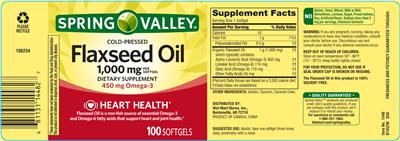
Cold-Pressed Flaxseed Oil 1,000 mg by Spring Valley label
The label scan from the NIH Dietary Supplement Label Database. Tap to enlarge.
Label images are published by the NIH Dietary Supplement Label Database for the version of this product on file. Always read your actual product label.
View the full label (PDF)The Ingredients in Cold-Pressed Flaxseed Oil 1,000 mg by Spring Valley
This is the 1 active ingredient this product is made of. Select it to open its full monograph.
Serving size1 Softgel(s) Dosage formSoftgel Capsule Amounts shown are per serving.
Organic Flaxseed Oil
Interacts with293 drugs
Flaxseed oil is a plant-based source of the omega-3 fatty acid ALA, which the body can partly convert to the omega-3s found in fish oil. It may help s...
Organic Flaxseed Oil monograph & interactions- › Linoleic Acid
- › Oleic Acid
- › Alpha-Linolenic Acid
- › Other Fatty Acids
Other (inactive) ingredients: Gelatin, Glycerin, Caramel. These complete the product’s ingredient list but are not active constituents.
Cold-Pressed Flaxseed Oil 1,000 mg by Spring Valley Drug Interactions
HelloPharmacist Interaction Report
Spring Valley's Cold-Pressed Flaxseed Oil contains oleic acid, which has documented interactions with one medication type.
Oleic acid may increase the effects of antidiabetes drugs (medications that lower blood sugar), a moderate-severity interaction. Research in people with type 2 diabetes suggests that a diet rich in oleic acid from olive oil lowers fasting blood sugar more than a diet high in linoleic acid.
Read the full breakdown — every affected drug type, severity by severity
We couldn't check three of the five ingredients in this product — polyunsaturated fat, linoleic acid, and alpha-linolenic acid — because we hold no interaction data for them. The flaxseed oil itself is a blend of these components listed separately.
If you take any antidiabetes drug, check your specific medication below before starting this supplement.
Check your own medications below · Editorial policy · How we use AI
Want to check YOUR meds against Cold-Pressed Flaxseed Oil 1,000 mg?
Ask about interactions with your drugs in plain English — “Can I take it with lisinopril?” — and we find you the answer in seconds, ingredient by ingredient.
Go to the checkerIngredients driving the most interactions
Individual Drug Interactions
The ingredients in Cold-Pressed Flaxseed Oil 1,000 mg interact with 379 drugs. Click any drug to see the details.
1 of the 1 ingredient in Cold-Pressed Flaxseed Oil 1,000 mg interact with drugs. Each result below shows which ingredient is responsible. organic Flaxseed Oil
AbciximabReoPro
How Abciximab interacts with Cold-Pressed Flaxseed Oil 1,000 mg — through 1 ingredient. Tap an ingredient for the detail:
Organic Flaxseed OilAnticoagulant/antiplatelet Drugs Moderate
Interaction Summary
Theoretically, using flaxseed oil in combination with anticoagulant or antiplatelet drugs might have additive effects and increase the risk of bleeding.
Read the full Organic Flaxseed Oil + Abciximab interactionAbrocitinibCibinqo
How Abrocitinib interacts with Cold-Pressed Flaxseed Oil 1,000 mg — through 1 ingredient. Tap an ingredient for the detail:
Organic Flaxseed OilAnticoagulant/antiplatelet Drugs Moderate
Interaction Summary
Theoretically, using flaxseed oil in combination with anticoagulant or antiplatelet drugs might have additive effects and increase the risk of bleeding.
Read the full Organic Flaxseed Oil + Abrocitinib interactionAcarboseGlucobay, Prandase, Precose
How Acarbose interacts with Cold-Pressed Flaxseed Oil 1,000 mg — through 1 ingredient. Tap an ingredient for the detail:
Oleic AcidAntidiabetes Drugs Moderate
Interaction Summary
Theoretically, oleic acid might increase the effects of antidiabetes drugs.
Read the full Oleic Acid + Acarbose interactionAcebutololRhotral, Sectral
How Acebutolol interacts with Cold-Pressed Flaxseed Oil 1,000 mg — through 1 ingredient. Tap an ingredient for the detail:
Organic Flaxseed OilAntihypertensive Drugs Moderate
Interaction Summary
Theoretically, combining flaxseed oil with other antihypertensive drugs might have additive effects and increase the risk of hypotension.
Read the full Organic Flaxseed Oil + Acebutolol interactionAcenocoumarolSintrom
How Acenocoumarol interacts with Cold-Pressed Flaxseed Oil 1,000 mg — through 1 ingredient. Tap an ingredient for the detail:
Organic Flaxseed OilAnticoagulant/antiplatelet Drugs Moderate
Interaction Summary
Theoretically, using flaxseed oil in combination with anticoagulant or antiplatelet drugs might have additive effects and increase the risk of bleeding.
Read the full Organic Flaxseed Oil + Acenocoumarol interactionAcetaminophen, AspirinGemnisyn
How Acetaminophen, Aspirin interacts with Cold-Pressed Flaxseed Oil 1,000 mg — through 1 ingredient. Tap an ingredient for the detail:
Organic Flaxseed OilAnticoagulant/antiplatelet Drugs Moderate
Interaction Summary
Theoretically, using flaxseed oil in combination with anticoagulant or antiplatelet drugs might have additive effects and increase the risk of bleeding.
Read the full Organic Flaxseed Oil + Acetaminophen, Aspirin interactionAcetaminophen, Aspirin, CaffeineExcedrin, Excedrin Extra Strength, Excedrin Migraine
How Acetaminophen, Aspirin, Caffeine interacts with Cold-Pressed Flaxseed Oil 1,000 mg — through 1 ingredient. Tap an ingredient for the detail:
Organic Flaxseed OilAnticoagulant/antiplatelet Drugs Moderate
Interaction Summary
Theoretically, using flaxseed oil in combination with anticoagulant or antiplatelet drugs might have additive effects and increase the risk of bleeding.
Read the full Organic Flaxseed Oil + Acetaminophen, Aspirin, Caffeine interactionAcetaminophen, IbuprofenCombogesic
How Acetaminophen, Ibuprofen interacts with Cold-Pressed Flaxseed Oil 1,000 mg — through 1 ingredient. Tap an ingredient for the detail:
Organic Flaxseed OilAnticoagulant/antiplatelet Drugs Moderate
Interaction Summary
Theoretically, using flaxseed oil in combination with anticoagulant or antiplatelet drugs might have additive effects and increase the risk of bleeding.
Read the full Organic Flaxseed Oil + Acetaminophen, Ibuprofen interactionAcetazolamideAk-Zol, Diamox
How Acetazolamide interacts with Cold-Pressed Flaxseed Oil 1,000 mg — through 1 ingredient. Tap an ingredient for the detail:
Organic Flaxseed OilAntihypertensive Drugs Moderate
Interaction Summary
Theoretically, combining flaxseed oil with other antihypertensive drugs might have additive effects and increase the risk of hypotension.
Read the full Organic Flaxseed Oil + Acetazolamide interactionAcetohexamideDymelor
How Acetohexamide interacts with Cold-Pressed Flaxseed Oil 1,000 mg — through 1 ingredient. Tap an ingredient for the detail:
Oleic AcidAntidiabetes Drugs Moderate
Interaction Summary
Theoretically, oleic acid might increase the effects of antidiabetes drugs.
Read the full Oleic Acid + Acetohexamide interactionAcetylsalicylic AcidEntrophen
How Acetylsalicylic Acid interacts with Cold-Pressed Flaxseed Oil 1,000 mg — through 1 ingredient. Tap an ingredient for the detail:
Organic Flaxseed OilAnticoagulant/antiplatelet Drugs Moderate
Interaction Summary
Theoretically, using flaxseed oil in combination with anticoagulant or antiplatelet drugs might have additive effects and increase the risk of bleeding.
Read the full Organic Flaxseed Oil + Acetylsalicylic Acid interactionAlbiglutideTanzeum
How Albiglutide interacts with Cold-Pressed Flaxseed Oil 1,000 mg — through 1 ingredient. Tap an ingredient for the detail:
Oleic AcidAntidiabetes Drugs Moderate
Interaction Summary
Theoretically, oleic acid might increase the effects of antidiabetes drugs.
Read the full Oleic Acid + Albiglutide interactionAliskirenTekturna
How Aliskiren interacts with Cold-Pressed Flaxseed Oil 1,000 mg — through 1 ingredient. Tap an ingredient for the detail:
Organic Flaxseed OilAntihypertensive Drugs Moderate
Interaction Summary
Theoretically, combining flaxseed oil with other antihypertensive drugs might have additive effects and increase the risk of hypotension.
Read the full Organic Flaxseed Oil + Aliskiren interactionAlogliptinNesina
How Alogliptin interacts with Cold-Pressed Flaxseed Oil 1,000 mg — through 1 ingredient. Tap an ingredient for the detail:
Oleic AcidAntidiabetes Drugs Moderate
Interaction Summary
Theoretically, oleic acid might increase the effects of antidiabetes drugs.
Read the full Oleic Acid + Alogliptin interactionAlogliptin, MetforminKazano
How Alogliptin, Metformin interacts with Cold-Pressed Flaxseed Oil 1,000 mg — through 1 ingredient. Tap an ingredient for the detail:
Oleic AcidAntidiabetes Drugs Moderate
Interaction Summary
Theoretically, oleic acid might increase the effects of antidiabetes drugs.
Read the full Oleic Acid + Alogliptin, Metformin interactionAlogliptin, PioglitazoneOseni
How Alogliptin, Pioglitazone interacts with Cold-Pressed Flaxseed Oil 1,000 mg — through 1 ingredient. Tap an ingredient for the detail:
Oleic AcidAntidiabetes Drugs Moderate
Interaction Summary
Theoretically, oleic acid might increase the effects of antidiabetes drugs.
Read the full Oleic Acid + Alogliptin, Pioglitazone interactionAlteplase, TpaActilyse, Activase
How Alteplase, Tpa interacts with Cold-Pressed Flaxseed Oil 1,000 mg — through 1 ingredient. Tap an ingredient for the detail:
Organic Flaxseed OilAnticoagulant/antiplatelet Drugs Moderate
Interaction Summary
Theoretically, using flaxseed oil in combination with anticoagulant or antiplatelet drugs might have additive effects and increase the risk of bleeding.
Read the full Organic Flaxseed Oil + Alteplase, Tpa interactionAluminum Hydroxide, Aspirin, Codeine Phosphate, Magnesium HydroxideAscriptin Codeine #2
How Aluminum Hydroxide, Aspirin, Codeine Phosphate, Magnesium Hydroxide interacts with Cold-Pressed Flaxseed Oil 1,000 mg — through 1 ingredient. Tap an ingredient for the detail:
Organic Flaxseed OilAnticoagulant/antiplatelet Drugs Moderate
Interaction Summary
Theoretically, using flaxseed oil in combination with anticoagulant or antiplatelet drugs might have additive effects and increase the risk of bleeding.
Read the full Organic Flaxseed Oil + Aluminum Hydroxide, Aspirin, Codeine Phosphate, Magnesium Hydroxide interactionAluminum Hydroxide, Aspirin, Magnesium HydroxideAscriptin
How Aluminum Hydroxide, Aspirin, Magnesium Hydroxide interacts with Cold-Pressed Flaxseed Oil 1,000 mg — through 1 ingredient. Tap an ingredient for the detail:
Organic Flaxseed OilAnticoagulant/antiplatelet Drugs Moderate
Interaction Summary
Theoretically, using flaxseed oil in combination with anticoagulant or antiplatelet drugs might have additive effects and increase the risk of bleeding.
Read the full Organic Flaxseed Oil + Aluminum Hydroxide, Aspirin, Magnesium Hydroxide interactionAmbrisentanLetairis, Volibris
How Ambrisentan interacts with Cold-Pressed Flaxseed Oil 1,000 mg — through 1 ingredient. Tap an ingredient for the detail:
Organic Flaxseed OilAntihypertensive Drugs Moderate
Interaction Summary
Theoretically, combining flaxseed oil with other antihypertensive drugs might have additive effects and increase the risk of hypotension.
Read the full Organic Flaxseed Oil + Ambrisentan interactionAmilorideAmilamont, Midamor
How Amiloride interacts with Cold-Pressed Flaxseed Oil 1,000 mg — through 1 ingredient. Tap an ingredient for the detail:
Organic Flaxseed OilAntihypertensive Drugs Moderate
Interaction Summary
Theoretically, combining flaxseed oil with other antihypertensive drugs might have additive effects and increase the risk of hypotension.
Read the full Organic Flaxseed Oil + Amiloride interactionAmiloride, HydrochlorothiazideAmil-Co, Amilzide, Moduret 25, Moduretic
How Amiloride, Hydrochlorothiazide interacts with Cold-Pressed Flaxseed Oil 1,000 mg — through 1 ingredient. Tap an ingredient for the detail:
Organic Flaxseed OilAntihypertensive Drugs Moderate
Interaction Summary
Theoretically, combining flaxseed oil with other antihypertensive drugs might have additive effects and increase the risk of hypotension.
Read the full Organic Flaxseed Oil + Amiloride, Hydrochlorothiazide interactionAmlodipineNorliqva
How Amlodipine interacts with Cold-Pressed Flaxseed Oil 1,000 mg — through 1 ingredient. Tap an ingredient for the detail:
Organic Flaxseed OilAntihypertensive Drugs Moderate
Interaction Summary
Theoretically, combining flaxseed oil with other antihypertensive drugs might have additive effects and increase the risk of hypotension.
Read the full Organic Flaxseed Oil + Amlodipine interactionAmlodipine BenzoateKaterzia
How Amlodipine Benzoate interacts with Cold-Pressed Flaxseed Oil 1,000 mg — through 1 ingredient. Tap an ingredient for the detail:
Organic Flaxseed OilAntihypertensive Drugs Moderate
Interaction Summary
Theoretically, combining flaxseed oil with other antihypertensive drugs might have additive effects and increase the risk of hypotension.
Read the full Organic Flaxseed Oil + Amlodipine Benzoate interactionAmlodipine BesilateIstin
How Amlodipine Besilate interacts with Cold-Pressed Flaxseed Oil 1,000 mg — through 1 ingredient. Tap an ingredient for the detail:
Organic Flaxseed OilAntihypertensive Drugs Moderate
Interaction Summary
Theoretically, combining flaxseed oil with other antihypertensive drugs might have additive effects and increase the risk of hypotension.
Read the full Organic Flaxseed Oil + Amlodipine Besilate interactionAmlodipine BesylateNorvasc
How Amlodipine Besylate interacts with Cold-Pressed Flaxseed Oil 1,000 mg — through 1 ingredient. Tap an ingredient for the detail:
Organic Flaxseed OilAntihypertensive Drugs Moderate
Interaction Summary
Theoretically, combining flaxseed oil with other antihypertensive drugs might have additive effects and increase the risk of hypotension.
Read the full Organic Flaxseed Oil + Amlodipine Besylate interactionAmlodipine Besylate, BenazeprilLotrel
How Amlodipine Besylate, Benazepril interacts with Cold-Pressed Flaxseed Oil 1,000 mg — through 1 ingredient. Tap an ingredient for the detail:
Organic Flaxseed OilAntihypertensive Drugs Moderate
Interaction Summary
Theoretically, combining flaxseed oil with other antihypertensive drugs might have additive effects and increase the risk of hypotension.
Read the full Organic Flaxseed Oil + Amlodipine Besylate, Benazepril interactionAmlodipine, CelecoxibConsensi
How Amlodipine, Celecoxib interacts with Cold-Pressed Flaxseed Oil 1,000 mg — through 1 ingredient. Tap an ingredient for the detail:
Organic Flaxseed OilAntihypertensive Drugs Moderate
Interaction Summary
Theoretically, combining flaxseed oil with other antihypertensive drugs might have additive effects and increase the risk of hypotension.
Read the full Organic Flaxseed Oil + Amlodipine, Celecoxib interactionAmmonium ChlorideAmmonium Chloride
How Ammonium Chloride interacts with Cold-Pressed Flaxseed Oil 1,000 mg — through 1 ingredient. Tap an ingredient for the detail:
Organic Flaxseed OilAntihypertensive Drugs Moderate
Interaction Summary
Theoretically, combining flaxseed oil with other antihypertensive drugs might have additive effects and increase the risk of hypotension.
Read the full Organic Flaxseed Oil + Ammonium Chloride interactionAnacaulase-bcdbNexoBrid
How Anacaulase-bcdb interacts with Cold-Pressed Flaxseed Oil 1,000 mg — through 1 ingredient. Tap an ingredient for the detail:
Organic Flaxseed OilAnticoagulant/antiplatelet Drugs Moderate
Interaction Summary
Theoretically, using flaxseed oil in combination with anticoagulant or antiplatelet drugs might have additive effects and increase the risk of bleeding.
Read the full Organic Flaxseed Oil + Anacaulase-bcdb interactionEach ingredient & the kinds of drugs it affects
For each ingredient in Cold-Pressed Flaxseed Oil 1,000 mg with known interactions, here are the types of medications it can affect. Open any type for the detail — or search your exact drug in the checker above.
organic Flaxseed Oil
Anticoagulant/Antiplatelet Drugs
Theoretically, using flaxseed oil in combination with anticoagulant or antiplatelet drugs might have additive effects and increase the risk of bleeding.
Small clinical studies show that consuming flaxseed oil might decrease platelet aggregation and increase bleeding time.
Antihypertensive Drugs
Theoretically, combining flaxseed oil with other antihypertensive drugs might have additive effects and increase the risk of hypotension.
Some clinical evidence suggests that long-term consumption of flaxseed oil can modestly lower systolic and diastolic blood pressure, while other clinical research shows no effect.
Ezetimibe (Zetia)
Concomitant use of flaxseed oil and ezetimibe reduces the absorption of alpha-linolenic acid from flaxseed oil.
In one clinical study, concomitant consumption of ezetimibe 10 mg daily with flaxseed oil 2 grams providing 1 gram of alpha-linolenic acid daily blocked the absorption of alpha-linolenic acid, resulting in an overall reduction in alpha-linolenic plasma levels from baseline.
Brand information
Manufacturer and brand details for Cold-Pressed Flaxseed Oil 1,000 mg, from the product label.
Spring Valley
See all Spring Valley products- Name
- Wal-Mart Stores, Inc.
- City
- Bentonville
- State
- AR
- ZipCode
- 72716
- Phone Number
- 1-866-251-1662
- Web Address
- Walmart.com/springvalley
Cold-Pressed Flaxseed Oil 1,000 mg by Spring Valley: Common Questions
Does Cold-Pressed Flaxseed Oil 1,000 mg by Spring Valley interact with any medications?
How can one product interact with so many drugs?
Where does this information come from?
Does this flaxseed oil really help with cholesterol?
Is it safe to take while I'm pregnant or breastfeeding?
What is oleic acid and why is it in here?
What are the inactive ingredients?
Are there any side effects I should know about?
Written and reviewed by the HelloPharmacist editorial staff. Our editorial policy
Not sure if Cold-Pressed Flaxseed Oil 1,000 mg is safe with your meds?
Our pharmacists answer your medication & supplement questions — free.
Label information is sourced from the NIH Dietary Supplement Label Database and reflects the product version on file; always read your actual product label. This page is for education only and is not a substitute for professional medical advice. Confirm with your pharmacist or doctor before combining supplements and medications.
The Full Monographs Behind Cold-Pressed Flaxseed Oil 1,000 mg’s Ingredients
Every ingredient we hold a full HelloPharmacist monograph for — uses, evidence, safety, and the complete interaction list.
Flaxseed Oil
Interacts with 293 drugsFlaxseed oil is a plant-based source of the omega-3 fatty acid ALA, which the body can partly convert to the omega-3s found in fish oil. It may help support heart health and provide healthy...
Read the full Flaxseed Oil monograph → Herb & supplement monographOleic Acid
Interacts with 86 drugsOleic acid is a heart-healthy monounsaturated fat found mainly in olive oil, canola oil, avocados, and nuts. As part of a Mediterranean-style diet, it is widely viewed as a healthier replace...
Read the full Oleic Acid monograph →Sources & How We Checked
Cold-Pressed Flaxseed Oil 1,000 mg's label data comes from the NIH Dietary Supplement Label Database; the ingredient interaction data is from the Natural Medicines database, reviewed by our pharmacists.
- NIH Dietary Supplement Label Database (DSLD) — The official product label on file for this supplement.
- Natural Medicines (Therapeutic Research Center) — Evidence-graded clinical reference behind the ingredient interaction data.
Content is written and reviewed by licensed HelloPharmacist pharmacists. See our data sources and editorial standards for how this information is built and checked.
The 22 references behind this product’s interaction data
Every citation that drives the interaction findings for this product’s ingredients, from the evidence-graded Natural Medicines (TRC Healthcare) database. Open an ingredient to browse its citations — links open the study on PubMed or the publisher’s site.
Oleic Acid 1 reference
- Madigan C, Ryan M, Owens D, et al. Dietary unsaturated fatty acids in type 2 diabetes: higher levels of postprandial lipoprotein on a linoleic acid-rich sunflower oil diet compared with an oleic acid-rich olive oil diet. Diabetes Care 2000;23:1472-7. PubMed
Flaxseed Oil 21 references
- Kolonel LN, Nomura AM, Cooney RV. Dietary fat and prostate cancer: current status. J Natl Cancer Inst 1999;91:414-28. PubMed
- Ramon JM, Bou R, Romea S, et al. Dietary fat intake and prostate cancer risk: a case-control study in Spain. Cancer Causes Control 2000;11:679-85. PubMed
- Nordstrom DC, Honkanen VE, Nasu Y, et al. Alpha-linolenic acid in the treatment of rheumatoid arthritis. A double-blind, placebo-controlled and randomized study: flaxseed vs. safflower seed. Rheumatol Int 1995;14:231-4. PubMed
- De Stefani E, Deneo-Pellegrini H, Boffetta P, et al. Alpha-linolenic acid and risk of prostate cancer: a case-control study in Uruguay. Cancer Epidemiol Biomarkers Prev 2000;9:335-8.
- Giovannucci E, Rimm EB, Colditz GA, et al. A prospective study of dietary fat and risk of prostate cancer. J Natl Cancer Inst 1993;85:1571-9. PubMed
- Bloedon LT, Szapary PO. Flaxseed and cardiovascular risk. Nutr Rev 2004;62:18-27. DOI
- Laaksonen DE, Laukkanen JA, Niskanen L, et al. Serum linoleic and total polyunsaturated fatty acids in relation to prostate and other cancers: a population-based cohort study. Int J Cancer 2004;111:444-50.. PubMed
- Brouwer IA, Katan MB, Zock PL. Dietary alpha-linolenic acid is associated with reduced risk of fatal coronary heart disease, but increased prostate cancer risk: a meta-analysis. J Nutr 2004;134:919-22.
- Paschos GK, Magkos F, Panagiotakos DB, et al. Dietary supplementation with flaxseed oil lowers blood pressure in dyslipidaemic patients. Eur J Clin Nutr 2007;61:1201-6. PubMed
- Harper CR, Edwards MC, Jacobson TA. Flaxseed oil supplementation does not affect plasma lipoprotein concentration or particle size in human subjects. J Nutr 2006;136:2844-8. PubMed
- University of Montreal. Pregnant Women Consuming Flaxseed Oil Have High Risk Of Premature Birth.ScienceDaily, October 29, 2008. Available at: www.sciencedaily.com/releases/2008/10/081027140817.htm (Accessed May 14, 2009).
- Allman, M. A., Pena, M. M., and Pang, D. Supplementation with flaxseed oil versus sunflowerseed oil in healthy young men consuming a low fat diet: effects on platelet composition and function. Eur.J Clin.Nutr. 1995;49(3):169-178.
- Ursoniu S, Sahebkar A, Andrica F, Serban C, Banach M; Lipid and Blood Pressure Meta-analysis Collaboration Group. Effects of flaxseed supplements on blood pressure: a systematic review and meta-analysis of controlled clinical trial. Clin Nutr. 2016 Jun;3 PubMed
- Taghizadeh M, Jamilian M, Mazloomi M, Sanami M, Asemi Z. A randomized-controlled clinical trial investigating the effect of omega-3 fatty acids on vitamin E co-supplementation on markers of insulin metabolism and lipid profiles in gestational diabetes. J
- Blackwood DP, LaVallee RK, Al Busaidi A, Jassal DS, Pierce GN. A randomized trial of the effects of ezetimibe on the absorption of omega-3 fatty acids in cardiac disease patients: a pilot study. Clin Nutr ESPEN. 2015 Oct;10(5):e155-e159. PubMed
- Morshedzadeh N, Shahrokh S, Aghdaei HA, et al. Effects of flaxseed and flaxseed oil supplement on serum levels of inflammatory markers, metabolic parameters and severity of disease in patients with ulcerative colitis. Complement Ther Med. 2019;46:36-43. PubMed
- Downie LE, Hom MM, Berdy GJ, et al. An artificial tear containing flaxseed oil for treating dry eye disease: A randomized controlled trial. Ocul Surf. 2020;18(1):148-157. PubMed
- Saleh-Ghadimi S, Kheirouri S, Golmohammadi A, Moludi J, Jafari-Vayghan H, Alizadeh M. Effect of flaxseed oil supplementation on anthropometric and metabolic indices in patients with coronary artery disease: A double-blinded randomized controlled trial. J PubMed
- Jamilian M, Tabassi Z, Reiner Z, et al. The effects of n-3 fatty acids from flaxseed oil on genetic and metabolic profiles in patients with gestational diabetes mellitus: a randomised, double-blind, placebo-controlled trial. Br J Nutr. 2020;123(7):792-799
- Li L, Li H, Gao Y, Vafaei S, Zhang X, Yang M. Effect of flaxseed supplementation on blood pressure: a systematic review, and dose-response meta-analysis of randomized clinical trials. Food Funct 2023;14(2):675-690. PubMed
- Mahmudiono T, Jasim SA, Karim YS, et al. The effect of flaxseed oil consumption on blood pressure among patients with metabolic syndrome and related disorders: A systematic review and meta-analysis of randomized clinical trials. Phytother Res 2022;36(10):
Parts of this content are provided by the Therapeutic Research Center, LLC.
DISCLAIMER: Currently this does not check for drug-drug interactions. This is not an all-inclusive comprehensive list of potential interactions and is for informational purposes only. Not all interactions are known or well-reported in the scientific literature, and new interactions are continually being reported. Input is needed from a qualified healthcare provider including a pharmacist before starting any therapy. Application of clinical judgment is necessary.
© 2021 Therapeutic Research Center, LLC