
Dill Ingredients & Drug Interactions
by Revive
What is this page for?
First and foremost: checking Dill against your medications. The heart of this page is the interaction checker and the full interaction report — how this product’s ingredients may interact with prescription and over-the-counter medicines you may be taking.
Around that, we add a pharmacist’s high-level view of the product as a whole — what’s inside, the evidence for its stated use, how transparent the label is, and what safety data exists — so you can see the full picture in one place. It’s educational information from our licensed clinical databases and the clinical staff at HelloPharmacist — not medical advice — and we don’t sell or endorse products. Our editorial policy
Dill is a dietary supplement by Revive with 1 active ingredient. Its ingredients are commonly taken for digestive upset and gas, colic in infants (traditional), stimulating appetite.Based on those ingredients, 87 medications have a known interaction with it, the most serious rated moderate. The ingredients most likely to interact are Dill. Use the checker below to test your specific medication, or read the full HelloPharmacist Interaction Report.
Check Your Meds Against Dill by Revive
Ask about any prescription or over-the-counter medication and we check it for interactions with Dill by Revive — and tell you which ingredient is responsible.
AI summaries are generated from our interaction database for education only — always confirm with your pharmacist. How we use AI
Ask the Pharmacist
A licensed pharmacist will answer your question by email — free, usually within 24 hours.
Got it — thank you!
A licensed pharmacist will answer within 24 hours. Keep an eye on your email (worth checking spam, just in case).
HelloPharmacist Scorecard of Dill by Revive
Our pharmacy team’s full take, with four database checks built into the cards below — a summary of what is known, not a grade of the product itself.
What’s inside
Full disclosure
Revive Dill Liquid contains one active ingredient: dill extract. In food amounts, dill has a long history of culinary use.
This product is a concentrated liquid form, which means you're getting a more potent dose than you would from seasoning your dinner.
Does it work?
Couldn't assess
The effectiveness evidence for dill is limited. We have insufficient reliable evidence to rate how well it works for aging skin, high cholesterol (hyperlipidemia), labor pain, or menstrual cramps (dysmenorrhea).
The science just isn't there yet to say whether it actually helps with these uses.
How safe is it?
Well-documented data
Dill is generally well tolerated when you use the amounts found in food. However, concentrated supplements and seed extracts haven't been studied enough at medicinal doses to know how safe they truly are — you should get your doctor's approval before using them.
Allergies to dill do occur; symptoms can range from mild (itching, rash, swollen eyes) to severe (anaphylaxis, vomiting, diarrhea). If you apply dill juice to your skin from freshly harvested plants, you may develop a sun-sensitive reaction or contact dermatitis.
Meds to double-check
Moderate interaction found
If you take antidiabetes drugs or lithium, check with your pharmacist before using this product — both have Moderate-severity interactions with dill. Antidiabetes medications may have their blood-sugar-lowering effect increased; lithium levels may rise.
The bottom line
Scorecard at a glanceFully disclosed formula with no assessable stated purpose. Moderate medication interactions have been identified, and safety information is well characterized.
Dill liquid is generally well tolerated, but it's not the right choice if you take diabetes medication or lithium without talking to your doctor first. If you have a known allergy to dill or related plants, skip it.
Check your medications with our tool before you start.
Educational only — not medical advice; always confirm with your pharmacist. Our editorial policy · How we use AI
Assessment coverage: 1 of 1 active ingredient matched to our full ingredient reviews (monographs). Based on the product label dated Jun 25, 2025.
This Scorecard evaluates available label information, ingredient evidence, and known medication-safety considerations. It does not independently verify product identity, purity, potency, contamination, or manufacturing quality. How these ratings are computed
General information
Key facts about Dill, straight from the product label.
Everything in this section is reproduced from the manufacturer’s own product label — it’s the label speaking, not HelloPharmacist. We show it so you can see exactly what the maker states; we don’t verify or endorse those statements.
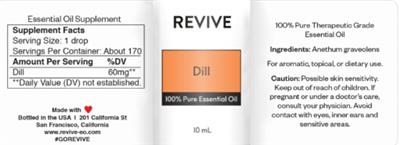
Supplement Facts
The label details for Dill by Revive, sourced from the NIH Dietary Supplement Label Database.
Supplement Facts
| Ingredient | Amount | % DV |
|---|---|---|
| Dill | 60 mg | -- |
Tap any ingredient to jump to its full detail below.
These statements are the manufacturer’s wording, reproduced from the product label — the label is saying it, not HelloPharmacist. We don’t verify or endorse them.
FDA Statement of Identity
Essential Oil Supplement
General Statements
Made with love #Gorevive
Formulation
Bottled in the USA
For aromatic, topical, or dietary use.
Formula
100% Pure essential oil 100% pure therapeutic grade essential oil
Precautions
Caution: Possible skin sensitivity. Avoid contact with eyes, inner ears and sensitive areas.
Keep out of reach of children.
If pregnant or under a doctor's care, consult your physician.
Is this label outdated? Report a formula or label change and our pharmacy team will review it.
Dill by Revive label
The label scan from the NIH Dietary Supplement Label Database. Tap to enlarge.
Label images are published by the NIH Dietary Supplement Label Database for the version of this product on file. Always read your actual product label.
View the full label (PDF)The Ingredients in Dill by Revive
This is the 1 active ingredient this product is made of. Select it to open its full monograph.
Serving size1 Drop(s) Dosage formLiquid Servings per container170 Amounts shown are per serving.
Dill
Interacts with87 drugs
Dill is a common culinary herb that has long been used in traditional medicine for digestive complaints, but solid human evidence for any medicinal us...
Dill monograph & interactionsDill by Revive Drug Interactions
HelloPharmacist Interaction Report
Revive Dill Liquid has documented interactions with two main medication types.
The most serious concern is with antidiabetes drugs (like glimepiride and glyburide) — dill extract may lower blood sugar in a way that adds to what these medications already do, raising the risk of low blood sugar (hypoglycemia). Animal studies show dill can reduce blood sugar on its own, so if you're taking diabetes medication, you'll need to monitor your levels closely and your doctor may need to adjust your dose.
Read the full breakdown — every affected drug type, severity by severity
Dill also interacts with lithium. Because dill has diuretic properties (it may increase urination), it could theoretically reduce how much lithium your body clears, causing lithium levels to build up.
If you take lithium, your dose might need to be lowered.
Altogether, these interactions span 86 individual medications. Use the medication checker on this page to look up your exact prescriptions before you start.
Check your own medications below · Editorial policy · How we use AI
Want to check YOUR meds against Dill?
Ask about interactions with your drugs in plain English — “Can I take it with lisinopril?” — and we find you the answer in seconds, ingredient by ingredient.
Go to the checkerIngredients driving the most interactions
Individual Drug Interactions
The ingredients in Dill interact with 87 drugs. Click any drug to see the details.
1 of the 1 ingredient in Dill interact with drugs. Each result below shows which ingredient is responsible. Dill
AcarboseGlucobay, Prandase, Precose
How Acarbose interacts with Dill — through 1 ingredient. Tap an ingredient for the detail:
DillAntidiabetes Drugs Moderate
Interaction Summary
Theoretically, dill extract might have additive effects with antidiabetes drugs and increase the risk of hypoglycemia.
Read the full Dill + Acarbose interactionAcetohexamideDymelor
How Acetohexamide interacts with Dill — through 1 ingredient. Tap an ingredient for the detail:
DillAntidiabetes Drugs Moderate
Interaction Summary
Theoretically, dill extract might have additive effects with antidiabetes drugs and increase the risk of hypoglycemia.
Read the full Dill + Acetohexamide interactionAlbiglutideTanzeum
How Albiglutide interacts with Dill — through 1 ingredient. Tap an ingredient for the detail:
DillAntidiabetes Drugs Moderate
Interaction Summary
Theoretically, dill extract might have additive effects with antidiabetes drugs and increase the risk of hypoglycemia.
Read the full Dill + Albiglutide interactionAlogliptinNesina
How Alogliptin interacts with Dill — through 1 ingredient. Tap an ingredient for the detail:
DillAntidiabetes Drugs Moderate
Interaction Summary
Theoretically, dill extract might have additive effects with antidiabetes drugs and increase the risk of hypoglycemia.
Read the full Dill + Alogliptin interactionAlogliptin, MetforminKazano
How Alogliptin, Metformin interacts with Dill — through 1 ingredient. Tap an ingredient for the detail:
DillAntidiabetes Drugs Moderate
Interaction Summary
Theoretically, dill extract might have additive effects with antidiabetes drugs and increase the risk of hypoglycemia.
Read the full Dill + Alogliptin, Metformin interactionAlogliptin, PioglitazoneOseni
How Alogliptin, Pioglitazone interacts with Dill — through 1 ingredient. Tap an ingredient for the detail:
DillAntidiabetes Drugs Moderate
Interaction Summary
Theoretically, dill extract might have additive effects with antidiabetes drugs and increase the risk of hypoglycemia.
Read the full Dill + Alogliptin, Pioglitazone interactionAntidiabetes, Dipeptidyl Peptidase-4 (dpp-iv) InhibitorGlyxambi
How Antidiabetes, Dipeptidyl Peptidase-4 (dpp-iv) Inhibitor interacts with Dill — through 1 ingredient. Tap an ingredient for the detail:
DillAntidiabetes Drugs Moderate
Interaction Summary
Theoretically, dill extract might have additive effects with antidiabetes drugs and increase the risk of hypoglycemia.
Read the full Dill + Antidiabetes, Dipeptidyl Peptidase-4 (dpp-iv) Inhibitor interactionCanagliflozinInvokana
How Canagliflozin interacts with Dill — through 1 ingredient. Tap an ingredient for the detail:
DillAntidiabetes Drugs Moderate
Interaction Summary
Theoretically, dill extract might have additive effects with antidiabetes drugs and increase the risk of hypoglycemia.
Read the full Dill + Canagliflozin interactionCanagliflozin, MetforminInvokamet
How Canagliflozin, Metformin interacts with Dill — through 1 ingredient. Tap an ingredient for the detail:
DillAntidiabetes Drugs Moderate
Interaction Summary
Theoretically, dill extract might have additive effects with antidiabetes drugs and increase the risk of hypoglycemia.
Read the full Dill + Canagliflozin, Metformin interactionCanagliflozin, Metformin HydrochlorideInvokamet XR
How Canagliflozin, Metformin Hydrochloride interacts with Dill — through 1 ingredient. Tap an ingredient for the detail:
DillAntidiabetes Drugs Moderate
Interaction Summary
Theoretically, dill extract might have additive effects with antidiabetes drugs and increase the risk of hypoglycemia.
Read the full Dill + Canagliflozin, Metformin Hydrochloride interactionChlorpropamideChlorpropam, Diabinese
How Chlorpropamide interacts with Dill — through 1 ingredient. Tap an ingredient for the detail:
DillAntidiabetes Drugs Moderate
Interaction Summary
Theoretically, dill extract might have additive effects with antidiabetes drugs and increase the risk of hypoglycemia.
Read the full Dill + Chlorpropamide interactionDapagliflozinFarxiga
How Dapagliflozin interacts with Dill — through 1 ingredient. Tap an ingredient for the detail:
DillAntidiabetes Drugs Moderate
Interaction Summary
Theoretically, dill extract might have additive effects with antidiabetes drugs and increase the risk of hypoglycemia.
Read the full Dill + Dapagliflozin interactionDapagliflozin Propanediol, MetforminXigduo XR
How Dapagliflozin Propanediol, Metformin interacts with Dill — through 1 ingredient. Tap an ingredient for the detail:
DillAntidiabetes Drugs Moderate
Interaction Summary
Theoretically, dill extract might have additive effects with antidiabetes drugs and increase the risk of hypoglycemia.
Read the full Dill + Dapagliflozin Propanediol, Metformin interactionDapagliflozin Propanediol, Saxagliptin HydrochlorideQtern
How Dapagliflozin Propanediol, Saxagliptin Hydrochloride interacts with Dill — through 1 ingredient. Tap an ingredient for the detail:
DillAntidiabetes Drugs Moderate
Interaction Summary
Theoretically, dill extract might have additive effects with antidiabetes drugs and increase the risk of hypoglycemia.
Read the full Dill + Dapagliflozin Propanediol, Saxagliptin Hydrochloride interactionDapagliflozin, Metformin Hydrochloride, Saxagliptin HydrochlorideQternmet XR
How Dapagliflozin, Metformin Hydrochloride, Saxagliptin Hydrochloride interacts with Dill — through 1 ingredient. Tap an ingredient for the detail:
DillAntidiabetes Drugs Moderate
Interaction Summary
Theoretically, dill extract might have additive effects with antidiabetes drugs and increase the risk of hypoglycemia.
Read the full Dill + Dapagliflozin, Metformin Hydrochloride, Saxagliptin Hydrochloride interactionDasiglucagon HydrochlorideZegalogue
How Dasiglucagon Hydrochloride interacts with Dill — through 1 ingredient. Tap an ingredient for the detail:
DillAntidiabetes Drugs Moderate
Interaction Summary
Theoretically, dill extract might have additive effects with antidiabetes drugs and increase the risk of hypoglycemia.
Read the full Dill + Dasiglucagon Hydrochloride interactionDulaglutideTrulicity
How Dulaglutide interacts with Dill — through 1 ingredient. Tap an ingredient for the detail:
DillAntidiabetes Drugs Moderate
Interaction Summary
Theoretically, dill extract might have additive effects with antidiabetes drugs and increase the risk of hypoglycemia.
Read the full Dill + Dulaglutide interactionEmpagliflozinJardiance
How Empagliflozin interacts with Dill — through 1 ingredient. Tap an ingredient for the detail:
DillAntidiabetes Drugs Moderate
Interaction Summary
Theoretically, dill extract might have additive effects with antidiabetes drugs and increase the risk of hypoglycemia.
Read the full Dill + Empagliflozin interactionEmpagliflozin, Linagliptin, Metformin HydrochlorideTrijardy XR
How Empagliflozin, Linagliptin, Metformin Hydrochloride interacts with Dill — through 1 ingredient. Tap an ingredient for the detail:
DillAntidiabetes Drugs Moderate
Interaction Summary
Theoretically, dill extract might have additive effects with antidiabetes drugs and increase the risk of hypoglycemia.
Read the full Dill + Empagliflozin, Linagliptin, Metformin Hydrochloride interactionEmpagliflozin, MetforminSynjardy
How Empagliflozin, Metformin interacts with Dill — through 1 ingredient. Tap an ingredient for the detail:
DillAntidiabetes Drugs Moderate
Interaction Summary
Theoretically, dill extract might have additive effects with antidiabetes drugs and increase the risk of hypoglycemia.
Read the full Dill + Empagliflozin, Metformin interactionEmpagliflozin, Metformin HydrochlorideSynjardy XR
How Empagliflozin, Metformin Hydrochloride interacts with Dill — through 1 ingredient. Tap an ingredient for the detail:
DillAntidiabetes Drugs Moderate
Interaction Summary
Theoretically, dill extract might have additive effects with antidiabetes drugs and increase the risk of hypoglycemia.
Read the full Dill + Empagliflozin, Metformin Hydrochloride interactionErtugliflozinSteglatro
How Ertugliflozin interacts with Dill — through 1 ingredient. Tap an ingredient for the detail:
DillAntidiabetes Drugs Moderate
Interaction Summary
Theoretically, dill extract might have additive effects with antidiabetes drugs and increase the risk of hypoglycemia.
Read the full Dill + Ertugliflozin interactionErtugliflozin, Metformin HydrochlorideSegluromet
How Ertugliflozin, Metformin Hydrochloride interacts with Dill — through 1 ingredient. Tap an ingredient for the detail:
DillAntidiabetes Drugs Moderate
Interaction Summary
Theoretically, dill extract might have additive effects with antidiabetes drugs and increase the risk of hypoglycemia.
Read the full Dill + Ertugliflozin, Metformin Hydrochloride interactionExenatideBydureon, Byetta
How Exenatide interacts with Dill — through 1 ingredient. Tap an ingredient for the detail:
DillAntidiabetes Drugs Moderate
Interaction Summary
Theoretically, dill extract might have additive effects with antidiabetes drugs and increase the risk of hypoglycemia.
Read the full Dill + Exenatide interactionExenatide SyntheticBydureon BCISE
How Exenatide Synthetic interacts with Dill — through 1 ingredient. Tap an ingredient for the detail:
DillAntidiabetes Drugs Moderate
Interaction Summary
Theoretically, dill extract might have additive effects with antidiabetes drugs and increase the risk of hypoglycemia.
Read the full Dill + Exenatide Synthetic interactionGliclazideDiamicron
How Gliclazide interacts with Dill — through 1 ingredient. Tap an ingredient for the detail:
DillAntidiabetes Drugs Moderate
Interaction Summary
Theoretically, dill extract might have additive effects with antidiabetes drugs and increase the risk of hypoglycemia.
Read the full Dill + Gliclazide interactionGlimepirideAmaryl
How Glimepiride interacts with Dill — through 1 ingredient. Tap an ingredient for the detail:
DillAntidiabetes Drugs Moderate
Interaction Summary
Theoretically, dill extract might have additive effects with antidiabetes drugs and increase the risk of hypoglycemia.
Read the full Dill + Glimepiride interactionGlipizideGlucotrol, Glucotrol XL
How Glipizide interacts with Dill — through 1 ingredient. Tap an ingredient for the detail:
DillAntidiabetes Drugs Moderate
Interaction Summary
Theoretically, dill extract might have additive effects with antidiabetes drugs and increase the risk of hypoglycemia.
Read the full Dill + Glipizide interactionGlipizide, MetforminMetaglip
How Glipizide, Metformin interacts with Dill — through 1 ingredient. Tap an ingredient for the detail:
DillAntidiabetes Drugs Moderate
Interaction Summary
Theoretically, dill extract might have additive effects with antidiabetes drugs and increase the risk of hypoglycemia.
Read the full Dill + Glipizide, Metformin interactionGlucagonBaqsimi, Glucagon
How Glucagon interacts with Dill — through 1 ingredient. Tap an ingredient for the detail:
DillAntidiabetes Drugs Moderate
Interaction Summary
Theoretically, dill extract might have additive effects with antidiabetes drugs and increase the risk of hypoglycemia.
Read the full Dill + Glucagon interactionEach ingredient & the kinds of drugs it affects
For each ingredient in Dill with known interactions, here are the types of medications it can affect. Open any type for the detail — or search your exact drug in the checker above.
Dill
Antidiabetes Drugs
Theoretically, dill extract might have additive effects with antidiabetes drugs and increase the risk of hypoglycemia. Animal research shows that dill extract can reduce blood sugar levels. Monitor blood glucose levels closely. Dose adjustments might be necessary.
Some antidiabetes drugs include glimepiride (Amaryl), glyburide (DiaBeta, Glynase PresTab, Micronase), insulin, pioglitazone (Actos), rosiglitazone (Avandia), and others.
Lithium
Dill is thought to have diuretic properties. Theoretically, due to these potential diuretic effects, dill might reduce excretion and increase levels of lithium. The dose of lithium might need to be decreased.
Brand information
Manufacturer and brand details for Dill, from the product label.
Revive
See all Revive products- Name
- Revive
- Street Address
- 201 California St
- City
- San Francisco
- State
- California
- Web Address
- www.revive-eo.com
Dill by Revive: Common Questions
Does Dill by Revive interact with any medications?
How can one product interact with so many drugs?
Where does this information come from?
Is dill safe to take while pregnant?
What about breastfeeding?
Can dill cause allergic reactions?
Will dill help with my cholesterol?
Is this safe to use at food amounts?
Written and reviewed by the HelloPharmacist editorial staff. Our editorial policy
Not sure if Dill is safe with your meds?
Our pharmacists answer your medication & supplement questions — free.
Label information is sourced from the NIH Dietary Supplement Label Database and reflects the product version on file; always read your actual product label. This page is for education only and is not a substitute for professional medical advice. Confirm with your pharmacist or doctor before combining supplements and medications.
The Full Monographs Behind Dill’s Ingredients
Every ingredient we hold a full HelloPharmacist monograph for — uses, evidence, safety, and the complete interaction list.
Sources & How We Checked
Dill's label data comes from the NIH Dietary Supplement Label Database; the ingredient interaction data is from the Natural Medicines database, reviewed by our pharmacists.
- NIH Dietary Supplement Label Database (DSLD) — The official product label on file for this supplement.
- Natural Medicines (Therapeutic Research Center) — Evidence-graded clinical reference behind the ingredient interaction data.
Content is written and reviewed by licensed HelloPharmacist pharmacists. See our data sources and editorial standards for how this information is built and checked.
The 17 references behind this product’s interaction data
Every citation that drives the interaction findings for this product’s ingredients, from the evidence-graded Natural Medicines (TRC Healthcare) database. Open an ingredient to browse its citations — links open the study on PubMed or the publisher’s site.
Dill 17 references
- Leung AY, Foster S. Encyclopedia of Common Natural Ingredients Used in Food, Drugs and Cosmetics. 2nd ed. New York, NY: John Wiley & Sons, 1996.
- McGuffin M, Hobbs C, Upton R, Goldberg A, eds. American Herbal Products Association's Botanical Safety Handbook. Boca Raton, FL: CRC Press, LLC 1997.
- Brinker F. Herb Contraindications and Drug Interactions. 2nd ed. Sandy, OR: Eclectic Medical Publications, 1998.
- Electronic Code of Federal Regulations. Title 21. Part 182 -- Substances Generally Recognized As Safe. Available at: https://www.accessdata.fda.gov/scripts/cdrh/cfdocs/cfcfr/CFRSearch.cfm?CFRPart=182
- Freeman, G. L. Allergy to fresh dill. Allergy 1999;54(5):531-532. PubMed
- Chiu, A. M. and Zacharisen, M. C. Anaphylaxis to dill. Ann Allergy Asthma Immunol. 2000;84(5):559-560.
- Monteseirin, J., Perez-Formoso, J. L., Sanchez-Hernandez, M. C., Hernandez, M., Camacho, M. J., Bonilla, I., Guardia, P., and Conde, J. Occupational contact dermatitis to dill. Allergy 2002;57(9):866-867. PubMed
- Monteseirin, J., Perez-Formoso, J. L., Hernandez, M., Sanchez-Hernandez, M. C., Camacho, M. J., Bonilla, I., Chaparro, A., and Conde, J. Contact urticaria from dill. Contact Dermatitis 2003;48(5):275. PubMed
- Kojuri, J., Vosoughi, A. R., and Akrami, M. Effects of anethum graveolens and garlic on lipid profile in hyperlipidemic patients. Lipids Health Dis. 2007;6:5. PubMed
- Panda, S. The effect of Anethum graveolens L. (dill) on corticosteroid induced diabetes mellitus: involvement of thyroid hormones. Phytother.Res 2008;22(12):1695-1697.
- Madani H, Mahmoodabady NA Vahdati A. Effects of hydroalchoholic [sic] extract of Anethum graveolens (DILL) on plasma glucose an [sic] lipid levels in diabetes induced rats. Iranian Journal of Diabetes & Lipid Disorders 2006;5(2):E13.
- Hekmatzadeh SF, Bazarganipour F, Malekzadeh J, Goodarzi F, Aramesh S. A randomized clinical trial of the efficacy of applying a simple protocol of boiled Anethum Graveolens seeds on pain intensity and duration of labor stages. Complement Ther Med. 2014;22 PubMed
- Sohm B, Cenizo V, André V, Zahouani H, Pailler-Mattei C, Vogelgesang B. Evaluation of the efficacy of a dill extract in vitro and in vivo. Int J Cosmet Sci. 2011;33(2):157-63.
- Hekmatzadeh SF, Bazarganipour F, Allan H, Aramesh S, Mohammadi J. Effects of boiled dill seed on anxiety during labor: A randomized clinical trial. Chin J Integr Med. 2020;26(2):100-105. PubMed
- Omidvar S, Nasiri-Amiri F, Bakhtiari A, Begum K. Clinical trial for the management dysmenorrhea using selected spices. Complement Ther Clin Pract. 2019;36:34-38. PubMed
- Haidari F, Zakerkish M, Borazjani F, Ahmadi Angali K, Amoochi Foroushani G. The effects of Anethum graveolens (dill) powder supplementation on clinical and metabolic status in patients with type 2 diabetes. Trials 2020;21(1):483. PubMed
- Mousavi SM, Beatriz Pizarro A, Akhgarjand C, et al. The effects of Anethum graveolens (dill) supplementation on lipid profile and glycemic control: a systematic review and meta-analysis of randomized controlled trials. Crit Rev Food Sci Nutr 2022;62(21):5
Parts of this content are provided by the Therapeutic Research Center, LLC.
DISCLAIMER: Currently this does not check for drug-drug interactions. This is not an all-inclusive comprehensive list of potential interactions and is for informational purposes only. Not all interactions are known or well-reported in the scientific literature, and new interactions are continually being reported. Input is needed from a qualified healthcare provider including a pharmacist before starting any therapy. Application of clinical judgment is necessary.
© 2021 Therapeutic Research Center, LLC