
Eagle Vision Ingredients & Drug Interactions
by Ron Teeguarden's Dragon Herbs
What is this page for?
First and foremost: checking Eagle Vision against your medications. The heart of this page is the interaction checker and the full interaction report — how this product’s ingredients may interact with prescription and over-the-counter medicines you may be taking.
Around that, we add a pharmacist’s high-level view of the product as a whole — what’s inside, the evidence for its stated use, how transparent the label is, and what safety data exists — so you can see the full picture in one place. It’s educational information from our licensed clinical databases and the clinical staff at HelloPharmacist — not medical advice — and we don’t sell or endorse products. Our editorial policy
Eagle Vision is a dietary supplement by Ron Teeguarden's Dragon Herbs with 11 active ingredients. Its ingredients are commonly taken for general antioxidant support, eye health, immune support.Based on those ingredients, 1,431 medications have a known interaction with it, the most serious rated major. The ingredients most likely to interact are Goji Berry Extract, White Peony root extract, Dendrobium Stem Extract. Use the checker below to test your specific medication, or read the full HelloPharmacist Interaction Report.
Check Your Meds Against Eagle Vision by Ron Teeguarden's Dragon Herbs
Ask about any prescription or over-the-counter medication and we check it for interactions with Eagle Vision by Ron Teeguarden's Dragon Herbs — and tell you which ingredient is responsible.
AI summaries are generated from our interaction database for education only — always confirm with your pharmacist. How we use AI
Ask the Pharmacist
A licensed pharmacist will answer your question by email — free, usually within 24 hours.
Got it — thank you!
A licensed pharmacist will answer within 24 hours. Keep an eye on your email (worth checking spam, just in case).
HelloPharmacist Scorecard of Eagle Vision by Ron Teeguarden's Dragon Herbs
Our pharmacy team’s full take, with four database checks built into the cards below — a summary of what is known, not a grade of the product itself.
What’s inside
Low disclosure
Eagle Vision contains 11 ingredients, 6 of which are herbal extracts with established traditional roles in vision and eye health. The active ingredients are goji berry extract, white peony root extract, chrysanthemum flower extract, Chinese yam rhizome extract, cornus fruit extract, ligusticum rhizome extract, dendrobium stem extract, cassia tora seed extract, astragalus seed extract, tribulus seed extract, and vitex rotundifolia fruit extract.
There is also a proprietary extract formula whose individual components are listed separately. The remaining ingredients—pullulan polysaccharide, rice powder, bamboo extract powder, and rice extract blend—are inactive ingredients used as fillers and capsule material.
Does it work?
Not established
The evidence we hold does not establish that Eagle Vision or its individual ingredients are effective for any condition. Goji berry, white peony, chrysanthemum, astragalus, and tribulus all carry an 'insufficient reliable evidence' rating for the conditions listed in our data—meaning research is lacking or unclear.
Tribulus alone carries a 'possibly effective' rating for sexual dysfunction, but that is outside the scope of an eye-health product. We have no effectiveness data on file for Chinese yam, cornus fruit, ligusticum, dendrobium, cassia tora, or vitex rotundifolia.
If you're considering this product for vision support, talk with your pharmacist or doctor about what the current evidence shows.
How safe is it?
Well-documented data
Goji berry is generally well tolerated as a food, but concentrated supplements have less safety data. Rare cases of allergic reactions—including facial swelling, throat tightness, and anaphylaxis—have been reported, and one case of autoimmune hepatitis and another of acute hepatitis linked to goji-containing products are on record.
White peony is generally well tolerated short-term; reported side effects include stomach upset, diarrhea, nausea, and abdominal bloating, with diarrhea occurring in 5% of patients taking high doses over 24 weeks versus 1% on placebo. Chrysanthemum can cause allergic reactions, with contact dermatitis and urticaria most common and rare asthma reported.
Dendrobium, astragalus, and tribulus have limited modern safety data. Tribulus can cause abdominal pain, nausea, vomiting, diarrhea, and constipation; rare cases of liver and kidney injury and seizures have been reported.
None of the pregnancy or breastfeeding data for these ingredients supports use during pregnancy or while nursing—safety has not been established for any of them.
Meds to double-check
Major interaction found
Before taking Eagle Vision, double-check if you're on warfarin or other blood thinners (goji can increase bleeding risk), blood pressure medications, diabetes medications, antiseizure drugs, immunosuppressants, lithium, or certain psychiatric or heart-rhythm medications. The product's interactions span medications processed by your liver's cytochrome P450 system, so if you take anything regularly, run it through the tool on this page.
The bottom line
Scorecard at a glanceFormula with limited ingredient disclosure with no established evidence rating for its marketed use. Major medication interactions have been identified, and safety information is well characterized.
Eagle Vision is a multi-ingredient herbal formula with several ingredients that interact with common medications, especially blood thinners, blood pressure drugs, diabetes medications, and drugs processed through your liver. If you take warfarin or any regular prescription medication, check with your pharmacist before starting.
The evidence for its effectiveness isn't established in our data, and several ingredients should be avoided in pregnancy and while breastfeeding.
Educational only — not medical advice; always confirm with your pharmacist. Our editorial policy · How we use AI
Assessment coverage: 7 of 11 active ingredients matched to our full ingredient reviews (monographs). Based on the product label dated Jul 25, 2024.
This Scorecard evaluates available label information, ingredient evidence, and known medication-safety considerations. It does not independently verify product identity, purity, potency, contamination, or manufacturing quality. How these ratings are computed
General information
Key facts about Eagle Vision, straight from the product label.
| Brand | Ron Teeguarden's Dragon Herbs |
|---|---|
| Barcode (UPC) | 679372002914 |
| Net contents | 100 Vegetarian Capsule(s) |
| Market status | On market |
| Date entered into DSLD | Jul 25, 2024 |
| DSLD ID | 316867 |
| Product type | Botanical |
| Supplement form | Capsule |
| Dietary claims / uses | All Other, Structure/Function |
| Intended target group(s) | Adult (18 - 50 Years) |
Everything in this section is reproduced from the manufacturer’s own product label — it’s the label speaking, not HelloPharmacist. We show it so you can see exactly what the maker states; we don’t verify or endorse those statements.
Supplement Facts
The label details for Eagle Vision by Ron Teeguarden's Dragon Herbs, sourced from the NIH Dietary Supplement Label Database.
Supplement Facts
| Ingredient | Amount | % DV |
|---|---|---|
| Goji Berry Extract | 0 NP | -- |
| Proprietary Extract Formula | 1500 mg | -- |
| Chinese Yam rhizome extract | 0 NP | -- |
| Cornus Fruit Extract | 0 NP | -- |
| White Peony root extract | 0 NP | -- |
| Chrysanthemum flower extract | 0 NP | -- |
| Ligusticum Rhizome Extract | 0 NP | -- |
| Dendrobium Stem Extract | 0 NP | -- |
| Cassia Tora Seed Extract | 0 NP | -- |
| Astragalus Seed Extract | 0 NP | -- |
| Tribulus Seed Extract | 0 NP | -- |
| Vitex rotundifolia Fruit Extract | 0 NP | -- |
Other ingredients: Pullulan Polysaccharide, Rice, Powder, Bamboo Extract, Powder, Rice extract Blend
Tap any ingredient to jump to its full detail below.
These statements are the manufacturer’s wording, reproduced from the product label — the label is saying it, not HelloPharmacist. We don’t verify or endorse them.
FDA Disclaimer Statement
These statements have not been evaluated by the Food and Drug Administration. This product is not intended to diagnose, treat, cure, or prevent any disease.
Formulation
Eagle Vision is a premium formulation made from the finest Chinese herbs. This formulation is extremely safe and effective.
Pullulan caps - 100% natural, water-soluble polysaccharide produced through a fermentation process; vegetable origin; non-GMO; no starch, preservatives or chemical modifications; gluten free.
Brand IP Statement(s)
Ron Teeguarden's Dragon Herbs Health Deserves Cultivation
FDA Statement of Identity
Dietary Supplement
General Statements
Eagle Vision 500 mg each
Suggested/Recommended/Usage/Directions
Directions: Take 3 capsules, 2 times per day or as directed by a healthcare professional.
Formula
Pullulan caps - 100% natural, water-soluble polysaccharide produced through a fermentation process; vegetable origin; non-GMO; no starch, preservatives or chemical modifications; gluten free.
Precautions
Keep out of the reach of children.
Is this label outdated? Report a formula or label change and our pharmacy team will review it.
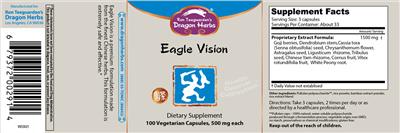
Eagle Vision by Ron Teeguarden's Dragon Herbs label
The label scan from the NIH Dietary Supplement Label Database. Tap to enlarge.
Label images are published by the NIH Dietary Supplement Label Database for the version of this product on file. Always read your actual product label.
View the full label (PDF)The Ingredients in Eagle Vision by Ron Teeguarden's Dragon Herbs
These are the 11 active ingredients this product is made of. Select any to open its full monograph.
Serving size3 Capsule(s) Dosage formCapsule Servings per container33 Amounts shown are per serving.
Most supplement products combine several ingredients, and a medication can interact with the product through any one of them. Each ingredient below shows whether it has known drug interactions.
Proprietary Extract Formula
- › Goji Berry Extract
- › Chinese Yam rhizome extract
- › Cornus Fruit Extract
- › White Peony root extract
- › Chrysanthemum flower extract
- › Ligusticum Rhizome Extract
- › Dendrobium Stem Extract
- › Cassia Tora Seed Extract
- › Astragalus Seed Extract
- › Tribulus Seed Extract
- › Vitex rotundifolia Fruit Extract
Other (inactive) ingredients: Pullulan Polysaccharide, Rice, Powder, Bamboo Extract, Powder, Rice extract Blend. These complete the product’s ingredient list but are not active constituents.
Eagle Vision by Ron Teeguarden's Dragon Herbs Drug Interactions
HelloPharmacist Interaction Report
Eagle Vision by Ron Teeguarden's Dragon Herbs contains several ingredients with documented interactions with medications.
The most serious is goji berry extract, which can increase the effects of warfarin (a blood thinner) and raise bleeding risk—case reports show it raised INR levels in patients stabilized on warfarin who drank goji juice or concentrated tea. Goji berry also interacts with several types of drugs metabolized by your liver's cytochrome P450 enzymes (2C9, 2C19, 2D6, and 3A4 substrates), potentially increasing their levels in your body; these interactions are theoretical in humans but shown in lab research.
Additionally, goji may add to the effects of blood pressure–lowering drugs and diabetes medications, and a case report linked it to flecainide toxicity.
Read the full breakdown — every affected drug type, severity by severity
White peony root extract can interfere with hormone-based contraceptives and estrogen therapy, raise the levels of certain psychiatric and heart-rhythm medications (clozapine and CYP1A2 and CYP3A4 substrates), and theoretically increase bleeding risk with blood thinners and antiplatelet drugs. Dendrobium stem extract may lower seizure threshold and reduce the effectiveness of anti-seizure medications.
Astragalus seed extract can interfere with immune-suppressing drugs and lithium, and may add to blood sugar–lowering effects. Tribulus seed extract may strengthen the effects of blood pressure and diabetes medications, and may raise lithium levels.
Chryanthemum flower extract and three other ingredients—Chinese yam rhizome extract, Ligusticum rhizome extract, Cassia tora seed extract, and Vitex rotundifolia fruit extract—either have no interactions documented in our data or cannot be checked. Altogether, these interactions span 1,415 individual medications.
Before you start Eagle Vision, run your current medications through the checker on this page to see if any are affected.
Check your own medications below · Editorial policy · How we use AI
Want to check YOUR meds against Eagle Vision?
Ask about interactions with your drugs in plain English — “Can I take it with lisinopril?” — and we find you the answer in seconds, ingredient by ingredient.
Go to the checkerIngredients driving the most interactions
Individual Drug Interactions
The ingredients in Eagle Vision interact with 1,431 drugs. Click any drug to see the details.
5 of the 11 ingredients in Eagle Vision interact with drugs. Each result below shows which ingredient is responsible. Goji Berry Extract White Peony root extract Dendrobium Stem Extract Tribulus Seed Extract Astragalus Seed Extract
WarfarinWarfarin
How Warfarin interacts with Eagle Vision — through 2 ingredients. Tap an ingredient for the detail:
Goji Berry ExtractCytochrome P450 2c19 (cyp2c19) Substrates, Cytochrome P450 2c9 (cyp2c9) Substrates +2 Major
Interaction Summary
Theoretically, goji berry might inhibit CYP2C19 and reduce metabolism of CYP2C19 substrates.
Read the full Goji Berry Extract + Warfarin interactionWhite Peony Root ExtractCytochrome P450 3a4 (cyp3a4) Substrates, Cytochrome P450 1a2 (cyp1a2) Substrates +1 Moderate
Interaction Summary
Theoretically, use of peony may increase the levels and clinical effects of drugs metabolized by CYP3A4.
Read the full White Peony Root Extract + Warfarin interactionWarfarin SodiumCoumadin, Panwarfin, Sofarin
How Warfarin Sodium interacts with Eagle Vision — through 2 ingredients. Tap an ingredient for the detail:
Goji Berry ExtractWarfarin (coumadin), Cytochrome P450 2c19 (cyp2c19) Substrates +2 Major
Interaction Summary
Goji can increase the effects of warfarin and possibly increase the risk of bleeding.
Read the full Goji Berry Extract + Warfarin Sodium interactionWhite Peony Root ExtractAnticoagulant/antiplatelet Drugs, Cytochrome P450 3a4 (cyp3a4) Substrates +1 Moderate
Interaction Summary
Theoretically, combining peony with anticoagulant or antiplatelet drugs might increase the risk of bleeding.
Read the full White Peony Root Extract + Warfarin Sodium interaction6-mercaptopurinePurinethol
How 6-mercaptopurine interacts with Eagle Vision — through 1 ingredient. Tap an ingredient for the detail:
Astragalus Seed ExtractImmunosuppressants Moderate
Interaction Summary
Theoretically, astragalus might interfere with immunosuppressive therapy.
Read the full Astragalus Seed Extract + 6-mercaptopurine interactionAdo-trastuzumab EmtansineKadcyla
How Ado-trastuzumab Emtansine interacts with Eagle Vision — through 2 ingredients. Tap an ingredient for the detail:
White Peony Root ExtractCytochrome P450 3a4 (cyp3a4) Substrates Moderate
Interaction Summary
Theoretically, use of peony may increase the levels and clinical effects of drugs metabolized by CYP3A4.
Read the full White Peony Root Extract + Ado-trastuzumab Emtansine interactionGoji Berry ExtractCytochrome P450 3a4 (cyp3a4) Substrates Moderate
Interaction Summary
Theoretically, goji berry might inhibit CYP3A4 and reduce metabolism of CYP3A4 substrates.
Read the full Goji Berry Extract + Ado-trastuzumab Emtansine interactionAbciximabReoPro
How Abciximab interacts with Eagle Vision — through 1 ingredient. Tap an ingredient for the detail:
White Peony Root ExtractAnticoagulant/antiplatelet Drugs Moderate
Interaction Summary
Theoretically, combining peony with anticoagulant or antiplatelet drugs might increase the risk of bleeding.
Read the full White Peony Root Extract + Abciximab interactionAbemaciclibVerzenio
How Abemaciclib interacts with Eagle Vision — through 2 ingredients. Tap an ingredient for the detail:
White Peony Root ExtractCytochrome P450 3a4 (cyp3a4) Substrates Moderate
Interaction Summary
Theoretically, use of peony may increase the levels and clinical effects of drugs metabolized by CYP3A4.
Read the full White Peony Root Extract + Abemaciclib interactionGoji Berry ExtractCytochrome P450 3a4 (cyp3a4) Substrates Moderate
Interaction Summary
Theoretically, goji berry might inhibit CYP3A4 and reduce metabolism of CYP3A4 substrates.
Read the full Goji Berry Extract + Abemaciclib interactionAbiraterone
How Abiraterone interacts with Eagle Vision — through 2 ingredients. Tap an ingredient for the detail:
Goji Berry ExtractCytochrome P450 3a4 (cyp3a4) Substrates Moderate
Interaction Summary
Theoretically, goji berry might inhibit CYP3A4 and reduce metabolism of CYP3A4 substrates.
Read the full Goji Berry Extract + Abiraterone interactionWhite Peony Root ExtractCytochrome P450 3a4 (cyp3a4) Substrates Moderate
Interaction Summary
Theoretically, use of peony may increase the levels and clinical effects of drugs metabolized by CYP3A4.
Read the full White Peony Root Extract + Abiraterone interactionAbiraterone AcetateYonsa, Zytiga
How Abiraterone Acetate interacts with Eagle Vision — through 2 ingredients. Tap an ingredient for the detail:
White Peony Root ExtractCytochrome P450 3a4 (cyp3a4) Substrates Moderate
Interaction Summary
Theoretically, use of peony may increase the levels and clinical effects of drugs metabolized by CYP3A4.
Read the full White Peony Root Extract + Abiraterone Acetate interactionGoji Berry ExtractCytochrome P450 3a4 (cyp3a4) Substrates Moderate
Interaction Summary
Theoretically, goji berry might inhibit CYP3A4 and reduce metabolism of CYP3A4 substrates.
Read the full Goji Berry Extract + Abiraterone Acetate interactionAbrocitinibCibinqo
How Abrocitinib interacts with Eagle Vision — through 3 ingredients. Tap an ingredient for the detail:
Goji Berry ExtractCytochrome P450 2c19 (cyp2c19) Substrates, Cytochrome P450 2c9 (cyp2c9) Substrates Moderate
Interaction Summary
Theoretically, goji berry might inhibit CYP2C19 and reduce metabolism of CYP2C19 substrates.
Read the full Goji Berry Extract + Abrocitinib interactionWhite Peony Root ExtractAnticoagulant/antiplatelet Drugs Moderate
Interaction Summary
Theoretically, combining peony with anticoagulant or antiplatelet drugs might increase the risk of bleeding.
Read the full White Peony Root Extract + Abrocitinib interactionAstragalus Seed ExtractImmunosuppressants Moderate
Interaction Summary
Theoretically, astragalus might interfere with immunosuppressive therapy.
Read the full Astragalus Seed Extract + Abrocitinib interactionAcalabrutinibCalquence
How Acalabrutinib interacts with Eagle Vision — through 2 ingredients. Tap an ingredient for the detail:
White Peony Root ExtractCytochrome P450 3a4 (cyp3a4) Substrates Moderate
Interaction Summary
Theoretically, use of peony may increase the levels and clinical effects of drugs metabolized by CYP3A4.
Read the full White Peony Root Extract + Acalabrutinib interactionGoji Berry ExtractCytochrome P450 3a4 (cyp3a4) Substrates Moderate
Interaction Summary
Theoretically, goji berry might inhibit CYP3A4 and reduce metabolism of CYP3A4 substrates.
Read the full Goji Berry Extract + Acalabrutinib interactionAcarboseGlucobay, Prandase, Precose
How Acarbose interacts with Eagle Vision — through 3 ingredients. Tap an ingredient for the detail:
Astragalus Seed ExtractAntidiabetes Drugs Moderate
Interaction Summary
Theoretically, taking astragalus with antidiabetes drugs might increase the risk of hypoglycemia.
Read the full Astragalus Seed Extract + Acarbose interactionTribulus Seed ExtractAntidiabetes Drugs Moderate
Interaction Summary
Taking tribulus with antidiabetes drugs might increase the risk of hypoglycemia.
Read the full Tribulus Seed Extract + Acarbose interactionGoji Berry ExtractAntidiabetes Drugs Minor
Interaction Summary
Theoretically, concomitant use of goji fruit polysaccharides or goji root bark with antidiabetes drugs might have additive effects.
Read the full Goji Berry Extract + Acarbose interactionAcebutololRhotral, Sectral
How Acebutolol interacts with Eagle Vision — through 3 ingredients. Tap an ingredient for the detail:
Goji Berry ExtractAntihypertensive Drugs Moderate
Interaction Summary
Theoretically, concomitant use of goji root bark, but not goji fruit, with antihypertensive drugs might have additive effects.
Read the full Goji Berry Extract + Acebutolol interactionTribulus Seed ExtractAntihypertensive Drugs Moderate
Interaction Summary
Theoretically, taking tribulus with antihypertensive drugs might increase the risk of hypotension.
Read the full Tribulus Seed Extract + Acebutolol interactionDendrobium Stem ExtractAntihypertensive Drugs Minor
Interaction Summary
The dendrobium constituent dendrobine is reported to have hypotensive effects.
Read the full Dendrobium Stem Extract + Acebutolol interactionAcenocoumarolSintrom
How Acenocoumarol interacts with Eagle Vision — through 1 ingredient. Tap an ingredient for the detail:
White Peony Root ExtractAnticoagulant/antiplatelet Drugs Moderate
Interaction Summary
Theoretically, combining peony with anticoagulant or antiplatelet drugs might increase the risk of bleeding.
Read the full White Peony Root Extract + Acenocoumarol interactionAcetaminophenChildren's Tylenol, Children's Tylenol Meltaways, Tylenol, Tylenol Ex Strength
How Acetaminophen interacts with Eagle Vision — through 1 ingredient. Tap an ingredient for the detail:
White Peony Root ExtractCytochrome P450 1a2 (cyp1a2) Substrates Moderate
Interaction Summary
Theoretically, use of peony may increase the levels and clinical effects of drugs metabolized by CYP1A2.
Read the full White Peony Root Extract + Acetaminophen interactionAcetaminophen, AspirinGemnisyn
How Acetaminophen, Aspirin interacts with Eagle Vision — through 1 ingredient. Tap an ingredient for the detail:
White Peony Root ExtractCytochrome P450 1a2 (cyp1a2) Substrates, Anticoagulant/antiplatelet Drugs Moderate
Interaction Summary
Theoretically, use of peony may increase the levels and clinical effects of drugs metabolized by CYP1A2.
Read the full White Peony Root Extract + Acetaminophen, Aspirin interactionAcetaminophen, Aspirin, CaffeineExcedrin, Excedrin Extra Strength, Excedrin Migraine
How Acetaminophen, Aspirin, Caffeine interacts with Eagle Vision — through 2 ingredients. Tap an ingredient for the detail:
White Peony Root ExtractAnticoagulant/antiplatelet Drugs, Cytochrome P450 1a2 (cyp1a2) Substrates +1 Moderate
Interaction Summary
Theoretically, combining peony with anticoagulant or antiplatelet drugs might increase the risk of bleeding.
Read the full White Peony Root Extract + Acetaminophen, Aspirin, Caffeine interactionGoji Berry ExtractCytochrome P450 3a4 (cyp3a4) Substrates Moderate
Interaction Summary
Theoretically, goji berry might inhibit CYP3A4 and reduce metabolism of CYP3A4 substrates.
Read the full Goji Berry Extract + Acetaminophen, Aspirin, Caffeine interactionAcetaminophen, Brompheniramine, PhenylpropanolamineDimetapp Cold and Flu
How Acetaminophen, Brompheniramine, Phenylpropanolamine interacts with Eagle Vision — through 2 ingredients. Tap an ingredient for the detail:
Dendrobium Stem ExtractSeizure Threshold Lowering Drugs Moderate
Interaction Summary
The dendrobium constituent dendrobine is reported to have convulsant effects.
Read the full Dendrobium Stem Extract + Acetaminophen, Brompheniramine, Phenylpropanolamine interactionWhite Peony Root ExtractCytochrome P450 1a2 (cyp1a2) Substrates Moderate
Interaction Summary
Theoretically, use of peony may increase the levels and clinical effects of drugs metabolized by CYP1A2.
Read the full White Peony Root Extract + Acetaminophen, Brompheniramine, Phenylpropanolamine interactionAcetaminophen, ButalbitalAxocet, Bancap, Bucet, Butex Forte, Esgic CF, Orbivan CF +5 more
How Acetaminophen, Butalbital interacts with Eagle Vision — through 1 ingredient. Tap an ingredient for the detail:
White Peony Root ExtractCytochrome P450 1a2 (cyp1a2) Substrates Moderate
Interaction Summary
Theoretically, use of peony may increase the levels and clinical effects of drugs metabolized by CYP1A2.
Read the full White Peony Root Extract + Acetaminophen, Butalbital interactionAcetaminophen, Butalbital, CaffeineEsgic, Esgic Plus, Fiogesic, Fioricet, Repan, Tecnal +1 more
How Acetaminophen, Butalbital, Caffeine interacts with Eagle Vision — through 2 ingredients. Tap an ingredient for the detail:
White Peony Root ExtractCytochrome P450 1a2 (cyp1a2) Substrates, Cytochrome P450 3a4 (cyp3a4) Substrates Moderate
Interaction Summary
Theoretically, use of peony may increase the levels and clinical effects of drugs metabolized by CYP1A2.
Read the full White Peony Root Extract + Acetaminophen, Butalbital, Caffeine interactionGoji Berry ExtractCytochrome P450 3a4 (cyp3a4) Substrates Moderate
Interaction Summary
Theoretically, goji berry might inhibit CYP3A4 and reduce metabolism of CYP3A4 substrates.
Read the full Goji Berry Extract + Acetaminophen, Butalbital, Caffeine interactionAcetaminophen, Butalbital, Caffeine, CodeineEsgic with Codeine, Fioricet w/ Codeine
How Acetaminophen, Butalbital, Caffeine, Codeine interacts with Eagle Vision — through 3 ingredients. Tap an ingredient for the detail:
Goji Berry ExtractCytochrome P450 3a4 (cyp3a4) Substrates, Cytochrome P450 2d6 (cyp2d6) Substrates Moderate
Interaction Summary
Theoretically, goji berry might inhibit CYP3A4 and reduce metabolism of CYP3A4 substrates.
Read the full Goji Berry Extract + Acetaminophen, Butalbital, Caffeine, Codeine interactionDendrobium Stem ExtractSeizure Threshold Lowering Drugs Moderate
Interaction Summary
The dendrobium constituent dendrobine is reported to have convulsant effects.
Read the full Dendrobium Stem Extract + Acetaminophen, Butalbital, Caffeine, Codeine interactionWhite Peony Root ExtractCytochrome P450 3a4 (cyp3a4) Substrates, Cytochrome P450 1a2 (cyp1a2) Substrates Moderate
Interaction Summary
Theoretically, use of peony may increase the levels and clinical effects of drugs metabolized by CYP3A4.
Read the full White Peony Root Extract + Acetaminophen, Butalbital, Caffeine, Codeine interactionAcetaminophen, Butalbital, CodeineBancap w/ Codeine
How Acetaminophen, Butalbital, Codeine interacts with Eagle Vision — through 3 ingredients. Tap an ingredient for the detail:
White Peony Root ExtractCytochrome P450 1a2 (cyp1a2) Substrates Moderate
Interaction Summary
Theoretically, use of peony may increase the levels and clinical effects of drugs metabolized by CYP1A2.
Read the full White Peony Root Extract + Acetaminophen, Butalbital, Codeine interactionDendrobium Stem ExtractSeizure Threshold Lowering Drugs Moderate
Interaction Summary
The dendrobium constituent dendrobine is reported to have convulsant effects.
Read the full Dendrobium Stem Extract + Acetaminophen, Butalbital, Codeine interactionGoji Berry ExtractCytochrome P450 2d6 (cyp2d6) Substrates Moderate
Interaction Summary
Theoretically, goji berry might inhibit CYP2D6 and reduce metabolism of CYP2D6 substrates.
Read the full Goji Berry Extract + Acetaminophen, Butalbital, Codeine interactionAcetaminophen, Butalbital, Codeine PhosphatePhrenilin #3
How Acetaminophen, Butalbital, Codeine Phosphate interacts with Eagle Vision — through 3 ingredients. Tap an ingredient for the detail:
Goji Berry ExtractCytochrome P450 2d6 (cyp2d6) Substrates Moderate
Interaction Summary
Theoretically, goji berry might inhibit CYP2D6 and reduce metabolism of CYP2D6 substrates.
Read the full Goji Berry Extract + Acetaminophen, Butalbital, Codeine Phosphate interactionDendrobium Stem ExtractSeizure Threshold Lowering Drugs Moderate
Interaction Summary
The dendrobium constituent dendrobine is reported to have convulsant effects.
Read the full Dendrobium Stem Extract + Acetaminophen, Butalbital, Codeine Phosphate interactionWhite Peony Root ExtractCytochrome P450 1a2 (cyp1a2) Substrates Moderate
Interaction Summary
Theoretically, use of peony may increase the levels and clinical effects of drugs metabolized by CYP1A2.
Read the full White Peony Root Extract + Acetaminophen, Butalbital, Codeine Phosphate interactionAcetaminophen, Caffeine, Chlorpheniramine, Hydrocodone, PhenylephrineHycomine Compound
How Acetaminophen, Caffeine, Chlorpheniramine, Hydrocodone, Phenylephrine interacts with Eagle Vision — through 3 ingredients. Tap an ingredient for the detail:
White Peony Root ExtractCytochrome P450 1a2 (cyp1a2) Substrates, Cytochrome P450 3a4 (cyp3a4) Substrates Moderate
Interaction Summary
Theoretically, use of peony may increase the levels and clinical effects of drugs metabolized by CYP1A2.
Read the full White Peony Root Extract + Acetaminophen, Caffeine, Chlorpheniramine, Hydrocodone, Phenylephrine interactionDendrobium Stem ExtractSeizure Threshold Lowering Drugs Moderate
Interaction Summary
The dendrobium constituent dendrobine is reported to have convulsant effects.
Read the full Dendrobium Stem Extract + Acetaminophen, Caffeine, Chlorpheniramine, Hydrocodone, Phenylephrine interactionGoji Berry ExtractCytochrome P450 3a4 (cyp3a4) Substrates, Cytochrome P450 2d6 (cyp2d6) Substrates Moderate
Interaction Summary
Theoretically, goji berry might inhibit CYP3A4 and reduce metabolism of CYP3A4 substrates.
Read the full Goji Berry Extract + Acetaminophen, Caffeine, Chlorpheniramine, Hydrocodone, Phenylephrine interactionAcetaminophen, Caffeine, CodeineGesic C15, Gesic C30, Gesic C8, Lenoltec 1, Lenoltec 2, Lenoltec 3 +1 more
How Acetaminophen, Caffeine, Codeine interacts with Eagle Vision — through 3 ingredients. Tap an ingredient for the detail:
Goji Berry ExtractCytochrome P450 2d6 (cyp2d6) Substrates, Cytochrome P450 3a4 (cyp3a4) Substrates Moderate
Interaction Summary
Theoretically, goji berry might inhibit CYP2D6 and reduce metabolism of CYP2D6 substrates.
Read the full Goji Berry Extract + Acetaminophen, Caffeine, Codeine interactionDendrobium Stem ExtractSeizure Threshold Lowering Drugs Moderate
Interaction Summary
The dendrobium constituent dendrobine is reported to have convulsant effects.
Read the full Dendrobium Stem Extract + Acetaminophen, Caffeine, Codeine interactionWhite Peony Root ExtractCytochrome P450 3a4 (cyp3a4) Substrates, Cytochrome P450 1a2 (cyp1a2) Substrates Moderate
Interaction Summary
Theoretically, use of peony may increase the levels and clinical effects of drugs metabolized by CYP3A4.
Read the full White Peony Root Extract + Acetaminophen, Caffeine, Codeine interactionAcetaminophen, Caffeine, Codeine, SalicylamideCodalan No.1, Codalan No.2, Codalan No.3
How Acetaminophen, Caffeine, Codeine, Salicylamide interacts with Eagle Vision — through 3 ingredients. Tap an ingredient for the detail:
White Peony Root ExtractCytochrome P450 1a2 (cyp1a2) Substrates, Cytochrome P450 3a4 (cyp3a4) Substrates Moderate
Interaction Summary
Theoretically, use of peony may increase the levels and clinical effects of drugs metabolized by CYP1A2.
Read the full White Peony Root Extract + Acetaminophen, Caffeine, Codeine, Salicylamide interactionGoji Berry ExtractCytochrome P450 3a4 (cyp3a4) Substrates, Cytochrome P450 2d6 (cyp2d6) Substrates Moderate
Interaction Summary
Theoretically, goji berry might inhibit CYP3A4 and reduce metabolism of CYP3A4 substrates.
Read the full Goji Berry Extract + Acetaminophen, Caffeine, Codeine, Salicylamide interactionDendrobium Stem ExtractSeizure Threshold Lowering Drugs Moderate
Interaction Summary
The dendrobium constituent dendrobine is reported to have convulsant effects.
Read the full Dendrobium Stem Extract + Acetaminophen, Caffeine, Codeine, Salicylamide interactionAcetaminophen, Caffeine, DihydrocodeineDHC Plus, Panlor DC, Panlor SS
How Acetaminophen, Caffeine, Dihydrocodeine interacts with Eagle Vision — through 3 ingredients. Tap an ingredient for the detail:
Dendrobium Stem ExtractSeizure Threshold Lowering Drugs Moderate
Interaction Summary
The dendrobium constituent dendrobine is reported to have convulsant effects.
Read the full Dendrobium Stem Extract + Acetaminophen, Caffeine, Dihydrocodeine interactionGoji Berry ExtractCytochrome P450 3a4 (cyp3a4) Substrates, Cytochrome P450 2d6 (cyp2d6) Substrates Moderate
Interaction Summary
Theoretically, goji berry might inhibit CYP3A4 and reduce metabolism of CYP3A4 substrates.
Read the full Goji Berry Extract + Acetaminophen, Caffeine, Dihydrocodeine interactionWhite Peony Root ExtractCytochrome P450 3a4 (cyp3a4) Substrates, Cytochrome P450 1a2 (cyp1a2) Substrates Moderate
Interaction Summary
Theoretically, use of peony may increase the levels and clinical effects of drugs metabolized by CYP3A4.
Read the full White Peony Root Extract + Acetaminophen, Caffeine, Dihydrocodeine interactionAcetaminophen, Caffeine, IsomethepteneMigralam
How Acetaminophen, Caffeine, Isometheptene interacts with Eagle Vision — through 2 ingredients. Tap an ingredient for the detail:
White Peony Root ExtractCytochrome P450 1a2 (cyp1a2) Substrates, Cytochrome P450 3a4 (cyp3a4) Substrates Moderate
Interaction Summary
Theoretically, use of peony may increase the levels and clinical effects of drugs metabolized by CYP1A2.
Read the full White Peony Root Extract + Acetaminophen, Caffeine, Isometheptene interactionGoji Berry ExtractCytochrome P450 3a4 (cyp3a4) Substrates Moderate
Interaction Summary
Theoretically, goji berry might inhibit CYP3A4 and reduce metabolism of CYP3A4 substrates.
Read the full Goji Berry Extract + Acetaminophen, Caffeine, Isometheptene interactionAcetaminophen, Caffeine, PyrilamineMidol Max Strength Menstrual
How Acetaminophen, Caffeine, Pyrilamine interacts with Eagle Vision — through 2 ingredients. Tap an ingredient for the detail:
Goji Berry ExtractCytochrome P450 3a4 (cyp3a4) Substrates Moderate
Interaction Summary
Theoretically, goji berry might inhibit CYP3A4 and reduce metabolism of CYP3A4 substrates.
Read the full Goji Berry Extract + Acetaminophen, Caffeine, Pyrilamine interactionWhite Peony Root ExtractCytochrome P450 3a4 (cyp3a4) Substrates, Cytochrome P450 1a2 (cyp1a2) Substrates Moderate
Interaction Summary
Theoretically, use of peony may increase the levels and clinical effects of drugs metabolized by CYP3A4.
Read the full White Peony Root Extract + Acetaminophen, Caffeine, Pyrilamine interactionAcetaminophen, Chlorpheniramine Maleate, Dextromethorphan HbrVicks Formula 44M Cough, Cold & Flu Relief
How Acetaminophen, Chlorpheniramine Maleate, Dextromethorphan Hbr interacts with Eagle Vision — through 3 ingredients. Tap an ingredient for the detail:
White Peony Root ExtractCytochrome P450 1a2 (cyp1a2) Substrates, Cytochrome P450 3a4 (cyp3a4) Substrates Moderate
Interaction Summary
Theoretically, use of peony may increase the levels and clinical effects of drugs metabolized by CYP1A2.
Read the full White Peony Root Extract + Acetaminophen, Chlorpheniramine Maleate, Dextromethorphan Hbr interactionGoji Berry ExtractCytochrome P450 2d6 (cyp2d6) Substrates, Cytochrome P450 3a4 (cyp3a4) Substrates Moderate
Interaction Summary
Theoretically, goji berry might inhibit CYP2D6 and reduce metabolism of CYP2D6 substrates.
Read the full Goji Berry Extract + Acetaminophen, Chlorpheniramine Maleate, Dextromethorphan Hbr interactionDendrobium Stem ExtractSeizure Threshold Lowering Drugs Moderate
Interaction Summary
The dendrobium constituent dendrobine is reported to have convulsant effects.
Read the full Dendrobium Stem Extract + Acetaminophen, Chlorpheniramine Maleate, Dextromethorphan Hbr interactionAcetaminophen, Chlorpheniramine, Codeine, PhenylephrineColrex
How Acetaminophen, Chlorpheniramine, Codeine, Phenylephrine interacts with Eagle Vision — through 3 ingredients. Tap an ingredient for the detail:
Goji Berry ExtractCytochrome P450 3a4 (cyp3a4) Substrates, Cytochrome P450 2d6 (cyp2d6) Substrates Moderate
Interaction Summary
Theoretically, goji berry might inhibit CYP3A4 and reduce metabolism of CYP3A4 substrates.
Read the full Goji Berry Extract + Acetaminophen, Chlorpheniramine, Codeine, Phenylephrine interactionDendrobium Stem ExtractSeizure Threshold Lowering Drugs Moderate
Interaction Summary
The dendrobium constituent dendrobine is reported to have convulsant effects.
Read the full Dendrobium Stem Extract + Acetaminophen, Chlorpheniramine, Codeine, Phenylephrine interactionWhite Peony Root ExtractCytochrome P450 3a4 (cyp3a4) Substrates, Cytochrome P450 1a2 (cyp1a2) Substrates Moderate
Interaction Summary
Theoretically, use of peony may increase the levels and clinical effects of drugs metabolized by CYP3A4.
Read the full White Peony Root Extract + Acetaminophen, Chlorpheniramine, Codeine, Phenylephrine interactionEach ingredient & the kinds of drugs it affects
For each ingredient in Eagle Vision with known interactions, here are the types of medications they can affect. Open any type for the detail — or search your exact drug in the checker above.
Goji Berry Extract
Warfarin (Coumadin)
Goji can increase the effects of warfarin and possibly increase the risk of bleeding.
There are at least 5 case reports of increased international normalized ratio (INR) in patients stabilized on warfarin who began drinking goji juice, concentrated goji tea, or goji wine. Goji may inhibit the metabolism of warfarin by cytochrome P450 2C9 (CYP2C9).
Antihypertensive Drugs
Theoretically, concomitant use of goji root bark, but not goji fruit, with antihypertensive drugs might have additive effects.
Animal and in vitro research suggest that goji root bark has hypotensive effects. However, goji fruit juice does not appear to reduce systolic or diastolic blood pressure in humans.
Cytochrome P450 2C19 (Cyp2C19) Substrates
Theoretically, goji berry might inhibit CYP2C19 and reduce metabolism of CYP2C19 substrates.
In vitro research shows that goji berry tincture and juice inhibit CYP2C19 enzymes. Concomitant use with goji may decrease metabolism and increase levels of CYP2C19 substrates. However, this has not been reported in humans.
Cytochrome P450 2C9 (Cyp2C9) Substrates
Theoretically, goji berry might inhibit CYP2C9 and reduce metabolism of CYP2C9 substrates.
In vitro research shows that goji berry tincture and juice inhibit CYP2C9 enzymes. Additionally, multiple case reports suggest that goji berry concentrated tea and juice inhibit the metabolism of warfarin, a CYP2C9 substrate. Concomitant use with goji may decrease metabolism and increase levels of CYP2C9 substrates.
Cytochrome P450 2D6 (Cyp2D6) Substrates
Theoretically, goji berry might inhibit CYP2D6 and reduce metabolism of CYP2D6 substrates.
In vitro research shows that goji berry juice inhibits CYP2D6 enzymes. Concomitant use with goji may decrease metabolism and increase levels of CYP2D6 substrates. However, this has not been reported in humans.
Cytochrome P450 3A4 (Cyp3A4) Substrates
Theoretically, goji berry might inhibit CYP3A4 and reduce metabolism of CYP3A4 substrates.
In vitro research shows that goji berry juice inhibits CYP3A4 enzymes. Concomitant use with goji may decrease metabolism and increase levels of CYP3A4 substrates. However, this has not been reported in humans.
Flecainide (Tambocor)
Theoretically, goji berry might increase the levels and clinical effects of flecainide.
In one case report, a 75-year-old patient stable on flecainide and warfarin presented to the emergency room with fainting and pleomorphic arrhythmia caused by flecainide toxicity. Flecainide toxicity was attributed to drinking 1-2 glasses of concentrated goji tea daily for 2 weeks. Theoretically, goji may have inhibited the cytochrome P450 2D6 (CYP2D6) metabolism of flecainide.
Antidiabetes Drugs
Theoretically, concomitant use of goji fruit polysaccharides or goji root bark with antidiabetes drugs might have additive effects.
Animal and in vitro research show that goji root bark and fruit polysaccharides might have hypoglycemic effects. However, clinical research has only shown that taking goji fruit polysaccharides with or without antidiabetes drugs modestly reduces postprandial glucose when compared with control, with no reports of hypoglycemia.
White Peony root extract
Anticoagulant/Antiplatelet Drugs
Theoretically, combining peony with anticoagulant or antiplatelet drugs might increase the risk of bleeding.
In vitro research suggests that peony might have antiplatelet, anticoagulant, and antithrombotic effects.
Clozapine (Clozaril)
Theoretically, peony might increase the levels and clinical effects of clozapine.
In vitro research shows that peony suppresses the metabolism of clozapine via weak-to-moderate inhibitory effects on cytochromes P450 (CYP) 1A2 and CYP3A4. This effect has not been reported in humans.
Contraceptive Drugs
Theoretically, peony might interfere with contraceptive drugs due to competition for estrogen receptors.
In vitro and animal research shows that peony extract has estrogenic activity. Concomitant use might also increase the risk for estrogen-related adverse effects.
Cytochrome P450 1A2 (Cyp1A2) Substrates
Theoretically, use of peony may increase the levels and clinical effects of drugs metabolized by CYP1A2.
In vitro research shows that peony suppresses the metabolism of clozapine via weak-to-moderate inhibitory effects on CYP1A2 and CYP3A4. This effect has not been reported in humans.
Cytochrome P450 3A4 (Cyp3A4) Substrates
Theoretically, use of peony may increase the levels and clinical effects of drugs metabolized by CYP3A4.
In vitro research shows that peony suppresses the metabolism of clozapine via weak-to-moderate inhibitory effects on CYP1A2 and CYP3A4. This effect has not been reported in humans.
Estrogens
Theoretically, concomitant use of large amounts of peony might interfere with hormone replacement therapy and/or increase the risk for estrogen-related adverse effects.
In vitro and animal research shows that peony extract has estrogenic activity. Theoretically, peony might compete for estrogen receptors and/or cause additive estrogenic effects.
Phenytoin (Dilantin)
Theoretically, peony might reduce the levels and clinical effects of phenytoin.
Animal research shows that taking peony root reduces levels of phenytoin. Some researchers suggest that peony root might affect cytochrome P450 (CYP) 2C9, which metabolizes phenytoin. However, preliminary research in humans shows that peony root does not alter levels of losartan (Cozaar), which is also metabolized by CYP2C9.
Dendrobium Stem Extract
Anticonvulsants
The dendrobium constituent dendrobine is reported to have convulsant effects. Theoretically, combining dendrobium with anticonvulsant drugs might decrease drug effectiveness and increase the risk of seizure. Some anticonvulsant drugs include phenobarbital, primidone (Mysoline), valproic acid (Depakene), gabapentin (Neurontin), carbamazepine (Tegretol), phenytoin (Dilantin), and others.
Seizure Threshold Lowering Drugs
The dendrobium constituent dendrobine is reported to have convulsant effects. Theoretically, combining dendrobium with pro-convulsant drugs might increase the risk of seizure. Some drugs that lower the seizure threshold include anesthetics (propofol, others), antiarrhythmics (mexiletine), antibiotics (amphotericin, penicillin, cephalosporins, imipenem), antidepressants (bupropion, others), antihistamines (cyproheptadine, others), immunosuppressants (cyclosporine), narcotics (fentanyl, others), stimulants (methylphenidate), theophylline, and others.
Antihypertensive Drugs
The dendrobium constituent dendrobine is reported to have hypotensive effects. Theoretically, combining dendrobium with antihypertensive drugs might increase the risk of hypotension; use with caution.
Tribulus Seed Extract
Antidiabetes Drugs
Taking tribulus with antidiabetes drugs might increase the risk of hypoglycemia.
Clinical research shows that Tribulus can lower blood glucose levels in adults with type 2 diabetes who are taking antidiabetes medications.
Antihypertensive Drugs
Theoretically, taking tribulus with antihypertensive drugs might increase the risk of hypotension.
Animal research shows that tribulus can lower blood pressure by inhibiting angiotensin-converting enzyme (ACE). Tribulus has also demonstrated hypotensive effects in pre-hypertensive adults.
Lithium
Theoretically, tribulus might increase the levels and clinical effects of lithium.
Tribulus is thought to have diuretic properties. Due to these potential diuretic effects, tribulus might reduce excretion and increase levels of lithium. The dose of lithium might need to be decreased.
Astragalus Seed Extract
Antidiabetes Drugs
Theoretically, taking astragalus with antidiabetes drugs might increase the risk of hypoglycemia.
Clinical research in humans shows that astragalus might have hypoglycemic effects. Theoretically, taking astragalus, especially in combination with other hypoglycemic agents, might increase the risk of hypoglycemia.
Cyclophosphamide
Theoretically, astragalus might interfere with cyclophosphamide therapy.
Evidence regarding the effect of astragalus on immunosuppression caused by cyclophosphamide is conflicting. Some animal research suggests that astragalus reverses cyclophosphamide-induced immunosuppression. However, other animal research shows no effect.
Immunosuppressants
Theoretically, astragalus might interfere with immunosuppressive therapy.
Astragalus seems to stimulate immune function. Theoretically, taking astragalus might decrease the effects of immunosuppressive therapy.
Lithium
Theoretically, astragalus might increase levels and adverse effects of lithium.
Animal research suggests that astragalus has diuretic properties. Theoretically, due to this diuretic effect, astragalus might reduce excretion and increase levels of lithium.
Brand information
Manufacturer and brand details for Eagle Vision, from the product label.
Ron Teeguarden's Dragon Herbs
See all Ron Teeguarden's Dragon Herbs products- Name
- Ron Teeguarden's Dragon Herbs
- City
- Los Angeles
- State
- CA
- ZipCode
- 90036
- Phone Number
- (888) 558-6642
- Web Address
- www.dragonherbs.com
Eagle Vision by Ron Teeguarden's Dragon Herbs: Common Questions
Does Eagle Vision by Ron Teeguarden's Dragon Herbs interact with any medications?
How can one product interact with so many drugs?
Where does this information come from?
Can I take Eagle Vision if I'm pregnant or breastfeeding?
What are the most common side effects?
Is this product proven to help with vision?
What is goji berry extract supposed to do in this formula?
Can goji in this product affect my warfarin?
Are there any ingredients I should know about if I take blood pressure or diabetes medication?
Written and reviewed by the HelloPharmacist editorial staff. Our editorial policy
Not sure if Eagle Vision is safe with your meds?
Our pharmacists answer your medication & supplement questions — free.
Label information is sourced from the NIH Dietary Supplement Label Database and reflects the product version on file; always read your actual product label. This page is for education only and is not a substitute for professional medical advice. Confirm with your pharmacist or doctor before combining supplements and medications.
The Full Monographs Behind Eagle Vision’s Ingredients
Every ingredient we hold a full HelloPharmacist monograph for — uses, evidence, safety, and the complete interaction list.
Goji
Interacts with 1,000 drugsGoji berries are a nutritious fruit rich in antioxidants, vitamins, and plant polysaccharides, and they are safe for most people as a food. While they are popular for eye health, immune supp...
Read the full Goji monograph → Herb & supplement monographAmerican Dogwood
American Dogwood is a North American flowering tree whose bark was used in traditional folk medicine, especially as a substitute for quinine to treat fevers. There is very little modern huma...
Read the full American Dogwood monograph → Herb & supplement monographPeony
Interacts with 811 drugsPeony root is a traditional Chinese medicine herb often used for menstrual problems, cramps, and inflammation, frequently as part of combination formulas. Human evidence for most uses is lim...
Read the full Peony monograph → Herb & supplement monographChrysanthemum
Chrysanthemum flowers are most often used as a soothing tea in traditional Chinese medicine and as a folk remedy for eye irritation, colds, and minor inflammation. Solid human evidence for t...
Read the full Chrysanthemum monograph → Herb & supplement monographDendrobium
Interacts with 609 drugsDendrobium is a group of orchids long used in traditional Chinese medicine, often to moisten the body and as a general tonic. Human evidence for its modern health claims is very limited, so...
Read the full Dendrobium monograph → Herb & supplement monographAstragalus
Interacts with 208 drugsAstragalus is a root used for centuries in traditional Chinese medicine, mainly to support the immune system and help the body cope with stress. While early studies are interesting, strong h...
Read the full Astragalus monograph → Herb & supplement monographTribulus
Interacts with 259 drugsTribulus is a plant supplement most often marketed to boost libido, testosterone, and athletic performance, but the human evidence behind these claims is weak and inconsistent. It is general...
Read the full Tribulus monograph →Sources & How We Checked
Eagle Vision's label data comes from the NIH Dietary Supplement Label Database; the ingredient interaction data is from the Natural Medicines database, reviewed by our pharmacists.
- NIH Dietary Supplement Label Database (DSLD) — The official product label on file for this supplement.
- Natural Medicines (Therapeutic Research Center) — Evidence-graded clinical reference behind the ingredient interaction data.
Content is written and reviewed by licensed HelloPharmacist pharmacists. See our data sources and editorial standards for how this information is built and checked.
The 81 references behind this product’s interaction data
Every citation that drives the interaction findings for this product’s ingredients, from the evidence-graded Natural Medicines (TRC Healthcare) database. Open an ingredient to browse its citations — links open the study on PubMed or the publisher’s site.
Goji 14 references
- Huang KC. The Pharmacology of Chinese Herbs. 2nd ed. Boca Raton, FL: CRC Press, LLC 1999.
- Lam AY, Elmer GW, Mohutsky MA. Possible interaction between warfarin and Lycium Barbarum. Ann Pharmacother 2001;35:1199-201.
- Leung H, Hung A, Hui AC, Chan TY. Warfarin overdose due to the possible effects of Lycium barbarum L. Food Chem Toxicol 2008;46:1860-2. PubMed
- Amagase H, Nance DM. A randomized, double-blind, placebo-controlled, clinical study of the general effects of a standardized Lycium barbarum (goji) juice, GoChi. J Altern Complement Med 2008;14:403-12.
- Rivera, C. A., Ferro, C. L., Bursua, A. J., and Gerber, B. S. Probable interaction between Lycium barbarum (goji) and warfarin. Pharmacotherapy 2012;32(3):e50-e53.
- Monzon, Ballarin S., Lopez-Matas, M. A., Saenz, Abad D., Perez-Cinto, N., and Carnes, J. Anaphylaxis associated with the ingestion of Goji berries (Lycium barbarum). J.Investig.Allergol.Clin.Immunol. 2011;21(7):567-570.
- Franco, M., Monmany, J., Domingo, P., and Turbau, M. [Autoimmune hepatitis triggered by consumption of Goji berries]. Med.Clin.(Barc.) 9-22-2012;139(7):320-321.
- Jiménez-Encarnación E, Ríos G, Muñoz-Mirabal A, Vilá LM. Euforia-induced acute hepatitis in a patient with scleroderma. BMJ Case Rep 2012;2012. PubMed
- Larramendi CH, García-Abujeta JL, Vicario S, García-Endrino A, López-Matas MA, García-Sedeño MD, et al. Goji berries (Lycium barbarum): Risk of allergic reactions in individuals with food allergy. J Investig Allergol Clin Immunol. 2012;22(5):345-50.
- Cai H, Liu F, Zuo P, Huang G, Song Z, Wang T, et al. Practical application of antidiabetic efficacy of Lycium barbarum polysaccharide in patients with type 2 diabetes. Med Chem. 2015;11(4):383-90.
- Potterat O. Goji (Lycium barbarum and L. chinense): Phytochemistry, pharmacology and safety in the perspective of traditional uses and recent popularity. Planta Med 2010;76(1):7-19.
- Guzmán CE, Guzmán-Moreno CG, Assad-Morell JL, Edgar Francisco Carrizales-Sepúlveda EF. Flecainide toxicity associated with the use of goji berries: a case report. Eur Heart J Case Rep. 2021;5(6):ytab204. PubMed
- Liu R, Tam TW, Mao J, et al. In vitro activity of Lycium barbarum (Goji) against major human phase I metabolism enzymes. Complement Integr Med. 2016;13(3):257-265.
- Zhang J, Tian L, Xie B. Bleeding due to a probable interaction between warfarin and Gouqizi (Lycium Barbarum L.). Toxicol Rep. 2015;2:1209-1212. PubMed
American Dogwood 1 reference
- Dietary Supplements: What You Need to Know — NIH Office of Dietary Supplements Source
Peony 15 references
- Chen LC, Chou MH, Lin MF, Yang LL. Effects of Paeoniae Radix, a traditional Chinese medicine, on the pharmacokinetics of phenytoin. J Clin Pharm Ther 2001;26:271-8. PubMed
- Guo TL, Zhou XW. [Clinical observations on the treatment of the gestational hypertension syndrome with Angelica and Paeonia powder]. Zhong Xi Yi Jie He Za Zhi 1986;6:714-6, 707.
- Xie HJ, Yasar U, Sandberg M, Rane A. Paeoniae Radix, a traditional Chinese medicine, and CYP2C9 activity. J Clin Pharm Ther 2002;27:229-30. . PubMed
- Harada M, Suzuki M, Ozaki Y. Effect of Japanese Angelica root and peony root on uterine contraction in the rabbit in situ. J Pharmacobiodyn 1984;7:304-11. PubMed
- Anon. Monograph. Peony (Paeonia spp). Alt Med Rev 2001;6:495-9.
- Bruynzeel DP. Contact Dermatitis Due to Paeonia (Peony). Contact Dermatitis 1989; 20:152-3..
- Bian, X., Xu, Y., Zhu, L., Gao, P., Liu, X., Liu, S., Qian, M., Gai, M., Yang, J., and Wu, Y. Prevention of maternal-fetal blood group incompatibility with traditional Chinese herbal medicine. Chin Med J (Engl.) 1998;111(7):585-587.
- Wong, A. L. and Chan, T. Y. Interaction between warfarin and the herbal product quilinggao. Ann Pharmacother 2003;37(6):836-838.
- Cai Y, Yuan Q, Xu K, et al. Assessment of the therapeutic effect of total glycosides of peony for juvenile idiopathic arthritis: a systematic review and meta-analysis. Evid Based Complement Alternat Med 2016;2016:8292486.
- Koo YK, Kim JM, Koo JY, et al. Platelet anti-aggregatory and blood anti-coagulant effects of compounds isolated from Paeonia lactiflora and Paeonia suffruticosa. Pharmazie 2010;65(8):624-8.
- Wang W, Tian DD, Zheng B, et al. Peony-glycyrrhiza decoction, an herbal preparation, inhibits clozapine metabolism via cytochrome P450s, but not flavin-containing monooxygenase in in vitro models. Drug Metab Dispos 2015;43(7):1147-53. PubMed
- Zhou Y, Jin L, Kong F, et al. Clinical and immunological consequences of total glucosides of paeony treatment in Sjögren's syndrome: A randomized controlled pilot trial. Int Immunopharmacol. 2016 Oct;39:314-319. doi: 10.1016/j.intimp.2016.08.006. PubMed
- Zhu Q, Qi X, Wu Y, Wang K. Clinical study of total glucosides of paeony for the treatment of diabetic kidney disease in patients with diabetes mellitus. Int Urol Nephrol. 2016 Nov;48(11):1873-1880. doi: 10.1007/s11255-016-1345-5. PubMed
- Xu Y, Li X, Chen T, et al. Radix Paeoniae Alba increases serum estrogen level and up-regulates estrogen receptor expression in uterus and vagina of immature/ovariectomized mice. Phytother Res. 2019;33(1):117-29. [RETRACTED].
- Liu X, Li X, Li X, et al. The efficacy and safety of total glucosides of peony in the treatment of primary Sjögren's syndrome: a multi-center, randomized, double-blinded, placebo-controlled clinical trial. Clin Rheumatol. 2019;38(3):657-64. Erratum i
Chrysanthemum 25 references
- Kuno Y, Kawabe Y, Sakakibara S. Allergic contact dermatitis associated with photosensitivity, from alantolactone in a chrysanthemum farmer. Contact Dermatitis 1999;40:224-5. PubMed
- deJong NW, Vermeulen AM, van Wijik RG, deGroot H. Occupational allergy caused by flowers. Allergy 1998;53:204-9. PubMed
- Camplimi P, Sertoli A, Fabbri P, Panconesi E. Alantolactone sensitivity in chrysanthemum contact dermatitis. Contact Dermatitis 1978;4:93-102. PubMed
- Bleumink E, Mitchell JC, Geismann TA, Towers GH. Contact hypersensitivity to sesquiterpene lactones in Chrysanthemum dermatitis. Contact Dermatitis 1976;2:81-8.
- Lamminpaa A, Estlander T, Jolanki R, Kanerva L. Occupational allergic contact dermatitis caused by decorative plants. Contact Dermatitis 1996;34:330-5. PubMed
- Hausen BM. The sensitizing capacity of Compositae plants. III. Test results and cross-reactions in Compositae-sensitive patients. Dermatologica 1979;159:1-11. DOI
- Kuno, Y., Kawabe, Y., and Sakakibara, S. Allergic contact dermatitis associated with photosensitivity, from alantolactone in a chrysanthemum farmer. Contact Dermatitis 1999;40(4):224-225. PubMed
- Schulz, K. H., Hausen, B. M., Wallhofer, L., and Schmidt-Loffler, P. Chrysanthemum allergy. Pt. II: Experimental studies on the causative agents. Arch.Dermatol.Forsch. 1975;251(3):235-244.
- Singhal, V. and Reddy, B. S. Common contact sensitizers in Delhi. J Dermatol 2000;27(7):440-445. PubMed
- Kuroume, T., Todokoro, M., Tomidokoro, H., Kanbe, Y., and Matsumura, T. Chrysanthemum pollinosis in Japan. Int.Arch.Allergy Appl.Immunol. 1975;48(6):800-811.
- Groenewoud, G. C., de Jong, N. W., Burdorf, A., de Groot, H., and van Wyk, R. G. Prevalence of occupational allergy to Chrysanthemum pollen in greenhouses in the Netherlands. Allergy 2002;57(9):835-840.
- Jovanovic, M. and Poljacki, M. [Compositae dermatitis]. Med Pregl. 2003;56(1-2):43-49. PubMed
- Hashimoto, Y., Kawada, A., Aragane, Y., and Tezuka, T. Occupational contact dermatitis from chrysanthemum in a mortician. Contact Dermatitis 2003;49(2):106-107. PubMed
- Groenewoud, G. C., de Groot, H., and van Wijk, R. G. Impact of occupational and inhalant allergy on rhinitis-specific quality of life in employees of bell pepper greenhouses in the Netherlands. Ann Allergy Asthma Immunol 2006;96(1):92-97. PubMed
- Sharma, S. C. and Kaur, S. Airborne contact dermatitis from Compositae plants in northern India. Contact Dermatitis 1989;21(1):1-5. PubMed
- Sharma, S. C., Tanwar, R. C., and Kaur, S. Contact dermatitis from chrysanthemums in India. Contact Dermatitis 1989;21(2):69-71. PubMed
- Tanaka, T., Moriwaki, S. I., and Horio, T. Occupational dermatitis with simultaneous immediate and delayed allergy to chrysanthemum. Contact Dermatitis 1987;16(3):152-154. PubMed
- Frain-Bell, W., Hetherington, A., and Johnson, B. E. Contact allergic sensitivity to chrysanthemum and the photosensitivity dermatitis and actinic reticuloid syndrome. Br.J.Dermatol. 1979;101(5):491-501. PubMed
- Diener, C., Schlenvoigt, G., Jager, L., Prater, E., and Schubert, H. Allergens of chrysanthemum pollen. Allergol.Immunopathol.(Madr.) 1986;14(1):49-53.
- Zeller, W., de Gols, M., and Hausen, B. M. The sensitizing capacity of Compositae plants. VI. Guinea pig sensitization experiments with ornamental plants and weeds using different methods. Arch Dermatol.Res 1985;277(1):28-35. PubMed
- Schmidt, R. J. When is a chrysanthemum dermatitis not a chrysanthemum dermatitis? The case for describing florists' chrysanthemums as Dendranthema cultivars. Contact Dermatitis 1985;13(2):115-119.
- Schmidt, R. J. and Kingston, T. Chrysanthemum dermatitis in South Wales; diagnosis by patch testing with feverfew (Tanacetum parthenium) extract. Contact Dermatitis 1985;13(2):120-121.
- Mitchell, J. C., Geissman, T. A., Dupuis, G., and Towers, G. H. Allergic contact dermatitis caused by Artemisia and Chrysanthemum species. The role of sesquiterpene lactones. J.Invest Dermatol. 1971;56(2):98-101. PubMed
- Sugai, T., Takahashi, Y., and Okuno, F. Chrysanthemum dermatitis in Japan. Contact Dermatitis 1980;6(2):155. PubMed
- Wakelin, S. H., Marren, P., Young, E., and Shaw, S. Compositae sensitivity and chronic hand dermatitis in a seven-year-old boy. Br J Dermatol 1997;137(2):289-291. PubMed
Dendrobium 3 references
- Dr. Duke's Phytochemical and Ethnobotanical Databases. Available at: http://www.ars-grin.gov/duke/.
- Kedia AW, Hofheins JE, Habowski SM, et al. Effects of a pre-workout supplement on lean mass, muscular performance, subjective workout experience and markers of safety. Int J Med Sci 2014;11(2):116-26.
- Warning Letter: Driven Sports, Inc 04/04/14. FDA Inspections, Compliance, Enforcement, and Criminal Investigations, April 4, 2014. https://www.fda.gov/inspections-compliance-enforcement-and-criminal-investigations/warning-letters/driven-sports-inc-0404201
Astragalus 13 references
- Upton R, ed. Astragalus Root: Analytical, quality control, and therapeutic monograph. Santa Cruz, CA: American Herbal Pharmacopoeia. 1999:1-25.
- Khoo KS, Ang PT. Extract of astragalus membranaceus and ligustrum lucidum does not prevent cyclophosphamide-induced myelosuppression. Singapore Med J 1995;36:387-90.
- Chu DT, Wong WL, Mavligit GM. Immunotherapy with Chinese medicinal herbs. II. Reversal of cyclophosphamide-induced immune suppression by administration of fractionated Astragalus membranaceus in vivo. J Clin Lab Immunol 1988;25:125-9.
- Sun Y, Hersh EM, Lee SL, et al. Preliminary observations on the effects of the Chinese medicinal herbs Astragalus membranaceus and Ligustrum lucidum on lymphocyte blastogenic responses. J Biol Response Mod 1983;2:227-37..
- Ma J, Peng A, Lin S. Mechanisms of the therapeutic effect of astragalus membranaceus on sodium and water retention in experimental heart failure. Chin Med J (Engl) 1998;111:17-23.
- Matkovic Z, Zivkovic V, Korica M, et al. Efficacy and safety of Astragalus membranaceus in the treatment of patients with seasonal allergic rhinitis. Phytother Res 2010;24:175-81.
- Zhang, J. G., Yang, N., He, H., Wei, G. H., Gao, D. S., Wang, X. L., Wang, X. Z., and Song, G. Y. [Effect of Astragalus injection on plasma levels of apoptosis-related factors in aged patients with chronic heart failure.]. Chin J Integr.Med 2005;11(3):18 PubMed
- Chen, H. W., Lin, I. H., Chen, Y. J., Chang, K. H., Wu, M. H., Su, W. H., Huang, G. C., and Lai, Y. L. A novel infusible botanically-derived drug, PG2, for cancer-related fatigue: a phase II double-blind, randomized placebo-controlled study. Clin Invest PubMed
- Tian H, Lu J, He H, et al.The effect of Astragalus as an adjuvant treatment in type 2 diabetes mellitus: A (preliminary) meta-analysis. J Ethnopharmacol. 2016;191:206-215. doi: 10.1016/j.jep.2016.05.062. PubMed
- Hong KF, Liu PY, Zhang W, Gui DK, Xu YH. The Efficacy and Safety of Astragalus as an Adjuvant Treatment for Type 2 Diabetes Mellitus: A Systematic Review and Meta-Analysis. J Integr Complement Med 2023. PubMed
- Chan KW, Kwong ASK, Tsui PN, et al. Add-on astragalus in type 2 diabetes and chronic kidney disease: A multi-center, assessor-blind, randomized controlled trial. Phytomedicine 2024;130:155457. PubMed
- Han X, Yu T, Chen X, Du Z, Yu M, Xiong J. Effect of Astragalus membranaceus on left ventricular remodeling in HFrEF: a systematic review and meta-analysis. Front Pharmacol 2024;15:1345797. PubMed
- Jing P, Hongzheng H, Zhenqi WU, Meijuan Z, Zuojing LI, Gang C. Long-term efficacy and safety of Huangqi ()-based Traditional Chinese Medicine in diabetic peripheral neuropathy: a Meta-analysis of randomized controlled trials. J Tradit Chin Med 2024;44(2):
Tribulus 10 references
- Sharifi AM, Darabi R, Akbarloo N. Study of antihypertensive mechanism of Tribulus terrestris in 2K1C hypertensive rats: role of tissue ACE activity. Life Sci 2003;73:2963-71. PubMed
- Walker D, Bird A, Flora T, O'Sullivan B. Some effects of feeding Tribulus terrestris, Ipomoea lonchophylla and the seed of Abelmoschus ficulneus on fetal development and the outcome of pregnancy in sheep. Reprod Fertil Dev 1992;4:135-44. PubMed
- Al-Ali M, Wahbi S, Twaij H, Al-Badr A. Tribulus terrestris: preliminary study of its diuretic and contractile effects and comparison with Zea mays. J Ethnopharmacol 2003;85:257-60. PubMed
- Tabakova, P., Dimitrov, M., Ognyanov, K., and et al. Clinical study of Tribestan in females with endocrine sterility. Documentation for Registration (unpublished) 1999.
- Akhtari E, Raisi F, Keshavarz M, et al. Tribulus terrestris for treatment of sexual dysfunction in women: randomized double-blind placebo-controlled study. Daru 2014;22:40. PubMed
- Ryan M, Lazar I, Nadasdy GM, et al. Acute kidney injury and hyperbilirubinemia in a young male after ingestion of Tribulus terrestris. Clin Nephrol 2015;83(3):177-83. PubMed
- Postigo S, Lima SM, Yamada SS, et al. Assessment of the effects of Tribulus terrestris on sexual function of menopausal women. Rev Bras Ginecol Obstet 2016;38(3):140-6. PubMed
- Talasaz AH, Abbasi MR, Abkhiz S, Dashti-Khavidaki S. Tribulus terrestris-induced severe nephrotoxicity in a young healthy male. Nephrol Dial Tranplant 2010;25(11):3792-3. PubMed
- Samani NB, Jokar A, Soveid M, Heydari M, Mosavat SH. Efficacy of the hydroalcoholic extract of Tribulus terrestris on the serum glucose and lipid profile of women with diabetes mellitus: a double-blind randomized placebo-controlled clinical trial. J Evid
- Siddiqui MA, Itrat M, Mobeen A, Khan MI. Efficacy of khar-i-khasak (Tribulus terrestris Linn.) in prehypertension: a randomized, double-blind, placebo-controlled trial. J Complement Integr Med. 2021.
Parts of this content are provided by the Therapeutic Research Center, LLC.
DISCLAIMER: Currently this does not check for drug-drug interactions. This is not an all-inclusive comprehensive list of potential interactions and is for informational purposes only. Not all interactions are known or well-reported in the scientific literature, and new interactions are continually being reported. Input is needed from a qualified healthcare provider including a pharmacist before starting any therapy. Application of clinical judgment is necessary.
© 2021 Therapeutic Research Center, LLC