
Feverfew Ingredients & Drug Interactions
What is this page for?
First and foremost: checking Feverfew against your medications. The heart of this page is the interaction checker and the full interaction report — how this product’s ingredients may interact with prescription and over-the-counter medicines you may be taking.
Around that, we add a pharmacist’s high-level view of the product as a whole — what’s inside, the evidence for its stated use, how transparent the label is, and what safety data exists — so you can see the full picture in one place. It’s educational information from our licensed clinical databases and the clinical staff at HelloPharmacist — not medical advice — and we don’t sell or endorse products. Our editorial policy
Feverfew is a dietary supplement by Oregon's Wild Harvest with 1 active ingredient. Its ingredients are commonly taken for migraine prevention, headache, fever (traditional).Based on those ingredients, 931 medications have a known interaction with it, the most serious rated moderate. The ingredients most likely to interact are Feverfew, Freeze-Dried. Use the checker below to test your specific medication, or read the full HelloPharmacist Interaction Report.
Check Your Meds Against Feverfew by Oregon's Wild Harvest
Ask about any prescription or over-the-counter medication and we check it for interactions with Feverfew by Oregon's Wild Harvest — and tell you which ingredient is responsible.
AI summaries are generated from our interaction database for education only — always confirm with your pharmacist. How we use AI
Ask the Pharmacist
A licensed pharmacist will answer your question by email — free, usually within 24 hours.
Got it — thank you!
A licensed pharmacist will answer within 24 hours. Keep an eye on your email (worth checking spam, just in case).
HelloPharmacist Scorecard of Feverfew by Oregon's Wild Harvest
Our pharmacy team’s full take, with four database checks built into the cards below — a summary of what is known, not a grade of the product itself.
What’s inside
Full disclosure
This product contains one active ingredient: freeze-dried feverfew, a powdered herb form designed to preserve the plant's compounds. The capsule itself is made from pullulan, an inactive ingredient that forms the capsule shell.
Does it work?
Couldn't assess
The evidence for feverfew's effectiveness is insufficient to rate. Our data shows that its benefits for tension headaches, prurigo nodularis (an itchy skin condition), psoriasis, and rheumatoid arthritis have not been established as reliable.
If you're considering it for any of these uses, there's no proven track record in the data we hold.
How safe is it?
Well-documented data
Feverfew is generally well tolerated in the short term, but some people do have adverse reactions. The most common side effects are gastrointestinal — nausea, heartburn, diarrhea, constipation, abdominal pain, bloating, and gas.
Mouth ulcers, inflamed gums, and tongue soreness can occur, especially if you chew fresh leaves; commercial capsules like this one carry lower risk. Some people develop skin rashes or mouth irritation if they're sensitive.
One important caution: stopping feverfew after long-term use may trigger "post-feverfew syndrome" — a rebound effect with anxiety, headaches, and insomnia. The safety data advises against taking feverfew during pregnancy because it may stimulate the uterus.
There isn't enough reliable safety information to recommend it while breastfeeding — talk with your doctor or pharmacist for personalized guidance.
Meds to double-check
Moderate interaction found
Before taking this product, talk with your pharmacist or doctor if you take blood thinners or antiplatelet drugs (like warfarin, apixaban, aspirin, or clopidogrel) — feverfew may increase bleeding risk. Additionally, if you take any medication broken down by your liver — which includes many common drugs — confirm it's safe to combine, since feverfew may theoretically raise their blood levels.
The bottom line
Scorecard at a glanceFully disclosed formula with no assessable stated purpose. Moderate medication interactions have been identified, and safety information is well characterized.
Feverfew is generally well tolerated short-term, but the evidence that it actually works for headaches, skin conditions, or arthritis just isn't there yet. The real concern is its interaction potential with blood thinners and drugs metabolized by certain liver enzymes — even though human cases haven't been reported, the theoretical risk is real.
If you're on any prescription medications, especially anticoagulants or antiplatelet drugs, check with your doctor or pharmacist before you start.
Educational only — not medical advice; always confirm with your pharmacist. Our editorial policy · How we use AI
Assessment coverage: 1 of 1 active ingredient matched to our full ingredient reviews (monographs). Based on the product label dated Jul 25, 2024.
This Scorecard evaluates available label information, ingredient evidence, and known medication-safety considerations. It does not independently verify product identity, purity, potency, contamination, or manufacturing quality. How these ratings are computed
General information
Key facts about Feverfew, straight from the product label.
| Brand | Oregon's Wild Harvest |
|---|---|
| Barcode (UPC) | 706195004198 |
| Net contents | 90 Vegan Capsule(s) |
| Market status | On market |
| Date entered into DSLD | Jul 25, 2024 |
| DSLD ID | 317155 |
| Product type | Botanical |
| Supplement form | Capsule |
| Dietary claims / uses | All Other, Structure/Function |
| Intended target group(s) | Adult (18 - 50 Years), Women (not pregnant or lactating), Organic, Gluten Free, Dairy Free |
Everything in this section is reproduced from the manufacturer’s own product label — it’s the label speaking, not HelloPharmacist. We show it so you can see exactly what the maker states; we don’t verify or endorse those statements.
Supplement Facts
The label details for Feverfew by Oregon's Wild Harvest, sourced from the NIH Dietary Supplement Label Database.
Tap any ingredient to jump to its full detail below.
These statements are the manufacturer’s wording, reproduced from the product label — the label is saying it, not HelloPharmacist. We don’t verify or endorse them.
General Statements
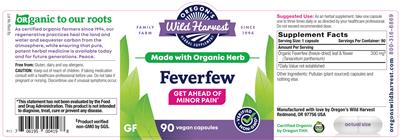
Organic to our roots As certified organic farmers since 1994, our regenerative practices heal the land and water and sequester carbon from the atmosphere, while ensuring that pure, potent herbal medicine is available today and for future generations. Peace.
Precautions
Free from: Gluten, dairy and soy allergens.
Caution: Keep out of reach of children.
If taking medication consult with a healthcare professional before use. Do not take if pregnant or nursing.
Discontinue use if unusual symptoms occur.
Do not exceed recommended dose.
FDA Disclaimer Statement
This statement has not been evaluated by the Food and Drug Administration. This product is not intended to diagnose, treat, cure or prevent any disease.
Formulation
Product verified non-GMO by SGS. GF (Gluten free) Verified non-GMO
Made with organic herb
Get ahead of minor pain
Certified Organic by Oregon Tilth.
Brand IP Statement(s)
Oregon's Wild Harvest Family Farm Since 1994
FDA Statement of Identity
Herbal Supplement
Formula
Made with organic herb
Seals/Symbols
Verified non-GMO
Oregon Tilth Certified Organic (OTCO)
Suggested/Recommended/Usage/Directions
Suggested Use: As an herbal supplement, take one capsule one to three times daily or as directed by your healthcare professional. Do not exceed recommended dose.
Is this label outdated? Report a formula or label change and our pharmacy team will review it.
Feverfew by Oregon's Wild Harvest label
The label scan from the NIH Dietary Supplement Label Database. Tap to enlarge.
Label images are published by the NIH Dietary Supplement Label Database for the version of this product on file. Always read your actual product label.
View the full label (PDF)The Ingredients in Feverfew by Oregon's Wild Harvest
This is the 1 active ingredient this product is made of. Select it to open its full monograph.
Serving size1 Capsule(s) Dosage formCapsule Servings per container90 Amounts shown are per serving.
Feverfew, Freeze-Dried
Interacts with931 drugs
Feverfew is a daisy-family herb best known for migraine prevention, where some studies suggest it may modestly lower how often migraines occur, though...
Feverfew, Freeze-Dried monograph & interactionsOther (inactive) ingredients: Pullulan. These complete the product’s ingredient list but are not active constituents.
Feverfew by Oregon's Wild Harvest Drug Interactions
HelloPharmacist Interaction Report
Feverfew by Oregon's Wild Harvest contains one active ingredient — feverfew — that theoretically interacts with a broad range of medications.
The most serious documented concern involves blood thinners and antiplatelet drugs (drugs that prevent clots): feverfew may boost their effect and raise your bleeding risk. One case report described vaginal bleeding in a person taking high-dose feverfew alongside these medications.
Read the full breakdown — every affected drug type, severity by severity
The ingredient also appears to inhibit several liver enzymes (CYP2C19, CYP2D6, CYP1A2, CYP2C9, CYP3A4, and CYP2C8) in laboratory studies. This could theoretically raise blood levels of drugs your liver normally breaks down — but so far, this hasn't been documented in actual patients.
Altogether, these interactions span 930 individual medications.
None of these enzyme interactions have been reported in humans yet, so we don't know how often or how severely they'd occur in real life. Even so, if you take any prescription drug — especially blood thinners or drugs that work through one of these liver pathways — check your exact medications with the tool on this page before you start.
Check your own medications below · Editorial policy · How we use AI
Want to check YOUR meds against Feverfew?
Ask about interactions with your drugs in plain English — “Can I take it with lisinopril?” — and we find you the answer in seconds, ingredient by ingredient.
Go to the checkerIngredients driving the most interactions
Individual Drug Interactions
The ingredients in Feverfew interact with 931 drugs. Click any drug to see the details.
1 of the 1 ingredient in Feverfew interact with drugs. Each result below shows which ingredient is responsible. Feverfew, Freeze-Dried
Ado-trastuzumab EmtansineKadcyla
How Ado-trastuzumab Emtansine interacts with Feverfew — through 1 ingredient. Tap an ingredient for the detail:
Feverfew, Freeze-driedCytochrome P450 3a4 (cyp3a4) Substrates Moderate
Interaction Summary
Theoretically, feverfew might increase levels of drugs metabolized by CYP3A4.
Read the full Feverfew, Freeze-dried + Ado-trastuzumab Emtansine interactionAbciximabReoPro
How Abciximab interacts with Feverfew — through 1 ingredient. Tap an ingredient for the detail:
Feverfew, Freeze-driedAnticoagulant/antiplatelet Drugs Moderate
Interaction Summary
Theoretically, feverfew might have additive effects and increase the risk of bleeding when used with anticoagulant or antiplatelet drugs.
Read the full Feverfew, Freeze-dried + Abciximab interactionAbemaciclibVerzenio
How Abemaciclib interacts with Feverfew — through 1 ingredient. Tap an ingredient for the detail:
Feverfew, Freeze-driedCytochrome P450 3a4 (cyp3a4) Substrates Moderate
Interaction Summary
Theoretically, feverfew might increase levels of drugs metabolized by CYP3A4.
Read the full Feverfew, Freeze-dried + Abemaciclib interactionAbiraterone
How Abiraterone interacts with Feverfew — through 1 ingredient. Tap an ingredient for the detail:
Feverfew, Freeze-driedCytochrome P450 3a4 (cyp3a4) Substrates Moderate
Interaction Summary
Theoretically, feverfew might increase levels of drugs metabolized by CYP3A4.
Read the full Feverfew, Freeze-dried + Abiraterone interactionAbiraterone AcetateYonsa, Zytiga
How Abiraterone Acetate interacts with Feverfew — through 1 ingredient. Tap an ingredient for the detail:
Feverfew, Freeze-driedCytochrome P450 3a4 (cyp3a4) Substrates Moderate
Interaction Summary
Theoretically, feverfew might increase levels of drugs metabolized by CYP3A4.
Read the full Feverfew, Freeze-dried + Abiraterone Acetate interactionAbrocitinibCibinqo
How Abrocitinib interacts with Feverfew — through 1 ingredient. Tap an ingredient for the detail:
Feverfew, Freeze-driedCytochrome P450 2c9 (cyp2c9) Substrates, Anticoagulant/antiplatelet Drugs +1 Moderate
Interaction Summary
Theoretically, feverfew might increase levels of drugs metabolized by CYP2C9.
Read the full Feverfew, Freeze-dried + Abrocitinib interactionAcalabrutinibCalquence
How Acalabrutinib interacts with Feverfew — through 1 ingredient. Tap an ingredient for the detail:
Feverfew, Freeze-driedCytochrome P450 3a4 (cyp3a4) Substrates Moderate
Interaction Summary
Theoretically, feverfew might increase levels of drugs metabolized by CYP3A4.
Read the full Feverfew, Freeze-dried + Acalabrutinib interactionAcenocoumarolSintrom
How Acenocoumarol interacts with Feverfew — through 1 ingredient. Tap an ingredient for the detail:
Feverfew, Freeze-driedAnticoagulant/antiplatelet Drugs Moderate
Interaction Summary
Theoretically, feverfew might have additive effects and increase the risk of bleeding when used with anticoagulant or antiplatelet drugs.
Read the full Feverfew, Freeze-dried + Acenocoumarol interactionAcetaminophenChildren's Tylenol, Children's Tylenol Meltaways, Tylenol, Tylenol Ex Strength
How Acetaminophen interacts with Feverfew — through 1 ingredient. Tap an ingredient for the detail:
Feverfew, Freeze-driedCytochrome P450 1a2 (cyp1a2) Substrates Moderate
Interaction Summary
Theoretically, feverfew might increase levels of drugs metabolized by CYP1A2.
Read the full Feverfew, Freeze-dried + Acetaminophen interactionAcetaminophen, AspirinGemnisyn
How Acetaminophen, Aspirin interacts with Feverfew — through 1 ingredient. Tap an ingredient for the detail:
Feverfew, Freeze-driedCytochrome P450 1a2 (cyp1a2) Substrates, Anticoagulant/antiplatelet Drugs Moderate
Interaction Summary
Theoretically, feverfew might increase levels of drugs metabolized by CYP1A2.
Read the full Feverfew, Freeze-dried + Acetaminophen, Aspirin interactionAcetaminophen, Aspirin, CaffeineExcedrin, Excedrin Extra Strength, Excedrin Migraine
How Acetaminophen, Aspirin, Caffeine interacts with Feverfew — through 1 ingredient. Tap an ingredient for the detail:
Feverfew, Freeze-driedAnticoagulant/antiplatelet Drugs, Cytochrome P450 1a2 (cyp1a2) Substrates +1 Moderate
Interaction Summary
Theoretically, feverfew might have additive effects and increase the risk of bleeding when used with anticoagulant or antiplatelet drugs.
Read the full Feverfew, Freeze-dried + Acetaminophen, Aspirin, Caffeine interactionAcetaminophen, Brompheniramine, PhenylpropanolamineDimetapp Cold and Flu
How Acetaminophen, Brompheniramine, Phenylpropanolamine interacts with Feverfew — through 1 ingredient. Tap an ingredient for the detail:
Feverfew, Freeze-driedCytochrome P450 1a2 (cyp1a2) Substrates Moderate
Interaction Summary
Theoretically, feverfew might increase levels of drugs metabolized by CYP1A2.
Read the full Feverfew, Freeze-dried + Acetaminophen, Brompheniramine, Phenylpropanolamine interactionAcetaminophen, ButalbitalAxocet, Bancap, Bucet, Butex Forte, Esgic CF, Orbivan CF +5 more
How Acetaminophen, Butalbital interacts with Feverfew — through 1 ingredient. Tap an ingredient for the detail:
Feverfew, Freeze-driedCytochrome P450 1a2 (cyp1a2) Substrates Moderate
Interaction Summary
Theoretically, feverfew might increase levels of drugs metabolized by CYP1A2.
Read the full Feverfew, Freeze-dried + Acetaminophen, Butalbital interactionAcetaminophen, Butalbital, CaffeineEsgic, Esgic Plus, Fiogesic, Fioricet, Repan, Tecnal +1 more
How Acetaminophen, Butalbital, Caffeine interacts with Feverfew — through 1 ingredient. Tap an ingredient for the detail:
Feverfew, Freeze-driedCytochrome P450 1a2 (cyp1a2) Substrates, Cytochrome P450 3a4 (cyp3a4) Substrates Moderate
Interaction Summary
Theoretically, feverfew might increase levels of drugs metabolized by CYP1A2.
Read the full Feverfew, Freeze-dried + Acetaminophen, Butalbital, Caffeine interactionAcetaminophen, Butalbital, Caffeine, CodeineEsgic with Codeine, Fioricet w/ Codeine
How Acetaminophen, Butalbital, Caffeine, Codeine interacts with Feverfew — through 1 ingredient. Tap an ingredient for the detail:
Feverfew, Freeze-driedCytochrome P450 3a4 (cyp3a4) Substrates, Cytochrome P450 2d6 (cyp2d6) Substrates +1 Moderate
Interaction Summary
Theoretically, feverfew might increase levels of drugs metabolized by CYP3A4.
Read the full Feverfew, Freeze-dried + Acetaminophen, Butalbital, Caffeine, Codeine interactionAcetaminophen, Butalbital, CodeineBancap w/ Codeine
How Acetaminophen, Butalbital, Codeine interacts with Feverfew — through 1 ingredient. Tap an ingredient for the detail:
Feverfew, Freeze-driedCytochrome P450 1a2 (cyp1a2) Substrates, Cytochrome P450 2d6 (cyp2d6) Substrates Moderate
Interaction Summary
Theoretically, feverfew might increase levels of drugs metabolized by CYP1A2.
Read the full Feverfew, Freeze-dried + Acetaminophen, Butalbital, Codeine interactionAcetaminophen, Butalbital, Codeine PhosphatePhrenilin #3
How Acetaminophen, Butalbital, Codeine Phosphate interacts with Feverfew — through 1 ingredient. Tap an ingredient for the detail:
Feverfew, Freeze-driedCytochrome P450 2d6 (cyp2d6) Substrates, Cytochrome P450 1a2 (cyp1a2) Substrates Moderate
Interaction Summary
Theoretically, feverfew might increase levels of drugs metabolized by CYP2D6.
Read the full Feverfew, Freeze-dried + Acetaminophen, Butalbital, Codeine Phosphate interactionAcetaminophen, Caffeine, Chlorpheniramine, Hydrocodone, PhenylephrineHycomine Compound
How Acetaminophen, Caffeine, Chlorpheniramine, Hydrocodone, Phenylephrine interacts with Feverfew — through 1 ingredient. Tap an ingredient for the detail:
Feverfew, Freeze-driedCytochrome P450 1a2 (cyp1a2) Substrates, Cytochrome P450 3a4 (cyp3a4) Substrates +1 Moderate
Interaction Summary
Theoretically, feverfew might increase levels of drugs metabolized by CYP1A2.
Read the full Feverfew, Freeze-dried + Acetaminophen, Caffeine, Chlorpheniramine, Hydrocodone, Phenylephrine interactionAcetaminophen, Caffeine, CodeineGesic C15, Gesic C30, Gesic C8, Lenoltec 1, Lenoltec 2, Lenoltec 3 +1 more
How Acetaminophen, Caffeine, Codeine interacts with Feverfew — through 1 ingredient. Tap an ingredient for the detail:
Feverfew, Freeze-driedCytochrome P450 2d6 (cyp2d6) Substrates, Cytochrome P450 1a2 (cyp1a2) Substrates +1 Moderate
Interaction Summary
Theoretically, feverfew might increase levels of drugs metabolized by CYP2D6.
Read the full Feverfew, Freeze-dried + Acetaminophen, Caffeine, Codeine interactionAcetaminophen, Caffeine, Codeine, SalicylamideCodalan No.1, Codalan No.2, Codalan No.3
How Acetaminophen, Caffeine, Codeine, Salicylamide interacts with Feverfew — through 1 ingredient. Tap an ingredient for the detail:
Feverfew, Freeze-driedCytochrome P450 3a4 (cyp3a4) Substrates, Cytochrome P450 2d6 (cyp2d6) Substrates +1 Moderate
Interaction Summary
Theoretically, feverfew might increase levels of drugs metabolized by CYP3A4.
Read the full Feverfew, Freeze-dried + Acetaminophen, Caffeine, Codeine, Salicylamide interactionAcetaminophen, Caffeine, DihydrocodeineDHC Plus, Panlor DC, Panlor SS
How Acetaminophen, Caffeine, Dihydrocodeine interacts with Feverfew — through 1 ingredient. Tap an ingredient for the detail:
Feverfew, Freeze-driedCytochrome P450 1a2 (cyp1a2) Substrates, Cytochrome P450 3a4 (cyp3a4) Substrates +1 Moderate
Interaction Summary
Theoretically, feverfew might increase levels of drugs metabolized by CYP1A2.
Read the full Feverfew, Freeze-dried + Acetaminophen, Caffeine, Dihydrocodeine interactionAcetaminophen, Caffeine, IsomethepteneMigralam
How Acetaminophen, Caffeine, Isometheptene interacts with Feverfew — through 1 ingredient. Tap an ingredient for the detail:
Feverfew, Freeze-driedCytochrome P450 1a2 (cyp1a2) Substrates, Cytochrome P450 3a4 (cyp3a4) Substrates Moderate
Interaction Summary
Theoretically, feverfew might increase levels of drugs metabolized by CYP1A2.
Read the full Feverfew, Freeze-dried + Acetaminophen, Caffeine, Isometheptene interactionAcetaminophen, Caffeine, PyrilamineMidol Max Strength Menstrual
How Acetaminophen, Caffeine, Pyrilamine interacts with Feverfew — through 1 ingredient. Tap an ingredient for the detail:
Feverfew, Freeze-driedCytochrome P450 3a4 (cyp3a4) Substrates, Cytochrome P450 1a2 (cyp1a2) Substrates Moderate
Interaction Summary
Theoretically, feverfew might increase levels of drugs metabolized by CYP3A4.
Read the full Feverfew, Freeze-dried + Acetaminophen, Caffeine, Pyrilamine interactionAcetaminophen, Chlorpheniramine Maleate, Dextromethorphan HbrVicks Formula 44M Cough, Cold & Flu Relief
How Acetaminophen, Chlorpheniramine Maleate, Dextromethorphan Hbr interacts with Feverfew — through 1 ingredient. Tap an ingredient for the detail:
Feverfew, Freeze-driedCytochrome P450 1a2 (cyp1a2) Substrates, Cytochrome P450 2d6 (cyp2d6) Substrates +1 Moderate
Interaction Summary
Theoretically, feverfew might increase levels of drugs metabolized by CYP1A2.
Read the full Feverfew, Freeze-dried + Acetaminophen, Chlorpheniramine Maleate, Dextromethorphan Hbr interactionAcetaminophen, Chlorpheniramine, Codeine, PhenylephrineColrex
How Acetaminophen, Chlorpheniramine, Codeine, Phenylephrine interacts with Feverfew — through 1 ingredient. Tap an ingredient for the detail:
Feverfew, Freeze-driedCytochrome P450 2d6 (cyp2d6) Substrates, Cytochrome P450 1a2 (cyp1a2) Substrates +1 Moderate
Interaction Summary
Theoretically, feverfew might increase levels of drugs metabolized by CYP2D6.
Read the full Feverfew, Freeze-dried + Acetaminophen, Chlorpheniramine, Codeine, Phenylephrine interactionAcetaminophen, Chlorpheniramine, DextromethorphanCoricidin II Extra Strength Cold and Flu
How Acetaminophen, Chlorpheniramine, Dextromethorphan interacts with Feverfew — through 1 ingredient. Tap an ingredient for the detail:
Feverfew, Freeze-driedCytochrome P450 2d6 (cyp2d6) Substrates, Cytochrome P450 3a4 (cyp3a4) Substrates +1 Moderate
Interaction Summary
Theoretically, feverfew might increase levels of drugs metabolized by CYP2D6.
Read the full Feverfew, Freeze-dried + Acetaminophen, Chlorpheniramine, Dextromethorphan interactionAcetaminophen, Chlorpheniramine, Dextromethorphan HydrobromideCoricidin HBP Maximum Strength Flu
How Acetaminophen, Chlorpheniramine, Dextromethorphan Hydrobromide interacts with Feverfew — through 1 ingredient. Tap an ingredient for the detail:
Feverfew, Freeze-driedCytochrome P450 1a2 (cyp1a2) Substrates, Cytochrome P450 2d6 (cyp2d6) Substrates +1 Moderate
Interaction Summary
Theoretically, feverfew might increase levels of drugs metabolized by CYP1A2.
Read the full Feverfew, Freeze-dried + Acetaminophen, Chlorpheniramine, Dextromethorphan Hydrobromide interactionAcetaminophen, Chlorpheniramine, Dextromethorphan, PhenylpropanolamineMulti Symptom Cold Relief
How Acetaminophen, Chlorpheniramine, Dextromethorphan, Phenylpropanolamine interacts with Feverfew — through 1 ingredient. Tap an ingredient for the detail:
Feverfew, Freeze-driedCytochrome P450 1a2 (cyp1a2) Substrates, Cytochrome P450 3a4 (cyp3a4) Substrates +1 Moderate
Interaction Summary
Theoretically, feverfew might increase levels of drugs metabolized by CYP1A2.
Read the full Feverfew, Freeze-dried + Acetaminophen, Chlorpheniramine, Dextromethorphan, Phenylpropanolamine interactionAcetaminophen, Chlorpheniramine, Dextromethorphan, PseudoephedrineChildren's Tylenol Cold Plus Cough, Tylenol Cold Ex Strength
How Acetaminophen, Chlorpheniramine, Dextromethorphan, Pseudoephedrine interacts with Feverfew — through 1 ingredient. Tap an ingredient for the detail:
Feverfew, Freeze-driedCytochrome P450 2d6 (cyp2d6) Substrates, Cytochrome P450 1a2 (cyp1a2) Substrates +1 Moderate
Interaction Summary
Theoretically, feverfew might increase levels of drugs metabolized by CYP2D6.
Read the full Feverfew, Freeze-dried + Acetaminophen, Chlorpheniramine, Dextromethorphan, Pseudoephedrine interactionAcetaminophen, Chlorpheniramine, Guaifenesin, Phenylephrine, SalicylamideRhinogesic GG
How Acetaminophen, Chlorpheniramine, Guaifenesin, Phenylephrine, Salicylamide interacts with Feverfew — through 1 ingredient. Tap an ingredient for the detail:
Feverfew, Freeze-driedCytochrome P450 3a4 (cyp3a4) Substrates, Cytochrome P450 1a2 (cyp1a2) Substrates Moderate
Interaction Summary
Theoretically, feverfew might increase levels of drugs metabolized by CYP3A4.
Read the full Feverfew, Freeze-dried + Acetaminophen, Chlorpheniramine, Guaifenesin, Phenylephrine, Salicylamide interactionEach ingredient & the kinds of drugs it affects
For each ingredient in Feverfew with known interactions, here are the types of medications it can affect. Open any type for the detail — or search your exact drug in the checker above.
Feverfew, Freeze-Dried
Anticoagulant/Antiplatelet Drugs
Theoretically, feverfew might have additive effects and increase the risk of bleeding when used with anticoagulant or antiplatelet drugs.
Laboratory research suggests that feverfew may inhibit platelet aggregation. Additionally, in one case report, a 36-year-old patient taking feverfew 2400 mg daily for 3 months experienced vaginal bleeding and a prolonged menstrual cycle, with a modest increase in partial thromboplastin time (PTT) and prothrombin time (PT).
Cytochrome P450 1A2 (Cyp1A2) Substrates
Theoretically, feverfew might increase levels of drugs metabolized by CYP1A2.
Laboratory research shows that feverfew might inhibit CYP1A2. So far, this interaction has not been reported in humans.
Cytochrome P450 2C19 (Cyp2C19) Substrates
Theoretically, feverfew might increase levels of drugs metabolized by CYP2C19.
Laboratory research shows that feverfew might inhibit CYP2C19. So far, this interaction has not been reported in humans.
Cytochrome P450 2C8 (Cyp2C8) Substrates
Theoretically, feverfew might increase levels of drugs metabolized by CYP2C8.
Laboratory research shows that feverfew might inhibit CYP2C8. So far, this interaction has not been reported in humans.
Cytochrome P450 2C9 (Cyp2C9) Substrates
Theoretically, feverfew might increase levels of drugs metabolized by CYP2C9.
Laboratory research shows that feverfew might inhibit CYP2C9. So far, this interaction has not been reported in humans.
Cytochrome P450 2D6 (Cyp2D6) Substrates
Theoretically, feverfew might increase levels of drugs metabolized by CYP2D6.
Laboratory research shows that feverfew might inhibit CYP2D6. So far, this interaction has not been reported in humans.
Cytochrome P450 3A4 (Cyp3A4) Substrates
Theoretically, feverfew might increase levels of drugs metabolized by CYP3A4.
Laboratory research shows that feverfew might inhibit CYP3A4. So far, this interaction has not been reported in humans.
Brand information
Manufacturer and brand details for Feverfew, from the product label.
Oregon's Wild Harvest
See all Oregon's Wild Harvest products- Name
- Oregon's Wild Harvest
- City
- Redmond
- State
- OR
- ZipCode
- 97756
- Phone Number
- 800-316-6869
- Web Address
- oregonswildharvest.com
Feverfew by Oregon's Wild Harvest: Common Questions
Does Feverfew by Oregon's Wild Harvest interact with any medications?
How can one product interact with so many drugs?
Where does this information come from?
Can I take Feverfew if I'm pregnant?
Can I breastfeed while taking Feverfew?
What are the most common side effects?
If I've been taking Feverfew for a while, can I just stop?
Will Feverfew help my headaches?
Why does chewing fresh feverfew leaves cause mouth sores when the capsule doesn't?
Written and reviewed by the HelloPharmacist editorial staff. Our editorial policy
Not sure if Feverfew is safe with your meds?
Our pharmacists answer your medication & supplement questions — free.
Label information is sourced from the NIH Dietary Supplement Label Database and reflects the product version on file; always read your actual product label. This page is for education only and is not a substitute for professional medical advice. Confirm with your pharmacist or doctor before combining supplements and medications.
The Full Monographs Behind Feverfew’s Ingredients
Every ingredient we hold a full HelloPharmacist monograph for — uses, evidence, safety, and the complete interaction list.
Sources & How We Checked
Feverfew's label data comes from the NIH Dietary Supplement Label Database; the ingredient interaction data is from the Natural Medicines database, reviewed by our pharmacists.
- NIH Dietary Supplement Label Database (DSLD) — The official product label on file for this supplement.
- Natural Medicines (Therapeutic Research Center) — Evidence-graded clinical reference behind the ingredient interaction data.
Content is written and reviewed by licensed HelloPharmacist pharmacists. See our data sources and editorial standards for how this information is built and checked.
The 18 references behind this product’s interaction data
Every citation that drives the interaction findings for this product’s ingredients, from the evidence-graded Natural Medicines (TRC Healthcare) database. Open an ingredient to browse its citations — links open the study on PubMed or the publisher’s site.
Feverfew 18 references
- McGuffin M, Hobbs C, Upton R, Goldberg A, eds. American Herbal Products Association's Botanical Safety Handbook. Boca Raton, FL: CRC Press, LLC 1997.
- Awang DVC. Prescribing therapeutic feverfew (Tancetum pathrnium (L.) Schultz Bip., syn. Chrysanthemumparthenium (L.) Bernh). Int Med 1998;1:11-3.
- Heptinstall S, Groenewegen WA, Spangenberg P, Loesche W. Extracts of feverfew may inhibit platelet behaviour via neutralization of sulphydryl groups. J Pharm Pharmacol 1987;39:459-65. PubMed
- Heptinstall S, White A, Williamson L, Mitchell JR. Extracts of feverfew inhibit granule secretion in blood platelets and polymorphonuclear leucocytes. Lancet 1985;1:1071-4. PubMed
- Makheja AN, Bailey JM. A platelet phospholipase inhibitor from the medicinal herb feverfew (Tanacetum parthenium). Prostaglandins Leukot Med 1982;8:653-60.
- Groenewegen WA, Heptinstall S. A comparison of the effects of an extract of feverfew and parthenolide, a component of feverfew, on human platelet activity in-vitro. J Pharm Pharmacol 1990;42:553-7. PubMed
- Heptinstall S, Groenewegen WA, Spangenberg P, Losche W. Inhibition of platelet behaviour by feverfew: a mechanism of action involving sulphydryl groups. Folia Haematol Int Mag Klin Morphol Blutforsch 1988;115:447-9.
- Biggs MJ, Johnson ES, Persaud NP, Ratcliffe DM. Platelet aggregation in patients using feverfew for migraine. Lancet 1982;2:776. PubMed
- Lamminpaa A, Estlander T, Jolanki R, Kanerva L. Occupational allergic contact dermatitis caused by decorative plants. Contact Dermatitis 1996;34:330-5. PubMed
- Johnson ES, Kadam NP, Hylands DM, Hylands PJ. Efficacy of feverfew as prophylactic treatment of migraine. Br Med J (Clin Res Ed) 1985;291:569-73. PubMed
- Pittler MH, Ernst E. Feverfew for preventing migraine. Cochrane Database Syst Rev 2004;(1):CD002286. PubMed
- Ernst E, Pittler MH. The efficacy and safety of feverfew (Tanacetum parthenium L.): an update of a systematic review. Public Health Nutr 2000;3:509-14.
- Unger M, Frank A. Simultaneous determination of the inhibitory potency of herbal extracts on the activity of six major cytochrome P450 enzymes using liquid chromatography/mass spectrometry and automated online extraction. Rapid Commun Mass Spectrom 2004;1 PubMed
- Sil'vestrov VP, Kinitin AV, and Chesnokova, IV. [Immunological and metabolic disorders and the means for their correction in patients with chronic bronchitis]. Ter.Arkh. 1991;63:7-11.
- Cady RK, Goldstein J, Nett R, et al. A double-blind placebo-controlled pilot study of sublingual feverfew and ginger (LipiGesic M) in the treatment of migraine. Headache 2011;51:1078-86.
- Jovanovic, M. and Poljacki, M. [Compositae dermatitis]. Med Pregl. 2003;56(1-2):43-49. PubMed
- Burry, J. N. Compositae dermatitis in South Australia: contact dermatitis from Chrysanthemum parthenium. Contact Dermatitis 1980;6(6):445.
- Alenzi KA, Alharbi FH, Tawhari FM, Fradees GS. Alteration of Coagulation Test Results and Vaginal Bleeding Associated With the Use of Feverfew (Tanacetum parthenium). J Med Cases 2021;12(1):9-12.
Parts of this content are provided by the Therapeutic Research Center, LLC.
DISCLAIMER: Currently this does not check for drug-drug interactions. This is not an all-inclusive comprehensive list of potential interactions and is for informational purposes only. Not all interactions are known or well-reported in the scientific literature, and new interactions are continually being reported. Input is needed from a qualified healthcare provider including a pharmacist before starting any therapy. Application of clinical judgment is necessary.
© 2021 Therapeutic Research Center, LLC