
Forskolin Ingredients & Drug Interactions
What is this page for?
First and foremost: checking Forskolin against your medications. The heart of this page is the interaction checker and the full interaction report — how this product’s ingredients may interact with prescription and over-the-counter medicines you may be taking.
Around that, we add a pharmacist’s high-level view of the product as a whole — what’s inside, the evidence for its stated use, how transparent the label is, and what safety data exists — so you can see the full picture in one place. It’s educational information from our licensed clinical databases and the clinical staff at HelloPharmacist — not medical advice — and we don’t sell or endorse products. Our editorial policy
Forskolin is a dietary supplement by Cardiovascular Research with 2 active ingredients. Its ingredients are commonly taken for weight management, asthma and breathing, high blood pressure.Based on those ingredients, 917 medications have a known interaction with it, the most serious rated major. The ingredients most likely to interact are ForsLean(R). Use the checker below to test your specific medication, or read the full HelloPharmacist Interaction Report.
Check Your Meds Against Forskolin by Cardiovascular Research
Ask about any prescription or over-the-counter medication and we check it for interactions with Forskolin by Cardiovascular Research — and tell you which ingredient is responsible.
AI summaries are generated from our interaction database for education only — always confirm with your pharmacist. How we use AI
Ask the Pharmacist
A licensed pharmacist will answer your question by email — free, usually within 24 hours.
Got it — thank you!
A licensed pharmacist will answer within 24 hours. Keep an eye on your email (worth checking spam, just in case).
HelloPharmacist Scorecard of Forskolin by Cardiovascular Research
Our pharmacy team’s full take, with four database checks built into the cards below — a summary of what is known, not a grade of the product itself.
What’s inside
Full disclosure
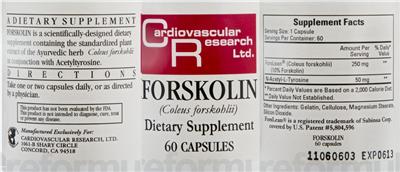
This supplement has 2 active ingredients: ForsLean (coleus extract, the source of forskolin) and N-Acetyl-L-Tyrosine. Coleus is a plant traditionally used to support heart and metabolic health; forskolin is its active compound.
N-Acetyl-L-Tyrosine is an amino acid thought to support mental clarity and stress response. The capsule also contains inactive ingredients — gelatin, cellulose, magnesium stearate, and silicon dioxide — which are standard binders and fillers.
Does it work?
Couldn't assess
The evidence on what this supplement actually does isn't established in our data. Coleus and its forskolin content have been studied for angina, asthma, cancer, heart failure, eczema, and dry eye, but we don't hold reliable evidence strong enough to rate whether it works for any of these.
Talk with your doctor about whether the research outside our files supports its use for your specific goal.
How safe is it?
Well-documented data
Coleus is generally well tolerated, but it does come with cautions. The most common side effects when taken by mouth are constipation, diarrhea, nausea, and vomiting — with diarrhea appearing most often.
Because coleus may lower your blood pressure, it's not well studied for long-term use, so you'll want professional guidance if you're considering it. The safety data advises against use during pregnancy and while breastfeeding.
Meds to double-check
Major interaction found
Before you take this, double-check with your doctor or pharmacist if you use nitrates, calcium channel blockers, blood pressure medications, blood thinners or antiplatelet drugs like aspirin or warfarin, or any medications processed by your liver's CYP2C9 or CYP3A4 enzymes — that last group includes many common prescriptions.
The bottom line
Scorecard at a glanceFully disclosed formula with no assessable stated purpose. Major medication interactions have been identified, and safety information is well characterized.
If you take heart or blood pressure medications, blood thinners, or any drug metabolized by your liver, you need to check this product with your doctor or pharmacist before starting. Even if your medications aren't on the major list, the scope of potential interactions here is broad.
It's a good idea to review the full checker on this page with your own healthcare provider.
Educational only — not medical advice; always confirm with your pharmacist. Our editorial policy · How we use AI
Assessment coverage: 1 of 2 active ingredients matched to our full ingredient reviews (monographs). Based on the product label dated Jul 25, 2013.
This Scorecard evaluates available label information, ingredient evidence, and known medication-safety considerations. It does not independently verify product identity, purity, potency, contamination, or manufacturing quality. How these ratings are computed
General information
Key facts about Forskolin, straight from the product label.
| Brand | Cardiovascular Research |
|---|---|
| Net contents | 60 Capsule(s) |
| Market status | On market |
| Date entered into DSLD | Jul 25, 2013 |
| DSLD ID | 22440 |
| Product type | Other Combinations |
| Supplement form | Capsule |
| Dietary claims / uses | All Other, Structure/Function |
| Intended target group(s) | Adult (18 - 50 Years) |
Everything in this section is reproduced from the manufacturer’s own product label — it’s the label speaking, not HelloPharmacist. We show it so you can see exactly what the maker states; we don’t verify or endorse those statements.
Supplement Facts
The label details for Forskolin by Cardiovascular Research, sourced from the NIH Dietary Supplement Label Database.
Supplement Facts
| Ingredient | Amount | % DV |
|---|---|---|
| N-Acetyl-L-Tyrosine | 50 mg | -- |
| ForsLean(R) | 250 mg | -- |
Other ingredients: Gelatin, Cellulose, Magnesium Stearate, Silicon Dioxide
Tap any ingredient to jump to its full detail below.
These statements are the manufacturer’s wording, reproduced from the product label — the label is saying it, not HelloPharmacist. We don’t verify or endorse them.
FDA Statement of Identity
A DIETARY SUPPLEMENT
Dietary Supplement
General Statements
FORSKOLIN is a scientifically-designed dietary supplement containing the standardized plant extract of the Ayurvedic herb Coleus forskohlii in conjunction with Acetyltyrosine.
11060603 EXP0613
Suggested/Recommended/Usage/Directions
DIRECTIONS Take one or two capsules daily, or as directed by a physician.
FDA Disclaimer Statement
This product has not been evaluated by the FDA. This product is not intended to diagnose, cure, treat or prevent any disease.
Seals/Symbols
ECOLOGICAL FORMULAS
Brand IP Statement(s)
ForsLean(R) is a registered trademark of Sabinsa Corp. covered by U.S. Patent #5,804,596
Formula
(Coleus forskohlii)
Is this label outdated? Report a formula or label change and our pharmacy team will review it.
Forskolin by Cardiovascular Research label
The label scan from the NIH Dietary Supplement Label Database. Tap to enlarge.
Label images are published by the NIH Dietary Supplement Label Database for the version of this product on file. Always read your actual product label.
View the full label (PDF)The Ingredients in Forskolin by Cardiovascular Research
These are the 2 active ingredients this product is made of. Select any to open its full monograph.
Serving size1 Capsule(s) Dosage formCapsule Servings per container60 Amounts shown are per serving.
Most supplement products combine several ingredients, and a medication can interact with the product through any one of them. Each ingredient below shows whether it has known drug interactions.
N-Acetyl-L-Tyrosine
ForsLean(R)
Interacts with917 drugs
Coleus is a plant from the mint family whose root contains a compound called forskolin, often marketed for weight loss, asthma, and heart health. Whil...
ForsLean(R) monograph & interactionsOther (inactive) ingredients: Gelatin, Cellulose, Magnesium Stearate, Silicon Dioxide. These complete the product’s ingredient list but are not active constituents.
Forskolin by Cardiovascular Research Drug Interactions
HelloPharmacist Interaction Report
Cardiovascular Research Forskolin contains ForsLean (a coleus extract) that interacts with several major medication types.
The most serious concerns are nitrates and calcium channel blockers — both used for heart and blood pressure conditions — because coleus may amplify their blood-vessel-relaxing effects, potentially causing unwanted drops in blood pressure or chest symptoms.
Read the full breakdown — every affected drug type, severity by severity
Beyond those, coleus can interact with blood pressure medications (antihypertensives) in ways that might lower your pressure too much, and with blood thinners and antiplatelet drugs (like aspirin or warfarin), raising your bleeding and bruising risk. The ingredient may also affect how your liver processes certain medications metabolized by the enzymes CYP2C9 and CYP3A4 — a broad group that includes many common drugs — which could make them less effective or cause them to build up to unsafe levels.
We could not check the other active ingredient, N-Acetyl-L-Tyrosine, for interactions because we hold no data for it. Altogether, these interactions span 916 individual medications.
Before you start this supplement, run your exact medications through the interaction checker on this page.
Check your own medications below · Editorial policy · How we use AI
Want to check YOUR meds against Forskolin?
Ask about interactions with your drugs in plain English — “Can I take it with lisinopril?” — and we find you the answer in seconds, ingredient by ingredient.
Go to the checkerIngredients driving the most interactions
Individual Drug Interactions
The ingredients in Forskolin interact with 917 drugs. Click any drug to see the details.
1 of the 2 ingredients in Forskolin interact with drugs. Each result below shows which ingredient is responsible. ForsLean(R)
AmlodipineNorliqva
How Amlodipine interacts with Forskolin — through 1 ingredient. Tap an ingredient for the detail:
Forslean(r)Cytochrome P450 3a4 (cyp3a4) Substrates, Calcium Channel Blockers +1 Major
Interaction Summary
Theoretically, taking coleus might decrease serum levels of drugs metabolized by CYP3A4.
Read the full Forslean(r) + Amlodipine interactionAmlodipine BenzoateKaterzia
How Amlodipine Benzoate interacts with Forskolin — through 1 ingredient. Tap an ingredient for the detail:
Forslean(r)Antihypertensive Drugs, Cytochrome P450 3a4 (cyp3a4) Substrates +1 Major
Interaction Summary
Theoretically, combining coleus with antihypertensive drugs might cause additive blood pressure lowering effects and increase the risk of hypotension.
Read the full Forslean(r) + Amlodipine Benzoate interactionAmlodipine BesilateIstin
How Amlodipine Besilate interacts with Forskolin — through 1 ingredient. Tap an ingredient for the detail:
Forslean(r)Calcium Channel Blockers, Antihypertensive Drugs +1 Major
Interaction Summary
Theoretically, combining coleus with calcium channel blockers might increase the coronary vasodilatory effects.
Read the full Forslean(r) + Amlodipine Besilate interactionAmlodipine BesylateNorvasc
How Amlodipine Besylate interacts with Forskolin — through 1 ingredient. Tap an ingredient for the detail:
Forslean(r)Antihypertensive Drugs, Cytochrome P450 3a4 (cyp3a4) Substrates +1 Major
Interaction Summary
Theoretically, combining coleus with antihypertensive drugs might cause additive blood pressure lowering effects and increase the risk of hypotension.
Read the full Forslean(r) + Amlodipine Besylate interactionAmlodipine Besylate, BenazeprilLotrel
How Amlodipine Besylate, Benazepril interacts with Forskolin — through 1 ingredient. Tap an ingredient for the detail:
Forslean(r)Calcium Channel Blockers, Cytochrome P450 3a4 (cyp3a4) Substrates +1 Major
Interaction Summary
Theoretically, combining coleus with calcium channel blockers might increase the coronary vasodilatory effects.
Read the full Forslean(r) + Amlodipine Besylate, Benazepril interactionAmlodipine, CelecoxibConsensi
How Amlodipine, Celecoxib interacts with Forskolin — through 1 ingredient. Tap an ingredient for the detail:
Forslean(r)Antihypertensive Drugs, Cytochrome P450 2c9 (cyp2c9) Substrates +2 Major
Interaction Summary
Theoretically, combining coleus with antihypertensive drugs might cause additive blood pressure lowering effects and increase the risk of hypotension.
Read the full Forslean(r) + Amlodipine, Celecoxib interactionBepridilVascor
How Bepridil interacts with Forskolin — through 1 ingredient. Tap an ingredient for the detail:
Forslean(r)Calcium Channel Blockers, Cytochrome P450 3a4 (cyp3a4) Substrates Major
Interaction Summary
Theoretically, combining coleus with calcium channel blockers might increase the coronary vasodilatory effects.
Read the full Forslean(r) + Bepridil interactionDiltiazemAdizem-SR, Adizem-XL, Angitil SR, Angitil XL, Calcicard CR, Cardizem +23 more
How Diltiazem interacts with Forskolin — through 1 ingredient. Tap an ingredient for the detail:
Forslean(r)Calcium Channel Blockers, Cytochrome P450 3a4 (cyp3a4) Substrates +1 Major
Interaction Summary
Theoretically, combining coleus with calcium channel blockers might increase the coronary vasodilatory effects.
Read the full Forslean(r) + Diltiazem interactionDiltiazem, EnalaprilTeczem
How Diltiazem, Enalapril interacts with Forskolin — through 1 ingredient. Tap an ingredient for the detail:
Forslean(r)Antihypertensive Drugs, Calcium Channel Blockers +1 Major
Interaction Summary
Theoretically, combining coleus with antihypertensive drugs might cause additive blood pressure lowering effects and increase the risk of hypotension.
Read the full Forslean(r) + Diltiazem, Enalapril interactionEnalapril Maleate, FelodipineLexxel
How Enalapril Maleate, Felodipine interacts with Forskolin — through 1 ingredient. Tap an ingredient for the detail:
Forslean(r)Antihypertensive Drugs, Calcium Channel Blockers +1 Major
Interaction Summary
Theoretically, combining coleus with antihypertensive drugs might cause additive blood pressure lowering effects and increase the risk of hypotension.
Read the full Forslean(r) + Enalapril Maleate, Felodipine interactionFelodipinePlendil, Renedil
How Felodipine interacts with Forskolin — through 1 ingredient. Tap an ingredient for the detail:
Forslean(r)Cytochrome P450 3a4 (cyp3a4) Substrates, Antihypertensive Drugs +1 Major
Interaction Summary
Theoretically, taking coleus might decrease serum levels of drugs metabolized by CYP3A4.
Read the full Forslean(r) + Felodipine interactionGlyceryl TrinitrateNitronal
How Glyceryl Trinitrate interacts with Forskolin — through 1 ingredient. Tap an ingredient for the detail:
Forslean(r)Nitrates Major
Interaction Summary
Theoretically, combining coleus with nitrates might increase the coronary vasodilatory effects.
Read the full Forslean(r) + Glyceryl Trinitrate interactionIsosorbide DinitrateAngitak, Cedocard Retard, Isoket, Isoket Retard, Isordil
How Isosorbide Dinitrate interacts with Forskolin — through 1 ingredient. Tap an ingredient for the detail:
Forslean(r)Nitrates Major
Interaction Summary
Theoretically, combining coleus with nitrates might increase the coronary vasodilatory effects.
Read the full Forslean(r) + Isosorbide Dinitrate interactionIsosorbide Dinitrate, HydralazineBiDil
How Isosorbide Dinitrate, Hydralazine interacts with Forskolin — through 1 ingredient. Tap an ingredient for the detail:
Forslean(r)Nitrates, Antihypertensive Drugs Major
Interaction Summary
Theoretically, combining coleus with nitrates might increase the coronary vasodilatory effects.
Read the full Forslean(r) + Isosorbide Dinitrate, Hydralazine interactionIsosorbide MononitrateAngeze, Angeze SR, Chemydur 60XL, Dynamin, Elantan, Elantan LA +13 more
How Isosorbide Mononitrate interacts with Forskolin — through 1 ingredient. Tap an ingredient for the detail:
Forslean(r)Nitrates Major
Interaction Summary
Theoretically, combining coleus with nitrates might increase the coronary vasodilatory effects.
Read the full Forslean(r) + Isosorbide Mononitrate interactionIsradipineDynacirc CR
How Isradipine interacts with Forskolin — through 1 ingredient. Tap an ingredient for the detail:
Forslean(r)Antihypertensive Drugs, Calcium Channel Blockers +1 Major
Interaction Summary
Theoretically, combining coleus with antihypertensive drugs might cause additive blood pressure lowering effects and increase the risk of hypotension.
Read the full Forslean(r) + Isradipine interactionLercanidipine HydrochlorideZanidip
How Lercanidipine Hydrochloride interacts with Forskolin — through 1 ingredient. Tap an ingredient for the detail:
Forslean(r)Calcium Channel Blockers, Antihypertensive Drugs +1 Major
Interaction Summary
Theoretically, combining coleus with calcium channel blockers might increase the coronary vasodilatory effects.
Read the full Forslean(r) + Lercanidipine Hydrochloride interactionLevamlodipineConjupri
How Levamlodipine interacts with Forskolin — through 1 ingredient. Tap an ingredient for the detail:
Forslean(r)Cytochrome P450 3a4 (cyp3a4) Substrates, Antihypertensive Drugs +1 Major
Interaction Summary
Theoretically, taking coleus might decrease serum levels of drugs metabolized by CYP3A4.
Read the full Forslean(r) + Levamlodipine interactionNicardipineCardene, Cardene IV, Cardene SR
How Nicardipine interacts with Forskolin — through 1 ingredient. Tap an ingredient for the detail:
Forslean(r)Cytochrome P450 3a4 (cyp3a4) Substrates, Calcium Channel Blockers +1 Major
Interaction Summary
Theoretically, taking coleus might decrease serum levels of drugs metabolized by CYP3A4.
Read the full Forslean(r) + Nicardipine interactionNicorandilAprior, Dancor, Ikorel, Sigmart, Zynicor
How Nicorandil interacts with Forskolin — through 1 ingredient. Tap an ingredient for the detail:
Forslean(r)Nitrates Major
Interaction Summary
Theoretically, combining coleus with nitrates might increase the coronary vasodilatory effects.
Read the full Forslean(r) + Nicorandil interactionNifedipineAdalat, Adalat CC, Adalat LA, Adalat PA, Adalat Retard, Adalat XL +15 more
How Nifedipine interacts with Forskolin — through 1 ingredient. Tap an ingredient for the detail:
Forslean(r)Antihypertensive Drugs, Cytochrome P450 3a4 (cyp3a4) Substrates +1 Major
Interaction Summary
Theoretically, combining coleus with antihypertensive drugs might cause additive blood pressure lowering effects and increase the risk of hypotension.
Read the full Forslean(r) + Nifedipine interactionNisoldipineSular
How Nisoldipine interacts with Forskolin — through 1 ingredient. Tap an ingredient for the detail:
Forslean(r)Calcium Channel Blockers, Antihypertensive Drugs +1 Major
Interaction Summary
Theoretically, combining coleus with calcium channel blockers might increase the coronary vasodilatory effects.
Read the full Forslean(r) + Nisoldipine interactionNitrendipineCardif
How Nitrendipine interacts with Forskolin — through 1 ingredient. Tap an ingredient for the detail:
Forslean(r)Calcium Channel Blockers, Cytochrome P450 3a4 (cyp3a4) Substrates Major
Interaction Summary
Theoretically, combining coleus with calcium channel blockers might increase the coronary vasodilatory effects.
Read the full Forslean(r) + Nitrendipine interactionNitroglycerinGonitro, Nitro Time, Nitro-Bid, Nitrocine Timecaps, Nitrogard, Nitrogard SR +7 more
How Nitroglycerin interacts with Forskolin — through 1 ingredient. Tap an ingredient for the detail:
Forslean(r)Nitrates Major
Interaction Summary
Theoretically, combining coleus with nitrates might increase the coronary vasodilatory effects.
Read the full Forslean(r) + Nitroglycerin interactionPentaerythritol TetranitratePeritrate, Peritrate SA
How Pentaerythritol Tetranitrate interacts with Forskolin — through 1 ingredient. Tap an ingredient for the detail:
Forslean(r)Nitrates Major
Interaction Summary
Theoretically, combining coleus with nitrates might increase the coronary vasodilatory effects.
Read the full Forslean(r) + Pentaerythritol Tetranitrate interactionPerindopril Arginine, AmlodipinePrestalia
How Perindopril Arginine, Amlodipine interacts with Forskolin — through 1 ingredient. Tap an ingredient for the detail:
Forslean(r)Cytochrome P450 3a4 (cyp3a4) Substrates, Antihypertensive Drugs +1 Major
Interaction Summary
Theoretically, taking coleus might decrease serum levels of drugs metabolized by CYP3A4.
Read the full Forslean(r) + Perindopril Arginine, Amlodipine interactionTelmisartan, AmlodipineTwynsta
How Telmisartan, Amlodipine interacts with Forskolin — through 1 ingredient. Tap an ingredient for the detail:
Forslean(r)Antihypertensive Drugs, Cytochrome P450 3a4 (cyp3a4) Substrates +1 Major
Interaction Summary
Theoretically, combining coleus with antihypertensive drugs might cause additive blood pressure lowering effects and increase the risk of hypotension.
Read the full Forslean(r) + Telmisartan, Amlodipine interactionTrandolapril, VerapamilTarka
How Trandolapril, Verapamil interacts with Forskolin — through 1 ingredient. Tap an ingredient for the detail:
Forslean(r)Antihypertensive Drugs, Cytochrome P450 3a4 (cyp3a4) Substrates +1 Major
Interaction Summary
Theoretically, combining coleus with antihypertensive drugs might cause additive blood pressure lowering effects and increase the risk of hypotension.
Read the full Forslean(r) + Trandolapril, Verapamil interactionVerapamilCalan, Calan SR, Covera HS, Isoptin, Isoptin SR, Veramil +3 more
How Verapamil interacts with Forskolin — through 1 ingredient. Tap an ingredient for the detail:
Forslean(r)Cytochrome P450 3a4 (cyp3a4) Substrates, Calcium Channel Blockers +1 Major
Interaction Summary
Theoretically, taking coleus might decrease serum levels of drugs metabolized by CYP3A4.
Read the full Forslean(r) + Verapamil interactionAdo-trastuzumab EmtansineKadcyla
How Ado-trastuzumab Emtansine interacts with Forskolin — through 1 ingredient. Tap an ingredient for the detail:
Forslean(r)Cytochrome P450 3a4 (cyp3a4) Substrates Moderate
Interaction Summary
Theoretically, taking coleus might decrease serum levels of drugs metabolized by CYP3A4.
Read the full Forslean(r) + Ado-trastuzumab Emtansine interactionEach ingredient & the kinds of drugs it affects
For each ingredient in Forskolin with known interactions, here are the types of medications it can affect. Open any type for the detail — or search your exact drug in the checker above.
ForsLean(R)
Calcium Channel Blockers
Theoretically, combining coleus with calcium channel blockers might increase the coronary vasodilatory effects.
Forskolin, a constituent of coleus, and calcium channel blockers both cause coronary vasodilatory effects.
Nitrates
Theoretically, combining coleus with nitrates might increase the coronary vasodilatory effects.
Forskolin, a constituent of coleus, and nitrates both cause coronary vasodilatory effects.
Anticoagulant/Antiplatelet Drugs
Theoretically, concomitant use of coleus and anticoagulant or antiplatelet drugs might increase the risk of bruising and bleeding.
In vitro and animal research shows that forskolin, a constituent of coleus, can inhibit platelet aggregation and adhesion.
Antihypertensive Drugs
Theoretically, combining coleus with antihypertensive drugs might cause additive blood pressure lowering effects and increase the risk of hypotension.
Animal research shows that forskolin, a constituent of coleus, may lower blood pressure.
Cytochrome P450 2C9 (Cyp2C9) Substrates
Theoretically, taking coleus may affect drugs metabolized by CYP2C9 and increase the risk of adverse effects or reduce the effectiveness.
Research on the effect of coleus on CYP2C9 is conflicting. Some animal research shows that coleus extract can induce CYP2C9, while in vitro research shows that coleus can inhibit CYP2C9. Until more is known, advise patients that taking coleus might increase or decrease levels of drugs metabolized by CYP2C9.
Cytochrome P450 3A4 (Cyp3A4) Substrates
Theoretically, taking coleus might decrease serum levels of drugs metabolized by CYP3A4.
In vitro research shows that coleus can activate the nuclear receptor, pregnane X receptor (PXR), which results in increased expression of CYP3A4. Although the clinical significance of this is not known, use caution when considering concomitant use of coleus and other drugs affected by these enzymes.
Warfarin (Coumadin)
Theoretically, taking coleus may affect the metabolism of warfarin and increase the risk of adverse effects or reduce the effectiveness.
Some animal research shows that coleus extract can induce cytochrome P450 2C9 (CYP2C9), an enzyme that metabolizes warfarin. However, other in vitro research shows that coleus can inhibit CYP2C9. Theoretically, taking coleus with drugs metabolized by CYP2C9 might affect drug levels and the risk of adverse effects. Until more is known, advise patients that taking coleus might increase or decrease levels of warfarin.
Brand information
Manufacturer and brand details for Forskolin, from the product label.
Cardiovascular Research
See all Cardiovascular Research products- Name
- CARDIOVASCULAR RESEARCH, LTD.
- Street Address
- 1061-B SHARY CIRCLE
- City
- CONCORD
- State
- CA
- ZipCode
- 94518
Forskolin by Cardiovascular Research: Common Questions
Does Forskolin by Cardiovascular Research interact with any medications?
How can one product interact with so many drugs?
Where does this information come from?
Can I take this if I'm on a blood pressure or heart medication?
What are the most common side effects?
Is it safe to take during pregnancy or while breastfeeding?
How long can I safely take this supplement?
What is N-Acetyl-L-Tyrosine and why is it in here?
Written and reviewed by the HelloPharmacist editorial staff. Our editorial policy
Not sure if Forskolin is safe with your meds?
Our pharmacists answer your medication & supplement questions — free.
Label information is sourced from the NIH Dietary Supplement Label Database and reflects the product version on file; always read your actual product label. This page is for education only and is not a substitute for professional medical advice. Confirm with your pharmacist or doctor before combining supplements and medications.
The Full Monographs Behind Forskolin’s Ingredients
Every ingredient we hold a full HelloPharmacist monograph for — uses, evidence, safety, and the complete interaction list.
Sources & How We Checked
Forskolin's label data comes from the NIH Dietary Supplement Label Database; the ingredient interaction data is from the Natural Medicines database, reviewed by our pharmacists.
- NIH Dietary Supplement Label Database (DSLD) — The official product label on file for this supplement.
- Natural Medicines (Therapeutic Research Center) — Evidence-graded clinical reference behind the ingredient interaction data.
Content is written and reviewed by licensed HelloPharmacist pharmacists. See our data sources and editorial standards for how this information is built and checked.
The 16 references behind this product’s interaction data
Every citation that drives the interaction findings for this product’s ingredients, from the evidence-graded Natural Medicines (TRC Healthcare) database. Open an ingredient to browse its citations — links open the study on PubMed or the publisher’s site.
Coleus 16 references
- Baumann G, Felix S, Sattelberger U, Klein G. Cardiovascular effects of forskolin (HL-362) in patients with idiopathic congestiv cardiomyopathy. A comparative study with dobutamine and sodium nitroprusside. J Cardiovasc Pharmacol 1990;16:93-100.
- Kramer W, Thormann J, Kindler M, Schlepper M. Effects of forskolin on left ventricular function in dilated cardiomyopathy. Arzneimittelforschung 1987;37:364-7.
- Bauer K, Dietersdorfer F, Kaspar S, et al. Pharmacodynamic effects of inhaled dry powder formulations of fenoterol and colforsin in asthma. Clin Pharmacol Ther 1993;53:76-83. PubMed
- Christenson JT, Thulesius O, Nazzal MM. The effect of forskolin on blood flow, platelet metabolism, aggregation and ATP release. Vasa 1995;24:56-61.
- Agarwal KC, Zielinski BA, Maitra RS. Significance of plasma adenosine in the antiplatelet activity of forskolin: potentiation by dipyridamole and dilazep. Thromb Haemost 1989;61:106-10. DOI
- Agarwal KC, Parks RE. Forskolin: a potential antimetastatic agent. Int J Cancer 1983;32:801-4. PubMed
- Almeida, F. C. and Lemonica, I. P. The toxic effects of Coleus barbatus B. on the different periods of pregnancy in rats. J Ethnopharmacol 2000;73(1-2):53-60. PubMed
- Ding, X. and Staudinger, J. L. Induction of drug metabolism by forskolin: the role of the pregnane X receptor and the protein kinase a signal transduction pathway. J Pharmacol Exp Ther 2005;312(2):849-856. PubMed
- Staudinger, J. L., Ding, X., and Lichti, K. Pregnane X receptor and natural products: beyond drug-drug interactions. Expert.Opin Drug Metab Toxicol 2006;2(6):847-857. PubMed
- van Hecke, E., Hindryckx, P., Geuns, J. M., and Devriese, E. Airborne contact dermatitis from coleus in a housewife. Contact Dermatitis 1991;25(2):128-129. PubMed
- Schlepper, M., Thormann, J., and Mitrovic, V. Cardiovascular effects of forskolin and phosphodiesterase-III inhibitors. Basic Res Cardiol 1989;84 Suppl 1:197-212. PubMed
- Dooms-Goossens, A., Borghijs, A., Degreef, H., Devriese, E. G., and Geuns, J. M. Airborne contact dermatitis to Coleus. Contact Dermatitis 1987;17(2):109-110. PubMed
- Lindner, E., Dohadwalla, A. N., and Bhattacharya, B. K. Positive inotropic and blood pressure lowering activity of a diterpene derivative isolated from Coleus forskohli: Forskolin. Arzneimittelforschung 1978;28(2):284-289.
- Loftus HL, Astell KJ, Mathai ML, et al. Coleus forskohlii Extract Supplementation in Conjunction with a Hypocaloric Diet Reduces the Risk Factors of Metabolic Syndrome in Overweight and Obese Subjects: A Randomized Controlled Trial. Nutrients. 2015;7(11): PubMed
- Yokotani K, Chiba T, Sato Y, et al. Hepatic cytochrome P450 mediates interaction between warfarin and Coleus forskohlii extract in vivo and in vitro. J Pharm Pharmacol. 2012;64(12):1793-801.
- Nishijima C, Chiba T, Sato Y, Umegaki K. Nationwide Online Survey Enables the Reevaluation of the Safety of Coleus forskohlii Extract Intake Based on the Adverse Event Frequencies. Nutrients. 2019;11(4). pii: E866. PubMed
Parts of this content are provided by the Therapeutic Research Center, LLC.
DISCLAIMER: Currently this does not check for drug-drug interactions. This is not an all-inclusive comprehensive list of potential interactions and is for informational purposes only. Not all interactions are known or well-reported in the scientific literature, and new interactions are continually being reported. Input is needed from a qualified healthcare provider including a pharmacist before starting any therapy. Application of clinical judgment is necessary.
© 2021 Therapeutic Research Center, LLC