
GasEnz Ingredients & Drug Interactions
by ProEnzol
What is this page for?
First and foremost: checking GasEnz against your medications. The heart of this page is the interaction checker and the full interaction report — how this product’s ingredients may interact with prescription and over-the-counter medicines you may be taking.
Around that, we add a pharmacist’s high-level view of the product as a whole — what’s inside, the evidence for its stated use, how transparent the label is, and what safety data exists — so you can see the full picture in one place. It’s educational information from our licensed clinical databases and the clinical staff at HelloPharmacist — not medical advice — and we don’t sell or endorse products. Our editorial policy
GasEnz is a dietary supplement by ProEnzol with 19 active ingredients. Its ingredients are commonly taken for water retention (diuretic), digestive upset, liver and gallbladder support.Based on those ingredients, 1,136 medications have a known interaction with it, the most serious rated moderate. The ingredients most likely to interact are Fennel seed extract, Dandelion Leaf Extract, Caraway seed extract. Use the checker below to test your specific medication, or read the full HelloPharmacist Interaction Report.
Check Your Meds Against GasEnz by ProEnzol
Ask about any prescription or over-the-counter medication and we check it for interactions with GasEnz by ProEnzol — and tell you which ingredient is responsible.
AI summaries are generated from our interaction database for education only — always confirm with your pharmacist. How we use AI
Ask the Pharmacist
A licensed pharmacist will answer your question by email — free, usually within 24 hours.
Got it — thank you!
A licensed pharmacist will answer within 24 hours. Keep an eye on your email (worth checking spam, just in case).
HelloPharmacist Scorecard of GasEnz by ProEnzol
Our pharmacy team’s full take, with four database checks built into the cards below — a summary of what is known, not a grade of the product itself.
What’s inside
Low disclosure
ProEnzol GasEnz contains 19 ingredients total: multiple digestive enzymes — amylase, protease, lipase, lactase, cellulase, peptidase, invertase, glucoamylase, alpha-galactosidase, xylanase, pectinase, maltase, beta-glucanase, phytase, hemicellulase, and diastase — along with herbal extracts of dandelion leaf, fennel seed, and caraway seed. These enzymes are designed to help break down different types of food components: proteins, fats, carbohydrates, and plant fibers.
Lactase specifically helps digest lactose (milk sugar) in people who have trouble with it. The inactive ingredients are plant fiber and water.
The herbal ingredients add traditional digestive support, though their effectiveness for gas and bloating in humans is not well established in the data we hold.
Does it work?
Moderate evidence
For lactose intolerance specifically, lactase is rated Effective — the evidence supports its use for that purpose. For the other conditions the product might address — dyspepsia (indigestion) with caraway, or general digestive support with the other enzymes — the evidence is insufficient or has not been reliably established.
Dandelion leaf, fennel seed, phytase, lipase, and the remaining enzymes lack clear evidence that they work for any of the digestive or other conditions listed in our data.
How safe is it?
Well-documented data
Protease is generally well tolerated in most adults but may cause digestive upset or allergic reactions in sensitive people. Lactase is generally well tolerated when used as directed.
Lipase is generally well tolerated but should be used under medical guidance in people with serious digestive conditions. Dandelion leaf is generally well tolerated as food but supplement-strength doses are less studied; rare cases of anaphylaxis in sensitive individuals have been reported, and allergy to dandelion pollen can cause allergic rhinitis, conjunctivitis, or asthma.
Fennel seed is generally safe as a food, but concentrated supplements carry risk of allergic reactions and rarely seizures. Caraway seed is generally safe in food amounts, but concentrated forms are less studied.
Phytase has limited human supplement data, and occupational exposure to powdered phytase has triggered allergic asthma and hypersensitivity pneumonitis in some workers.
Meds to double-check
Moderate interaction found
Before taking GasEnz, double-check these medication types with your pharmacist, starting with the most serious: blood thinners (anticoagulants/antiplatelets), drugs metabolized by CYP3A4 or CYP1A2, potassium-sparing diuretics, lithium, diabetes medications, contraceptive drugs, hormone replacement therapy, ciprofloxacin (and other quinolone antibiotics), tamoxifen, CNS depressants, diuretics that deplete potassium, and TB drugs (isoniazid, rifampin, pyrazinamide). No interactions are documented for the enzyme ingredients we could fully check.
The bottom line
Scorecard at a glanceFormula with limited ingredient disclosure with some supporting evidence for its stated purpose. Moderate medication interactions have been identified, and safety information is well characterized.
This product may help with lactose intolerance, but evidence for gas relief is limited. If you take any blood thinners, diabetes drugs, lithium, potassium-sparing diuretics, contraceptives, hormone therapy, ciprofloxacin, TB medications, or CNS depressants, check with your pharmacist before starting — the herbal ingredients interact with many of these.
Pregnant people should avoid the concentrated herbal ingredients. Talk to your pharmacist about your specific medications.
Educational only — not medical advice; always confirm with your pharmacist. Our editorial policy · How we use AI
Assessment coverage: 7 of 19 active ingredients matched to our full ingredient reviews (monographs). Based on the product label dated Mar 25, 2025.
This Scorecard evaluates available label information, ingredient evidence, and known medication-safety considerations. It does not independently verify product identity, purity, potency, contamination, or manufacturing quality. How these ratings are computed
General information
Key facts about GasEnz, straight from the product label.
| Brand | ProEnzol |
|---|---|
| Barcode (UPC) | 707636120965 |
| Net contents | 60 Vegan Capsule(s) |
| Market status | On market |
| Date entered into DSLD | Mar 25, 2025 |
| DSLD ID | 322829 |
| Product type | Other Combinations |
| Supplement form | Capsule |
| Dietary claims / uses | All Other, Structure/Function |
| Intended target group(s) | Vegan, Vegetarian, Adult (18 - 50 Years), Gluten Free, Dairy Free, Sugar Free |
Everything in this section is reproduced from the manufacturer’s own product label — it’s the label speaking, not HelloPharmacist. We show it so you can see exactly what the maker states; we don’t verify or endorse those statements.
Supplement Facts
The label details for GasEnz by ProEnzol, sourced from the NIH Dietary Supplement Label Database.
Supplement Facts
| Ingredient | Amount | % DV |
|---|---|---|
| Amylase | 0 NP | -- |
| Protease | 0 NP | -- |
| Lipase | 0 NP | -- |
| Lactase | 0 NP | -- |
| Cellulase | 0 NP | -- |
| Peptidase | 0 NP | -- |
| Invertase | 0 NP | -- |
| Glucoamylase | 0 NP | -- |
| Alpha-Galactosidase | 0 NP | -- |
| Xylanase | 0 NP | -- |
| Pectinase | 0 NP | -- |
| Maltase | 0 NP | -- |
| Beta-Glucanase | 0 NP | -- |
| Phytase | 0 NP | -- |
| Hemicellulase | 0 NP | -- |
| Diastase | 0 NP | -- |
| Dandelion Leaf Extract | 0 NP | -- |
| Fennel seed extract | 0 NP | -- |
| Caraway seed extract | 0 NP | -- |
| Gas-Relieving Herbal Blend | 350 mg | -- |
| GasEnz Blend | 260 mg | -- |
Other ingredients: Plant Fiber, Water
Tap any ingredient to jump to its full detail below.
These statements are the manufacturer’s wording, reproduced from the product label — the label is saying it, not HelloPharmacist. We don’t verify or endorse them.
Formula
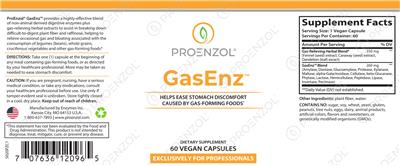
ProEnzol GasEnz provides a blend of non-animal derived enzymes plus gas-relieving herbal extracts to assist in breaking down difficult-to-digest plant fiber and raffinose, helping to relieve occasional gas and bloating associated with the consumption of legumes (beans), whole grains, cruciferous vegetables and other gas-forming foods
Suggested/Recommended/Usage/Directions
Directions: take one (1) capsule at the beginning of any meal containing gas-forming foods, or as directed by your healthcare professional. More may be taken as needed to ease stomach discomfort.
Precautions
Caution: if you are pregnant, nursing, have a serious medical condition, or take any medications, consult your healthcare professional before use.
Use only if tamper-evident seal is unbroken.
Keep out of reach of children.
Exclusively for professionals
Storage
Store tightly closed in a cool, dry place.
FDA Disclaimer Statement
This statement has not been evaluated by the Food and Drug Administration. This product is not intended to diagnose, treat, mitigate, cure, or prevent any disease.
Formulation
Helps ease stomach discomfort caused by gas-forming foods
Contains no: sugar, soy, wheat, yeast, gluten, peanuts, tree nuts, eggs, dairy, animal products, artificial colors, flavors and sweeteners or genetically modified organisms (GMOs).
FDA Statement of Identity
Dietary Supplement
Is this label outdated? Report a formula or label change and our pharmacy team will review it.
GasEnz by ProEnzol label
The label scan from the NIH Dietary Supplement Label Database. Tap to enlarge.
Label images are published by the NIH Dietary Supplement Label Database for the version of this product on file. Always read your actual product label.
View the full label (PDF)The Ingredients in GasEnz by ProEnzol
These are the 19 active ingredients this product is made of. Select any to open its full monograph.
Serving size1 Vegan Capsule(s) Dosage formCapsule Servings per container60 Amounts shown are per serving.
Most supplement products combine several ingredients, and a medication can interact with the product through any one of them. Each ingredient below shows whether it has known drug interactions.
Gas-Relieving Herbal Blend
Other (inactive) ingredients: Plant Fiber, Water. These complete the product’s ingredient list but are not active constituents.
GasEnz by ProEnzol Drug Interactions
HelloPharmacist Interaction Report
ProEnzol GasEnz contains several digestive enzymes and herbal ingredients, some of which interact with medications.
The most serious concern is dandelion leaf extract, which has Moderate-severity interactions across seven drug types. Dandelion may increase levels of drugs metabolized by CYP1A2 enzymes, raise potassium to risky levels if you take potassium-sparing diuretics, raise bleeding risk with blood thinners (anticoagulant/antiplatelet drugs), lower blood sugar too far with diabetes medications, speed clearance of drugs processed by glucuronidation, increase lithium levels (risking toxicity), and reduce absorption of quinolone antibiotics like ciprofloxacin.
Read the full breakdown — every affected drug type, severity by severity
Fennel seed extract also carries Moderate interactions with contraceptive drugs (potentially reducing their effectiveness), CYP3A4-metabolized drugs (which may build up in your system), hormone replacement therapy, blood thinners, ciprofloxacin specifically, and the breast cancer drug tamoxifen. Caraway seed extract has Moderate interactions with sedatives (CNS depressants), diabetes medications, certain diuretics, and lithium, plus Minor interactions with tuberculosis drugs (isoniazid, rifampin, and pyrazinamide).
The enzyme ingredients protease and lipase have no documented interactions. We could not check amylase, cellulase, peptidase, invertase, glucoamylase, alpha-galactosidase, xylanase, pectinase, maltase, beta-glucanase, hemicellulase, or diastase — interaction data is not on file for these.
Altogether, these interactions span 1,124 individual medications.
If you take any of the drug types listed above, use the medication checker on this page to see if your specific medications are affected before starting this product.
Check your own medications below · Editorial policy · How we use AI
Want to check YOUR meds against GasEnz?
Ask about interactions with your drugs in plain English — “Can I take it with lisinopril?” — and we find you the answer in seconds, ingredient by ingredient.
Go to the checkerIngredients driving the most interactions
Individual Drug Interactions
The ingredients in GasEnz interact with 1,136 drugs. Click any drug to see the details.
3 of the 19 ingredients in GasEnz interact with drugs. Each result below shows which ingredient is responsible. Fennel seed extract Dandelion Leaf Extract Caraway seed extract
Ado-trastuzumab EmtansineKadcyla
How Ado-trastuzumab Emtansine interacts with GasEnz — through 1 ingredient. Tap an ingredient for the detail:
Fennel Seed ExtractCytochrome P450 3a4 (cyp3a4) Substrates Moderate
Interaction Summary
Theoretically, fennel might increase levels of drugs metabolized by CYP3A4.
Read the full Fennel Seed Extract + Ado-trastuzumab Emtansine interactionAbciximabReoPro
How Abciximab interacts with GasEnz — through 2 ingredients. Tap an ingredient for the detail:
Dandelion Leaf ExtractAnticoagulant/antiplatelet Drugs Moderate
Interaction Summary
Theoretically, taking dandelion root along with anticoagulant or antiplatelet drugs might increase the risk of bruising and bleeding.
Read the full Dandelion Leaf Extract + Abciximab interactionFennel Seed ExtractAnticoagulant/antiplatelet Drugs Moderate
Interaction Summary
Theoretically, fennel might increase the risk of bleeding when used with antiplatelet or anticoagulant drugs.
Read the full Fennel Seed Extract + Abciximab interactionAbemaciclibVerzenio
How Abemaciclib interacts with GasEnz — through 1 ingredient. Tap an ingredient for the detail:
Fennel Seed ExtractCytochrome P450 3a4 (cyp3a4) Substrates Moderate
Interaction Summary
Theoretically, fennel might increase levels of drugs metabolized by CYP3A4.
Read the full Fennel Seed Extract + Abemaciclib interactionAbiraterone
How Abiraterone interacts with GasEnz — through 1 ingredient. Tap an ingredient for the detail:
Fennel Seed ExtractCytochrome P450 3a4 (cyp3a4) Substrates Moderate
Interaction Summary
Theoretically, fennel might increase levels of drugs metabolized by CYP3A4.
Read the full Fennel Seed Extract + Abiraterone interactionAbiraterone AcetateYonsa, Zytiga
How Abiraterone Acetate interacts with GasEnz — through 1 ingredient. Tap an ingredient for the detail:
Fennel Seed ExtractCytochrome P450 3a4 (cyp3a4) Substrates Moderate
Interaction Summary
Theoretically, fennel might increase levels of drugs metabolized by CYP3A4.
Read the full Fennel Seed Extract + Abiraterone Acetate interactionAbrocitinibCibinqo
How Abrocitinib interacts with GasEnz — through 2 ingredients. Tap an ingredient for the detail:
Dandelion Leaf ExtractAnticoagulant/antiplatelet Drugs Moderate
Interaction Summary
Theoretically, taking dandelion root along with anticoagulant or antiplatelet drugs might increase the risk of bruising and bleeding.
Read the full Dandelion Leaf Extract + Abrocitinib interactionFennel Seed ExtractAnticoagulant/antiplatelet Drugs Moderate
Interaction Summary
Theoretically, fennel might increase the risk of bleeding when used with antiplatelet or anticoagulant drugs.
Read the full Fennel Seed Extract + Abrocitinib interactionAcalabrutinibCalquence
How Acalabrutinib interacts with GasEnz — through 1 ingredient. Tap an ingredient for the detail:
Fennel Seed ExtractCytochrome P450 3a4 (cyp3a4) Substrates Moderate
Interaction Summary
Theoretically, fennel might increase levels of drugs metabolized by CYP3A4.
Read the full Fennel Seed Extract + Acalabrutinib interactionAcarboseGlucobay, Prandase, Precose
How Acarbose interacts with GasEnz — through 2 ingredients. Tap an ingredient for the detail:
Caraway Seed ExtractAntidiabetes Drugs Moderate
Interaction Summary
Theoretically, caraway might increase the risk of hypoglycemia when used with antidiabetes drugs.
Read the full Caraway Seed Extract + Acarbose interactionDandelion Leaf ExtractAntidiabetes Drugs Moderate
Interaction Summary
Theoretically, dandelion might increase the risk for hypoglycemia when used with antidiabetes drugs.
Read the full Dandelion Leaf Extract + Acarbose interactionAcenocoumarolSintrom
How Acenocoumarol interacts with GasEnz — through 2 ingredients. Tap an ingredient for the detail:
Fennel Seed ExtractAnticoagulant/antiplatelet Drugs Moderate
Interaction Summary
Theoretically, fennel might increase the risk of bleeding when used with antiplatelet or anticoagulant drugs.
Read the full Fennel Seed Extract + Acenocoumarol interactionDandelion Leaf ExtractAnticoagulant/antiplatelet Drugs Moderate
Interaction Summary
Theoretically, taking dandelion root along with anticoagulant or antiplatelet drugs might increase the risk of bruising and bleeding.
Read the full Dandelion Leaf Extract + Acenocoumarol interactionAcepromazineAtravet
How Acepromazine interacts with GasEnz — through 1 ingredient. Tap an ingredient for the detail:
Caraway Seed ExtractCns Depressants Moderate
Interaction Summary
Theoretically, caraway might increase the effects and adverse effects of CNS depressants.
Read the full Caraway Seed Extract + Acepromazine interactionAcetaminophenChildren's Tylenol, Children's Tylenol Meltaways, Tylenol, Tylenol Ex Strength
How Acetaminophen interacts with GasEnz — through 1 ingredient. Tap an ingredient for the detail:
Dandelion Leaf ExtractGlucuronidated Drugs, Cytochrome P450 1a2 (cyp1a2) Substrates Moderate
Interaction Summary
Theoretically, dandelion might increase the clearance of drugs that are UDP-glucuronosyltransferase substrates.
Read the full Dandelion Leaf Extract + Acetaminophen interactionAcetaminophen, AspirinGemnisyn
How Acetaminophen, Aspirin interacts with GasEnz — through 2 ingredients. Tap an ingredient for the detail:
Fennel Seed ExtractAnticoagulant/antiplatelet Drugs Moderate
Interaction Summary
Theoretically, fennel might increase the risk of bleeding when used with antiplatelet or anticoagulant drugs.
Read the full Fennel Seed Extract + Acetaminophen, Aspirin interactionDandelion Leaf ExtractCytochrome P450 1a2 (cyp1a2) Substrates, Anticoagulant/antiplatelet Drugs +1 Moderate
Interaction Summary
Theoretically, dandelion might increase levels of drugs metabolized by CYP1A2.
Read the full Dandelion Leaf Extract + Acetaminophen, Aspirin interactionAcetaminophen, Aspirin, CaffeineExcedrin, Excedrin Extra Strength, Excedrin Migraine
How Acetaminophen, Aspirin, Caffeine interacts with GasEnz — through 2 ingredients. Tap an ingredient for the detail:
Dandelion Leaf ExtractGlucuronidated Drugs, Cytochrome P450 1a2 (cyp1a2) Substrates +1 Moderate
Interaction Summary
Theoretically, dandelion might increase the clearance of drugs that are UDP-glucuronosyltransferase substrates.
Read the full Dandelion Leaf Extract + Acetaminophen, Aspirin, Caffeine interactionFennel Seed ExtractAnticoagulant/antiplatelet Drugs, Cytochrome P450 3a4 (cyp3a4) Substrates Moderate
Interaction Summary
Theoretically, fennel might increase the risk of bleeding when used with antiplatelet or anticoagulant drugs.
Read the full Fennel Seed Extract + Acetaminophen, Aspirin, Caffeine interactionAcetaminophen, Brompheniramine, PhenylpropanolamineDimetapp Cold and Flu
How Acetaminophen, Brompheniramine, Phenylpropanolamine interacts with GasEnz — through 1 ingredient. Tap an ingredient for the detail:
Dandelion Leaf ExtractGlucuronidated Drugs, Cytochrome P450 1a2 (cyp1a2) Substrates Moderate
Interaction Summary
Theoretically, dandelion might increase the clearance of drugs that are UDP-glucuronosyltransferase substrates.
Read the full Dandelion Leaf Extract + Acetaminophen, Brompheniramine, Phenylpropanolamine interactionAcetaminophen, ButalbitalAxocet, Bancap, Bucet, Butex Forte, Esgic CF, Orbivan CF +5 more
How Acetaminophen, Butalbital interacts with GasEnz — through 1 ingredient. Tap an ingredient for the detail:
Dandelion Leaf ExtractCytochrome P450 1a2 (cyp1a2) Substrates, Glucuronidated Drugs Moderate
Interaction Summary
Theoretically, dandelion might increase levels of drugs metabolized by CYP1A2.
Read the full Dandelion Leaf Extract + Acetaminophen, Butalbital interactionAcetaminophen, Butalbital, CaffeineEsgic, Esgic Plus, Fiogesic, Fioricet, Repan, Tecnal +1 more
How Acetaminophen, Butalbital, Caffeine interacts with GasEnz — through 2 ingredients. Tap an ingredient for the detail:
Dandelion Leaf ExtractGlucuronidated Drugs, Cytochrome P450 1a2 (cyp1a2) Substrates Moderate
Interaction Summary
Theoretically, dandelion might increase the clearance of drugs that are UDP-glucuronosyltransferase substrates.
Read the full Dandelion Leaf Extract + Acetaminophen, Butalbital, Caffeine interactionFennel Seed ExtractCytochrome P450 3a4 (cyp3a4) Substrates Moderate
Interaction Summary
Theoretically, fennel might increase levels of drugs metabolized by CYP3A4.
Read the full Fennel Seed Extract + Acetaminophen, Butalbital, Caffeine interactionAcetaminophen, Butalbital, Caffeine, CodeineEsgic with Codeine, Fioricet w/ Codeine
How Acetaminophen, Butalbital, Caffeine, Codeine interacts with GasEnz — through 3 ingredients. Tap an ingredient for the detail:
Dandelion Leaf ExtractCytochrome P450 1a2 (cyp1a2) Substrates, Glucuronidated Drugs Moderate
Interaction Summary
Theoretically, dandelion might increase levels of drugs metabolized by CYP1A2.
Read the full Dandelion Leaf Extract + Acetaminophen, Butalbital, Caffeine, Codeine interactionCaraway Seed ExtractCns Depressants Moderate
Interaction Summary
Theoretically, caraway might increase the effects and adverse effects of CNS depressants.
Read the full Caraway Seed Extract + Acetaminophen, Butalbital, Caffeine, Codeine interactionFennel Seed ExtractCytochrome P450 3a4 (cyp3a4) Substrates Moderate
Interaction Summary
Theoretically, fennel might increase levels of drugs metabolized by CYP3A4.
Read the full Fennel Seed Extract + Acetaminophen, Butalbital, Caffeine, Codeine interactionAcetaminophen, Butalbital, CodeineBancap w/ Codeine
How Acetaminophen, Butalbital, Codeine interacts with GasEnz — through 2 ingredients. Tap an ingredient for the detail:
Dandelion Leaf ExtractGlucuronidated Drugs, Cytochrome P450 1a2 (cyp1a2) Substrates Moderate
Interaction Summary
Theoretically, dandelion might increase the clearance of drugs that are UDP-glucuronosyltransferase substrates.
Read the full Dandelion Leaf Extract + Acetaminophen, Butalbital, Codeine interactionCaraway Seed ExtractCns Depressants Moderate
Interaction Summary
Theoretically, caraway might increase the effects and adverse effects of CNS depressants.
Read the full Caraway Seed Extract + Acetaminophen, Butalbital, Codeine interactionAcetaminophen, Butalbital, Codeine PhosphatePhrenilin #3
How Acetaminophen, Butalbital, Codeine Phosphate interacts with GasEnz — through 2 ingredients. Tap an ingredient for the detail:
Caraway Seed ExtractCns Depressants Moderate
Interaction Summary
Theoretically, caraway might increase the effects and adverse effects of CNS depressants.
Read the full Caraway Seed Extract + Acetaminophen, Butalbital, Codeine Phosphate interactionDandelion Leaf ExtractGlucuronidated Drugs, Cytochrome P450 1a2 (cyp1a2) Substrates Moderate
Interaction Summary
Theoretically, dandelion might increase the clearance of drugs that are UDP-glucuronosyltransferase substrates.
Read the full Dandelion Leaf Extract + Acetaminophen, Butalbital, Codeine Phosphate interactionAcetaminophen, Caffeine, Chlorpheniramine, Hydrocodone, PhenylephrineHycomine Compound
How Acetaminophen, Caffeine, Chlorpheniramine, Hydrocodone, Phenylephrine interacts with GasEnz — through 3 ingredients. Tap an ingredient for the detail:
Dandelion Leaf ExtractCytochrome P450 1a2 (cyp1a2) Substrates, Glucuronidated Drugs Moderate
Interaction Summary
Theoretically, dandelion might increase levels of drugs metabolized by CYP1A2.
Read the full Dandelion Leaf Extract + Acetaminophen, Caffeine, Chlorpheniramine, Hydrocodone, Phenylephrine interactionCaraway Seed ExtractCns Depressants Moderate
Interaction Summary
Theoretically, caraway might increase the effects and adverse effects of CNS depressants.
Read the full Caraway Seed Extract + Acetaminophen, Caffeine, Chlorpheniramine, Hydrocodone, Phenylephrine interactionFennel Seed ExtractCytochrome P450 3a4 (cyp3a4) Substrates Moderate
Interaction Summary
Theoretically, fennel might increase levels of drugs metabolized by CYP3A4.
Read the full Fennel Seed Extract + Acetaminophen, Caffeine, Chlorpheniramine, Hydrocodone, Phenylephrine interactionAcetaminophen, Caffeine, CodeineGesic C15, Gesic C30, Gesic C8, Lenoltec 1, Lenoltec 2, Lenoltec 3 +1 more
How Acetaminophen, Caffeine, Codeine interacts with GasEnz — through 3 ingredients. Tap an ingredient for the detail:
Dandelion Leaf ExtractGlucuronidated Drugs, Cytochrome P450 1a2 (cyp1a2) Substrates Moderate
Interaction Summary
Theoretically, dandelion might increase the clearance of drugs that are UDP-glucuronosyltransferase substrates.
Read the full Dandelion Leaf Extract + Acetaminophen, Caffeine, Codeine interactionCaraway Seed ExtractCns Depressants Moderate
Interaction Summary
Theoretically, caraway might increase the effects and adverse effects of CNS depressants.
Read the full Caraway Seed Extract + Acetaminophen, Caffeine, Codeine interactionFennel Seed ExtractCytochrome P450 3a4 (cyp3a4) Substrates Moderate
Interaction Summary
Theoretically, fennel might increase levels of drugs metabolized by CYP3A4.
Read the full Fennel Seed Extract + Acetaminophen, Caffeine, Codeine interactionAcetaminophen, Caffeine, Codeine, SalicylamideCodalan No.1, Codalan No.2, Codalan No.3
How Acetaminophen, Caffeine, Codeine, Salicylamide interacts with GasEnz — through 3 ingredients. Tap an ingredient for the detail:
Fennel Seed ExtractCytochrome P450 3a4 (cyp3a4) Substrates Moderate
Interaction Summary
Theoretically, fennel might increase levels of drugs metabolized by CYP3A4.
Read the full Fennel Seed Extract + Acetaminophen, Caffeine, Codeine, Salicylamide interactionCaraway Seed ExtractCns Depressants Moderate
Interaction Summary
Theoretically, caraway might increase the effects and adverse effects of CNS depressants.
Read the full Caraway Seed Extract + Acetaminophen, Caffeine, Codeine, Salicylamide interactionDandelion Leaf ExtractGlucuronidated Drugs, Cytochrome P450 1a2 (cyp1a2) Substrates Moderate
Interaction Summary
Theoretically, dandelion might increase the clearance of drugs that are UDP-glucuronosyltransferase substrates.
Read the full Dandelion Leaf Extract + Acetaminophen, Caffeine, Codeine, Salicylamide interactionAcetaminophen, Caffeine, DihydrocodeineDHC Plus, Panlor DC, Panlor SS
How Acetaminophen, Caffeine, Dihydrocodeine interacts with GasEnz — through 3 ingredients. Tap an ingredient for the detail:
Dandelion Leaf ExtractCytochrome P450 1a2 (cyp1a2) Substrates, Glucuronidated Drugs Moderate
Interaction Summary
Theoretically, dandelion might increase levels of drugs metabolized by CYP1A2.
Read the full Dandelion Leaf Extract + Acetaminophen, Caffeine, Dihydrocodeine interactionCaraway Seed ExtractCns Depressants Moderate
Interaction Summary
Theoretically, caraway might increase the effects and adverse effects of CNS depressants.
Read the full Caraway Seed Extract + Acetaminophen, Caffeine, Dihydrocodeine interactionFennel Seed ExtractCytochrome P450 3a4 (cyp3a4) Substrates Moderate
Interaction Summary
Theoretically, fennel might increase levels of drugs metabolized by CYP3A4.
Read the full Fennel Seed Extract + Acetaminophen, Caffeine, Dihydrocodeine interactionAcetaminophen, Caffeine, IsomethepteneMigralam
How Acetaminophen, Caffeine, Isometheptene interacts with GasEnz — through 2 ingredients. Tap an ingredient for the detail:
Dandelion Leaf ExtractGlucuronidated Drugs, Cytochrome P450 1a2 (cyp1a2) Substrates Moderate
Interaction Summary
Theoretically, dandelion might increase the clearance of drugs that are UDP-glucuronosyltransferase substrates.
Read the full Dandelion Leaf Extract + Acetaminophen, Caffeine, Isometheptene interactionFennel Seed ExtractCytochrome P450 3a4 (cyp3a4) Substrates Moderate
Interaction Summary
Theoretically, fennel might increase levels of drugs metabolized by CYP3A4.
Read the full Fennel Seed Extract + Acetaminophen, Caffeine, Isometheptene interactionAcetaminophen, Caffeine, PyrilamineMidol Max Strength Menstrual
How Acetaminophen, Caffeine, Pyrilamine interacts with GasEnz — through 3 ingredients. Tap an ingredient for the detail:
Fennel Seed ExtractCytochrome P450 3a4 (cyp3a4) Substrates Moderate
Interaction Summary
Theoretically, fennel might increase levels of drugs metabolized by CYP3A4.
Read the full Fennel Seed Extract + Acetaminophen, Caffeine, Pyrilamine interactionDandelion Leaf ExtractGlucuronidated Drugs, Cytochrome P450 1a2 (cyp1a2) Substrates Moderate
Interaction Summary
Theoretically, dandelion might increase the clearance of drugs that are UDP-glucuronosyltransferase substrates.
Read the full Dandelion Leaf Extract + Acetaminophen, Caffeine, Pyrilamine interactionCaraway Seed ExtractDiuretic Drugs Moderate
Interaction Summary
Theoretically, caraway might increase the risk of hypokalemia when used with diuretics that deplete potassium.
Read the full Caraway Seed Extract + Acetaminophen, Caffeine, Pyrilamine interactionAcetaminophen, Chlorpheniramine Maleate, Dextromethorphan HbrVicks Formula 44M Cough, Cold & Flu Relief
How Acetaminophen, Chlorpheniramine Maleate, Dextromethorphan Hbr interacts with GasEnz — through 2 ingredients. Tap an ingredient for the detail:
Fennel Seed ExtractCytochrome P450 3a4 (cyp3a4) Substrates Moderate
Interaction Summary
Theoretically, fennel might increase levels of drugs metabolized by CYP3A4.
Read the full Fennel Seed Extract + Acetaminophen, Chlorpheniramine Maleate, Dextromethorphan Hbr interactionDandelion Leaf ExtractCytochrome P450 1a2 (cyp1a2) Substrates, Glucuronidated Drugs Moderate
Interaction Summary
Theoretically, dandelion might increase levels of drugs metabolized by CYP1A2.
Read the full Dandelion Leaf Extract + Acetaminophen, Chlorpheniramine Maleate, Dextromethorphan Hbr interactionAcetaminophen, Chlorpheniramine, Codeine, PhenylephrineColrex
How Acetaminophen, Chlorpheniramine, Codeine, Phenylephrine interacts with GasEnz — through 3 ingredients. Tap an ingredient for the detail:
Dandelion Leaf ExtractGlucuronidated Drugs, Cytochrome P450 1a2 (cyp1a2) Substrates Moderate
Interaction Summary
Theoretically, dandelion might increase the clearance of drugs that are UDP-glucuronosyltransferase substrates.
Read the full Dandelion Leaf Extract + Acetaminophen, Chlorpheniramine, Codeine, Phenylephrine interactionFennel Seed ExtractCytochrome P450 3a4 (cyp3a4) Substrates Moderate
Interaction Summary
Theoretically, fennel might increase levels of drugs metabolized by CYP3A4.
Read the full Fennel Seed Extract + Acetaminophen, Chlorpheniramine, Codeine, Phenylephrine interactionCaraway Seed ExtractCns Depressants Moderate
Interaction Summary
Theoretically, caraway might increase the effects and adverse effects of CNS depressants.
Read the full Caraway Seed Extract + Acetaminophen, Chlorpheniramine, Codeine, Phenylephrine interactionAcetaminophen, Chlorpheniramine, DextromethorphanCoricidin II Extra Strength Cold and Flu
How Acetaminophen, Chlorpheniramine, Dextromethorphan interacts with GasEnz — through 2 ingredients. Tap an ingredient for the detail:
Dandelion Leaf ExtractGlucuronidated Drugs, Cytochrome P450 1a2 (cyp1a2) Substrates Moderate
Interaction Summary
Theoretically, dandelion might increase the clearance of drugs that are UDP-glucuronosyltransferase substrates.
Read the full Dandelion Leaf Extract + Acetaminophen, Chlorpheniramine, Dextromethorphan interactionFennel Seed ExtractCytochrome P450 3a4 (cyp3a4) Substrates Moderate
Interaction Summary
Theoretically, fennel might increase levels of drugs metabolized by CYP3A4.
Read the full Fennel Seed Extract + Acetaminophen, Chlorpheniramine, Dextromethorphan interactionAcetaminophen, Chlorpheniramine, Dextromethorphan HydrobromideCoricidin HBP Maximum Strength Flu
How Acetaminophen, Chlorpheniramine, Dextromethorphan Hydrobromide interacts with GasEnz — through 2 ingredients. Tap an ingredient for the detail:
Fennel Seed ExtractCytochrome P450 3a4 (cyp3a4) Substrates Moderate
Interaction Summary
Theoretically, fennel might increase levels of drugs metabolized by CYP3A4.
Read the full Fennel Seed Extract + Acetaminophen, Chlorpheniramine, Dextromethorphan Hydrobromide interactionDandelion Leaf ExtractCytochrome P450 1a2 (cyp1a2) Substrates, Glucuronidated Drugs Moderate
Interaction Summary
Theoretically, dandelion might increase levels of drugs metabolized by CYP1A2.
Read the full Dandelion Leaf Extract + Acetaminophen, Chlorpheniramine, Dextromethorphan Hydrobromide interactionAcetaminophen, Chlorpheniramine, Dextromethorphan, PhenylpropanolamineMulti Symptom Cold Relief
How Acetaminophen, Chlorpheniramine, Dextromethorphan, Phenylpropanolamine interacts with GasEnz — through 2 ingredients. Tap an ingredient for the detail:
Dandelion Leaf ExtractGlucuronidated Drugs, Cytochrome P450 1a2 (cyp1a2) Substrates Moderate
Interaction Summary
Theoretically, dandelion might increase the clearance of drugs that are UDP-glucuronosyltransferase substrates.
Read the full Dandelion Leaf Extract + Acetaminophen, Chlorpheniramine, Dextromethorphan, Phenylpropanolamine interactionFennel Seed ExtractCytochrome P450 3a4 (cyp3a4) Substrates Moderate
Interaction Summary
Theoretically, fennel might increase levels of drugs metabolized by CYP3A4.
Read the full Fennel Seed Extract + Acetaminophen, Chlorpheniramine, Dextromethorphan, Phenylpropanolamine interactionEach ingredient & the kinds of drugs it affects
For each ingredient in GasEnz with known interactions, here are the types of medications they can affect. Open any type for the detail — or search your exact drug in the checker above.
Fennel seed extract
Anticoagulant/Antiplatelet Drugs
Theoretically, fennel might increase the risk of bleeding when used with antiplatelet or anticoagulant drugs.
Animal research suggests that fennel oil has antithrombotic and antiplatelet effects.
Ciprofloxacin (Cipro)
Theoretically, fennel might decrease the levels and clinical effects of ciprofloxacin.
Animal research shows that fennel reduces ciprofloxacin bioavailability by nearly 50%, possibly due to the metal cations such as calcium, iron, and magnesium contained in fennel. This study also found that fennel increased tissue distribution and slowed elimination of ciprofloxacin.
Contraceptive Drugs
Theoretically, taking large amounts of fennel might decrease the effects of contraceptive drugs due to competition for estrogen receptors.
Some constituents of fennel have estrogenic activity.
Cytochrome P450 3A4 (Cyp3A4) Substrates
Theoretically, fennel might increase levels of drugs metabolized by CYP3A4.
In vitro research suggests that fennel inhibits CYP3A4 enzyme activity. This effect has not been reported in humans.
Estrogens
Theoretically, taking large amounts of fennel might interfere with hormone replacement therapy due to competition for estrogen receptors.
Some constituents of fennel have estrogenic activity.
Tamoxifen (Nolvadex)
Theoretically, taking large amounts of fennel might decrease the antiestrogenic effect of tamoxifen.
Some constituents of fennel have estrogenic activity, which may interfere with the antiestrogenic activity of tamoxifen.
Dandelion Leaf Extract
Anticoagulant/Antiplatelet Drugs
Theoretically, taking dandelion root along with anticoagulant or antiplatelet drugs might increase the risk of bruising and bleeding.
In vitro research suggests that dandelion root inhibits platelet aggregation.
Antidiabetes Drugs
Theoretically, dandelion might increase the risk for hypoglycemia when used with antidiabetes drugs.
Laboratory research suggests that dandelion extract may have moderate alpha-glucosidase inhibitor activity and might also increase insulin secretion. Also, in a case report, a 58-year-old woman with type 2 diabetes who was being treated with insulin developed hypoglycemia 2 weeks after beginning to eat salads containing dandelion.
Cytochrome P450 1A2 (Cyp1A2) Substrates
Theoretically, dandelion might increase levels of drugs metabolized by CYP1A2.
Laboratory research suggests that dandelion might inhibit CYP1A2. So far, this interaction has not been reported in humans. However, until more is known, watch for an increase in the levels of drugs metabolized by CYP1A2 in patients taking dandelion.
Glucuronidated Drugs
Theoretically, dandelion might increase the clearance of drugs that are UDP-glucuronosyltransferase substrates.
There is some preliminary evidence that dandelion might induce UDP-glucuronosyltransferase, a phase II enzyme.
Lithium
Theoretically, through diuretic effects, dandelion might reduce excretion and increase levels of lithium.
Animal research suggests that dandelion has diuretic properties. As diuretics can increase serum lithium levels, the dose of lithium might need to be decreased when taken with dandelion.
Potassium-Sparing Diuretics
Theoretically, dandelion might increase the risk of hyperkalemia when taken with potassium-sparing diuretics.
Dandelion contains significant amounts of potassium.
Quinolone Antibiotics
Theoretically, dandelion might lower fluoroquinolone levels.
Animal research shows that dandelion reduces absorption of ciprofloxacin and can lower levels by 73%. However, this effect has not been reported in humans.
Caraway seed extract
Antidiabetes Drugs
Theoretically, caraway might increase the risk of hypoglycemia when used with antidiabetes drugs.
Animal research suggests that caraway can reduce blood glucose levels. Monitor blood glucose levels closely. Medication dose adjustments may be necessary.
Cns Depressants
Theoretically, caraway might increase the effects and adverse effects of CNS depressants.
Animal research suggests that (S)-(+)-carvone, a major constituent of caraway seed extract, has sedative effects.
Diuretic Drugs
Theoretically, caraway might increase the risk of hypokalemia when used with diuretics that deplete potassium.
Animal research suggests that a single dose of caraway fruit extract can promote diuresis and increase the urinary excretion of sodium and potassium. However, sub-chronic use of caraway fruit extract does not seem to significantly increase potassium excretion, although urine output continues to be increased for up to 6 days.
Lithium
Theoretically, caraway might reduce excretion and increase levels of lithium due to diuretic effects.
Animal research suggests that caraway fruit extract has diuretic properties.
Isoniazid
Theoretically, caraway might increase the effects and adverse effects of isoniazid.
Animal research suggests that a specific fraction of caraway seed extract (CC-1a) can increase plasma levels of isoniazid when administered concomitantly. This interaction has not been reported in humans.
Pyrazinamide
Theoretically, caraway might increase the effects and adverse effects of pyrazinamide.
Animal research suggests that a specific fraction of caraway seed extract (CC-1a) can increase plasma levels of pyrazinamide when administered concomitantly. This interaction has not been reported in humans.
Rifampin (Rifadin)
Theoretically, caraway might increase the effects and adverse effects of rifampin.
Animal research suggests that a specific fraction of caraway seed extract (CC-1a) can increase plasma levels of rifampin when administered concomitantly. This interaction has not been reported in humans.
Brand information
Manufacturer and brand details for GasEnz, from the product label.
ProEnzol
See all ProEnzol products- Name
- Enzymes Inc.
- City
- Kansas City
- State
- MO
- ZipCode
- 64153
- Phone Number
- 1-800-637-7893
- Web Address
- www.proenzol.com
GasEnz by ProEnzol: Common Questions
Does GasEnz by ProEnzol interact with any medications?
How can one product interact with so many drugs?
Where does this information come from?
Does this product have enzymes to help break down all types of food?
I'm lactose intolerant. Will lactase in this product help?
What should I watch for if I take this product?
Is it safe to take during pregnancy?
Can I take this while breastfeeding?
Does this product contain any fillers?
Written and reviewed by the HelloPharmacist editorial staff. Our editorial policy
Not sure if GasEnz is safe with your meds?
Our pharmacists answer your medication & supplement questions — free.
Label information is sourced from the NIH Dietary Supplement Label Database and reflects the product version on file; always read your actual product label. This page is for education only and is not a substitute for professional medical advice. Confirm with your pharmacist or doctor before combining supplements and medications.
The Full Monographs Behind GasEnz’s Ingredients
Every ingredient we hold a full HelloPharmacist monograph for — uses, evidence, safety, and the complete interaction list.
Dandelion
Interacts with 457 drugsDandelion is a common plant used in food and traditional medicine, often promoted as a natural 'water pill' and digestive aid. Human evidence for these uses is very limited, so its benefits...
Read the full Dandelion monograph → Herb & supplement monographFennel
Interacts with 740 drugsFennel is a Mediterranean herb widely used as a food and spice, and traditionally taken for digestive complaints, colic, and menstrual cramps. Some small studies suggest possible benefit for...
Read the full Fennel monograph → Herb & supplement monographCaraway
Interacts with 413 drugsCaraway is a common cooking spice that has long been used to ease gas, bloating, and indigestion. Some evidence suggests caraway oil—often combined with peppermint oil—may help with indigest...
Read the full Caraway monograph → Herb & supplement monographProteolytic Enzymes (proteases)
Proteolytic enzymes are proteins that help break down other proteins, and common examples include bromelain (from pineapple), papain (from papaya), trypsin, chymotrypsin, and pancreatin. Peo...
Read the full Proteolytic Enzymes (proteases) monograph → Herb & supplement monographLipase
Lipase is a digestive enzyme that helps your body break down dietary fats. It is well established as part of prescription pancreatic enzyme therapy for people who cannot make enough of their...
Read the full Lipase monograph → Herb & supplement monographLactase
Lactase is a digestive enzyme supplement that helps people who lack enough natural lactase break down lactose, the sugar in milk and dairy. It can reduce gas, bloating, cramping, and diarrhe...
Read the full Lactase monograph → Herb & supplement monographPhytase
Phytase is an enzyme that breaks down phytic acid (phytate) found in grains, beans, nuts, and seeds, which can free up minerals like iron, zinc, and calcium for absorption. It is widely used...
Read the full Phytase monograph →Sources & How We Checked
GasEnz's label data comes from the NIH Dietary Supplement Label Database; the ingredient interaction data is from the Natural Medicines database, reviewed by our pharmacists.
- NIH Dietary Supplement Label Database (DSLD) — The official product label on file for this supplement.
- Natural Medicines (Therapeutic Research Center) — Evidence-graded clinical reference behind the ingredient interaction data.
Content is written and reviewed by licensed HelloPharmacist pharmacists. See our data sources and editorial standards for how this information is built and checked.
The 67 references behind this product’s interaction data
Every citation that drives the interaction findings for this product’s ingredients, from the evidence-graded Natural Medicines (TRC Healthcare) database. Open an ingredient to browse its citations — links open the study on PubMed or the publisher’s site.
Proteolytic Enzymes (proteases) 3 references
- Weeks JA, Harper RA, Simon RA, Burdick JD. Assessment of sensitization risk of a laundry pre-spotter containing protease. Cutan Ocul Toxicol. 2011;30(4):272-9. PubMed
- Marquès LI, Lara S, Abós T, Bartolomé B. Occupational rhinitis due to pepsin. J Investig Allergol Clin Immunol. 2006;16(2):136-7. DOI
- Cartier A, Malo JL, Pineau L, Dolovich J. Occupational asthma due to pepsin. J Allergy Clin Immunol. 1984;73(5 Pt 1):574-7. PubMed
See these in context on the Proteolytic Enzymes (proteases) monograph →
Lipase 1 reference
- Casper C, Hascoet JM, Ertl T, et al. Recombinant bile salt-stimulated lipase in preterm infant feeding: A randomized phase 3 study. PLoS One. 2016;11(5):e0156071. PubMed
Lactase 1 reference
- Laukkanen A, Ruoppi P, Remes S, Koistinen T, Mäkinen-Kiljunen S. Lactase-induced occupational protein contact dermatitis and allergic rhinoconjunctivitis. Contact Dermatitis. 2007;57(2):89-93. PubMed
Phytase 7 references
- Lei XG, Weaver JD, Mullaney E, Ullah AH, Azain MJ. Phytase, a new life for an "old" enzyme. Annu Rev Anim Biosci. 2013;1:283-309. PubMed
- Smuts CM, Matsungo TM, Malan L, et al. Effect of small-quantity lipid-based nutrient supplements on growth, psychomotor development, iron status, and morbidity among 6- to 12-mo-old infants in South Africa: a randomized controlled trial. Am J Clin Nutr. 2 PubMed
- van Heemst RC, Sander I, Rooyackers J, et al. Hypersensitivity pneumonitis caused by occupational exposure to phytase. Eur Respir J. 2009;33(6):1507-9. PubMed
- Baur X, Melching-Kollmuss S, Koops F, Strassburger K, Zober A. IgE-mediated allergy to phytase -- a new animal feed additive. Allergy. 2002;57(10):943-5. PubMed
- Doekes G, Kamminga N, Helwegen L, Heederik D. Occupational IgE sensitisation to phytase, a phosphatase derived from Aspergillus niger. Occup Environ Med. 1999;56(7):454-9. PubMed
- Brnic M, Hurrell RF, Songré-Ouattara LT, et al. Effect of phytase on zinc absorption from a millet-based porridge fed to young Burkinabe children. Eur J Clin Nutr. 2017;71(1):137-141. PubMed
- Koshy JC, Sharabi SE, Feldman EM, Hollier LH Jr, Patrinely JR, Soparkar CN. Effect of dietary zinc and phytase supplementation on botulinum toxin treatments. J Drugs Dermatol. 2012;11(4):507-12.
Dandelion 27 references
- Maliakal PP, Wanwimolruk S. Effect of herbal teas on hepatic drug metabolizing enzymes in rats. J Pharm Pharmacol 2001;53:1323-9. PubMed
- Williams CA, Goldstone F, Greenham J. Flavonoids, cinnamic acids and coumarins from the different tissues and medicinal preparations of Taraxacum officinale. Phytochemistry 1996;42:121-7. PubMed
- Hussain Z, Waheed A, Qureshi RA, et al. The effect of medicinal plants of Islamabad and Murree region of Pakistan on insulin secretion from INS-1 cells. Phytother Res 2004;18:73-7. PubMed
- Racz-Kotilla E, Racz G, Solomon A. The action of Taraxacum officinale extracts on the body weight and diuresis of laboratory animals. Planta Med 1974;26:212-7. PubMed
- Zhu M, Wong PY, Li RC. Effects of taraxacum mongolicum on the bioavailability and disposition of ciprofloxacin in rats. J Pharm Sci 1999;88:632-4. PubMed
- Jovanovic M, Mimica-Dukic N, Poljacki M, Boza P. Erythema multiforme due to contact with weeds: a recurrence after patch testing. Contact Dermatitis 2003;48:17-25. PubMed
- Chivato T, Juan F, Montoro A, Laguna R. Anaphylaxis induced by ingestion of a pollen compound. J Investig Allergol Clin Immunol 1996;6:208-9.
- Cohen SH, Yunginger JW, Rosenberg N, Fink JN. Acute allergic reaction after composite pollen ingestion. J Allergy Clin Immunol 1979;64:270-4. PubMed
- Lovell CR, Rowan M. Dandelion dermatitis. Contact Dermatitis 1991;25:185-8. PubMed
- Agarwal SC, Crook JR, Pepper CB. Herbal remedies -- how safe are they? A case report of polymorphic ventricular tachycardia/ventricular fibrillation induced by herbal medication used for obesity. Int J Cardiol 2006;106:260-1. PubMed
- Martín-Muñoz MF, Bartolome B, Caminoa M, et al. Bee pollen: a dangerous food for allergic children. Identification of responsible allergens. Allergol Immunopathol (Madr) 2010;38:263-5. PubMed
- Neef H, Cilli F, Declerck PJ, et al. Platelet anti-aggregating activity of Taraxacum officinale Weber. Phytotherapy Research 1996;10:s138-s140.
- Cuzzolin L, Zaffani S, and Benoni G. Safety implications regarding use of phytomedicines. Eur.J Clin Pharmacol. 2006;62:37-42. PubMed
- Posadzki, P., Watson, L. K., and Ernst, E. Adverse effects of herbal medicines: an overview of systematic reviews. Clin Med 2013;13(1):7-12. PubMed
- Wakelin, S. H., Marren, P., Young, E., and Shaw, S. Compositae sensitivity and chronic hand dermatitis in a seven-year-old boy. Br J Dermatol 1997;137(2):289-291. PubMed
- Ingber, A. Seasonal allergic contact dermatitis from Taraxacum officinale (dandelion) in an Israeli florist. Contact Dermatitis 2000;43(1):49.
- Rodriguez, B., Rodriguez, A., de Barrio, M., Tornero, P., and Baeza, M. L. Asthma induced by canary food mix. Allergy Asthma Proc. 2003;24(4):265-268.
- Syhaieva, I. A. [Efficiency of specific immunotherapy in treatment of patients with seasonal allergic rhinitis]. Lik.Sprava. 2006;(1-2):51-53.
- Catania, M. A., Oteri, A., Caiello, P., Russo, A., Salvo, F., Giustini, E. S., Caputi, A. P., and Polimeni, G. Hemorrhagic cystitis induced by an herbal mixture. South.Med.J. 2010;103(1):90-92. PubMed
- Goksu, E., Eken, C., Karadeniz, O., and Kucukyilmaz, O. First report of hypoglycemia secondary to dandelion (Taraxacum officinale) ingestion. Am J Emerg.Med 2010;28(1):111-112. PubMed
- Fernandez-Gonzalez, D., Gonzalez-Parrado, Z., Vega-Maray, A. M., Valencia-Barrera, R. M., Camazon-Izquierdo, B., De, Nuntiis P., and Mandrioli, P. Platanus pollen allergen, Pla a 1: quantification in the atmosphere and influence on a sensitizing populati
- Liang, K. L., Su, M. C., Shiao, J. Y., Wu, S. H., Li, Y. H., and Jiang, R. S. Role of pollen allergy in Taiwanese patients with allergic rhinitis. J Formos.Med Assoc. 2010;109(12):879-885. PubMed
- Yang, Y., Zhao, Y., Wang, C. S., Wang, X. D., and Zhang, L. [Prevalence of sensitization to aeroallergens in 10 030 patients with allergic rhinitis]. Zhonghua Er.Bi Yan.Hou Tou.Jing.Wai Ke Za Zhi 2011;46(11):914-920.
- Davies, M. G. and Kersey, P. J. Contact allergy to yarrow and dandelion. Contact Dermatitis 1986;14(4):256-257. PubMed
- Collins JM and Miller DR. Dandelion green bezoar following antrectomy and vagotomy - case report. J Kansas Med Soc 1966;67(6):303-304.
- Moriarty B, Pinney JH, Owen-Casey MP, Rustin MH, Deroide F, Laing C, Davenport A. Digital necrosis from dandelion tea. Br J Dermatol. 2013 Jul;169(1):227-30. PubMed
- Onal S, Timur S, Okutucu B, Zihnioglu F. Inhibition of alphaglucosidase by aqueous extracts of some potent antidiabetic medicinal herbs. Prep Biochem Biotechnol 2005;35:29-36.
Fennel 17 references
- Leung AY, Foster S. Encyclopedia of Common Natural Ingredients Used in Food, Drugs and Cosmetics. 2nd ed. New York, NY: John Wiley & Sons, 1996.
- Brinker F. Herb Contraindications and Drug Interactions. 2nd ed. Sandy, OR: Eclectic Medical Publications, 1998.
- Zhu M, Wong PY, Li RC. Effect of oral administration of fennel (Foeniculum vulgare) on ciprofloxacin absorption and disposition in the rat. J Pharm Pharmacol 1999;51:1391-6.
- Gral N, Beani JC, Bonnot D, et al. [Plasma levels of psoralens after celery ingestion]. Ann Dermatol Venereol 1993;120:599-603.
- Burkhard PR, Burkhardt K, Haenggeli CA, Landis T. Plant-induced seizures: reappearance of an old problem. J Neurol 1999;246:667-70. PubMed
- Rosti L, Nardini A, Bettinelli ME, Rosti D. Toxic effects of a herbal tea mixture in two newborns. Acta Paediatrica 1994;83:683. PubMed
- Cuzzolin L, Zaffani S, and Benoni G. Safety implications regarding use of phytomedicines. Eur.J Clin Pharmacol. 2006;62:37-42. PubMed
- Tognolini, M., Ballabeni, V., Bertoni, S., Bruni, R., Impicciatore, M., and Barocelli, E. Protective effect of Foeniculum vulgare essential oil and anethole in an experimental model of thrombosis. Pharmacol.Res 2007;56(3):254-260. PubMed
- Subehan, Usia, T., Iwata, H., Kadota, S., and Tezuka, Y. Mechanism-based inhibition of CYP3A4 and CYP2D6 by Indonesian medicinal plants. J Ethnopharmacol. 5-24-2006;105(3):449-455. PubMed
- Tognolini, M., Barocelli, E., Ballabeni, V., Bruni, R., Bianchi, A., Chiavarini, M., and Impicciatore, M. Comparative screening of plant essential oils: phenylpropanoid moiety as basic core for antiplatelet activity. Life Sci. 2-23-2006;78(13):1419-1432. PubMed
- Subehan, Zaidi, S. F., Kadota, S., and Tezuka, Y. Inhibition on human liver cytochrome P450 3A4 by constituents of fennel (Foeniculum vulgare): identification and characterization of a mechanism-based inactivator. J Agric.Food Chem. 12-12-2007;55(25):101 PubMed
- LEVY, S. B. Bronchial asthma due to ingestion of fennel and fennel seed. Ann.Allergy 1948;6(4):415.
- Ottolenghi, A., De Chiara, A., Arrigoni, S., Terracciano, L., and De Amici, M. [Diagnosis of food allergy caused by fruit and vegetables in children with atopic dermatitis]. Pediatr Med Chir 1995;17(6):525-530.
- Trabace L, Tucci P, Ciuffreda L, et al. "Natural" relief of pregnancy-related symptoms and neonatal outcomes: above all do no harm. J Ethnopharmacol. 2015;174:396-402. PubMed
- Denaxa D, Arkwright PD. Fennel as a cause of immediate hypersensitivity to toothpaste. Ann Allergy Asthma Immunol. 2020;125(1):99-100. PubMed
- Lee HW, Ang L, Lee MS, Alimoradi Z, Kim E. Fennel for reducing pain in primary dysmenorrhea: a systematic review and meta-analysis of randomized controlled trials. Nutrients 2020;12(11):3438. PubMed
- Mathew T, John SK, Javali M, Vasireddy M, Nadig R, Sarma GRK. Substance use related cluster headache: A case series. Headache 2022;62(7):908-910. PubMed
Caraway 11 references
- Electronic Code of Federal Regulations. Title 21. Part 182 -- Substances Generally Recognized As Safe. Available at: https://www.accessdata.fda.gov/scripts/cdrh/cfdocs/cfcfr/CFRSearch.cfm?CFRPart=182
- May B, Kuntz HD, Kieser M, Kohler S. Efficacy of a fixed peppermint oil/caraway oil combination in non-ulcer dyspepsia. Arzneimittelforschung 1996;46:1149-53.
- Micklefield GH, Greving I, May B. Effects of peppermint oil and caraway oil on gastroduodenal motility. Phytother Res 2000;14:20-3. DOI
- Herb Info Canada. Caraway website. www.herb.plant.org/caraway.htm (Accessed 11 September 2000).
- May B, Kohler S, Schneider B. Efficacy and tolerability of a fixed combination of peppermint oil and caraway oil in patients suffering from functional dyspepsia. Aliment Pharmacol Ther 2000;14:1671-7. PubMed
- Eddouks M, Lemhardri A, Michel JB. Caraway and caper: potential anti-hyperglycaemic plants in diabetic rats. J Ethnopharmacol 2004;94:143-8. PubMed
- Sachin BS, Monica P, Sharma SC, et al. Pharmacokinetic interaction of some antitubercular drugs with caraway: implications in the enhancement of drug bioavailability. Hum Exp Toxicol. 2009;28(4):175-84. PubMed
- Lahlou, S., Tahraoui, A., Israili, Z., and Lyoussi, B. Diuretic activity of the aqueous extracts of Carum carvi and Tanacetum vulgare in normal rats. J Ethnopharmacol. 4-4-2007;110(3):458-463. PubMed
- de Sousa, D. P., Farias Nobrega, F. F., and de Almeida, R. N. Influence of the chirality of (R)-(-)- and (S)-(+)-carvone in the central nervous system: a comparative study. Chirality 5-5-2007;19(4):264-268.
- Modu S, Gohla K Umar IA. The hypoglycaemic and hypocholrsterolaemic properties of black caraway (Carum carvi L.) oil in alloxan diabetic rats. Biokemistri (Nigeria) 1997;7:91-97.
- Rich G, Shah A, Koloski N, et al. A randomized placebo-controlled trial on the effects of Menthacarin, a proprietary peppermint- and caraway-oil-preparation, on symptoms and quality of life in patients with functional dyspepsia. Neurogastroenterol Motil 2 PubMed
Parts of this content are provided by the Therapeutic Research Center, LLC.
DISCLAIMER: Currently this does not check for drug-drug interactions. This is not an all-inclusive comprehensive list of potential interactions and is for informational purposes only. Not all interactions are known or well-reported in the scientific literature, and new interactions are continually being reported. Input is needed from a qualified healthcare provider including a pharmacist before starting any therapy. Application of clinical judgment is necessary.
© 2021 Therapeutic Research Center, LLC