
Organic Kelp Ingredients & Drug Interactions
by NOW
What is this page for?
First and foremost: checking Organic Kelp against your medications. The heart of this page is the interaction checker and the full interaction report — how this product’s ingredients may interact with prescription and over-the-counter medicines you may be taking.
Around that, we add a pharmacist’s high-level view of the product as a whole — what’s inside, the evidence for its stated use, how transparent the label is, and what safety data exists — so you can see the full picture in one place. It’s educational information from our licensed clinical databases and the clinical staff at HelloPharmacist — not medical advice — and we don’t sell or endorse products. Our editorial policy
Organic Kelp is a dietary supplement by NOW with 2 active ingredients. Its ingredients are commonly taken for preventing iodine deficiency, supporting thyroid hormone production, general energy and metabolism support.Based on those ingredients, 891 medications have a known interaction with it, the most serious rated moderate. The ingredients most likely to interact are Kelp, Iodine. Use the checker below to test your specific medication, or read the full HelloPharmacist Interaction Report.
Check Your Meds Against Organic Kelp by NOW
Ask about any prescription or over-the-counter medication and we check it for interactions with Organic Kelp by NOW — and tell you which ingredient is responsible.
AI summaries are generated from our interaction database for education only — always confirm with your pharmacist. How we use AI
Ask the Pharmacist
A licensed pharmacist will answer your question by email — free, usually within 24 hours.
Got it — thank you!
A licensed pharmacist will answer within 24 hours. Keep an eye on your email (worth checking spam, just in case).
HelloPharmacist Scorecard of Organic Kelp by NOW
Our pharmacy team’s full take, with four database checks built into the cards below — a summary of what is known, not a grade of the product itself.
What’s inside
Full disclosure
NOW Organic Kelp is a simple two-ingredient product. The active ingredient is iodine, an element your body needs to make thyroid hormones and support your metabolism.
The product also contains kelp, a sea vegetable that naturally contains iodine. There are no inactive fillers listed.
Does it work?
Strong evidence
Iodine is likely effective for preventing iodine deficiency—a real problem in parts of the world without iodine in food or salt. It's also likely effective as a protective agent if you're exposed to radiation.
For oral sores (oral mucositis) and gum disease (periodontitis), the evidence is less clear; iodine is possibly effective for both, meaning there's some data but we're not confident enough to call it proven.
How safe is it?
Well-documented data
Iodine from food and normal supplement doses is well tolerated by most people. High doses, though, can cause thyroid problems—either an underactive thyroid (hypothyroidism) or an overactive one (hyperthyroidism).
Common side effects at high doses include nausea, diarrhea, stomach upset, metallic taste, and headache. Rarely, some people have an allergic reaction to iodine itself (though many "iodine allergies" are actually reactions to other compounds, like seafood proteins).
In pregnancy, adequate iodine matters for your baby's development, but stick to the amount your doctor recommends and avoid high-dose products. During breastfeeding, some iodine is needed for the baby, but excess can pass into breast milk, so follow your doctor's guidance.
Meds to double-check
Moderate interaction found
Before taking this product, check with your pharmacist if you take lithium, antithyroid drugs, or amiodarone—all three have Moderate interactions with the iodine in this supplement and require thyroid monitoring.
The bottom line
Scorecard at a glanceFully disclosed formula with clinical evidence supporting its stated purpose. Moderate medication interactions have been identified, and safety information is well characterized.
This product is straightforward iodine from kelp—useful if you're iodine-deficient or need thyroid support. But if you take lithium, antithyroid drugs, or amiodarone, you need to talk with your pharmacist or doctor first.
Check your exact medications before you start.
Educational only — not medical advice; always confirm with your pharmacist. Our editorial policy · How we use AI
Assessment coverage: 2 of 2 active ingredients matched to our full ingredient reviews (monographs). Based on the product label dated Jun 20, 2024.
This Scorecard evaluates available label information, ingredient evidence, and known medication-safety considerations. It does not independently verify product identity, purity, potency, contamination, or manufacturing quality. How these ratings are computed
General information
Key facts about Organic Kelp, straight from the product label.
| Brand | NOW |
|---|---|
| Barcode (UPC) | 733739026767 |
| Net contents | 8 Ounce(s); 227 Gram(s) |
| Market status | On market |
| Date entered into DSLD | Jun 20, 2024 |
| DSLD ID | 313893 |
| Product type | Other Combinations |
| Supplement form | Powder |
| Dietary claims / uses | Nutrient, All Other, Structure/Function |
| Intended target group(s) | Vegan, Vegetarian, Adult (18 - 50 Years), Kosher, Organic, Gluten Free |
Everything in this section is reproduced from the manufacturer’s own product label — it’s the label speaking, not HelloPharmacist. We show it so you can see exactly what the maker states; we don’t verify or endorse those statements.
Supplement Facts
The label details for Organic Kelp by NOW, sourced from the NIH Dietary Supplement Label Database.
Tap any ingredient to jump to its full detail below.
These statements are the manufacturer’s wording, reproduced from the product label — the label is saying it, not HelloPharmacist. We don’t verify or endorse them.
Suggested/Recommended/Usage/Directions
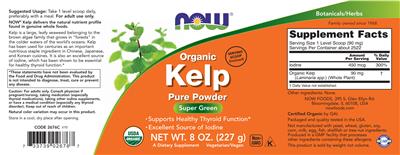
Suggested Usage: Take 1 level scoop daily, preferably with a meal. For adult use only.
Formula
NOW Kelp delivers the natural nutrient profile found in genuine whole foods. Kelp is a large, leafy seaweed belonging to the brown algae family that grows in "forests" in the colder waters of the world’s oceans. Kelp has been used for centuries as an important nutritious staple ingredient in Chinese, Japanese, and Korean cuisines. It is also an excellent source of iodine, which has been shown to be essential for healthy thyroid function.
Excellent source of Iodine
Triangle K (Kosher)
FDA Disclaimer Statement
These statements have not been evaluated by the Food and Drug Administration. This product is not intended to diagnose, treat, cure or prevent any disease.
Precautions
Caution: For adults only. Keep out of reach of children.
Consult physician if pregnant/nursing, taking medication (especially thyroid medications), taking other iodine supplements, or have a medical condition (especially any thyroid disorder).
Not manufactured with yeast, wheat, gluten, soy, corn, milk, egg, fish, shellfish or tree nut ingredients. Produced in a GMP facility that processes other ingredients containing these allergens.
Formulation
Natural color variation may occur in this product.
Non-GMO
Vegetarian/Vegan
Certified Organic by QAI.
Packaged and quality tested in the USA.
Not manufactured with yeast, wheat, gluten, soy, corn, milk, egg, fish, shellfish or tree nut ingredients.
Pure powder Super green Supports healthy thyroid function
Storage
Store in a cool, dry place after opening.
General Statements
Serving scoop enclosed!
Botanicals/Herbs Family owned since 1968.
This product is sold by weight not volume.
Seals/Symbols
USDA Organic Triangle K (Kosher)
GMP Quality Assured
FDA Statement of Identity
A Dietary Supplement
Is this label outdated? Report a formula or label change and our pharmacy team will review it.
Organic Kelp by NOW label
The label scan from the NIH Dietary Supplement Label Database. Tap to enlarge.
Label images are published by the NIH Dietary Supplement Label Database for the version of this product on file. Always read your actual product label.
View the full label (PDF)The Ingredients in Organic Kelp by NOW
These are the 2 active ingredients this product is made of. Select any to open its full monograph.
Serving size90 mg Dosage formPowder Servings per container2522 Amounts shown are per serving.
Most supplement products combine several ingredients, and a medication can interact with the product through any one of them. Each ingredient below shows whether it has known drug interactions.
Iodine
Interacts with7 drugs
Iodine is an essential mineral your body needs to make thyroid hormones, and most people get enough from iodized salt, dairy, and seafood. Supplements...
Iodine monograph & interactionsKelp
Interacts with891 drugs
Fucus vesiculosus (bladderwrack) is a brown seaweed rich in iodine that has been used traditionally for thyroid concerns, weight, and skin. There is l...
Kelp monograph & interactionsOrganic Kelp by NOW Drug Interactions
HelloPharmacist Interaction Report
NOW Organic Kelp is a two-ingredient powder built on iodine, which does interact with several medications.
The most serious concern is with lithium (used for mood disorders): iodine can add to lithium's effect on your thyroid, slowing it down and potentially causing low thyroid hormone (hypothyroidism). Your doctor will want to monitor your thyroid function if you take both.
Read the full breakdown — every affected drug type, severity by severity
Iodine also interacts with antithyroid drugs—medicines used to treat overactive thyroid. High-dose iodine can swing your thyroid either way, and combining it with antithyroid medications could make those drugs less predictable or effective.
Additionally, if you take amiodarone (Cordarone), a heart rhythm medication that already contains a lot of iodine, adding this supplement could push your iodine levels too high and damage your thyroid. Again, monitoring is key.
We couldn't check the second ingredient, kelp itself, for interactions — we hold no data on it. Altogether, these interactions span 7 individual medications.
Before you start this product, run it through the medication checker on this page with any prescriptions you take, especially anything for your thyroid or heart.
Check your own medications below · Editorial policy · How we use AI
Want to check YOUR meds against Organic Kelp?
Ask about interactions with your drugs in plain English — “Can I take it with lisinopril?” — and we find you the answer in seconds, ingredient by ingredient.
Go to the checkerIngredients driving the most interactions
Individual Drug Interactions
The ingredients in Organic Kelp interact with 891 drugs. Click any drug to see the details.
2 of the 2 ingredients in Organic Kelp interact with drugs. Each result below shows which ingredient is responsible. Kelp Iodine
AmiodaroneCordarone, Pacerone
How Amiodarone interacts with Organic Kelp — through 2 ingredients. Tap an ingredient for the detail:
KelpCytochrome P450 2c8 (cyp2c8) Substrates, Cytochrome P450 3a4 (cyp3a4) Substrates +1 Moderate
Interaction Summary
Theoretically, concomitant use of Fucus vesiculosus with CYP2C8 substrates might increase the risk for adverse effects.
Read the full Kelp + Amiodarone interactionIodineAmiodarone (cordarone) Moderate
Interaction Summary
Combining iodine with amiodarone might cause excessively high iodine levels.
Read the full Iodine + Amiodarone interactionCarbimazoleNeo-Mercazole
How Carbimazole interacts with Organic Kelp — through 2 ingredients. Tap an ingredient for the detail:
IodineAntithyroid Drugs Moderate
Interaction Summary
Iodine might alter the effects of antithyroid drugs.
Read the full Iodine + Carbimazole interactionKelpAntithyroid Drugs Moderate
Interaction Summary
Due to its iodine content, Fucus vesiculosus might alter the effects of antithyroid drugs.
Read the full Kelp + Carbimazole interactionConjugated EstrogensCenestin, Enjuvia, Premarin, Premarin Vaginal Cream
How Conjugated Estrogens interacts with Organic Kelp — through 1 ingredient. Tap an ingredient for the detail:
KelpCytochrome P450 3a4 (cyp3a4) Substrates, Thyroid Hormone Moderate
Interaction Summary
Theoretically, concomitant use of Fucus vesiculosus with CYP3A4 substrates might increase the risk for adverse effects.
Read the full Kelp + Conjugated Estrogens interactionDesiccated Thyroid ExtractWesthroid, WP Thyroid
How Desiccated Thyroid Extract interacts with Organic Kelp — through 1 ingredient. Tap an ingredient for the detail:
KelpThyroid Hormone Moderate
Interaction Summary
Due to its iodine content, Fucus vesiculosus might alter the effects of thyroid hormone.
Read the full Kelp + Desiccated Thyroid Extract interactionDesiccated Thyroid Extract (prescription Drug)Nature-Throid, Thyrar
How Desiccated Thyroid Extract (prescription Drug) interacts with Organic Kelp — through 1 ingredient. Tap an ingredient for the detail:
KelpThyroid Hormone Moderate
Interaction Summary
Due to its iodine content, Fucus vesiculosus might alter the effects of thyroid hormone.
Read the full Kelp + Desiccated Thyroid Extract (prescription Drug) interactionDextrothyroxineCholoxin
How Dextrothyroxine interacts with Organic Kelp — through 1 ingredient. Tap an ingredient for the detail:
KelpThyroid Hormone Moderate
Interaction Summary
Due to its iodine content, Fucus vesiculosus might alter the effects of thyroid hormone.
Read the full Kelp + Dextrothyroxine interactionHuman Chorionic Gonadotropin (hcg)Pregnyl
How Human Chorionic Gonadotropin (hcg) interacts with Organic Kelp — through 1 ingredient. Tap an ingredient for the detail:
KelpThyroid Hormone Moderate
Interaction Summary
Due to its iodine content, Fucus vesiculosus might alter the effects of thyroid hormone.
Read the full Kelp + Human Chorionic Gonadotropin (hcg) interactionLevothyroxineEltroxin, Estre, Euthyrox, Levo-T, Levolet, Levothroid +5 more
How Levothyroxine interacts with Organic Kelp — through 1 ingredient. Tap an ingredient for the detail:
KelpThyroid Hormone Moderate
Interaction Summary
Due to its iodine content, Fucus vesiculosus might alter the effects of thyroid hormone.
Read the full Kelp + Levothyroxine interactionLevothyroxine SodiumErmez, Thyquidity, Tirosint-Sol
How Levothyroxine Sodium interacts with Organic Kelp — through 1 ingredient. Tap an ingredient for the detail:
KelpThyroid Hormone Moderate
Interaction Summary
Due to its iodine content, Fucus vesiculosus might alter the effects of thyroid hormone.
Read the full Kelp + Levothyroxine Sodium interactionLevothyroxine, LiothyronineArmour Thyroid
How Levothyroxine, Liothyronine interacts with Organic Kelp — through 1 ingredient. Tap an ingredient for the detail:
KelpThyroid Hormone Moderate
Interaction Summary
Due to its iodine content, Fucus vesiculosus might alter the effects of thyroid hormone.
Read the full Kelp + Levothyroxine, Liothyronine interactionLiothyronineCytomel
How Liothyronine interacts with Organic Kelp — through 1 ingredient. Tap an ingredient for the detail:
KelpThyroid Hormone Moderate
Interaction Summary
Due to its iodine content, Fucus vesiculosus might alter the effects of thyroid hormone.
Read the full Kelp + Liothyronine interactionLiotrixEuthroid 1, Euthroid 1/2, Euthroid 3
How Liotrix interacts with Organic Kelp — through 1 ingredient. Tap an ingredient for the detail:
KelpThyroid Hormone Moderate
Interaction Summary
Due to its iodine content, Fucus vesiculosus might alter the effects of thyroid hormone.
Read the full Kelp + Liotrix interactionLiotrix, T4/t3Euthroid 2
How Liotrix, T4/t3 interacts with Organic Kelp — through 1 ingredient. Tap an ingredient for the detail:
KelpThyroid Hormone Moderate
Interaction Summary
Due to its iodine content, Fucus vesiculosus might alter the effects of thyroid hormone.
Read the full Kelp + Liotrix, T4/t3 interactionLithium Carbonate (prescription Drug)Eskalith, Lithium Carbonate
How Lithium Carbonate (prescription Drug) interacts with Organic Kelp — through 2 ingredients. Tap an ingredient for the detail:
IodineLithium Moderate
Interaction Summary
Combining iodine with lithium might have additive hypothyroid effects.
Read the full Iodine + Lithium Carbonate (prescription Drug) interactionKelpLithium Moderate
Interaction Summary
Concomitant use of Fucus vesiculosus and lithium has resulted in hyperthyroidism.
Read the full Kelp + Lithium Carbonate (prescription Drug) interactionMenotropinsMenopur, Repronex
How Menotropins interacts with Organic Kelp — through 1 ingredient. Tap an ingredient for the detail:
KelpThyroid Hormone Moderate
Interaction Summary
Due to its iodine content, Fucus vesiculosus might alter the effects of thyroid hormone.
Read the full Kelp + Menotropins interactionMethenamine MandelateMandelamine, Methimazole
How Methenamine Mandelate interacts with Organic Kelp — through 2 ingredients. Tap an ingredient for the detail:
IodineAntithyroid Drugs Moderate
Interaction Summary
Iodine might alter the effects of antithyroid drugs.
Read the full Iodine + Methenamine Mandelate interactionKelpAntithyroid Drugs Moderate
Interaction Summary
Due to its iodine content, Fucus vesiculosus might alter the effects of antithyroid drugs.
Read the full Kelp + Methenamine Mandelate interactionMethimazoleTapazole
How Methimazole interacts with Organic Kelp — through 2 ingredients. Tap an ingredient for the detail:
KelpAntithyroid Drugs Moderate
Interaction Summary
Due to its iodine content, Fucus vesiculosus might alter the effects of antithyroid drugs.
Read the full Kelp + Methimazole interactionIodineAntithyroid Drugs Moderate
Interaction Summary
Iodine might alter the effects of antithyroid drugs.
Read the full Iodine + Methimazole interactionOspemifeneOsphena
How Ospemifene interacts with Organic Kelp — through 1 ingredient. Tap an ingredient for the detail:
KelpCytochrome P450 3a4 (cyp3a4) Substrates, Thyroid Hormone Moderate
Interaction Summary
Theoretically, concomitant use of Fucus vesiculosus with CYP3A4 substrates might increase the risk for adverse effects.
Read the full Kelp + Ospemifene interactionPotassium Iodide (prescription Drug)Thyro-Block
How Potassium Iodide (prescription Drug) interacts with Organic Kelp — through 2 ingredients. Tap an ingredient for the detail:
IodineAntithyroid Drugs Moderate
Interaction Summary
Iodine might alter the effects of antithyroid drugs.
Read the full Iodine + Potassium Iodide (prescription Drug) interactionKelpAntithyroid Drugs Moderate
Interaction Summary
Due to its iodine content, Fucus vesiculosus might alter the effects of antithyroid drugs.
Read the full Kelp + Potassium Iodide (prescription Drug) interactionPropylthiouracil, PtuPropylthiouracil
How Propylthiouracil, Ptu interacts with Organic Kelp — through 2 ingredients. Tap an ingredient for the detail:
IodineAntithyroid Drugs Moderate
Interaction Summary
Iodine might alter the effects of antithyroid drugs.
Read the full Iodine + Propylthiouracil, Ptu interactionKelpAntithyroid Drugs Moderate
Interaction Summary
Due to its iodine content, Fucus vesiculosus might alter the effects of antithyroid drugs.
Read the full Kelp + Propylthiouracil, Ptu interactionTestosterone UndecanoateAndriol, Aveed, Jatenzo, Kyzatrex
How Testosterone Undecanoate interacts with Organic Kelp — through 1 ingredient. Tap an ingredient for the detail:
KelpCytochrome P450 3a4 (cyp3a4) Substrates, Thyroid Hormone Moderate
Interaction Summary
Theoretically, concomitant use of Fucus vesiculosus with CYP3A4 substrates might increase the risk for adverse effects.
Read the full Kelp + Testosterone Undecanoate interactionThyroglobulinProloid
How Thyroglobulin interacts with Organic Kelp — through 1 ingredient. Tap an ingredient for the detail:
KelpThyroid Hormone Moderate
Interaction Summary
Due to its iodine content, Fucus vesiculosus might alter the effects of thyroid hormone.
Read the full Kelp + Thyroglobulin interactionThyroid HormoneEtwon
How Thyroid Hormone interacts with Organic Kelp — through 1 ingredient. Tap an ingredient for the detail:
KelpThyroid Hormone Moderate
Interaction Summary
Due to its iodine content, Fucus vesiculosus might alter the effects of thyroid hormone.
Read the full Kelp + Thyroid Hormone interactionAdo-trastuzumab EmtansineKadcyla
How Ado-trastuzumab Emtansine interacts with Organic Kelp — through 1 ingredient. Tap an ingredient for the detail:
KelpCytochrome P450 3a4 (cyp3a4) Substrates Minor
Interaction Summary
Theoretically, concomitant use of Fucus vesiculosus with CYP3A4 substrates might increase the risk for adverse effects.
Read the full Kelp + Ado-trastuzumab Emtansine interactionAbciximabReoPro
How Abciximab interacts with Organic Kelp — through 1 ingredient. Tap an ingredient for the detail:
KelpAnticoagulant/antiplatelet Drugs Minor
Interaction Summary
Theoretically, taking Fucus vesiculosus with antiplatelet or anticoagulant drugs might increase the risk of bruising and bleeding.
Read the full Kelp + Abciximab interactionAbemaciclibVerzenio
How Abemaciclib interacts with Organic Kelp — through 1 ingredient. Tap an ingredient for the detail:
KelpCytochrome P450 3a4 (cyp3a4) Substrates Minor
Interaction Summary
Theoretically, concomitant use of Fucus vesiculosus with CYP3A4 substrates might increase the risk for adverse effects.
Read the full Kelp + Abemaciclib interactionAbiraterone
How Abiraterone interacts with Organic Kelp — through 1 ingredient. Tap an ingredient for the detail:
KelpCytochrome P450 3a4 (cyp3a4) Substrates Minor
Interaction Summary
Theoretically, concomitant use of Fucus vesiculosus with CYP3A4 substrates might increase the risk for adverse effects.
Read the full Kelp + Abiraterone interactionAbiraterone AcetateYonsa, Zytiga
How Abiraterone Acetate interacts with Organic Kelp — through 1 ingredient. Tap an ingredient for the detail:
KelpCytochrome P450 3a4 (cyp3a4) Substrates Minor
Interaction Summary
Theoretically, concomitant use of Fucus vesiculosus with CYP3A4 substrates might increase the risk for adverse effects.
Read the full Kelp + Abiraterone Acetate interactionAbrocitinibCibinqo
How Abrocitinib interacts with Organic Kelp — through 1 ingredient. Tap an ingredient for the detail:
KelpAnticoagulant/antiplatelet Drugs, Cytochrome P450 2c9 (cyp2c9) Substrates Minor
Interaction Summary
Theoretically, taking Fucus vesiculosus with antiplatelet or anticoagulant drugs might increase the risk of bruising and bleeding.
Read the full Kelp + Abrocitinib interactionAcalabrutinibCalquence
How Acalabrutinib interacts with Organic Kelp — through 1 ingredient. Tap an ingredient for the detail:
KelpCytochrome P450 3a4 (cyp3a4) Substrates Minor
Interaction Summary
Theoretically, concomitant use of Fucus vesiculosus with CYP3A4 substrates might increase the risk for adverse effects.
Read the full Kelp + Acalabrutinib interactionEach ingredient & the kinds of drugs it affects
For each ingredient in Organic Kelp with known interactions, here are the types of medications they can affect. Open any type for the detail — or search your exact drug in the checker above.
Kelp
Amiodarone (Cordarone)
Theoretically, combining Fucus vesiculosus with amiodarone might cause excessively high iodine levels.
Fucus vesiculosus contains high concentrations of iodine. Amiodarone contains 37.3% iodine and can increase iodine levels. Concomitant use might increase the risk of having excessive iodine levels and adversely affecting thyroid function. Monitor thyroid function.
Antithyroid Drugs
Due to its iodine content, Fucus vesiculosus might alter the effects of antithyroid drugs.
Fucus vesiculosus contains high concentrations of iodine. Iodine in high doses has been reported to cause both hyperthyroidism and hypothyroidism, depending on the individual's past medical history. Taking Fucus vesiculosus while using antithyroid drugs could alter the effects of the antithyroid drugs.
Lithium
Concomitant use of Fucus vesiculosus and lithium has resulted in hyperthyroidism.
There is a case of hyperthyroidism occurring in a patient taking Fucus vesiculosus and lithium. Monitor thyroid hormones closely in patients taking lithium and Fucus vesiculosus concomitantly.
Thyroid Hormone
Due to its iodine content, Fucus vesiculosus might alter the effects of thyroid hormone.
Fucus vesiculosus contains high concentrations of iodine. Iodine in high doses has been reported to cause both hyperthyroidism and hypothyroidism, depending on the individual's past medical history. Taking Fucus vesiculosus while using thyroid hormone could alter the effects of thyroid hormone.
Anticoagulant/Antiplatelet Drugs
Theoretically, taking Fucus vesiculosus with antiplatelet or anticoagulant drugs might increase the risk of bruising and bleeding.
In vitro evidence suggests that a constituent of Fucus vesiculosus, known as fucoidan, has anticoagulant effects. However, in clinical research, fucoidan does not seem to have significant anticoagulant activity when taken orally, possibly due to poor absorption.
Cytochrome P450 2C8 (Cyp2C8) Substrates
Theoretically, concomitant use of Fucus vesiculosus with CYP2C8 substrates might increase the risk for adverse effects.
In vitro research shows that fucoidan, a constituent of Fucus vesiculosus, inhibits CYP2C8. This interaction has not been reported in humans.
Cytochrome P450 2C9 (Cyp2C9) Substrates
Theoretically, concomitant use of Fucus vesiculosus with CYP2C9 substrates might increase the risk for adverse effects.
In vitro research shows that fucoidan, a constituent of Fucus vesiculosus, inhibits CYP2C9. This interaction has not been reported in humans.
Cytochrome P450 2D6 (Cyp2D6) Substrates
Theoretically, concomitant use of Fucus vesiculosus with CYP2D6 substrates might alter the effects of these substrates.
In vitro research shows that fucoidan, a constituent of Fucus vesiculosus, both inhibits and induces CYP2D6. This interaction has not been reported in humans.
Cytochrome P450 3A4 (Cyp3A4) Substrates
Theoretically, concomitant use of Fucus vesiculosus with CYP3A4 substrates might increase the risk for adverse effects.
In vitro research shows that fucoidan, a constituent of Fucus vesiculosus, inhibits CYP3A4. This interaction has not been reported in humans.
Iodine
Amiodarone (Cordarone)
Combining iodine with amiodarone might cause excessively high iodine levels.
Amiodarone contains 37.3% iodine and can increase iodine levels. Concomitant use with iodine might increase the risk of having excessive iodine levels and adversely affecting thyroid function. Monitor thyroid function.
Antithyroid Drugs
Iodine might alter the effects of antithyroid drugs.
Iodine in high doses has been reported to cause both hyperthyroidism and hypothyroidism, depending on the individual's past medical history. Taking iodine while using antithyroid drugs could alter the effects of the antithyroid drugs.
Lithium
Combining iodine with lithium might have additive hypothyroid effects.
Lithium can inhibit thyroid function. Several case reports suggest that concomitant use of lithium and potassium iodide can reduce thyroid function in otherwise healthy adults. Monitor thyroid function.
Brand information
Manufacturer and brand details for Organic Kelp, from the product label.
NOW
See all NOW products- Name
- NOW Foods
- Street Address
- 395 S. Glen Ellyn Rd.
- City
- Bloomingdale
- State
- IL
- ZipCode
- 60108
- Web Address
- www.nowfoods.com
Organic Kelp by NOW: Common Questions
Does Organic Kelp by NOW interact with any medications?
How can one product interact with so many drugs?
Where does this information come from?
Is this safe to take if I have a thyroid condition?
Can I take this while pregnant or breastfeeding?
What does iodine actually do in my body?
What are the side effects of taking too much iodine?
Can I use this if I'm allergic to seafood?
Will this supplement help my thyroid?
Written and reviewed by the HelloPharmacist editorial staff. Our editorial policy
Not sure if Organic Kelp is safe with your meds?
Our pharmacists answer your medication & supplement questions — free.
Label information is sourced from the NIH Dietary Supplement Label Database and reflects the product version on file; always read your actual product label. This page is for education only and is not a substitute for professional medical advice. Confirm with your pharmacist or doctor before combining supplements and medications.
The Full Monographs Behind Organic Kelp’s Ingredients
Every ingredient we hold a full HelloPharmacist monograph for — uses, evidence, safety, and the complete interaction list.
Iodine
Interacts with 7 drugsIodine is an essential mineral your body needs to make thyroid hormones, and most people get enough from iodized salt, dairy, and seafood. Supplements help when you are truly deficient, but...
Read the full Iodine monograph → Herb & supplement monographFucus Vesiculosus
Interacts with 891 drugsFucus vesiculosus (bladderwrack) is a brown seaweed rich in iodine that has been used traditionally for thyroid concerns, weight, and skin. There is little solid human evidence to support mo...
Read the full Fucus Vesiculosus monograph →Sources & How We Checked
Organic Kelp's label data comes from the NIH Dietary Supplement Label Database; the ingredient interaction data is from the Natural Medicines database, reviewed by our pharmacists.
- NIH Dietary Supplement Label Database (DSLD) — The official product label on file for this supplement.
- Natural Medicines (Therapeutic Research Center) — Evidence-graded clinical reference behind the ingredient interaction data.
Content is written and reviewed by licensed HelloPharmacist pharmacists. See our data sources and editorial standards for how this information is built and checked.
The 41 references behind this product’s interaction data
Every citation that drives the interaction findings for this product’s ingredients, from the evidence-graded Natural Medicines (TRC Healthcare) database. Open an ingredient to browse its citations — links open the study on PubMed or the publisher’s site.
Iodine 26 references
- McEvoy GK, ed. AHFS Drug Information. Bethesda, MD: American Society of Health-System Pharmacists, 1998.
- Goodman GA, Rall TW, Nies AS, Taylor P. The Pharmacological Basis of Therapeutics, 9th ed.
- Ghent WR, Eskin BA, Low DA, Hill LP. Iodine replacement in fibrocystic disease of the breast. Can J Surg 1993;36:453-60.
- Potassium iodide for nuclear exposure. Pharmacist's Letter/Prescriber's Letter 2001;17(12):171214.
- Food and Nutrition Board, Institute of Medicine. Dietary Reference Intakes for Vitamin A, Vitamin K, Arsenic, Boron, Chromium, Copper, Iodine, Iron, Manganese, Molybdenum, Nickel, Silicon, Vanadium, and Zinc. Washington, DC: National Academy Press, 2002.
- Cabezas C, Bustamante B, Holgado W, Begue RE. Treatment of cutaneous sporotrichosis with one daily dose of potassium iodide. Pediatr Infect Dis J 1996;15:352-4. PubMed
- Sterling JB, Heymann WR. Potassium iodide in dermatology: a 19th century drug for the 21st century-uses, pharmacology, adverse effects, and contraindications. J Am Acad Dermatol 2000;43:691-7. PubMed
- Yarrington CD, Pearce EN. Dietary iodine in pregnancy and postpartum. Clin Obstet Gynecol 2011;54:459-70. PubMed
- Goel, S., Mandhani, A., Srivastava, A., Kapoor, R., Gogoi, S., Kumar, A., and Bhandari, M. Is povidone iodine an alternative to silver nitrate for renal pelvic instillation sclerotherapy in chyluria? BJU.Int 2004;94(7):1082-1085. PubMed
- Teng, W., Shan, Z., Teng, X., Guan, H., Li, Y., Teng, D., Jin, Y., Yu, X., Fan, C., Chong, W., Yang, F., Dai, H., Yu, Y., Li, J., Chen, Y., Zhao, D., Shi, X., Hu, F., Mao, J., Gu, X., Yang, R., Tong, Y., Wang, W., Gao, T., and Li, C. Effect of iodine int
- Crawford, B. A., Cowell, C. T., Emder, P. J., Learoyd, D. L., Chua, E. L., Sinn, J., and Jack, M. M. Iodine toxicity from soy milk and seaweed ingestion is associated with serious thyroid dysfunction. Med J Aust. 10-4-2010;193(7):413-415. PubMed
- Ohkuma, M. Molluscum contagiosum treated with iodine solution and salicylic acid plaster. Int J Dermatol. 1990;29(6):443-445. PubMed
- Connelly KJ, Boston BA, Pearce EN, Sesser D, Snyder D, Braverman LE, Pino S, LaFranchi SH. Congenital hypothyroidism caused by excess prenatal maternal iodine ingestion. J Pediatr. 2012 Oct;161(4):760-2. PubMed
- Kasahara T, Narumi S, Okasora K, Takaya R, Tamai H, Hasegawa T. Delayed onset congenital hypothyroidism in a patient with DUOX2 mutations and maternal iodine excess. Am J Med Genet A. 2013 Jan;161A(1):214-7.
- Murcia M, Rebagliato M, Iñiguez C, Lopez-Espinosa MJ, Estarlich M, Plaza B, Barona-Vilar C, Espada M, Vioque J, Ballester F. Effect of iodine supplementation during pregnancy on infant neurodevelopment at 1 year of age. Am J Epidemiol. 2011 Apr 1;173(7):8 PubMed
- Sang Z, Wang PP, Yao Z, Shen J, Halfyard B, Tan L, Zhao N, Wu Y, Gao S, Tan J, Liu J, Chen Z, Zhang W. Exploration of the safe upper level of iodine intake in euthyroid Chinese adults: a randomized double-blind trial. Am J Clin Nutr. 2012 Feb;95(2):367-73 PubMed
- Speeckaert MM, Speeckaert R, Wierckx K, Delanghe JR, Kaufman JM. Value and pitfalls in iodine fortification and supplementation in the 21st century. Br J Nutr. 2011 Oct;106(7):964-73. PubMed
- Yun SE, Kang Y, Bae EJ, Hwang K, Jang HN, Cho HS, Chang SH, Park DJ. Iodine-induced thyrotoxic hypokalemic paralysis after ingestion of Salicornia herbace. Ren Fail. 2014 Apr;36(3):461-3.
- Iodine Hypersensitivity. Pharmacist's Letter/Prescriber's Letter 2011; 27(5):270504.
- Hammel JA, Selby JC. Pustular eruption in a patient with cancer treated with complementary and alternative medicine. JAMA Dermatology 2017 October; E1. doi: 10.1001/jamadermatol.2017.3749. [Epub ahead of print] PubMed
- Gil GS, Smith BW, Guerra JR, Williams WT. Acute Delirium in a Hypothyroid Patient Precipitated by Iodine Supplements Use. Am J Ther. 2018;25(6):e717-e718. PubMed
- Hamby T, Kunnel N, Dallas JS, Wilson DP. Maternal iodine excess: an uncommon cause of acquired neonatal hypothyroidism. J Pediatr Endocrinol Metab. 2018;31(9):1061-1064. PubMed
- Censi S, Watutantrige-Fernando S, Groccia G, et al. The Effects of Iodine Supplementation in Pregnancy on Iodine Status, Thyroglobulin Levels and Thyroid Function Parameters: Results from a Randomized Controlled Clinical Trial in a Mild-to-Moderate Iodine
- Rovner MS, Wolf BJ, Rubin M, et al. Instillation of 5% Povidone-Iodine Ophthalmic Drops Decreases the Respiratory Rate in Children Undergoing Strabismus Surgery: A Randomized Controlled Trial. J Pediatr Ophthalmol Strabismus. 2019;56(6):378-382. PubMed
- Guenezan J, Garcia M, Strasters D, et al. Povidone Iodine Mouthwash, Gargle, and Nasal Spray to Reduce Nasopharyngeal Viral Load in Patients With COVID-19: A Randomized Clinical Trial. JAMA Otolaryngol Head Neck Surg. 2021;147(4):400-401. PubMed
- Li F, Wan S, Zhang L, et al. A Meta-Analysis of the Effect of Iodine Excess on the Intellectual Development of Children in Areas with High Iodine Levels in their Drinking Water. Biol Trace Elem Res 2022;200(4):1580-1590. PubMed
Fucus Vesiculosus 15 references
- Goodman GA, Rall TW, Nies AS, Taylor P. The Pharmacological Basis of Therapeutics, 9th ed.
- Food and Nutrition Board, Institute of Medicine. Dietary Reference Intakes for Vitamin A, Vitamin K, Arsenic, Boron, Chromium, Copper, Iodine, Iron, Manganese, Molybdenum, Nickel, Silicon, Vanadium, and Zinc. Washington, DC: National Academy Press, 2002.
- Phaneuf D, Cote I, Dumas P, et al. Evaluation of the contamination of marine algae (Seaweed) from the St. Lawrence River and likely to be consumed by humans. Environ Res 1999;80:S175-S182. PubMed
- Durig J, Bruhn T, Zurborn KH, et al. Anticoagulant fucoidan fractions from Fucus vesiculosus induce platelet activation in vitro. Thromb Res 1997;85:479-91. PubMed
- Conz PA, La Greca G, Benedetti P, et al. Fucus vesiculosus: a nephrotoxic alga? Nephrol Dial Transplant 1998;13:526-7.
- Ohye H, Fukata S, Kanoh M, et al. Thyrotoxicosis caused by weight-reducing herbal medicines. Arch Intern Med 2005;165:831-4. PubMed
- Okamura K, Inoue K, Omae T. A case of Hashimoto's thyroiditis with thyroid immunological abnormality manifested after habitual ingestion of seaweed. Acta Endocrinol (Copenh) 1978;88:703-12. PubMed
- Agarwal SC, Crook JR, Pepper CB. Herbal remedies -- how safe are they? A case report of polymorphic ventricular tachycardia/ventricular fibrillation induced by herbal medication used for obesity. Int J Cardiol 2006;106:260-1. PubMed
- Sterling JB, Heymann WR. Potassium iodide in dermatology: a 19th century drug for the 21st century-uses, pharmacology, adverse effects, and contraindications. J Am Acad Dermatol 2000;43:691-7. PubMed
- Catania, M. A., Oteri, A., Caiello, P., Russo, A., Salvo, F., Giustini, E. S., Caputi, A. P., and Polimeni, G. Hemorrhagic cystitis induced by an herbal mixture. South.Med.J. 2010;103(1):90-92. PubMed
- Cumashi, A., Ushakova, N. A., Preobrazhenskaya, M. E., D'Incecco, A., Piccoli, A., Totani, L., Tinari, N., Morozevich, G. E., Berman, A. E., Bilan, M. I., Usov, A. I., Ustyuzhanina, N. E., Grachev, A. A., Sanderson, C. J., Kelly, M., Rabinovich, G. A., I
- Irhimeh, M. R., Fitton, J. H., and Lowenthal, R. M. Pilot clinical study to evaluate the anticoagulant activity of fucoidan. Blood Coagul.Fibrinolysis 2009;20(7):607-610. PubMed
- Arbaizar, B. and Llorca, J. [Fucus vesiculosus induced hyperthyroidism in a patient undergoing concomitant treatment with lithium]. Actas Esp.Psiquiatr. 2011;39(6):401-403.
- Church FC, Meade JB, Treanor RE, and et al. Antithrombin activity of fucoidan. The interaction of fucoidan with heparin cofactor II, antithrombin III, and thrombin. J Biol Chem 2-25-1989;264(6):3618-3623. DOI
- Mathew L, Burney M, Gaikwad A, et al. Preclinical evaluation of safety of fucoidan extracts from Undaria pinnatifida and Fucus vesiculosus for use in cancer treatment. Integr Cancer Ther 2017;16(4):572-84.
Parts of this content are provided by the Therapeutic Research Center, LLC.
DISCLAIMER: Currently this does not check for drug-drug interactions. This is not an all-inclusive comprehensive list of potential interactions and is for informational purposes only. Not all interactions are known or well-reported in the scientific literature, and new interactions are continually being reported. Input is needed from a qualified healthcare provider including a pharmacist before starting any therapy. Application of clinical judgment is necessary.
© 2021 Therapeutic Research Center, LLC