
Kidney Cleanse Tea Ingredients & Drug Interactions
What is this page for?
First and foremost: checking Kidney Cleanse Tea against your medications. The heart of this page is the interaction checker and the full interaction report — how this product’s ingredients may interact with prescription and over-the-counter medicines you may be taking.
Around that, we add a pharmacist’s high-level view of the product as a whole — what’s inside, the evidence for its stated use, how transparent the label is, and what safety data exists — so you can see the full picture in one place. It’s educational information from our licensed clinical databases and the clinical staff at HelloPharmacist — not medical advice — and we don’t sell or endorse products. Our editorial policy
Kidney Cleanse Tea is a dietary supplement by Dr. Clark Store with 3 active ingredients. Its ingredients are commonly taken for kidney and bladder stones, urinary tract complaints, enlarged prostate symptoms.Based on those ingredients, 2,049 medications have a known interaction with it, the most serious rated moderate. The ingredients most likely to interact are Marshmallow, Gravel Root, Hydrangea. Use the checker below to test your specific medication, or read the full HelloPharmacist Interaction Report.
Check Your Meds Against Kidney Cleanse Tea by Dr. Clark Store
Ask about any prescription or over-the-counter medication and we check it for interactions with Kidney Cleanse Tea by Dr. Clark Store — and tell you which ingredient is responsible.
AI summaries are generated from our interaction database for education only — always confirm with your pharmacist. How we use AI
Ask the Pharmacist
A licensed pharmacist will answer your question by email — free, usually within 24 hours.
Got it — thank you!
A licensed pharmacist will answer within 24 hours. Keep an eye on your email (worth checking spam, just in case).
HelloPharmacist Scorecard of Kidney Cleanse Tea by Dr. Clark Store
Our pharmacy team’s full take, with four database checks built into the cards below — a summary of what is known, not a grade of the product itself.
What’s inside
Low disclosure
This tea contains three active ingredients. Hydrangea and marshmallow are both thought to have diuretic properties (they increase urine output).
Gravel root is also included for its diuretic effects. Beyond these three, there are no other inactive ingredients listed.
Does it work?
Couldn't assess
The product facts we hold contain no effectiveness ratings for any of these three ingredients for kidney health or cleansing. Evidence supporting their use for that purpose isn't established in our data.
How safe is it?
Well-documented data
Hydrangea and marshmallow are generally well tolerated for short-term use, though human safety data are limited. Gravel root requires particular caution because it contains pyrrolizidine alkaloids, compounds that can cause liver and lung damage.
Chronic exposure to these alkaloids may lead to veno-occlusive disease, a serious liver condition with symptoms like abdominal pain, vomiting, diarrhea, and fluid buildup (ascites), followed by persistent liver enlargement. All three ingredients should be avoided during pregnancy and breastfeeding due to insufficient safety data.
Hydrangea and marshmallow may cause side effects including gastroenteritis, dizziness, and chest tightness.
Meds to double-check
Moderate interaction found
Check with your pharmacist if you take lithium (moderate interaction with all three ingredients), CYP3A4 inducer medications like carbamazepine, phenobarbital, phenytoin, rifampin, or rifabutin (moderate interaction with gravel root), any oral medications (minor interaction with marshmallow's effect on absorption), or blood thinners or antiplatelet drugs (minor interaction with marshmallow flower).
The bottom line
Scorecard at a glanceFormula with limited ingredient disclosure with no assessable stated purpose. Moderate medication interactions have been identified, and safety information is well characterized.
If you take lithium, any CYP3A4 inducer medications, or blood thinners, talk with your pharmacist before using this tea—dosage adjustments may be needed. Because gravel root carries liver and lung toxicity risks, this product is best used short-term and under caution.
Pregnant or breastfeeding individuals should avoid it.
Educational only — not medical advice; always confirm with your pharmacist. Our editorial policy · How we use AI
Assessment coverage: 3 of 3 active ingredients matched to our full ingredient reviews (monographs). Based on the product label dated Oct 24, 2024.
This Scorecard evaluates available label information, ingredient evidence, and known medication-safety considerations. It does not independently verify product identity, purity, potency, contamination, or manufacturing quality. How these ratings are computed
General information
Key facts about Kidney Cleanse Tea, straight from the product label.
| Brand | Dr. Clark Store |
|---|---|
| Barcode (UPC) | 652386102869 |
| Net contents | N/A |
| Market status | On market |
| Date entered into DSLD | Oct 24, 2024 |
| DSLD ID | 313173 |
| Product type | Botanical |
| Supplement form | Other (e.g. Tea Bag) |
| Dietary claims / uses | All Other |
| Intended target group(s) | Adult (18 - 50 Years) |
Everything in this section is reproduced from the manufacturer’s own product label — it’s the label speaking, not HelloPharmacist. We show it so you can see exactly what the maker states; we don’t verify or endorse those statements.
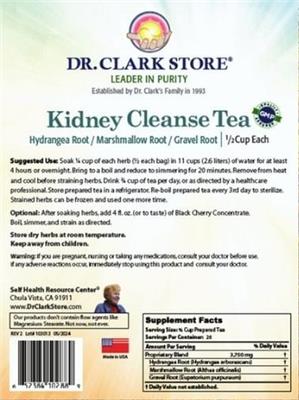
Supplement Facts
The label details for Kidney Cleanse Tea by Dr. Clark Store, sourced from the NIH Dietary Supplement Label Database.
Supplement Facts
| Ingredient | Amount | % DV |
|---|---|---|
| Proprietary Blend | 3750 mg | -- |
| Hydrangea | 0 NP | -- |
| Marshmallow | 0 NP | -- |
| Gravel Root | 0 NP | -- |
Tap any ingredient to jump to its full detail below.
These statements are the manufacturer’s wording, reproduced from the product label — the label is saying it, not HelloPharmacist. We don’t verify or endorse them.
Brand IP Statement(s)
Dr. Clark Store Leader in Purity Established by Dr. Clark's Family in 1993
Formula
Hydrangea root Marshmallow root Gravel root 1/2 cup each
Seals/Symbols
GMP Quality Assured
Made in USA
Suggested/Recommended/Usage/Directions
Suggested use: Soak 1/4 cup of each herb (1/2 each bag) in 11 cups (2.6 liters) of water for at least 4 hours or overnight. Bring to a boil and reduce to simmering for 20 minutes. Remove from heat and cool before straining herbs. Drink 3/4 cup of tea per day, or as directed by a healthcare professional. Re-boil prepared tea every 3rd day to sterilize. Strained herbs can be frozen and used one more time. Optional: After soaking herbs, add 4 fl. oz. (or to taste) of black cherry concentrate. Boil, simmer, and strain as directed.
Storage
Store prepared tea in a refrigerator. Store dry herbs at room temperature.
Precautions
Keep away from children.
Warning: If you are pregnant, nursing or taking any medications, consult your doctor before use.
If any adverse reactions occur, immediately stop using this product and consult your doctor.
Formulation
Our products don't contain flow agents like magnesium stearate. Now now, not ever.
Is this label outdated? Report a formula or label change and our pharmacy team will review it.
Kidney Cleanse Tea by Dr. Clark Store label
The label scan from the NIH Dietary Supplement Label Database. Tap to enlarge.
Label images are published by the NIH Dietary Supplement Label Database for the version of this product on file. Always read your actual product label.
View the full label (PDF)The Ingredients in Kidney Cleanse Tea by Dr. Clark Store
These are the 3 active ingredients this product is made of. Select any to open its full monograph.
Serving size0.25 Cup(s) Dosage formOther (e.g. Tea Bag) Servings per container26 Amounts shown are per serving.
Most supplement products combine several ingredients, and a medication can interact with the product through any one of them. Each ingredient below shows whether it has known drug interactions.
Proprietary Blend
- › Hydrangea
- › Marshmallow
- › Gravel Root
Kidney Cleanse Tea by Dr. Clark Store Drug Interactions
HelloPharmacist Interaction Report
Dr.
Clark Store's Kidney Cleanse Tea contains three active ingredients, all of which interact with medications. The most serious concern is gravel root, which carries moderate-severity interactions with two drug categories.
Read the full breakdown — every affected drug type, severity by severity
Gravel root's primary risk is with CYP3A4 inducer medications—drugs that speed up how your liver processes certain compounds. If you take carbamazepine (Tegretol), phenobarbital, phenytoin (Dilantin), rifampin, rifabutin (Mycobutin), or similar inducers, gravel root may increase the conversion of its own toxic compounds (pyrrolizidine alkaloids) to harmful metabolites.
Additionally, all three ingredients—hydrangea, marshmallow, and gravel root—carry moderate-severity interactions with lithium. Because they're thought to have diuretic properties (they increase urine output), they may reduce how your body clears lithium, potentially raising it to toxic levels; your lithium dose might need adjustment.
Marshmallow adds two further concerns. It may impair how your body absorbs oral medications generally (a minor-severity effect); if you take marshmallow, space it 30–60 minutes after your other drugs.
Marshmallow flower also has minor-severity antiplatelet properties, which theoretically could add to the effects of blood thinners (anticoagulants) or antiplatelet drugs, though the root and leaf—the parts most common in supplements—carry less risk than the flower.
Additionally, check your exact medications with the search tool on this page before starting.
Check your own medications below · Editorial policy · How we use AI
Want to check YOUR meds against Kidney Cleanse Tea?
Ask about interactions with your drugs in plain English — “Can I take it with lisinopril?” — and we find you the answer in seconds, ingredient by ingredient.
Go to the checkerIngredients driving the most interactions
Individual Drug Interactions
The ingredients in Kidney Cleanse Tea interact with 2,049 drugs. Click any drug to see the details.
3 of the 3 ingredients in Kidney Cleanse Tea interact with drugs. Each result below shows which ingredient is responsible. Marshmallow Gravel Root Hydrangea
AminoglutethimideCytadren
How Aminoglutethimide interacts with Kidney Cleanse Tea — through 2 ingredients. Tap an ingredient for the detail:
Gravel RootCytochrome P450 3a4 (cyp3a4) Inducers Moderate
Interaction Summary
Hepatotoxic pyrrolizidine alkaloids (PA) are substrates of cytochrome P450 3A4 (CYP3A4).
Read the full Gravel Root + Aminoglutethimide interactionMarshmallowOral Drugs Minor
Interaction Summary
Theoretically, mucilage in marshmallow might impair absorption of oral drugs.
Read the full Marshmallow + Aminoglutethimide interactionAmoxicillin, Omeprazole Magnesium, RifabutinTalicia
How Amoxicillin, Omeprazole Magnesium, Rifabutin interacts with Kidney Cleanse Tea — through 2 ingredients. Tap an ingredient for the detail:
Gravel RootCytochrome P450 3a4 (cyp3a4) Inducers Moderate
Interaction Summary
Hepatotoxic pyrrolizidine alkaloids (PA) are substrates of cytochrome P450 3A4 (CYP3A4).
Read the full Gravel Root + Amoxicillin, Omeprazole Magnesium, Rifabutin interactionMarshmallowOral Drugs Minor
Interaction Summary
Theoretically, mucilage in marshmallow might impair absorption of oral drugs.
Read the full Marshmallow + Amoxicillin, Omeprazole Magnesium, Rifabutin interactionApalutamideErleada
How Apalutamide interacts with Kidney Cleanse Tea — through 2 ingredients. Tap an ingredient for the detail:
Gravel RootCytochrome P450 3a4 (cyp3a4) Inducers Moderate
Interaction Summary
Hepatotoxic pyrrolizidine alkaloids (PA) are substrates of cytochrome P450 3A4 (CYP3A4).
Read the full Gravel Root + Apalutamide interactionMarshmallowOral Drugs Minor
Interaction Summary
Theoretically, mucilage in marshmallow might impair absorption of oral drugs.
Read the full Marshmallow + Apalutamide interactionAprepitantCinvanti, Emend
How Aprepitant interacts with Kidney Cleanse Tea — through 2 ingredients. Tap an ingredient for the detail:
Gravel RootCytochrome P450 3a4 (cyp3a4) Inducers Moderate
Interaction Summary
Hepatotoxic pyrrolizidine alkaloids (PA) are substrates of cytochrome P450 3A4 (CYP3A4).
Read the full Gravel Root + Aprepitant interactionMarshmallowOral Drugs Minor
Interaction Summary
Theoretically, mucilage in marshmallow might impair absorption of oral drugs.
Read the full Marshmallow + Aprepitant interactionAprobarbital, Butabarbital, PhenobarbitalTriple Barbital
How Aprobarbital, Butabarbital, Phenobarbital interacts with Kidney Cleanse Tea — through 2 ingredients. Tap an ingredient for the detail:
Gravel RootCytochrome P450 3a4 (cyp3a4) Inducers Moderate
Interaction Summary
Hepatotoxic pyrrolizidine alkaloids (PA) are substrates of cytochrome P450 3A4 (CYP3A4).
Read the full Gravel Root + Aprobarbital, Butabarbital, Phenobarbital interactionMarshmallowOral Drugs Minor
Interaction Summary
Theoretically, mucilage in marshmallow might impair absorption of oral drugs.
Read the full Marshmallow + Aprobarbital, Butabarbital, Phenobarbital interactionAprocitentanTryvio
How Aprocitentan interacts with Kidney Cleanse Tea — through 2 ingredients. Tap an ingredient for the detail:
Gravel RootCytochrome P450 3a4 (cyp3a4) Inducers Moderate
Interaction Summary
Hepatotoxic pyrrolizidine alkaloids (PA) are substrates of cytochrome P450 3A4 (CYP3A4).
Read the full Gravel Root + Aprocitentan interactionMarshmallowOral Drugs Minor
Interaction Summary
Theoretically, mucilage in marshmallow might impair absorption of oral drugs.
Read the full Marshmallow + Aprocitentan interactionArmodafinilNuvigil
How Armodafinil interacts with Kidney Cleanse Tea — through 2 ingredients. Tap an ingredient for the detail:
Gravel RootCytochrome P450 3a4 (cyp3a4) Inducers Moderate
Interaction Summary
Hepatotoxic pyrrolizidine alkaloids (PA) are substrates of cytochrome P450 3A4 (CYP3A4).
Read the full Gravel Root + Armodafinil interactionMarshmallowOral Drugs Minor
Interaction Summary
Theoretically, mucilage in marshmallow might impair absorption of oral drugs.
Read the full Marshmallow + Armodafinil interactionAspirin, Codeine Phosphate, PhenobarbitalPhenaphen
How Aspirin, Codeine Phosphate, Phenobarbital interacts with Kidney Cleanse Tea — through 2 ingredients. Tap an ingredient for the detail:
Gravel RootCytochrome P450 3a4 (cyp3a4) Inducers Moderate
Interaction Summary
Hepatotoxic pyrrolizidine alkaloids (PA) are substrates of cytochrome P450 3A4 (CYP3A4).
Read the full Gravel Root + Aspirin, Codeine Phosphate, Phenobarbital interactionMarshmallowOral Drugs, Anticoagulant/antiplatelet Drugs Minor
Interaction Summary
Theoretically, mucilage in marshmallow might impair absorption of oral drugs.
Read the full Marshmallow + Aspirin, Codeine Phosphate, Phenobarbital interactionAtropine, Hyoscyamine, PhenobarbitalHypnaldyne
How Atropine, Hyoscyamine, Phenobarbital interacts with Kidney Cleanse Tea — through 2 ingredients. Tap an ingredient for the detail:
Gravel RootCytochrome P450 3a4 (cyp3a4) Inducers Moderate
Interaction Summary
Hepatotoxic pyrrolizidine alkaloids (PA) are substrates of cytochrome P450 3A4 (CYP3A4).
Read the full Gravel Root + Atropine, Hyoscyamine, Phenobarbital interactionMarshmallowOral Drugs Minor
Interaction Summary
Theoretically, mucilage in marshmallow might impair absorption of oral drugs.
Read the full Marshmallow + Atropine, Hyoscyamine, Phenobarbital interactionAtropine, Hyoscyamine, Phenobarbital, ScopolamineBarbidonna No. 2, Belladonna Phenobarbital
How Atropine, Hyoscyamine, Phenobarbital, Scopolamine interacts with Kidney Cleanse Tea — through 2 ingredients. Tap an ingredient for the detail:
Gravel RootCytochrome P450 3a4 (cyp3a4) Inducers Moderate
Interaction Summary
Hepatotoxic pyrrolizidine alkaloids (PA) are substrates of cytochrome P450 3A4 (CYP3A4).
Read the full Gravel Root + Atropine, Hyoscyamine, Phenobarbital, Scopolamine interactionMarshmallowOral Drugs Minor
Interaction Summary
Theoretically, mucilage in marshmallow might impair absorption of oral drugs.
Read the full Marshmallow + Atropine, Hyoscyamine, Phenobarbital, Scopolamine interactionAtropine, Hyoscyamine, Scopolamine, PhenobarbitalBarbeloid, Donnatal #2, Donphen
How Atropine, Hyoscyamine, Scopolamine, Phenobarbital interacts with Kidney Cleanse Tea — through 2 ingredients. Tap an ingredient for the detail:
Gravel RootCytochrome P450 3a4 (cyp3a4) Inducers Moderate
Interaction Summary
Hepatotoxic pyrrolizidine alkaloids (PA) are substrates of cytochrome P450 3A4 (CYP3A4).
Read the full Gravel Root + Atropine, Hyoscyamine, Scopolamine, Phenobarbital interactionMarshmallowOral Drugs Minor
Interaction Summary
Theoretically, mucilage in marshmallow might impair absorption of oral drugs.
Read the full Marshmallow + Atropine, Hyoscyamine, Scopolamine, Phenobarbital interactionAtropine, PhenobarbitalAnthrocol
How Atropine, Phenobarbital interacts with Kidney Cleanse Tea — through 2 ingredients. Tap an ingredient for the detail:
Gravel RootCytochrome P450 3a4 (cyp3a4) Inducers Moderate
Interaction Summary
Hepatotoxic pyrrolizidine alkaloids (PA) are substrates of cytochrome P450 3A4 (CYP3A4).
Read the full Gravel Root + Atropine, Phenobarbital interactionMarshmallowOral Drugs Minor
Interaction Summary
Theoretically, mucilage in marshmallow might impair absorption of oral drugs.
Read the full Marshmallow + Atropine, Phenobarbital interactionBelladona Extract, PhenobarbitalChardonna-2
How Belladona Extract, Phenobarbital interacts with Kidney Cleanse Tea — through 2 ingredients. Tap an ingredient for the detail:
Gravel RootCytochrome P450 3a4 (cyp3a4) Inducers Moderate
Interaction Summary
Hepatotoxic pyrrolizidine alkaloids (PA) are substrates of cytochrome P450 3A4 (CYP3A4).
Read the full Gravel Root + Belladona Extract, Phenobarbital interactionMarshmallowOral Drugs Minor
Interaction Summary
Theoretically, mucilage in marshmallow might impair absorption of oral drugs.
Read the full Marshmallow + Belladona Extract, Phenobarbital interactionBelladonna Alkaloids, Ergotamine Tartrate, PhenobarbitalBel Tabs, Bellamine-S, Bellaphen-S, Duragal S, Phenarbal S, Spastrin
How Belladonna Alkaloids, Ergotamine Tartrate, Phenobarbital interacts with Kidney Cleanse Tea — through 2 ingredients. Tap an ingredient for the detail:
Gravel RootCytochrome P450 3a4 (cyp3a4) Inducers Moderate
Interaction Summary
Hepatotoxic pyrrolizidine alkaloids (PA) are substrates of cytochrome P450 3A4 (CYP3A4).
Read the full Gravel Root + Belladonna Alkaloids, Ergotamine Tartrate, Phenobarbital interactionMarshmallowOral Drugs Minor
Interaction Summary
Theoretically, mucilage in marshmallow might impair absorption of oral drugs.
Read the full Marshmallow + Belladonna Alkaloids, Ergotamine Tartrate, Phenobarbital interactionBelladonna Alkaloids, PhenobarbitalBarbidonna, Donnatal
How Belladonna Alkaloids, Phenobarbital interacts with Kidney Cleanse Tea — through 2 ingredients. Tap an ingredient for the detail:
Gravel RootCytochrome P450 3a4 (cyp3a4) Inducers Moderate
Interaction Summary
Hepatotoxic pyrrolizidine alkaloids (PA) are substrates of cytochrome P450 3A4 (CYP3A4).
Read the full Gravel Root + Belladonna Alkaloids, Phenobarbital interactionMarshmallowOral Drugs Minor
Interaction Summary
Theoretically, mucilage in marshmallow might impair absorption of oral drugs.
Read the full Marshmallow + Belladonna Alkaloids, Phenobarbital interactionBelladonna Extract, PhenobarbitalBelap
How Belladonna Extract, Phenobarbital interacts with Kidney Cleanse Tea — through 2 ingredients. Tap an ingredient for the detail:
Gravel RootCytochrome P450 3a4 (cyp3a4) Inducers Moderate
Interaction Summary
Hepatotoxic pyrrolizidine alkaloids (PA) are substrates of cytochrome P450 3A4 (CYP3A4).
Read the full Gravel Root + Belladonna Extract, Phenobarbital interactionMarshmallowOral Drugs Minor
Interaction Summary
Theoretically, mucilage in marshmallow might impair absorption of oral drugs.
Read the full Marshmallow + Belladonna Extract, Phenobarbital interactionBelladonna, Ergotamine Tartrate, Phenobarbital
How Belladonna, Ergotamine Tartrate, Phenobarbital interacts with Kidney Cleanse Tea — through 2 ingredients. Tap an ingredient for the detail:
Gravel RootCytochrome P450 3a4 (cyp3a4) Inducers Moderate
Interaction Summary
Hepatotoxic pyrrolizidine alkaloids (PA) are substrates of cytochrome P450 3A4 (CYP3A4).
Read the full Gravel Root + Belladonna, Ergotamine Tartrate, Phenobarbital interactionMarshmallowOral Drugs Minor
Interaction Summary
Theoretically, mucilage in marshmallow might impair absorption of oral drugs.
Read the full Marshmallow + Belladonna, Ergotamine Tartrate, Phenobarbital interactionBelladonna, Ergotamine, PhenobarbitalBellergal-S
How Belladonna, Ergotamine, Phenobarbital interacts with Kidney Cleanse Tea — through 2 ingredients. Tap an ingredient for the detail:
Gravel RootCytochrome P450 3a4 (cyp3a4) Inducers Moderate
Interaction Summary
Hepatotoxic pyrrolizidine alkaloids (PA) are substrates of cytochrome P450 3A4 (CYP3A4).
Read the full Gravel Root + Belladonna, Ergotamine, Phenobarbital interactionMarshmallowOral Drugs Minor
Interaction Summary
Theoretically, mucilage in marshmallow might impair absorption of oral drugs.
Read the full Marshmallow + Belladonna, Ergotamine, Phenobarbital interactionBelladonna, PhenobarbitalBellophen, Susano
How Belladonna, Phenobarbital interacts with Kidney Cleanse Tea — through 2 ingredients. Tap an ingredient for the detail:
Gravel RootCytochrome P450 3a4 (cyp3a4) Inducers Moderate
Interaction Summary
Hepatotoxic pyrrolizidine alkaloids (PA) are substrates of cytochrome P450 3A4 (CYP3A4).
Read the full Gravel Root + Belladonna, Phenobarbital interactionMarshmallowOral Drugs Minor
Interaction Summary
Theoretically, mucilage in marshmallow might impair absorption of oral drugs.
Read the full Marshmallow + Belladonna, Phenobarbital interactionBellafoline, PhenobarbitalBelladenal, Belladenal-S
How Bellafoline, Phenobarbital interacts with Kidney Cleanse Tea — through 2 ingredients. Tap an ingredient for the detail:
Gravel RootCytochrome P450 3a4 (cyp3a4) Inducers Moderate
Interaction Summary
Hepatotoxic pyrrolizidine alkaloids (PA) are substrates of cytochrome P450 3A4 (CYP3A4).
Read the full Gravel Root + Bellafoline, Phenobarbital interactionMarshmallowOral Drugs Minor
Interaction Summary
Theoretically, mucilage in marshmallow might impair absorption of oral drugs.
Read the full Marshmallow + Bellafoline, Phenobarbital interactionButabarbital, Phenobarbital, SecobarbitalS.B.P.
How Butabarbital, Phenobarbital, Secobarbital interacts with Kidney Cleanse Tea — through 2 ingredients. Tap an ingredient for the detail:
Gravel RootCytochrome P450 3a4 (cyp3a4) Inducers Moderate
Interaction Summary
Hepatotoxic pyrrolizidine alkaloids (PA) are substrates of cytochrome P450 3A4 (CYP3A4).
Read the full Gravel Root + Butabarbital, Phenobarbital, Secobarbital interactionMarshmallowOral Drugs Minor
Interaction Summary
Theoretically, mucilage in marshmallow might impair absorption of oral drugs.
Read the full Marshmallow + Butabarbital, Phenobarbital, Secobarbital interactionButalbital, Phenobarbital, SecobarbitalTribarb
How Butalbital, Phenobarbital, Secobarbital interacts with Kidney Cleanse Tea — through 2 ingredients. Tap an ingredient for the detail:
Gravel RootCytochrome P450 3a4 (cyp3a4) Inducers Moderate
Interaction Summary
Hepatotoxic pyrrolizidine alkaloids (PA) are substrates of cytochrome P450 3A4 (CYP3A4).
Read the full Gravel Root + Butalbital, Phenobarbital, Secobarbital interactionMarshmallowOral Drugs Minor
Interaction Summary
Theoretically, mucilage in marshmallow might impair absorption of oral drugs.
Read the full Marshmallow + Butalbital, Phenobarbital, Secobarbital interactionCamphor, Hyoscyamine, Passif, Phenobarbital, Scopolamine, ValerianNevrotose #3
How Camphor, Hyoscyamine, Passif, Phenobarbital, Scopolamine, Valerian interacts with Kidney Cleanse Tea — through 2 ingredients. Tap an ingredient for the detail:
Gravel RootCytochrome P450 3a4 (cyp3a4) Inducers Moderate
Interaction Summary
Hepatotoxic pyrrolizidine alkaloids (PA) are substrates of cytochrome P450 3A4 (CYP3A4).
Read the full Gravel Root + Camphor, Hyoscyamine, Passif, Phenobarbital, Scopolamine, Valerian interactionMarshmallowOral Drugs Minor
Interaction Summary
Theoretically, mucilage in marshmallow might impair absorption of oral drugs.
Read the full Marshmallow + Camphor, Hyoscyamine, Passif, Phenobarbital, Scopolamine, Valerian interactionCarbamazepineCarbatrol, Carnexiv, Equetro, Tegretol, Tegretol XR
How Carbamazepine interacts with Kidney Cleanse Tea — through 2 ingredients. Tap an ingredient for the detail:
Gravel RootCytochrome P450 3a4 (cyp3a4) Inducers Moderate
Interaction Summary
Hepatotoxic pyrrolizidine alkaloids (PA) are substrates of cytochrome P450 3A4 (CYP3A4).
Read the full Gravel Root + Carbamazepine interactionMarshmallowOral Drugs Minor
Interaction Summary
Theoretically, mucilage in marshmallow might impair absorption of oral drugs.
Read the full Marshmallow + Carbamazepine interactionCenobamateXcopri
How Cenobamate interacts with Kidney Cleanse Tea — through 2 ingredients. Tap an ingredient for the detail:
Gravel RootCytochrome P450 3a4 (cyp3a4) Inducers Moderate
Interaction Summary
Hepatotoxic pyrrolizidine alkaloids (PA) are substrates of cytochrome P450 3A4 (CYP3A4).
Read the full Gravel Root + Cenobamate interactionMarshmallowOral Drugs Minor
Interaction Summary
Theoretically, mucilage in marshmallow might impair absorption of oral drugs.
Read the full Marshmallow + Cenobamate interactionDabrafenibTafinlar
How Dabrafenib interacts with Kidney Cleanse Tea — through 2 ingredients. Tap an ingredient for the detail:
Gravel RootCytochrome P450 3a4 (cyp3a4) Inducers Moderate
Interaction Summary
Hepatotoxic pyrrolizidine alkaloids (PA) are substrates of cytochrome P450 3A4 (CYP3A4).
Read the full Gravel Root + Dabrafenib interactionMarshmallowOral Drugs Minor
Interaction Summary
Theoretically, mucilage in marshmallow might impair absorption of oral drugs.
Read the full Marshmallow + Dabrafenib interactionDeferasiroxExjade, Jadenu
How Deferasirox interacts with Kidney Cleanse Tea — through 2 ingredients. Tap an ingredient for the detail:
Gravel RootCytochrome P450 3a4 (cyp3a4) Inducers Moderate
Interaction Summary
Hepatotoxic pyrrolizidine alkaloids (PA) are substrates of cytochrome P450 3A4 (CYP3A4).
Read the full Gravel Root + Deferasirox interactionMarshmallowOral Drugs Minor
Interaction Summary
Theoretically, mucilage in marshmallow might impair absorption of oral drugs.
Read the full Marshmallow + Deferasirox interactionDehydrocholic Acid, Homatropine Methylbromide, PhenobarbitalG.B.S.
How Dehydrocholic Acid, Homatropine Methylbromide, Phenobarbital interacts with Kidney Cleanse Tea — through 2 ingredients. Tap an ingredient for the detail:
Gravel RootCytochrome P450 3a4 (cyp3a4) Inducers Moderate
Interaction Summary
Hepatotoxic pyrrolizidine alkaloids (PA) are substrates of cytochrome P450 3A4 (CYP3A4).
Read the full Gravel Root + Dehydrocholic Acid, Homatropine Methylbromide, Phenobarbital interactionMarshmallowOral Drugs Minor
Interaction Summary
Theoretically, mucilage in marshmallow might impair absorption of oral drugs.
Read the full Marshmallow + Dehydrocholic Acid, Homatropine Methylbromide, Phenobarbital interactionDexamethasoneDecadron, Dexone, Dextenza, Dexycu, Hemady, Hexadrol +1 more
How Dexamethasone interacts with Kidney Cleanse Tea — through 2 ingredients. Tap an ingredient for the detail:
Gravel RootCytochrome P450 3a4 (cyp3a4) Inducers Moderate
Interaction Summary
Hepatotoxic pyrrolizidine alkaloids (PA) are substrates of cytochrome P450 3A4 (CYP3A4).
Read the full Gravel Root + Dexamethasone interactionMarshmallowOral Drugs Minor
Interaction Summary
Theoretically, mucilage in marshmallow might impair absorption of oral drugs.
Read the full Marshmallow + Dexamethasone interactionDicyclomine, PhenobarbitalBentyl w/ Pb
How Dicyclomine, Phenobarbital interacts with Kidney Cleanse Tea — through 2 ingredients. Tap an ingredient for the detail:
Gravel RootCytochrome P450 3a4 (cyp3a4) Inducers Moderate
Interaction Summary
Hepatotoxic pyrrolizidine alkaloids (PA) are substrates of cytochrome P450 3A4 (CYP3A4).
Read the full Gravel Root + Dicyclomine, Phenobarbital interactionMarshmallowOral Drugs Minor
Interaction Summary
Theoretically, mucilage in marshmallow might impair absorption of oral drugs.
Read the full Marshmallow + Dicyclomine, Phenobarbital interactionEach ingredient & the kinds of drugs it affects
For each ingredient in Kidney Cleanse Tea with known interactions, here are the types of medications they can affect. Open any type for the detail — or search your exact drug in the checker above.
Marshmallow
Lithium
Theoretically, due to potential diuretic effects, marshmallow might reduce excretion and increase levels of lithium.
Marshmallow is thought to have diuretic properties. To avoid lithium toxicity, the dose of lithium might need to be decreased when used with marshmallow.
Anticoagulant/Antiplatelet Drugs
Theoretically, marshmallow flower might have antiplatelet effects.
Animal research suggests that marshmallow flower extract has antiplatelet effects. However, the root and leaf of marshmallow, not the flower, are the plant parts most commonly found in dietary supplements. Theoretically, use of marshmallow flower with anticoagulant/antiplatelet drugs can have additive effects, and might increase the risk for bleeding in some patients.
Oral Drugs
Theoretically, mucilage in marshmallow might impair absorption of oral drugs.
Marshmallow contains mucilage which can affect oral drug absorption. To avoid changes in absorption, take marshmallow 30-60 minutes after oral medications.
Gravel Root
Cytochrome P450 3A4 (Cyp3A4) Inducers
Hepatotoxic pyrrolizidine alkaloids (PA) are substrates of cytochrome P450 3A4 (CYP3A4). Theoretically, drugs that induce CYP3A4 might increase the conversion of PAs to toxic metabolites. Some drugs that induce CYP3A4 include carbamazepine (Tegretol), phenobarbital, phenytoin (Dilantin), rifampin, rifabutin (Mycobutin), and others.
Lithium
Gravel root is thought to have diuretic properties. Theoretically, due to these potential diuretic effects, gravel root might reduce excretion and increase levels of lithium. The dose of lithium might need to be decreased.
Hydrangea
Lithium
Hydrangea is thought to have diuretic properties. Theoretically, due to these potential diuretic effects, hydrangea might reduce excretion and increase levels of lithium. The dose of lithium might need to be decreased.
Brand information
Manufacturer and brand details for Kidney Cleanse Tea, from the product label.
Dr. Clark Store
See all Dr. Clark Store products- Name
- Self Health Resource Center
- City
- Chula Vista
- State
- CA
- ZipCode
- 91911
- Web Address
- www.DrClarkStore.com
Kidney Cleanse Tea by Dr. Clark Store: Common Questions
Does Kidney Cleanse Tea by Dr. Clark Store interact with any medications?
How can one product interact with so many drugs?
Where does this information come from?
What does this tea do?
Can I take it if I'm pregnant or breastfeeding?
What side effects might I notice?
How long is it safe to use?
Does it interfere with other medications I take by mouth?
Written and reviewed by the HelloPharmacist editorial staff. Our editorial policy
Not sure if Kidney Cleanse Tea is safe with your meds?
Our pharmacists answer your medication & supplement questions — free.
Label information is sourced from the NIH Dietary Supplement Label Database and reflects the product version on file; always read your actual product label. This page is for education only and is not a substitute for professional medical advice. Confirm with your pharmacist or doctor before combining supplements and medications.
The Full Monographs Behind Kidney Cleanse Tea’s Ingredients
Every ingredient we hold a full HelloPharmacist monograph for — uses, evidence, safety, and the complete interaction list.
Hydrangea
Interacts with 1 drugHydrangea root has a long history in folk medicine, mainly for urinary and kidney stone complaints, but there is very little modern human research to confirm it works for any condition. Beca...
Read the full Hydrangea monograph → Herb & supplement monographMarshmallow
Interacts with 2,040 drugsMarshmallow root is a traditional herb rich in soothing, gel-like fibers called mucilage, which is why it has long been used for coughs, sore throats, and stomach irritation. Evidence for th...
Read the full Marshmallow monograph → Herb & supplement monographGravel Root
Interacts with 88 drugsGravel Root is a traditional North American herb long used by herbalists for kidney stones and urinary problems, but there is very little modern scientific evidence to support these uses. Be...
Read the full Gravel Root monograph →Sources & How We Checked
Kidney Cleanse Tea's label data comes from the NIH Dietary Supplement Label Database; the ingredient interaction data is from the Natural Medicines database, reviewed by our pharmacists.
- NIH Dietary Supplement Label Database (DSLD) — The official product label on file for this supplement.
- Natural Medicines (Therapeutic Research Center) — Evidence-graded clinical reference behind the ingredient interaction data.
Content is written and reviewed by licensed HelloPharmacist pharmacists. See our data sources and editorial standards for how this information is built and checked.
The 11 references behind this product’s interaction data
Every citation that drives the interaction findings for this product’s ingredients, from the evidence-graded Natural Medicines (TRC Healthcare) database. Open an ingredient to browse its citations — links open the study on PubMed or the publisher’s site.
Hydrangea 1 reference
- Newall CA, Anderson LA, Philpson JD. Herbal Medicine: A Guide for Healthcare Professionals. London, UK: The Pharmaceutical Press, 1996.
Marshmallow 5 references
- Monographs on the medicinal uses of plant drugs. Exeter, UK: European Scientific Co-op Phytother, 1997.
- Leung AY, Foster S. Encyclopedia of Common Natural Ingredients Used in Food, Drugs and Cosmetics. 2nd ed. New York, NY: John Wiley & Sons, 1996.
- McGuffin M, Hobbs C, Upton R, Goldberg A, eds. American Herbal Products Association's Botanical Safety Handbook. Boca Raton, FL: CRC Press, LLC 1997.
- Brinker F. Herb Contraindications and Drug Interactions. 2nd ed. Sandy, OR: Eclectic Medical Publications, 1998.
- Hage-Sleiman R, Mroueh M, Daher CF. Pharmacological evaluation of aqueous extract of Althaea officinalis flower grown in Lebanon. Pharm Biol 2011;49(3):327-33.
Gravel Root 5 references
- WHO working group. Pyrrolizidine alkaloids. Environmental Health Criteria, 80. WHO: Geneva, 1988.
- Stickel F, Seitz HK. The efficacy and safety of comfrey. Public Health Nutr 2000;3:501-8. PubMed
- Chojkier M. Hepatic sinusoidal-obstruction syndrome: toxicity of pyrrolizidine alkaloids. J Hepatol 2003;39:437-46. PubMed
- Roeder E. Medicinal plants in Europe containing pyrrolizidine alkaloids. Pharmazie 1995;50:83-98.
- Wang YP, Yan J, Fu PP, Chou MW. Human liver microsomal reduction of pyrrolizidine alkaloid N-oxides to form the corresponding carcinogenic parent alkaloid. Toxicol Lett 2005;155:411-20. PubMed
Parts of this content are provided by the Therapeutic Research Center, LLC.
DISCLAIMER: Currently this does not check for drug-drug interactions. This is not an all-inclusive comprehensive list of potential interactions and is for informational purposes only. Not all interactions are known or well-reported in the scientific literature, and new interactions are continually being reported. Input is needed from a qualified healthcare provider including a pharmacist before starting any therapy. Application of clinical judgment is necessary.
© 2021 Therapeutic Research Center, LLC