
NADH 10 mg Ingredients & Drug Interactions
by NOW
What is this page for?
First and foremost: checking NADH 10 mg against your medications. The heart of this page is the interaction checker and the full interaction report — how this product’s ingredients may interact with prescription and over-the-counter medicines you may be taking.
Around that, we add a pharmacist’s high-level view of the product as a whole — what’s inside, the evidence for its stated use, how transparent the label is, and what safety data exists — so you can see the full picture in one place. It’s educational information from our licensed clinical databases and the clinical staff at HelloPharmacist — not medical advice — and we don’t sell or endorse products. Our editorial policy
NADH 10 mg is a dietary supplement by NOW with 2 active ingredients. Its ingredients are commonly taken for chronic fatigue syndrome, low energy and tiredness, athletic performance.Based on those ingredients, 86 medications have a known interaction with it, the most serious rated moderate. The ingredients most likely to interact are Bioenergy Ribose. Use the checker below to test your specific medication, or read the full HelloPharmacist Interaction Report.
Check Your Meds Against NADH 10 mg by NOW
Ask about any prescription or over-the-counter medication and we check it for interactions with NADH 10 mg by NOW — and tell you which ingredient is responsible.
AI summaries are generated from our interaction database for education only — always confirm with your pharmacist. How we use AI
Ask the Pharmacist
A licensed pharmacist will answer your question by email — free, usually within 24 hours.
Got it — thank you!
A licensed pharmacist will answer within 24 hours. Keep an eye on your email (worth checking spam, just in case).
HelloPharmacist Scorecard of NADH 10 mg by NOW
Our pharmacy team’s full take, with four database checks built into the cards below — a summary of what is known, not a grade of the product itself.
What’s inside
Full disclosure
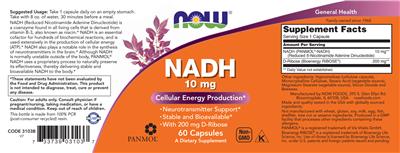
This product contains 2 active ingredients: NADH (10 mg per capsule) and Bioenergy Ribose. NADH is a coenzyme that plays a role in energy production in your cells.
Bioenergy Ribose is a five-carbon sugar involved in ATP synthesis, the process your body uses to generate energy. The remaining ingredients are inactive — they're just the capsule material and binders (hypromellose, microcrystalline cellulose, stearic acid, magnesium stearate, silicon dioxide, and beeswax).
Does it work?
Moderate evidence
For NADH, the evidence is modest: it's rated possibly effective for chronic fatigue syndrome (CFS), but there isn't enough reliable evidence to know whether it helps with Parkinson disease, dementia, or alcohol-related liver disease. For Bioenergy Ribose, the picture is less encouraging — it's rated possibly ineffective for athletic performance and McArdle disease, and the evidence is insufficient to rate it for restless legs syndrome, congestive heart failure, muscle soreness, or recovery from bypass surgery.
In short, neither ingredient has strong evidence backing its use for most conditions.
How safe is it?
Well-documented data
Both NADH and Bioenergy Ribose are generally well tolerated in the short term, but long-term safety data are limited — we simply don't know what happens if you take them for months or years. Ribose can cause diarrhea, nausea, headache, lightheadedness, and anxiety in some people; lowering the dose has resolved nausea and anxiety in some cases.
It can also lower your blood sugar, even on its own. For pregnancy and breastfeeding, there isn't enough safety information for either ingredient — both should be avoided during pregnancy and while nursing.
Talk with your doctor or pharmacist if you're planning a pregnancy or are breastfeeding.
Meds to double-check
Moderate interaction found
Before taking this product, double-check with your pharmacist if you take insulin or antidiabetes drugs (like metformin, glipizide, glyburide, or pioglitazone) — Bioenergy Ribose can lower blood sugar and increase the risk of hypoglycemia when combined with these medications. The NADH component has no documented interactions with medications in our data.
The bottom line
Scorecard at a glanceFully disclosed formula with some supporting evidence for its stated purpose. Moderate medication interactions have been identified, and safety information is well characterized.
This product may be worth considering if you're looking for an energy support supplement and don't take diabetes medications or insulin. If you do take blood sugar drugs, check with your pharmacist first — the Bioenergy Ribose component could increase your hypoglycemia risk.
Long-term safety isn't well established, so it's a supplement to discuss with your healthcare provider before starting, especially if you're pregnant, breastfeeding, or managing a chronic condition.
Educational only — not medical advice; always confirm with your pharmacist. Our editorial policy · How we use AI
Assessment coverage: 2 of 2 active ingredients matched to our full ingredient reviews (monographs). Based on the product label dated May 23, 2024.
This Scorecard evaluates available label information, ingredient evidence, and known medication-safety considerations. It does not independently verify product identity, purity, potency, contamination, or manufacturing quality. How these ratings are computed
General information
Key facts about NADH 10 mg, straight from the product label.
| Brand | NOW |
|---|---|
| Barcode (UPC) | 733739031037 |
| Net contents | 60 Capsule(s) |
| Market status | On market |
| Date entered into DSLD | May 23, 2024 |
| DSLD ID | 313865 |
| Product type | Other Combinations |
| Supplement form | Capsule |
| Dietary claims / uses | All Other, Structure/Function |
| Intended target group(s) | Adult (18 - 50 Years), Kosher, Gluten Free, Dairy Free |
Everything in this section is reproduced from the manufacturer’s own product label — it’s the label speaking, not HelloPharmacist. We show it so you can see exactly what the maker states; we don’t verify or endorse those statements.
Supplement Facts
The label details for NADH 10 mg by NOW, sourced from the NIH Dietary Supplement Label Database.
Supplement Facts
| Ingredient | Amount | % DV |
|---|---|---|
| NADH | 10 mg | -- |
| Bioenergy Ribose | 200 mg | -- |
Other ingredients: Hypromellose, Microcrystalline Cellulose, Stearic Acid, Magnesium Stearate, Silicon Dioxide, Beeswax
Tap any ingredient to jump to its full detail below.
These statements are the manufacturer’s wording, reproduced from the product label — the label is saying it, not HelloPharmacist. We don’t verify or endorse them.
Suggested/Recommended/Usage/Directions
Suggested Usage: Take 1 capsule daily on an empty stomach. Take with 8 oz. of water, 30 minutes before a meal.
Formula
NADH (Reduced Nicotinamide Adenine Dinucleotide) is a coenzyme found in all living cells that is derived from Vitamin B-3, also known as Niacin. NADH is an essential cofactor for hundreds of biochemical reactions, and is used extensively in the production of cellular energy (ATP). NADH also plays a notable role in the synthesis of neurotransmitters in the brain. Although NADH is normally unstable outside of the body, PANMOL NADH uses a patented process to naturally preserve its effectiveness, thereby delivering stable and bioavailable NADH to the body.
NADH with 200 mg D-Ribose
Panmol
Triangle K (Kosher)
FDA Disclaimer Statement
These statements have not been evaluated by the Food and Drug Administration. This product is not intended to diagnose, treat, cure or prevent any disease.
Precautions
Caution: For adults only. Keep out of reach of children.
Consult physician if pregnant/nursing, taking medication, or have a medical condition.
Not manufactured with wheat, gluten, soy, milk, egg, fish, shellfish, tree nut or sesame ingredients. Produced in a GMP facility that processes other ingredients containing these allergens.
Seals/Symbols
GMP Quality Assured
Triangle K (Kosher)
Formulation
Cellular energy production Neurotransmitter support Stable and bioavailable
Non-GMO
Made and quality tested in the USA with globally sourced ingredients.
Not manufactured with wheat, gluten, soy, milk, egg, fish, shellfish, tree nut or sesame ingredients.
FDA Statement of Identity
A Dietary Supplement
General Statements
General Health Family owned since 1968.
This bottle is made from 100% PCR (post-consumer recycled) resin.
Brand IP Statement(s)
PANMOL is a registered trademark of Vis Vitalis GmbH. Bioenergy RIBOSE is a registered trademark of Bioenergy Life Science, Inc. Use of ribose is licensed by Bioenergy Life Science, Inc. under U.S. Patents and foreign patents issued and pending.
Is this label outdated? Report a formula or label change and our pharmacy team will review it.
NADH 10 mg by NOW label
The label scan from the NIH Dietary Supplement Label Database. Tap to enlarge.
Label images are published by the NIH Dietary Supplement Label Database for the version of this product on file. Always read your actual product label.
View the full label (PDF)The Ingredients in NADH 10 mg by NOW
These are the 2 active ingredients this product is made of. Select any to open its full monograph.
Serving size1 Capsule(s) Dosage formCapsule Servings per container60 Amounts shown are per serving.
Most supplement products combine several ingredients, and a medication can interact with the product through any one of them. Each ingredient below shows whether it has known drug interactions.
NADH
No knowninteractions
NADH is the active, electron-carrying form of niacin (vitamin B3) that your body uses to make energy in cells. Some people take it as a supplement for...
NADH monograph & interactionsBioenergy Ribose
Interacts with86 drugs
Ribose (D-ribose) is a simple sugar your body makes naturally and uses to build energy molecules like ATP. Some people take it for fatigue, fibromyalg...
Bioenergy Ribose monograph & interactionsOther (inactive) ingredients: Hypromellose, Microcrystalline Cellulose, Stearic Acid, Magnesium Stearate, Silicon Dioxide, Beeswax. These complete the product’s ingredient list but are not active constituents.
NADH 10 mg by NOW Drug Interactions
HelloPharmacist Interaction Report
NOW's NADH 10 mg contains two active ingredients, and one of them — Bioenergy Ribose — interacts with medications that manage blood sugar.
Ribose can lower your blood sugar levels, so if you take insulin or other diabetes drugs (like metformin, glipizide, or glyburide), there's a moderate risk that combining them could push your blood sugar too low (hypoglycemia). This risk is dose-dependent, meaning higher doses of ribose pose a bigger concern.
Read the full breakdown — every affected drug type, severity by severity
NADH itself has no documented interactions with medications in our data. Altogether, these interactions span 85 individual medications.
If you take insulin or any diabetes medication, check your specific drugs with the search tool below before starting this supplement. Your pharmacist or doctor can help you figure out whether you need to adjust doses or monitor your blood sugar more closely.
Check your own medications below · Editorial policy · How we use AI
Want to check YOUR meds against NADH 10 mg?
Ask about interactions with your drugs in plain English — “Can I take it with lisinopril?” — and we find you the answer in seconds, ingredient by ingredient.
Go to the checkerIngredients driving the most interactions
Individual Drug Interactions
The ingredients in NADH 10 mg interact with 86 drugs. Click any drug to see the details.
1 of the 2 ingredients in NADH 10 mg interact with drugs. Each result below shows which ingredient is responsible. Bioenergy Ribose
AcarboseGlucobay, Prandase, Precose
How Acarbose interacts with NADH 10 mg — through 1 ingredient. Tap an ingredient for the detail:
Bioenergy RiboseAntidiabetes Drugs Moderate
Interaction Summary
Theoretically, taking ribose in combination with antidiabetes drugs might increase the risk of hypoglycemia.
Read the full Bioenergy Ribose + Acarbose interactionAcetohexamideDymelor
How Acetohexamide interacts with NADH 10 mg — through 1 ingredient. Tap an ingredient for the detail:
Bioenergy RiboseAntidiabetes Drugs Moderate
Interaction Summary
Theoretically, taking ribose in combination with antidiabetes drugs might increase the risk of hypoglycemia.
Read the full Bioenergy Ribose + Acetohexamide interactionAlbiglutideTanzeum
How Albiglutide interacts with NADH 10 mg — through 1 ingredient. Tap an ingredient for the detail:
Bioenergy RiboseAntidiabetes Drugs Moderate
Interaction Summary
Theoretically, taking ribose in combination with antidiabetes drugs might increase the risk of hypoglycemia.
Read the full Bioenergy Ribose + Albiglutide interactionAlogliptinNesina
How Alogliptin interacts with NADH 10 mg — through 1 ingredient. Tap an ingredient for the detail:
Bioenergy RiboseAntidiabetes Drugs Moderate
Interaction Summary
Theoretically, taking ribose in combination with antidiabetes drugs might increase the risk of hypoglycemia.
Read the full Bioenergy Ribose + Alogliptin interactionAlogliptin, MetforminKazano
How Alogliptin, Metformin interacts with NADH 10 mg — through 1 ingredient. Tap an ingredient for the detail:
Bioenergy RiboseAntidiabetes Drugs Moderate
Interaction Summary
Theoretically, taking ribose in combination with antidiabetes drugs might increase the risk of hypoglycemia.
Read the full Bioenergy Ribose + Alogliptin, Metformin interactionAlogliptin, PioglitazoneOseni
How Alogliptin, Pioglitazone interacts with NADH 10 mg — through 1 ingredient. Tap an ingredient for the detail:
Bioenergy RiboseAntidiabetes Drugs Moderate
Interaction Summary
Theoretically, taking ribose in combination with antidiabetes drugs might increase the risk of hypoglycemia.
Read the full Bioenergy Ribose + Alogliptin, Pioglitazone interactionAntidiabetes, Dipeptidyl Peptidase-4 (dpp-iv) InhibitorGlyxambi
How Antidiabetes, Dipeptidyl Peptidase-4 (dpp-iv) Inhibitor interacts with NADH 10 mg — through 1 ingredient. Tap an ingredient for the detail:
Bioenergy RiboseAntidiabetes Drugs Moderate
Interaction Summary
Theoretically, taking ribose in combination with antidiabetes drugs might increase the risk of hypoglycemia.
Read the full Bioenergy Ribose + Antidiabetes, Dipeptidyl Peptidase-4 (dpp-iv) Inhibitor interactionCanagliflozinInvokana
How Canagliflozin interacts with NADH 10 mg — through 1 ingredient. Tap an ingredient for the detail:
Bioenergy RiboseAntidiabetes Drugs Moderate
Interaction Summary
Theoretically, taking ribose in combination with antidiabetes drugs might increase the risk of hypoglycemia.
Read the full Bioenergy Ribose + Canagliflozin interactionCanagliflozin, MetforminInvokamet
How Canagliflozin, Metformin interacts with NADH 10 mg — through 1 ingredient. Tap an ingredient for the detail:
Bioenergy RiboseAntidiabetes Drugs Moderate
Interaction Summary
Theoretically, taking ribose in combination with antidiabetes drugs might increase the risk of hypoglycemia.
Read the full Bioenergy Ribose + Canagliflozin, Metformin interactionCanagliflozin, Metformin HydrochlorideInvokamet XR
How Canagliflozin, Metformin Hydrochloride interacts with NADH 10 mg — through 1 ingredient. Tap an ingredient for the detail:
Bioenergy RiboseAntidiabetes Drugs Moderate
Interaction Summary
Theoretically, taking ribose in combination with antidiabetes drugs might increase the risk of hypoglycemia.
Read the full Bioenergy Ribose + Canagliflozin, Metformin Hydrochloride interactionChlorpropamideChlorpropam, Diabinese
How Chlorpropamide interacts with NADH 10 mg — through 1 ingredient. Tap an ingredient for the detail:
Bioenergy RiboseAntidiabetes Drugs Moderate
Interaction Summary
Theoretically, taking ribose in combination with antidiabetes drugs might increase the risk of hypoglycemia.
Read the full Bioenergy Ribose + Chlorpropamide interactionDapagliflozinFarxiga
How Dapagliflozin interacts with NADH 10 mg — through 1 ingredient. Tap an ingredient for the detail:
Bioenergy RiboseAntidiabetes Drugs Moderate
Interaction Summary
Theoretically, taking ribose in combination with antidiabetes drugs might increase the risk of hypoglycemia.
Read the full Bioenergy Ribose + Dapagliflozin interactionDapagliflozin Propanediol, MetforminXigduo XR
How Dapagliflozin Propanediol, Metformin interacts with NADH 10 mg — through 1 ingredient. Tap an ingredient for the detail:
Bioenergy RiboseAntidiabetes Drugs Moderate
Interaction Summary
Theoretically, taking ribose in combination with antidiabetes drugs might increase the risk of hypoglycemia.
Read the full Bioenergy Ribose + Dapagliflozin Propanediol, Metformin interactionDapagliflozin Propanediol, Saxagliptin HydrochlorideQtern
How Dapagliflozin Propanediol, Saxagliptin Hydrochloride interacts with NADH 10 mg — through 1 ingredient. Tap an ingredient for the detail:
Bioenergy RiboseAntidiabetes Drugs Moderate
Interaction Summary
Theoretically, taking ribose in combination with antidiabetes drugs might increase the risk of hypoglycemia.
Read the full Bioenergy Ribose + Dapagliflozin Propanediol, Saxagliptin Hydrochloride interactionDapagliflozin, Metformin Hydrochloride, Saxagliptin HydrochlorideQternmet XR
How Dapagliflozin, Metformin Hydrochloride, Saxagliptin Hydrochloride interacts with NADH 10 mg — through 1 ingredient. Tap an ingredient for the detail:
Bioenergy RiboseAntidiabetes Drugs Moderate
Interaction Summary
Theoretically, taking ribose in combination with antidiabetes drugs might increase the risk of hypoglycemia.
Read the full Bioenergy Ribose + Dapagliflozin, Metformin Hydrochloride, Saxagliptin Hydrochloride interactionDasiglucagon HydrochlorideZegalogue
How Dasiglucagon Hydrochloride interacts with NADH 10 mg — through 1 ingredient. Tap an ingredient for the detail:
Bioenergy RiboseAntidiabetes Drugs Moderate
Interaction Summary
Theoretically, taking ribose in combination with antidiabetes drugs might increase the risk of hypoglycemia.
Read the full Bioenergy Ribose + Dasiglucagon Hydrochloride interactionDulaglutideTrulicity
How Dulaglutide interacts with NADH 10 mg — through 1 ingredient. Tap an ingredient for the detail:
Bioenergy RiboseAntidiabetes Drugs Moderate
Interaction Summary
Theoretically, taking ribose in combination with antidiabetes drugs might increase the risk of hypoglycemia.
Read the full Bioenergy Ribose + Dulaglutide interactionEmpagliflozinJardiance
How Empagliflozin interacts with NADH 10 mg — through 1 ingredient. Tap an ingredient for the detail:
Bioenergy RiboseAntidiabetes Drugs Moderate
Interaction Summary
Theoretically, taking ribose in combination with antidiabetes drugs might increase the risk of hypoglycemia.
Read the full Bioenergy Ribose + Empagliflozin interactionEmpagliflozin, Linagliptin, Metformin HydrochlorideTrijardy XR
How Empagliflozin, Linagliptin, Metformin Hydrochloride interacts with NADH 10 mg — through 1 ingredient. Tap an ingredient for the detail:
Bioenergy RiboseAntidiabetes Drugs Moderate
Interaction Summary
Theoretically, taking ribose in combination with antidiabetes drugs might increase the risk of hypoglycemia.
Read the full Bioenergy Ribose + Empagliflozin, Linagliptin, Metformin Hydrochloride interactionEmpagliflozin, MetforminSynjardy
How Empagliflozin, Metformin interacts with NADH 10 mg — through 1 ingredient. Tap an ingredient for the detail:
Bioenergy RiboseAntidiabetes Drugs Moderate
Interaction Summary
Theoretically, taking ribose in combination with antidiabetes drugs might increase the risk of hypoglycemia.
Read the full Bioenergy Ribose + Empagliflozin, Metformin interactionEmpagliflozin, Metformin HydrochlorideSynjardy XR
How Empagliflozin, Metformin Hydrochloride interacts with NADH 10 mg — through 1 ingredient. Tap an ingredient for the detail:
Bioenergy RiboseAntidiabetes Drugs Moderate
Interaction Summary
Theoretically, taking ribose in combination with antidiabetes drugs might increase the risk of hypoglycemia.
Read the full Bioenergy Ribose + Empagliflozin, Metformin Hydrochloride interactionErtugliflozinSteglatro
How Ertugliflozin interacts with NADH 10 mg — through 1 ingredient. Tap an ingredient for the detail:
Bioenergy RiboseAntidiabetes Drugs Moderate
Interaction Summary
Theoretically, taking ribose in combination with antidiabetes drugs might increase the risk of hypoglycemia.
Read the full Bioenergy Ribose + Ertugliflozin interactionErtugliflozin, Metformin HydrochlorideSegluromet
How Ertugliflozin, Metformin Hydrochloride interacts with NADH 10 mg — through 1 ingredient. Tap an ingredient for the detail:
Bioenergy RiboseAntidiabetes Drugs Moderate
Interaction Summary
Theoretically, taking ribose in combination with antidiabetes drugs might increase the risk of hypoglycemia.
Read the full Bioenergy Ribose + Ertugliflozin, Metformin Hydrochloride interactionExenatideBydureon, Byetta
How Exenatide interacts with NADH 10 mg — through 1 ingredient. Tap an ingredient for the detail:
Bioenergy RiboseAntidiabetes Drugs Moderate
Interaction Summary
Theoretically, taking ribose in combination with antidiabetes drugs might increase the risk of hypoglycemia.
Read the full Bioenergy Ribose + Exenatide interactionExenatide SyntheticBydureon BCISE
How Exenatide Synthetic interacts with NADH 10 mg — through 1 ingredient. Tap an ingredient for the detail:
Bioenergy RiboseAntidiabetes Drugs Moderate
Interaction Summary
Theoretically, taking ribose in combination with antidiabetes drugs might increase the risk of hypoglycemia.
Read the full Bioenergy Ribose + Exenatide Synthetic interactionGliclazideDiamicron
How Gliclazide interacts with NADH 10 mg — through 1 ingredient. Tap an ingredient for the detail:
Bioenergy RiboseAntidiabetes Drugs Moderate
Interaction Summary
Theoretically, taking ribose in combination with antidiabetes drugs might increase the risk of hypoglycemia.
Read the full Bioenergy Ribose + Gliclazide interactionGlimepirideAmaryl
How Glimepiride interacts with NADH 10 mg — through 1 ingredient. Tap an ingredient for the detail:
Bioenergy RiboseAntidiabetes Drugs Moderate
Interaction Summary
Theoretically, taking ribose in combination with antidiabetes drugs might increase the risk of hypoglycemia.
Read the full Bioenergy Ribose + Glimepiride interactionGlipizideGlucotrol, Glucotrol XL
How Glipizide interacts with NADH 10 mg — through 1 ingredient. Tap an ingredient for the detail:
Bioenergy RiboseAntidiabetes Drugs Moderate
Interaction Summary
Theoretically, taking ribose in combination with antidiabetes drugs might increase the risk of hypoglycemia.
Read the full Bioenergy Ribose + Glipizide interactionGlipizide, MetforminMetaglip
How Glipizide, Metformin interacts with NADH 10 mg — through 1 ingredient. Tap an ingredient for the detail:
Bioenergy RiboseAntidiabetes Drugs Moderate
Interaction Summary
Theoretically, taking ribose in combination with antidiabetes drugs might increase the risk of hypoglycemia.
Read the full Bioenergy Ribose + Glipizide, Metformin interactionGlucagonBaqsimi, Glucagon
How Glucagon interacts with NADH 10 mg — through 1 ingredient. Tap an ingredient for the detail:
Bioenergy RiboseAntidiabetes Drugs Moderate
Interaction Summary
Theoretically, taking ribose in combination with antidiabetes drugs might increase the risk of hypoglycemia.
Read the full Bioenergy Ribose + Glucagon interactionEach ingredient & the kinds of drugs it affects
For each ingredient in NADH 10 mg with known interactions, here are the types of medications it can affect. Open any type for the detail — or search your exact drug in the checker above.
Bioenergy Ribose
Antidiabetes Drugs
Theoretically, taking ribose in combination with antidiabetes drugs might increase the risk of hypoglycemia.
In clinical research, ribose decreases serum glucose levels in a dose-dependent manner.
Insulin
Theoretically, taking ribose with insulin could increase the hypoglycemic effect of insulin.
In clinical pharmacokinetic studies, oral administration of ribose modestly increased serum insulin levels.
Brand information
Manufacturer and brand details for NADH 10 mg, from the product label.
NOW
See all NOW products- Name
- NOW FOODS
- Street Address
- 395 S. Glen Ellyn Rd.
- City
- Bloomingdale
- State
- IL
- ZipCode
- 60108
- Web Address
- nowfoods.com
NADH 10 mg by NOW: Common Questions
Does NADH 10 mg by NOW interact with any medications?
How can one product interact with so many drugs?
Where does this information come from?
Can I take this if I'm pregnant or breastfeeding?
What side effects should I watch for?
Does NADH actually help with fatigue or chronic fatigue syndrome?
Will this help my athletic performance?
Is this safe to take long-term?
Can this lower my blood sugar?
Written and reviewed by the HelloPharmacist editorial staff. Our editorial policy
Not sure if NADH 10 mg is safe with your meds?
Our pharmacists answer your medication & supplement questions — free.
Label information is sourced from the NIH Dietary Supplement Label Database and reflects the product version on file; always read your actual product label. This page is for education only and is not a substitute for professional medical advice. Confirm with your pharmacist or doctor before combining supplements and medications.
The Full Monographs Behind NADH 10 mg’s Ingredients
Every ingredient we hold a full HelloPharmacist monograph for — uses, evidence, safety, and the complete interaction list.
Nadh
NADH is the active, electron-carrying form of niacin (vitamin B3) that your body uses to make energy in cells. Some people take it as a supplement for fatigue, mental sharpness, and athletic...
Read the full Nadh monograph → Herb & supplement monographRibose
Interacts with 86 drugsRibose (D-ribose) is a simple sugar your body makes naturally and uses to build energy molecules like ATP. Some people take it for fatigue, fibromyalgia, exercise recovery, or heart conditio...
Read the full Ribose monograph →Sources & How We Checked
NADH 10 mg's label data comes from the NIH Dietary Supplement Label Database; the ingredient interaction data is from the Natural Medicines database, reviewed by our pharmacists.
- NIH Dietary Supplement Label Database (DSLD) — The official product label on file for this supplement.
- Natural Medicines (Therapeutic Research Center) — Evidence-graded clinical reference behind the ingredient interaction data.
Content is written and reviewed by licensed HelloPharmacist pharmacists. See our data sources and editorial standards for how this information is built and checked.
The 9 references behind this product’s interaction data
Every citation that drives the interaction findings for this product’s ingredients, from the evidence-graded Natural Medicines (TRC Healthcare) database. Open an ingredient to browse its citations — links open the study on PubMed or the publisher’s site.
Nadh 1 reference
- Niacin - Health Professional Fact Sheet — NIH Office of Dietary Supplements Source
Ribose 8 references
- Segal S, Foley J. The metabolism of D-ribose in man. J Clin Invest 1958;37:719-35. PubMed
- Perlmutter NS, Wilson RA, Angello DA, et al. Ribose facilitates thallium-201 redistribution in patients with coronary artery disease. J Nucl Med 1991;32:193-200.
- Hegewald MG, Palac RT, Angello DA, et al. Ribose infusion accelerates thallium redistribution with early imaging compared with late 24-hour imaging without ribose. J Am Coll Cardiol 1991;18:1671-81. PubMed
- Pliml W, von Arnim T, Stalein A, et al. Effects of ribose on excercise-induced ischaemia in stable coronary artery disease. Lancet 1992;340:507-10.
- Burke ER. D-Ribose What You Need To Know. Garden City Park, NY: Avery Publishing Group 1999;1-43.
- Gross M, Reiter S, Zollner N. Metabolism of D-ribose administered continuously to healthy persons and to patients with myoadenylate deaminase deficiency. Klin Wochenschr 1989;67:1205-13. PubMed
- Teitelbaum JE, Johnson C, St Cyr J. The use of D-ribose in chronic fatigue syndrome and fibromyalgia: a pilot study. J Altern Complement Med 2006;12:857-62. PubMed
- Thompson J, Neutel J, Homer K, Tempero K, Shah A, Khankari R. Evaluation of D-ribose pharmacokinetics, dose proportionality, food effect, and pharmacodynamics after oral solution administration in healthy male and female subjects. J Clin Pharmacol 2014;54 PubMed
Parts of this content are provided by the Therapeutic Research Center, LLC.
DISCLAIMER: Currently this does not check for drug-drug interactions. This is not an all-inclusive comprehensive list of potential interactions and is for informational purposes only. Not all interactions are known or well-reported in the scientific literature, and new interactions are continually being reported. Input is needed from a qualified healthcare provider including a pharmacist before starting any therapy. Application of clinical judgment is necessary.
© 2021 Therapeutic Research Center, LLC